
PRESENTATION TO THE SELECT COMMITTEE ON LOCAL GOVERNMENT


- Slides: 41
PRESENTATION TO THE SELECT COMMITTEE ON LOCAL GOVERNMENT AND ADMINISTRATION 25 September 2002
MANAGEMENT OF SUSPENSIONS
Number of Employees on Suspension n The advent of the Disciplinary Code and Procedure brought a major change to the application of suspensions. – Prior to 1 July 1999 = most departments endorsed suspensions without remuneration. – With effect from 1 July 1999 = Code stipulates that suspensions with remuneration. n Survey conducted for the period 1 July 1999 to 31 July 1999.
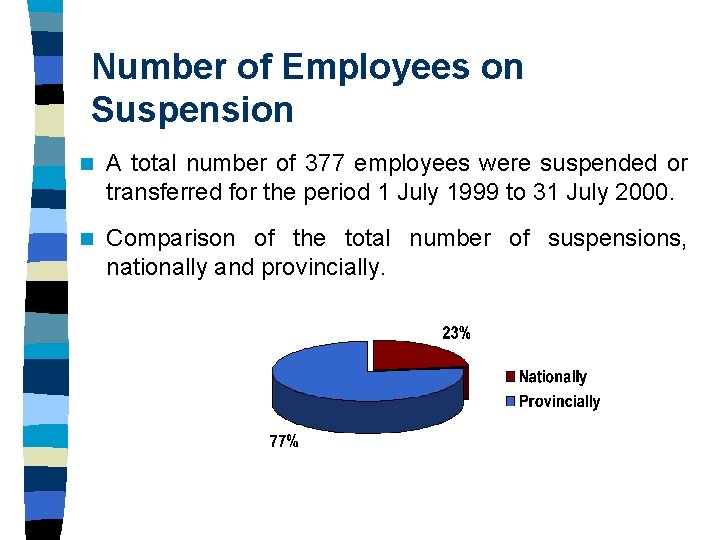
Number of Employees on Suspension n A total number of 377 employees were suspended or transferred for the period 1 July 1999 to 31 July 2000. n Comparison of the total number of suspensions, nationally and provincially.
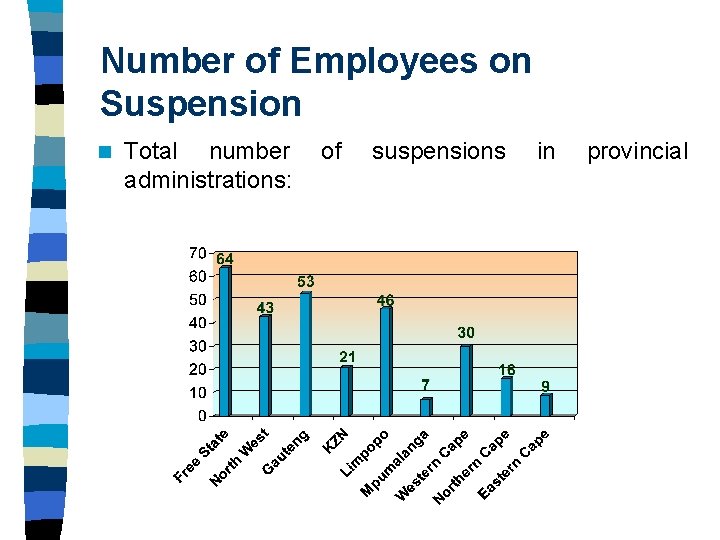
Number of Employees on Suspension n Total number administrations: of suspensions in provincial
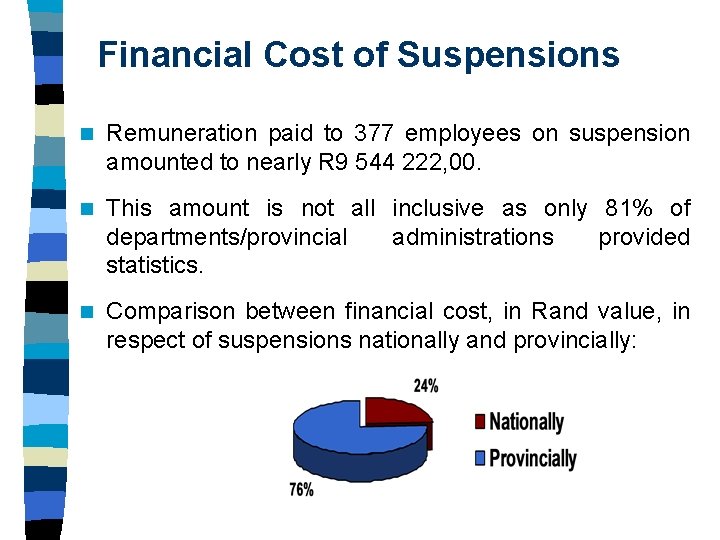
Financial Cost of Suspensions n Remuneration paid to 377 employees on suspension amounted to nearly R 9 544 222, 00. n This amount is not all inclusive as only 81% of departments/provincial administrations provided statistics. n Comparison between financial cost, in Rand value, in respect of suspensions nationally and provincially:
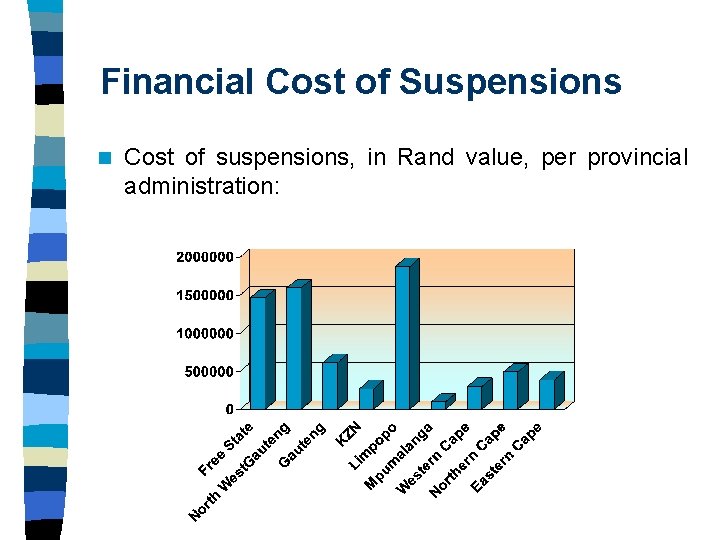
Financial Cost of Suspensions n Cost of suspensions, in Rand value, per provincial administration:
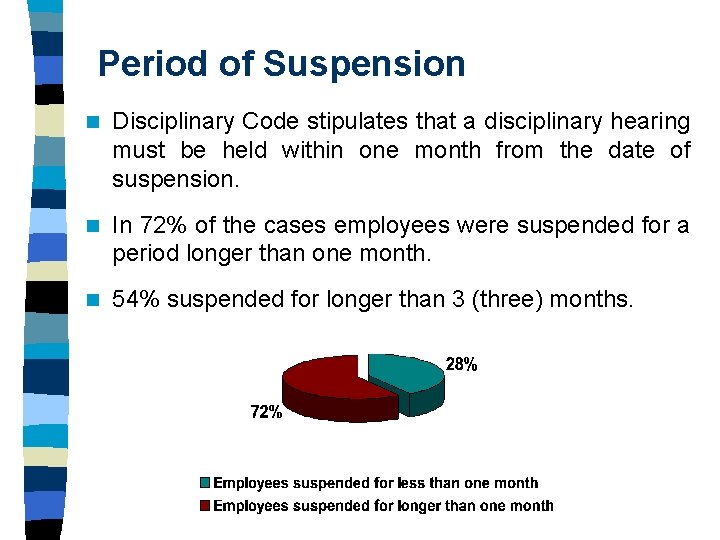
Period of Suspension n Disciplinary Code stipulates that a disciplinary hearing must be held within one month from the date of suspension. n In 72% of the cases employees were suspended for a period longer than one month. n 54% suspended for longer than 3 (three) months.
Observations n Employees are suspended pending charges such as absenteeism, unauthorised use of government vehicles, abusive language, racist remarks and insubordination. While some of these are serious transgressions, there are others which lend themselves to temporary transfer to another work location or reassignment of duties. n Alternatives to suspension not considered.
Observations n Lack of review of suspensions. In 72% of cases employees are suspended for a longer period than 1 month. Only a few dept/admin’s review suspension on a regular basis. n Lack of capacity to conduct hearings –trained presiding and investigating officers. n Lack of departmental policies on suspension.
Recommendations n A key recommendation was for the DPSA to coordinate a central database with particulars on such officers to be accessed by departments. n This work was supplemented with guidelines on the management of suspensions. n This should contribute in more effective management of a procedure that has serious socio-economic impact on the parties.
SURVEY BY THE PUBLIC SERVICE COMMISSION OF COMPLIANCE WITH THE BATHO PELE WHITE PAPER
Methodology and Scope of the Survey n Compare practice with requirements of the policy. Compliance/ adherence. n Not actual service delivery against standard n Not customer satisfaction n Assessment by staff of the Office of the Commission not self-assessment n Degrees of compliance
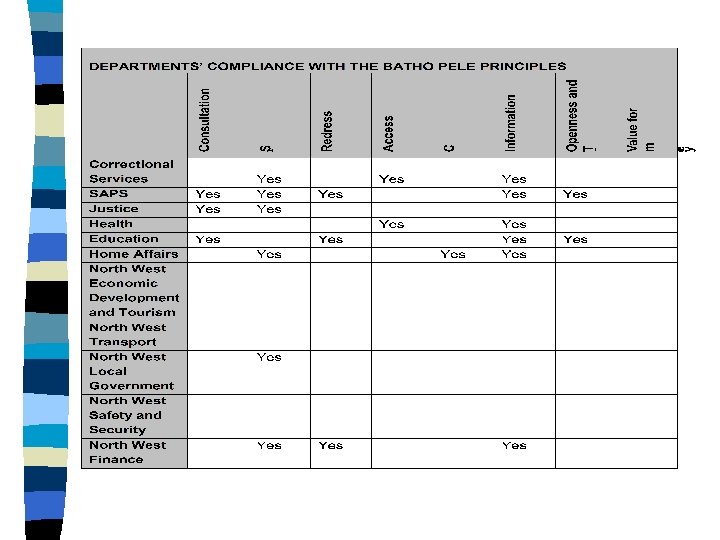
Departments Covered n Correctional Services n SA Police Service n Justice n Home Affairs n Provincial education departments n Provincial health departments
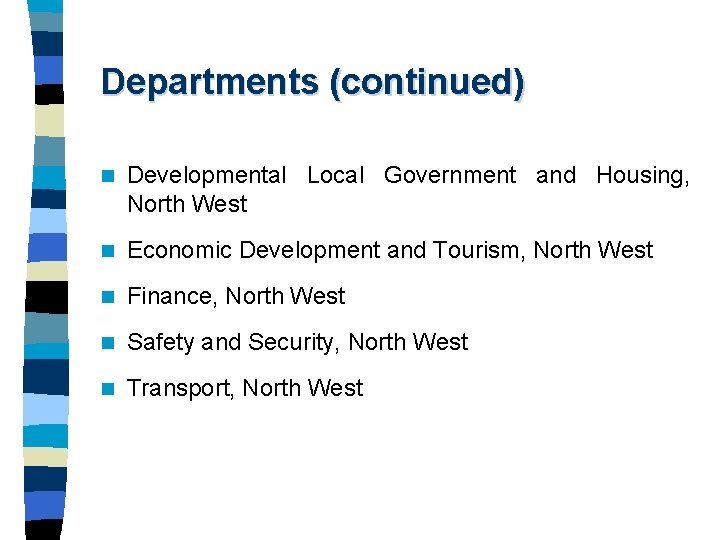
Departments (continued) n Developmental Local Government and Housing, North West n Economic Development and Tourism, North West n Finance, North West n Safety and Security, North West n Transport, North West
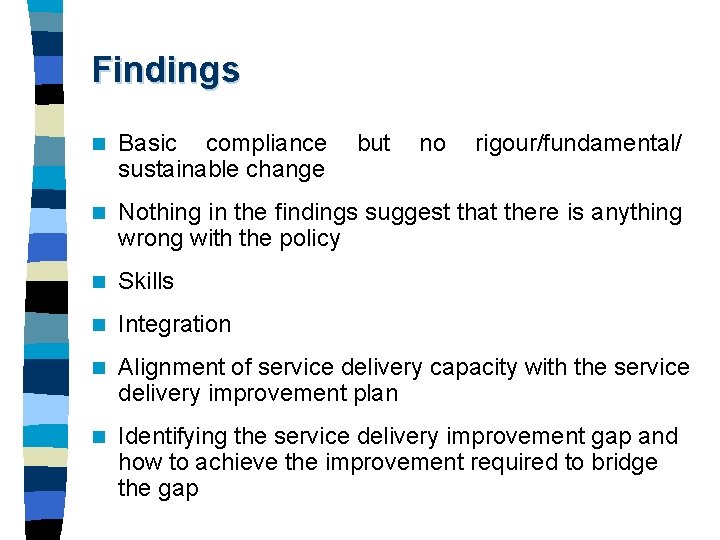
Findings n Basic compliance sustainable change but no rigour/fundamental/ n Nothing in the findings suggest that there is anything wrong with the policy n Skills n Integration n Alignment of service delivery capacity with the service delivery improvement plan n Identifying the service delivery improvement gap and how to achieve the improvement required to bridge the gap
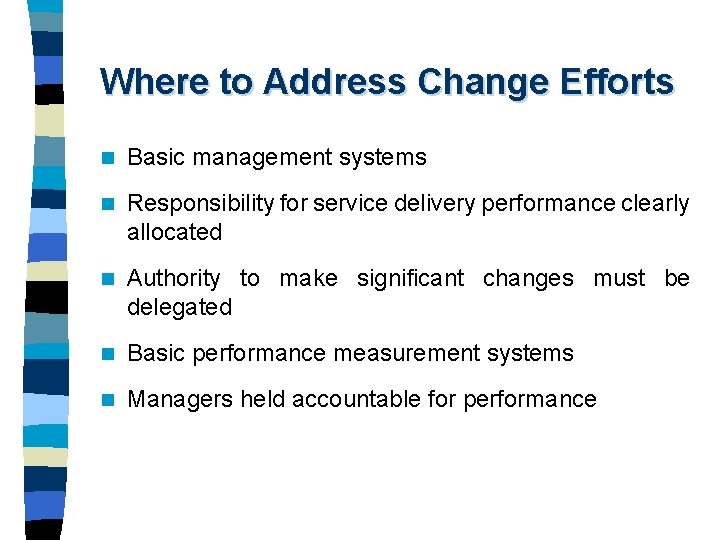
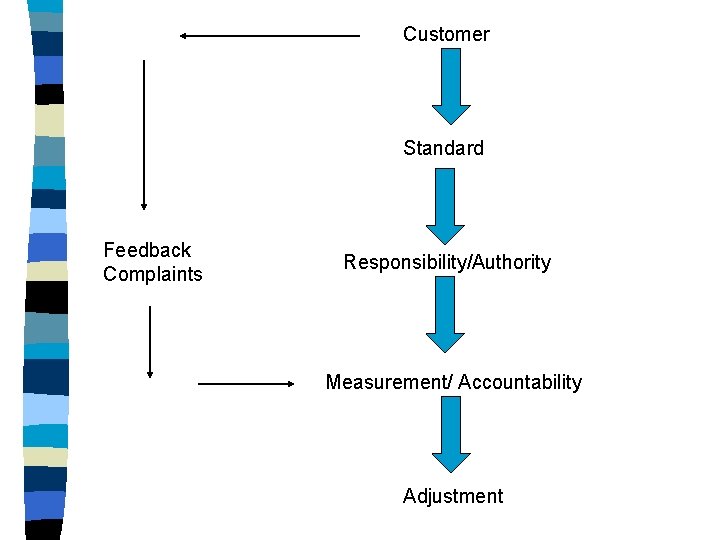
Where to Address Change Efforts n Basic management systems n Responsibility for service delivery performance clearly allocated n Authority to make significant changes must be delegated n Basic performance measurement systems n Managers held accountable for performance
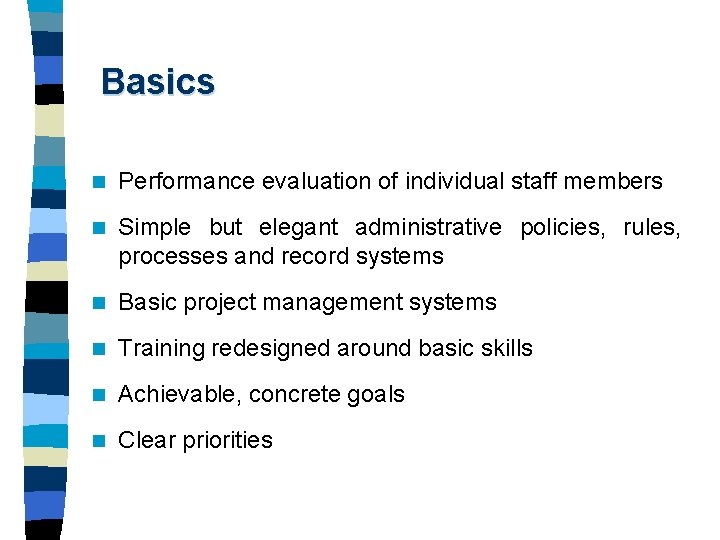
Basics n Performance evaluation of individual staff members n Simple but elegant administrative policies, rules, processes and record systems n Basic project management systems n Training redesigned around basic skills n Achievable, concrete goals n Clear priorities
Customer Standard Feedback Complaints Responsibility/Authority Measurement/ Accountability Adjustment
REPORT ON THE VERIFICATION OF QUALIFICATIONS OF SENIOR MANAGERS IN THE PUBLIC SERVICE COMMISSION
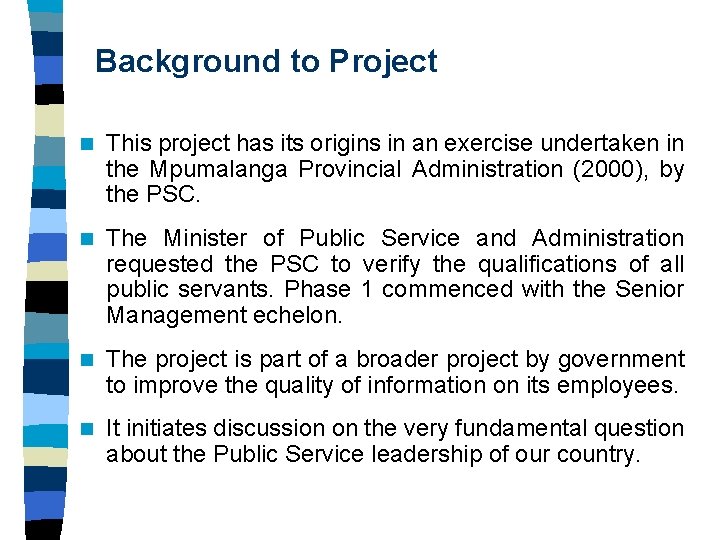
Background to Project n This project has its origins in an exercise undertaken in the Mpumalanga Provincial Administration (2000), by the PSC. n The Minister of Public Service and Administration requested the PSC to verify the qualifications of all public servants. Phase 1 commenced with the Senior Management echelon. n The project is part of a broader project by government to improve the quality of information on its employees. n It initiates discussion on the very fundamental question about the Public Service leadership of our country.
Objectives of the Project n Establish the qualifications. authenticity of formal tertiary n Provide a description and analysis of the qualification profile of public servants. n Contribute to the overall upgrading of information on personnel in government. There is a limited pool of skills at this level, and it is therefore important that this level of leadership is assessed and effectively managed.
Project Scope n The project covered 30 National Departments and 9 Provincial Administrations. n The Senior Management echelon – levels 13 -16 – includes professional and technical officials at this level. The total number is 3 597. n As at April 2001 (the PSC cut-off date for returns), a total of 2 376 Senior Managers had submitted qualifications for verification. The results of this project is based on this number.
Project Scope (continued) n It is of concern that as of end April 2001, 1 221 Senior Managers had not submitted their qualifications for verification. As of 25 September 2002, 11 are outstanding. n The project involved complex networking with 264 awarding and certifying institutions – 182 International and 82 National – to complete the exercise.
Key Findings 1. Results of the audit 2. Nature of qualifications 3. Training 4. Administrative compliance 5. Conclusions and recommendations
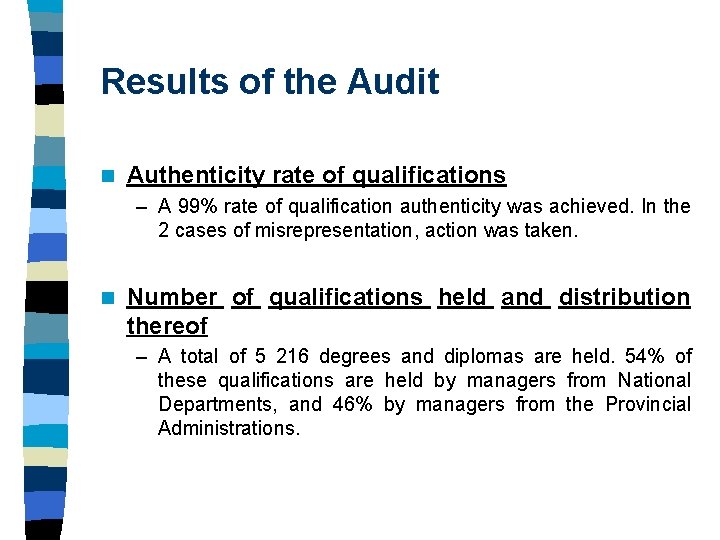
Results of the Audit n Authenticity rate of qualifications – A 99% rate of qualification authenticity was achieved. In the 2 cases of misrepresentation, action was taken. n Number of qualifications held and distribution thereof – A total of 5 216 degrees and diplomas are held. 54% of these qualifications are held by managers from National Departments, and 46% by managers from the Provincial Administrations.
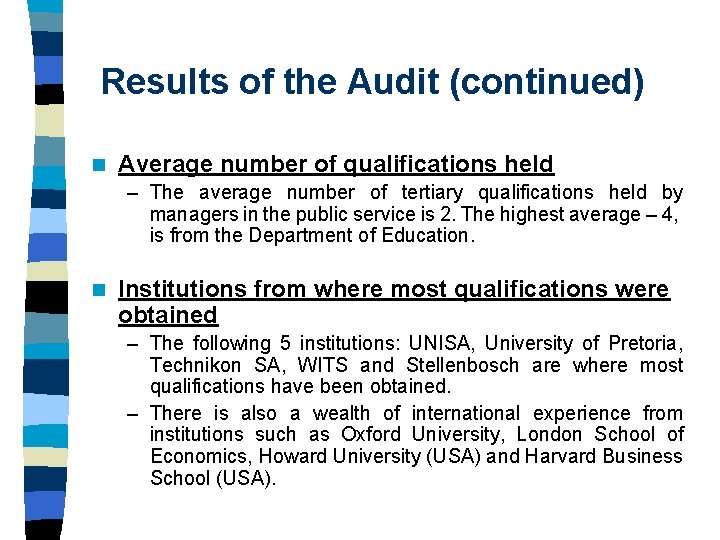
Results of the Audit (continued) n Average number of qualifications held – The average number of tertiary qualifications held by managers in the public service is 2. The highest average – 4, is from the Department of Education. n Institutions from where most qualifications were obtained – The following 5 institutions: UNISA, University of Pretoria, Technikon SA, WITS and Stellenbosch are where most qualifications have been obtained. – There is also a wealth of international experience from institutions such as Oxford University, London School of Economics, Howard University (USA) and Harvard Business School (USA).
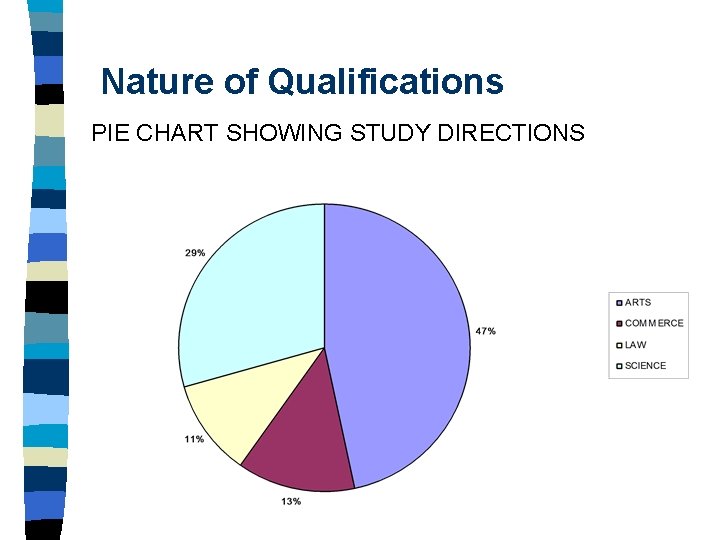
Nature of Qualifications PIE CHART SHOWING STUDY DIRECTIONS
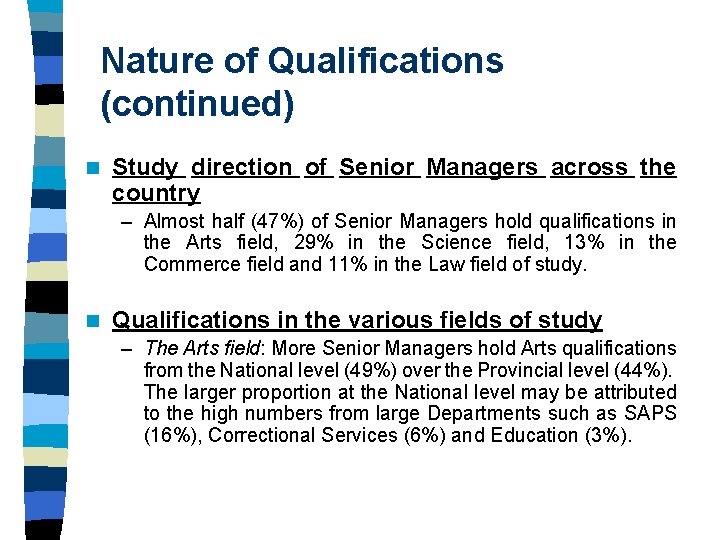
Nature of Qualifications (continued) n Study direction of Senior Managers across the country – Almost half (47%) of Senior Managers hold qualifications in the Arts field, 29% in the Science field, 13% in the Commerce field and 11% in the Law field of study. n Qualifications in the various fields of study – The Arts field: More Senior Managers hold Arts qualifications from the National level (49%) over the Provincial level (44%). The larger proportion at the National level may be attributed to the high numbers from large Departments such as SAPS (16%), Correctional Services (6%) and Education (3%).
Nature of Qualifications (continued) – The Commerce field: The Provincial Administrations (16%) have more capacity in this area over National Departments (11%). However, various reports by the Auditor-General have pointed to poor financial management controls at these levels, suggesting that this capacity is not used optimally. – The Law field: A higher proportion of legal skills is evident at the National level (15%) over the provincial administrations (6%). Contributory factors for this may be that policy drafting and state litigation tends to occur centrally.
Nature of Qualifications (continued) – The Science field: More science qualifications are held at the Provincial level (34%) over the national level (25%). This may be attributed to the fact that most health care professionals are located at service delivery points such as hospitals and clinics. n Nature of qualifications: some comments Thedominant. Artsqualification, whilstprovidinga useful general level of training, is inadequate and further training in the legal and commerce fields are required. Legal and financial skills are necessary for managers to cope with their new responsibilities.
Training n Potential within Senior Management echelon for further training – It was found that managers are well-qualified in their linefunctions, but there is a need for management specific training. - The potential for further training to be successful is high, given the sound educational basis possessed by senior managers. - If current skills are enhanced, there is strong management potential for transforming the public service.
Training (continued) n Shifting the qualification emphasis - A training policy that emphasises training at the provincial and local level, and which caters for new demands must be implemented. Imaginative training strategies that draw on life skills and on-the-job training should be considered. SAMDI has a role to play. n The type of training that is required - Training needs to be relevant and customized. It should also be able to be flexible and cater for the high work demands of Senior Managers.
Training (continued) n Factors influencing the placement of managers – past and present - Placement of managers in the past has tended to be based on policies favouring post progression, generally time and assessment based. Internal candidates were generally favoured, perpetuating the status quo and promoting a whitemale management hegemony. - Managers recruited post-1994 have generally been from outside the public service, and tend to hold a more diverse range of qualifications and experience.
Training (continued) 1. The report is suggesting that due to our socio-political context we may have produced one attribute (highly qualified managers), at the expense of others (inappropriately trained) officials. - There is no evidence that a highly qualified management cohort naturally translates into more effective service delivery of government.
Administrative Compliance n The extent of compliance by national departments and provincial administrations around this project raises issues of compliance and coordination. n Departments seemed to experience problems eliciting information from their manager. This may have to do with issues of leadership and management. n If relatively simple information such as this was so difficult to obtain, this does not augur well for other more complex information requests.
Administrative Compliance (continued) n The highest levels of returns of information to the PSC, which were on time and accurate were from: – – – – Agriculture Environmental Affairs and Tourism Minerals and Energy Social Development Free State Administration Eastern Cape Administration Northern Cape Administration
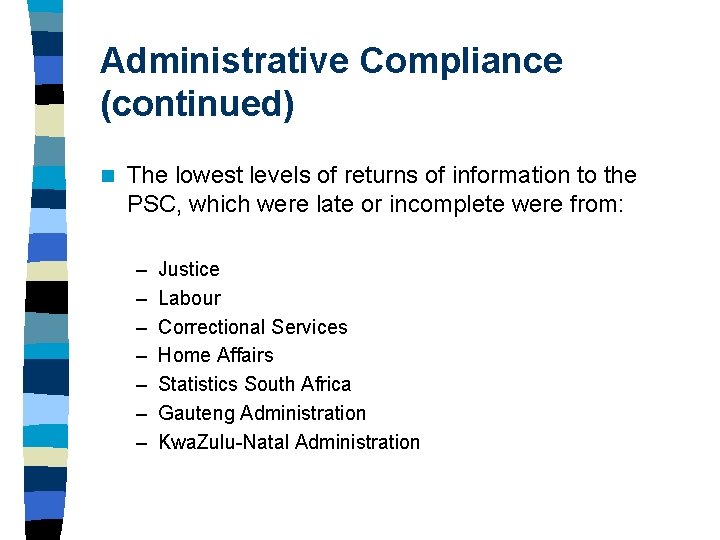
Administrative Compliance (continued) n The lowest levels of returns of information to the PSC, which were late or incomplete were from: – – – – Justice Labour Correctional Services Home Affairs Statistics South Africa Gauteng Administration Kwa. Zulu-Natal Administration
Conclusions and Recommendations n Departments and administrations must ensure that outstanding returns are submitted. Heads of Departments must assume responsibility for ensuring this takes place. n The completion of the skills audit is a priority for the development of customised training courses. The initiatives by the South African Management Development Institute (SAMDI) in this regard must be supported, and the outcomes of such training on increasing management effectiveness monitored.
Conclusions and Recommendations (continued) n The project has contributed to the update of PERSAL, and this must become a prerequisite when a qualification is obtained. The qualification must be authenticated with the relevant institution before the use of this facility on PERSAL. n Intense discussions on the quality of the Public Service leadership must be undertaken with key stakeholders. The report outlines an extensive dissemination strategy. n The project needs to be extended to other levels, working closely with the South African Qualifications Authority (SAQA).