
Presentation to the AdHoc Committee Health Update Dr
- Slides: 51
Presentation to the Ad-Hoc Committee Health Update Dr K Cloete 13 January 2021 © Western Cape Government 2012 |
Overview 1. 5 -point COVID Resurgence Strategy 2. Community Prevention 3. Surveillance & Response Update 4. Scaling up health platform COVID capacity 5. Fatalaties Management 6. Vaccine strategy 7. Conclusions
5 -point COVID Resurgence Strategy
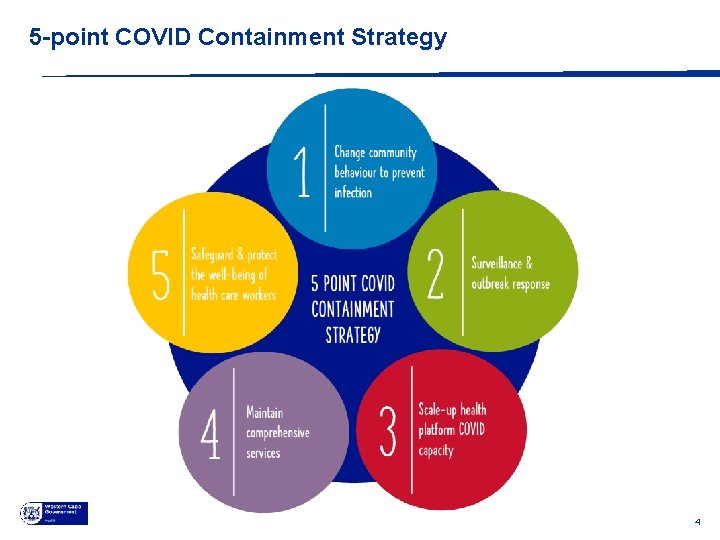
5 -point COVID Containment Strategy Go to Insert > Header & Footer > Enter presentation name into footer field 4
Community Prevention Update
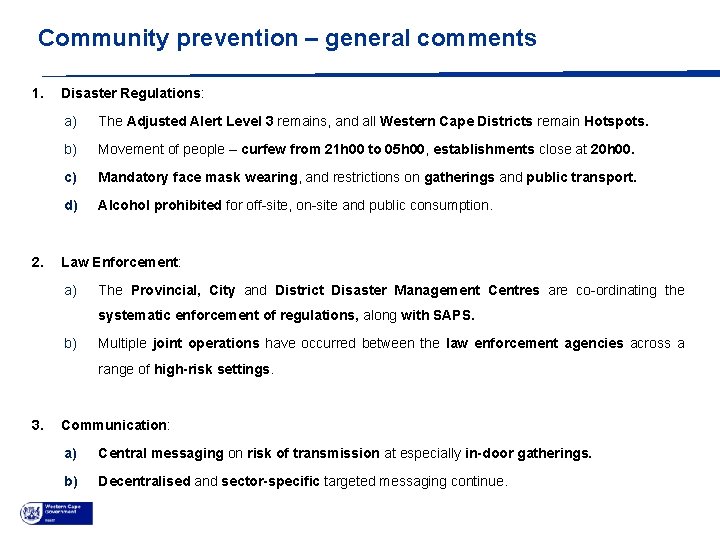
Community prevention – general comments 1. 2. Disaster Regulations: a) The Adjusted Alert Level 3 remains, and all Western Cape Districts remain Hotspots. b) Movement of people – curfew from 21 h 00 to 05 h 00, establishments close at 20 h 00. c) Mandatory face mask wearing, and restrictions on gatherings and public transport. d) Alcohol prohibited for off-site, on-site and public consumption. Law Enforcement: a) The Provincial, City and District Disaster Management Centres are co-ordinating the systematic enforcement of regulations, along with SAPS. b) Multiple joint operations have occurred between the law enforcement agencies across a range of high-risk settings. 3. Communication: a) Central messaging on risk of transmission at especially in-door gatherings. b) Decentralised and sector-specific targeted messaging continue.
Surveillance & Response Update
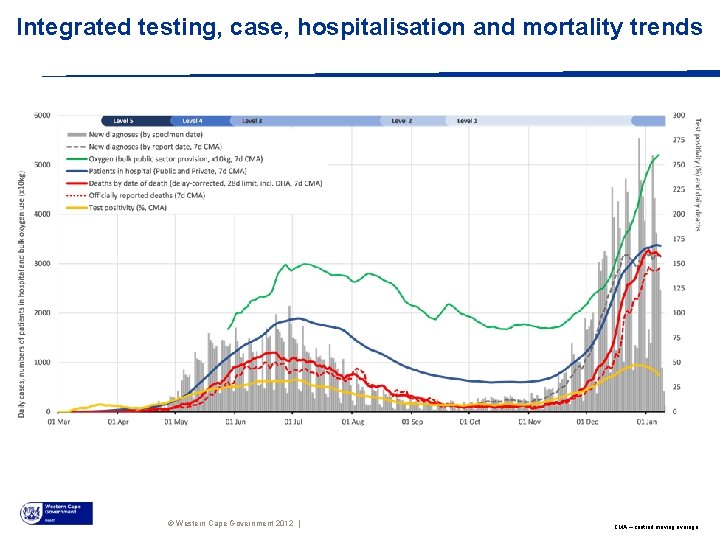
Integrated testing, case, hospitalisation and mortality trends © Western Cape Government 2012 | CMA – centred moving average
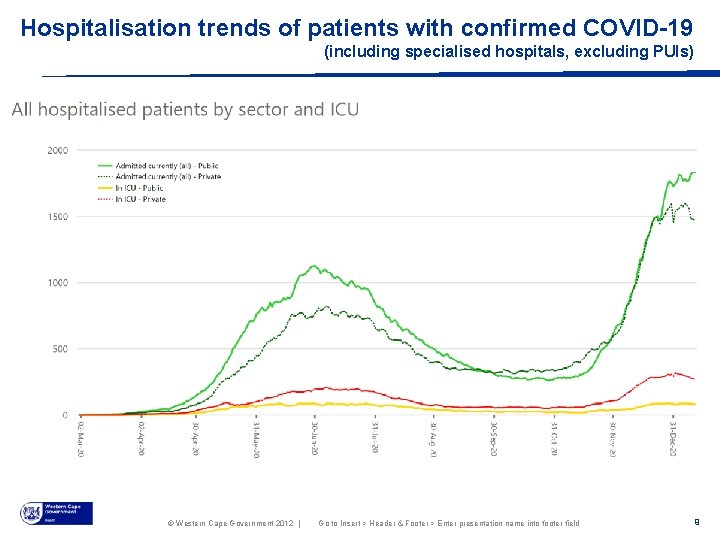
Hospitalisation trends of patients with confirmed COVID-19 (including specialised hospitals, excluding PUIs) © Western Cape Government 2012 | Go to Insert > Header & Footer > Enter presentation name into footer field 9
Mortality by date of death © Western Cape Government 2012 | Go to Insert > Header & Footer > Enter presentation name into footer field 10
Current reproduction number (province-wide) Calculated using epiestim © Western Cape Government 2012 | Go to Insert > Header & Footer > Enter presentation name into footer field 11
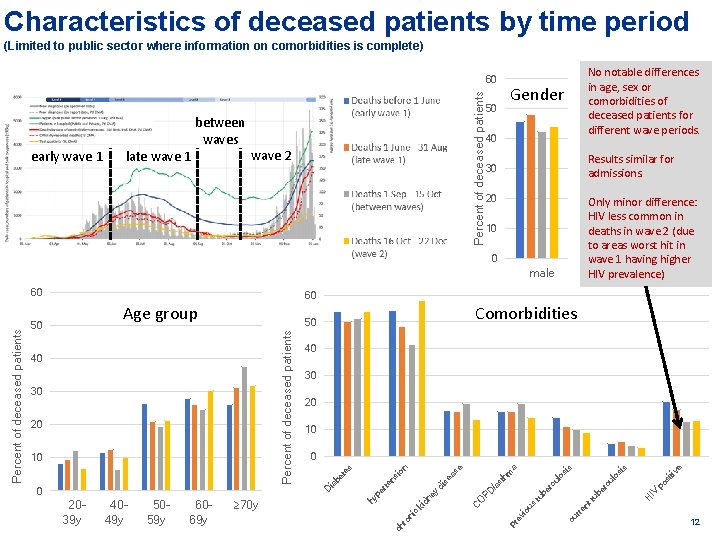
Characteristics of deceased patients by time period (Limited to public sector where information on comorbidities is complete) between waves early wave 1 late wave 1 Percent of deceased patients 60 wave 2 No notable differences in age, sex or comorbidities of deceased patients for different wave periods. Gender 50 40 Results similar for admissions. 30 20 Only minor difference: HIV less common in deaths in wave 2 (due to areas worst hit in wave 1 having higher HIV prevalence) 10 0 male 60 Comorbidities 50 e po si tiv IV H nt t rre cu io us ev pr ub tu be er rc cu ul os lo si s is a st /a PD O ey hm di se as ns io n pe rte dn ≥ 70 y ki 6069 y ic 5059 y on 4049 y ch r 2039 y e 0 D 0 10 hy 10 20 s 20 30 te 30 40 ia be 40 C Age group 50 Percent of deceased patients 60 12
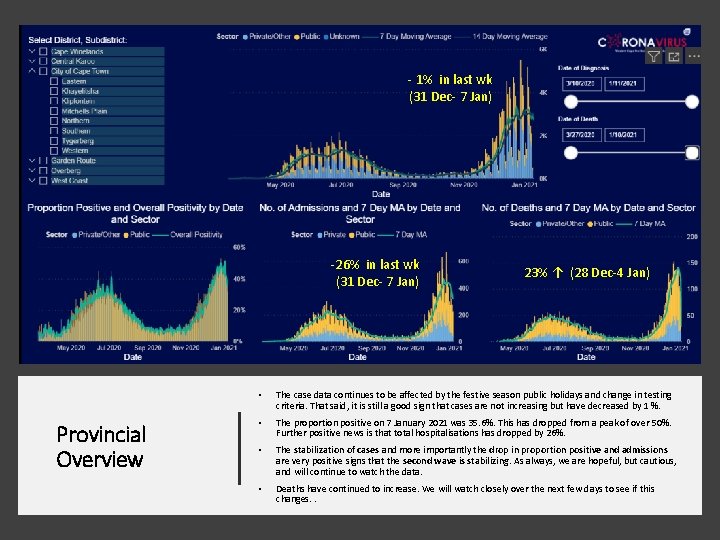
- 1% in last wk (31 Dec- 7 Jan) -26% in last wk (31 Dec- 7 Jan) Provincial Overview 23% ↑ (28 Dec-4 Jan) • The case data continues to be affected by the festive season public holidays and change in testing criteria. That said, it is still a good sign that cases are not increasing but have decreased by 1 %. • The proportion positive on 7 January 2021 was 35. 6%. This has dropped from a peak of over 50%. Further positive news is that total hospitalisations has dropped by 26%. • The stabilization of cases and more importantly the drop in proportion positive and admissions are very positive signs that the second wave is stabilizing. As always, we are hopeful, but cautious, and will continue to watch the data. • Deaths have continued to increase. We will watch closely over the next few days to see if this changes. .
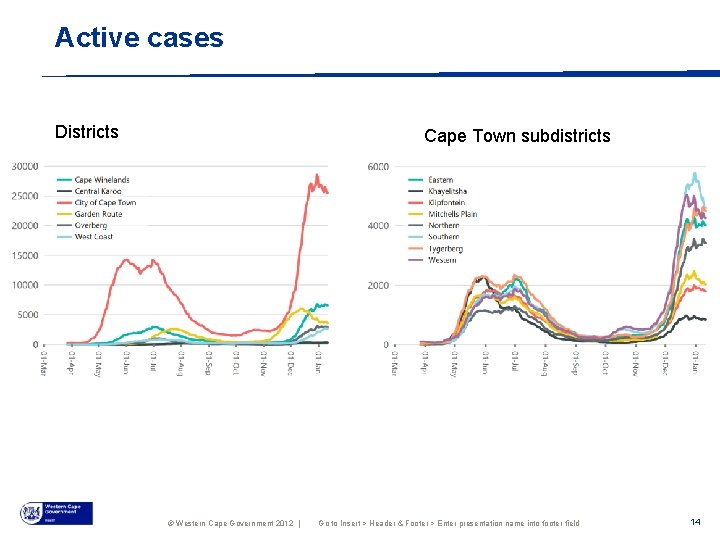
Active cases Districts Cape Town subdistricts © Western Cape Government 2012 | Go to Insert > Header & Footer > Enter presentation name into footer field 14
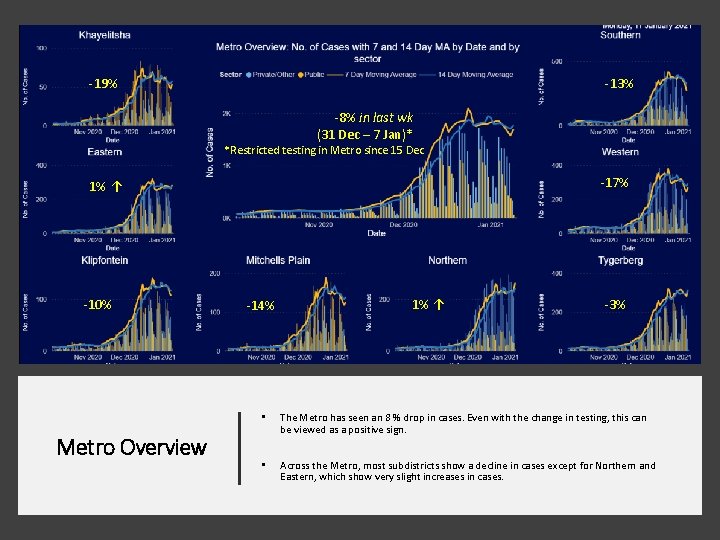
-19% -13% -8% in last wk (31 Dec – 7 Jan)* *Restricted testing in Metro since 15 Dec -17% 1% ↑ -10% Metro Overview -14% 1% ↑ -3% • The Metro has seen an 8 % drop in cases. Even with the change in testing, this can be viewed as a positive sign. • Across the Metro, most subdistricts show a decline in cases except for Northern and Eastern, which show very slight increases in cases.
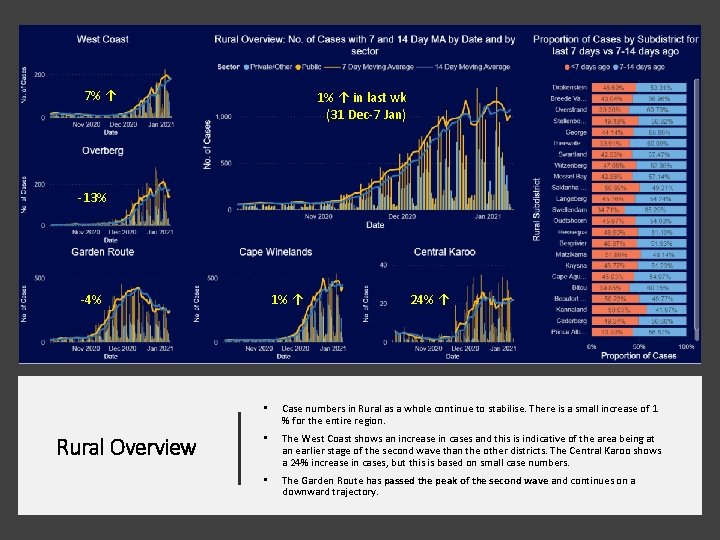
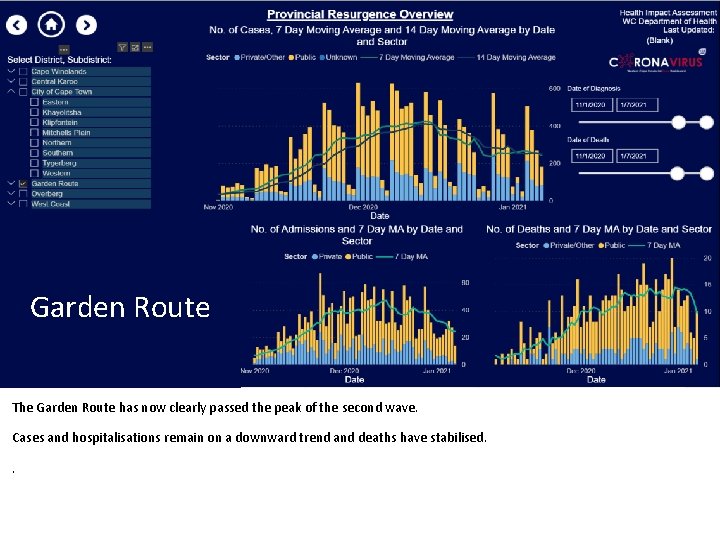
7% ↑ 1% ↑ in last wk (31 Dec-7 Jan) -13% 1% ↑ -4% Rural Overview 24% ↑ • Case numbers in Rural as a whole continue to stabilise. There is a small increase of 1 % for the entire region. • The West Coast shows an increase in cases and this is indicative of the area being at an earlier stage of the second wave than the other districts. The Central Karoo shows a 24% increase in cases, but this is based on small case numbers. • The Garden Route has passed the peak of the second wave and continues on a downward trajectory.
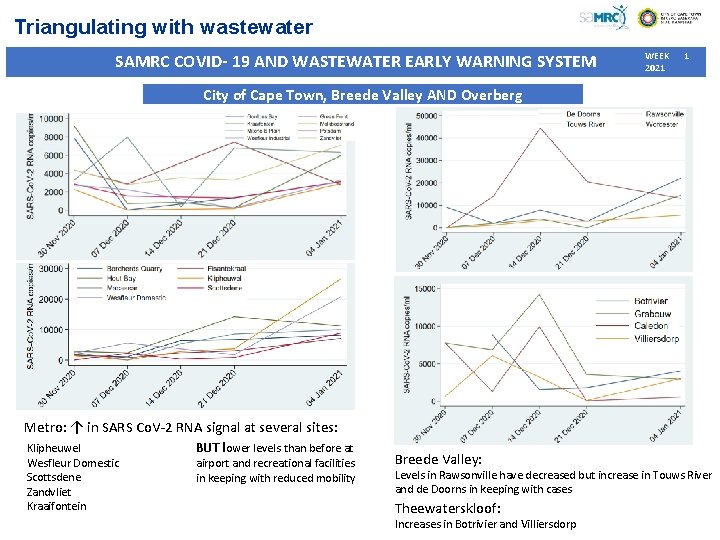
Triangulating with wastewater SAMRC COVID- 19 AND WASTEWATER EARLY WARNING SYSTEM City of Cape Town, Breede Valley AND Overberg WEEK 1 2021 update Metro: ↑ in SARS Co. V-2 RNA signal at several sites: Klipheuwel Wesfleur Domestic Scottsdene Zandvliet Kraaifontein BUT lower levels than before at airport and recreational facilities in keeping with reduced mobility Breede Valley: Levels in Rawsonville have decreased but increase in Touws River and de Doorns in keeping with cases Theewaterskloof: Increases in Botrivier and Villiersdorp
Garden Route The Garden Route has now clearly passed the peak of the second wave. Cases and hospitalisations remain on a downward trend and deaths have stabilised. .
Scaling up health platform COVID capacity
Scaling up COVID capacity – general comments 1. 2. PHC capacity: a) The PHC facilities have continued to see demand for COVID testing, and triage confirmed cases. b) There has been active de-escalation of non-COVID PHC services. Hospital capacity: a) 7 693 total acute operational public sector beds (excluding specialised beds at psych hospitals, TB hospitals, Red Cross hospitals, Mowbray Maternity hospital), inclusive of general and critical care public sector beds for COVID patients. The operational bed number differ from day to day. b) 626 inter-mediate care beds in Metro provisioned: 336 Brackengate, 90 at Lentegeur, 200 at MPH Hospital of Hope - beds commissioned in an incremental fashion. 3. c) We also have 64 intermediate care beds at Sonstraal Hospital (5 extra beds had been added), in Paarl. d) We have opened -- of the potential additional 136 intermediate care beds. Fatalities management capacity: a) Mass fatality centre in the Metro with capacity for 336 bodies [COCT had retained an additional 96 spaces]; currently 101 decedents and a cumulative total of 1006 bodies admitted. b) Mass fatality work group co-ordinating capacity across the province.
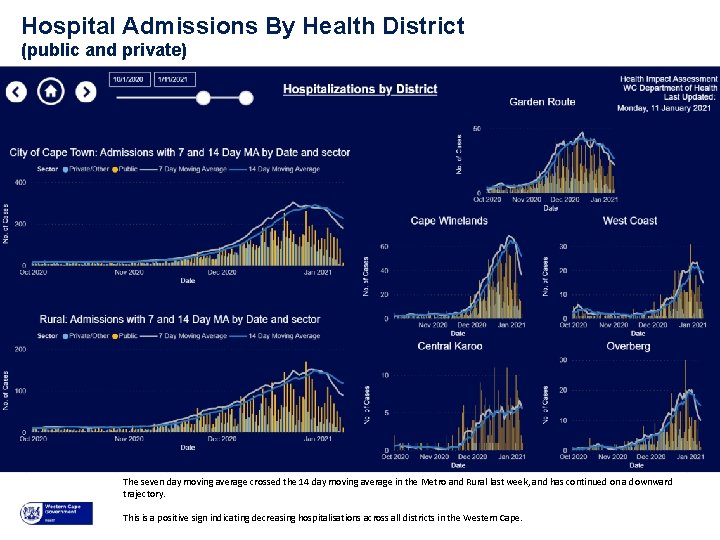
Hospital Admissions By Health District (public and private) Metro Cape Winelands Garden Route Overberg Central Karoo West Coast The seven day moving average crossed the 14 day moving average in the Metro and Rural last week, and has continued on a downward trajectory. This is a positive sign indicating decreasing hospitalisations across all districts in the Western Cape. © Western Cape Government 2012 |
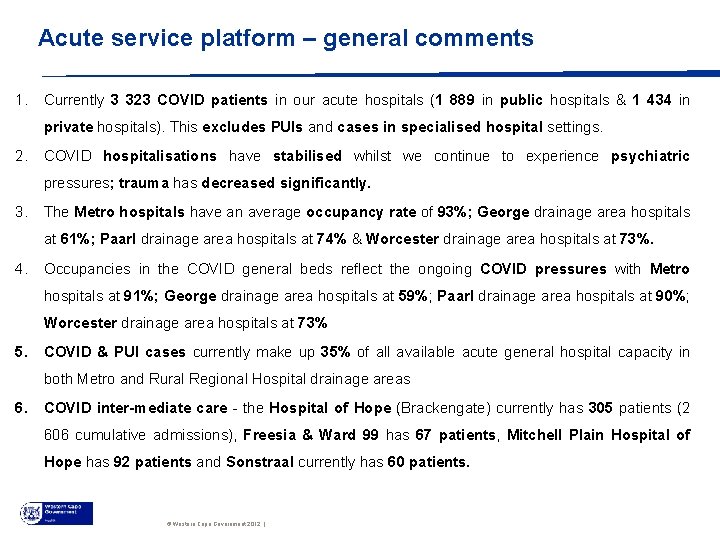
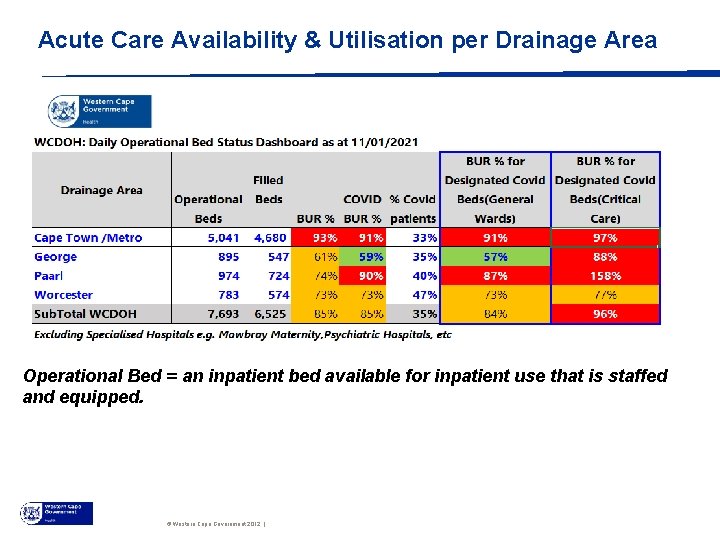
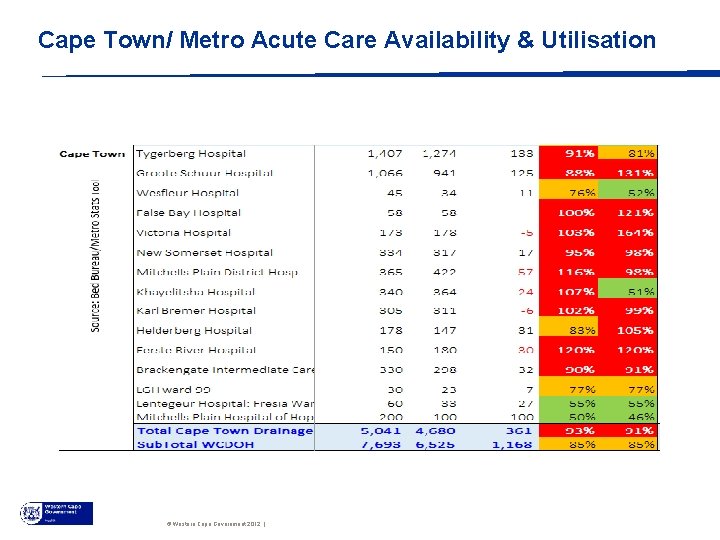
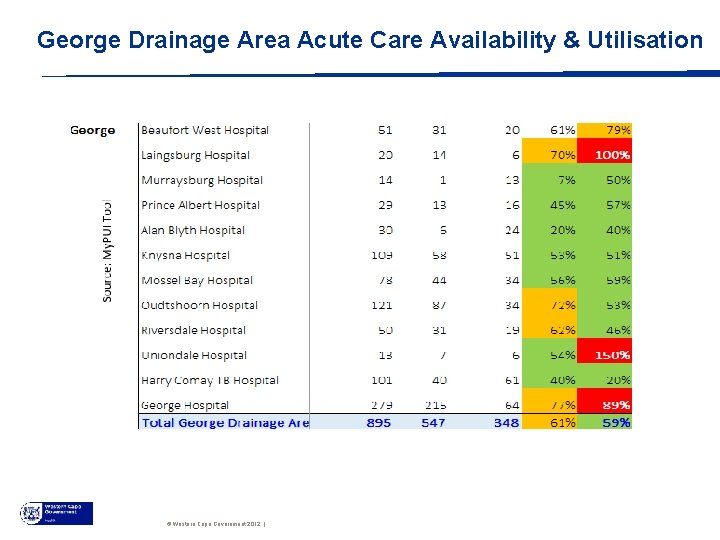
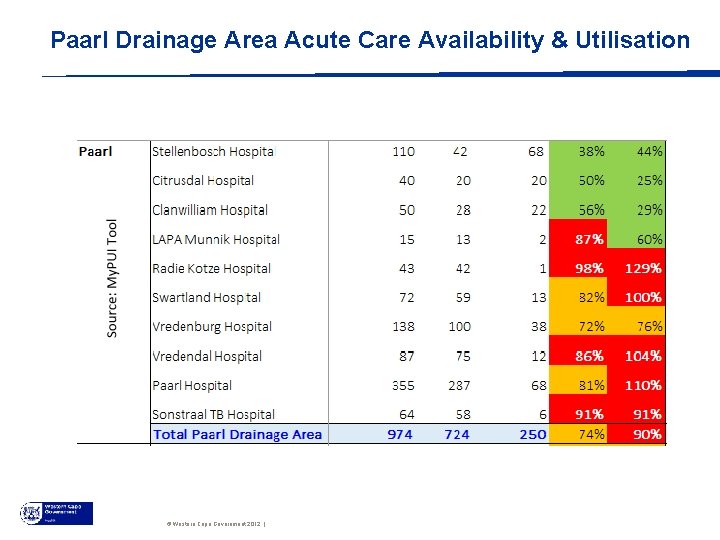
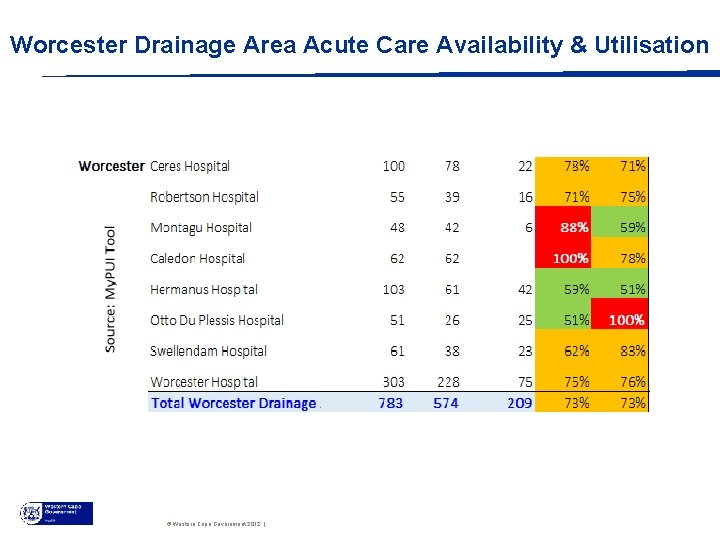
Acute service platform – general comments 1. Currently 3 323 COVID patients in our acute hospitals (1 889 in public hospitals & 1 434 in private hospitals). This excludes PUIs and cases in specialised hospital settings. 2. COVID hospitalisations have stabilised whilst we continue to experience psychiatric pressures; trauma has decreased significantly. 3. The Metro hospitals have an average occupancy rate of 93%; George drainage area hospitals at 61%; Paarl drainage area hospitals at 74% & Worcester drainage area hospitals at 73%. 4. Occupancies in the COVID general beds reflect the ongoing COVID pressures with Metro hospitals at 91%; George drainage area hospitals at 59%; Paarl drainage area hospitals at 90%; Worcester drainage area hospitals at 73% 5. COVID & PUI cases currently make up 35% of all available acute general hospital capacity in both Metro and Rural Regional Hospital drainage areas 6. COVID inter-mediate care - the Hospital of Hope (Brackengate) currently has 305 patients (2 606 cumulative admissions), Freesia & Ward 99 has 67 patients, Mitchell Plain Hospital of Hope has 92 patients and Sonstraal currently has 60 patients. © Western Cape Government 2012 |
Acute service platform – general comments 1. Temporary tents have been commissioned at the following hospitals: Khayelitsha, Wesfleur, Mitchell’s Plain, Eerste River, Helderberg, Karl Bremmer, Brackengate – these are used for discharges mainly to ensure a more rapid turn-around time of the operational beds (Brackengate has two tents used for admissions and discharges). 2. EMS and DTPW Taxi service have implemented a streamlined transport system to assist with inter-facility transfers and rapid discharges, to optimize capacity. The combined effect of this has been to significantly assist in decongesting the service platform. 3. Our data team has developed an integrated daily hospital bed available capacity and utilisation dashboard, which is also linked to available staffing and oxygen capacity at each of the hospitals. © Western Cape Government 2012 |
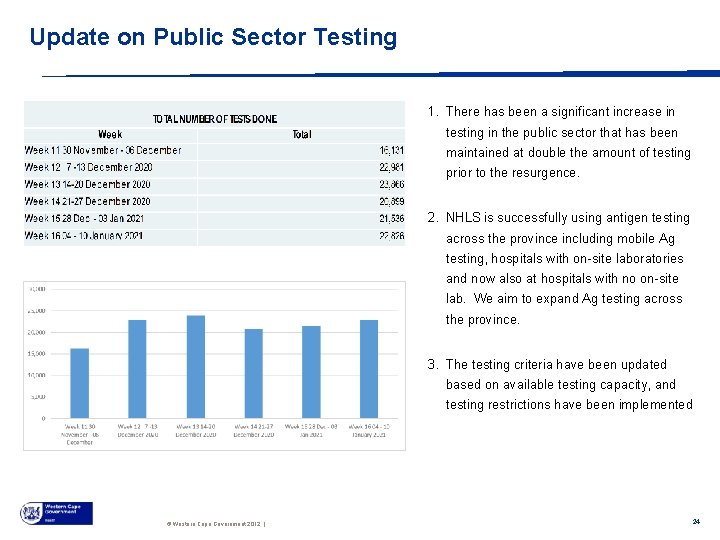
Update on Public Sector Testing 1. There has been a significant increase in testing in the public sector that has been maintained at double the amount of testing prior to the resurgence. 2. NHLS is successfully using antigen testing across the province including mobile Ag testing, hospitals with on-site laboratories and now also at hospitals with no on-site lab. We aim to expand Ag testing across the province. 3. The testing criteria have been updated based on available testing capacity, and testing restrictions have been implemented © Western Cape Government 2012 | 24
Acute Care Availability & Utilisation per Drainage Area Operational Bed = an inpatient bed available for inpatient use that is staffed and equipped. © Western Cape Government 2012 |
Cape Town/ Metro Acute Care Availability & Utilisation © Western Cape Government 2012 |
George Drainage Area Acute Care Availability & Utilisation © Western Cape Government 2012 |
Paarl Drainage Area Acute Care Availability & Utilisation © Western Cape Government 2012 |
Worcester Drainage Area Acute Care Availability & Utilisation © Western Cape Government 2012 |
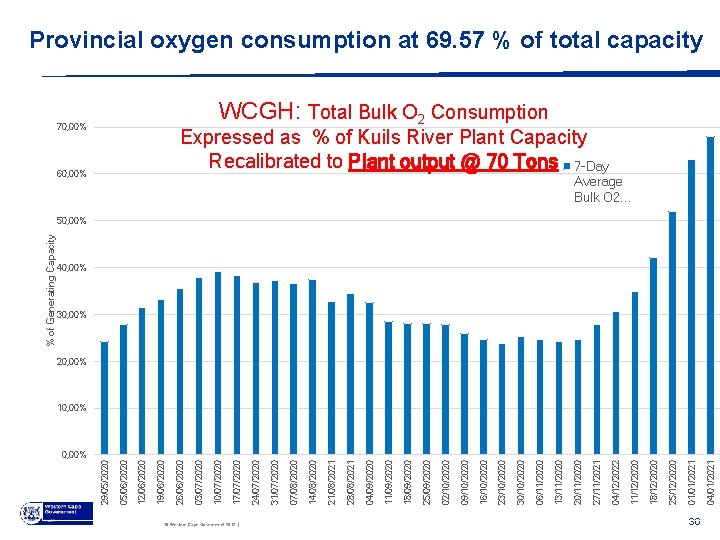
© Western Cape Government 2012 | 30 04/01/2021 01/01/2021 25/12/2020 18/12/2020 11/12/2020 04/12/2022 27/11/2021 20/11/2020 13/11/2020 06/11/2020 30/10/2020 23/10/2020 16/10/2020 09/10/2020 02/10/2020 25/09/2020 18/09/2020 11/09/2020 04/09/2020 28/08/2021 21/08/2021 14/08/2020 07/08/2020 31/07/2020 24/07/2020 17/07/2020 10/07/2020 60, 00% 03/07/2020 70, 00% 26/06/2020 19/06/2020 12/06/2020 05/06/2020 29/05/2020 % of Generating Capacity Provincial oxygen consumption at 69. 57 % of total capacity WCGH: Total Bulk O 2 Consumption Expressed as % of Kuils River Plant Capacity Recalibrated to Plant output @ 70 Tons 7 -Day Average Bulk O 2. . . 50, 00% 40, 00% 30, 00% 20, 00% 10, 00%
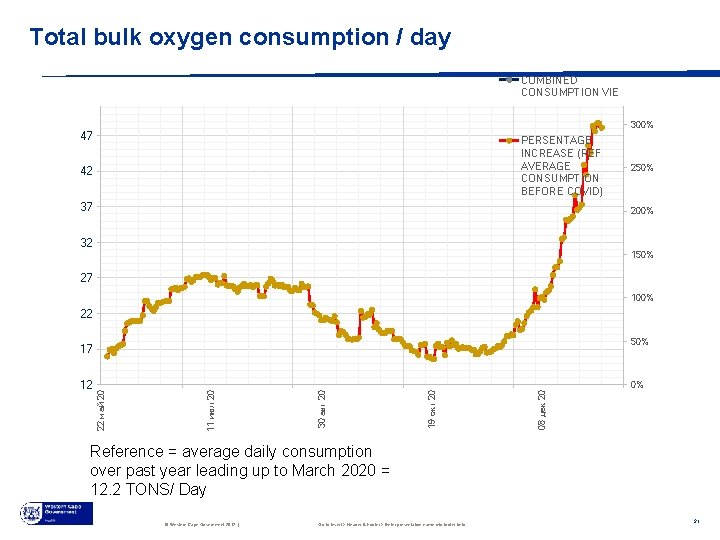
Total bulk oxygen consumption / day COMBINED CONSUMPTION VIE 300% 47 PERSENTAGE INCREASE (REF AVERAGE CONSUMPTION BEFORE COVID) 42 37 250% 200% 32 150% 27 100% 22 50% 17 08 дек 20 19 окт 20 30 авг 20 11 июл 20 0% 22 май 20 12 Reference = average daily consumption over past year leading up to March 2020 = 12. 2 TONS/ Day © Western Cape Government 2012 | Go to Insert > Header & Footer > Enter presentation name into footer field 31
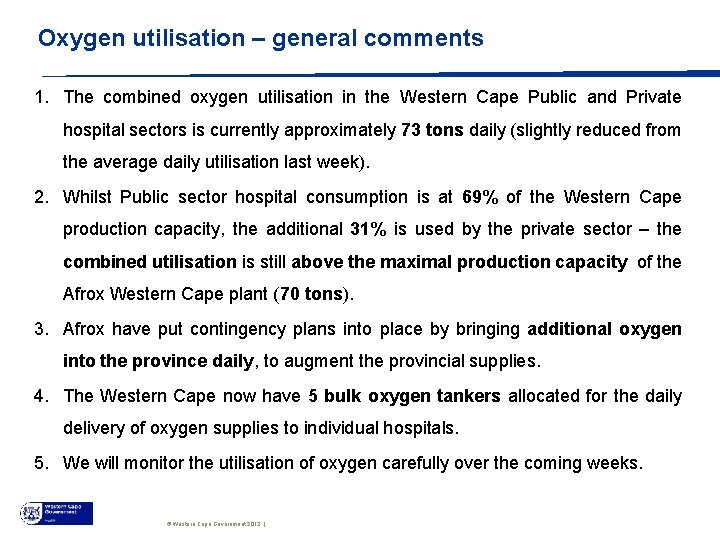
Oxygen utilisation – general comments 1. The combined oxygen utilisation in the Western Cape Public and Private hospital sectors is currently approximately 73 tons daily (slightly reduced from the average daily utilisation last week). 2. Whilst Public sector hospital consumption is at 69% of the Western Cape production capacity, the additional 31% is used by the private sector – the combined utilisation is still above the maximal production capacity of the Afrox Western Cape plant (70 tons). 3. Afrox have put contingency plans into place by bringing additional oxygen into the province daily, to augment the provincial supplies. 4. The Western Cape now have 5 bulk oxygen tankers allocated for the daily delivery of oxygen supplies to individual hospitals. 5. We will monitor the utilisation of oxygen carefully over the coming weeks. © Western Cape Government 2012 |
Fatalities Management © Western Cape Government 2012 |
COVID-19: Fatalities Management Working Group With the onset of the COVID-19 Pandemic in South Africa, March 2020, a dedicated Working Group, under the leadership of the Head of Department: Local Government was established to plan for and put measures in place, across the Province, to be able to deal with mass fatalities, should this be required. The working group initiated, developed and implemented comprehensive strategies for fatality management at Provincial and District level. This included: • Mass Fatality Plans & supporting strategies • Communication protocols, with Provincial and National Departments and also with external stakeholders such as the Funeral Industry • Mass burial capabilitiesshould this be required
Deliverables/Actions Completed to Date 1. Mass Fatality Plans: The City and all the 5 Districts have prepared Mass Fatality Plans and associated support plans. 2. Support of Home Affairs including opening additional offices and extended hours over the festive period to register deaths. 3. Capacity/Functioning of Crematoria- Where backlogs are registered, facilities function over night and over the weekends to ensure that they are cleared. 4. The Working Group is currently involved in the ongoing monitoring of the availability of storage space across the Province and to date have resolved all problems related to storage capacity
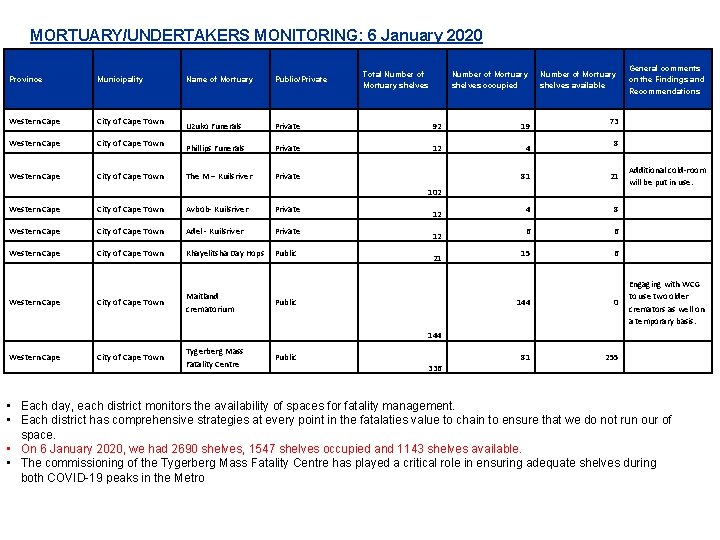
MORTUARY/UNDERTAKERS MONITORING: 6 January 2020 Province Municipality Western Cape City of Cape Town Total Number of Mortuary shelves occupied Name of Mortuary Public/Private Uzuko Funerals Private 92 19 Phillips Funerals Private 12 4 The M – Kuilsriver Private Number of Mortuary shelves available 73 8 81 21 4 8 6 6 15 6 102 Western Cape City of Cape Town Avbob- Kuilsriver Private Western Cape City of Cape Town Adel - Kuilsriver Private Western Cape City of Cape Town Khayelitsha Day Hops Public City of Cape Town Maitland crematorium Western Cape 12 12 21 Public General comments on the Findings and Recommendations 144 0 81 255 Additional cold-room will be put in use. Engaging with WCG to use two older cremators as well on a temporary basis. 144 Western Cape City of Cape Town Tygerberg Mass Fatality Centre Public 336 • Each day, each district monitors the availability of spaces for fatality management. • Each district has comprehensive strategies at every point in the fatalaties value to chain to ensure that we do not run our of space. • On 6 January 2020, we had 2690 shelves, 1547 shelves occupied and 1143 shelves available. • The commissioning of the Tygerberg Mass Fatality Centre has played a critical role in ensuring adequate shelves during both COVID-19 peaks in the Metro
Vaccine Strategy © Western Cape Government 2012 |
Introductory Comments 1. The vaccine is probably the most powerful global weapon to turn the tide against the Covid-19 pandemic. 2. The National Department of Health is driving the procurement process and we align with their efforts. 3. The National Minister announced on 7 th January 2021 the acquisition from the Serum Institute of India 1 million doses of the Astra Zeneca vaccine by the end of January 2021 and a further 500 000 doses in February 2021. 4. Further negotiations are being pursued on with other vaccine suppliers for more stock in addition to the stock to be secured via the Covax initiative. 5. The Western Cape Department of Health is focussing on readiness to implement the vaccination programme in the province. © Western Cape Government 2012 |
Objectives of Covid-19 vaccination To provide equitable and ethical access to Covid-19 vaccines in the Western Cape to: 1. Reduce morbidity and mortality in vulnerable people 2. Reduce community transmission through Herd Immunity 3. Protect the Health System capability © Western Cape Government 2012 |
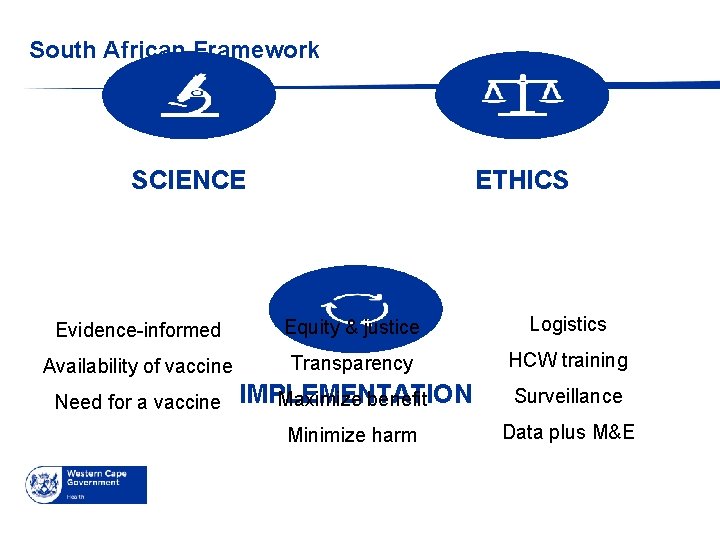
South African Framework SCIENCE ETHICS Evidence-informed Equity & justice Logistics Availability of vaccine Transparency HCW training Need for a vaccine IMPLEMENTATION Maximize benefit Surveillance Minimize harm Data plus M&E © Western Cape Government 2012 |
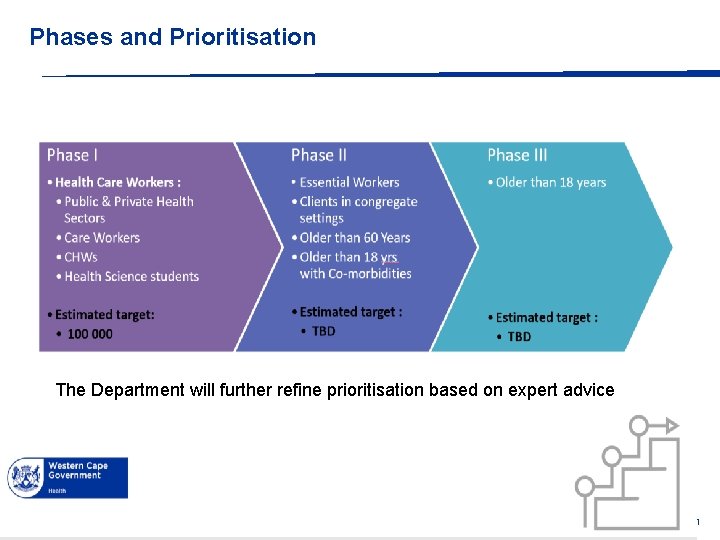
Phases and Prioritisation The Department will further refine prioritisation based on expert advice © Western Cape Government 2012 | Go to Insert > Header & Footer > Enter presentation name into footer field 41
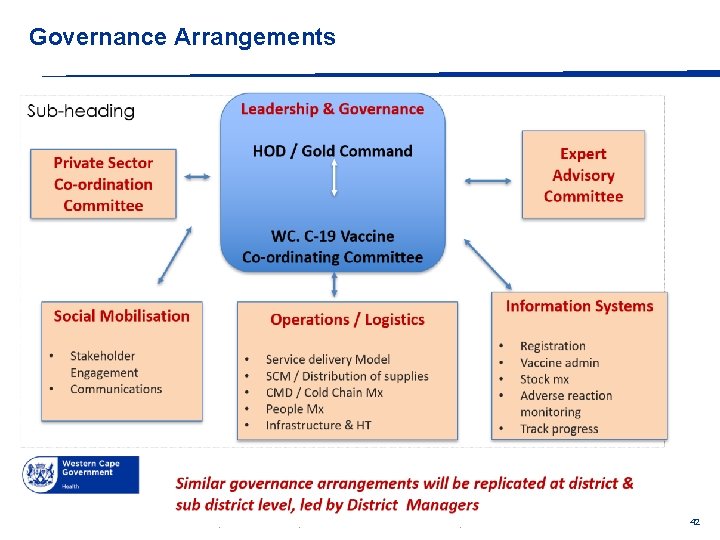
Governance Arrangements © Western Cape Government 2012 | Go to Insert > Header & Footer > Enter presentation name into footer field 42
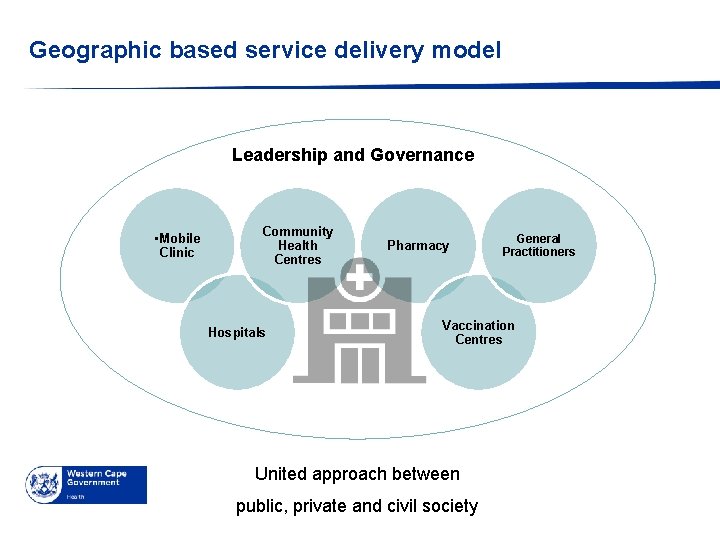
Geographic based service delivery model Leadership and Governance • Mobile Clinic Community Health Centres Hospitals Pharmacy Vaccination Centres United approach between public, private and civil society © Western Cape Government 2012 | General Practitioners
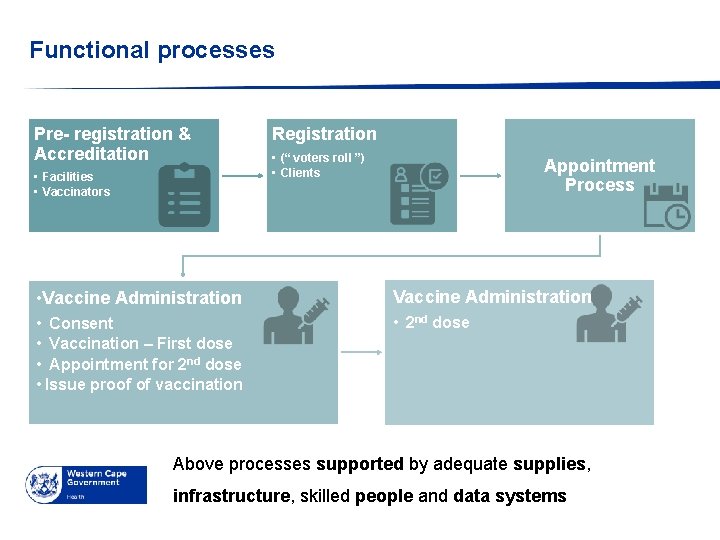
Functional processes Pre- registration & Accreditation • Facilities • Vaccinators Registration • (“ voters roll ”) • Clients Appointment Process • Vaccine Administration • Consent • Vaccination – First dose • Appointment for 2 nd dose • Issue proof of vaccination • 2 nd dose Above processes supported by adequate supplies, infrastructure, skilled people and data systems © Western Cape Government 2012 |
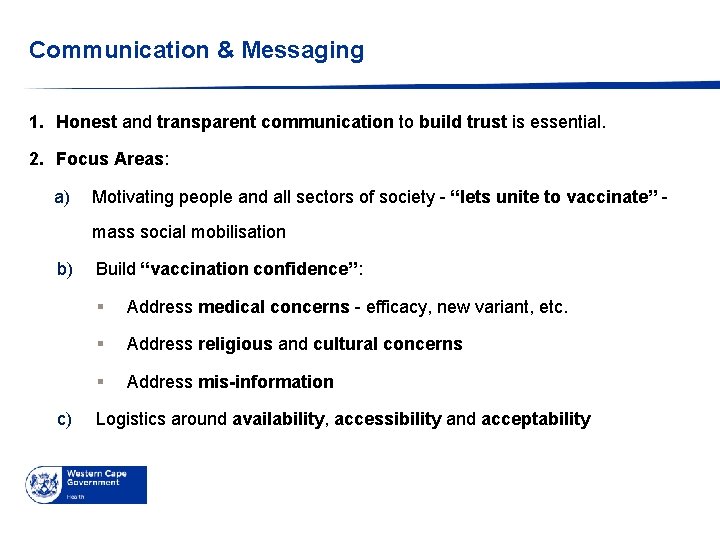
Communication & Messaging 1. Honest and transparent communication to build trust is essential. 2. Focus Areas: a) Motivating people and all sectors of society - “lets unite to vaccinate” mass social mobilisation b) c) Build “vaccination confidence”: § Address medical concerns - efficacy, new variant, etc. § Address religious and cultural concerns § Address mis-information Logistics around availability, accessibility and acceptability © Western Cape Government 2012 |
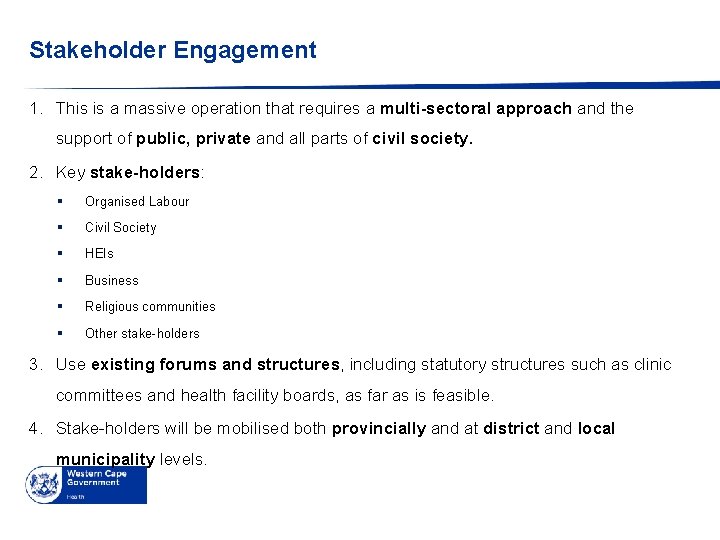
Stakeholder Engagement 1. This is a massive operation that requires a multi-sectoral approach and the support of public, private and all parts of civil society. 2. Key stake-holders: § Organised Labour § Civil Society § HEIs § Business § Religious communities § Other stake-holders 3. Use existing forums and structures, including statutory structures such as clinic committees and health facility boards, as far as is feasible. 4. Stake-holders will be mobilised both provincially and at district and local municipality levels. © Western Cape Government 2012 |
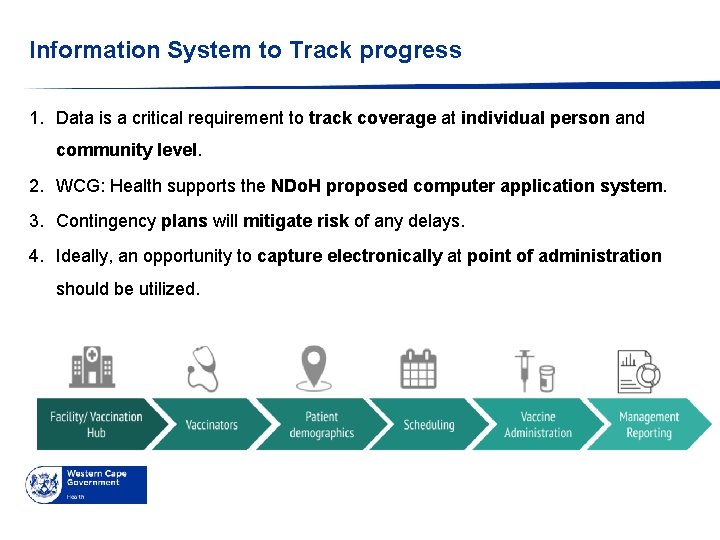
Information System to Track progress 1. Data is a critical requirement to track coverage at individual person and community level. 2. WCG: Health supports the NDo. H proposed computer application system. 3. Contingency plans will mitigate risk of any delays. 4. Ideally, an opportunity to capture electronically at point of administration should be utilized. © Western Cape Government 2012 |
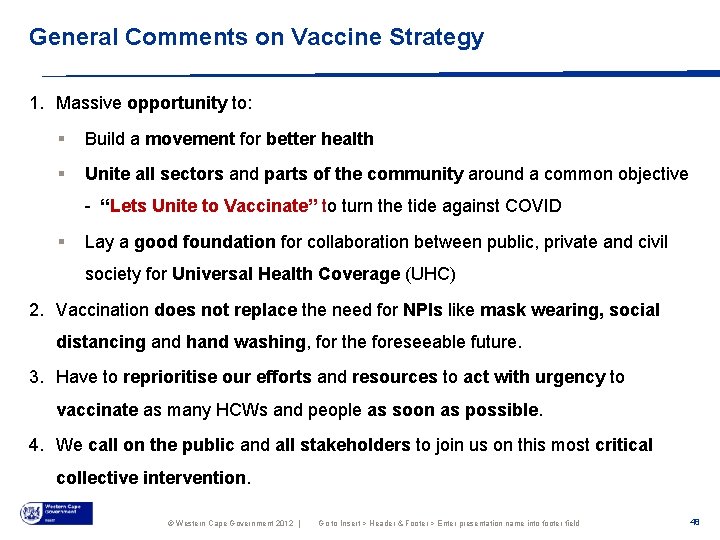
General Comments on Vaccine Strategy 1. Massive opportunity to: § Build a movement for better health § Unite all sectors and parts of the community around a common objective - “Lets Unite to Vaccinate” to turn the tide against COVID § Lay a good foundation for collaboration between public, private and civil society for Universal Health Coverage (UHC) 2. Vaccination does not replace the need for NPIs like mask wearing, social distancing and hand washing, for the foreseeable future. 3. Have to reprioritise our efforts and resources to act with urgency to vaccinate as many HCWs and people as soon as possible. 4. We call on the public and all stakeholders to join us on this most critical collective intervention. © Western Cape Government 2012 | Go to Insert > Header & Footer > Enter presentation name into footer field 48
Conclusions © Western Cape Government 2012 |
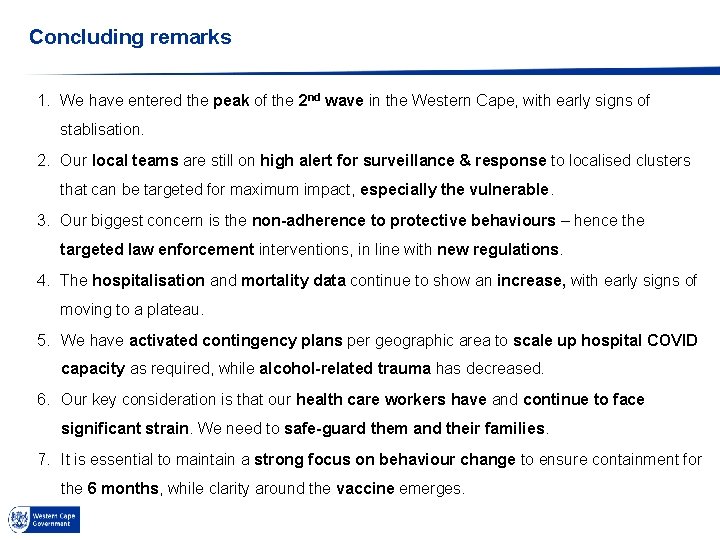
Concluding remarks 1. We have entered the peak of the 2 nd wave in the Western Cape, with early signs of stablisation. 2. Our local teams are still on high alert for surveillance & response to localised clusters that can be targeted for maximum impact, especially the vulnerable. 3. Our biggest concern is the non-adherence to protective behaviours – hence the targeted law enforcement interventions, in line with new regulations. 4. The hospitalisation and mortality data continue to show an increase, with early signs of moving to a plateau. 5. We have activated contingency plans per geographic area to scale up hospital COVID capacity as required, while alcohol-related trauma has decreased. 6. Our key consideration is that our health care workers have and continue to face significant strain. We need to safe-guard them and their families. 7. It is essential to maintain a strong focus on behaviour change to ensure containment for the 6 months, while clarity around the vaccine emerges.
Thank you © Western Cape Government 2012 |