
Presentation to California State Association of Counties CSAC

- Slides: 33
Presentation to California State Association of Counties (CSAC) Can Counties and Cities Get Along on Infrastructure Districts? : What to Expect When Cities Propose an EIFD or CRIA in Your County d October 4, 2016 1230 Rosecrans Ave, Suite 300, Manhattan Beach, CA 90266 (424) 456 -3088 www. kosmont. com
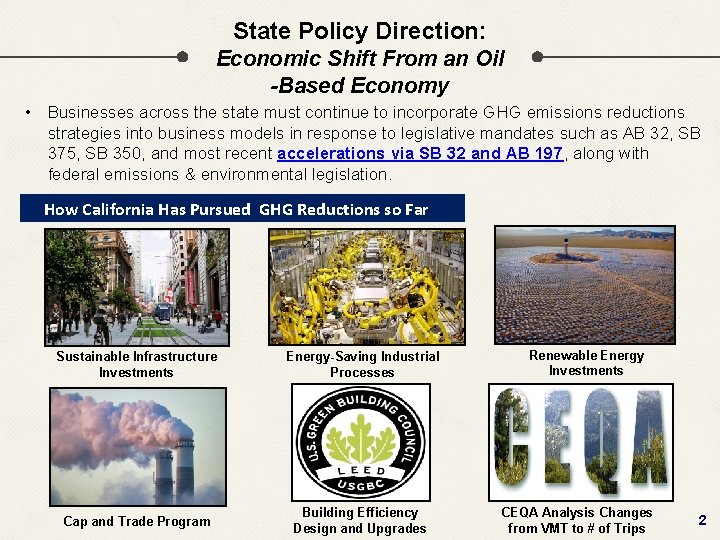
State Policy Direction: Economic Shift From an Oil -Based Economy • Businesses across the state must continue to incorporate GHG emissions reductions strategies into business models in response to legislative mandates such as AB 32, SB 375, SB 350, and most recent accelerations via SB 32 and AB 197, along with federal emissions & environmental legislation. How California Has Pursued GHG Reductions so Far Sustainable Infrastructure Investments Cap and Trade Program Energy-Saving Industrial Processes Building Efficiency Design and Upgrades Renewable Energy Investments CEQA Analysis Changes from VMT to # of Trips 2
SB 32: Acceleration of GHG Reduction CALIFORNIA: WORLD LEADER IN FIGHT AGAINST CLIMATE CHANGE SB 32: Requires State to reduce greenhouse gas emissions 40% below 1990 levels by 2030. 3
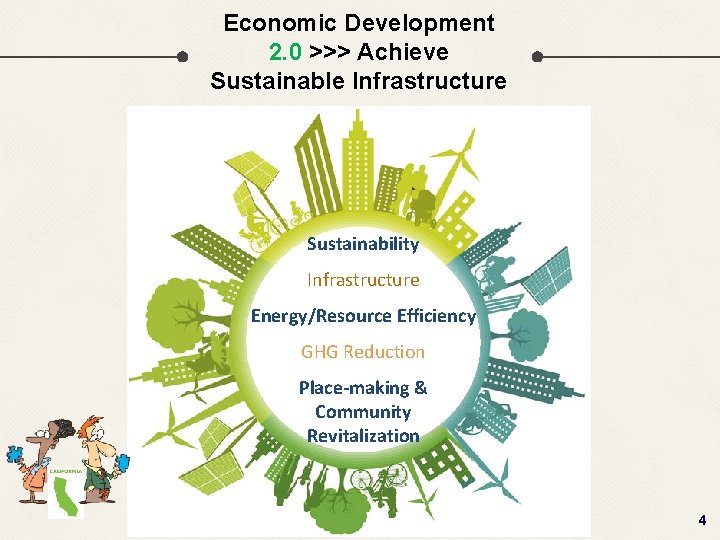
Economic Development 2. 0 >>> Achieve Sustainable Infrastructure Sustainability Infrastructure Energy/Resource Efficiency GHG Reduction Place-making & Community Revitalization 4
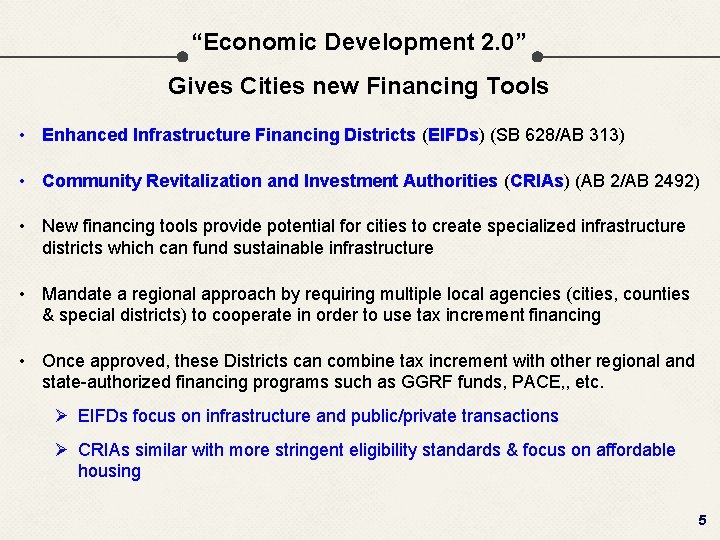
“Economic Development 2. 0” f Gives Cities new Financing Tools • Enhanced Infrastructure Financing Districts (EIFDs) (SB 628/AB 313) • Community Revitalization and Investment Authorities (CRIAs) (AB 2/AB 2492) • New financing tools provide potential for cities to create specialized infrastructure districts which can fund sustainable infrastructure • Mandate a regional approach by requiring multiple local agencies (cities, counties & special districts) to cooperate in order to use tax increment financing • Once approved, these Districts can combine tax increment with other regional and state-authorized financing programs such as GGRF funds, PACE, , etc. Ø EIFDs focus on infrastructure and public/private transactions Ø CRIAs similar with more stringent eligibility standards & focus on affordable housing 5
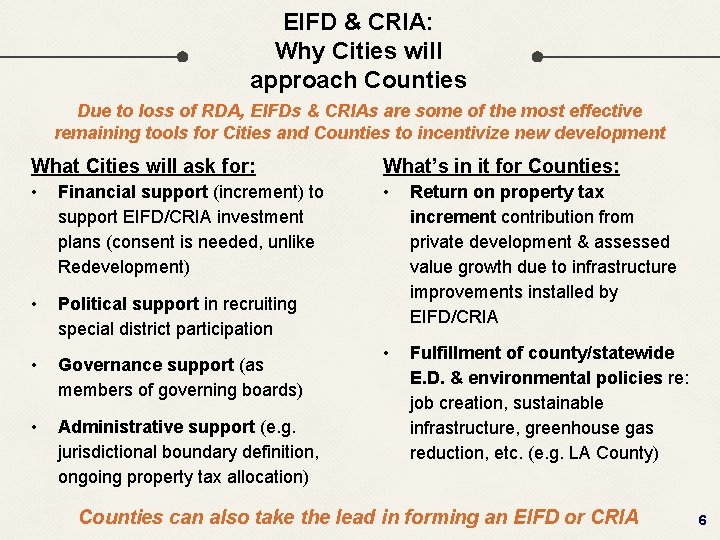
EIFD & CRIA: Why Cities will approach Counties Due to loss of RDA, EIFDs & CRIAs are some of the most effective remaining tools for Cities and Counties to incentivize new development What Cities will ask for: What’s in it for Counties: • Financial support (increment) to support EIFD/CRIA investment plans (consent is needed, unlike Redevelopment) • • Political support in recruiting special district participation Return on property tax increment contribution from private development & assessed value growth due to infrastructure improvements installed by EIFD/CRIA • Governance support (as members of governing boards) • • Administrative support (e. g. jurisdictional boundary definition, ongoing property tax allocation) Fulfillment of county/statewide E. D. & environmental policies re: job creation, sustainable infrastructure, greenhouse gas reduction, etc. (e. g. LA County) Counties can also take the lead in forming an EIFD or CRIA 6
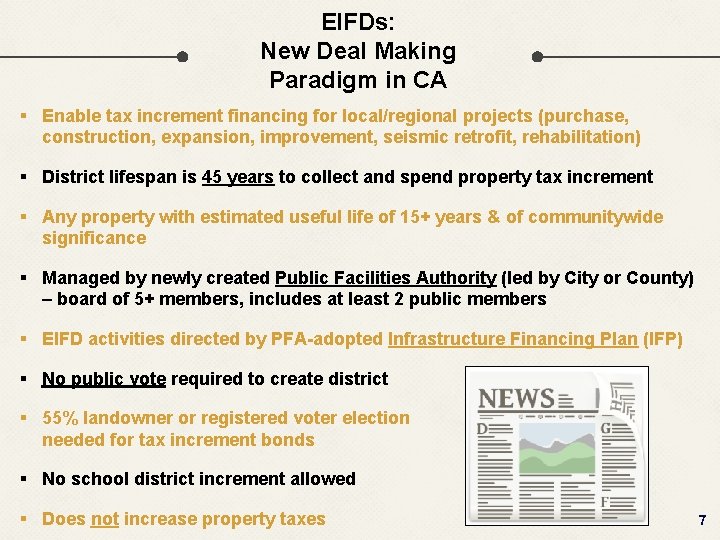
EIFDs: New Deal Making Paradigm in CA § Enable tax increment financing for local/regional projects (purchase, construction, expansion, improvement, seismic retrofit, rehabilitation) § District lifespan is 45 years to collect and spend property tax increment § Any property with estimated useful life of 15+ years & of communitywide significance § Managed by newly created Public Facilities Authority (led by City or County) – board of 5+ members, includes at least 2 public members § EIFD activities directed by PFA-adopted Infrastructure Financing Plan (IFP) § No public vote required to create district § 55% landowner or registered voter election needed for tax increment bonds § No school district increment allowed § Does not increase property taxes 7
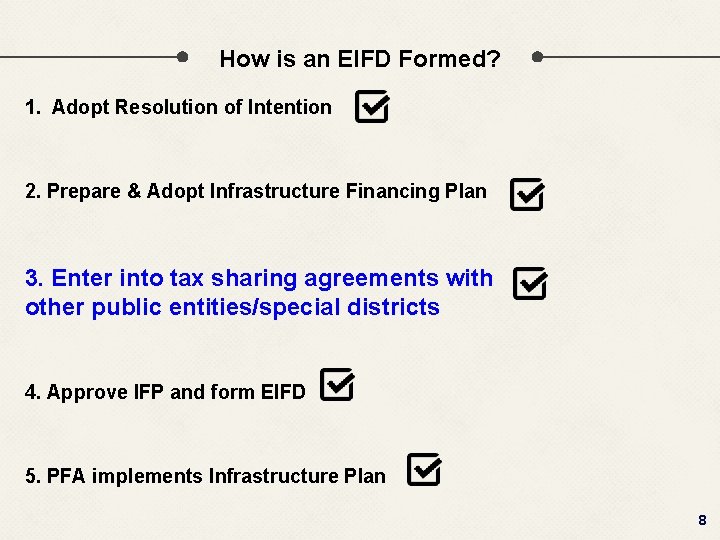
How is an EIFD Formed? 1. Adopt Resolution of Intention 2. Prepare & Adopt Infrastructure Financing Plan 3. Enter into tax sharing agreements with other public entities/special districts 4. Approve IFP and form EIFD 5. PFA implements Infrastructure Plan 8
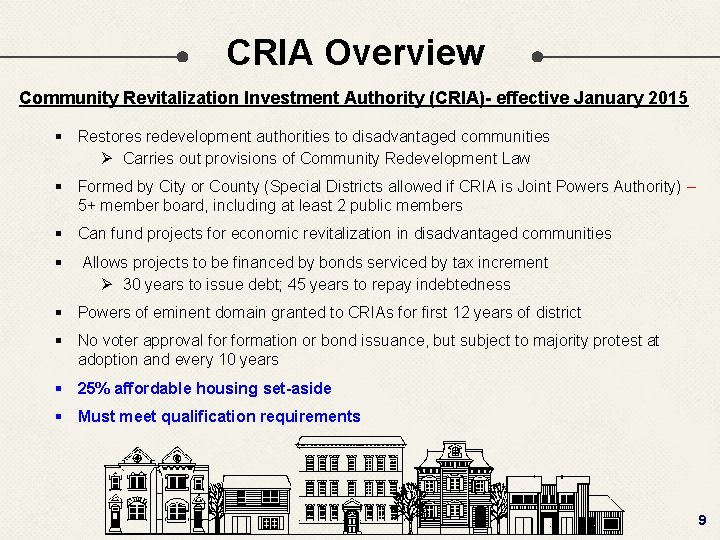
CRIA Overview Community Revitalization Investment Authority (CRIA)- effective January 2015 § Restores redevelopment authorities to disadvantaged communities Ø Carries out provisions of Community Redevelopment Law § Formed by City or County (Special Districts allowed if CRIA is Joint Powers Authority) – 5+ member board, including at least 2 public members § Can fund projects for economic revitalization in disadvantaged communities § Allows projects to be financed by bonds serviced by tax increment Ø 30 years to issue debt; 45 years to repay indebtedness § Powers of eminent domain granted to CRIAs for first 12 years of district § No voter approval formation or bond issuance, but subject to majority protest at adoption and every 10 years § 25% affordable housing set-aside § Must meet qualification requirements 9
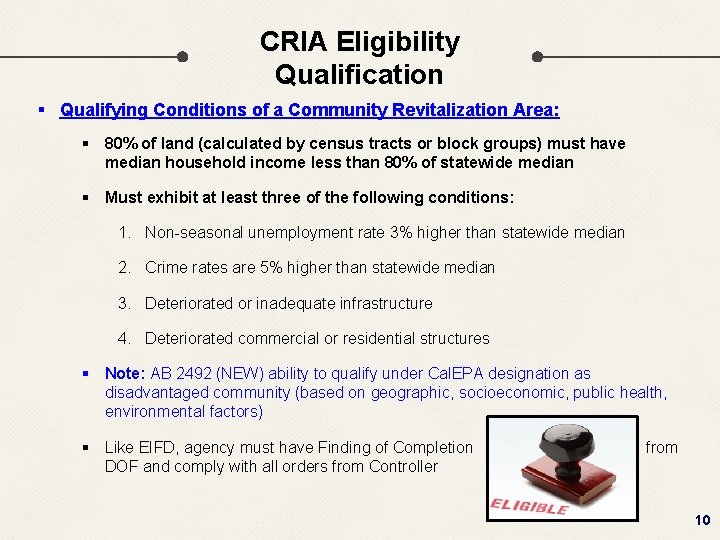
CRIA Eligibility Qualification § Qualifying Conditions of a Community Revitalization Area: § 80% of land (calculated by census tracts or block groups) must have median household income less than 80% of statewide median § Must exhibit at least three of the following conditions: 1. Non-seasonal unemployment rate 3% higher than statewide median 2. Crime rates are 5% higher than statewide median 3. Deteriorated or inadequate infrastructure 4. Deteriorated commercial or residential structures § Note: AB 2492 (NEW) ability to qualify under Cal. EPA designation as disadvantaged community (based on geographic, socioeconomic, public health, environmental factors) § Like EIFD, agency must have Finding of Completion from DOF and comply with all orders from Controller 10
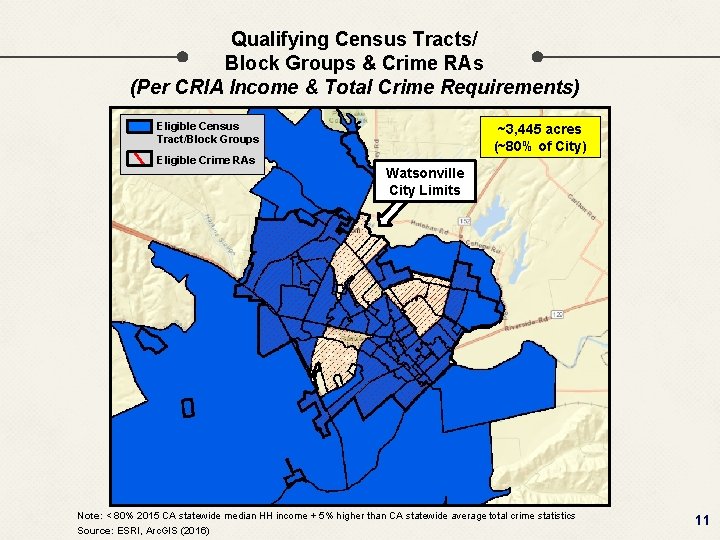
Qualifying Census Tracts/ Block Groups & Crime RAs (Per CRIA Income & Total Crime Requirements) Eligible Census Tract/Block Groups Eligible Crime RAs ~3, 445 acres (~80% of City) Watsonville City Limits Note: < 80% 2015 CA statewide median HH income + 5% higher than CA statewide average total crime statistics Source: ESRI, Arc. GIS (2016) 11
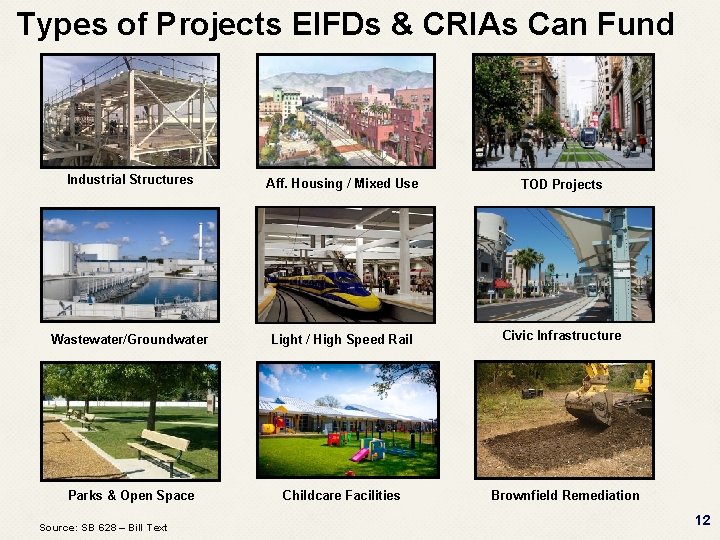
Types of Projects EIFDs & CRIAs Can Fund Industrial Structures Aff. Housing / Mixed Use TOD Projects Wastewater/Groundwater Light / High Speed Rail Civic Infrastructure Parks & Open Space Childcare Facilities Brownfield Remediation Source: SB 628 – Bill Text 12
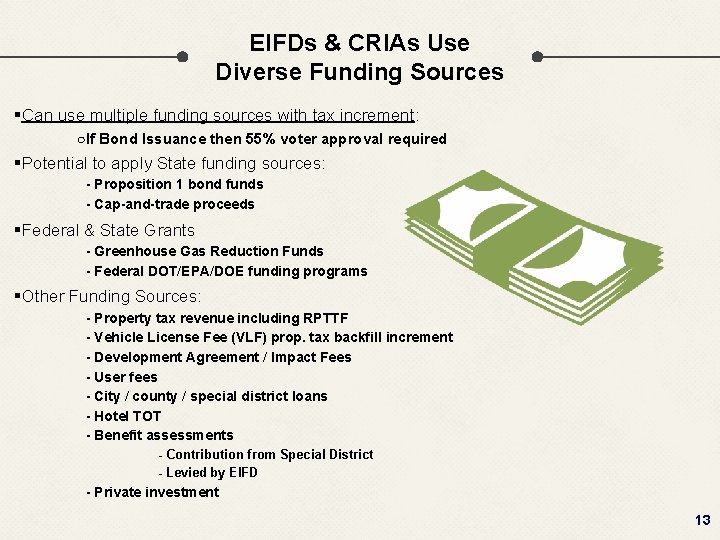
EIFDs & CRIAs Use Diverse Funding Sources §Can use multiple funding sources with tax increment: ○If Bond Issuance then 55% voter approval required §Potential to apply State funding sources: - Proposition 1 bond funds - Cap-and-trade proceeds §Federal & State Grants - Greenhouse Gas Reduction Funds - Federal DOT/EPA/DOE funding programs §Other Funding Sources: - Property tax revenue including RPTTF - Vehicle License Fee (VLF) prop. tax backfill increment - Development Agreement / Impact Fees - User fees - City / county / special district loans - Hotel TOT - Benefit assessments - Contribution from Special District - Levied by EIFD - Private investment 13
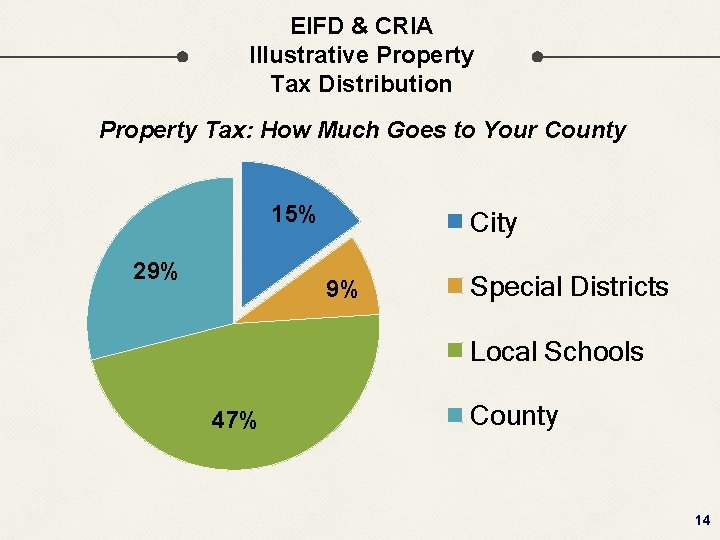
EIFD & CRIA Illustrative Property Tax Distribution Property Tax: How Much Goes to Your County 15% 29% City 9% Special Districts Local Schools 47% County 14
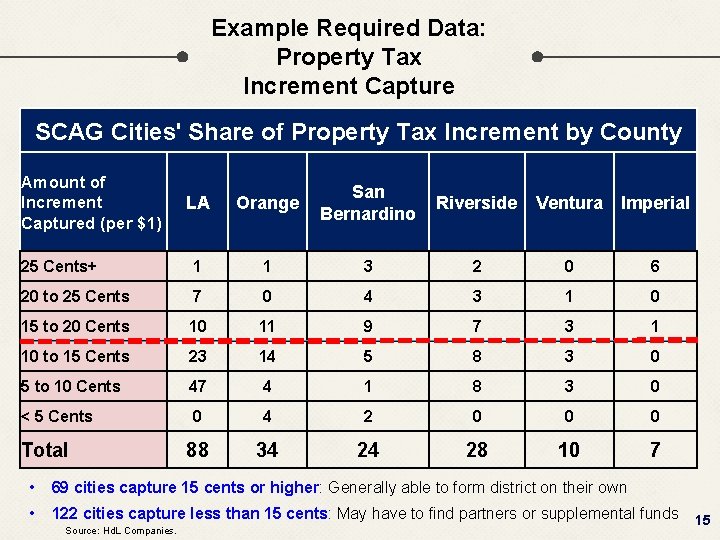
Example Required Data: Property Tax Increment Capture SCAG Cities' Share of Property Tax Increment by County Amount of Increment Captured (per $1) LA Orange San Bernardino Riverside Ventura Imperial 25 Cents+ 1 1 3 2 0 6 20 to 25 Cents 7 0 4 3 1 0 15 to 20 Cents 10 11 9 7 3 1 10 to 15 Cents 23 14 5 8 3 0 5 to 10 Cents 47 4 1 8 3 0 < 5 Cents 0 4 2 0 0 0 88 34 24 28 10 7 Total • 69 cities capture 15 cents or higher: Generally able to form district on their own • 122 cities capture less than 15 cents: May have to find partners or supplemental funds 15 Source: Hd. L Companies.
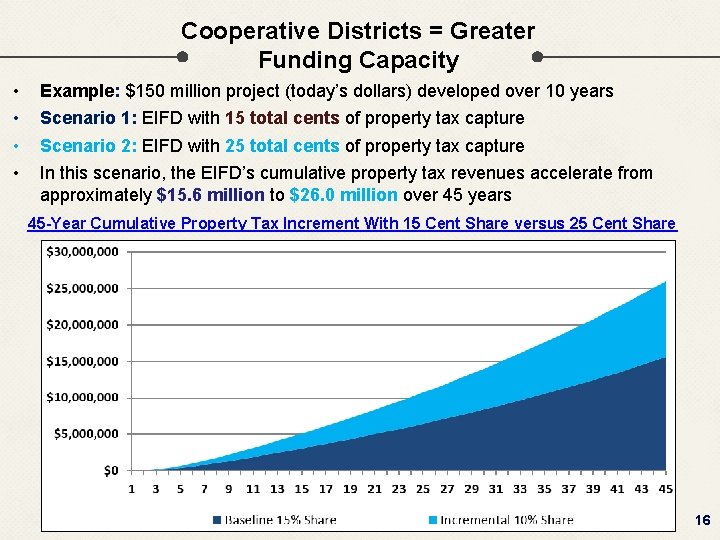
Cooperative Districts = Greater Funding Capacity • • Example: $150 million project (today’s dollars) developed over 10 years Scenario 1: EIFD with 15 total cents of property tax capture Scenario 2: EIFD with 25 total cents of property tax capture In this scenario, the EIFD’s cumulative property tax revenues accelerate from approximately $15. 6 million to $26. 0 million over 45 years 45 -Year Cumulative Property Tax Increment With 15 Cent Share versus 25 Cent Share 16
EIFD Case Study: City of La Verne Proposed EIFD (TOD focus) 17
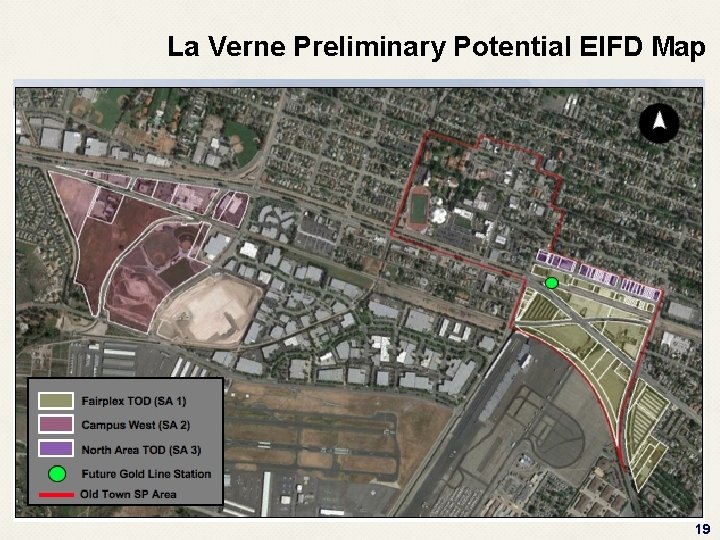
Case Study: La Verne TOD EIFD • EIFD Status § § EIFD under evaluation by City of La Verne as lead public agency La Verne’s EIFD Goals: • Induce private development around future gold line station • Access to Statewide sustainable funding sources such as Greenhouse Gas Reduction Fund (GGRF) • The Proposed District § § Proximate to Univ. La Verne, Fairplex properties & future Gold Line Station 388+ acres adjacent to La Verne’s Old Town Specific Plan Area • Projects (pubic and private) § § § Station area improvements, circulation infrastructure next to Foothill station Development of mixed-use housing, potential hotel, retail and event space Sustainable improvements to commercial and industrial structures 18
La Verne Preliminary Potential EIFD Map 19
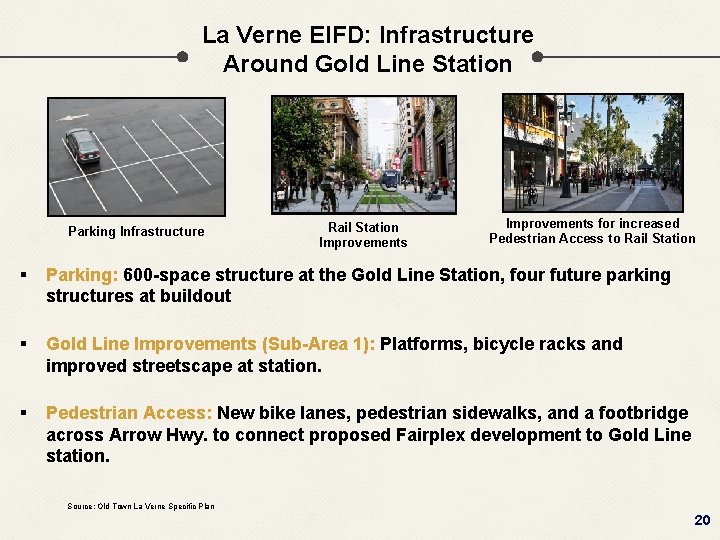
La Verne EIFD: Infrastructure Around Gold Line Station Parking Infrastructure Rail Station Improvements for increased Pedestrian Access to Rail Station § Parking: 600 -space structure at the Gold Line Station, four future parking structures at buildout § Gold Line Improvements (Sub-Area 1): Platforms, bicycle racks and improved streetscape at station. § Pedestrian Access: New bike lanes, pedestrian sidewalks, and a footbridge across Arrow Hwy. to connect proposed Fairplex development to Gold Line station. Source: Old Town La Verne Specific Plan 20
Potential Partners Potential Core Public Agencies • • Potential Public/Private Partnerships La Verne currently finalizing PFA composition & tax sharing agreements with participating entities PFA to draft IFP once PFA is formed by La Verne 21
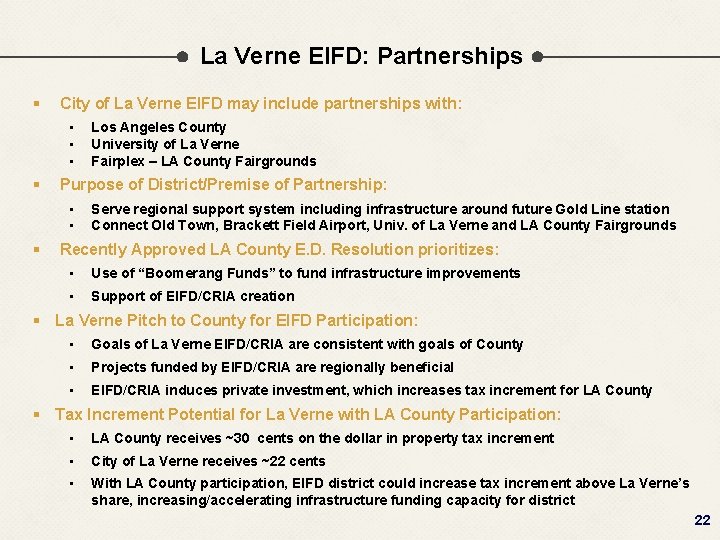
La Verne EIFD: Partnerships § City of La Verne EIFD may include partnerships with: • • • § Purpose of District/Premise of Partnership: • • § Los Angeles County University of La Verne Fairplex – LA County Fairgrounds Serve regional support system including infrastructure around future Gold Line station Connect Old Town, Brackett Field Airport, Univ. of La Verne and LA County Fairgrounds Recently Approved LA County E. D. Resolution prioritizes: • Use of “Boomerang Funds” to fund infrastructure improvements • Support of EIFD/CRIA creation § La Verne Pitch to County for EIFD Participation: • Goals of La Verne EIFD/CRIA are consistent with goals of County • Projects funded by EIFD/CRIA are regionally beneficial • EIFD/CRIA induces private investment, which increases tax increment for LA County § Tax Increment Potential for La Verne with LA County Participation: • LA County receives ~30 cents on the dollar in property tax increment • City of La Verne receives ~22 cents • With LA County participation, EIFD district could increase tax increment above La Verne’s share, increasing/accelerating infrastructure funding capacity for district 22
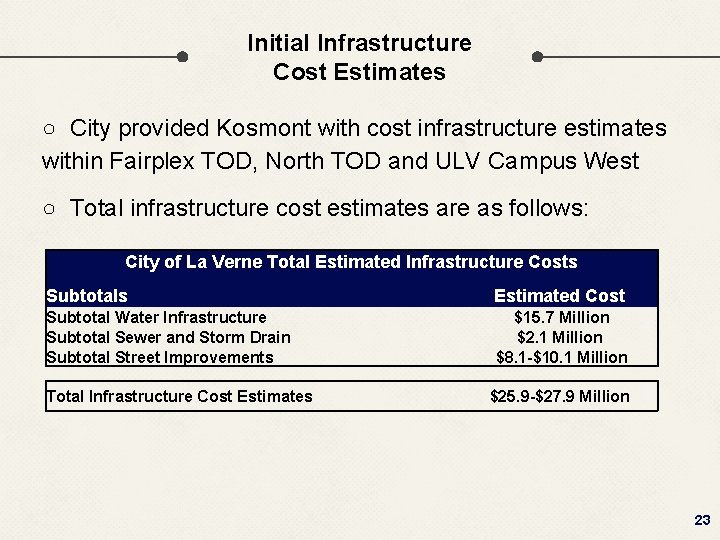
Initial Infrastructure Cost Estimates ○ City provided Kosmont with cost infrastructure estimates within Fairplex TOD, North TOD and ULV Campus West ○ Total infrastructure cost estimates are as follows: City of La Verne Total Estimated Infrastructure Costs Subtotals Estimated Cost Subtotal Water Infrastructure Subtotal Sewer and Storm Drain Subtotal Street Improvements $15. 7 Million $2. 1 Million $8. 1 -$10. 1 Million Total Infrastructure Cost Estimates $25. 9 -$27. 9 Million 23
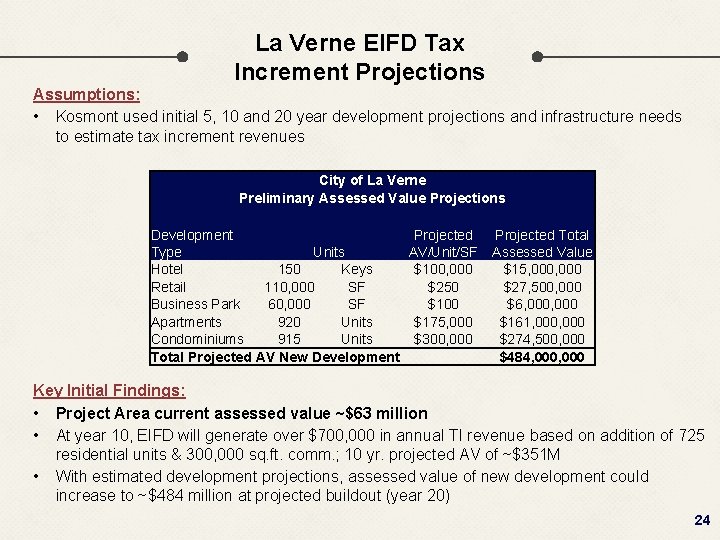
La Verne EIFD Tax Increment Projections Assumptions: • Kosmont used initial 5, 10 and 20 year development projections and infrastructure needs to estimate tax increment revenues City of La Verne Preliminary Assessed Value Projections Development Projected Type AV/Unit/SF Units Hotel 150 Keys $100, 000 Retail 110, 000 SF $250 Business Park 60, 000 SF $100 Apartments 920 Units $175, 000 Condominiums 915 Units $300, 000 Total Projected AV New Development Projected Total Assessed Value $15, 000 $27, 500, 000 $6, 000 $161, 000 $274, 500, 000 $484, 000 Key Initial Findings: • Project Area current assessed value ~$63 million • At year 10, EIFD will generate over $700, 000 in annual TI revenue based on addition of 725 residential units & 300, 000 sq. ft. comm. ; 10 yr. projected AV of ~$351 M • With estimated development projections, assessed value of new development could increase to ~$484 million at projected buildout (year 20) 24
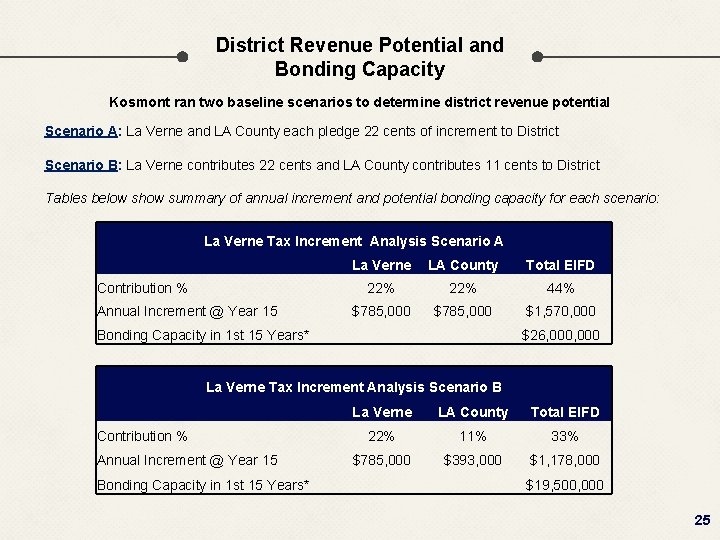
District Revenue Potential and Bonding Capacity Kosmont ran two baseline scenarios to determine district revenue potential Scenario A: La Verne and LA County each pledge 22 cents of increment to District Scenario B: La Verne contributes 22 cents and LA County contributes 11 cents to District Tables below show summary of annual increment and potential bonding capacity for each scenario: La Verne Tax Increment Analysis Scenario A Contribution % Annual Increment @ Year 15 Bonding Capacity in 1 st 15 Years* La Verne LA County Total EIFD 22% 44% $785, 000 $1, 570, 000 $26, 000 La Verne Tax Increment Analysis Scenario B Contribution % Annual Increment @ Year 15 Bonding Capacity in 1 st 15 Years* La Verne LA County Total EIFD 22% 11% 33% $785, 000 $393, 000 $1, 178, 000 $19, 500, 000 25
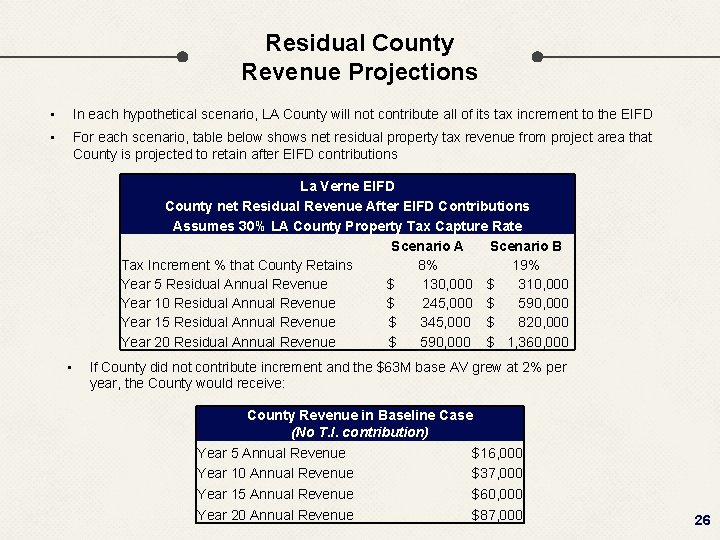
Residual County Revenue Projections • In each hypothetical scenario, LA County will not contribute all of its tax increment to the EIFD • For each scenario, table below shows net residual property tax revenue from project area that County is projected to retain after EIFD contributions La Verne EIFD County net Residual Revenue After EIFD Contributions Assumes 30% LA County Property Tax Capture Rate Scenario A Scenario B Tax Increment % that County Retains 8% 19% Year 5 Residual Annual Revenue $ 130, 000 $ 310, 000 Year 10 Residual Annual Revenue $ 245, 000 $ 590, 000 Year 15 Residual Annual Revenue $ 345, 000 $ 820, 000 Year 20 Residual Annual Revenue $ 590, 000 $ 1, 360, 000 • If County did not contribute increment and the $63 M base AV grew at 2% per year, the County would receive: County Revenue in Baseline Case (No T. I. contribution) Year 5 Annual Revenue $16, 000 Year 10 Annual Revenue $37, 000 Year 15 Annual Revenue $60, 000 Year 20 Annual Revenue $87, 000 26
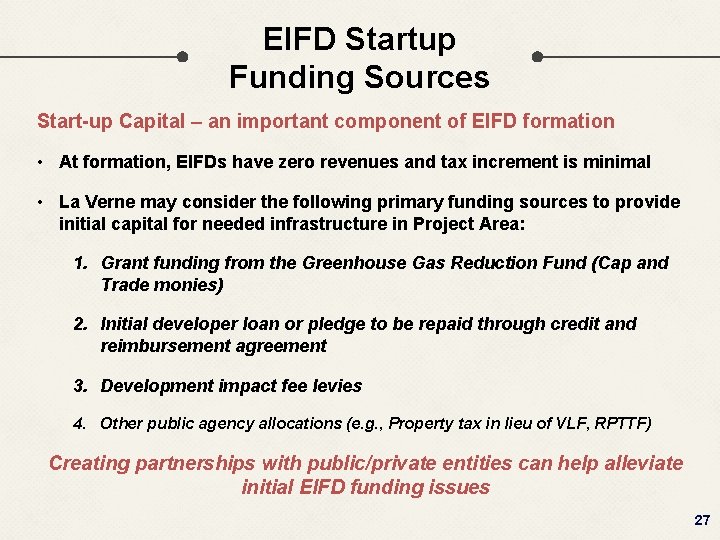
EIFD Startup Funding Sources Start-up Capital – an important component of EIFD formation • At formation, EIFDs have zero revenues and tax increment is minimal • La Verne may consider the following primary funding sources to provide initial capital for needed infrastructure in Project Area: 1. Grant funding from the Greenhouse Gas Reduction Fund (Cap and Trade monies) 2. Initial developer loan or pledge to be repaid through credit and reimbursement agreement 3. Development impact fee levies 4. Other public agency allocations (e. g. , Property tax in lieu of VLF, RPTTF) Creating partnerships with public/private entities can help alleviate initial EIFD funding issues 27
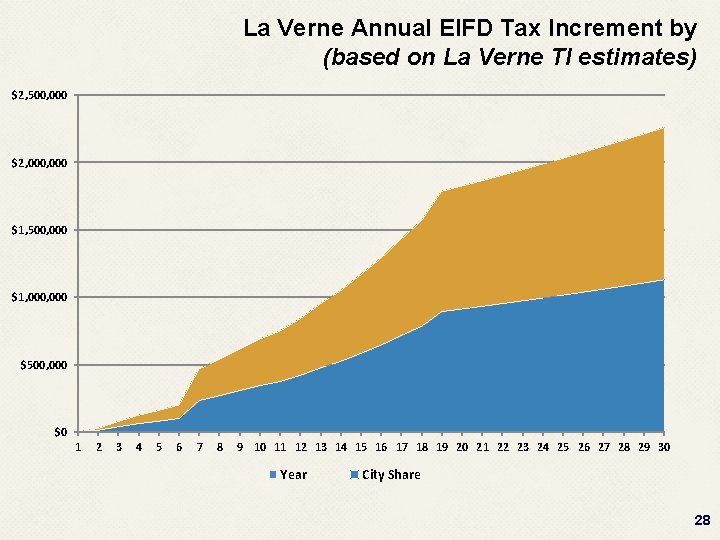
La Verne Annual EIFD Tax Increment by (based on La Verne TI estimates) $2, 500, 000 $2, 000 $1, 500, 000 $1, 000 $500, 000 $0 1 2 3 4 5 6 7 8 9 10 11 12 13 14 15 16 17 18 19 20 21 22 23 24 25 26 27 28 29 30 Year City Share 28
La Verne EIFD Status • La Verne reaching agreement with all taxing entities on EIFD boundaries, PFA composition, & Tax Increment contributions • La County has expressed interest in contributing TI to EIFD, determination expected by October 2016 • City must work with County to agree on PFA board • La Verne beginning refining infrastructure improvement costs for IFP • La Verne evaluating other funding sources for transit-orientedimprovements such as State and Federal grants (GHGRF, other) 29
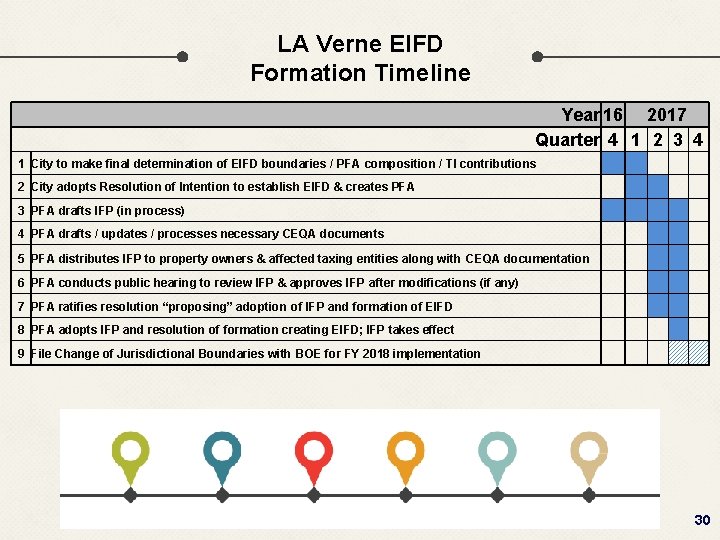
LA Verne EIFD Formation Timeline Year 16 2017 Quarter 4 1 2 3 4 1 City to make final determination of EIFD boundaries / PFA composition / TI contributions 2 City adopts Resolution of Intention to establish EIFD & creates PFA 3 PFA drafts IFP (in process) 4 PFA drafts / updates / processes necessary CEQA documents 6 PFA conducts public hearing to review IFP & approves IFP after modifications (if any) 7 PFA ratifies resolution “proposing” adoption of IFP and formation of EIFD 5 PFA distributes IFP to property owners & affected taxing entities along with CEQA documentation 8 PFA adopts IFP and resolution of formation creating EIFD; IFP takes effect 9 File Change of Jurisdictional Boundaries with BOE for FY 2018 implementation 30
Other Key Considerations for Implementation • Timing for adoption – Necessary to coordination formation efforts with County Auditor-Controller and State Board of Equalization Ø Necessary filings per guidelines from Board for Change of Jurisdictional Boundaries by December 1 st of the year immediately preceding division of taxes for EIFD • Former RDA Project Areas – If EIFD is within or overlaps a former RDA area with ongoing debt, EIFD debt is subordinate to existing obligations • CEQA – Legislation says IFP must be distributed with any required CEQA documentation for proposed public facilities and project development Ø IFP should leverage existing Specific Plan and/or General Plan environmental documentation to the extent possible 31
Economic Development 2. 0 - Next Gen • Basis of E. D. 2. 0 are partnerships which prioritize regional collaboration, energy efficiency, sustainability, infrastructure & creating a sense of place • Partnerships formed through new “districts” such as City of La Verne EIFD & Watsonville CRIA • Can use tax increment; private sector investment/participation needed • Can result in substantial funding for districts via private investment, yields taxes, jobs and infrastructure improvements 32
Questions? Kosmont Companies 1601 N. Sepulveda Blvd. , #382 Manhattan Beach, CA 90266 Phone: (424)-456 -3088 Larry J. Kosmont President & CEO lkosmont@Kosmont. com Office: (424)-456 -3080 Cell: (213)-507 -9000 Joseph Dieguez Senior Vice President jdieguez@Kosmont. com Cell: (347)-731 -5307 33