
PRESENTATION TITLE Project Name School name Student names

- Slides: 17
PRESENTATION TITLE (Project Name) School name & Student names
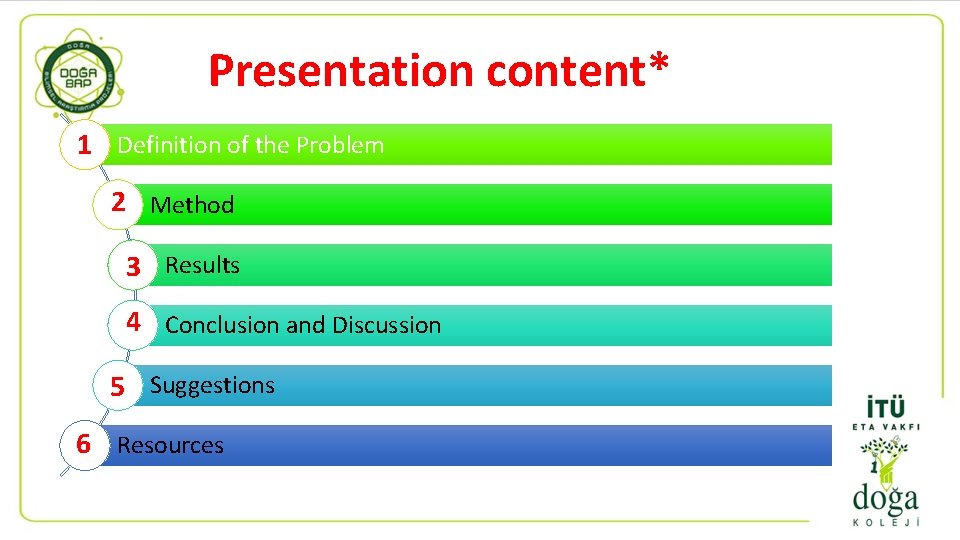
Presentation content* 1 Definition of the Problem 2 Method 3 Results 4 Conclusion and Discussion 5 Suggestions 6 Resources
In the first slide, the name of the school, the name of the project and the names of the student/students, the name of the advisor teacher can be included.
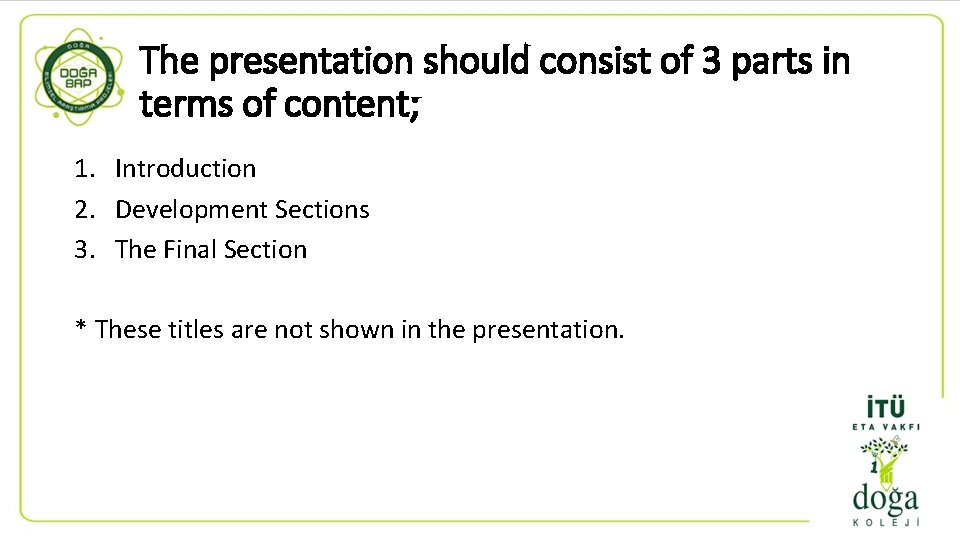
The presentation should consist of 3 parts in terms of content; 1. Introduction 2. Development Sections 3. The Final Section * These titles are not shown in the presentation.
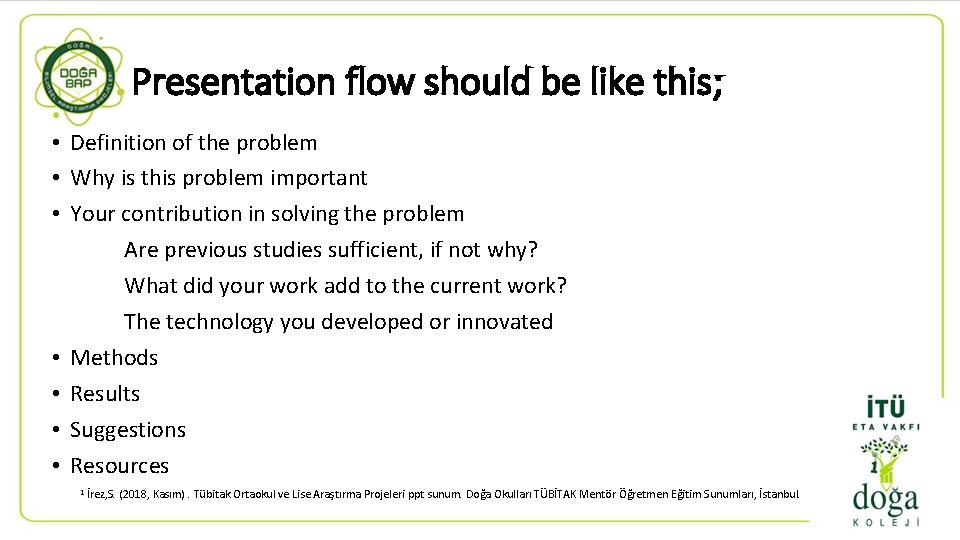
Presentation flow should be like this; • Definition of the problem • Why is this problem important • Your contribution in solving the problem Are previous studies sufficient, if not why? What did your work add to the current work? The technology you developed or innovated • Methods • Results • Suggestions • Resources 1 İrez, S. (2018, Kasım). Tübitak Ortaokul ve Lise Araştırma Projeleri ppt sunum. Doğa Okulları TÜBİTAK Mentör Öğretmen Eğitim Sunumları, İstanbul.
1. INTRODUCTION SECTION • In this section, students should find the problem situation in their projects, the problem situation, the problem question, why the problem situation is important, and the project purposes should be mentioned. • The purpose should be set out very clearly. It should be explained in 2 -3 sentences without being too long or 5 -6 sentences maximum.
EXAMPLE OF THE INTRODUCTION SECTION PROBLEM • What is the problem situation? • What is the problem question? • How was the problem detected? What are the scientific studies done while determining the problem? • Similar cases or studies in the literature • The difference of this study from similar / sample studies in the literature
EXAMPLE OF THE INTRODUCTION SECTION PURPOSE • What is the purpose of the problem situation? • It should be presented very briefly and clearly. • Students should present the purpose clearly by using keywords instead of long, memorized and copy and paste sentences from the report.
2. DEVELOPMENT SECTION • In this section, your contribution in solving the problem is the previous studies sufficient, if not why? • What did your work add to the current work? The answer to such questions and the technology, innovation, method, results you have developed should be mentioned.
EXAMPLE OF THE DEVELOPMENT SECTION METHOD • What is the method used? It should be explained in 1 sentence. All methods for data collection and analysis should be stated and explained. • Why was this method chosen? • What is the difference between the method used in other studies related to the problem situation and the method you use?
EXAMPLE OF THE DEVELOPMENT SECTION RESULTS • Long sentences should not be used and the results should not be memorized. • If possible, the results should be presented in tables and graphics. • Tables and graphs can be presented as frequency.
3. CONCLUSION SECTION • In this section, results, future studies and recommendations should be mentioned.
EXAMPLE OF THE CONCLUSION SECTION CONCLUSIONS • Long sentences should not be used. • Conclusions should be presented in the most impressive and clear way.
EXAMPLE OF THE SUGGESTIONS SECTION SUGGESTIONS • Long sentences should not be used. • Suggestions should be presented for future studies.
RESOURCES All references in the presentation should be submitted in APA 6 format http: //sbedergisi. ankara. edu. tr/apa 60. pdf. Example; Atıcı, T. , Obalı, O. , & Elmacı, A. (2005). Abant Gölü (Bolu) bentik algleri. Ekoloji, 14(56), 9 -15. Baştürk Akca, E. , Sayımer, İ. , & Ergül, S. (2015). Ortaokul öğrencilerinin sosyal medya kullanımları ve siber zorbalık deneyimleri: Ankara örneği. Global Media Journal: Turkish Edition, 5(10).
RESOURCES İrez, S. (2018, Ekim). Tübitak Ortaokul ve Lise Araştırma Projeleri ppt sunum. Doğa Okulları TÜBİTAK Mentör Öğretmen Eğitim Sunumları, Gaziantep Doğa Koleji, Gaziantep. İrez, S. (2018, Kasım). Tübitak Ortaokul ve Lise Araştırma Projeleri ppt sunum. Doğa Okulları TÜBİTAK Mentör Öğretmen Eğitim Sunumları, İstanbul.