
Presentation Pro American Government CHAPTER 1 Principles of
- Slides: 11
Presentation Pro American Government CHAPTER 1 Principles of Government © 2001 by Prentice Hall, Inc.
What Is Government? Government is the institution through which a society makes and enforces its public policies. Go To Section: 1 2 3 Chapter 1 Section 1
The State The state can be defined as having these four characteristics: Go To Section: 1 2 3 Chapter 1, Section 1
Origins of the State The Force Theory • The force theory states that one person or a small group took control of an area and forced all within it to submit to that person’s or group’s rule. The Evolutionary Theory • The evolutionary theory argues that the state evolved naturally out of the early family. The Divine Right Theory • The theory of divine right holds that God created the state and that God gives those of royal birth a “divine right” to rule. The Social Contract Theory • The social contract theory argues that the state arose out of a voluntary act of free people. Go To Section: 1 2 3 Chapter 1, Section 1
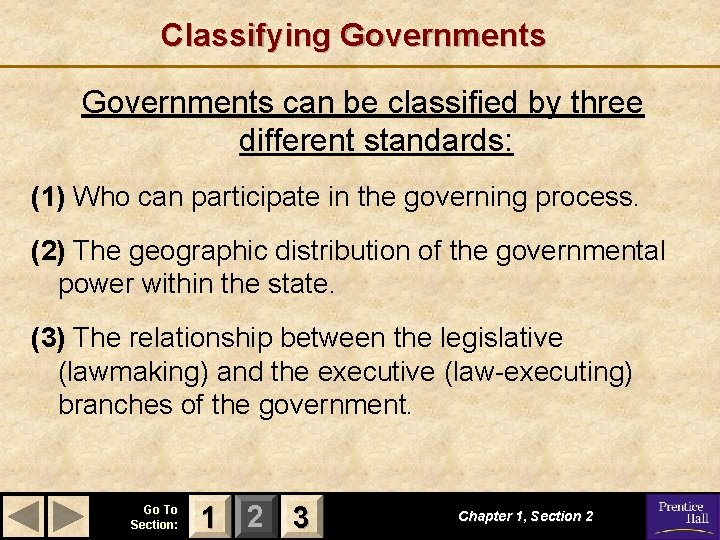
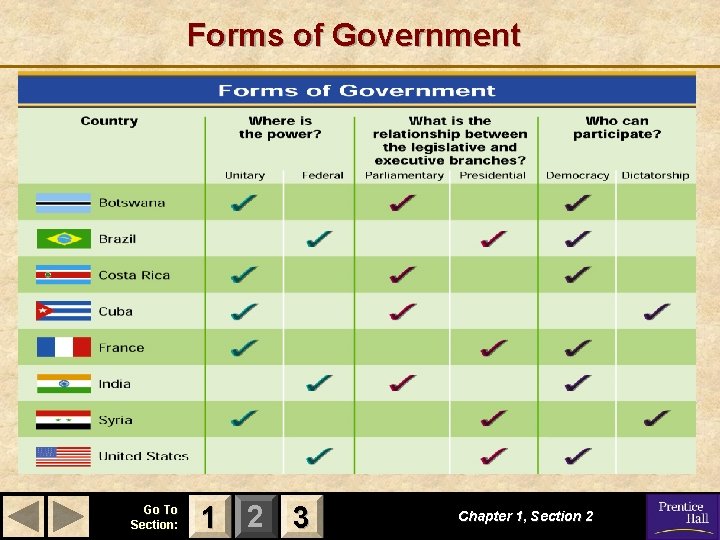
Classifying Governments can be classified by three different standards: (1) Who can participate in the governing process. (2) The geographic distribution of the governmental power within the state. (3) The relationship between the legislative (lawmaking) and the executive (law-executing) branches of the government. Go To Section: 1 2 3 Chapter 1, Section 2
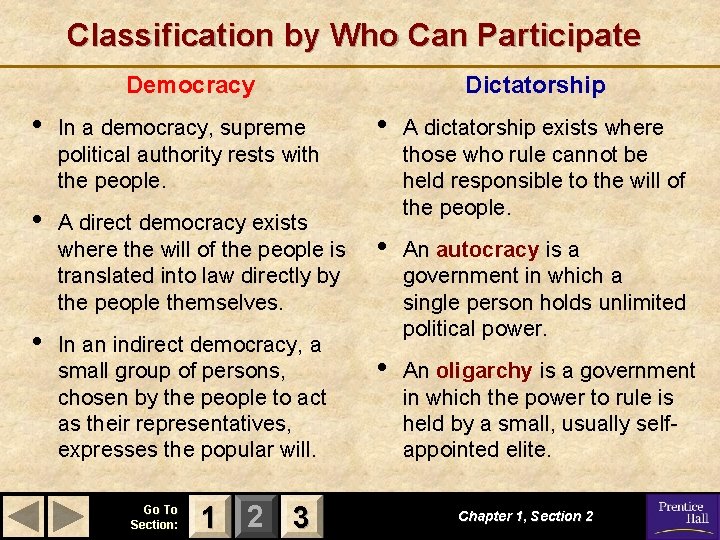
Classification by Who Can Participate Democracy • In a democracy, supreme political authority rests with the people. • A direct democracy exists where the will of the people is translated into law directly by the people themselves. • In an indirect democracy, a small group of persons, chosen by the people to act as their representatives, expresses the popular will. Go To Section: 1 2 3 Dictatorship • A dictatorship exists where those who rule cannot be held responsible to the will of the people. • An autocracy is a government in which a single person holds unlimited political power. • An oligarchy is a government in which the power to rule is held by a small, usually selfappointed elite. Chapter 1, Section 2
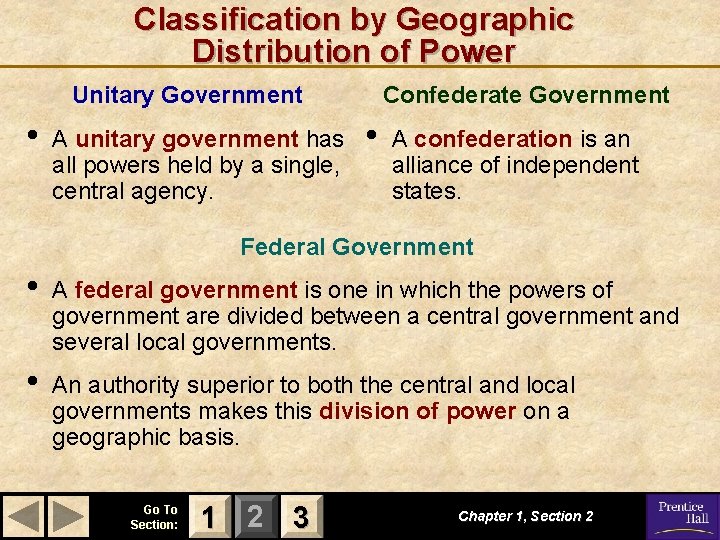
Classification by Geographic Distribution of Power Unitary Government • A unitary government has all powers held by a single, central agency. Confederate Government • A confederation is an alliance of independent states. Federal Government • A federal government is one in which the powers of government are divided between a central government and several local governments. • An authority superior to both the central and local governments makes this division of power on a geographic basis. Go To Section: 1 2 3 Chapter 1, Section 2
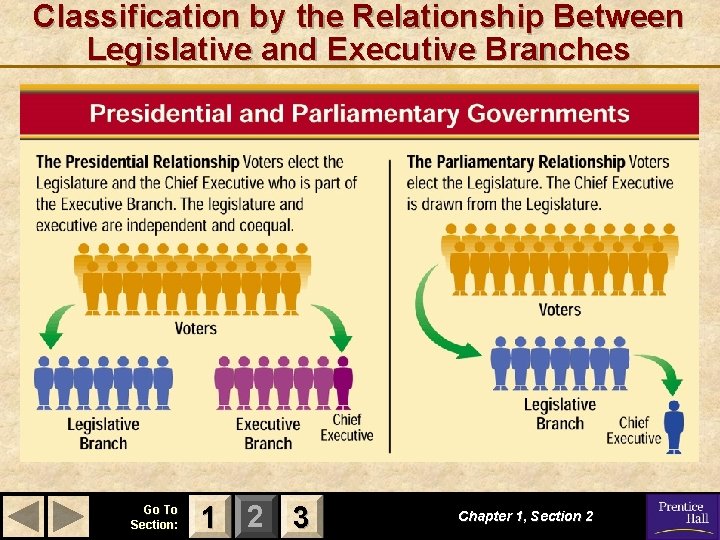
Classification by the Relationship Between Legislative and Executive Branches Go To Section: 1 2 3 Chapter 1, Section 2
Forms of Government Go To Section: 1 2 3 Chapter 1, Section 2
Section 2 Review 1. In a democracy, (a) independent states form an alliance. (b) supreme political authority rests with the people. (c) those who rule cannot be held responsible to the will of the people. (d) the rule by a few, select individuals regulates the will of the people. 2. The United States government has the following characteristics: (a) confederate, parliamentary, and dictatorship. (b) unitary, presidential, and democracy. (c) federal, presidential, and democracy. (d) unitary, parliamentary, and dictatorship. Want to connect to the Magruder’s link for this section? Click Here! Go To Section: 1 2 3 Chapter 1, Section 2
Foundations The American concept of democracy rests on these basic notions: (1) A recognition of the fundamental worth and dignity of every person; (2) A respect for the equality of all persons; (3) A faith in majority rule and an insistence upon minority rights; (4) An acceptance of the necessity of compromise; and (5) An insistence upon the widest possible degree of individual freedom. Go To Section: 1 2 3 Chapter 1, Section 3