
Presentation Plus Human Heritage A World History Copyright


- Slides: 91
Presentation Plus! Human Heritage: A World History Copyright © by The Mc. Graw-Hill Companies, Inc. Developed by FSCreations, Inc. , Cincinnati, Ohio 45202 Send all inquiries to: GLENCOE DIVISION Glencoe/Mc. Graw-Hill 8787 Orion Place Columbus, Ohio 43240 1
2
CHAPTER FOCUS SECTION 1 Martin Luther SECTION 2 A New Religion SECTION 3 Catholic Reform SECTION 4 A Middle Way SECTION 5 Wars of Religion SECTION 6 The Thirty Years’ War CHAPTER SUMMARY & STUDY GUIDE CHAPTER ASSESSMENT 3 Click a hyperlink to go to the corresponding section. Press the ESC key at any time to exit the presentation.
Overview • Chapter 29 examines the Protestant and Catholic reformations. – Section 1 discusses Martin Luther’s excommunication. – Section 2 describes the founding of Protestantism. – Section 3 explains the work of Catholic reformers. – Section 4 examines the Reformation in England. 4 Click the mouse button or press the Space Bar to display the information.
Overview (cont. ) – Section 5 summarizes the religious wars in Europe in the late 1500 s and the 1600 s. – Section 6 discusses the Thirty Years’ War. 5 Click the mouse button or press the Space Bar to display the information.
Objectives After studying this chapter, you will be able to: • explain why Luther’s beliefs brought him into conflict with the Roman Catholic Church. • describe how Protestantism developed. • identify how Catholic reformers changed their Church. • discuss the English Reformation. • explain why Europeans became involved in religious wars. • trace the Thirty Years’ War. 6 Click the mouse button or press the Space Bar to display the information.
Read to Discover • Why Martin Luther’s beliefs brought him into conflict with the Roman Catholic Church • How Protestantism developed • How Catholic reformers worked to improve their Church • How and why the reformation of the Church of England came about • How the Thirty Years’ War affected Europe 7 Click the mouse button or press the Space Bar to display the information. The Chapter Focus is on page 449 of your textbook.
Terms to Learn • reformation • Martin Luther • indulgences • Pope Leo X • theses • John Calvin • heretic • Henry VIII • armada • Mary Tudor • galleons • Elizabeth I People to Know Places to Locate • Wittenberg • Geneva 8 Click the mouse button or press the Space Bar to display the information. Click the Speaker On button to listen to the words.
Why It’s Important The Roman Catholic Church did not adjust to the many changes taking place in western Europe during the 1400 s and 1500 s. Many Europeans began to call for a reformation, or a change, in the way the Church taught and practiced Christianity. Church leaders, however, were too busy with their own and government affairs to make changes. They did not like the reformers’ ideas, especially those that could affect their power. Because of this, the unity of the Church was threatened. 9 Click the Speaker On button to replay audio.
10
Martin Luther • Born in 1483, Martin Luther was a faithful, German monk, and a reformer who challenged the Church. • Wanting to rebuild St. Peter's Church in 1517, Pope Leo X sent monks to sell indulgences, or documents that freed owners from punishment due for sins. • Luther posted a list of 95 theses, or statements of beliefs, on the door of the castle church in Wittenberg, Germany, stating that only God could forgive sins. 11 Click the mouse button or press the Space Bar to display the information. Section 1 begins on page 449 of your textbook.
Martin Luther (cont. ) • Luther began to attack other Catholic beliefs openly. • In 1520, Pope Leo condemned Luther’s teachings, excommunicated him, and insisted that the German emperor, Charles V, try Luther as a heretic, or person who holds a belief that is different from the accepted belief of the Church. 12 Click the mouse button or press the Space Bar to display the information.
Section Assessment Why did Luther come into conflict with the Church? Luther believed that trusting in Jesus, rather than doing good works, would save people from their sins. 13 Click the mouse button or press the Space Bar to display the answer.
Section Assessment (cont. ) What happened to Luther at Worms? He was condemned for heresy. 14 Click the mouse button or press the Space Bar to display the answer.
Section Assessment (cont. ) Identifying the Central Issues What was the central or underlying issue in the debate between Luther and Pope Leo X? The issue was that the purchase of indulgences would free people from punishment for their sins. 15 Click the mouse button or press the Space Bar to display the answer.
Section Assessment (cont. ) Draw a diagram like the on page 451 of your textbook, and use it to summarize Luther’s beliefs on indulgences, the Bible, the Pope, and prayer. indulgences–that people could not buy forgiveness for their sins; Bible–that it was the only guide to religious truth; Pope–that the Pope could make mistakes; prayer–that every Christian had the right to pray to God without the aid of a priest 16 Click the mouse button or press the Space Bar to display the answer.
17
A New Religion • By 1524, most people in northern Germany supported Luther, left the Roman Catholic Church, and formed the Lutheran Church. • In 1555, Charles realized he could not force the people to return to the Roman Catholic Church, and he agreed to sign a treaty known as the Peace of Augsburg. • The Peace of Augsburg kept German Lutherans and Catholics from fighting each other for nearly 50 years. 18 Click the mouse button or press the Space Bar to display the information. Section 2 begins on page 451 of your textbook.
Protestant Groups • As Luther’s ideas spread, people in Scandinavia founded Lutheran churches, and people in Switzerland set up Reformed churches. • Because they protested against Catholic ideas, Lutheran and Reformed churches were called Protestant, with leaders called ministers. • Ulrich Zwingli was important in leading Switzerland's Protestant movement. 19 Click the mouse button or press the Space Bar to display the information.
John Calvin • The most powerful Reformed group was in Geneva, Switzerland, where John Calvin set up the first Protestant church governed by a council of ministers and elected church members. • Calvin wrote books that became a guide for Protestants throughout Europe. • Rich merchants supported Calvin, and together they improved Geneva. 20 Click the mouse button or press the Space Bar to display the information.
Section Assessment What was the Peace of Augsburg? The Peace of Augsburg was a treaty allowing both Catholic and Lutheran churches in Germany. 21 Click the mouse button or press the Space Bar to display the answer.
Section Assessment (cont. ) Why were Lutheran and Reformed churches called Protestant? The Lutheran and Reformed churches were called Protestant because they protested against Catholic ideas. 22 Click the mouse button or press the Space Bar to display the answer.
Section Assessment (cont. ) Analyzing Information What ideas of Calvinism do you agree with? What ideas do you disagree with? Answers will vary. 23 Click the mouse button or press the Space Bar to display the answer.
Section Assessment (cont. ) Draw a diagram like the on page 452 of your textbook, and use it to compare Protestant and Catholic practices. Protestant practices–conducted services in local languages, church leaders called ministers, simplified services and taught from the Bible, preached that everyone had a right to read the Bible and pray directly to God; Catholic practices–conducted services in Latin, church leaders called priests, used Church-approved services, priests interpreted the Bible and guided worshipers in prayer, accepted the idea of salvation through good works 24 Click the mouse button or press the Space Bar to display the answer.
25
Catholic Reform • Catholic reformers, many coming from Spain and Italy, worked to improve their church. • Ignatius of Loyola, a Spanish noble, founded the Society of Jesus in 1540. Its members were called Jesuits. • During this time, the Pope also took steps to strengthen the Roman Catholic Church. • Each diocese was told to build a seminary, a school to train priests. • Together, the Council of Trent and the Jesuit missionaries helped the Pope reclaim Protestant areas. 26 Click the mouse button or press the Space Bar to display the information. Section 3 begins on page 452 of your textbook.
Section Assessment What were the leading countries involved in the Catholic reform movement? The leading countries were Spain and Italy. 27 Click the mouse button or press the Space Bar to display the answer.
Section Assessment (cont. ) What did the Council of Trent do? It stopped the sale of indulgences, ordered Church leaders to follow strict rules of behavior, told each diocese to build a seminary, and explained Catholic doctrine more fully. 28 Click the mouse button or press the Space Bar to display the answer.
Section Assessment (cont. ) Evaluating Information “The Council of Trent was important in strengthening the Roman Catholic Church. ” What is your opinion of this statement? Explain. Answers will vary. 29 Click the mouse button or press the Space Bar to display the answer.
Section Assessment (cont. ) Draw a diagram like the on page 455 of your textbook, and use it to describe the Jesuits founded by Ignatius of Loyola. Sample descriptions: formed to spread Roman Catholic ideas to all parts of the world; wore black robes; lived simple lives; set up schools; helped the poor; preached to the people; taught at universities; first to carry Catholic ideas to India, China, and Japan; used reason and good deeds to defend Catholic beliefs; tried to bring Protestants back into the Church 30 Click the mouse button or press the Space Bar to display the answer.
31
A Middle Way • Starting as a political quarrel between the Tudor King Henry VIII and Pope Clement VII, reformation of the Church in England was led by a monarch. Section 4 begins on page 455 of your textbook. 32
The Break With Rome • The trouble between Henry VIII and the Pope began in 1527. • Henry, who was married to Catherine of Aragon, had fallen in love with Anne Boleyn, a young woman of the court. • Since the Pope refused to end Henry’s marriage, Henry declared that the Pope no longer had power over the Church in England. Henry was then excommunicated. • In 1534, the English Parliament passed a law stating that the king was head of the Church of England. 33 Click the mouse button or press the Space Bar to display the information.
Edward and Mary • When Henry VIII died, his nine-year-old son became King Edward VI. • Since Edward was too young and sick to rule, a council of nobles governed for him. • When Edward died in 1553, the council of nobles tried to bring a Protestant noblewoman to the throne, but failed because the English people of England would only accept a Tudor. • They wanted Henry’s daughter Mary as their monarch. 34 Click the mouse button or press the Space Bar to display the information.
Edward and Mary (cont. ) • Mary was Catholic and, as queen, she accepted the Pope as head of the English Church and insisted that all English men and women return to the Roman Catholic Church. • When Mary was married to King Philip II of Spain, England’s enemy and the leading Catholic power in Europe, the people of England decided that they wanted a Protestant ruler. 35 Click the mouse button or press the Space Bar to display the information.
Elizabeth’s Church • When Mary died in 1558 without a child to succeed her, her half-sister, Elizabeth, became queen. • Most of the English people were pleased with the mix of Protestant belief and Catholic practice that Elizabeth enacted. 36 Click the mouse button or press the Space Bar to display the information.
Section Assessment What happened when Pope Clement refused to end Henry VIII’s marriage? Henry said he controlled the Church in England was excommunicated. 37 Click the mouse button or press the Space Bar to display the answer.
Section Assessment (cont. ) What did Mary Tudor expect the people to do as soon as she became queen? How did the people feel about this? She expected the people to return to the Roman Catholic Church. Many people refused and were persecuted. 38 Click the mouse button or press the Space Bar to display the answer.
Section Assessment (cont. ) What was the Church of England like under Elizabeth I? The Church of England was led by the monarch, used Cranmer’s prayer book, and taught Protestant beliefs. 39 Click the mouse button or press the Space Bar to display the answer.
Section Assessment (cont. ) Demonstrating Reasoned Judgment How effective do you think Elizabeth I was in establishing a new national church? Elizabeth successfully defended the new church. 40 Click the mouse button or press the Space Bar to display the answer.
Section Assessment (cont. ) Draw a diagram like the on page 458 of your textbook, and use it to compare the reigns of Mary Tudor and Elizabeth I. Diagrams will vary. 41 Click the mouse button or press the Space Bar to display the answer.
42
Wars of Religion • By the middle 1500 s, most northern Europeans were Protestants, while most southern Europeans were Catholics. • Toward the end of the 1500 s, Europe entered a period of religious wars that lasted until 1648. 43 Click the mouse button or press the Space Bar to display the information. Section 5 begins on page 459 of your textbook.
The Armada • Under Elizabeth I, England became the leading Protestant power in Europe. • Under Philip II, Spain remained the leading Catholic power. • As Philip wanted Protestant Europe to be open to Catholic control, he ordered the building of an armada, or a large group of warships. • The strength of the Spanish Armada lay in its galleons, or heavy ships with squarerigged sails and long, raised decks. 44 Click the mouse button or press the Space Bar to display the information.
The Armada (cont. ) • In 1588, the Armada sailed toward England to help the Spanish armies on the continent cross over to the English shore. • Elizabeth prepared England for war. • The English defeated the Armada, gained respect throughout Europe as champions of the Protestant cause, and allowed northern Europe to remain a Protestant stronghold. 45 Click the mouse button or press the Space Bar to display the information.
The Huguenots • Most people in France during the 1500 s were Catholics. • Many nobles, lawyers, doctors, and merchants were French Protestants, called Huguenots, that followed Calvin’s teachings. • In 1534, King Francis I, who was Catholic, forbade the Huguenots to worship freely. • Catholics began to persecute Huguenots, and by 1562 a civil war broke out. 46 Click the mouse button or press the Space Bar to display the information.
The Huguenots (cont. ) • In 1589, the king of France was killed, and Henry of Navarre, who was next in line for the throne, became Henry IV. • Henry ended the fighting between Protestants and Catholics. 47 Click the mouse button or press the Space Bar to display the information.
The Low Countries • The Low Countries were part of the Spanish Empire and their people were divided into Protestants and Catholics. • Philip wanted to keep them under Spanish control, and he wanted all his subjects to be Catholic. • He set up an Inquisition in the Low Countries to stamp out Protestantism. • Protestants revolted, and when the fighting ended it was decided that the southern provinces, known today as Belgium, were to remain Catholic and continue under the rule of Spain. 48 Click the mouse button or press the Space Bar to display the information.
Section Assessment How did the English defeat the Spanish Armada? The English caused the Spanish ships to break formation and fought the Spanish ships one by one. 49 Click the mouse button or press the Space Bar to display the answer.
Section Assessment (cont. ) What led to civil war in France in 1562? King Francis I forbade Huguenots to worship freely, and Catholics began to persecute Huguenots. 50 Click the mouse button or press the Space Bar to display the answer.
Section Assessment (cont. ) Identifying Alternatives How do you think the religious wars in Europe in the 1500 s and 1600 s might have been avoided? Answers will vary. 51 Click the mouse button or press the Space Bar to display the answer.
Section Assessment (cont. ) Draw a diagram like the on page 462 of your textbook, and use it to show the causes and effects of the Edict of Nantes. Causes–conflicts between Catholics and Protestants in France, desire of Henry IV to win people’s loyalty; Effects–gave Huguenots freedom of worship; made France first European country to allow two Christian religions 52 Click the mouse button or press the Space Bar to display the answer.
53
The Thirty Years’ War • During the 1590 s and early 1600 s, the German states began to quarrel over the terms of the Peace of Augsburg and form alliances based on religion. • The German emperor Ferdinand II led the Catholic alliance. • In 1618, the Protestant nobles of Bohemia revolted, choosing a German Protestant prince as their new king. • The revolt in Bohemia soon grew into the Thirty Years’ War. 54 Click the mouse button or press the Space Bar to display the information. Section 6 begins on page 462 of your textbook.
The Thirty Years’ War (cont. ) • During the war, half the armies of Europe fought in Germany. • The German people suffered great hardships during the war. • After this war, Europeans no longer fought over religion; instead, nations tried to gain power through trade and expansion overseas. 55 Click the mouse button or press the Space Bar to display the information.
Section Assessment What led to the Thirty Years’ War? The revolt in Bohemia against the German emperor Ferdinand II led to the Thirty Years’ War. 56 Click the mouse button or press the Space Bar to display the answer.
Section Assessment (cont. ) What effect did the Thirty Years’ War have on Europe? The German emperor lost much of his power, France emerged as a strong nation, and nations tried to gain power through trade and expansion. 57 Click the mouse button or press the Space Bar to display the answer.
Section Assessment (cont. ) Drawing Conclusions Based on the Thirty Years’ War, what conclusions can you draw about the reasons nations to go war? Sample conclusions: for religion, land, wealth, and political power. 58 Click the mouse button or press the Space Bar to display the answer.
Section Assessment (cont. ) Draw a diagram like the on page 464 of your textbook, and use it to show the main events in the Thirty Years’ War. (Add answer boxes as needed. ) Events will vary. 59 Click the mouse button or press the Space Bar to display the answer.
60
Chapter Summary & Study Guide • Luther posted his list of 95 theses to object to the sale of indulgences and other Church practices. • Luther’s ideas spread, with people in northern Germany forming the Lutheran Church and people in Switzerland elsewhere adopting what became known as Protestantism. • While Protestant reformers established new churches, Catholic reformers worked to improve their Church. 61 Click the mouse button or press the Space Bar to display the information.
Chapter Summary & Study Guide (cont. ) • Between 1545 and 1563, the Council of Trent reformed many Catholic practices. • The reformation came to England when Parliament declared Henry VIII the head of the Church of England. • After Henry’s death, advisers to his young son Edward introduced Protestant practices to the English Church. • Mary Tudor tried to return England to Catholicism, but failed. 62 Click the mouse button or press the Space Bar to display the information.
Chapter Summary & Study Guide (cont. ) • Elizabeth I decided the Church of England should be Protestant with some Catholic features. • The English defeat of the Spanish Armada in 1588 kept northern Europe Protestant, but it did not prevent other religious wars. 63 Click the mouse button or press the Space Bar to display the information.
64
Understanding the Main Idea How did Protestantism get its name, and what were some of the churches that belonged to this faith? Protestants got their name because they protested teaching of the Roman Catholic Church. Some of their churches included the Lutheran and Reformed churches. 65 Click the mouse button or press the Space Bar to display the answer.
Understanding the Main Idea What rules of behavior did John Calvin propose for his followers? They could not dance, play cards, go to theater, or take part in drinking parties. 66 Click the mouse button or press the Space Bar to display the answer.
Understanding the Main Idea What organization did Ignatius of Loyola form? the Society of Jesus 67 Click the mouse button or press the Space Bar to display the answer.
Understanding the Main Idea Why did Mary Tudor become known as “Bloody Mary”? because under her rule, many Protestants were persecuted or burned at the stake for heresy 68 Click the mouse button or press the Space Bar to display the answer.
Understanding the Main Idea How did the defeat of the Spanish Armada help the Protestant cause? It allowed northern Europe to remain a Protestant stronghold. 69 Click the mouse button or press the Space Bar to display the answer.
Understanding the Main Idea What was the basis of alliances formed by German states in the 1590 s and early 1600 s? religion 70 Click the mouse button or press the Space Bar to display the answer.
Critical Thinking What would you have liked about living in Geneva at the time of John Calvin? What would you have disliked? Explain your answer. 71
Critical Thinking Do you approve or disapprove of the way Elizabeth I organized the Church of England? Explain your answer. 72
Critical Thinking Explain whether you would or would not have converted to Catholicism if you had been Henry IV. Answers will vary. 73 Click the mouse button or press the Space Bar to display the answer.
Critical Thinking If you had been a Catholic in the mid -1500 s, in which European country would you have preferred to live? Why? Answers will vary. 74 Click the mouse button or press the Space Bar to display the answer.
Geography in History Location Refer to the location of Calvinist minorities on the map of western European religions on page 463 of your textbook. What connection might there be between their locations and the fact that they are minority groups (groups with fewer members than other religions)? The minorities were spread all over Europe in small pockets, while other religious groups lived in larger areas. Smaller groups are more apt to remain minorities if cut off from others of their beliefs. 75 Click the mouse button or press the Space Bar to display the answer.
How would Akbar have treated a non -Muslim farmer in his district whose crops had failed? Answers will vary. 76 Click the mouse button or press the Space Bar to display the answer.
77
Explore online information about the topics introduced in this chapter. Click on the Connect button to launch your browser and go to the Human Heritage: A World History Web site. At this site, you will find interactive activities, current events information, and Web sites correlated with the chapters and units in the textbook. When you finish exploring, exit the browser program to return to this presentation. If you experience difficulty connecting to the Web site, manually launch your Web browser and go to http: //www. humanheritage. glencoe. com 78
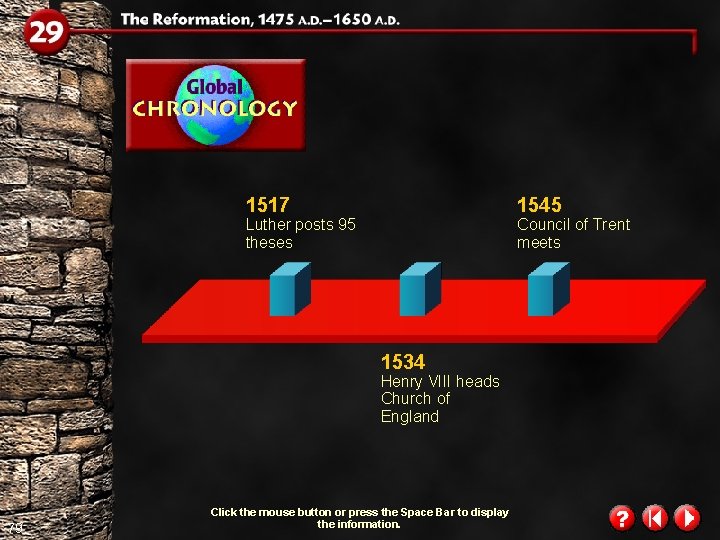
1517 1545 Luther posts 95 theses Council of Trent meets 1534 Henry VIII heads Church of England 79 Click the mouse button or press the Space Bar to display the information.
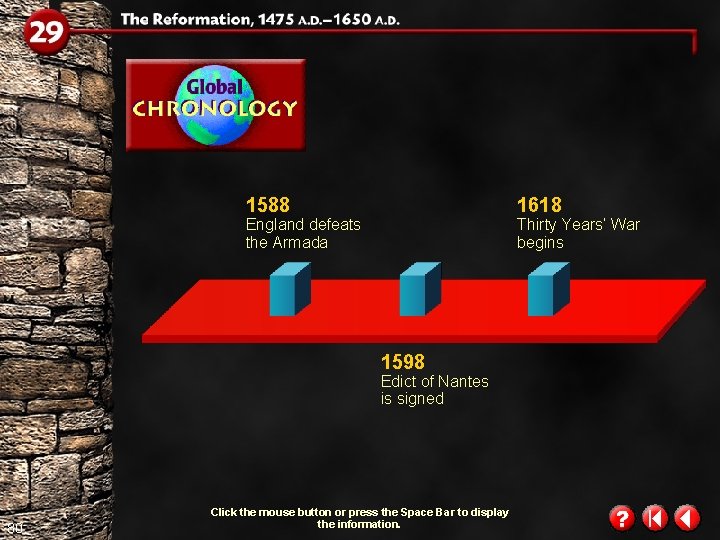
1588 1618 England defeats the Armada Thirty Years’ War begins 1598 Edict of Nantes is signed 80 Click the mouse button or press the Space Bar to display the information.
Elizabeth I 1533– 1603 English Queen Elizabeth came to the throne at age 25. She faced a nation deeply in debt, caught up in European wars, and torn apart by religious conflicts at home. King Philip II offered to marry her, but Elizabeth rejected him–and all other suitors as well. Instead, she led England through one of its greatest eras, producing a united country, a strong navy, and a powerful European nation. 81
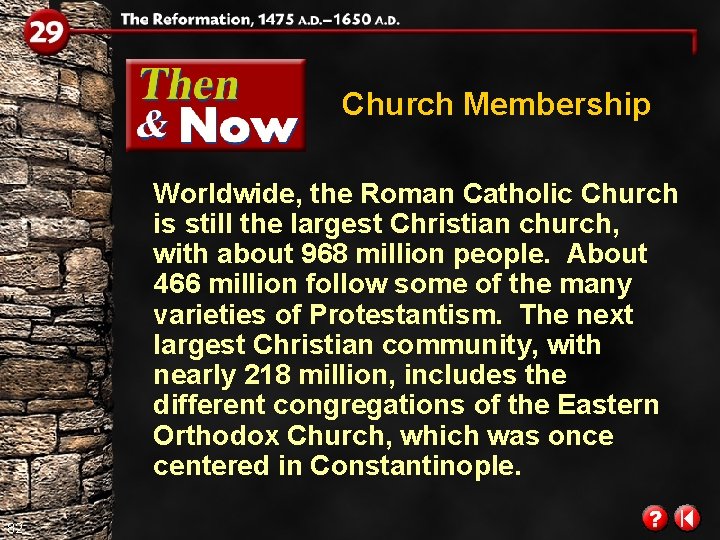
Church Membership Worldwide, the Roman Catholic Church is still the largest Christian church, with about 968 million people. About 466 million follow some of the many varieties of Protestantism. The next largest Christian community, with nearly 218 million, includes the different congregations of the Eastern Orthodox Church, which was once centered in Constantinople. 82
Drawing Conclusions • “Elementary, my dear Watson. ” • Detective Sherlock Holmes often said these words to his assistant when he solved yet another mystery. • Holmes would examine all the available evidence, or facts, and draw conclusions to solve the case. Continued on next slide. 83 Click the mouse button or press the Space Bar to display the information.
Drawing Conclusions • Drawing conclusions allows you to understand ideas that are not stated directly. • Follow these steps in learning to draw conclusions: – Review the facts that are stated directly. – Use your knowledge and insight to develop some new conclusions about these facts. – Look for information to check the accuracy of Continued on next slide. your conclusions. 84 Click the mouse button or press the Space Bar to display the information.
Drawing Conclusions Study the excerpt on page 461 of your textbook. Then answer the questions that follow. Continued on next slide. 85
Drawing Conclusions How does Elizabeth say she views the title of queen? She feels the title of queen is more glorious to others than to the person who must fulfill the duties that go with it. Continued on next slide. 86 Click the mouse button or press the Space Bar to display the answer.
Drawing Conclusions What aspect of being England’s ruler has “delighted” her the most? the chance to defend England Continued on next slide. 87 Click the mouse button or press the Space Bar to display the answer.
Drawing Conclusions What conclusion can you draw from this speech about how Elizabeth would like to be remembered? as a ruler who put her country and its people above her own well-being 88 Click the mouse button or press the Space Bar to display the answer.
Drawing Conclusions What evidence from the speech supports your conclusion? claims that the power and glory of a royal title never delighted her as much as the chance to serve her people; that the English will never see a ruler more loving of the people than she is Continued on next slide. 89 Click the mouse button or press the Space Bar to display the answer.
End of Custom Shows WARNING! Do Not Remove This slide is intentionally blank and is set to auto-advance to end custom shows and return to the main presentation. 90
91