
Presentation Outline To Educate and Inform You 1
- Slides: 30
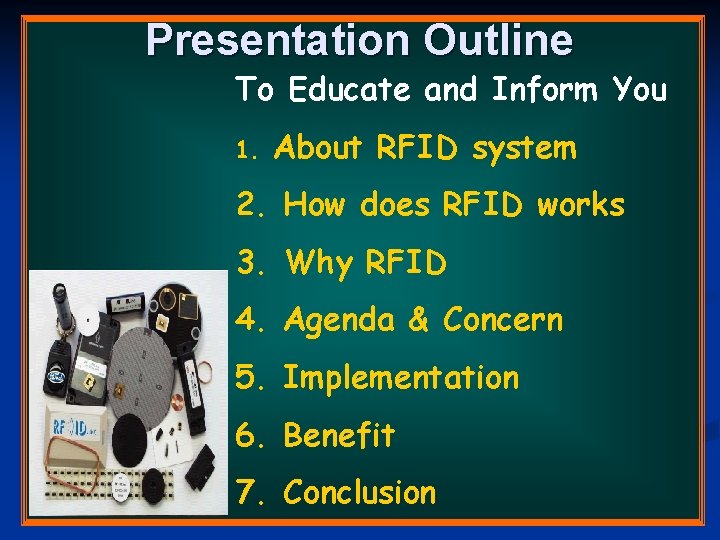
Presentation Outline To Educate and Inform You 1. About RFID system 2. How does RFID works 3. Why RFID 4. Agenda & Concern 5. Implementation 6. Benefit 7. Conclusion
1. About RFID system Brief History n What is RFID system n RFID Architecture & Key Components n Standards n Key Agenda & Concern for Library n
Brief History RFID (Radio Frequency Identifier) an Auto-ID data collection system surveillance, using RF waves for Identifying, Tracking and doing Management of material flow. Invented and used from (Early 1940’s) Commercial Operation begun from 1960’s … In 1970 s developers, inventors, companies, academic institution and government sectors were actively worked on RFID Most common application were tracked person and objects, identified goods in supply chain, reusable container, high value tools, security, controlling access to building, networks, payment systems and other assets.
What is RFID system An AUTO-ID based System RFID is an acronym for radio frequency identification. Briefly the RF stand for “radiofrequency” and ID means “identifier” that allows an item, for instance a library book, to be identified, accessed, stored, reprogrammed and communicated by using radio waves A method for controlling inventory Automatically identify objects Saving Time and Money Non-Line-Sight Communication Minimize Work Stress of Staff Offering Self Check out/in Gathering statistics on used Items Improve Customer Services And Easily Prevent Theft
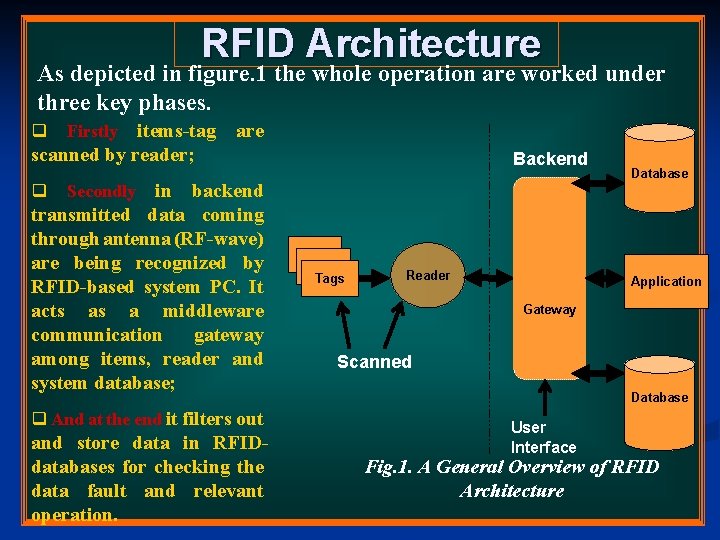
RFID Architecture As depicted in figure. 1 the whole operation are worked under three key phases. items-tag are scanned by reader; q Firstly in backend transmitted data coming through antenna (RF-wave) are being recognized by RFID-based system PC. It acts as a middleware communication gateway among items, reader and system database; q Backend Database Secondly q And at the end it filters out and store data in RFIDdatabases for checking the data fault and relevant operation. Tags Reader Application Gateway Scanned Database User Interface Fig. 1. A General Overview of RFID Architecture
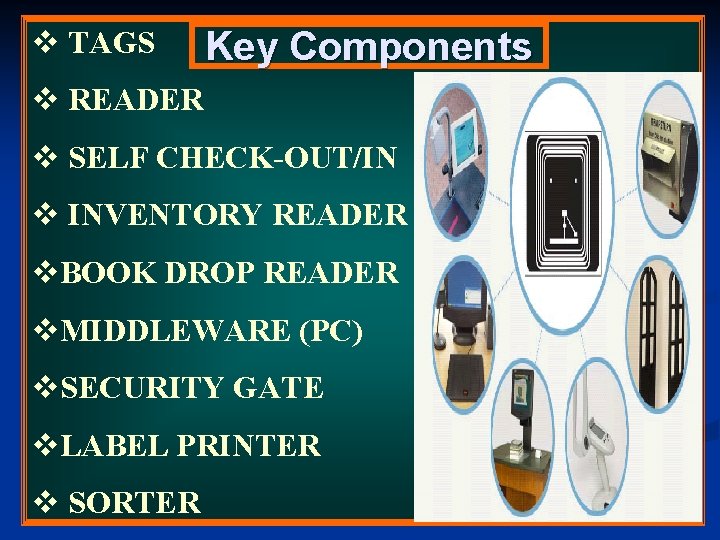
v TAGS Key Components v READER v SELF CHECK-OUT/IN v INVENTORY READER v. BOOK DROP READER v. MIDDLEWARE (PC) v. SECURITY GATE v. LABEL PRINTER v SORTER
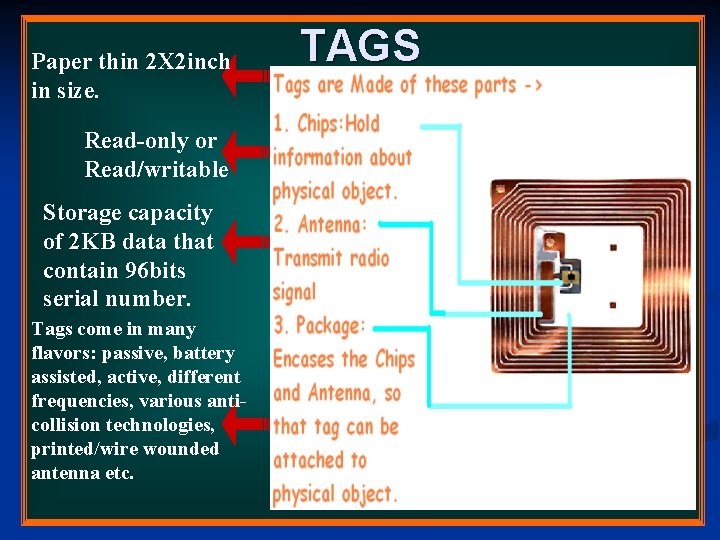
Paper thin 2 X 2 inch in size. Read-only or Read/writable Storage capacity of 2 KB data that contain 96 bits serial number. Tags come in many flavors: passive, battery assisted, active, different frequencies, various anticollision technologies, printed/wire wounded antenna etc. TAGS
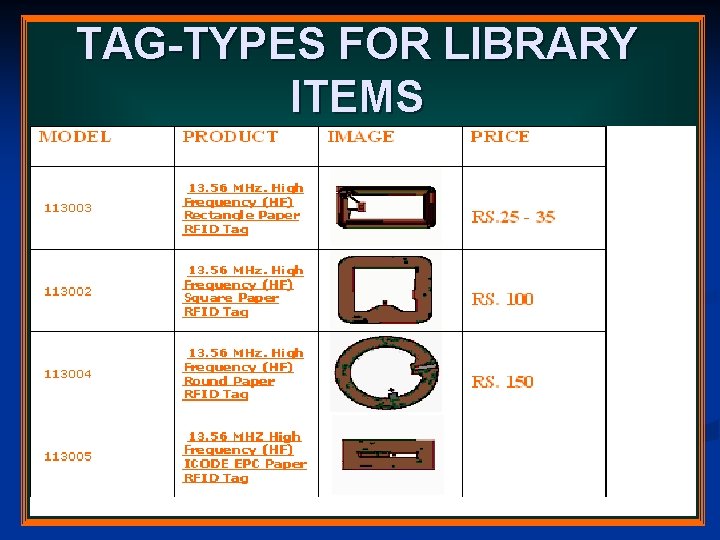
TAG-TYPES FOR LIBRARY ITEMS
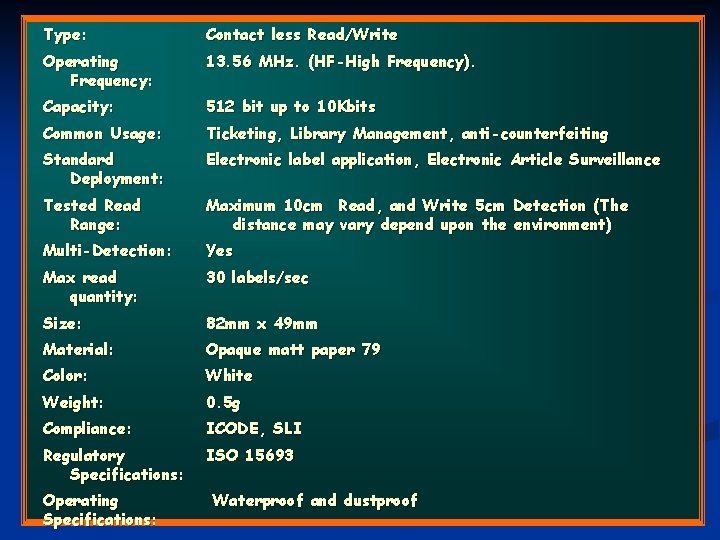
Type: Contact less Read/Write Operating Frequency: 13. 56 MHz. (HF-High Frequency). Capacity: 512 bit up to 10 Kbits Common Usage: Ticketing, Library Management, anti-counterfeiting Standard Deployment: Electronic label application, Electronic Article Surveillance Tested Read Range: Maximum 10 cm Read, and Write 5 cm Detection (The distance may vary depend upon the environment) Multi-Detection: Yes Max read quantity: 30 labels/sec Size: 82 mm x 49 mm Material: Opaque matt paper 79 Color: White Weight: 0. 5 g Compliance: ICODE, SLI Regulatory Specifications: ISO 15693 Operating Specifications: Waterproof and dustproof
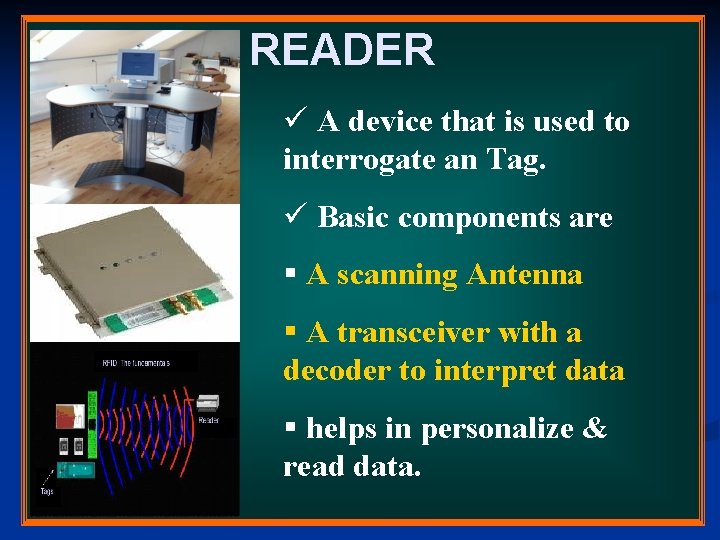
READER ü A device that is used to interrogate an Tag. ü Basic components are § A scanning Antenna § A transceiver with a decoder to interpret data § helps in personalize & read data.
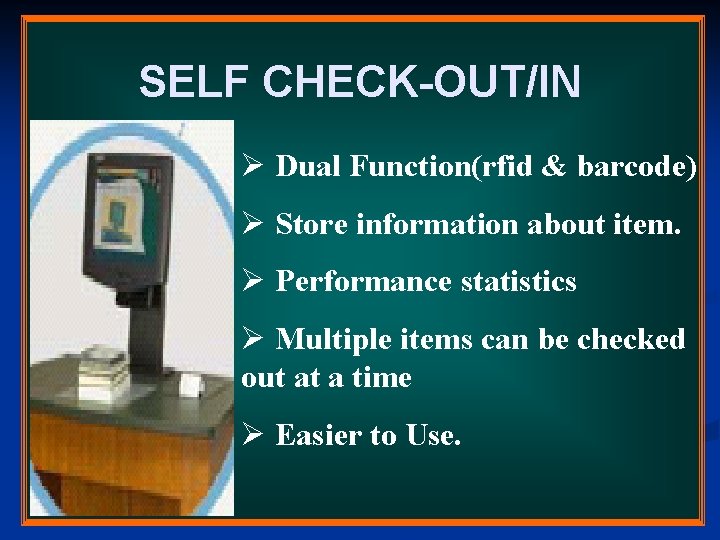
SELF CHECK-OUT/IN Ø Dual Function(rfid & barcode) Ø Store information about item. Ø Performance statistics Ø Multiple items can be checked out at a time Ø Easier to Use.
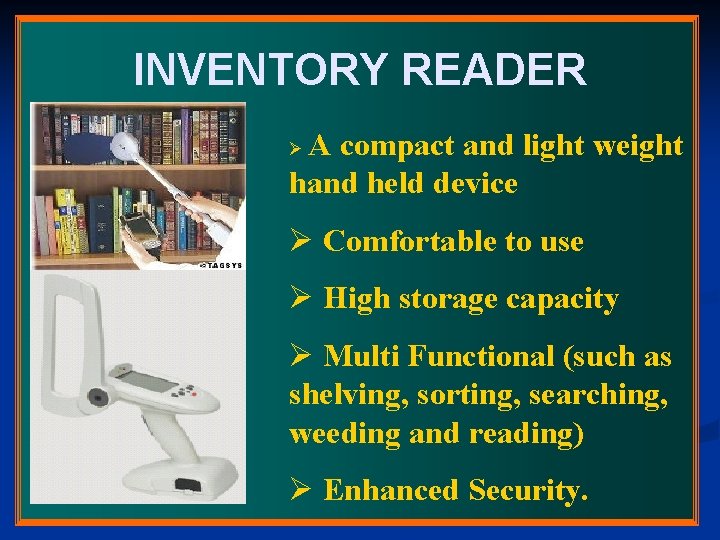
INVENTORY READER A compact and light weight hand held device Ø Ø Comfortable to use Ø High storage capacity Ø Multi Functional (such as shelving, sorting, searching, weeding and reading) Ø Enhanced Security.
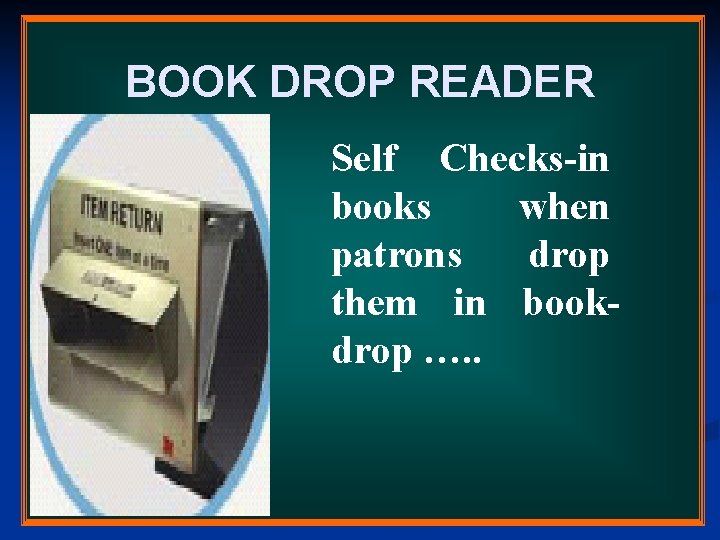
BOOK DROP READER Self Checks-in books when patrons drop them in bookdrop …. .
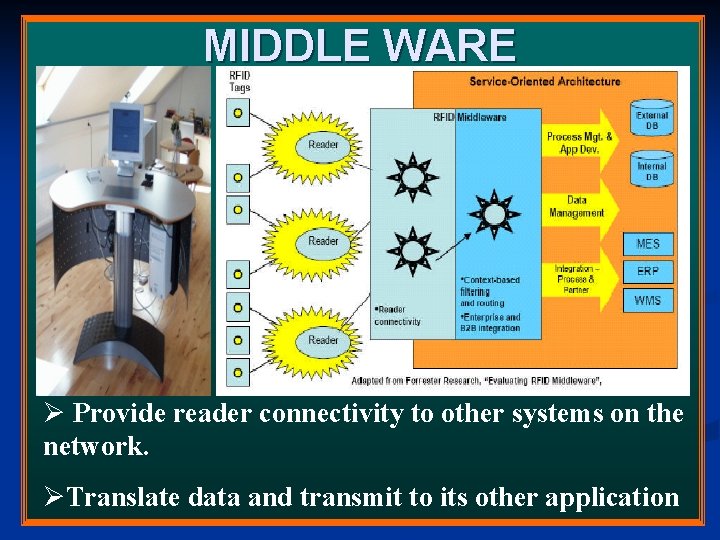
MIDDLE WARE Ø Provide reader connectivity to other systems on the network. ØTranslate data and transmit to its other application
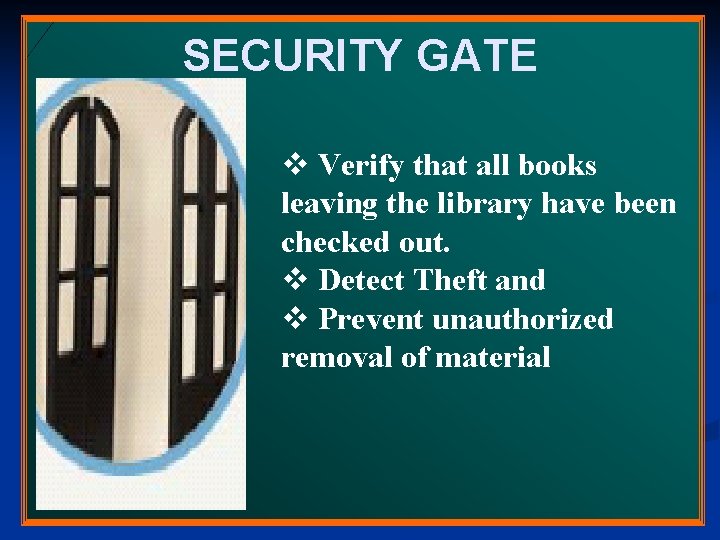
SECURITY GATE v Verify that all books leaving the library have been checked out. v Detect Theft and v Prevent unauthorized removal of material
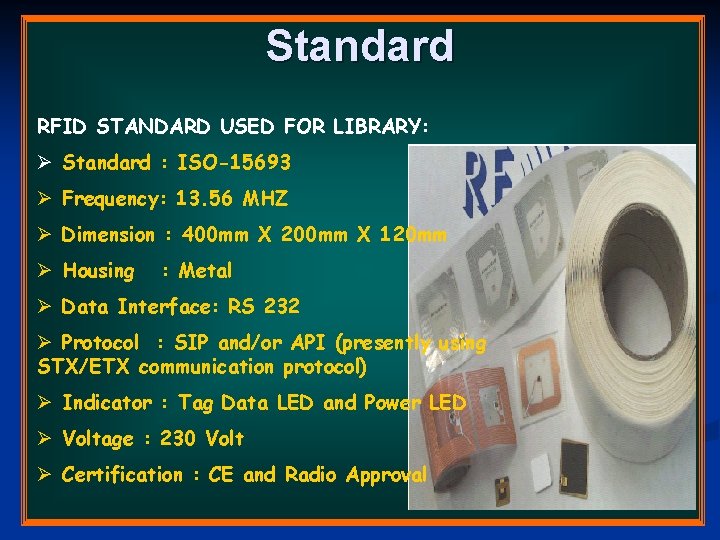
Standard RFID STANDARD USED FOR LIBRARY: Ø Standard : ISO-15693 Ø Frequency: 13. 56 MHZ Ø Dimension : 400 mm X 200 mm X 120 mm Ø Housing : Metal Ø Data Interface: RS 232 Ø Protocol : SIP and/or API (presently using STX/ETX communication protocol) Ø Indicator : Tag Data LED and Power LED Ø Voltage : 230 Volt Ø Certification : CE and Radio Approval
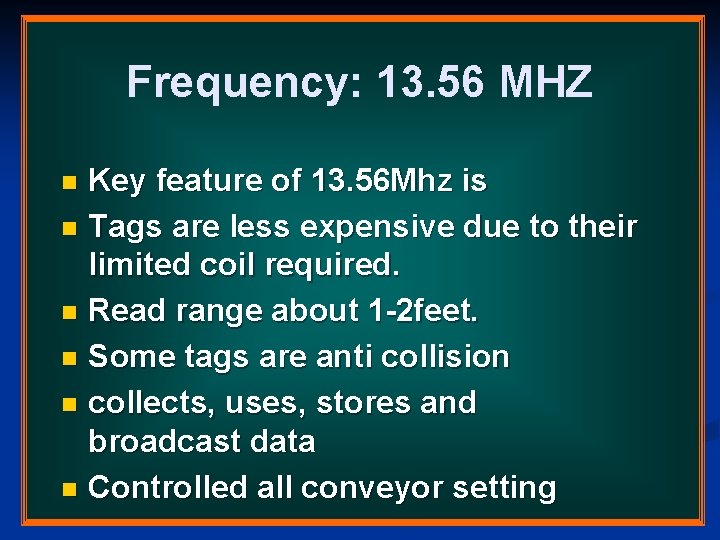
Frequency: 13. 56 MHZ Key feature of 13. 56 Mhz is n Tags are less expensive due to their limited coil required. n Read range about 1 -2 feet. n Some tags are anti collision n collects, uses, stores and broadcast data n Controlled all conveyor setting n
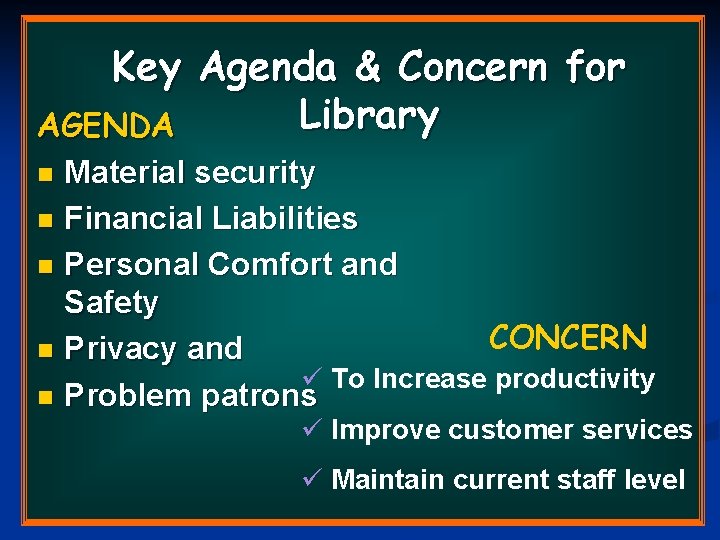
Key Agenda & Concern for Library AGENDA Material security n Financial Liabilities n Personal Comfort and Safety CONCERN n Privacy and ü To Increase productivity n Problem patrons n ü Improve customer services ü Maintain current staff level
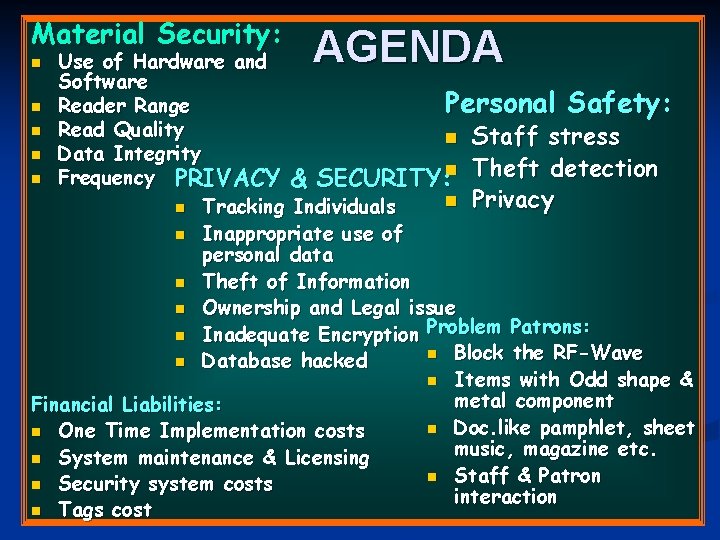
Material Security: AGENDA Use of Hardware and Software Personal Safety: n Reader Range n Read Quality n Staff stress n Data Integrity n Theft detection n Frequency PRIVACY & SECURITY: n Privacy n Tracking Individuals n Inappropriate use of personal data n Theft of Information n Ownership and Legal issue Problem Patrons: n Inadequate Encryption n Block the RF-Wave n Database hacked n Items with Odd shape & metal component Financial Liabilities: n Doc. like pamphlet, sheet n One Time Implementation costs music, magazine etc. n System maintenance & Licensing n Staff & Patron n Security system costs interaction n Tags cost n
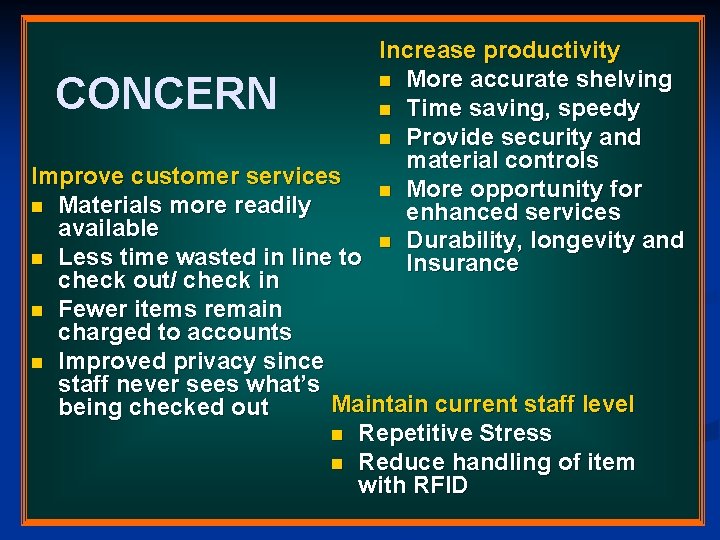
Increase productivity n More accurate shelving n Time saving, speedy n Provide security and material controls Improve customer services n More opportunity for n Materials more readily enhanced services available n Durability, longevity and n Less time wasted in line to Insurance check out/ check in n Fewer items remain charged to accounts n Improved privacy since staff never sees what’s Maintain current staff level being checked out n Repetitive Stress n Reduce handling of item with RFID CONCERN
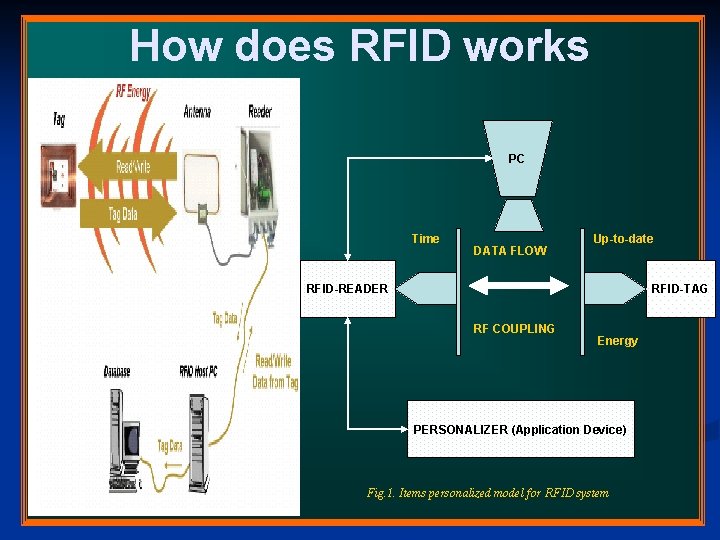
How does RFID works PC Time DATA FLOW Up-to-date RFID-READER RFID-TAG RF COUPLING Energy PERSONALIZER (Application Device) Fig. 1. Items personalized model for RFID system
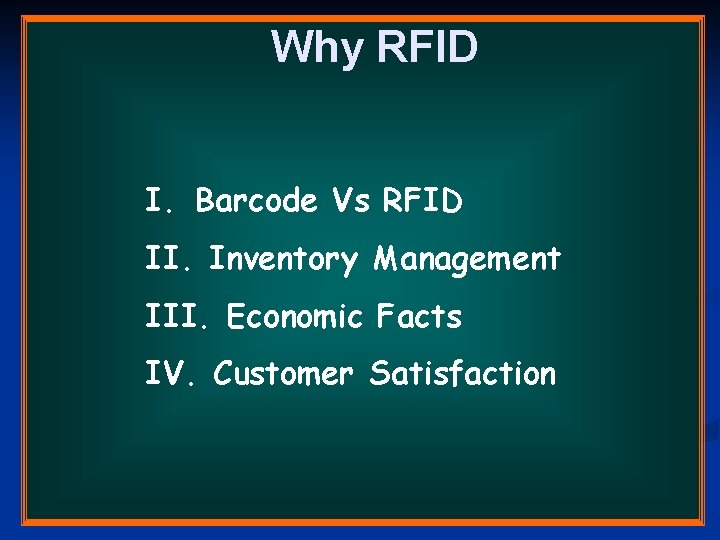
Why RFID I. Barcode Vs RFID II. Inventory Management III. Economic Facts IV. Customer Satisfaction
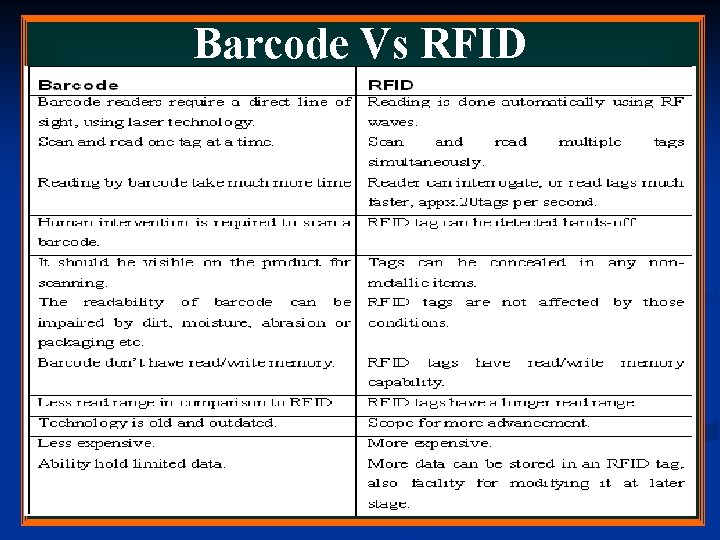
Barcode Vs RFID
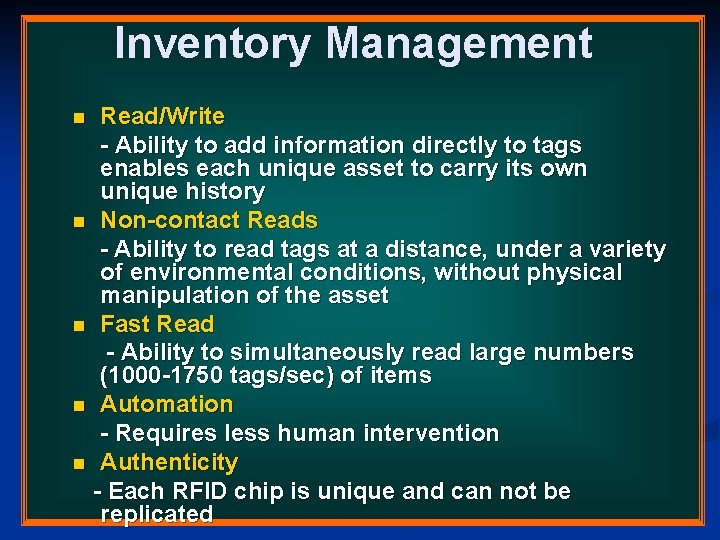
Inventory Management Read/Write - Ability to add information directly to tags enables each unique asset to carry its own unique history n Non-contact Reads - Ability to read tags at a distance, under a variety of environmental conditions, without physical manipulation of the asset n Fast Read - Ability to simultaneously read large numbers (1000 -1750 tags/sec) of items n Automation - Requires less human intervention n Authenticity - Each RFID chip is unique and can not be replicated n
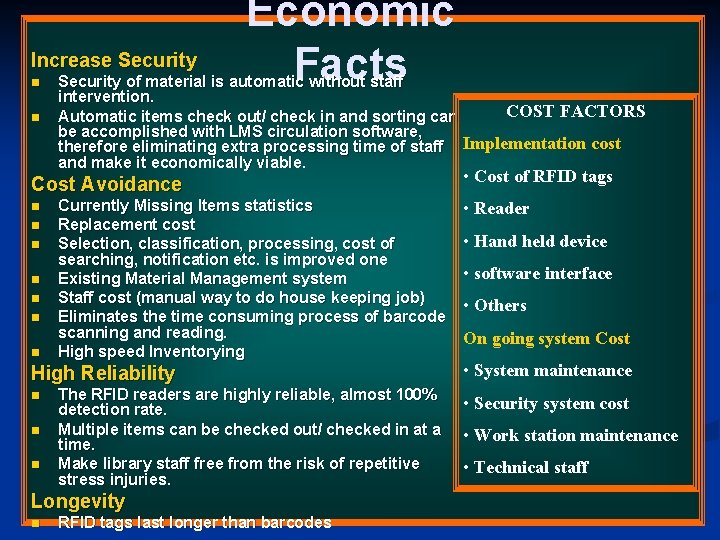
Increase Security n n Economic Facts Security of material is automatic without staff intervention. COST FACTORS Automatic items check out/ check in and sorting can be accomplished with LMS circulation software, therefore eliminating extra processing time of staff Implementation cost and make it economically viable. Cost Avoidance n n n n Currently Missing Items statistics Replacement cost Selection, classification, processing, cost of searching, notification etc. is improved one Existing Material Management system Staff cost (manual way to do house keeping job) Eliminates the time consuming process of barcode scanning and reading. High speed Inventorying High Reliability n n n The RFID readers are highly reliable, almost 100% detection rate. Multiple items can be checked out/ checked in at a time. Make library staff free from the risk of repetitive stress injuries. Longevity n RFID tags last longer than barcodes • Cost of RFID tags • Reader • Hand held device • software interface • Others On going system Cost • System maintenance • Security system cost • Work station maintenance • Technical staff
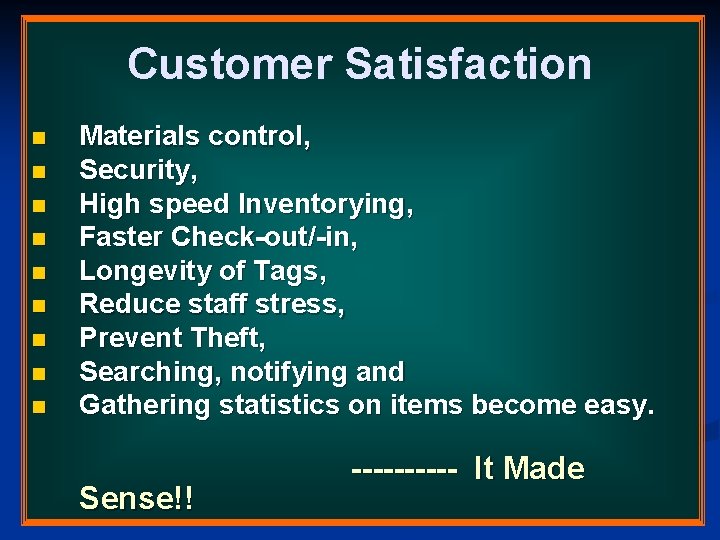
Customer Satisfaction n n n n Materials control, Security, High speed Inventorying, Faster Check-out/-in, Longevity of Tags, Reduce staff stress, Prevent Theft, Searching, notifying and Gathering statistics on items become easy. Sense!! ----- It Made
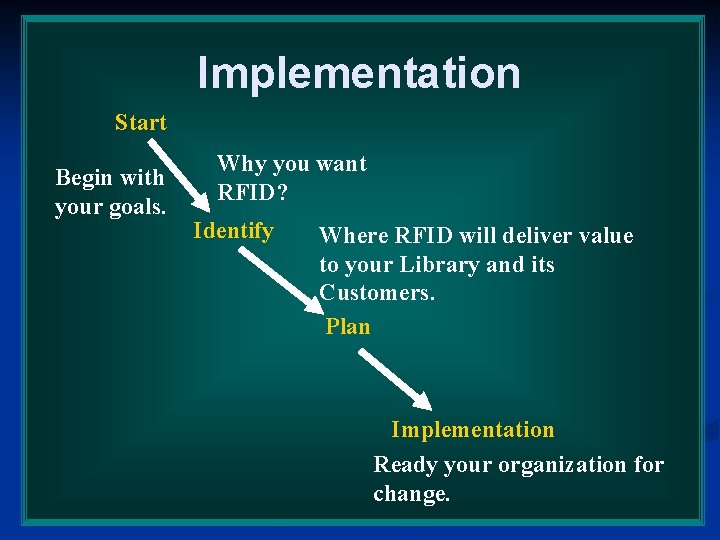
Implementation Start Begin with your goals. Why you want RFID? Identify Where RFID will deliver value to your Library and its Customers. Plan Implementation Ready your organization for change.
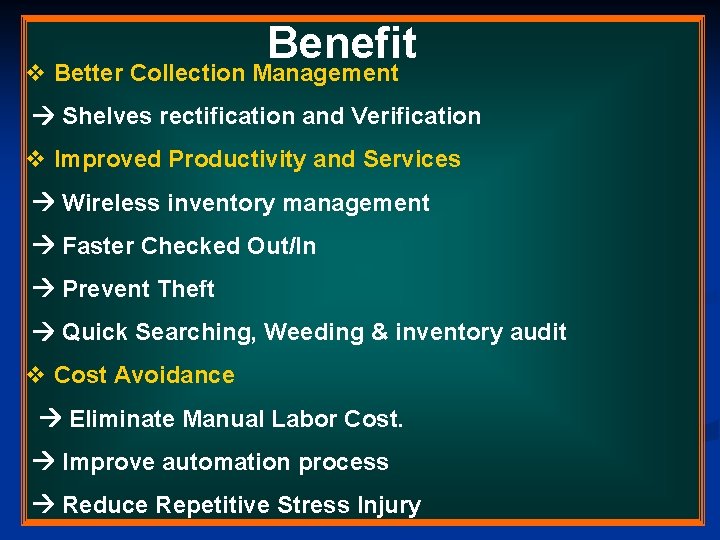
Benefit v Better Collection Management Shelves rectification and Verification v Improved Productivity and Services Wireless inventory management Faster Checked Out/In Prevent Theft Quick Searching, Weeding & inventory audit v Cost Avoidance Eliminate Manual Labor Cost. Improve automation process Reduce Repetitive Stress Injury
Conclusion RFID technology is taking off in libraries at an increasingly rapid pace. Though there are few libraries employing this technology today, but due to its customizable feature and continuing improvement the library communities are beginning to get involved in its development. It is easy to envision that, the RFID tags contents will increase in power, prices are expected to decline and tag will dramatically improve its efficiency, security and accuracy. Also major concerns need to be addressed for successfully implementing this technology. So that it will change our personal and work lives in library and adorns the conventional library management with a new idea and usher for a bright future. RFID IS A SUPPORTING TECHNOLOGY--- NOT A COMPETING !! 3 M-LIBRARY SYSTEM
THANK “YOU”