
Presentation Outline Introduction Historical perspective Introducing the PNA
- Slides: 14
Presentation Outline • Introduction • Historical perspective • Introducing the PNA series of network analyzers • Near-field antenna configuration • Far-field antenna configuration • Radar Cross-Section configuration • Typical performance comparisons • Summary and conclusions 1
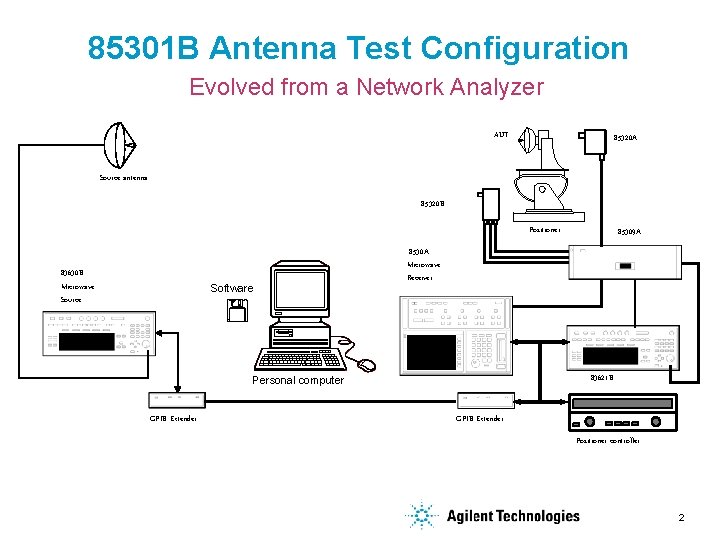
85301 B Antenna Test Configuration Evolved from a Network Analyzer AUT 85320 A Source antenna 85320 B Positioner 83630 B Microwave Source Software 8530 A Microwave Receiver 83621 B Personal computer GPIB Extender 85309 A GPIB Extender Positioner controller 2
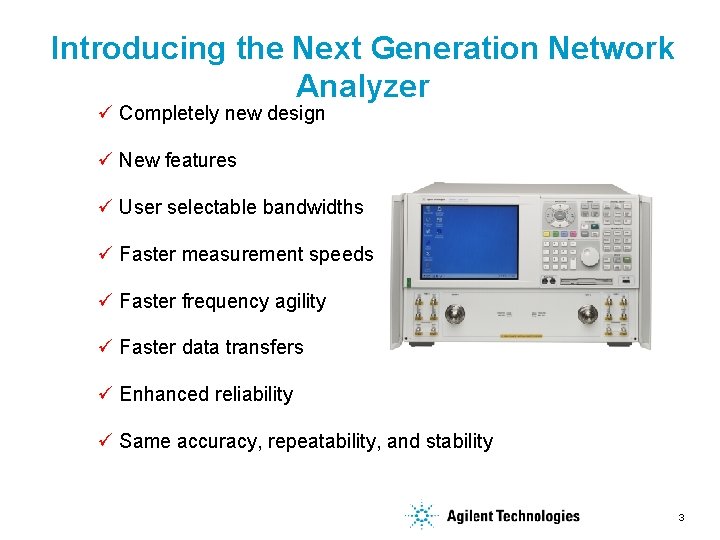
Introducing the Next Generation Network Analyzer ü Completely new design ü New features ü User selectable bandwidths ü Faster measurement speeds ü Faster frequency agility ü Faster data transfers ü Enhanced reliability ü Same accuracy, repeatability, and stability 3
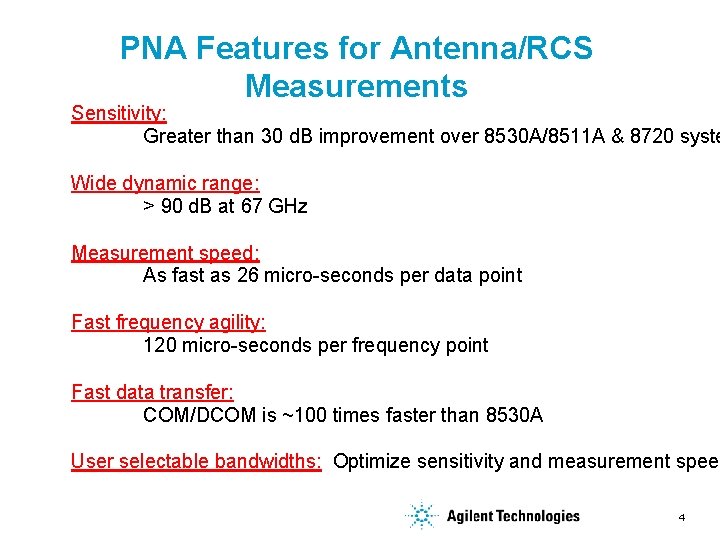
PNA Features for Antenna/RCS Measurements Sensitivity: Greater than 30 d. B improvement over 8530 A/8511 A & 8720 syste Wide dynamic range: > 90 d. B at 67 GHz Measurement speed: As fast as 26 micro-seconds per data point Fast frequency agility: 120 micro-seconds per frequency point Fast data transfer: COM/DCOM is ~100 times faster than 8530 A User selectable bandwidths: Optimize sensitivity and measurement speed 4
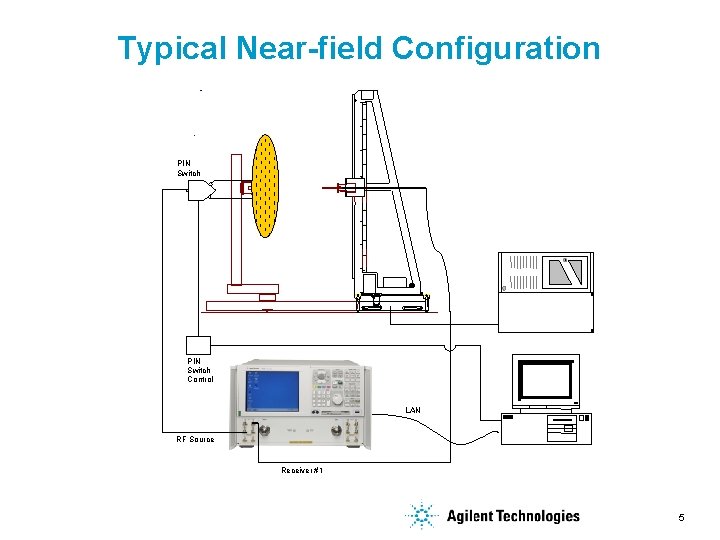
Typical Near-field Configuration PIN Switch AUT PIN Switch Control LAN RF Source Receiver #1 5
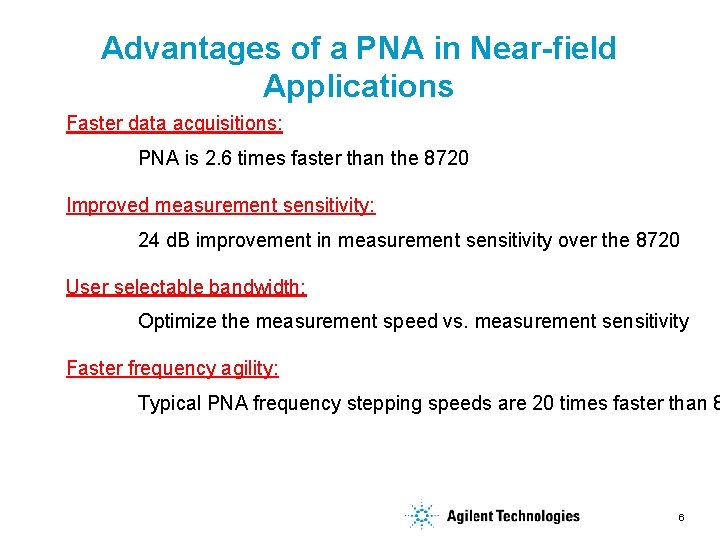
Advantages of a PNA in Near-field Applications Faster data acquisitions: PNA is 2. 6 times faster than the 8720 Improved measurement sensitivity: 24 d. B improvement in measurement sensitivity over the 8720 User selectable bandwidth: Optimize the measurement speed vs. measurement sensitivity Faster frequency agility: Typical PNA frequency stepping speeds are 20 times faster than 8 6
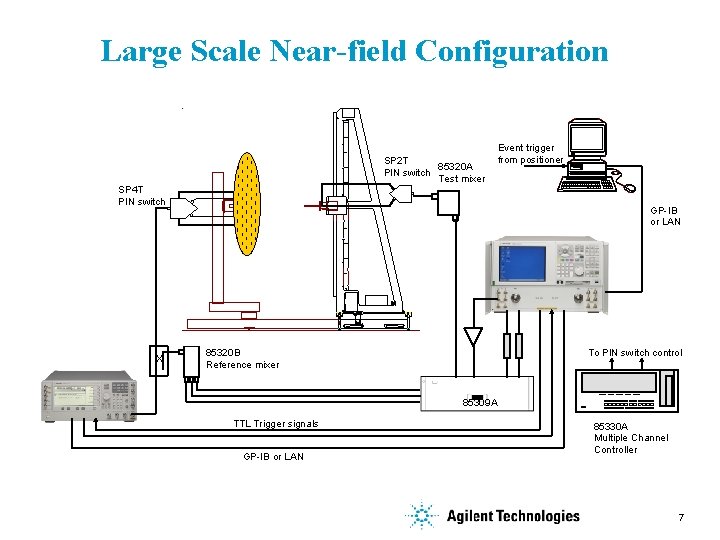
Large Scale Near-field Configuration SP 2 T 85320 A PIN switch Test mixer SP 4 T PIN switch X Event trigger from positioner AUT GP-IB or LAN To PIN switch control 85320 B Reference mixer 85309 A TTL Trigger signals GP-IB or LAN 85330 A Multiple Channel Controller 7
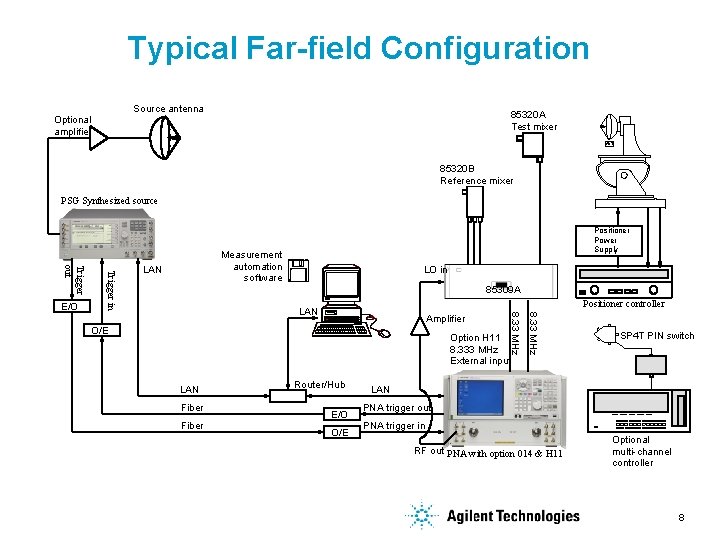
Typical Far-field Configuration Source antenna 85320 A Test mixer Optional amplifier AUT 85320 B Reference mixer PSG Synthesized source Trigger in Trigger out Measurement automation software LAN LO in 85309 A Positioner controller Amplifier O/E Option H 11 8. 333 MHz External input LAN Fiber Router/Hub E/O O/E 8. 33 MHz LAN 8. 33 MHz E/O Positioner Power Supply SP 4 T PIN switch LAN PNA trigger out PNA trigger in RF out PNA with option 014 & H 11 Optional multi-channel controller 8
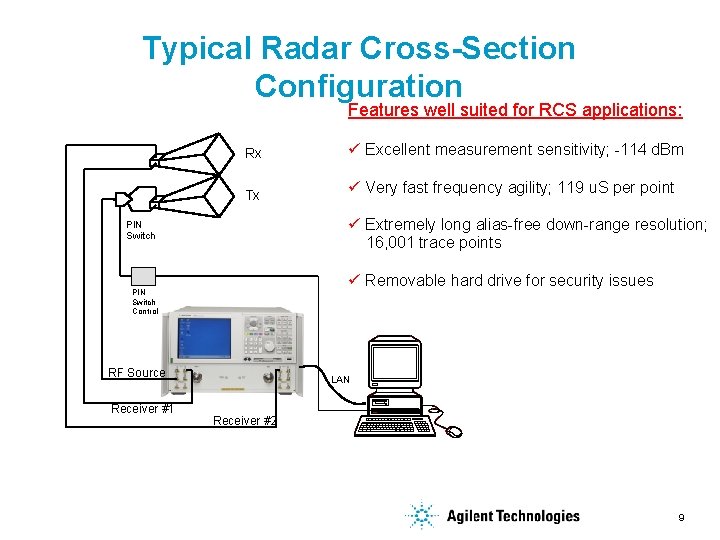
Typical Radar Cross-Section Configuration Features well suited for RCS applications: Rx Tx ü Very fast frequency agility; 119 u. S per point ü Extremely long alias-free down-range resolution; 16, 001 trace points PIN Switch ü Removable hard drive for security issues PIN Switch Control RF Source Receiver #1 ü Excellent measurement sensitivity; -114 d. Bm LAN Receiver #2 9
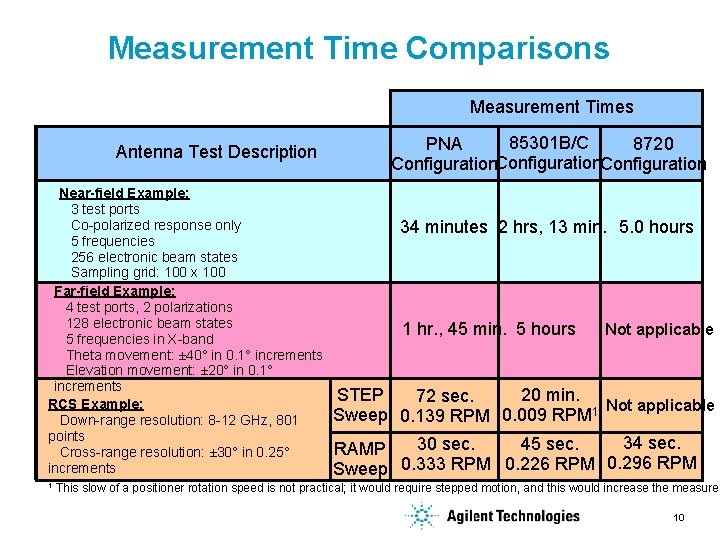
Measurement Time Comparisons Measurement Times Antenna Test Description Near-field Example: 3 test ports Co-polarized response only 5 frequencies 256 electronic beam states Sampling grid: 100 x 100 Far-field Example: 4 test ports, 2 polarizations 128 electronic beam states 5 frequencies in X-band Theta movement: ± 40° in 0. 1° increments Elevation movement: ± 20° in 0. 1° increments RCS Example: Down-range resolution: 8 -12 GHz, 801 points Cross-range resolution: ± 30° in 0. 25° increments 1 85301 B/C PNA 8720 Configuration 34 minutes 2 hrs, 13 min. 5. 0 hours 1 hr. , 45 min. 5 hours Not applicable STEP 20 min. 72 sec. Not applicable Sweep 0. 139 RPM 0. 009 RPM 1 34 sec. 30 sec. 45 sec. RAMP Sweep 0. 333 RPM 0. 226 RPM 0. 296 RPM This slow of a positioner rotation speed is not practical; it would require stepped motion, and this would increase the measurem 10
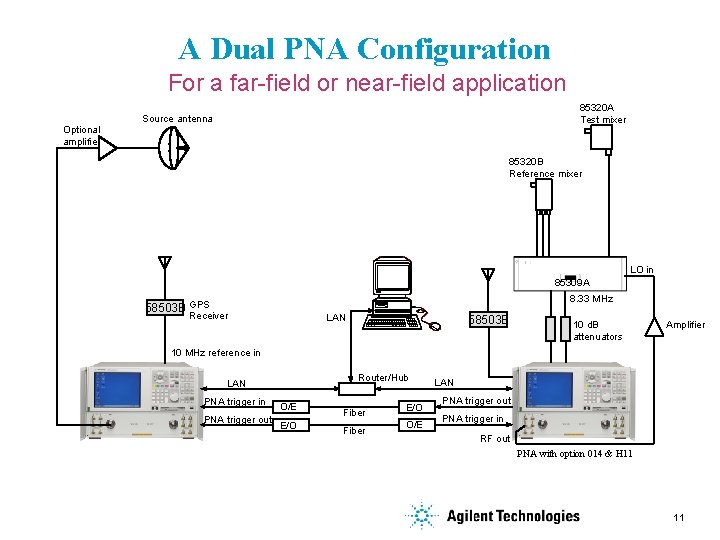
A Dual PNA Configuration For a far-field or near-field application 85320 A Test mixer Source antenna Optional amplifier 85320 B Reference mixer LO in 85309 A 8. 33 MHz 58503 B GPS Receiver LAN 58503 B 10 d. B attenuators Amplifier 10 MHz reference in Router/Hub LAN PNA trigger in PNA trigger out O/E E/O Fiber E/O O/E LAN PNA trigger out PNA trigger in RF out PNA with option 014 & H 11 11
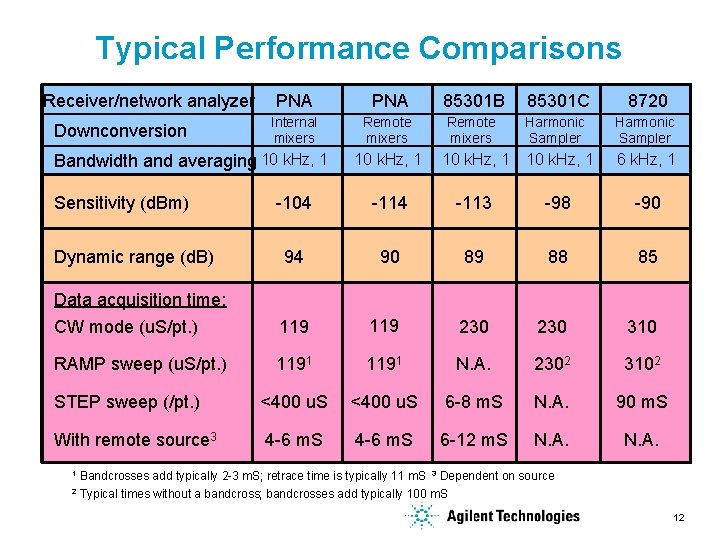
Typical Performance Comparisons Receiver/network analyzer Downconversion PNA 85301 B 85301 C 8720 Internal mixers Remote mixers Harmonic Sampler Bandwidth and averaging 10 k. Hz, 1 6 k. Hz, 1 -104 -113 -98 -90 94 90 89 88 85 CW mode (u. S/pt. ) 119 230 310 RAMP sweep (u. S/pt. ) 1191 N. A. 2302 3102 STEP sweep (/pt. ) <400 u. S 6 -8 m. S N. A. 90 m. S With remote source 3 4 -6 m. S 6 -12 m. S N. A. Sensitivity (d. Bm) Dynamic range (d. B) Data acquisition time: 1 Bandcrosses add typically 2 -3 m. S; retrace time is typically 11 m. S 2 Typical times without a bandcross; bandcrosses add typically 100 m. S 3 Dependent on source 12
Summary ü A new network analyzer which can be utilized in antenna/RCS measurement configurations was presented. ü New features that are particularly well suited to antenna/RCS applications ü Typical configuration diagrams for a variety of antenna/RCS applications ü Compared and contrasted the PNA to other Agilent instrumentation ü Example measurement scenarios and measurement time comparisons ü Typical performance specifications ü Advantages and tradeoffs 13
Conclusions The new PNA network analyzer can provide significant performance enhancements to antenna/RCS measurements Key economic benefit is faster data acquisition speeds that can reduce total measurement times, providing a more cost effective measurement solution. 14