
Presentation on Transportation and Assignment Problem Research and
Presentation on Transportation and Assignment Problem Research and Optimization Methods Presenter: Subash Chandra Pakhrin 072 MSI 616 MSC in Information and Comm. Engineering Pulchowk Campus 1
Transportation Problem Transportation means movement of goods from one place to another place. – It can be from one city to the next city. – It can be from one place to the next place. – It can be from one country to another country. So, definitely this movement is going to incur some costs or some expenses and we always try to minimize this expenses. This is what we exactly do in the transportation problem. In transportation of goods its going to incur some costs and we are going to minimize that costs that is why this is also known as minimization type of problem. 2
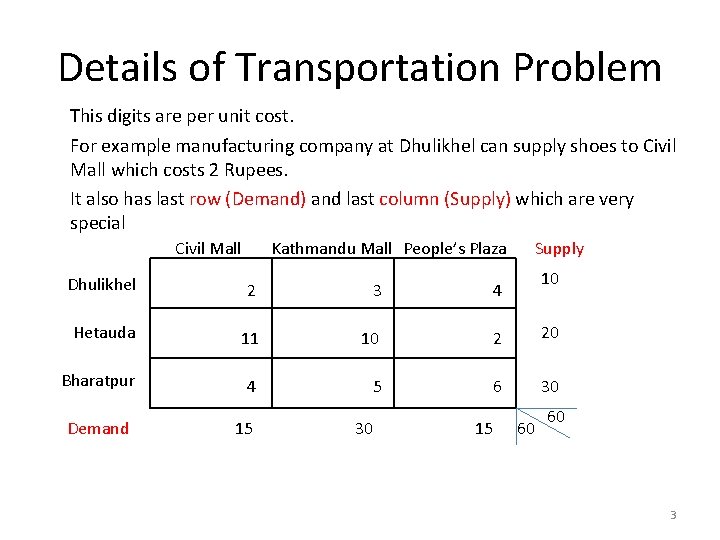
Details of Transportation Problem This digits are per unit cost. For example manufacturing company at Dhulikhel can supply shoes to Civil Mall which costs 2 Rupees. It also has last row (Demand) and last column (Supply) which are very special Civil Mall Kathmandu Mall People’s Plaza Supply 10 Dhulikhel 2 3 4 Hetauda 11 10 2 20 Bharatpur 4 5 6 30 Demand 15 30 15 60 60 3
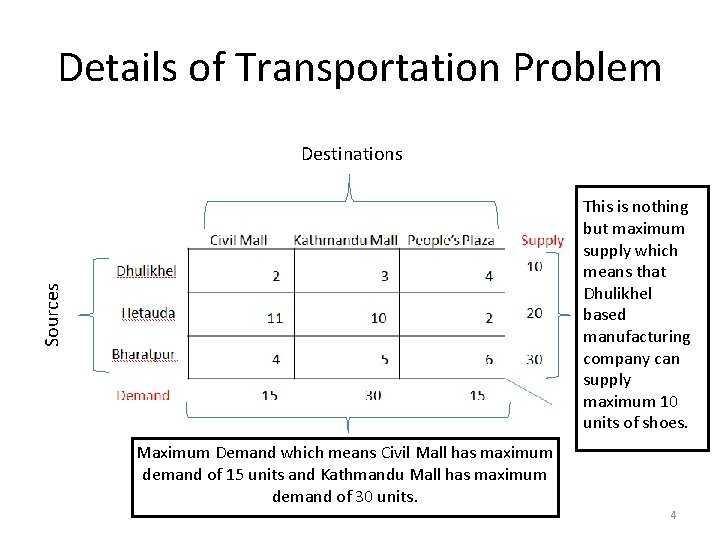
Details of Transportation Problem Destinations Sources This is nothing but maximum supply which means that Dhulikhel based manufacturing company can supply maximum 10 units of shoes. Maximum Demand which means Civil Mall has maximum demand of 15 units and Kathmandu Mall has maximum demand of 30 units. 4
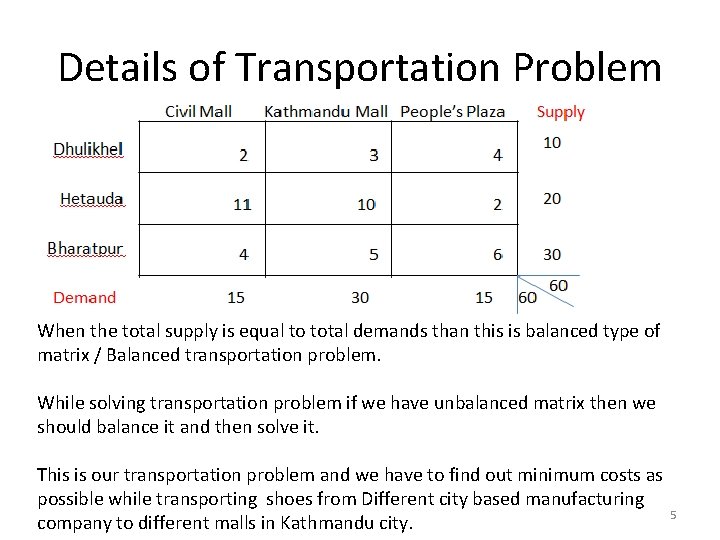
Details of Transportation Problem When the total supply is equal to total demands than this is balanced type of matrix / Balanced transportation problem. While solving transportation problem if we have unbalanced matrix then we should balance it and then solve it. This is our transportation problem and we have to find out minimum costs as possible while transporting shoes from Different city based manufacturing company to different malls in Kathmandu city. 5
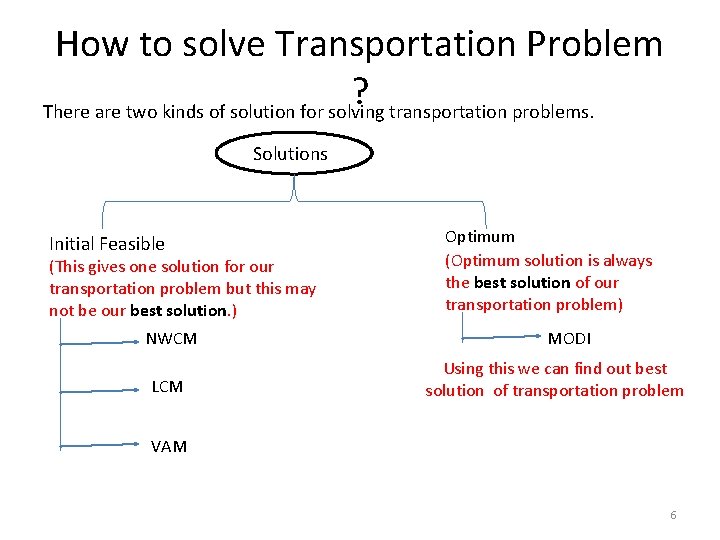
How to solve Transportation Problem ? There are two kinds of solution for solving transportation problems. Solutions Initial Feasible (This gives one solution for our transportation problem but this may not be our best solution. ) NWCM LCM Optimum (Optimum solution is always the best solution of our transportation problem) MODI Using this we can find out best solution of transportation problem VAM 6

How to solve Transportation Problem ? We cannot directly find out optimum solution first method while solving the transportation problem is we have to find out its Initial Basic Feasible Solution and depending upon that solution we are going to decide if its optimum solution exists or not if exists we are going to find it. Initial Feasible : NWCM (Northwest – Corner Method) LCM (Least – Cost Method) VAM (Vogel Approximation Method) Optimum : MODI (Modified Distribution Method) 7
Northwest – Corner Method 8
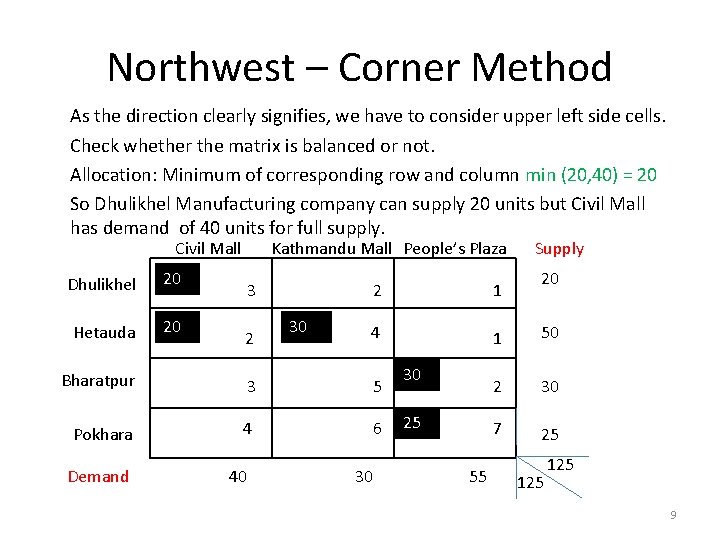
Northwest – Corner Method As the direction clearly signifies, we have to consider upper left side cells. Check whether the matrix is balanced or not. Allocation: Minimum of corresponding row and column min (20, 40) = 20 So Dhulikhel Manufacturing company can supply 20 units but Civil Mall has demand of 40 units for full supply. Civil Mall Dhulikhel 20 Hetauda 20 Kathmandu Mall People’s Plaza 3 2 30 Supply 20 2 1 4 1 50 2 30 7 25 Bharatpur 3 5 Pokhara 4 6 Demand 40 30 30 25 55 125 9
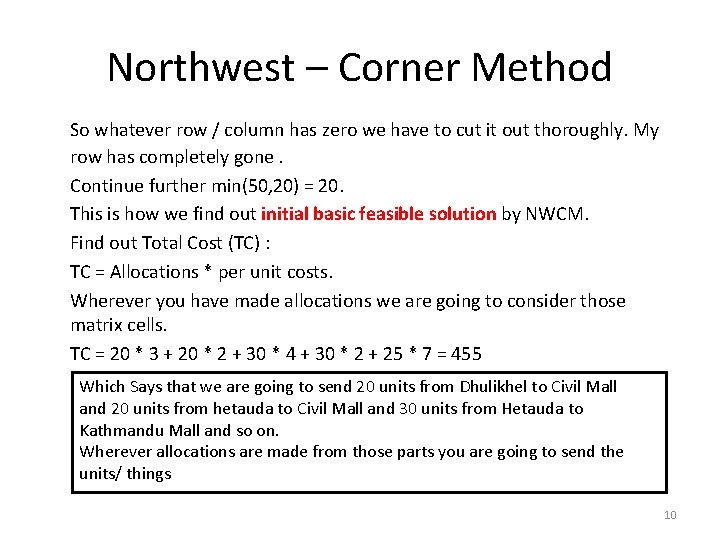
Northwest – Corner Method So whatever row / column has zero we have to cut it out thoroughly. My row has completely gone. Continue further min(50, 20) = 20. This is how we find out initial basic feasible solution by NWCM. Find out Total Cost (TC) : TC = Allocations * per unit costs. Wherever you have made allocations we are going to consider those matrix cells. TC = 20 * 3 + 20 * 2 + 30 * 4 + 30 * 2 + 25 * 7 = 455 Which Says that we are going to send 20 units from Dhulikhel to Civil Mall and 20 units from hetauda to Civil Mall and 30 units from Hetauda to Kathmandu Mall and so on. Wherever allocations are made from those parts you are going to send the units/ things 10
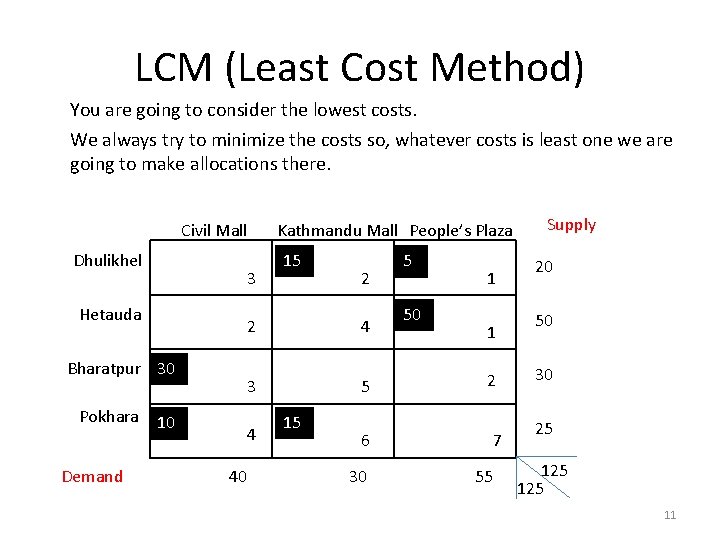
LCM (Least Cost Method) You are going to consider the lowest costs. We always try to minimize the costs so, whatever costs is least one we are going to make allocations there. Civil Mall Dhulikhel 3 Hetauda Bharatpur 30 Pokhara Demand 10 3 Kathmandu Mall People’s Plaza 15 2 2 4 3 5 4 40 15 6 30 5 50 1 1 2 7 55 Supply 20 50 30 25 125 11
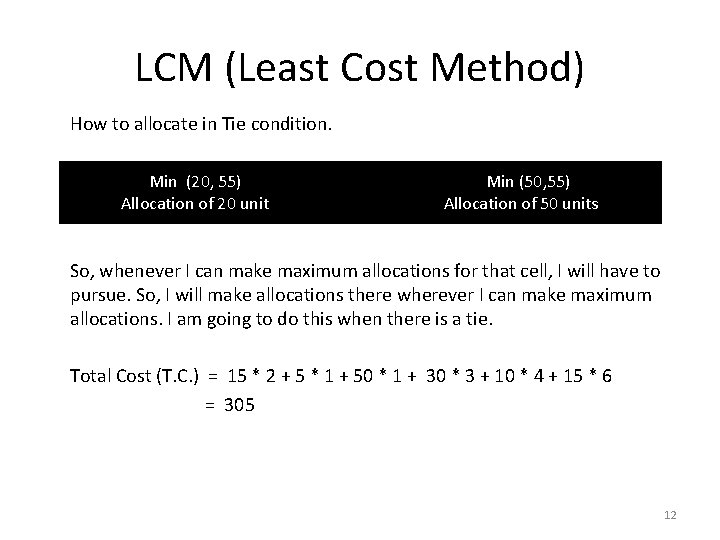
LCM (Least Cost Method) How to allocate in Tie condition. Min (20, 55) Allocation of 20 unit Min (50, 55) Allocation of 50 units So, whenever I can make maximum allocations for that cell, I will have to pursue. So, I will make allocations there wherever I can make maximum allocations. I am going to do this when there is a tie. Total Cost (T. C. ) = 15 * 2 + 5 * 1 + 50 * 1 + 30 * 3 + 10 * 4 + 15 * 6 = 305 12
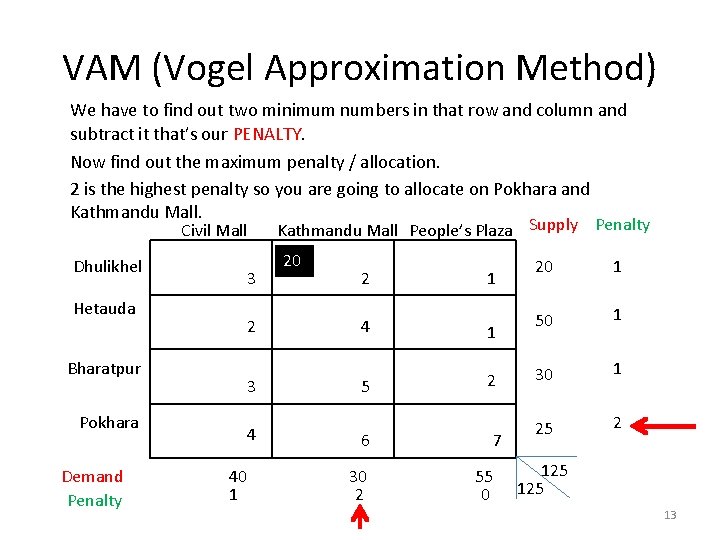
VAM (Vogel Approximation Method) We have to find out two minimum numbers in that row and column and subtract it that’s our PENALTY. Now find out the maximum penalty / allocation. 2 is the highest penalty so you are going to allocate on Pokhara and Kathmandu Mall. Civil Mall Dhulikhel Hetauda Bharatpur Pokhara Demand Penalty 3 3 2 3 4 40 1 Kathmandu Mall People’s Plaza Supply Penalty 20 2 1 4 1 5 2 6 30 2 7 55 0 20 1 50 1 30 1 25 2 125 13
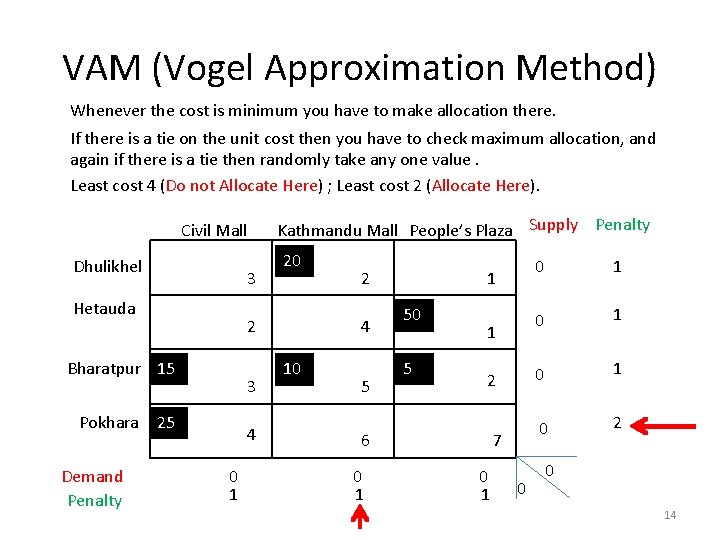
VAM (Vogel Approximation Method) Whenever the cost is minimum you have to make allocation there. If there is a tie on the unit cost then you have to check maximum allocation, and again if there is a tie then randomly take any one value. Least cost 4 (Do not Allocate Here) ; Least cost 2 (Allocate Here). Civil Mall Dhulikhel 3 3 Hetauda Demand Penalty 20 2 Bharatpur 15 Pokhara Kathmandu Mall People’s Plaza Supply Penalty 3 25 4 0 1 2 4 10 5 1 50 5 1 2 6 0 1 7 0 1 0 1 0 2 0 14
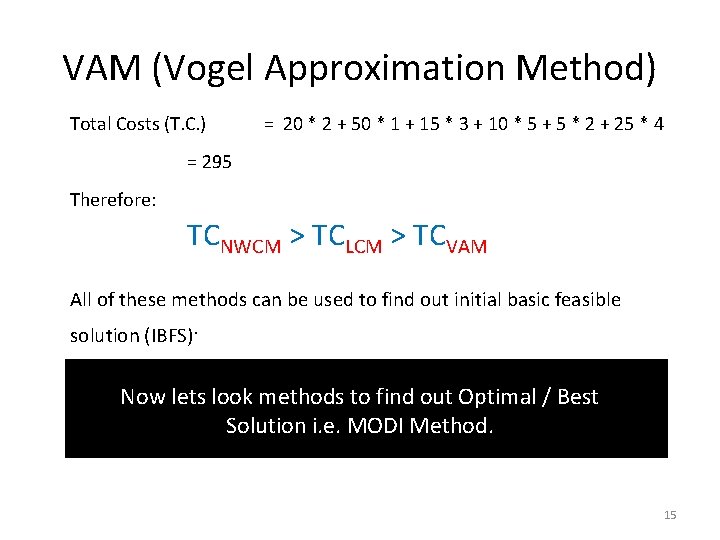
VAM (Vogel Approximation Method) Total Costs (T. C. ) = 20 * 2 + 50 * 1 + 15 * 3 + 10 * 5 + 5 * 2 + 25 * 4 = 295 Therefore: TCNWCM > TCLCM > TCVAM All of these methods can be used to find out initial basic feasible solution (IBFS). Now lets look methods to find out Optimal / Best Solution i. e. MODI Method. 15
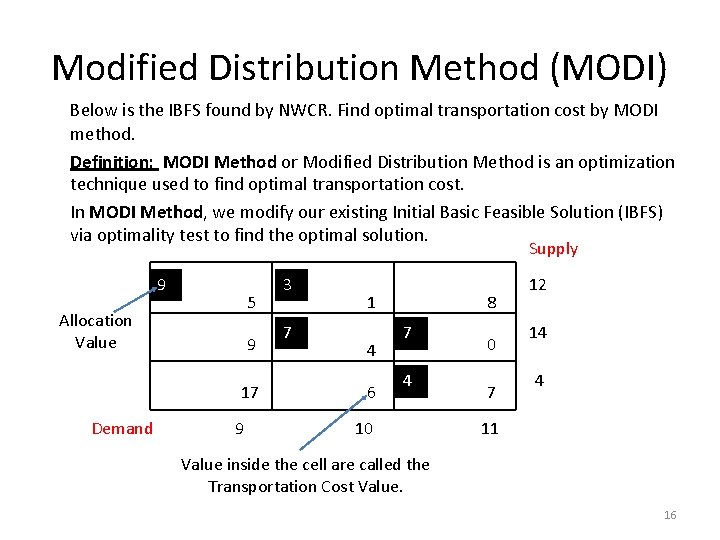
Modified Distribution Method (MODI) Below is the IBFS found by NWCR. Find optimal transportation cost by MODI method. Definition: MODI Method or Modified Distribution Method is an optimization technique used to find optimal transportation cost. In MODI Method, we modify our existing Initial Basic Feasible Solution (IBFS) via optimality test to find the optimal solution. Supply 9 Allocation Value 3 5 9 17 Demand 9 3 7 1 4 6 8 7 4 10 0 7 12 14 4 11 Value inside the cell are called the Transportation Cost Value. 16
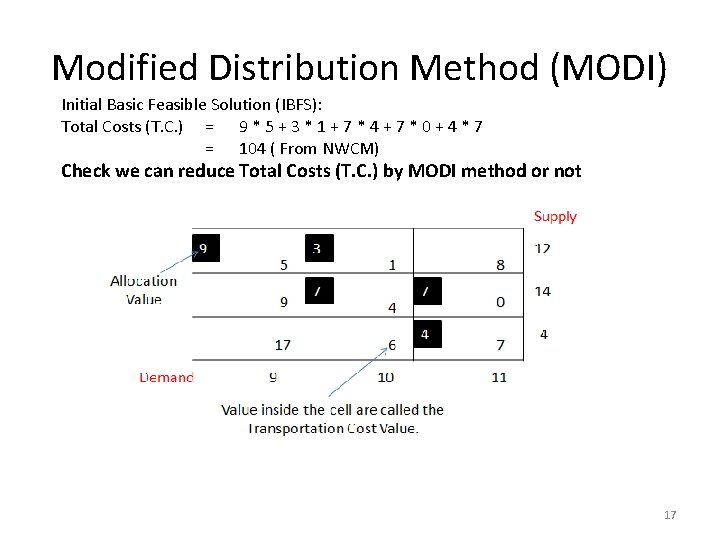
Modified Distribution Method (MODI) Initial Basic Feasible Solution (IBFS): Total Costs (T. C. ) = 9 * 5 + 3 * 1 + 7 * 4 + 7 * 0 + 4 * 7 = 104 ( From NWCM) Check we can reduce Total Costs (T. C. ) by MODI method or not 17
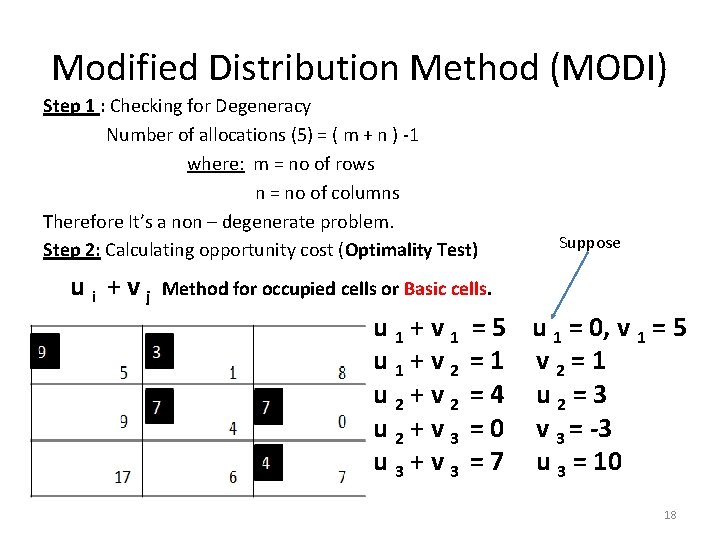
Modified Distribution Method (MODI) Step 1 : Checking for Degeneracy Number of allocations (5) = ( m + n ) -1 where: m = no of rows n = no of columns Therefore It’s a non – degenerate problem. Step 2: Calculating opportunity cost (Optimality Test) ui +vj Suppose Method for occupied cells or Basic cells. u 1+v 1 u 1+v 2 u 2+v 3 u 3+v 3 = 5 u 1 = 0, v 1 = 5 =1 v 2=1 =4 u 2=3 = 0 v 3 = -3 = 7 u 3 = 10 18
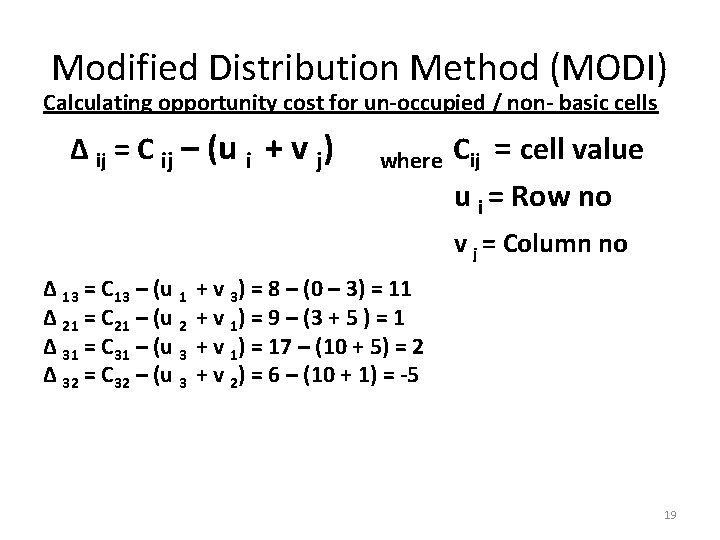
Modified Distribution Method (MODI) Calculating opportunity cost for un-occupied / non- basic cells ∆ ij = C ij – (u i + v j) where Cij = cell value u i = Row no v j = Column no ∆ 13 = C 13 – (u 1 ∆ 21 = C 21 – (u 2 ∆ 31 = C 31 – (u 3 ∆ 32 = C 32 – (u 3 + v 3) = 8 – (0 – 3) = 11 + v 1) = 9 – (3 + 5 ) = 1 + v 1) = 17 – (10 + 5) = 2 + v 2) = 6 – (10 + 1) = -5 19
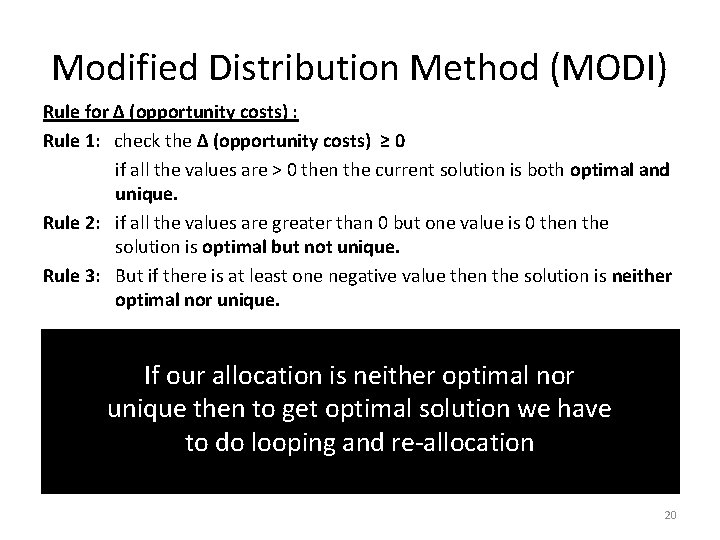
Modified Distribution Method (MODI) Rule for ∆ (opportunity costs) : Rule 1: check the ∆ (opportunity costs) ≥ 0 if all the values are > 0 then the current solution is both optimal and unique. Rule 2: if all the values are greater than 0 but one value is 0 then the solution is optimal but not unique. Rule 3: But if there is at least one negative value then the solution is neither optimal nor unique. If our allocation is neither optimal nor unique then to get optimal solution we have to do looping and re-allocation 20
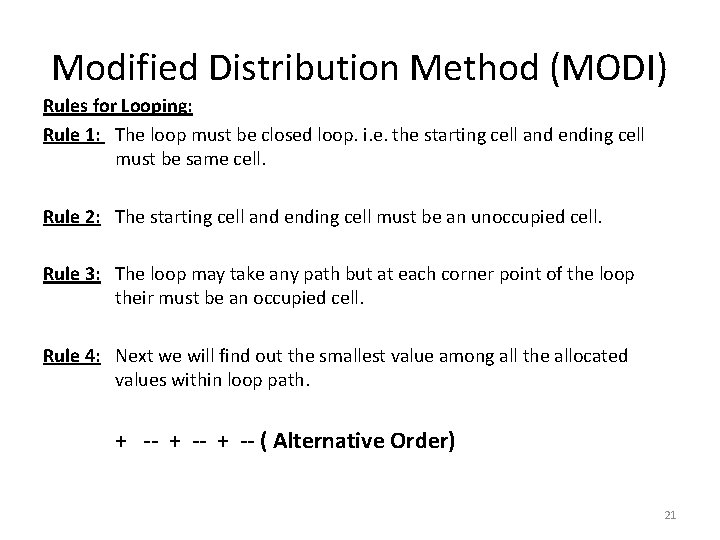
Modified Distribution Method (MODI) Rules for Looping: Rule 1: The loop must be closed loop. i. e. the starting cell and ending cell must be same cell. Rule 2: The starting cell and ending cell must be an unoccupied cell. Rule 3: The loop may take any path but at each corner point of the loop their must be an occupied cell. Rule 4: Next we will find out the smallest value among all the allocated values within loop path. + -- ( Alternative Order) 21
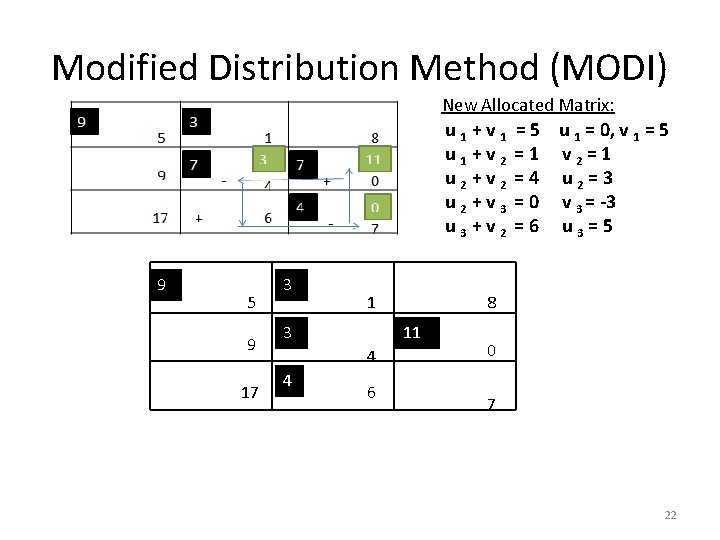
Modified Distribution Method (MODI) New Allocated Matrix: u 1+v 1 u 1+v 2 u 2+v 3 u 3+v 2 9 3 5 9 17 3 1 3 4 8 11 4 6 = 5 u 1 = 0, v 1 = 5 =1 v 2=1 =4 u 2=3 = 0 v 3 = -3 =6 u 3=5 0 7 22
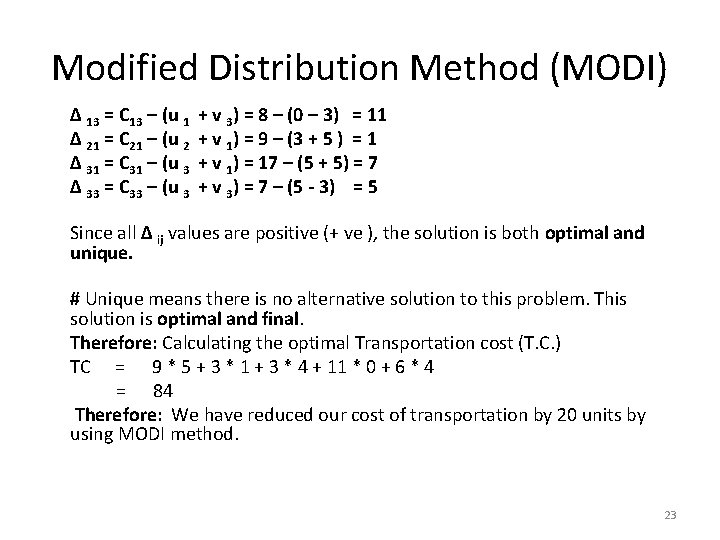
Modified Distribution Method (MODI) ∆ 13 = C 13 – (u 1 ∆ 21 = C 21 – (u 2 ∆ 31 = C 31 – (u 3 ∆ 33 = C 33 – (u 3 + v 3) = 8 – (0 – 3) = 11 + v 1) = 9 – (3 + 5 ) = 1 + v 1) = 17 – (5 + 5) = 7 + v 3) = 7 – (5 - 3) = 5 Since all ∆ ij values are positive (+ ve ), the solution is both optimal and unique. # Unique means there is no alternative solution to this problem. This solution is optimal and final. Therefore: Calculating the optimal Transportation cost (T. C. ) TC = 9 * 5 + 3 * 1 + 3 * 4 + 11 * 0 + 6 * 4 = 84 Therefore: We have reduced our cost of transportation by 20 units by using MODI method. 23
Assignment Problem Assignment : Allotment of something to someone. These two things something and someone are very important here 1. Something Job, Task 2. Someone Machine, Person A job can be performed by machine or person and in assignment problem you are given with number of jobs and no of machines and you have to assign those jobs to those machines, so that you can get optimum solution or effective solution. Assignment problem is same like transportation problem. 24
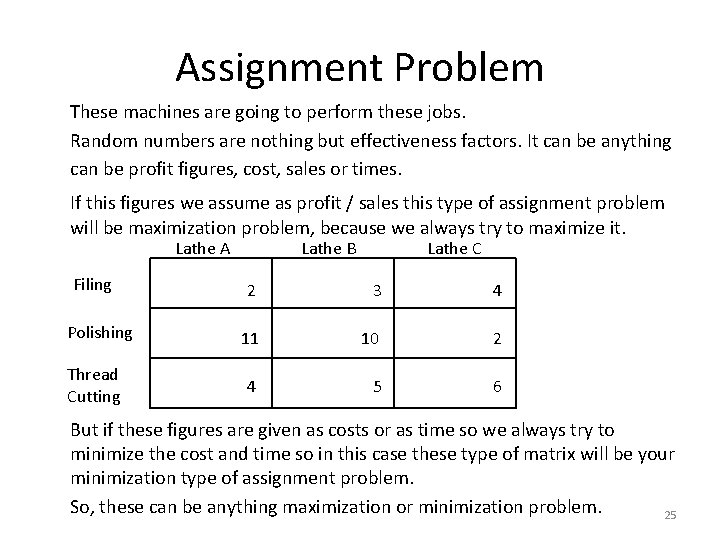
Assignment Problem These machines are going to perform these jobs. Random numbers are nothing but effectiveness factors. It can be anything can be profit figures, cost, sales or times. If this figures we assume as profit / sales this type of assignment problem will be maximization problem, because we always try to maximize it. Lathe A Filing Polishing Thread Cutting Lathe B Lathe C 2 3 4 11 10 2 4 5 6 But if these figures are given as costs or as time so we always try to minimize the cost and time so in this case these type of matrix will be your minimization type of assignment problem. So, these can be anything maximization or minimization problem. 25
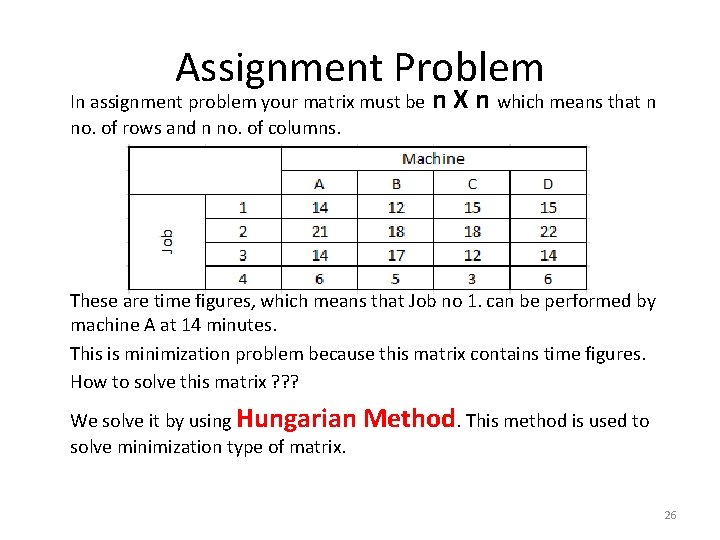
Assignment Problem In assignment problem your matrix must be no. of rows and n no. of columns. n X n which means that n These are time figures, which means that Job no 1. can be performed by machine A at 14 minutes. This is minimization problem because this matrix contains time figures. How to solve this matrix ? ? ? We solve it by using Hungarian solve minimization type of matrix. Method. This method is used to 26
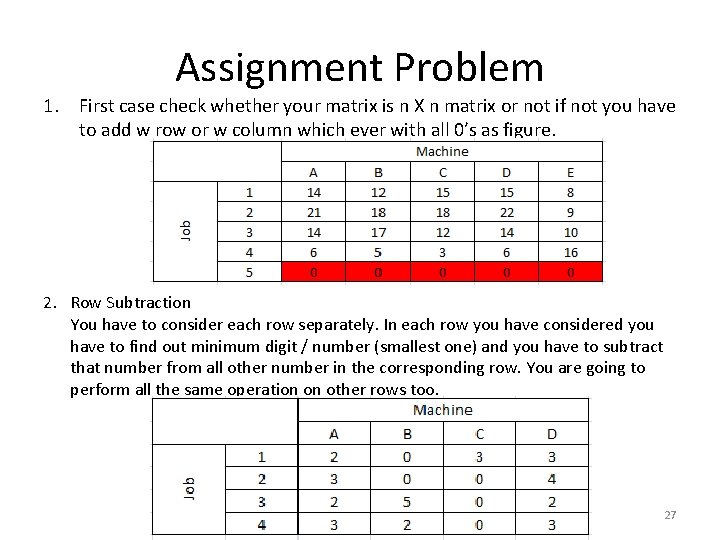
Assignment Problem 1. First case check whether your matrix is n X n matrix or not if not you have to add w row or w column which ever with all 0’s as figure. 2. Row Subtraction You have to consider each row separately. In each row you have considered you have to find out minimum digit / number (smallest one) and you have to subtract that number from all other number in the corresponding row. You are going to perform all the same operation on other rows too. 27
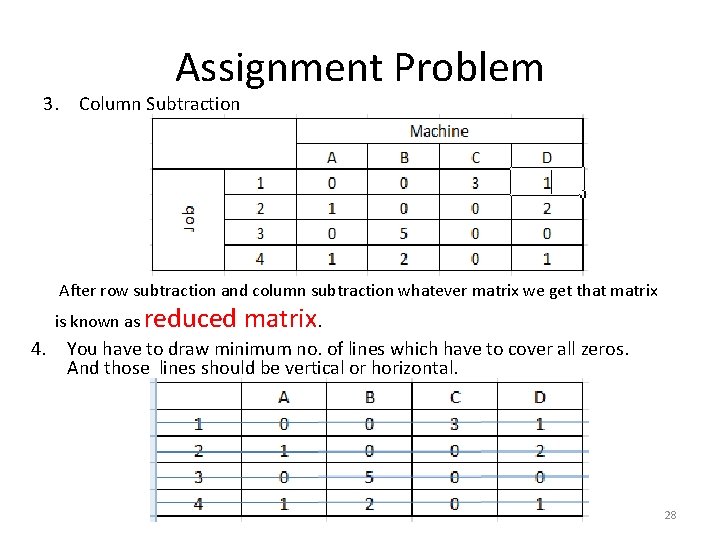
Assignment Problem 3. Column Subtraction After row subtraction and column subtraction whatever matrix we get that matrix is known as reduced 4. matrix. You have to draw minimum no. of lines which have to cover all zeros. And those lines should be vertical or horizontal. 28
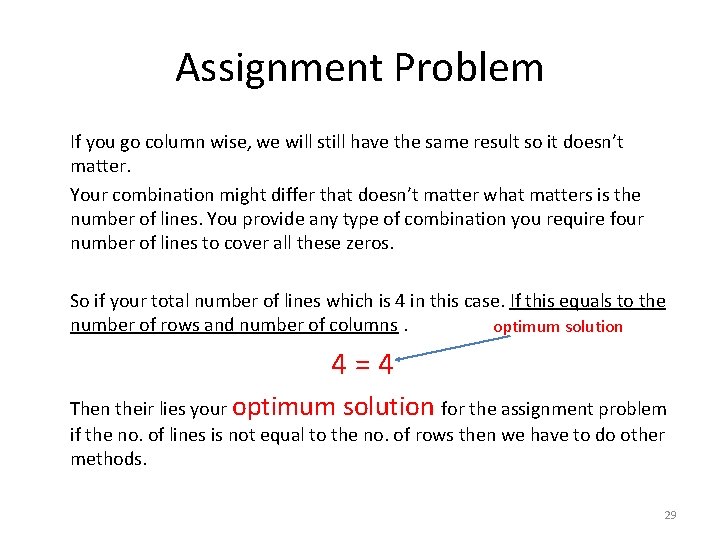
Assignment Problem If you go column wise, we will still have the same result so it doesn’t matter. Your combination might differ that doesn’t matter what matters is the number of lines. You provide any type of combination you require four number of lines to cover all these zeros. So if your total number of lines which is 4 in this case. If this equals to the number of rows and number of columns. optimum solution 4=4 Then their lies your optimum solution for the assignment problem if the no. of lines is not equal to the no. of rows then we have to do other methods. 29
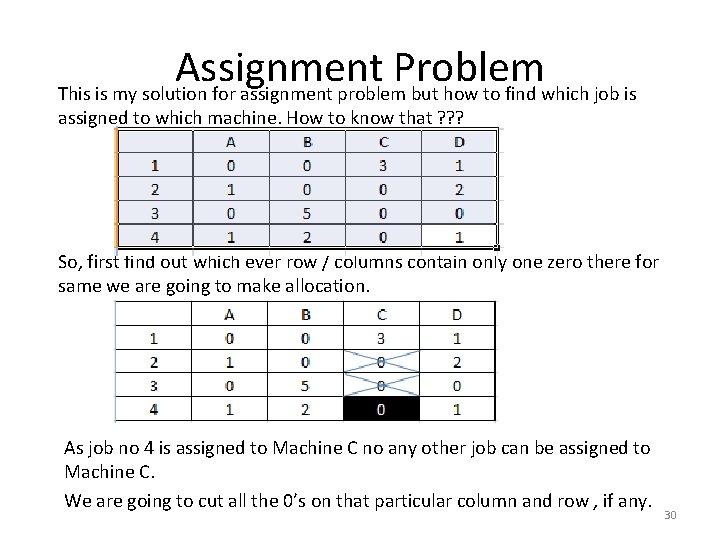
Assignment Problem This is my solution for assignment problem but how to find which job is assigned to which machine. How to know that ? ? ? So, first find out which ever row / columns contain only one zero there for same we are going to make allocation. As job no 4 is assigned to Machine C no any other job can be assigned to Machine C. We are going to cut all the 0’s on that particular column and row , if any. 30
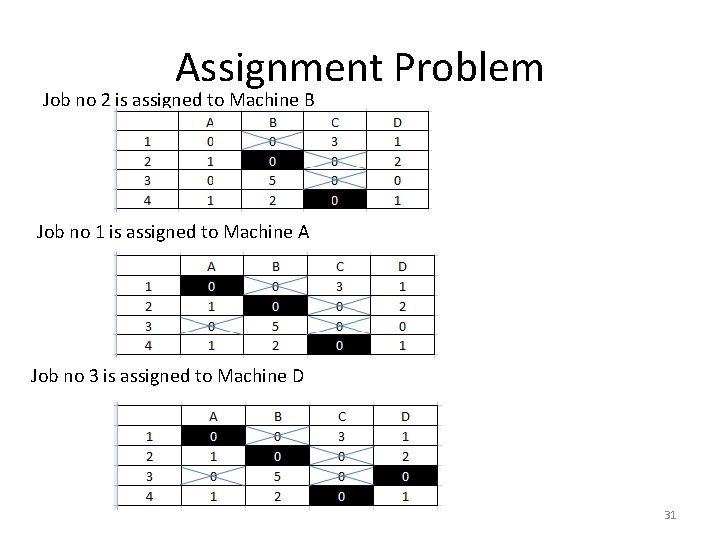
Assignment Problem Job no 2 is assigned to Machine B Job no 1 is assigned to Machine A Job no 3 is assigned to Machine D 31
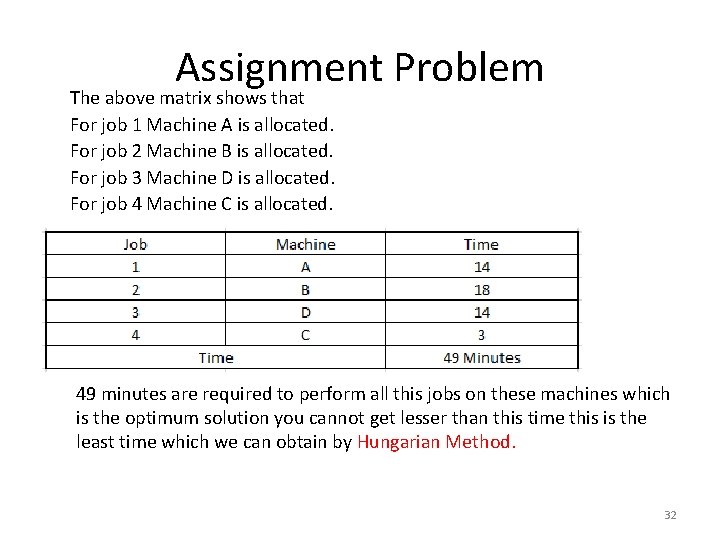
Assignment Problem The above matrix shows that For job 1 Machine A is allocated. For job 2 Machine B is allocated. For job 3 Machine D is allocated. For job 4 Machine C is allocated. 49 minutes are required to perform all this jobs on these machines which is the optimum solution you cannot get lesser than this time this is the least time which we can obtain by Hungarian Method. 32
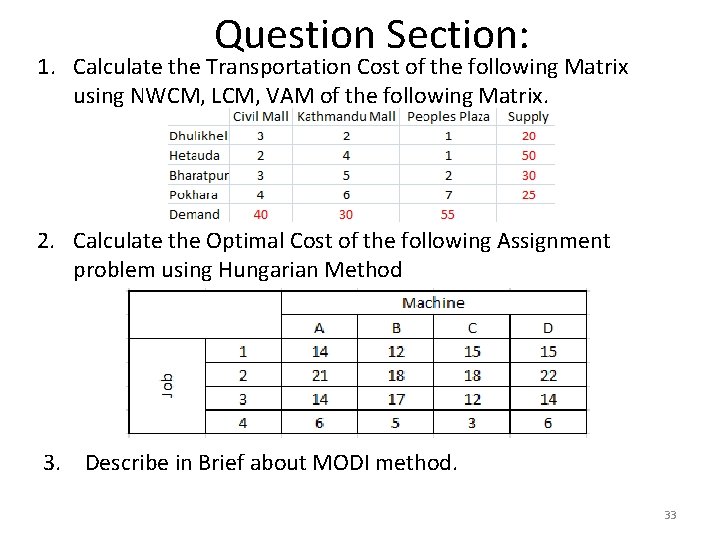
Question Section: 1. Calculate the Transportation Cost of the following Matrix using NWCM, LCM, VAM of the following Matrix. 2. Calculate the Optimal Cost of the following Assignment problem using Hungarian Method 3. Describe in Brief about MODI method. 33
References: 1. https: //www. youtube. com/watch? v=1 Ukw 6 yxpmcg By: Tejashree 2. https: //www. youtube. com/watch? v=f. TTrj. KL-r. J 0 By: Sujoy Krishna Das 3. https: //www. youtube. com/watch? v=q 7 VMz. OTZvq. M By: Tejashree 4 Operation Research: An Introduction, Eight Edition By: Hamdy A. Taha 34
Any Queries? ? ? 35
Thank You 36
- Slides: 36