
PRESENTATION ON SUBJECT FUZZY SETS AND THEIR APPLICATIONS

PRESENTATION ON SUBJECT FUZZY SETS AND THEIR APPLICATIONS Presendted by : Dr. premlata verma

INTRODUCTION
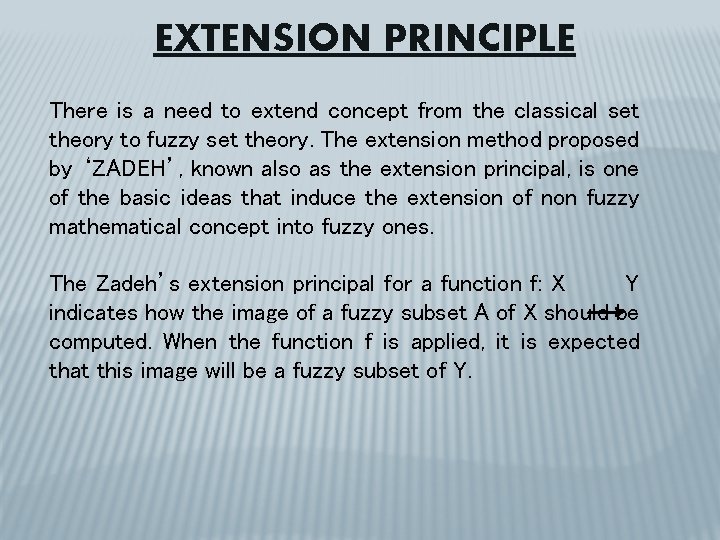
EXTENSION PRINCIPLE There is a need to extend concept from the classical set theory to fuzzy set theory. The extension method proposed by ‘ZADEH’, known also as the extension principal, is one of the basic ideas that induce the extension of non fuzzy mathematical concept into fuzzy ones. The Zadeh’s extension principal for a function f: X Y indicates how the image of a fuzzy subset A of X should be computed. When the function f is applied, it is expected that this image will be a fuzzy subset of Y.
FIRST DECOMPOSITION THEOREM In theory of fuzzy system, the cut set of fuzzy sets play of important role, which reveals the relationship between the fuzzy sets and classical sets. Furthermore, decomposition theorem can be obtained based on the cut sets. The cut sets of fuzzy sets can also be described by neighbourhood relation of fuzzy sets, which has many applications in fuzzy topology and fuzzy algebra. CONVEX SET The convex and strongly convex fully sets in the real line are characterized by means of the piece – wise monotonic function. A concept of a convex function sets was introduced by ‘ZADEH’.

EXTENSION PRINCIPLE
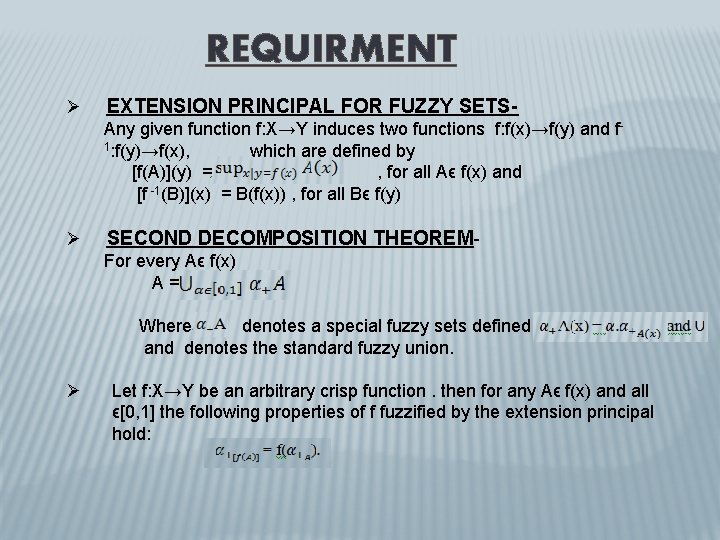
REQUIRMENT Ø EXTENSION PRINCIPAL FOR FUZZY SETSAny given function f: X→Y induces two functions f: f(x)→f(y) and f 1: f(y)→f(x), which are defined by [f(A)](y) = , for all Aϵ f(x) and [f -1(B)](x) = B(f(x)) , for all Bϵ f(y) Ø SECOND DECOMPOSITION THEOREMFor every Aϵ f(x) A= Where, denotes a special fuzzy sets defined by and denotes the standard fuzzy union. Ø Let f: X→Y be an arbitrary crisp function. then for any Aϵ f(x) and all ϵ[0, 1] the following properties of f fuzzified by the extension principal hold:
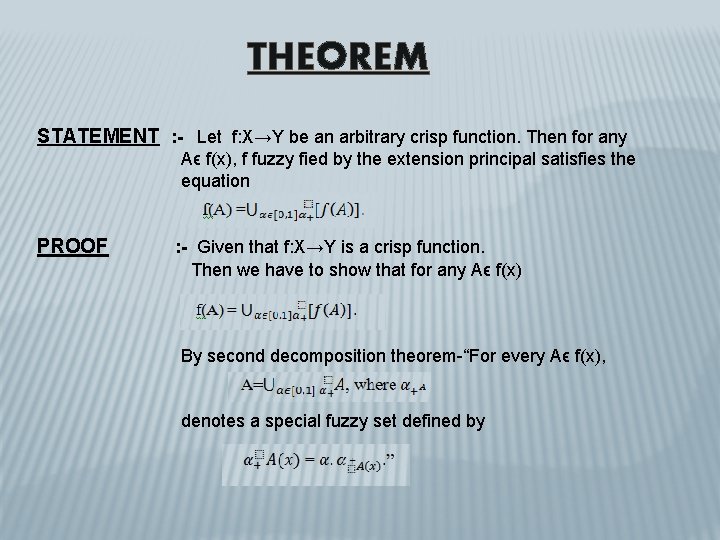
THEOREM STATEMENT : - Let f: X→Y be an arbitrary crisp function. Then for any Aϵ f(x), f fuzzy fied by the extension principal satisfies the equation PROOF : - Given that f: X→Y is a crisp function. Then we have to show that for any Aϵ f(x) By second decomposition theorem-“For every Aϵ f(x), denotes a special fuzzy set defined by
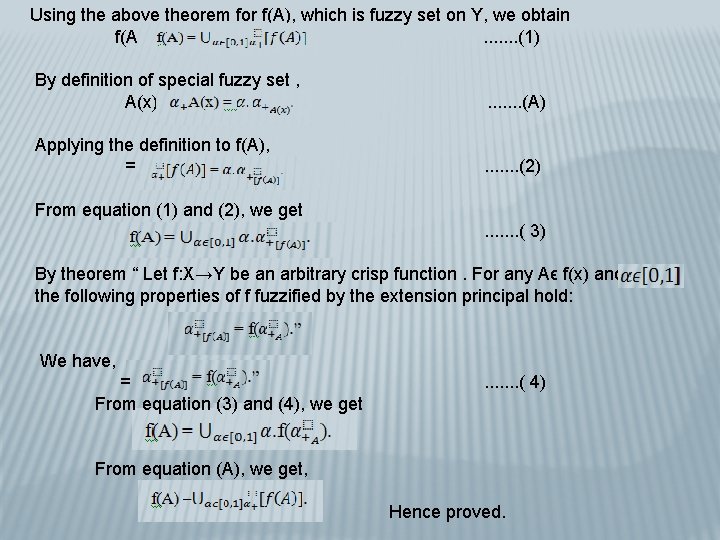
Using the above theorem for f(A), which is fuzzy set on Y, we obtain f(A) =. . . . (1) By definition of special fuzzy set , A(x) = . . . . (A) Applying the definition to f(A), = . . . . (2) From equation (1) and (2), we get. . . . ( 3) By theorem “ Let f: X→Y be an arbitrary crisp function. For any Aϵ f(x) and all the following properties of f fuzzified by the extension principal hold: We have, = From equation (3) and (4), we get . . . . ( 4) From equation (A), we get, Hence proved.
FIRST DECOMPOSITION THEOREM
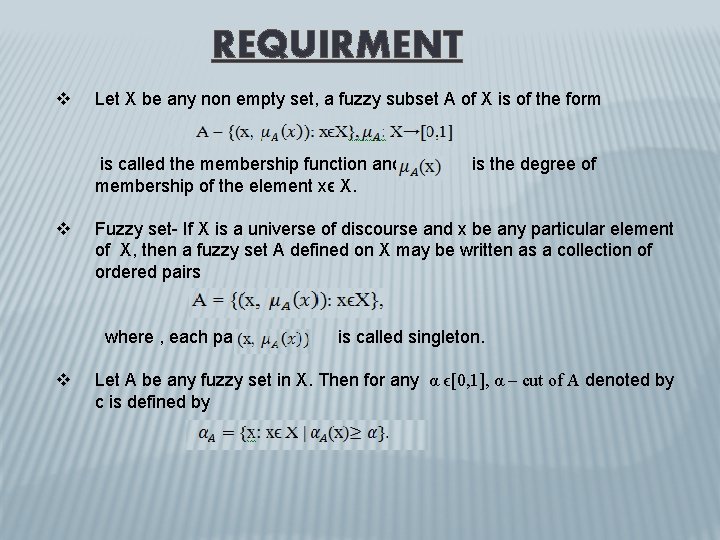
REQUIRMENT v Let X be any non empty set, a fuzzy subset A of X is of the form is called the membership function and membership of the element xϵ X. v Fuzzy set- If X is a universe of discourse and x be any particular element of X, then a fuzzy set A defined on X may be written as a collection of ordered pairs where , each pair v is the degree of is called singleton. Let A be any fuzzy set in X. Then for any α ϵ[0, 1], α – cut of A denoted by c is defined by
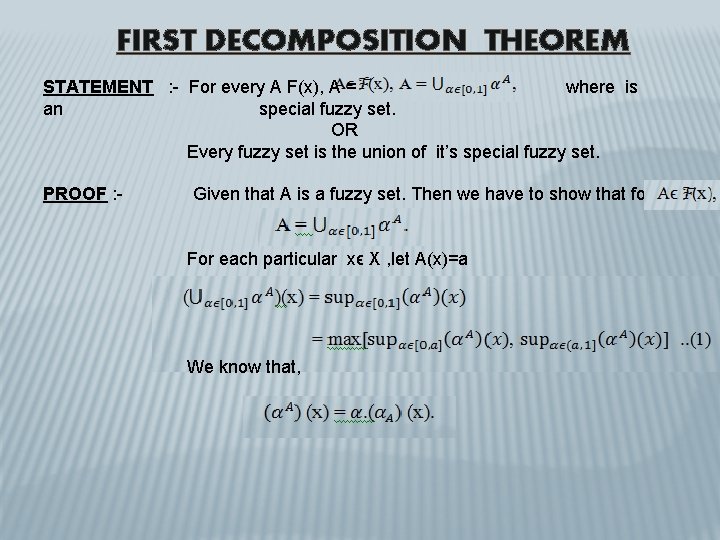
FIRST DECOMPOSITION THEOREM STATEMENT : - For every A F(x), A = where is an special fuzzy set. OR Every fuzzy set is the union of it’s special fuzzy set. PROOF : - Given that A is a fuzzy set. Then we have to show that for every For each particular xϵ X , let A(x)=a We know that,
![Now, when [0, a], then And when , then](http://slidetodoc.com/presentation_image/1c8da3fde422b465852b997b78f267e1/image-12.jpg "Now, when [0, a], then And when , then")
Now, when [0, a], then And when , then
![By (1), we have = max[a, 0] =a = A(x) Therefore, Hence proved.](http://slidetodoc.com/presentation_image/1c8da3fde422b465852b997b78f267e1/image-13.jpg "By (1), we have = max[a, 0] =a = A(x) Therefore, Hence proved.")
By (1), we have = max[a, 0] =a = A(x) Therefore, Hence proved.

CONVEX SET
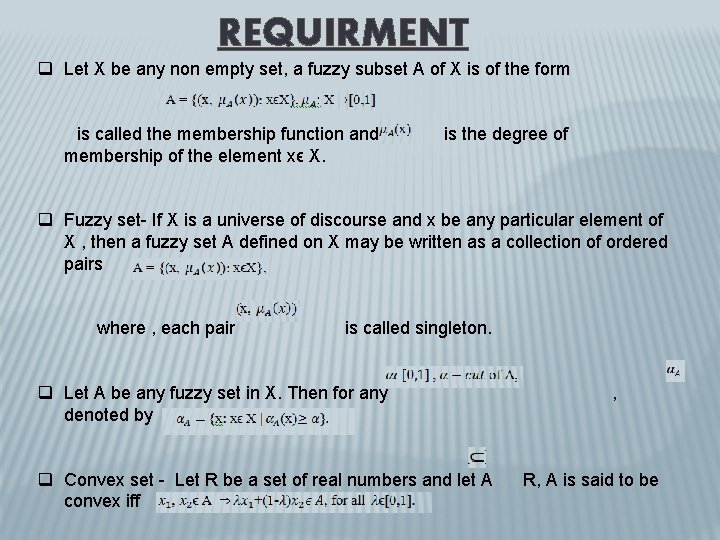
REQUIRMENT q Let X be any non empty set, a fuzzy subset A of X is of the form is called the membership function and membership of the element xϵ X. is the degree of q Fuzzy set- If X is a universe of discourse and x be any particular element of X , then a fuzzy set A defined on X may be written as a collection of ordered pairs where , each pair is called singleton. q Let A be any fuzzy set in X. Then for any denoted by is defined by q Convex set - Let R be a set of real numbers and let A convex iff , R, A is said to be
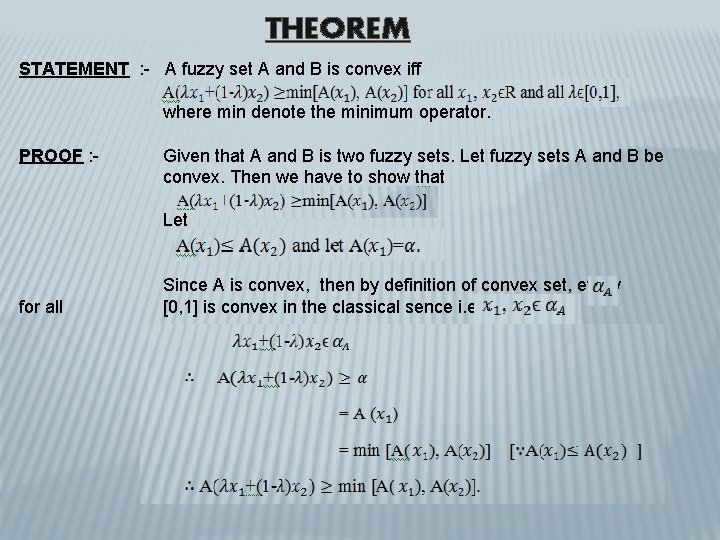
THEOREM STATEMENT : - A fuzzy set A and B is convex iff where min denote the minimum operator. PROOF : - Given that A and B is two fuzzy sets. Let fuzzy sets A and B be convex. Then we have to show that Let for all Since A is convex, then by definition of convex set, every [0, 1] is convex in the classical sence i. e. ,
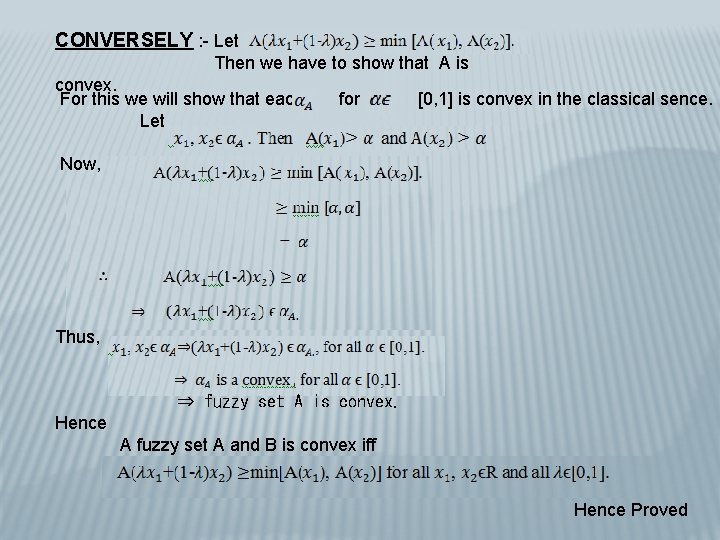
CONVERSELY : - Let Then we have to show that A is convex. For this we will show that each Let for all [0, 1] is convex in the classical sence. Now, Thus, ⇒ fuzzy set A is convex. Hence A fuzzy set A and B is convex iff Hence Proved

THANK YOU…
- Slides: 18