
Presentation on interoperability approach adopted in SADC Low

Presentation on interoperability approach adopted in SADC Low value Credit Transfers Cleared on an Immediate Basis (TCIB)
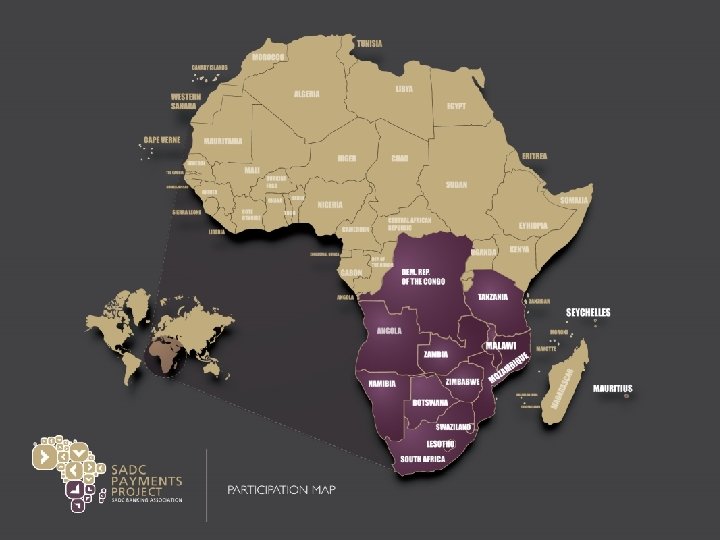

SADC Payments Project • Project driven under the SADC Finance and Investment Protocol • Governed at the Committee of Central Bank Governors • SADC Banking Association mandated to develop the various payment schemes and interface with the central bank settlement systems • In order to increase financial inclusion in the region non-banks have also been brought to the table in order to develop suitable solutions for end clients
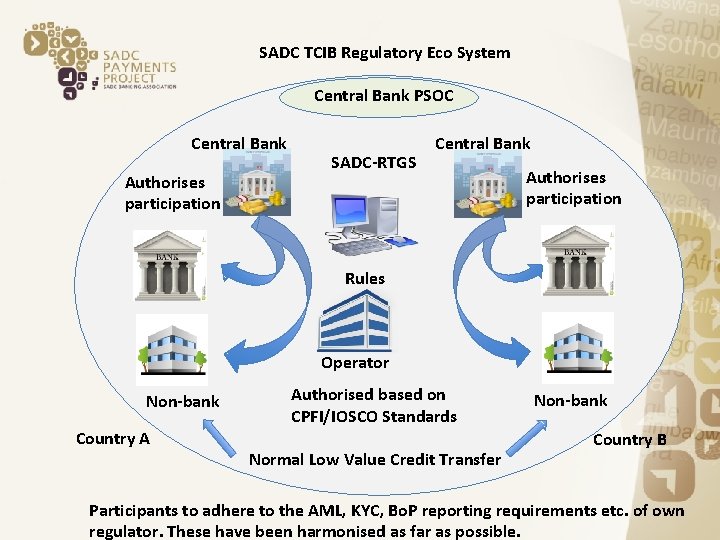
SADC TCIB Regulatory Eco System Central Bank PSOC Central Bank Authorises participation SADC-RTGS Central Bank Authorises participation Rules Operator Non-bank Country A Authorised based on CPFI/IOSCO Standards Normal Low Value Credit Transfer Non-bank Country B Participants to adhere to the AML, KYC, Bo. P reporting requirements etc. of own regulator. These have been harmonised as far as possible.
Started with the operating model • Needed to include all eligible participants • Needed to ensure use of existing intra-country settlement mechanisms • Needed to reuse existing infrastructure where possible • Needed to consider regulatory requirements

SADC Low Value Credit Transfers Cleared on an immediate basis via a RCSO operating model Bank can have various roles; -Send own payments -Manages Trust account -Settlement Bank -Nostro settlement bank for non-SIRESS currencies -FX provider RTGS being a multi-currency settlement system SADC RTGS Advices of DR or CR Daily Settlement Bank Direct or via local ACH Regional CSO Direct or via Local ACH Bank Direct or via PPSP Nonbank For CICO Agent SMS Notifications/exchange of payment detail Interoperability Agreement PPSP = message switch – FX provider –AML/KYC - operations Nonbank For CICO Agent

Transfers in non-SIRESS currencies Cleared and Settled via correspondent banks through a RCSO High level model Settlement Bank of non-bank or own transfers Bank Nostro Account Normal MT 202 /MT 103 transfer Settlement figures Bank Nonbank Here we would like to interface directly with Central Bank RTGS systems for settlements in any African currency Bank Nostro Account Regional CSO Settlement Bank of Non-bank or own transfers Bank Direct or via PPSP SMS Notifications/exchange of payment detail Interoperability Agreement Nonbank
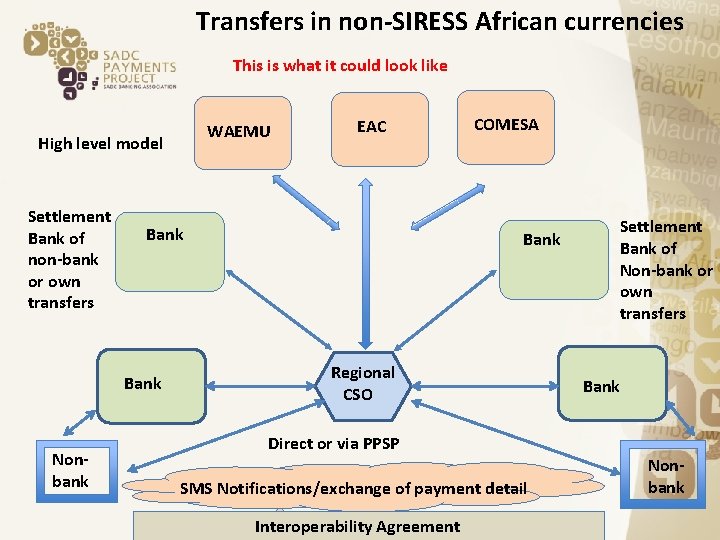
Transfers in non-SIRESS African currencies This is what it could look like WAEMU High level model Settlement Bank of non-bank or own transfers Bank Nonbank EAC COMESA Bank Regional CSO Settlement Bank of Non-bank or own transfers Bank Direct or via PPSP SMS Notifications/exchange of payment detail Interoperability Agreement Nonbank
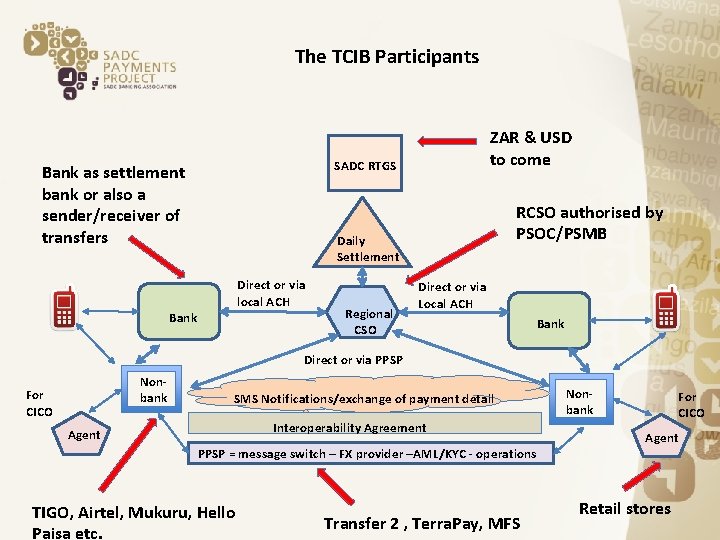
The TCIB Participants ZAR & USD to come SADC RTGS Bank as settlement bank or also a sender/receiver of transfers RCSO authorised by PSOC/PSMB Daily Settlement Direct or via local ACH Bank Regional CSO Direct or via Local ACH Bank Direct or via PPSP Nonbank For CICO SMS Notifications/exchange of payment detail Interoperability Agreement Agent PPSP = message switch – FX provider –AML/KYC - operations TIGO, Airtel, Mukuru, Hello Paisa etc. Transfer 2 , Terra. Pay, MFS Nonbank For CICO Agent Retail stores
How it works
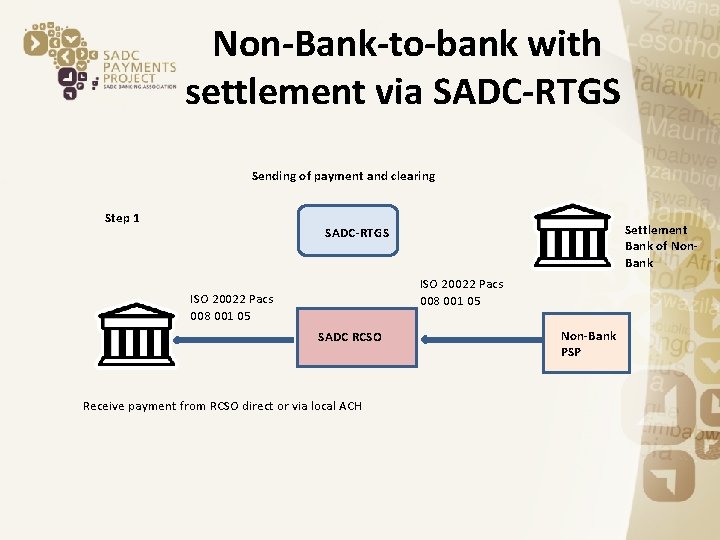
Non-Bank-to-bank with settlement via SADC-RTGS Sending of payment and clearing Step 1 ISO 20022 Pacs 008 001 05 Bank Settlement Bank of Non. Bank SADC-RTGS SADC RCSO Receive payment from RCSO direct or via local ACH Non-Bank PSP
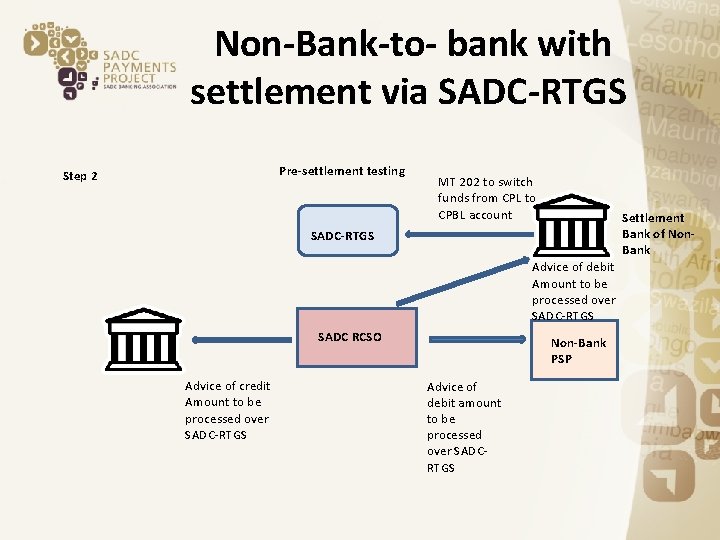
Non-Bank-to- bank with settlement via SADC-RTGS Pre-settlement testing Step 2 MT 202 to switch funds from CPL to CPBL account Settlement Bank of Non. Bank SADC-RTGS Advice of debit Amount to be processed over SADC-RTGS Bank SADC RCSO Advice of credit Amount to be processed over SADC-RTGS Non-Bank PSP Advice of debit amount to be processed over SADCRTGS
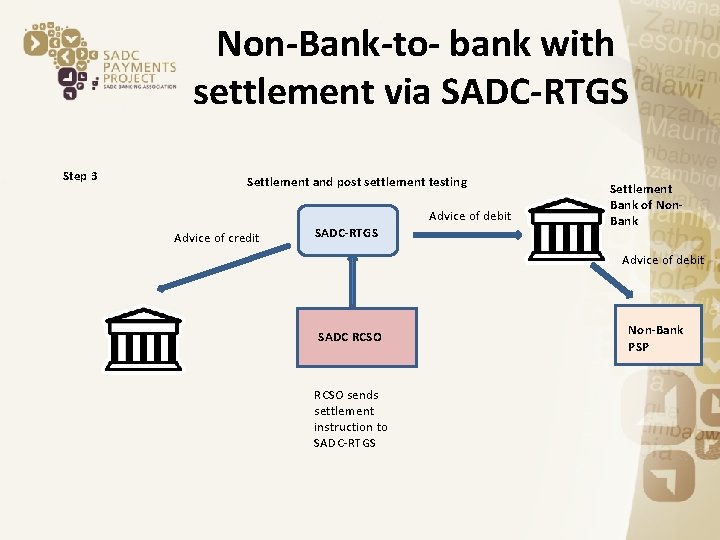
Non-Bank-to- bank with settlement via SADC-RTGS Step 3 Settlement and post settlement testing Advice of credit SADC-RTGS Advice of debit Settlement Bank of Non. Bank Advice of debit Bank SADC RCSO sends settlement instruction to SADC-RTGS Non-Bank PSP
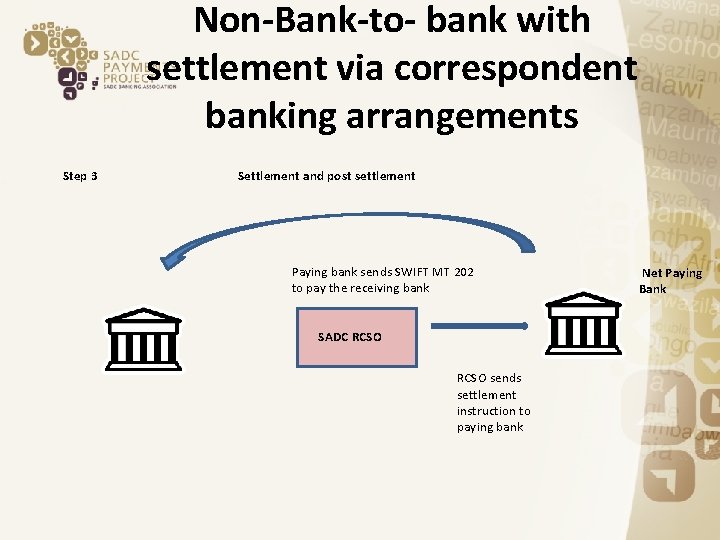
Non-Bank-to- bank with settlement via correspondent banking arrangements Step 3 Settlement and post settlement Paying bank sends SWIFT MT 202 to pay the receiving bank Bank SADC RCSO sends settlement instruction to paying bank Net Paying Bank
Components of a payment scheme • A payment scheme is more than just a switch and some rules. • It needs to comply with regulatory requirements • The infrastructure to be efficient, safe and secure • It needs to allow for suitable competition but at the lowest cost possible to end clients
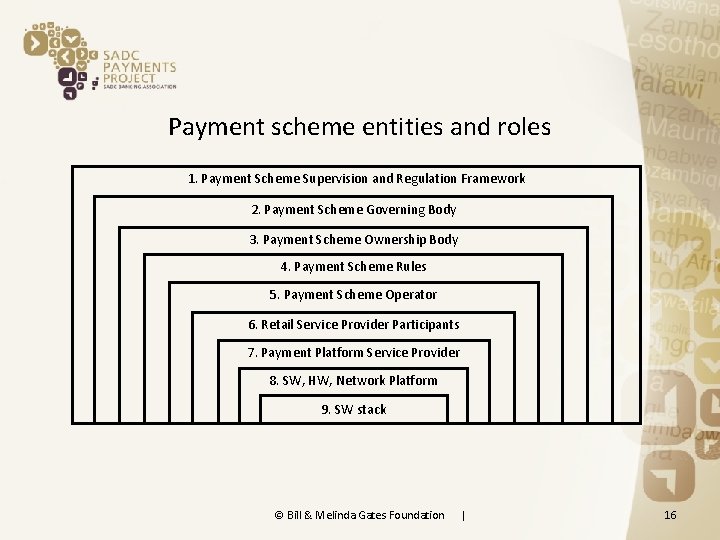
Payment scheme entities and roles 1. Payment Scheme Supervision and Regulation Framework 2. Payment Scheme Governing Body 3. Payment Scheme Ownership Body 4. Payment Scheme Rules 5. Payment Scheme Operator 6. Retail Service Provider Participants 7. Payment Platform Service Provider 8. SW, HW, Network Platform 9. SW stack © Bill & Melinda Gates Foundation | 16
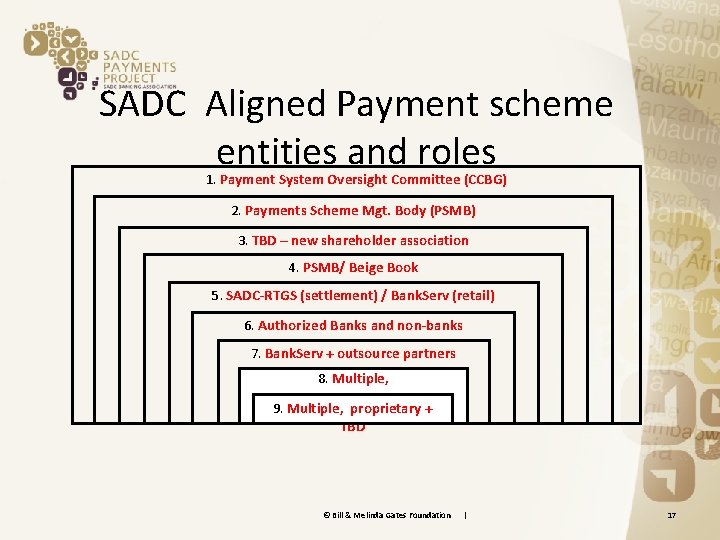
SADC Aligned Payment scheme entities and roles 1. Payment System Oversight Committee (CCBG) 2. Payments Scheme Mgt. Body (PSMB) 3. TBD – new shareholder association 4. PSMB/ Beige Book 5. SADC-RTGS (settlement) / Bank. Serv (retail) 6. Authorized Banks and non-banks 7. Bank. Serv + outsource partners 8. Multiple, 9. Multiple, proprietary + TBD © Bill & Melinda Gates Foundation | 17

Roles explained • PSOC – Central Bank Payment System Oversight Committee with representatives from all countries using the SADC –RTGS • PSMB – Payment Scheme Management Body – Self regulating body with representatives from all SADC countries using the SADC-RTGS • Payment Scheme Ownership Body – an association representing the participants – user group • Rule book – housed in the SADC Beige Book • SADC-RTGS for settlement and RCSO for clearing • Authorised banks and non-banks • Retail payment platform provider • IT platform – insourced/outsourced and networks • Software components
Areas where much work was done • Lots of time, effort and money allowed us to work on the following important aspects; • - Message standards • - Connectivity • - Meeting regulatory requirements • - Commercials • - Pre-settlement risk • - Supporting documentation
Aspects worked out with regulators • • • Transfers will be settled by banks Central Banks determine transfer limits Central Banks set KYC, AML and other regulatory requirements Operator authorised in terms of CPFI/IOSCO standards Operator manages limits and rejects transactions exceeding limits Operating model fully documented All participants bound by scheme rules Bo. P reporting information standardised SADC PSOC has oversight Central banks regulate both banks and non-banks and therefore central bank in SADC at other end of the transaction has assurance that all central banks in SADC regulate the same scheme on the same basis
Other aspects of the scheme • Commercials – client facing component out of scope – Operator charges the sender – Pricing fame work document developed to guide participants on how they should handle any charges in the chain. • Supporting documentation - Beige Book covering operating model, rules and regulatory requirements – message schemas and examples – associated documents e. g. SLA’s , claim procedures etc. – operator agreements and specifications etc.
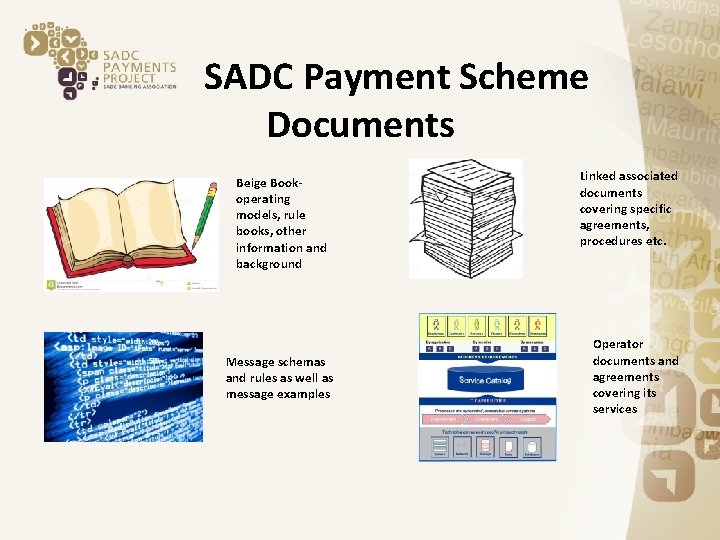
SADC Payment Scheme Documents Beige Bookoperating models, rule books, other information and background Message schemas and rules as well as message examples Linked associated documents covering specific agreements, procedures etc. Operator documents and agreements covering its services
Questions?
- Slides: 23