
Presentation on A Tour of the Major Economic

- Slides: 27
Presentation on A Tour of the Major Economic Indicators www. assignmentpoint. co m
Aggregate Output National income and product accounts (or, national income accounts, for short) are an accounting system used to measure of aggregate economic activity. The measure of aggregate output in the national income accounts is gross domestic product, or GDP. www. assignmentpoint. com
Aggregate Output GDP: Production and Income There are three ways of defining GDP: 1. GDP is the value of the final goods and services produced in the economy during a given period. § A final good is a good that is destined for final consumption. § An intermediate good is a good used in the production of another good. www. assignmentpoint. com
Aggregate Output GDP: Production and Income There are three ways of defining GDP: 2. GDP is the sum of value added in the economy during a given period. § Value added equals the value of a firm’s production minus the value of the intermediate goods it uses in production. www. assignmentpoint. com
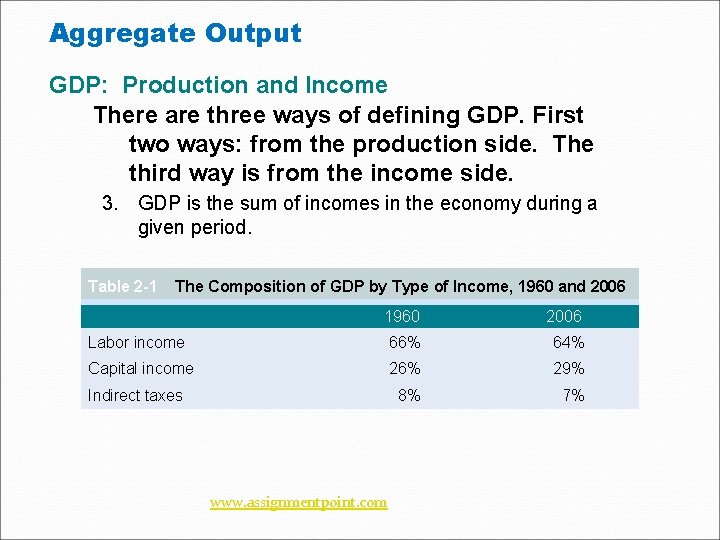
Aggregate Output GDP: Production and Income There are three ways of defining GDP. First two ways: from the production side. The third way is from the income side. 3. GDP is the sum of incomes in the economy during a given period. Table 2 -1 The Composition of GDP by Type of Income, 1960 and 2006 1960 2006 Labor income 66% 64% Capital income 26% 29% 8% 7% Indirect taxes www. assignmentpoint. com
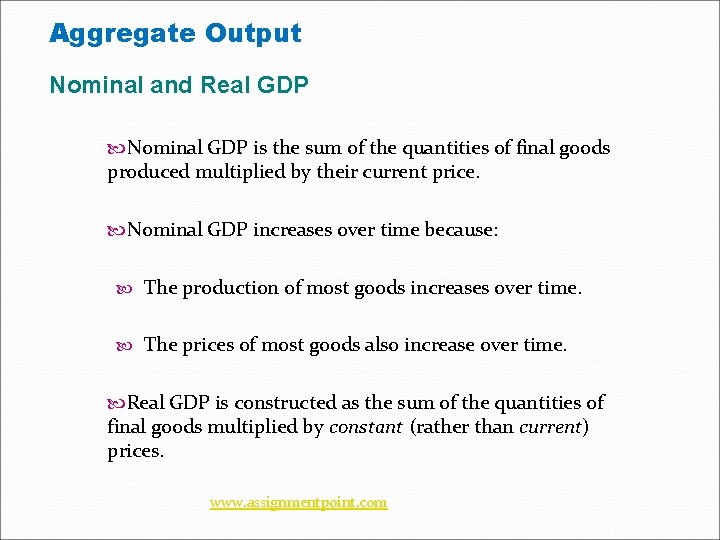
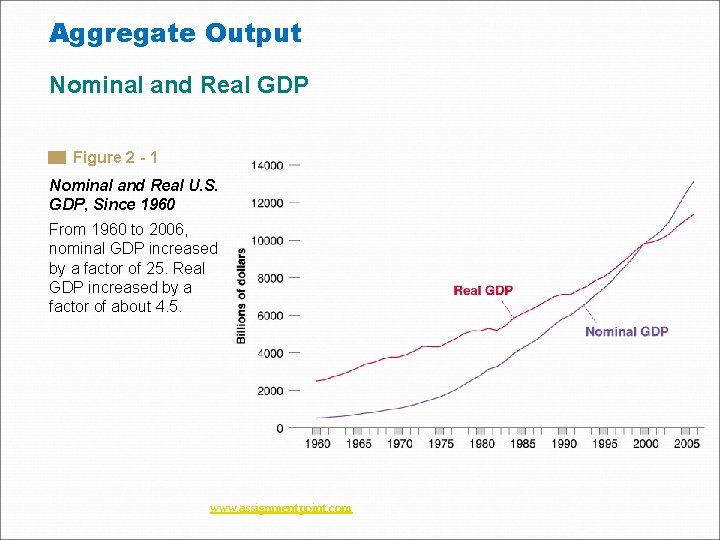
Aggregate Output Nominal and Real GDP Nominal GDP is the sum of the quantities of final goods produced multiplied by their current price. Nominal GDP increases over time because: The production of most goods increases over time. The prices of most goods also increase over time. Real GDP is constructed as the sum of the quantities of final goods multiplied by constant (rather than current) prices. www. assignmentpoint. com
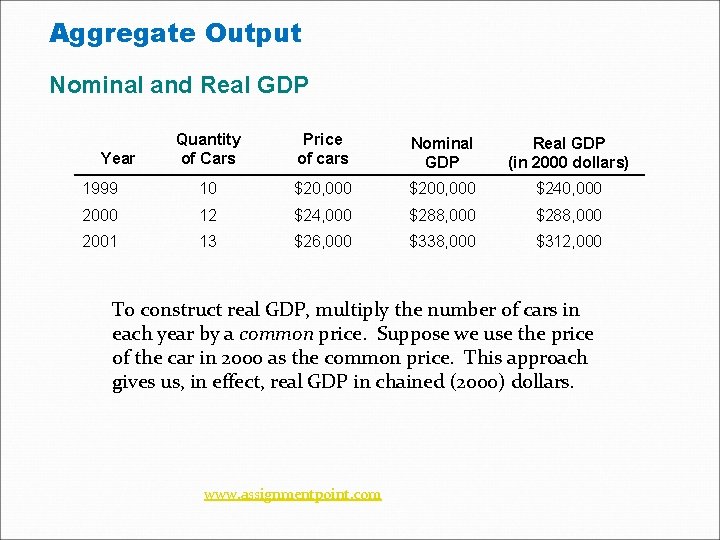
Aggregate Output Nominal and Real GDP Quantity of Cars Price of cars Nominal GDP Real GDP (in 2000 dollars) 1999 10 $20, 000 $200, 000 $240, 000 2000 12 $24, 000 $288, 000 2001 13 $26, 000 $338, 000 $312, 000 Year To construct real GDP, multiply the number of cars in each year by a common price. Suppose we use the price of the car in 2000 as the common price. This approach gives us, in effect, real GDP in chained (2000) dollars. www. assignmentpoint. com
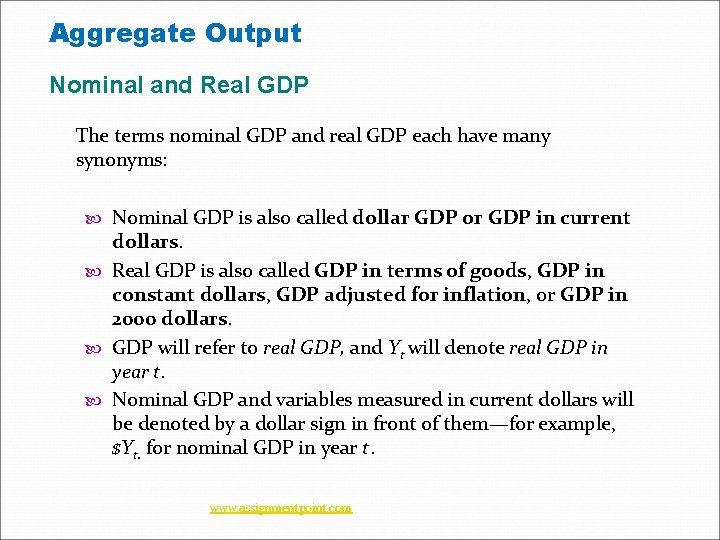
Aggregate Output Nominal and Real GDP The terms nominal GDP and real GDP each have many synonyms: Nominal GDP is also called dollar GDP or GDP in current dollars. Real GDP is also called GDP in terms of goods, GDP in constant dollars, GDP adjusted for inflation, or GDP in 2000 dollars. GDP will refer to real GDP, and Yt will denote real GDP in year t. Nominal GDP and variables measured in current dollars will be denoted by a dollar sign in front of them—for example, $Yt. for nominal GDP in year t. www. assignmentpoint. com
Aggregate Output Nominal and Real GDP Figure 2 - 1 Nominal and Real U. S. GDP, Since 1960 From 1960 to 2006, nominal GDP increased by a factor of 25. Real GDP increased by a factor of about 4. 5. www. assignmentpoint. com
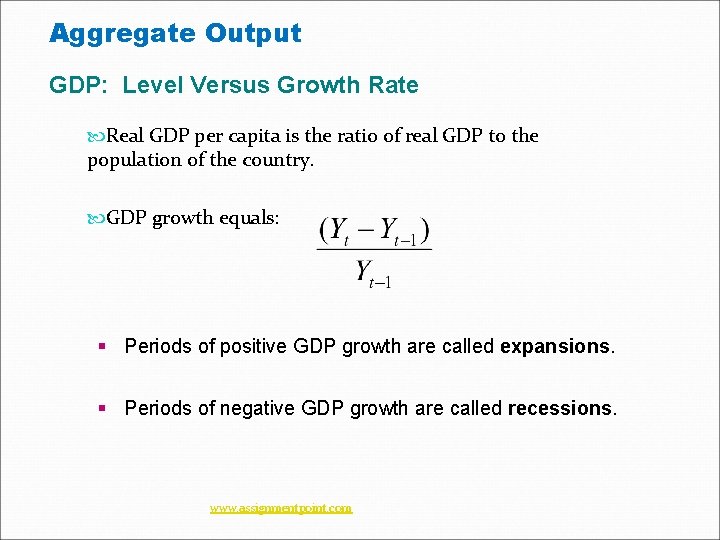
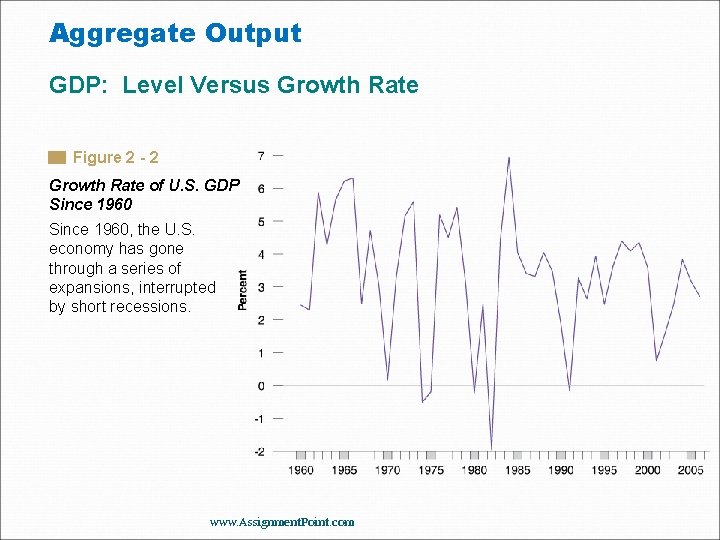
Aggregate Output GDP: Level Versus Growth Rate Real GDP per capita is the ratio of real GDP to the population of the country. GDP growth equals: § Periods of positive GDP growth are called expansions. § Periods of negative GDP growth are called recessions. www. assignmentpoint. com
Aggregate Output GDP: Level Versus Growth Rate Figure 2 - 2 Growth Rate of U. S. GDP Since 1960, the U. S. economy has gone through a series of expansions, interrupted by short recessions. www. Assignment. Point. com
The Other Major Macroeconomic Variables The Unemployment Rate Because it is a measure of aggregate activity, GDP is obviously the most important macroeconomic variable. But two other variables tell us about other important aspects of how an economic is performing: Unemployment Inflation www. Assignment. Point. com
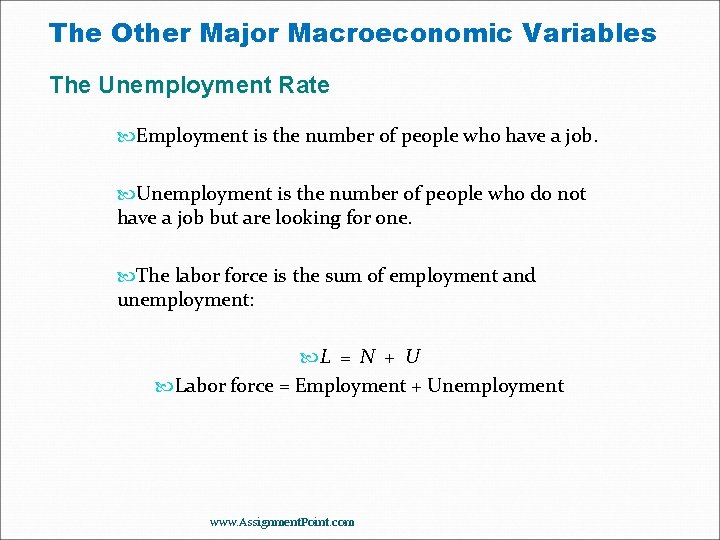
The Other Major Macroeconomic Variables The Unemployment Rate Employment is the number of people who have a job. Unemployment is the number of people who do not have a job but are looking for one. The labor force is the sum of employment and unemployment: L = N + U Labor force = Employment + Unemployment www. Assignment. Point. com
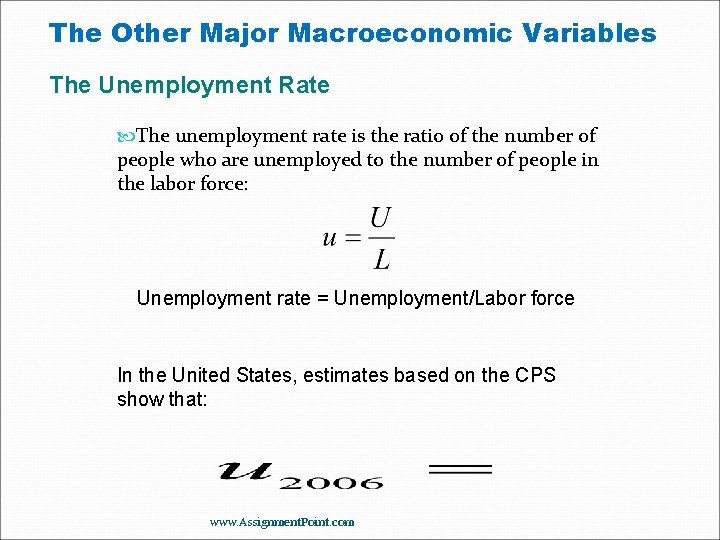
The Other Major Macroeconomic Variables The Unemployment Rate The unemployment rate is the ratio of the number of people who are unemployed to the number of people in the labor force: Unemployment rate = Unemployment/Labor force In the United States, estimates based on the CPS show that: www. Assignment. Point. com
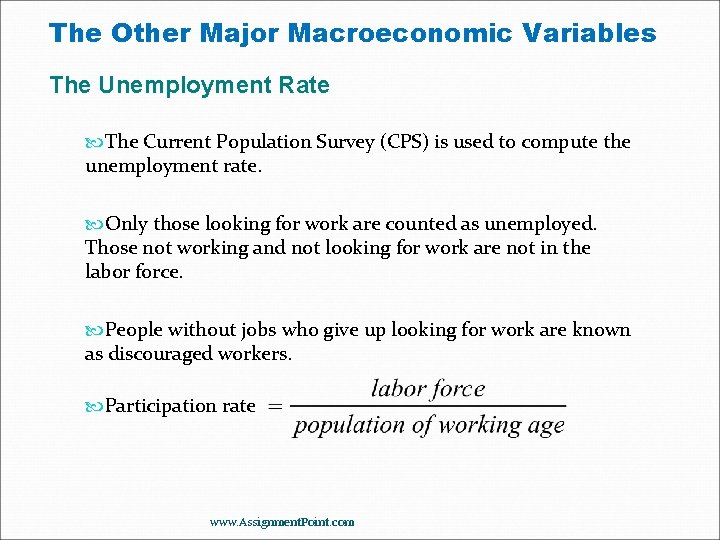
The Other Major Macroeconomic Variables The Unemployment Rate The Current Population Survey (CPS) is used to compute the unemployment rate. Only those looking for work are counted as unemployed. Those not working and not looking for work are not in the labor force. People without jobs who give up looking for work are known as discouraged workers. Participation rate www. Assignment. Point. com
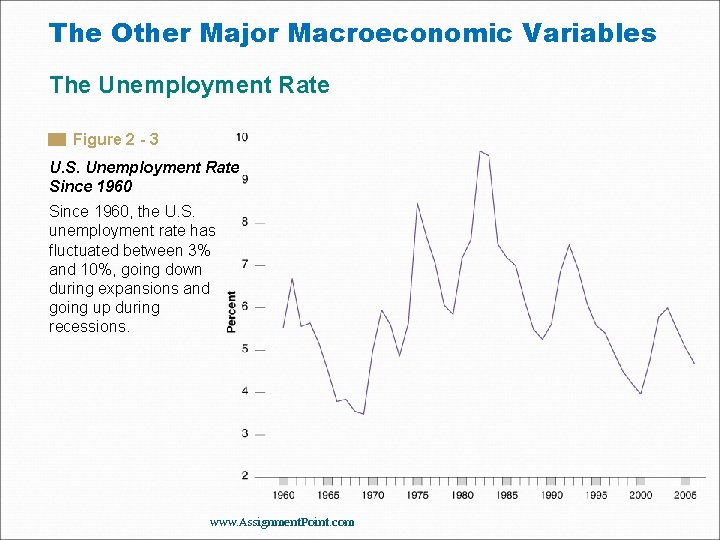
The Other Major Macroeconomic Variables The Unemployment Rate Figure 2 - 3 U. S. Unemployment Rate Since 1960, the U. S. unemployment rate has fluctuated between 3% and 10%, going down during expansions and going up during recessions. www. Assignment. Point. com
The Other Major Macroeconomic Variables The Unemployment Rate Why Do Economists Care About Unemployment? Economists care about unemployment for two reasons: Because of its direct effects on the welfare of the unemployed. Because it provides a signal that the economy may not be using some of its resources efficiently. www. Assignment. Point. com
The Other Major Macroeconomic Variables The Inflation Rate Inflation is a sustained rise in the general level of prices —the price level. The inflation rate is the rate at which the price level increases. Symmetrically, deflation is a sustained decline in the price level. It corresponds to a negative inflation rate. Deflation is rare, but it does happen. Japan has experienced deflation since the late 1990 s. www. Assignment. Point. com
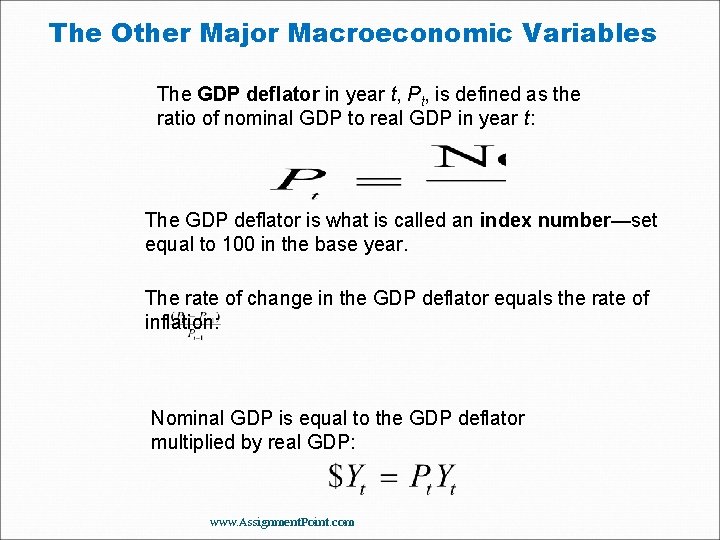
The Other Major Macroeconomic Variables The GDP deflator in year t, Pt, is defined as the ratio of nominal GDP to real GDP in year t: The GDP deflator is what is called an index number—set equal to 100 in the base year. The rate of change in the GDP deflator equals the rate of inflation: Nominal GDP is equal to the GDP deflator multiplied by real GDP: www. Assignment. Point. com
The Other Major Macroeconomic Variables The Inflation Rate The Consumer Price Index The GDP deflator measures the average price of output, while the consumer price index, or CPI, measures the average price of consumption, or equivalently, the cost of living. The CPI gives the cost in dollars of a specific list of goods and services over time, which attempts to represent the consumption basket of a typical urban consumer. www. Assignment. Point. com
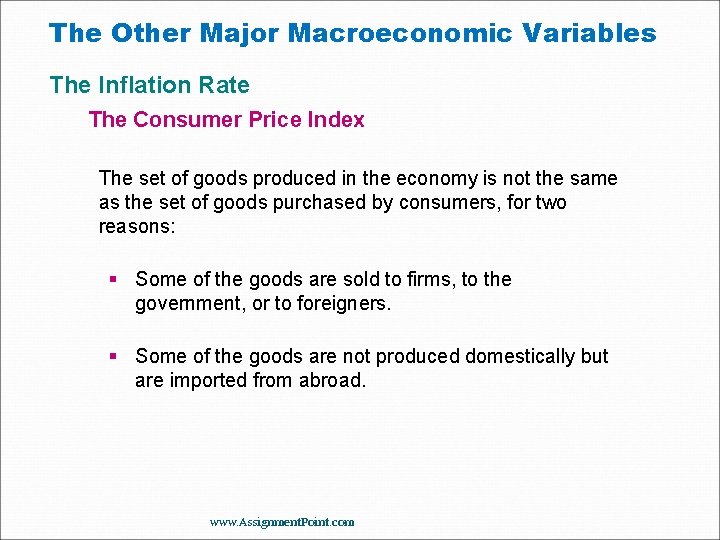
The Other Major Macroeconomic Variables The Inflation Rate The Consumer Price Index The set of goods produced in the economy is not the same as the set of goods purchased by consumers, for two reasons: § Some of the goods are sold to firms, to the government, or to foreigners. § Some of the goods are not produced domestically but are imported from abroad. www. Assignment. Point. com
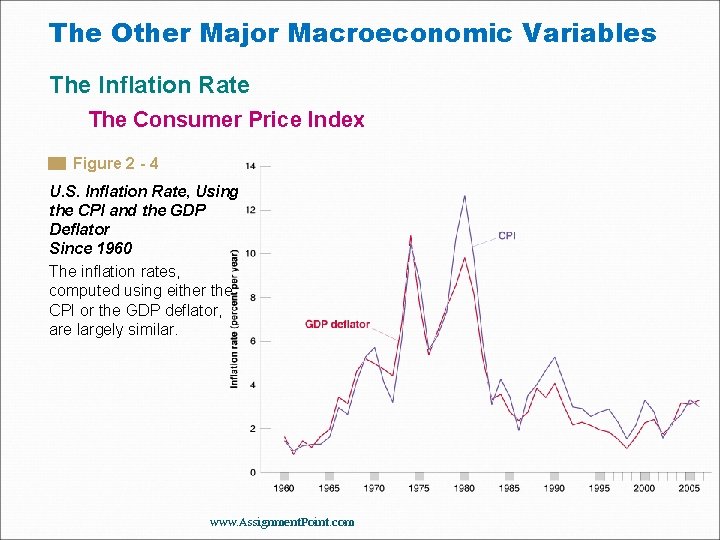
The Other Major Macroeconomic Variables The Inflation Rate The Consumer Price Index Figure 2 - 4 U. S. Inflation Rate, Using the CPI and the GDP Deflator Since 1960 The inflation rates, computed using either the CPI or the GDP deflator, are largely similar. www. Assignment. Point. com
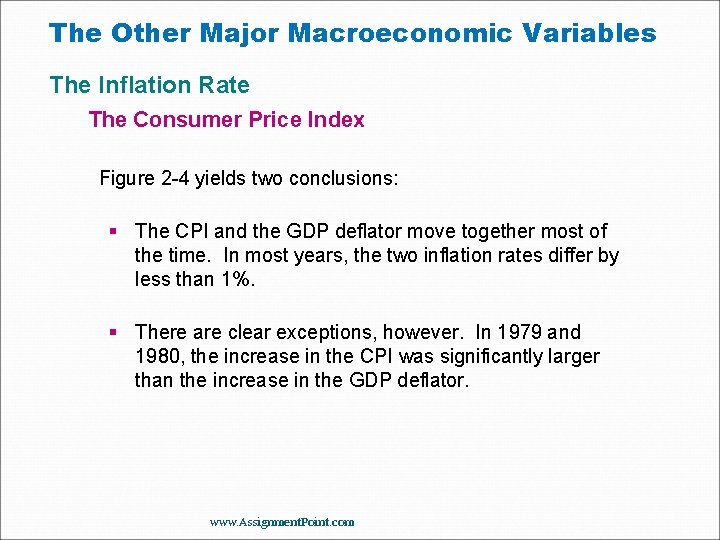
The Other Major Macroeconomic Variables The Inflation Rate The Consumer Price Index Figure 2 -4 yields two conclusions: § The CPI and the GDP deflator move together most of the time. In most years, the two inflation rates differ by less than 1%. § There are clear exceptions, however. In 1979 and 1980, the increase in the CPI was significantly larger than the increase in the GDP deflator. www. Assignment. Point. com
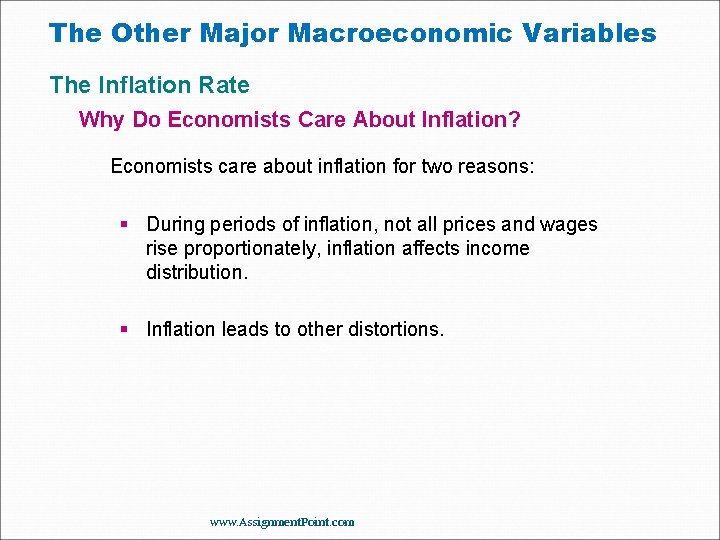
The Other Major Macroeconomic Variables The Inflation Rate Why Do Economists Care About Inflation? Economists care about inflation for two reasons: § During periods of inflation, not all prices and wages rise proportionately, inflation affects income distribution. § Inflation leads to other distortions. www. Assignment. Point. com
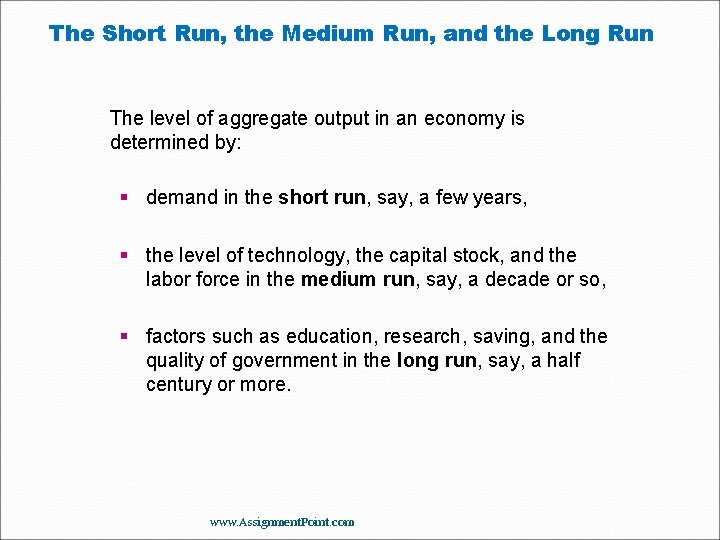
The Short Run, the Medium Run, and the Long Run The level of aggregate output in an economy is determined by: § demand in the short run, say, a few years, § the level of technology, the capital stock, and the labor force in the medium run, say, a decade or so, § factors such as education, research, saving, and the quality of government in the long run, say, a half century or more. www. Assignment. Point. com
2 -4 A Tour of the Book The book is organized into three parts: § A core which has three parts – the short run, the medium run, and the long run. § Three extensions which explore the role of expectations, closed economies, and expansion and recessions. § A deeper look at the role of microeconomic policy. www. Assignment. Point. com
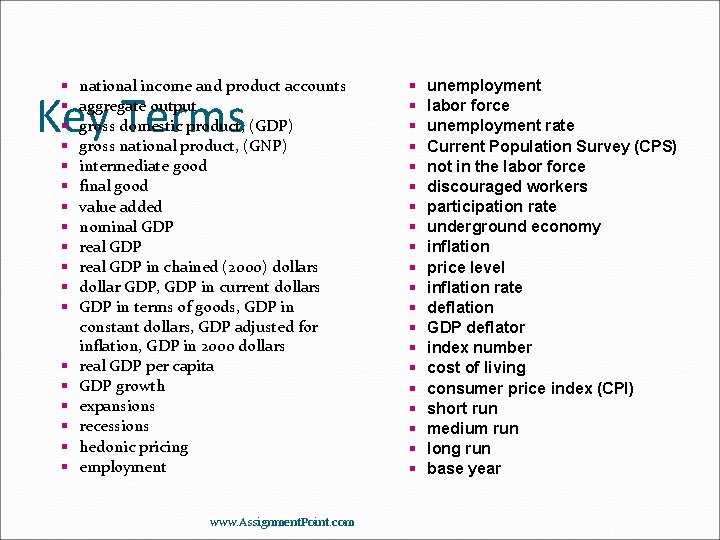
§ § § national income and product accounts aggregate output gross domestic product, (GDP) gross national product, (GNP) intermediate good final good value added nominal GDP real GDP in chained (2000) dollars dollar GDP, GDP in current dollars GDP in terms of goods, GDP in constant dollars, GDP adjusted for inflation, GDP in 2000 dollars real GDP per capita GDP growth expansions recessions hedonic pricing employment Key Terms § § § www. Assignment. Point. com § § § § § unemployment labor force unemployment rate Current Population Survey (CPS) not in the labor force discouraged workers participation rate underground economy inflation price level inflation rate deflation GDP deflator index number cost of living consumer price index (CPI) short run medium run long run base year