
Presentation of the MSFR reactor concept E MERLELUCOTTE
![Feedback coefficient [pcm/K] Operation time [years] Evolution calculations: Very good agreement between the different](https://slidetodoc.com/presentation_image_h/a3c84cae8b09b7794141916231f09a74/image-9.jpg "Feedback coefficient [pcm/K] Operation time [years] Evolution calculations: Very good agreement between the different")
- Slides: 16
Presentation of the MSFR reactor concept E. MERLE-LUCOTTE Professor at CNRS-IN 2 P 3 -LPSC / Grenoble INP - PHELMA For the MSFR team - M. ALLIBERT, M. AUFIERO, M. BROVCHENKO, D. HEUER, V. GHETTA, A. LAUREAU, E. MERLE-LUCOTTE, P. RUBIOLO merle@lpsc. in 2 p 3. fr With the support of the IN 2 P 3 institute and the PACEN and NEEDS French Programs, and of the EVOL Euratom FP 7 Project Workshop SERPENT and Multiphysics – February 2015 merle@lpsc. in 2 p 3. fr
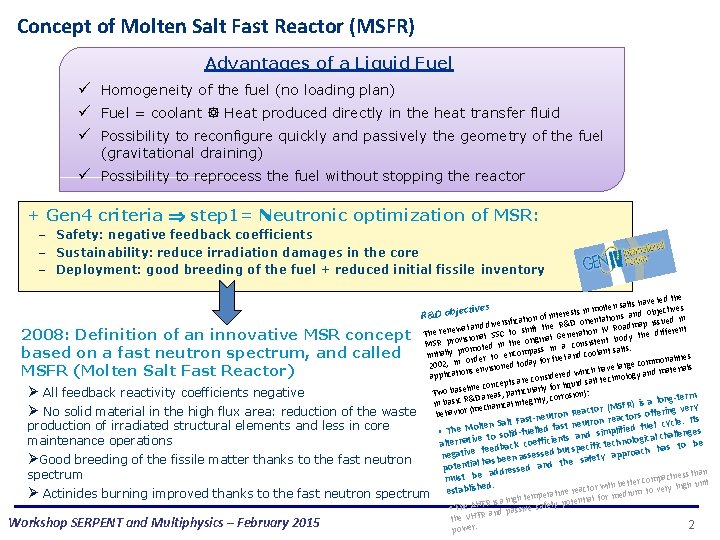
Concept of Molten Salt Fast Reactor (MSFR) Advantages of a Liquid Fuel ü Homogeneity of the fuel (no loading plan) ü Fuel = coolant Heat produced directly in the heat transfer fluid ü Possibility to reconfigure quickly and passively the geometry of the fuel (gravitational draining) ü Possibility to reprocess the fuel without stopping the reactor + Gen 4 criteria step 1= Neutronic optimization of MSR: – Safety: negative feedback coefficients – Sustainability: reduce irradiation damages in the core – Deployment: good breeding of the fuel + reduced initial fissile inventory led the alts have s n e s lt o ts in m objective R&D of interes rientations and n o in ti d a e ic issu D o iversif Roadmap ifferent t the R& wal and d d The rene ional SSC to shif al Generation IV e th y gin vis t bod n te is s n MSR pro moted in the ori o a c ro pass in nt salts. initially p to encom for fuel and coola r e nalities rd o today e commo rials d rg e 2002, in n la io e v is v a hh ate ns en gy and m ered whic applicatio re consid quid salt technolo a ts p e c n r li line co icularly fo Two base reas, part rity, corrosion): a D g-term & R ic g in bas ) is a lon R ical inte F n S a h c (M e r (m ring very eacto behavior tors offe eutron R s objective 2008: Definition of an innovative MSR concept based on a fast neutron spectrum, and called MSFR (Molten Salt Fast Reactor) Ø All feedback reactivity coefficients negative Ø No solid material in the high flux area: reduction of the waste production of irradiated structural elements and less in core maintenance operations ØGood breeding of the fissile matter thanks to the fast neutron spectrum Ø Actinides burning improved thanks to the fast neutron spectrum Workshop SERPENT and Multiphysics – February 2015 Fast-n. Its on reac olten Salt uelled fast neutr fuel cycle es d e fi li p • The M -f im ng d ts and s e to soli ical challe alternativ edback coefficien pecific technolog to be fe ach has d but s e ro s p e s a negative s a e safety has been potential ddressed and th a ess than must be compactn h unit r e tt e b. h ed very hig actor wit establish edium to erature re for m h temp potential TR is a hig • The AH nd passive safety a the VHTR r. e w o p 2
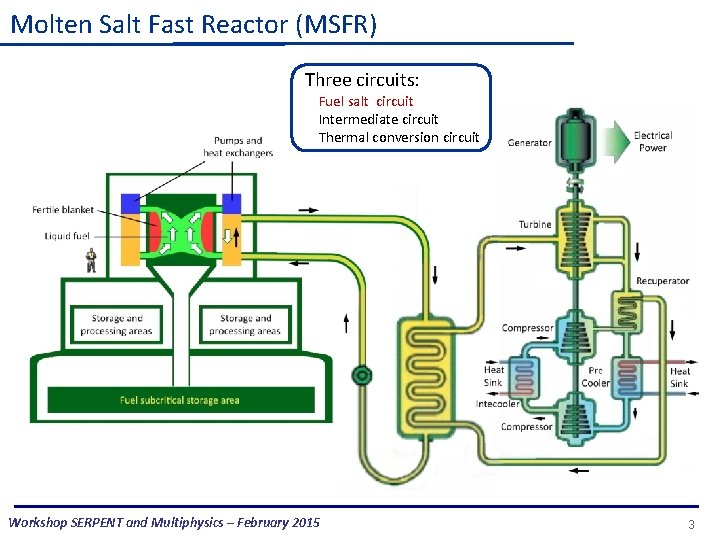
Molten Salt Fast Reactor (MSFR) Three circuits: Fuel salt circuit Intermediate circuit Thermal conversion circuit Workshop SERPENT and Multiphysics – February 2015 3
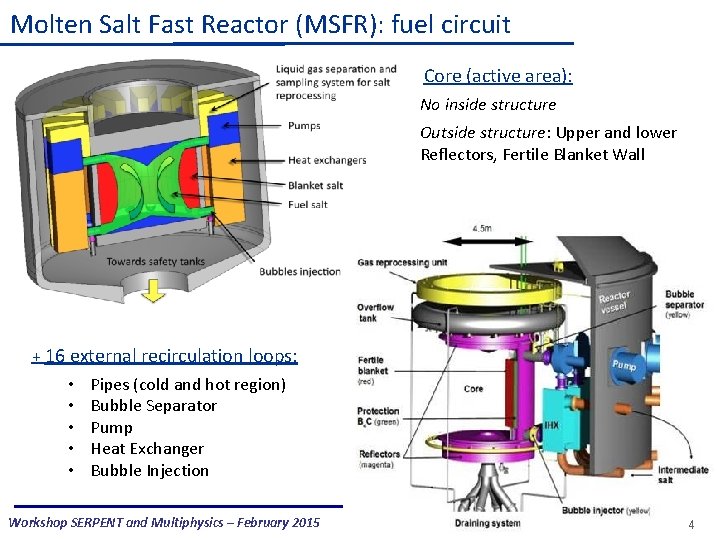
Molten Salt Fast Reactor (MSFR): fuel circuit Core (active area): No inside structure Outside structure: Upper and lower Reflectors, Fertile Blanket Wall + 16 external recirculation loops: • • • Pipes (cold and hot region) Bubble Separator Pump Heat Exchanger Bubble Injection Workshop SERPENT and Multiphysics – February 2015 Intermediate fluid 4
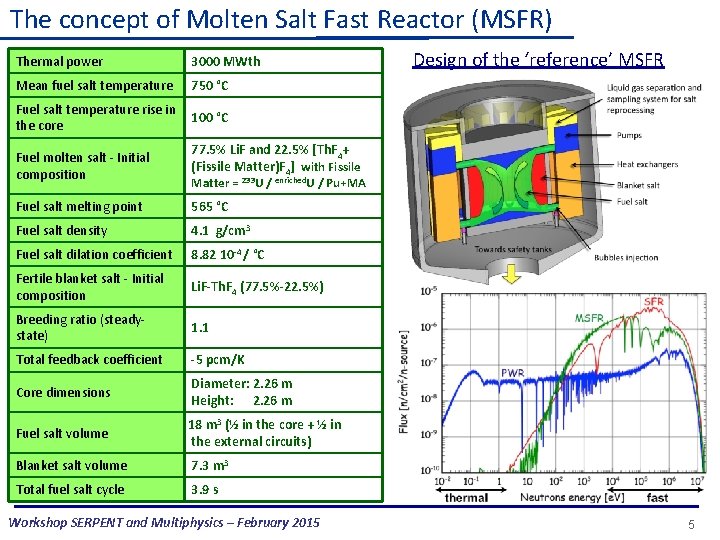
The concept of Molten Salt Fast Reactor (MSFR) Thermal power 3000 MWth Mean fuel salt temperature 750 °C Fuel salt temperature rise in the core 100 °C Fuel molten salt - Initial composition 77. 5% Li. F and 22. 5% [Th. F 4+ (Fissile Matter)F 4] with Fissile Fuel salt melting point 565 °C Fuel salt density 4. 1 g/cm 3 Fuel salt dilation coefficient 8. 82 10‐ 4 / °C Fertile blanket salt - Initial composition Li. F‐Th. F 4 (77. 5%‐ 22. 5%) Breeding ratio (steadystate) 1. 1 Total feedback coefficient ‐ 5 pcm/K Core dimensions Diameter: 2. 26 m Height: 2. 26 m Fuel salt volume 18 m 3 (½ in the core + ½ in the external circuits) Blanket salt volume 7. 3 m 3 Total fuel salt cycle 3. 9 s Design of the ‘reference’ MSFR Matter = 233 U / enriched. U / Pu+MA Workshop SERPENT and Multiphysics – February 2015 5
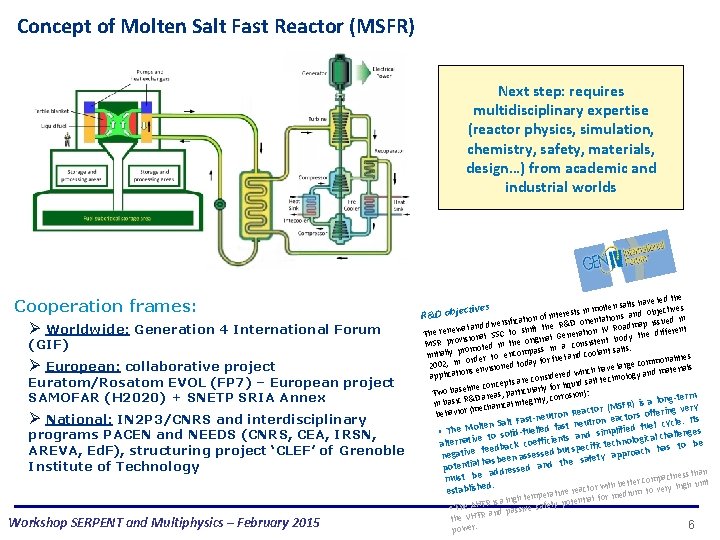
Concept of Molten Salt Fast Reactor (MSFR) Next step: requires multidisciplinary expertise (reactor physics, simulation, chemistry, safety, materials, design…) from academic and industrial worlds Cooperation frames: Ø Worldwide: Generation 4 International Forum (GIF) Ø European: collaborative project Euratom/Rosatom EVOL (FP 7) – European project SAMOFAR (H 2020) + SNETP SRIA Annex Ø National: IN 2 P 3/CNRS and interdisciplinary programs PACEN and NEEDS (CNRS, CEA, IRSN, AREVA, Ed. F), structuring project ‘CLEF’ of Grenoble Institute of Technology Workshop SERPENT and Multiphysics – February 2015 led the alts have s n e s lt o ts in m objective R&D of interes rientations and n o in ti d a e ic issu D o iversif Roadmap ifferent t the R& wal and d d The rene ional SSC to shif al Generation IV e th y gin vis t bod n te is s n MSR pro moted in the ori o a c ro pass in nt salts. initially p to encom for fuel and coola r e nalities rd o today e commo rials d rg e 2002, in n la io e v is v a hh ate ns en gy and m ered whic applicatio re consid quid salt technolo a ts p e c n r li line co icularly fo Two base reas, part rity, corrosion): a D g-term & R ic g in bas ) is a lon R ical inte F n S a h c (M e r (m eacto ring very behavior eutron R tors offe s objective n eac Fast-n. Its st neutro olten Salt fuel cycle es • The M to solid-fuelled fa and simplified ng ts e ical challe alternativ edback coefficien pecific technolog to be fe ach has d but s e ro s p e s a negative s a e safety has been potential ddressed and th a ess than must be compactn h unit r e tt e b. h ed very hig actor wit establish edium to erature re for m h temp potential TR is a hig • The AH nd passive safety a the VHTR r. e w o p 6
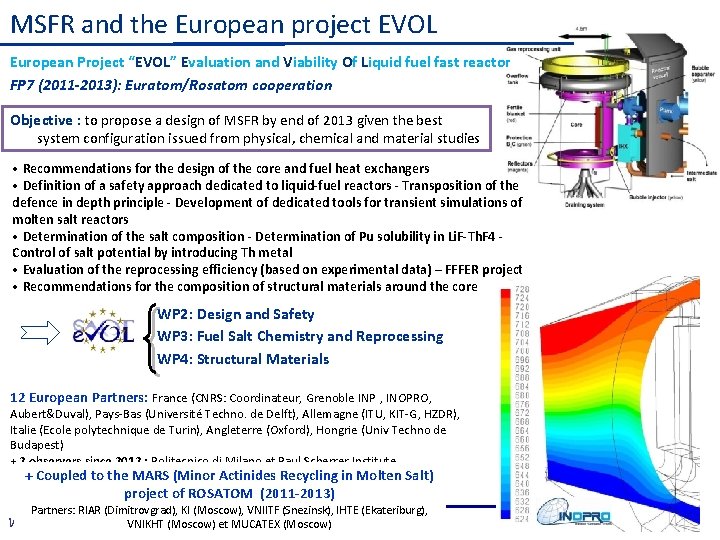
MSFR and the European project EVOL European Project “EVOL” Evaluation and Viability Of Liquid fuel fast reactor FP 7 (2011 -2013): Euratom/Rosatom cooperation Objective : to propose a design of MSFR by end of 2013 given the best system configuration issued from physical, chemical and material studies • Recommendations for the design of the core and fuel heat exchangers • Definition of a safety approach dedicated to liquid‐fuel reactors ‐ Transposition of the defence in depth principle ‐ Development of dedicated tools for transient simulations of molten salt reactors • Determination of the salt composition ‐ Determination of Pu solubility in Li. F‐Th. F 4 ‐ Control of salt potential by introducing Th metal • Evaluation of the reprocessing efficiency (based on experimental data) – FFFER project C • Recommendations for the composition of structural materials around the core WP 2: Design and Safety WP 3: Fuel Salt Chemistry and Reprocessing WP 4: Structural Materials 12 European Partners: France (CNRS: Coordinateur, Grenoble INP , INOPRO, Aubert&Duval), Pays-Bas (Université Techno. de Delft), Allemagne (ITU, KIT-G, HZDR), Italie (Ecole polytechnique de Turin), Angleterre (Oxford), Hongrie (Univ Techno de Budapest) + 2 observers since 2012 : Politecnico di Milano et Paul Scherrer Institute + Coupled to the MARS (Minor Actinides Recycling in Molten Salt) project of ROSATOM (2011‐ 2013) Partners: RIAR (Dimitrovgrad), KI (Moscow), VNIITF (Snezinsk), IHTE (Ekateriburg), Workshop SERPENT and Multiphysics February(Moscow) 2015 VNIKHT (Moscow) et–MUCATEX 7
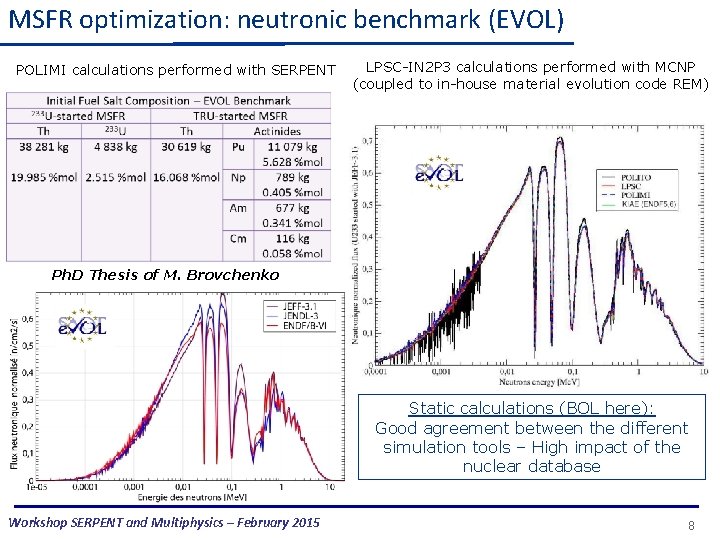
MSFR optimization: neutronic benchmark (EVOL) POLIMI calculations performed with SERPENT LPSC-IN 2 P 3 calculations performed with MCNP (coupled to in-house material evolution code REM) Ph. D Thesis of M. Brovchenko Static calculations (BOL here): Good agreement between the different simulation tools – High impact of the nuclear database Workshop SERPENT and Multiphysics – February 2015 8
Feedback coefficient [pcm/K] Operation time [years] Evolution calculations: Very good agreement between the different simulation tools – High impact of the nuclear database Workshop SERPENT and Multiphysics – February 2015 9
MSFR and Safety Evaluation Design aspects impacting the MSFR safety analysis • Liquid fuel ü ü Molten fuel salt acts as reactor fuel and coolant Relative uniform fuel irradiation A significant part of the fissile inventory is outside the core Fuel reprocessing and loading during reactor operation • No control rods in the core ü Reactivity is controlled by the heat transfer rate in the HX + fuel salt feedback coefficients, continuous fissile loading, and by the geometry of the fuel salt mass ü No requirement for controlling the neutron flux shape (no DNB, uniform fuel irradiation, etc. ) • Fuel salt draining ü Cold shutdown is obtained by draining the molten salt from the fuel circuit ü Changing the fuel geometry allows for adequate shutdown margin and cooling ü Fuel draining can be done passively or by operator action Workshop SERPENT and Multiphysics – February 2015 10
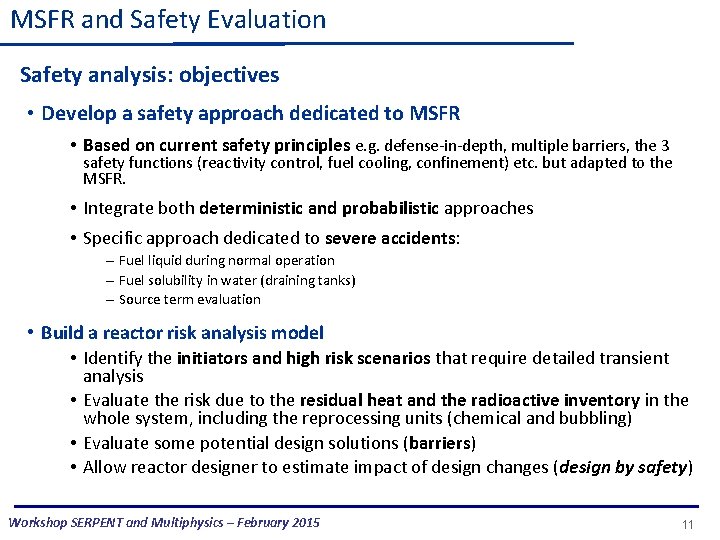
MSFR and Safety Evaluation Safety analysis: objectives • Develop a safety approach dedicated to MSFR • Based on current safety principles e. g. defense-in-depth, multiple barriers, the 3 safety functions (reactivity control, fuel cooling, confinement) etc. but adapted to the MSFR. • Integrate both deterministic and probabilistic approaches • Specific approach dedicated to severe accidents: – Fuel liquid during normal operation – Fuel solubility in water (draining tanks) – Source term evaluation • Build a reactor risk analysis model • Identify the initiators and high risk scenarios that require detailed transient analysis • Evaluate the risk due to the residual heat and the radioactive inventory in the whole system, including the reprocessing units (chemical and bubbling) • Evaluate some potential design solutions (barriers) • Allow reactor designer to estimate impact of design changes (design by safety) Workshop SERPENT and Multiphysics – February 2015 11
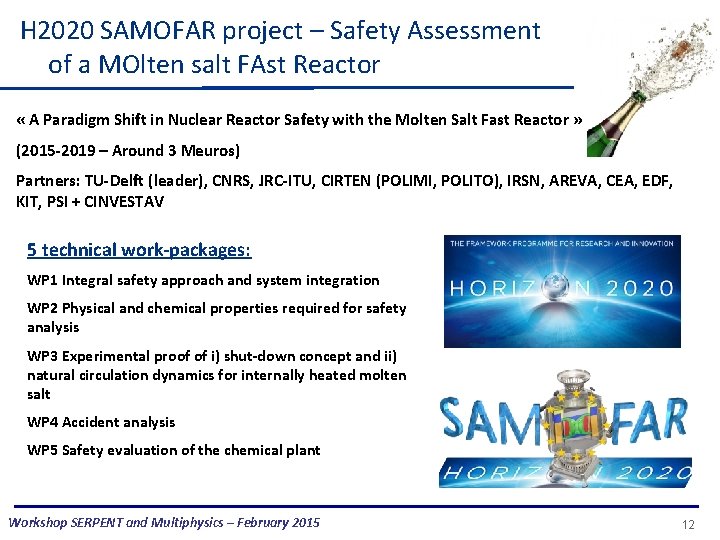
H 2020 SAMOFAR project – Safety Assessment of a MOlten salt FAst Reactor « A Paradigm Shift in Nuclear Reactor Safety with the Molten Salt Fast Reactor » (2015‐ 2019 – Around 3 Meuros) Partners: TU‐Delft (leader), CNRS, JRC‐ITU, CIRTEN (POLIMI, POLITO), IRSN, AREVA, CEA, EDF, KIT, PSI + CINVESTAV 5 technical work‐packages: WP 1 Integral safety approach and system integration WP 2 Physical and chemical properties required for safety analysis WP 3 Experimental proof of i) shut‐down concept and ii) natural circulation dynamics for internally heated molten salt WP 4 Accident analysis WP 5 Safety evaluation of the chemical plant Workshop SERPENT and Multiphysics – February 2015 12
! n o i t n e. htm t sf t r a s i r ubl u p o / y ch n r e fo r/fr u o /gp r y p k /g r n f. a 3 Th /lpsc. in 2 p : / http Workshop SERPENT and Multiphysics – February 2015 merle@lpsc. in 2 p 3. fr
Workshop SERPENT and Multiphysics – February 2015
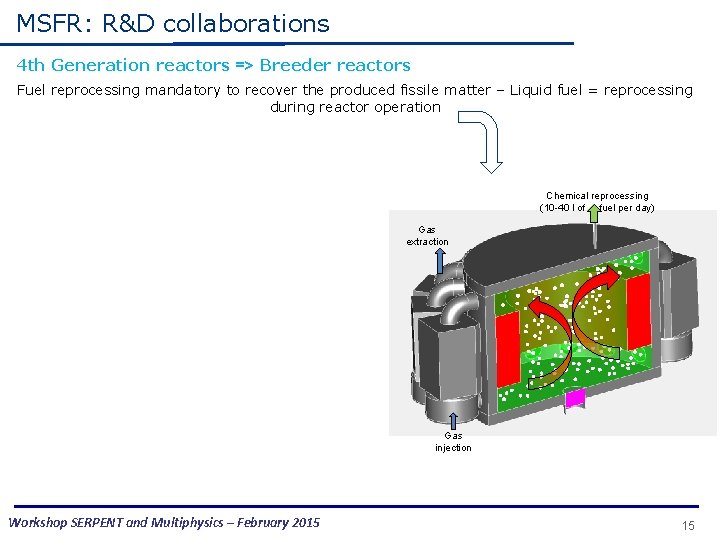
MSFR: R&D collaborations 4 th Generation reactors => Breeder reactors Fuel reprocessing mandatory to recover the produced fissile matter – Liquid fuel = reprocessing during reactor operation Chemical reprocessing (10 -40 l of fuel per day) Gas extraction Gas injection Workshop SERPENT and Multiphysics – February 2015 15
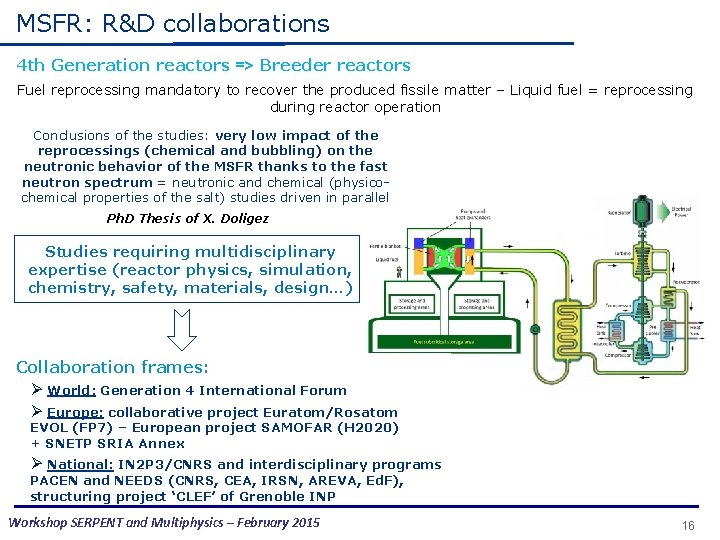
MSFR: R&D collaborations 4 th Generation reactors => Breeder reactors Fuel reprocessing mandatory to recover the produced fissile matter – Liquid fuel = reprocessing during reactor operation Conclusions of the studies: very low impact of the reprocessings (chemical and bubbling) on the neutronic behavior of the MSFR thanks to the fast neutron spectrum = neutronic and chemical (physicochemical properties of the salt) studies driven in parallel Ph. D Thesis of X. Doligez Studies requiring multidisciplinary expertise (reactor physics, simulation, chemistry, safety, materials, design…) Collaboration frames: Ø World: Generation 4 International Forum Ø Europe: collaborative project Euratom/Rosatom EVOL (FP 7) – European project SAMOFAR (H 2020) + SNETP SRIA Annex Ø National: IN 2 P 3/CNRS and interdisciplinary programs PACEN and NEEDS (CNRS, CEA, IRSN, AREVA, Ed. F), structuring project ‘CLEF’ of Grenoble INP Workshop SERPENT and Multiphysics – February 2015 16