
PRESENTATION OF FINANCIAL STATEMENTS SCHEDULE III DIVISION I
![Composition of Financial Statements [Sec. 2(40)] § Balance Sheet § Statement of Profit and](https://slidetodoc.com/presentation_image_h2/df8b77306b3d6f3fa9c74be103fc1947/image-4.jpg "Composition of Financial Statements [Sec. 2(40)] § Balance Sheet § Statement of Profit and")
![COMPANIES (AUDITOR'S REPORT) ORDER, 2016 [CARO]](https://slidetodoc.com/presentation_image_h2/df8b77306b3d6f3fa9c74be103fc1947/image-30.jpg "COMPANIES (AUDITOR'S REPORT) ORDER, 2016 [CARO]")

- Slides: 37
PRESENTATION OF FINANCIAL STATEMENTS SCHEDULE III (DIVISION I) TO THE COMPANIES ACT, 2013 CA. MADHAVI D K
Overview Presentation and Disclosure requirements covering: § Schedule III (Division I) to the Companies Act, 2013 (“the Act”) § Notified Accounting Standards (AS) § GNs issued by ICAI – Expenditure on CSR, Accounting for Depreciation, Employee share based payments, Credit available in respect of MAT § Those mandated under the Act for specific transactions § Those mandated under other statutes § Covering observations by Financial Reporting Review Board (FRRB) of the ICAI
General Principles § Minimum disclosures set out ; + disclosures relevant to understanding the financial position of a company. § Schedule III disclosures are additional and not substitute to disclosures as stated in AS. § Rounding off – turnover based criteria; to be used uniformly across the financial statements < Rs. 100 crores : hundreds, thousands, lakhs, millions or decimals thereof > Rs. 100 crores : lakhs, millions, crores or decimals thereof § Corresponding numbers to be included except for the first financial statements § Current / Non – current classification - operating cycle considerations § Aggregation for classification based on ‘Nature’ ; ‘Functional classification’ not permissible
Composition of Financial Statements [Sec. 2(40)] § Balance Sheet § Statement of Profit and Loss § Cash Flow Statement – exemption available to one person company [Sec. 2 (62)] , small company [Sec. 2 (85)], dormant company, private company if such company is a start up § Notes to Financial Statements § General information about the company § Summary of significant accounting policies - Basis of preparation : GAAP, operating cycle ; policies adopted by the company for accounting
Balance Sheet Share Capital: § For each class of shares – authorised, issued, subscribed and paid up capital, number of shares of current year and corresponding year / period. § Reconciliation of number of shares – movement from the beginning of year to the end of the year § Rights, preferences and restrictions attached to each class of shares § Shares held by holding company and subsidiary of holding company § Details of shares held by shareholders holding more than 5% of the aggregate shares § Shares reserved for issue under options § Aggregate number of shares allotted as fully paid up by way of bonus shares / shares allotted as fully paid pursuant to a contract(s) without payment being received in cash / shares bought back during 5 years immediately preceding current year end
Balance Sheet Share Capital (Contd. ): § Terms of securities convertible into equity shares § Others: § Share application money received pending allotment / Share warrants issued should be disclosed as a part of ‘Shareholders’ funds’ after ‘Reserves and Surplus’ § Share application money which is refundable to be disclosed under ‘Other current liabilities’ § Any allotment made during the year – number, date, premium etc.
Balance Sheet Reserves and Surplus: § Movement for each reserve – movement from the beginning of year to the end of the year § Appropriations to be disclosed as a note § Reserve specifically represented by earmarked investments to be termed as ‘Fund’ § Any restrictions on distribution to be specified § Nature / composition of reserves (eg: revaluation reserve)
Balance Sheet Long / Short term borrowings: § Category / nature wise : Debentures, term loans – party [banks / financial institutions / related parties] / nature wise [rupee / foreign currency] § Nature of security (if secured), significant terms – interest (rate and payment terms), re payment terms, any change in terms during the current year, continuing defaults in case of borrowings, specific disclosure if guarantee given by Directors / others § Events impacting classification (eg: default in repayment / not met covenants – if the lender has a right to recall then a non current could be classified as current – judgment to be exercised as to whether the default is negligible) § Other balances covered under long term borrowings – long term obligation relating to finance lease, sales tax deferrals § Other balances covered under short term borrowings -
Balance Sheet Deferred Tax Liability (Net) / Deferred Tax Assets (Net) : § DTL presented after long term borrowing , DTA presented after long term loans and advances § DTL Major components of DTA / DTL to be stated § DTA and DTL can be offset only if they relate to the same governing tax laws § DTA on carry forward business losses / unabsorbed depreciation – principle of virtual certainty, nature of convincing evidence supporting virtual certainty. § Rate at which DTA / DTL has been computed
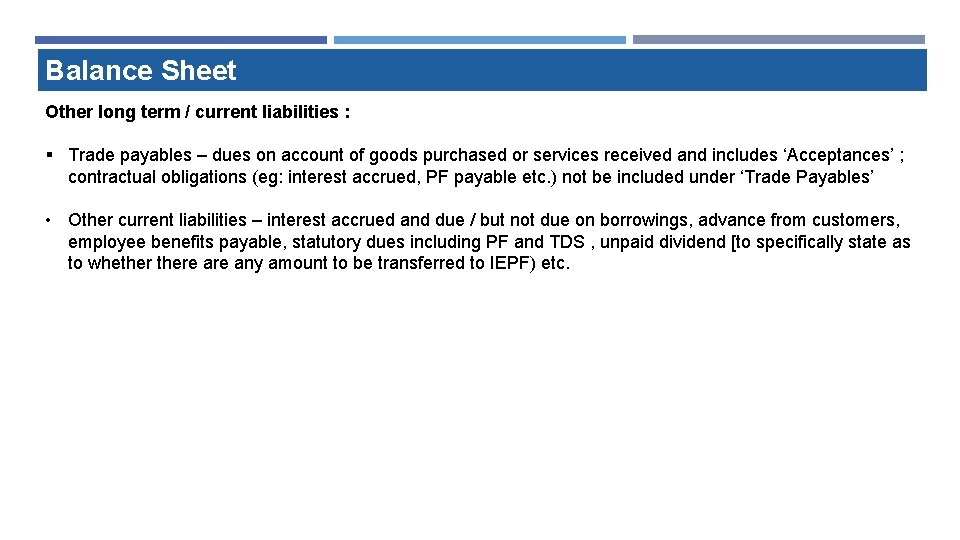
Balance Sheet Other long term / current liabilities : § Trade payables – dues on account of goods purchased or services received and includes ‘Acceptances’ ; contractual obligations (eg: interest accrued, PF payable etc. ) not be included under ‘Trade Payables’ • Other current liabilities – interest accrued and due / but not due on borrowings, advance from customers, employee benefits payable, statutory dues including PF and TDS , unpaid dividend [to specifically state as to whethere any amount to be transferred to IEPF) etc.
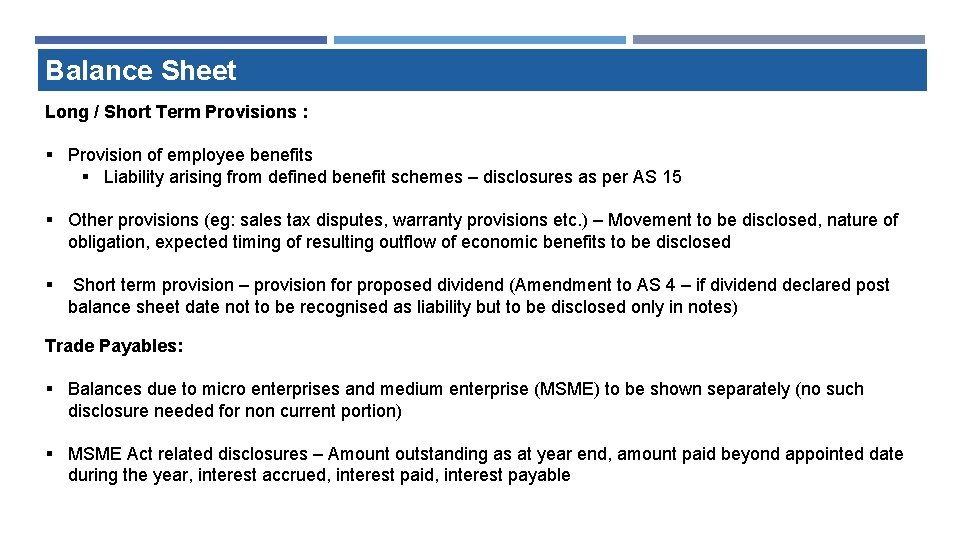
Balance Sheet Long / Short Term Provisions : § Provision of employee benefits § Liability arising from defined benefit schemes – disclosures as per AS 15 § Other provisions (eg: sales tax disputes, warranty provisions etc. ) – Movement to be disclosed, nature of obligation, expected timing of resulting outflow of economic benefits to be disclosed § Short term provision – provision for proposed dividend (Amendment to AS 4 – if dividend declared post balance sheet date not to be recognised as liability but to be disclosed only in notes) Trade Payables: § Balances due to micro enterprises and medium enterprise (MSME) to be shown separately (no such disclosure needed for non current portion) § MSME Act related disclosures – Amount outstanding as at year end, amount paid beyond appointed date during the year, interest accrued, interest paid, interest payable
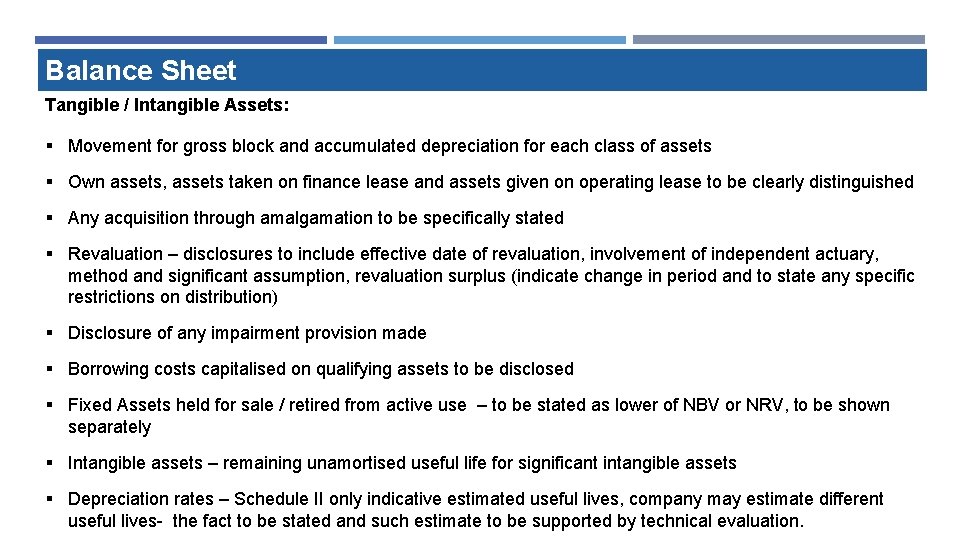
Balance Sheet Tangible / Intangible Assets: § Movement for gross block and accumulated depreciation for each class of assets § Own assets, assets taken on finance lease and assets given on operating lease to be clearly distinguished § Any acquisition through amalgamation to be specifically stated § Revaluation – disclosures to include effective date of revaluation, involvement of independent actuary, method and significant assumption, revaluation surplus (indicate change in period and to state any specific restrictions on distribution) § Disclosure of any impairment provision made § Borrowing costs capitalised on qualifying assets to be disclosed § Fixed Assets held for sale / retired from active use – to be stated as lower of NBV or NRV, to be shown separately § Intangible assets – remaining unamortised useful life for significant intangible assets § Depreciation rates – Schedule II only indicative estimated useful lives, company may estimate different useful lives- the fact to be stated and such estimate to be supported by technical evaluation.
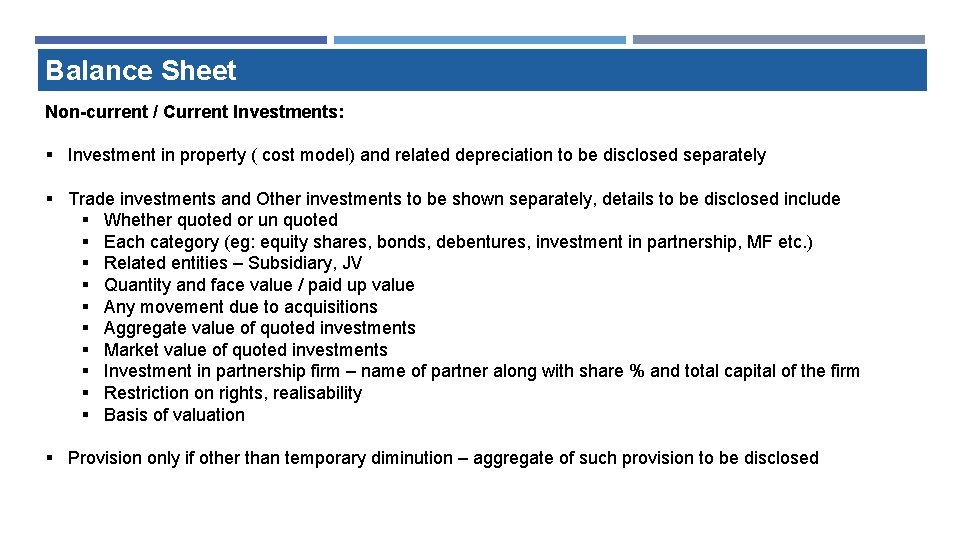
Balance Sheet Non-current / Current Investments: § Investment in property ( cost model) and related depreciation to be disclosed separately § Trade investments and Other investments to be shown separately, details to be disclosed include § Whether quoted or un quoted § Each category (eg: equity shares, bonds, debentures, investment in partnership, MF etc. ) § Related entities – Subsidiary, JV § Quantity and face value / paid up value § Any movement due to acquisitions § Aggregate value of quoted investments § Market value of quoted investments § Investment in partnership firm – name of partner along with share % and total capital of the firm § Restriction on rights, realisability § Basis of valuation § Provision only if other than temporary diminution – aggregate of such provision to be disclosed
Balance Sheet Long-term / Short- term Loans and Advances: § Secured and unsecured to be clearly stated § Recoverability – whether considered good or otherwise to be stated, if provision created toward recoverability disclosure = gross - provision § Loans given to related entities to be separately stated – reference to be made for compliance with requirements of Sec. 186 of the Act § Capital advances to be treated as long-term loans and advances § Advance taxes – disclosed net of provision
Balance Sheet Other non-current / current assets: § Non current portion of trade payable segregating between secured (nature of security to be stated) and unsecured to be disclosed, provision to be sated § Deposits with maturity period of more than 12 months, if there is a lien against such balances the same is to be stated § Unamortised portion of share issue expenses – identified based on amortization period. § Recoverability – whether considered good or otherwise to be stated, if provision created toward recoverability disclosure = gross - provision § Dues from Directors to be separately stated
Balance Sheet Inventories: § Board classification to include – RM, WIP, FG, Traded goods, PM, Stores and spares, loose tools § Within each classification composition of major category to be included, quantity not mandated only suggestive § Value of ‘In transit’ stock to be stated § Any lien on inventories held to be disclosed § To avoid statement such as ‘“As taken, valued and certified by the Management”
Balance Sheet Trade receivables: § Secured and unsecured to be clearly stated § Time based segregation – outstanding for a period of more than 6 months from the due date of payment to be disclosed § Recoverability – whether considered good or otherwise to be stated, if provision created toward recoverability disclosure = gross – provision § Dues from related parties to be disclosed separately § To distinguish between trade receivable an unbilled revenue § To avoid statements such as ‘“Trade Receivable Balances are subject to reconciliations and confirmations”
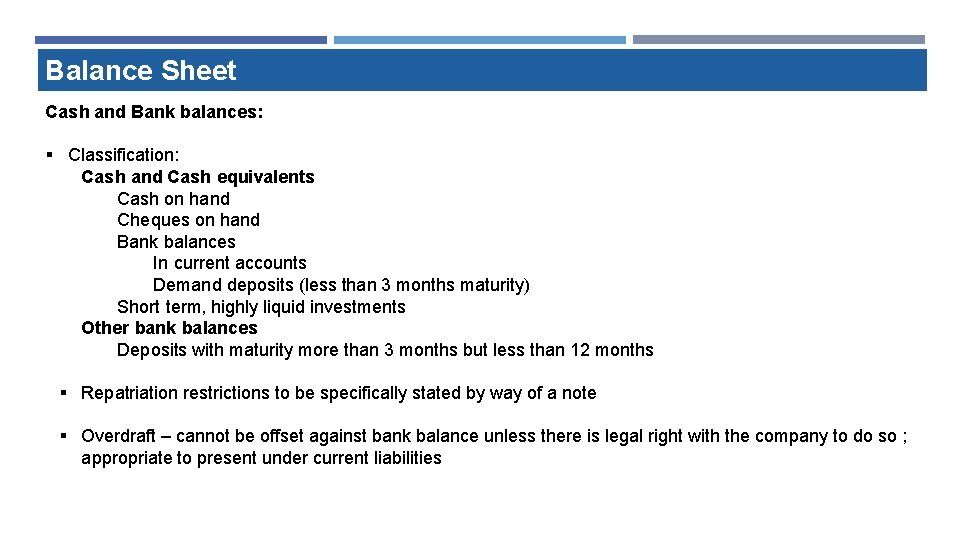
Balance Sheet Cash and Bank balances: § Classification: Cash and Cash equivalents Cash on hand Cheques on hand Bank balances In current accounts Demand deposits (less than 3 months maturity) Short term, highly liquid investments Other bank balances Deposits with maturity more than 3 months but less than 12 months § Repatriation restrictions to be specifically stated by way of a note § Overdraft – cannot be offset against bank balance unless there is legal right with the company to do so ; appropriate to present under current liabilities
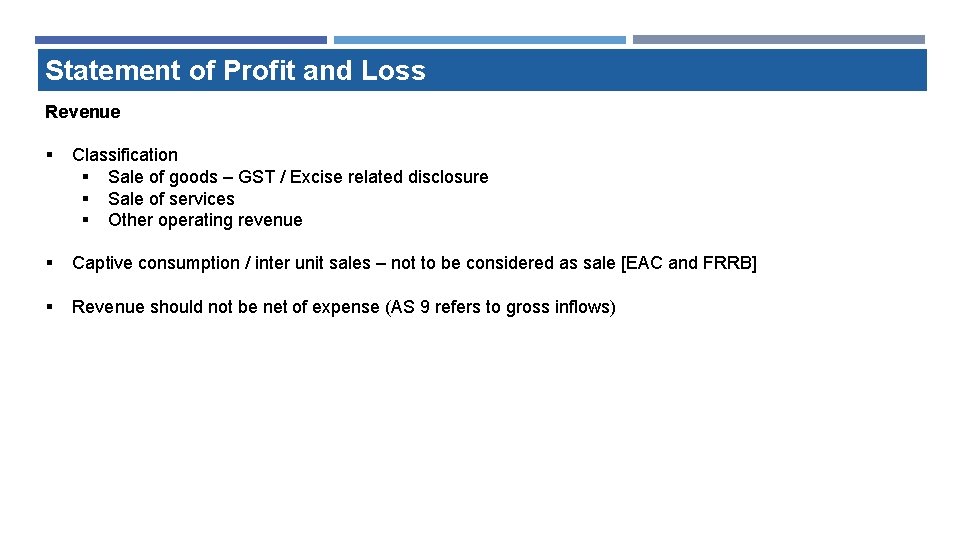
Statement of Profit and Loss Revenue § Classification § Sale of goods – GST / Excise related disclosure § Sale of services § Other operating revenue § Captive consumption / inter unit sales – not to be considered as sale [EAC and FRRB] § Revenue should not be net of expense (AS 9 refers to gross inflows)
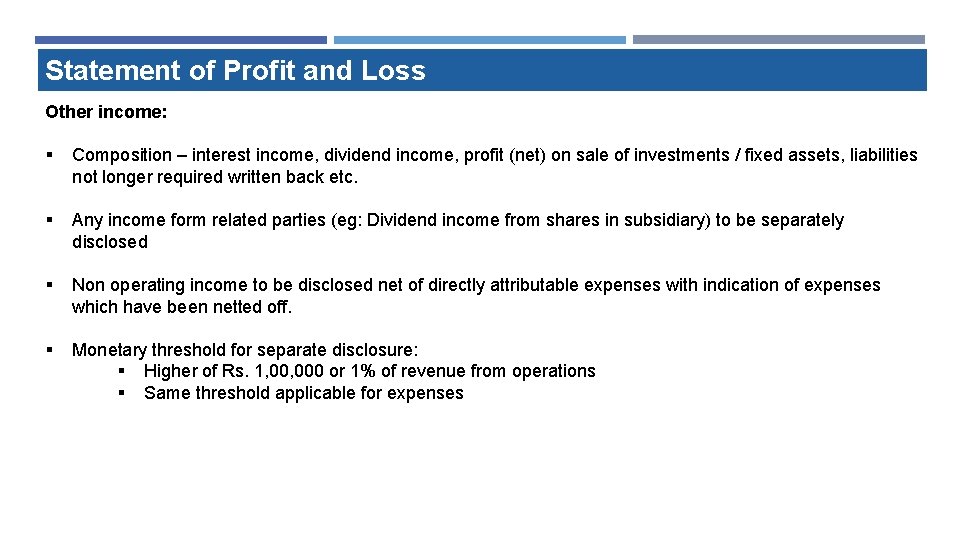
Statement of Profit and Loss Other income: § Composition – interest income, dividend income, profit (net) on sale of investments / fixed assets, liabilities not longer required written back etc. § Any income form related parties (eg: Dividend income from shares in subsidiary) to be separately disclosed § Non operating income to be disclosed net of directly attributable expenses with indication of expenses which have been netted off. § Monetary threshold for separate disclosure: § Higher of Rs. 1, 000 or 1% of revenue from operations § Same threshold applicable for expenses
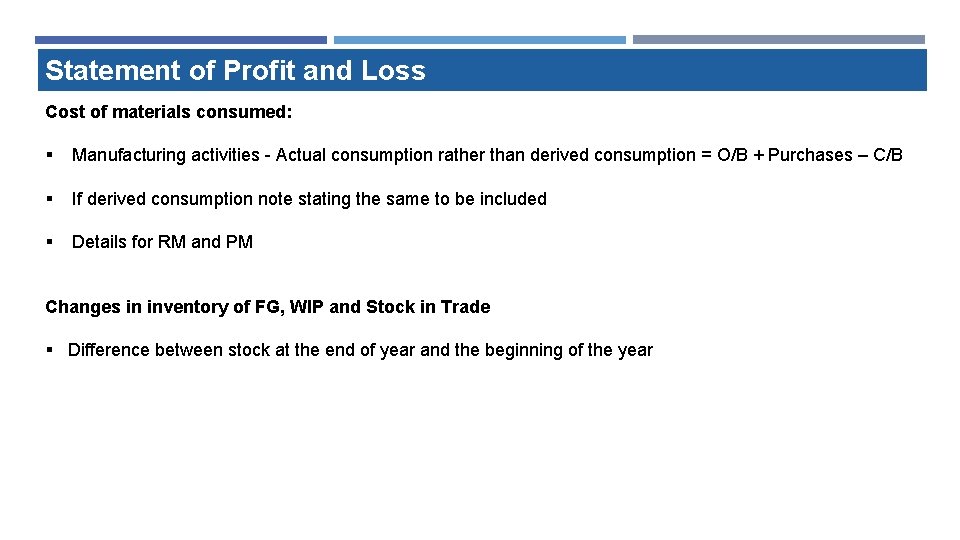
Statement of Profit and Loss Cost of materials consumed: § Manufacturing activities - Actual consumption rather than derived consumption = O/B + Purchases – C/B § If derived consumption note stating the same to be included § Details for RM and PM Changes in inventory of FG, WIP and Stock in Trade § Difference between stock at the end of year and the beginning of the year
Statement of Profit and Loss Employee Benefits Expense: § Only employee related expense – retainer related costs not to be included § Contribution to fund relating to defined contribution benefits to be disclosed separately (eg: PF, Pension Fund etc. ) § Charge relating to defined benefits plan to be disclosed separately along with disclosures as stated in AS 15 which included – Nature of fund; movement of - PV of defined benefit obligation, FV of plan assets; asset / liabilities recognized / charge to P&L ; major categories of planned assets ; assumptions – salary escalation, mortality rate, attrition rate etc, ; amounts recognized in current year and previous 5 year , expected contribution to funds in next 1 year § Employee stock option costs
Statement of Profit and Loss Finance costs: § Interest expense § Interest on shortfall of advance tax § Borrowing costs Depreciation and Amortisation costs: § Depreciation on tangible assets and investment property to be disclosed separately
Statement of Profit and Loss Other Expenses: § Mimimum heads for disclosure stated in Schedule II § Expenses capitalised as part of WIP / FA to be stated § Payments to Auditors for each service to be disclosed § CSR expenditure – gross amount required to be spent, amount spent during the year on § construction / acquisition of asset § Other purposes § No provision to be made for unspent amount § Tax related penalties (other than those in compensatory in nature) to be expenses as other expenses § Separate disclosure for provision for losses relating to investment in subsidiary and foreign exchanges gains /losses (net) § Payments to political parties to be disclosed
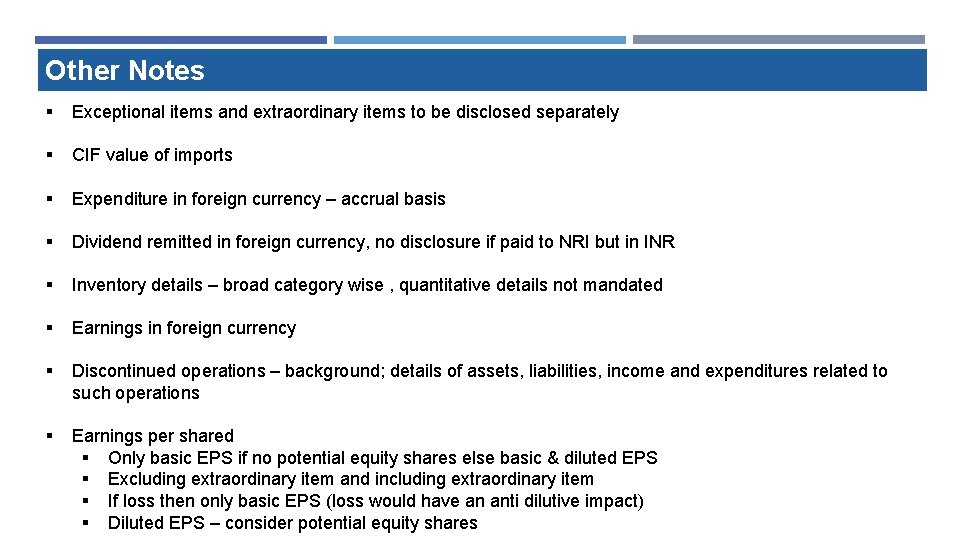
Other Notes Contingent liabilities § Claims against the Company not acknowledged as debts § Description and nature to be disclosed § In case of disputes, if deposits made under protest the same should not be netted off for presentation of contingent liability § To assess if there any possible reimbursements Capital and Other commitments Capital commitments § Value of capital contracts (unexecuted portion) § Unpaid portion in investments Other commitments § Only non cancellable (cancellation of which will result in penalty disproportionate to benefit) contractual commitments Proposed Dividend § Relating to each class to be shown separately – total amount and per share value to be stated § Preference shares – not to state if there any arrears
Other Notes § Exceptional items and extraordinary items to be disclosed separately § CIF value of imports § Expenditure in foreign currency – accrual basis § Dividend remitted in foreign currency, no disclosure if paid to NRI but in INR § Inventory details – broad category wise , quantitative details not mandated § Earnings in foreign currency § Discontinued operations – background; details of assets, liabilities, income and expenditures related to such operations § Earnings per shared § Only basic EPS if no potential equity shares else basic & diluted EPS § Excluding extraordinary item and including extraordinary item § If loss then only basic EPS (loss would have an anti dilutive impact) § Diluted EPS – consider potential equity shares
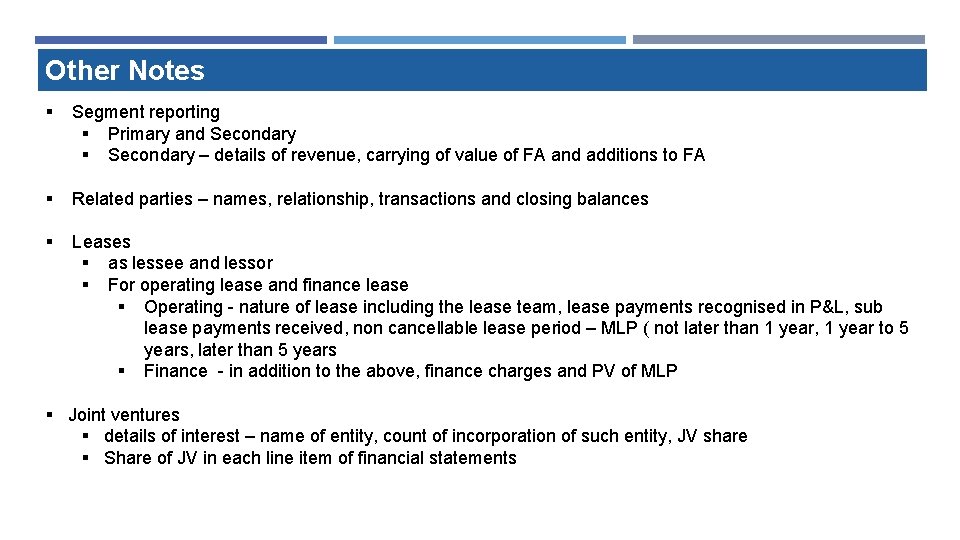
Other Notes § Segment reporting § Primary and Secondary § Secondary – details of revenue, carrying of value of FA and additions to FA § Related parties – names, relationship, transactions and closing balances § Leases § as lessee and lessor § For operating lease and finance lease § Operating - nature of lease including the lease team, lease payments recognised in P&L, sub lease payments received, non cancellable lease period – MLP ( not later than 1 year, 1 year to 5 years, later than 5 years § Finance - in addition to the above, finance charges and PV of MLP § Joint ventures § details of interest – name of entity, count of incorporation of such entity, JV share § Share of JV in each line item of financial statements
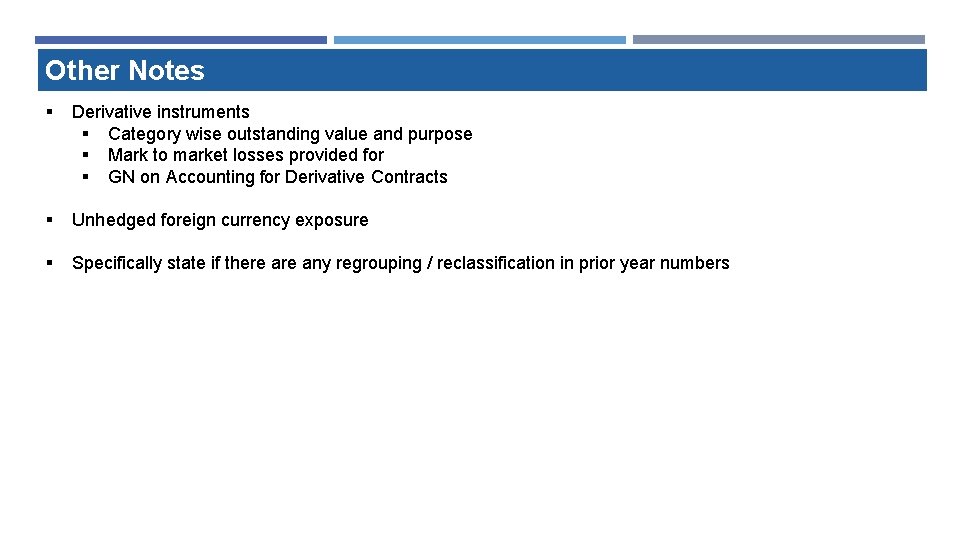
Other Notes § Derivative instruments § Category wise outstanding value and purpose § Mark to market losses provided for § GN on Accounting for Derivative Contracts § Unhedged foreign currency exposure § Specifically state if there any regrouping / reclassification in prior year numbers
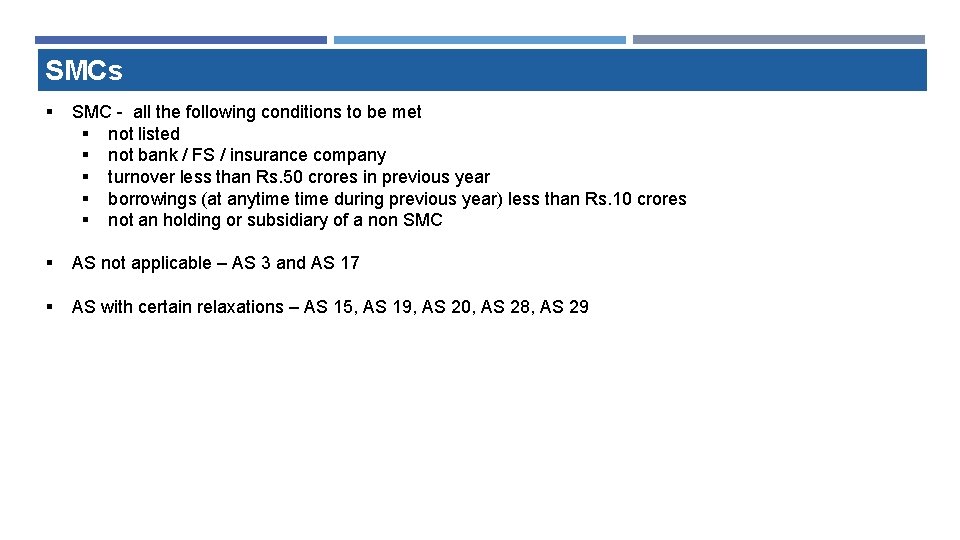
SMCs § SMC - all the following conditions to be met § not listed § not bank / FS / insurance company § turnover less than Rs. 50 crores in previous year § borrowings (at anytime during previous year) less than Rs. 10 crores § not an holding or subsidiary of a non SMC § AS not applicable – AS 3 and AS 17 § AS with certain relaxations – AS 15, AS 19, AS 20, AS 28, AS 29
COMPANIES (AUDITOR'S REPORT) ORDER, 2016 [CARO]
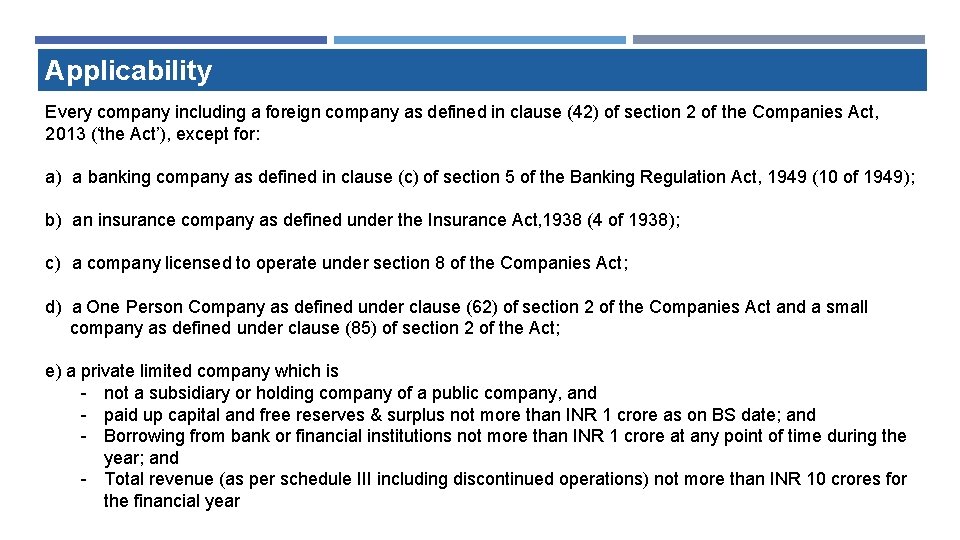
Applicability Every company including a foreign company as defined in clause (42) of section 2 of the Companies Act, 2013 (‘the Act’), except for: a) a banking company as defined in clause (c) of section 5 of the Banking Regulation Act, 1949 (10 of 1949); b) an insurance company as defined under the Insurance Act, 1938 (4 of 1938); c) a company licensed to operate under section 8 of the Companies Act; d) a One Person Company as defined under clause (62) of section 2 of the Companies Act and a small company as defined under clause (85) of section 2 of the Act; e) a private limited company which is - not a subsidiary or holding company of a public company, and - paid up capital and free reserves & surplus not more than INR 1 crore as on BS date; and - Borrowing from bank or financial institutions not more than INR 1 crore at any point of time during the year; and - Total revenue (as per schedule III including discontinued operations) not more than INR 10 crores for the financial year
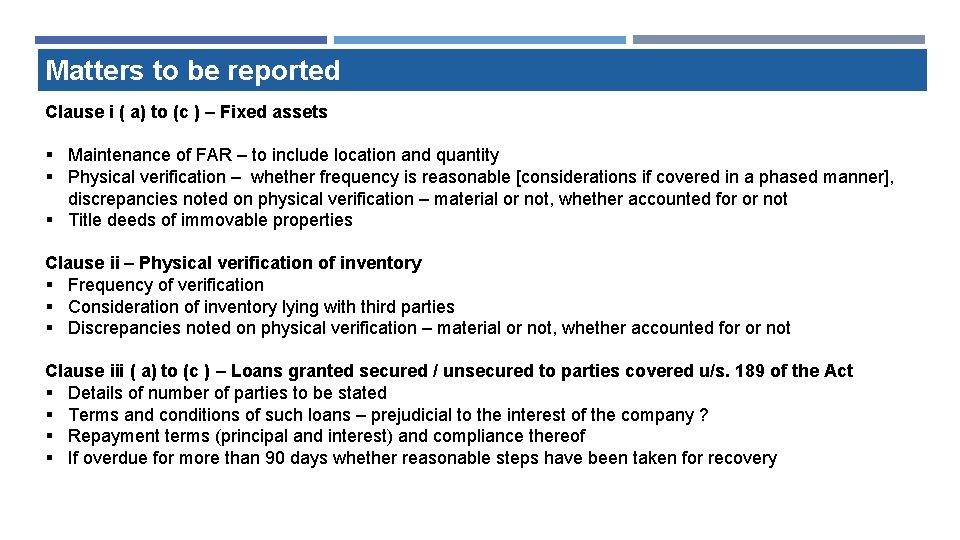
Matters to be reported Clause i ( a) to (c ) – Fixed assets § Maintenance of FAR – to include location and quantity § Physical verification – whether frequency is reasonable [considerations if covered in a phased manner], discrepancies noted on physical verification – material or not, whether accounted for or not § Title deeds of immovable properties Clause ii – Physical verification of inventory § Frequency of verification § Consideration of inventory lying with third parties § Discrepancies noted on physical verification – material or not, whether accounted for or not Clause iii ( a) to (c ) – Loans granted secured / unsecured to parties covered u/s. 189 of the Act § Details of number of parties to be stated § Terms and conditions of such loans – prejudicial to the interest of the company ? § Repayment terms (principal and interest) and compliance thereof § If overdue for more than 90 days whether reasonable steps have been taken for recovery
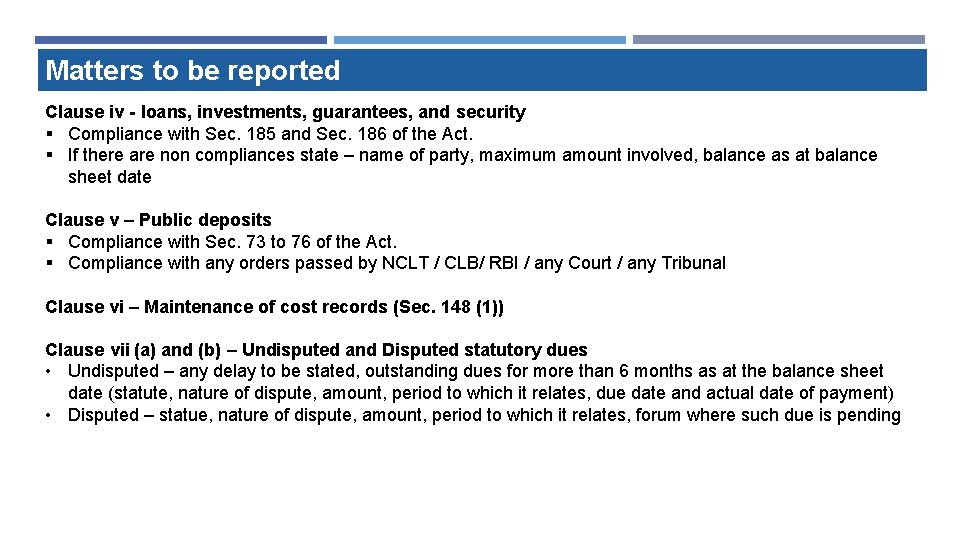
Matters to be reported Clause iv - loans, investments, guarantees, and security § Compliance with Sec. 185 and Sec. 186 of the Act. § If there are non compliances state – name of party, maximum amount involved, balance as at balance sheet date Clause v – Public deposits § Compliance with Sec. 73 to 76 of the Act. § Compliance with any orders passed by NCLT / CLB/ RBI / any Court / any Tribunal Clause vi – Maintenance of cost records (Sec. 148 (1)) Clause vii (a) and (b) – Undisputed and Disputed statutory dues • Undisputed – any delay to be stated, outstanding dues for more than 6 months as at the balance sheet date (statute, nature of dispute, amount, period to which it relates, due date and actual date of payment) • Disputed – statue, nature of dispute, amount, period to which it relates, forum where such due is pending
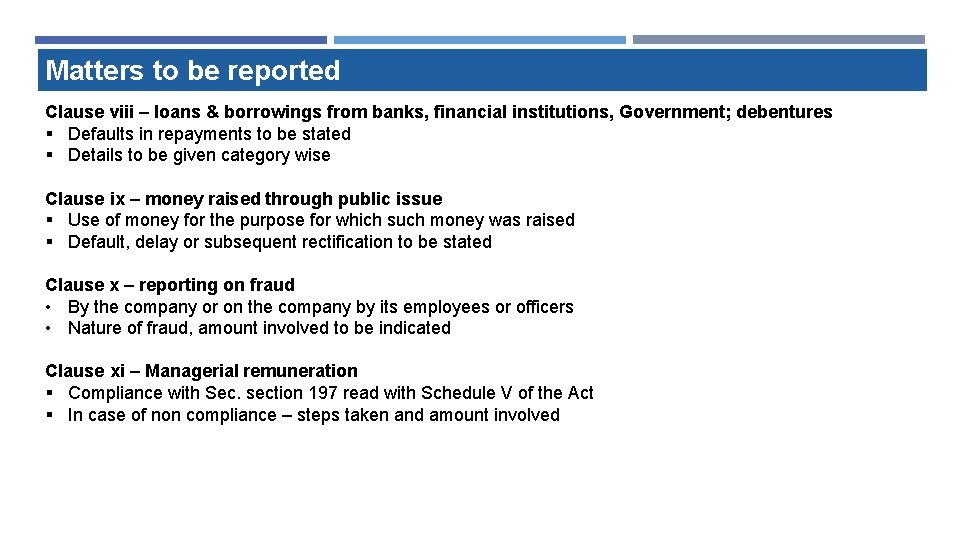
Matters to be reported Clause viii – loans & borrowings from banks, financial institutions, Government; debentures § Defaults in repayments to be stated § Details to be given category wise Clause ix – money raised through public issue § Use of money for the purpose for which such money was raised § Default, delay or subsequent rectification to be stated Clause x – reporting on fraud • By the company or on the company by its employees or officers • Nature of fraud, amount involved to be indicated Clause xi – Managerial remuneration § Compliance with Sec. section 197 read with Schedule V of the Act § In case of non compliance – steps taken and amount involved
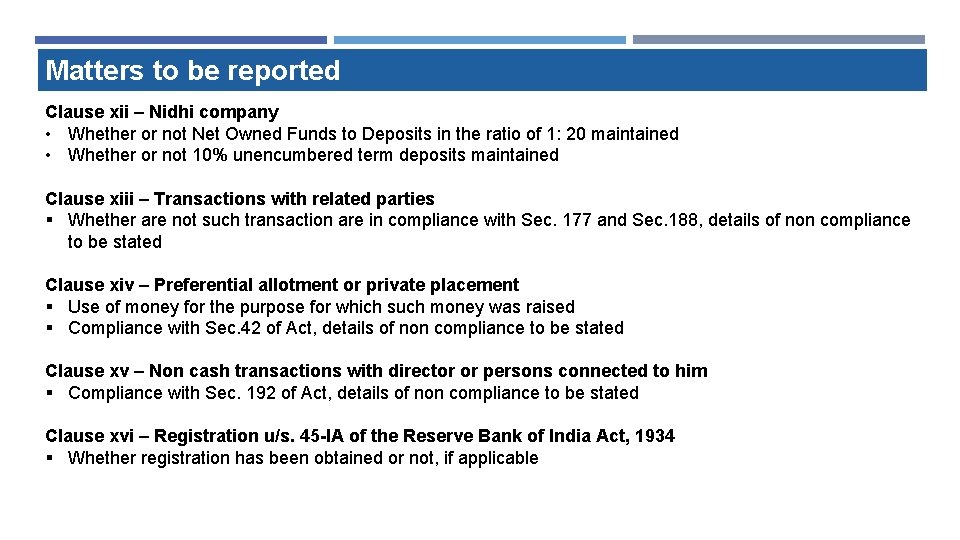
Matters to be reported Clause xii – Nidhi company • Whether or not Net Owned Funds to Deposits in the ratio of 1: 20 maintained • Whether or not 10% unencumbered term deposits maintained Clause xiii – Transactions with related parties § Whether are not such transaction are in compliance with Sec. 177 and Sec. 188, details of non compliance to be stated Clause xiv – Preferential allotment or private placement § Use of money for the purpose for which such money was raised § Compliance with Sec. 42 of Act, details of non compliance to be stated Clause xv – Non cash transactions with director or persons connected to him § Compliance with Sec. 192 of Act, details of non compliance to be stated Clause xvi – Registration u/s. 45 -IA of the Reserve Bank of India Act, 1934 § Whether registration has been obtained or not, if applicable
Other considerations § Specific mention of clauses not applicable § Clear mention of basis of negative remarks § Where appropriate referencing to notes in financial statements § Linkage between main audit report and CARO to be analysed
THANK YOU Disclaimer : The views expressed are that of the individual and does not represent the views of the firm with which the individual is associated