
Presentation of ECDC modelling networks and data availability
Presentation of ECDC, modelling networks and data availability Tommi Asikainen, Surveillance and Response Support European Centre for Disease Prevention and Control ICMS, Edinburgh, 14 September 2011
An EU agency dedicated to the prevention and control of communicable diseases • European Centre for Disease Prevention and Control (ECDC) operational May 2005 • Located in Stockholm, Sweden • Director Marc Sprenger • Member States EU-27 and EEA countries • Founding regulation EC/851/2004
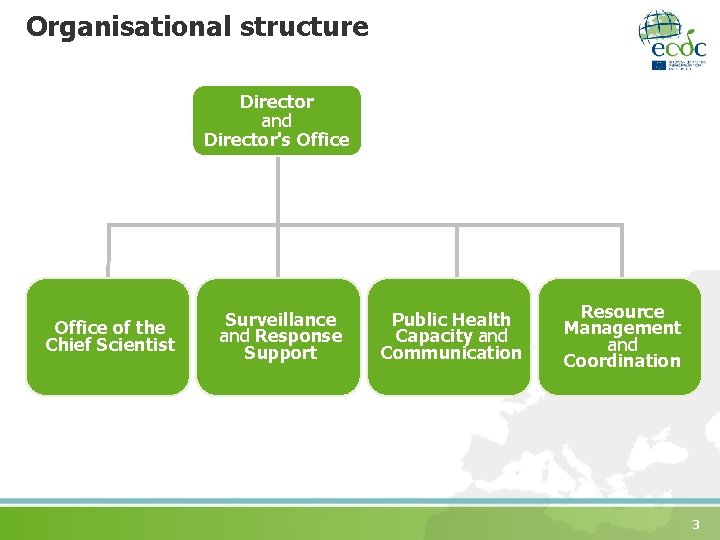
Organisational structure Director and Director's Office of the Chief Scientist Surveillance and Response Support Public Health Capacity and Communication Resource Management and Coordination 3
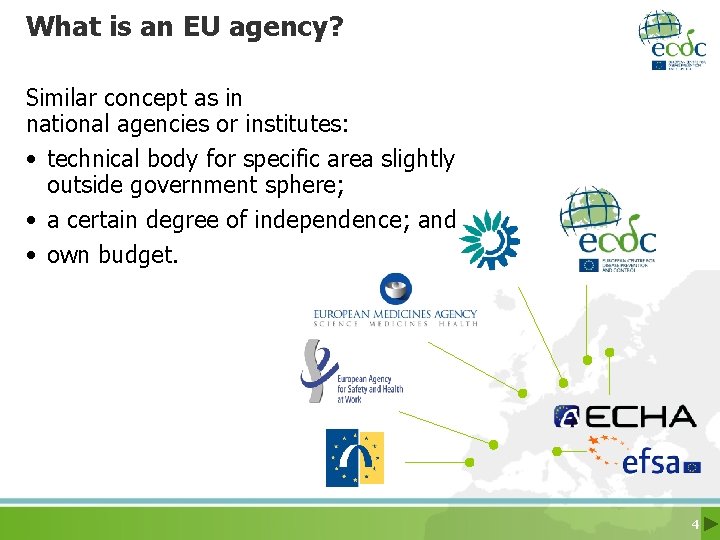
What is an EU agency? Similar concept as in national agencies or institutes: • technical body for specific area slightly outside government sphere; • a certain degree of independence; and • own budget. 4
Epidemiological background
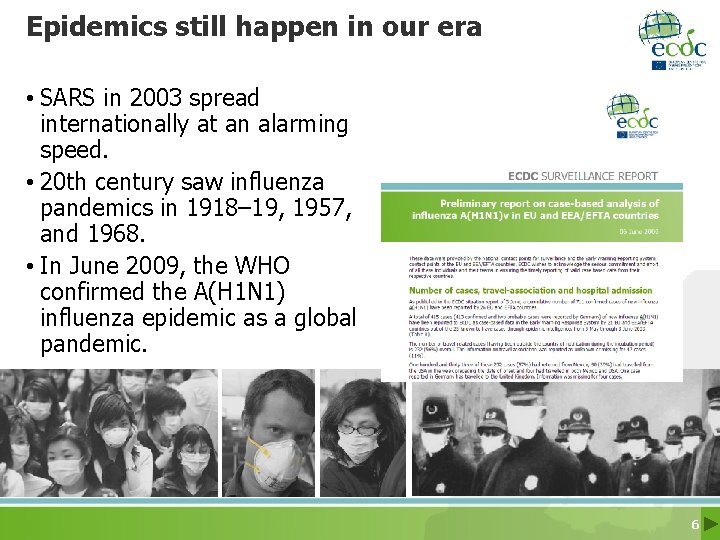
Epidemics still happen in our era • SARS in 2003 spread internationally at an alarming speed. • 20 th century saw influenza pandemics in 1918– 19, 1957, and 1968. • In June 2009, the WHO confirmed the A(H 1 N 1) influenza epidemic as a global pandemic. 6
ECDC's areas of activity Disease surveillance; event and disease monitoring
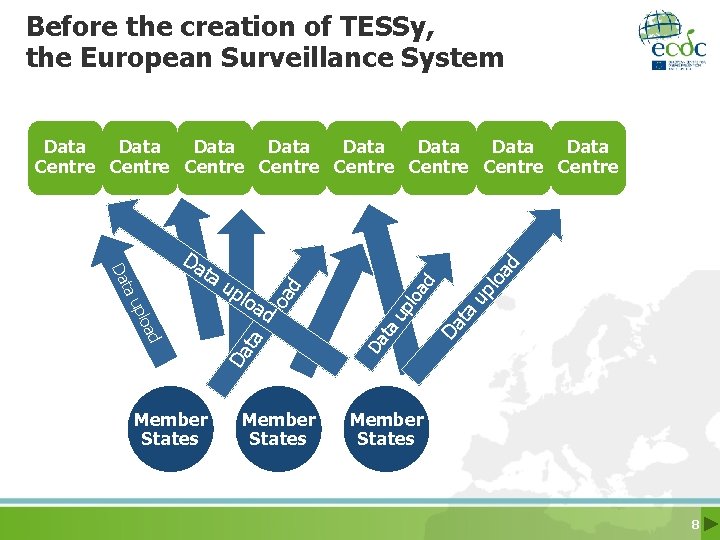
Before the creation of TESSy, the European Surveillance System Data Data Centre Centre Member States d pl oa Da ta u ad u plo u ta Member States ta d Da loa ad up Da d loa up ta Da ta plo Da Member States 8
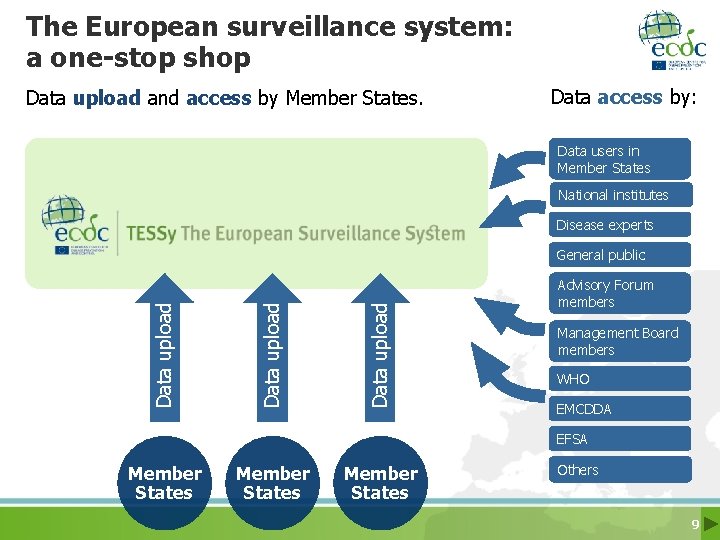
The European surveillance system: a one-stop shop Data upload and access by Member States. Data access by: Data users in Member States National institutes Disease experts Data upload General public Advisory Forum members Management Board members WHO EMCDDA EFSA Member States Others 9
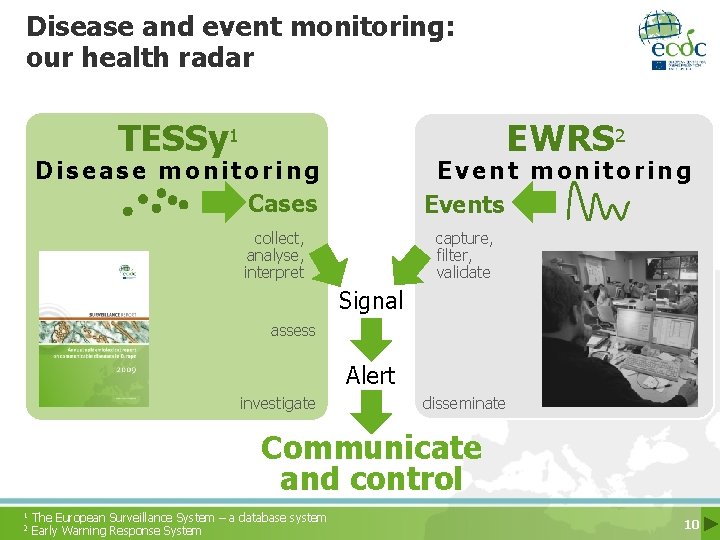
Disease and event monitoring: our health radar TESSy 1 EWRS 2 Disease monitoring Cases Event monitoring Events collect, analyse, interpret capture, filter, validate Signal assess Alert investigate disseminate Communicate and control 1 The European Surveillance System – a database system 2 Early Warning Response System 10
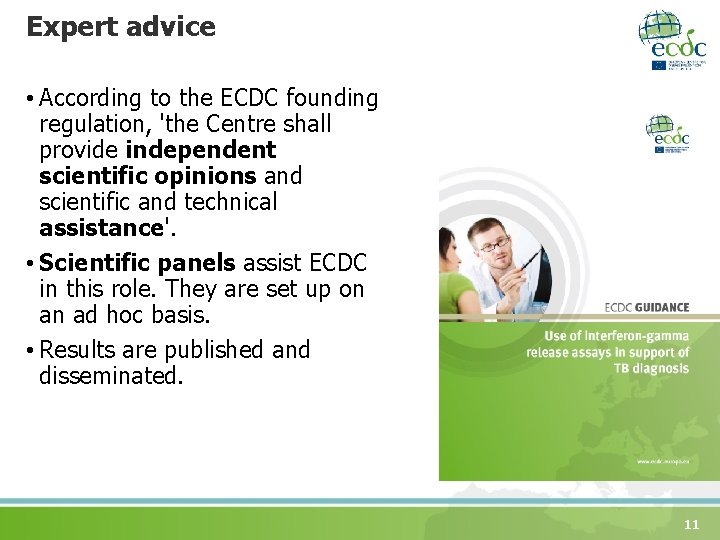
Expert advice • According to the ECDC founding regulation, 'the Centre shall provide independent scientific opinions and scientific and technical assistance'. • Scientific panels assist ECDC in this role. They are set up on an ad hoc basis. • Results are published and disseminated. 11
ECDC's areas of activity Modelling networks
Strategies • ECDC can initiate own projects to fill gaps in research: • Meaning and interpretation of generation times • Varicella vaccination • HIV prevalence estimates • Calls are published on ECDC homepage and Official Journal of EU 13
Larger scale (min. 5 countries)modelling projects • ECDC collaborates with European Commission and provides proposals for future modelling work • 3 -5 year projects • ECDC cannot be a partner but liaises with the projects • Steering committee • Involve the project on EU scale • Put in contact with experts in other fields • Assist with data availability issues 14
Special case: H 1 N 1 outbreak 2009 • Countries were doing their own work • Need for coordination and information sharing • ECDC created a network of modellers from EU countries • Collaboration with WHO informal H 1 N 1 modelling network van Kerkhove (PLOS Medicine 2010): Studies needed to address public health challenges of the 2009 H 1 N 1 influenza pandemic: insights from modeling. • 2 meetings at ECDC and several teleconferences • Involving EU funded modelling networks 15
Special case: H 1 N 1 outbreak 2009 • Working group on early analysis from several countries • Working group led by HPA Colindale –Participation by 12 countries –Problem with data access Flasche et al (Epidemics 2011): Different transmission patterns in the early stages of the influenza A(H 1 N 1)v pandemic: a comparative analysis of 12 European countries. 16
ECDC's areas of activity Data availability
Data availability • Data is not owned by ECDC – still country data • Procedure for applying access to data from Tessy • info@ecdc. europa. eu 18
Data availability • Need to specify for what purpose and which countries data is of interest 19
Categories ECDC personnel, EU Member States contact points, EC and EU Agencies Staff, WHO-EURO Staff may have direct access to TESSy data and downloads after training and awareness of confidentiality issues EU Agencies: (e. g. EMEA, EFSA, ECHA and the Commission Scientific Committees) may also request downloads of subset of data for own use directly after signature of confidentiality declaration or with agreement if outsourced to third parties
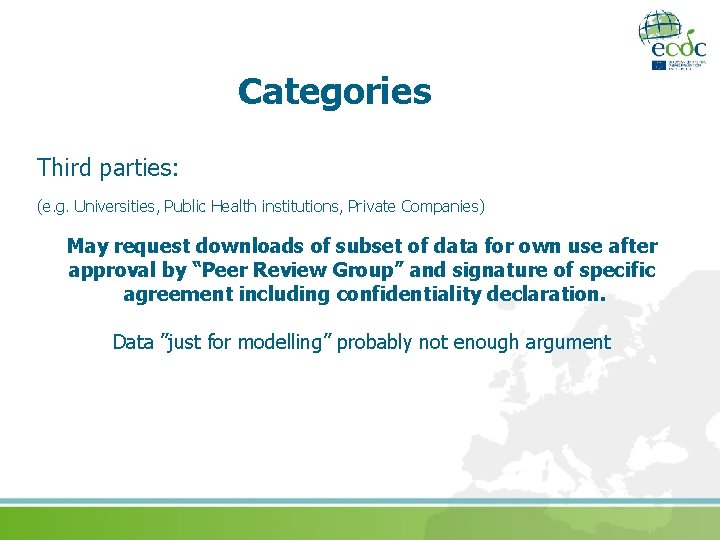
Categories Third parties: (e. g. Universities, Public Health institutions, Private Companies) May request downloads of subset of data for own use after approval by “Peer Review Group” and signature of specific agreement including confidentiality declaration. Data ”just for modelling” probably not enough argument
THANK YOU FOR YOUR ATTENTION 22
- Slides: 22