
Presentation Objective Identify opportunities to enhance project outcomes
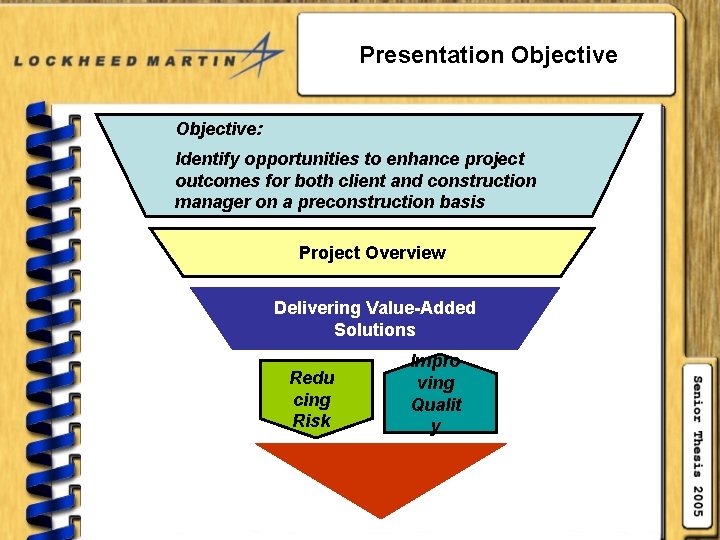
Presentation Objective: Identify opportunities to enhance project outcomes for both client and construction manager on a preconstruction basis Project Overview Delivering Value-Added Solutions Impro Redu ving cing Qualit Risk. Conclusionsy
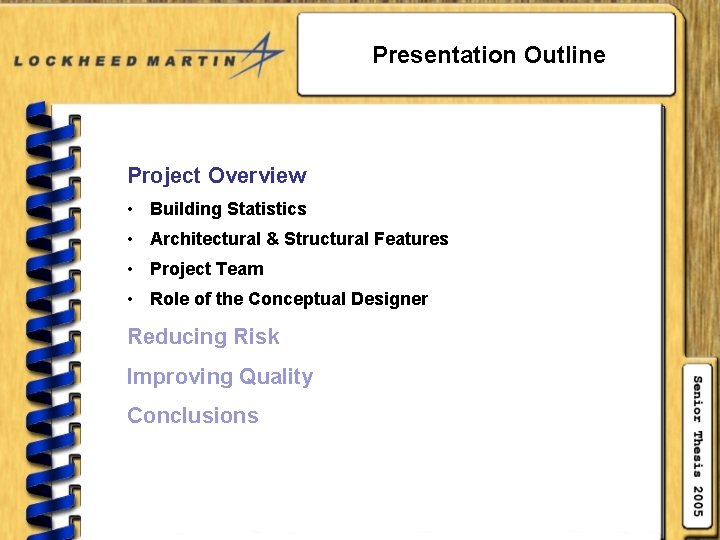
Presentation Outline Project Overview • Building Statistics • Architectural & Structural Features • Project Team • Role of the Conceptual Designer Reducing Risk Improving Quality Conclusions
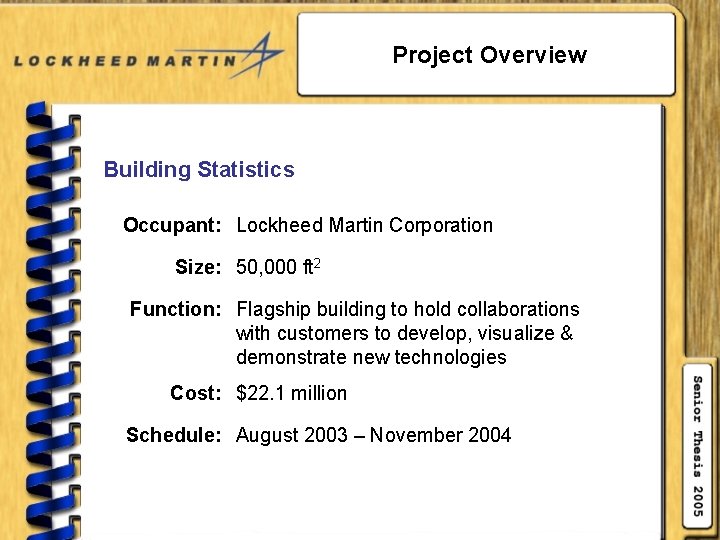
Project Overview Building Statistics Occupant: Lockheed Martin Corporation Size: 50, 000 ft 2 Function: Flagship building to hold collaborations with customers to develop, visualize & demonstrate new technologies Cost: $22. 1 million Schedule: August 2003 – November 2004
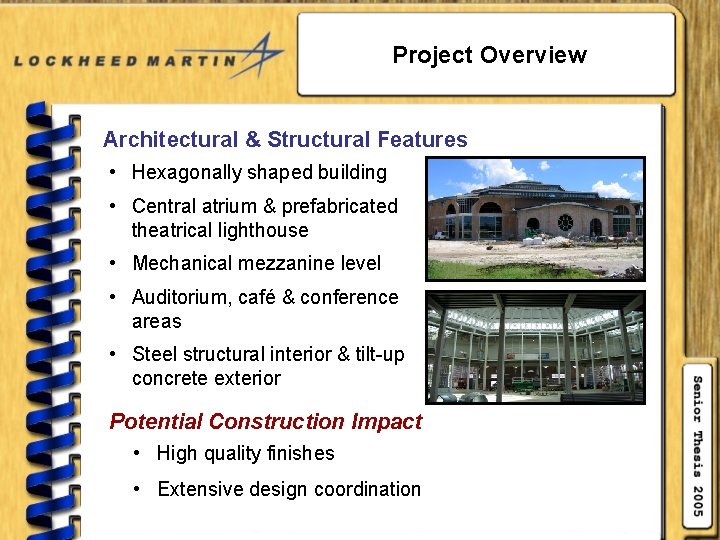
Project Overview Architectural & Structural Features • Hexagonally shaped building • Central atrium & prefabricated theatrical lighthouse • Mechanical mezzanine level • Auditorium, café & conference areas • Steel structural interior & tilt-up concrete exterior Potential Construction Impact • High quality finishes • Extensive design coordination
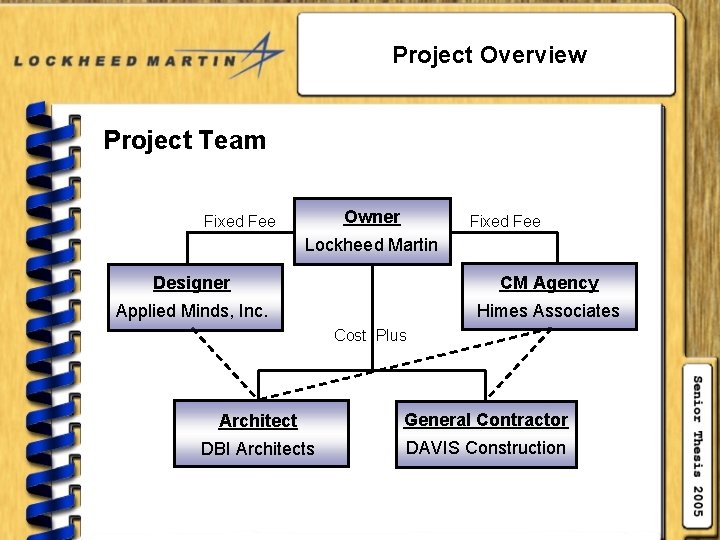
Project Overview Project Team Owner Fixed Fee Lockheed Martin Designer CM Agency Applied Minds, Inc. Himes Associates Cost Plus Architect General Contractor DBI Architects DAVIS Construction
Project Overview Role of the Conceptual Designer Applied Minds, Inc. • High-profile, “the little Big Idea company” • Invents, designs and prototypes products & services • Previous work for Disney, AT&T and government Potential Construction Impact • Less knowledgeable about constructability • High level of influence with Owner • Increased likelihood of design changes
Presentation Outline Project Overview Reducing Risk • Preconstruction Modeling Improving Quality Conclusions
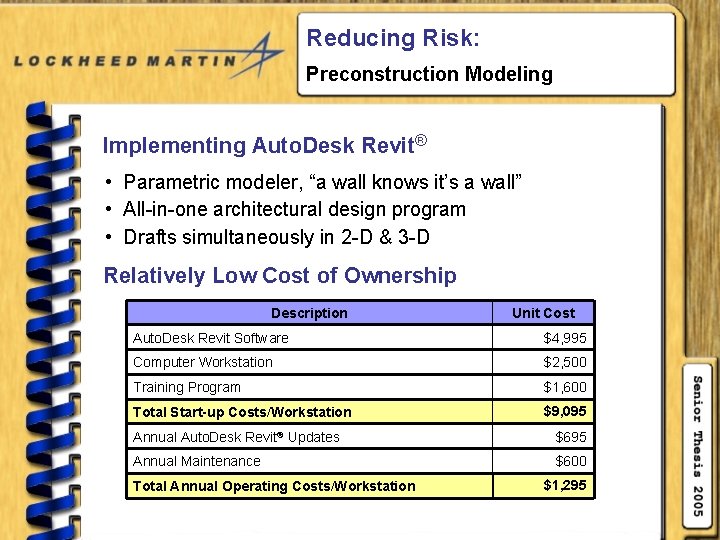
Reducing Risk: Preconstruction Modeling Implementing Auto. Desk Revit® • Parametric modeler, “a wall knows it’s a wall” • All-in-one architectural design program • Drafts simultaneously in 2 -D & 3 -D Relatively Low Cost of Ownership Description Unit Cost Auto. Desk Revit Software $4, 995 Computer Workstation $2, 500 Training Program $1, 600 Total Start-up Costs/Workstation $9, 095 Annual Auto. Desk Revit® Updates $695 Annual Maintenance $600 Total Annual Operating Costs/Workstation $1, 295
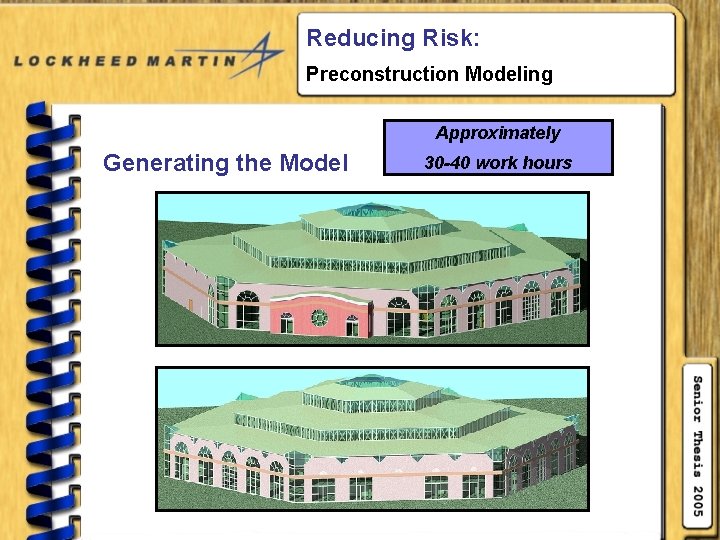
Reducing Risk: Preconstruction Modeling Approximately Generating the Model 30 -40 work hours
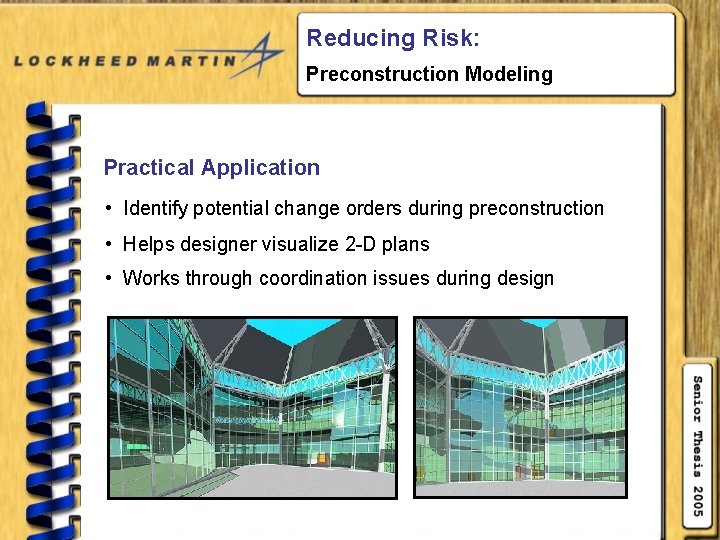
Reducing Risk: Preconstruction Modeling Practical Application • Identify potential change orders during preconstruction • Helps designer visualize 2 -D plans • Works through coordination issues during design
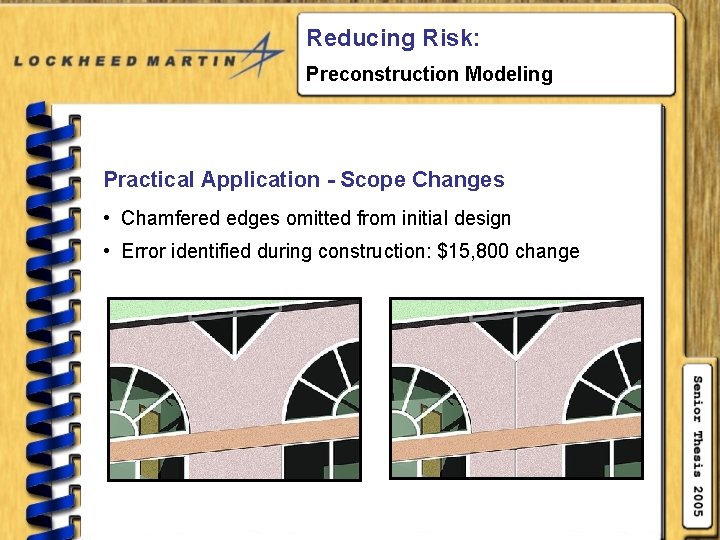
Reducing Risk: Preconstruction Modeling Practical Application - Scope Changes • Chamfered edges omitted from initial design • Error identified during construction: $15, 800 change
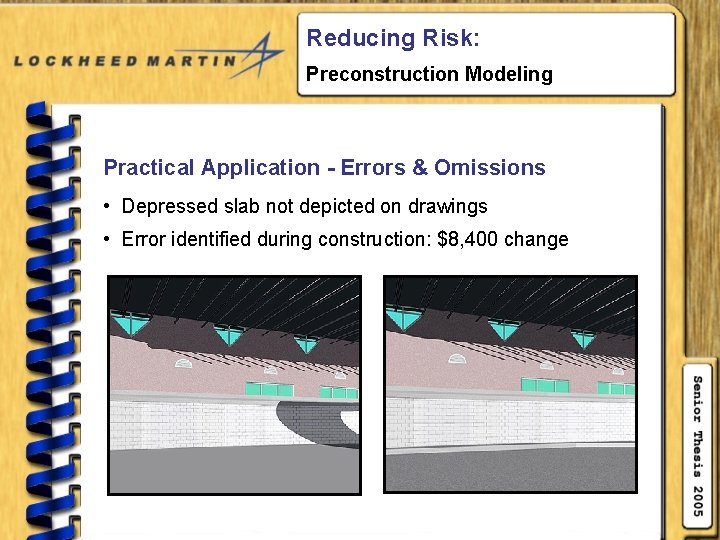
Reducing Risk: Preconstruction Modeling Practical Application - Errors & Omissions • Depressed slab not depicted on drawings • Error identified during construction: $8, 400 change

Reducing Risk: Preconstruction Modeling Reasons to Implement Revit® Fully coordinated drawings & documents + Reduced change management + Greater confidence in project costs & estimates Less risk from conceptual designer
Presentation Outline Project Overview Reducing Risk Improving Quality • Precast Panel Feasibility • Acoustical Review Conclusions
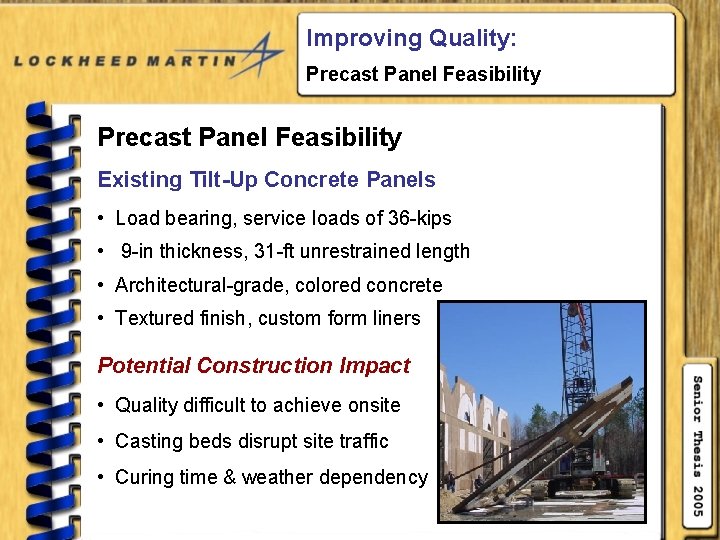
Improving Quality: Precast Panel Feasibility Existing Tilt-Up Concrete Panels • Load bearing, service loads of 36 -kips • 9 -in thickness, 31 -ft unrestrained length • Architectural-grade, colored concrete • Textured finish, custom form liners Potential Construction Impact • Quality difficult to achieve onsite • Casting beds disrupt site traffic • Curing time & weather dependency
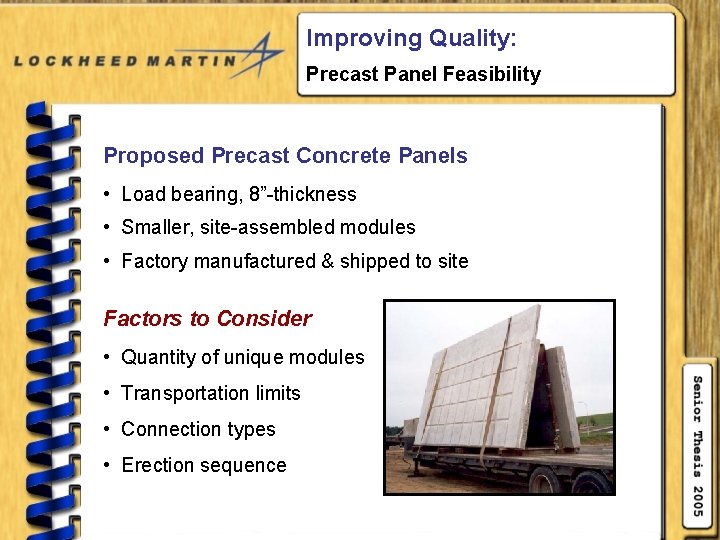
Improving Quality: Precast Panel Feasibility Proposed Precast Concrete Panels • Load bearing, 8”-thickness • Smaller, site-assembled modules • Factory manufactured & shipped to site Factors to Consider • Quantity of unique modules • Transportation limits • Connection types • Erection sequence
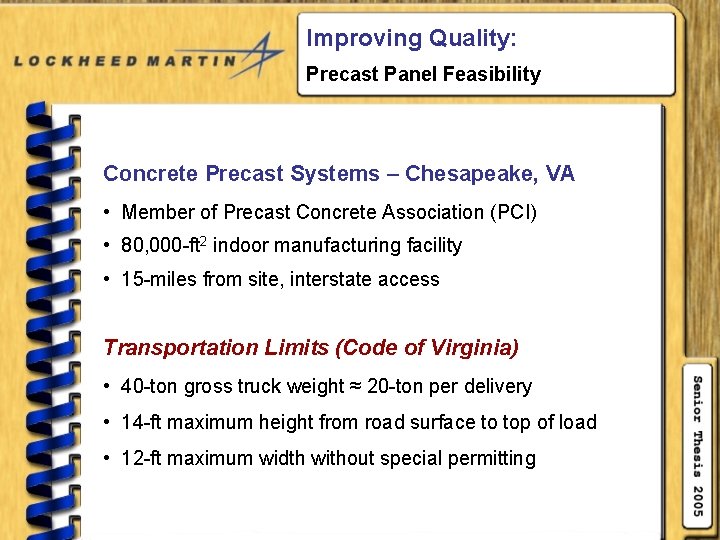
Improving Quality: Precast Panel Feasibility Concrete Precast Systems – Chesapeake, VA • Member of Precast Concrete Association (PCI) • 80, 000 -ft 2 indoor manufacturing facility • 15 -miles from site, interstate access Transportation Limits (Code of Virginia) • 40 -ton gross truck weight ≈ 20 -ton per delivery • 14 -ft maximum height from road surface to top of load • 12 -ft maximum width without special permitting

Improving Quality: Precast Panel Feasibility Panelizing the Façade Tilt-Up Precast
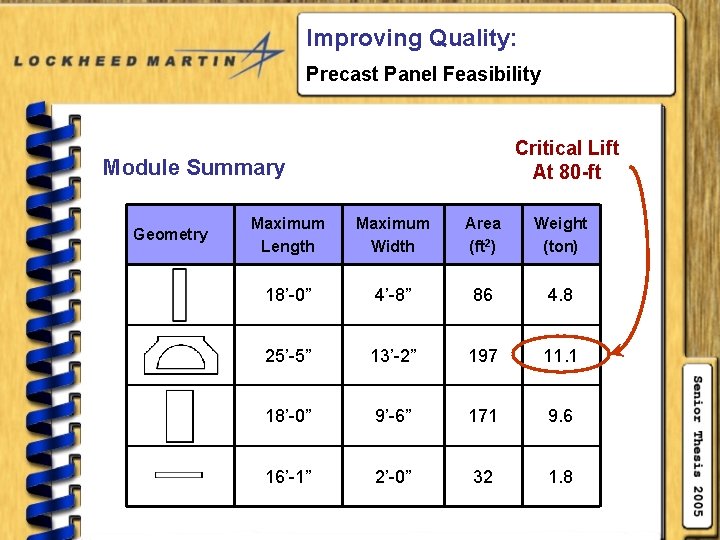
Improving Quality: Precast Panel Feasibility Critical Lift At 80 -ft Module Summary Geometry Maximum Length Maximum Width Area (ft 2) Weight (ton) 18’-0” 4’-8” 86 4. 8 25’-5” 13’-2” 197 11. 1 18’-0” 9’-6” 171 9. 6 16’-1” 2’-0” 32 1. 8
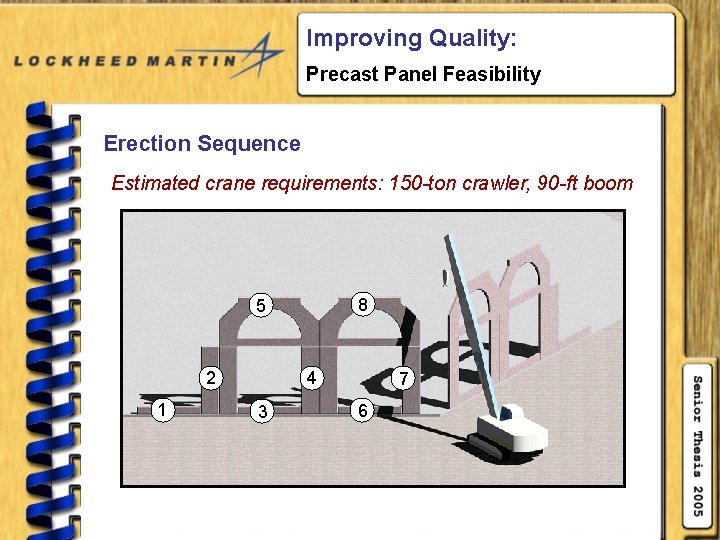
Improving Quality: Precast Panel Feasibility Erection Sequence Estimated crane requirements: 150 -ton crawler, 90 -ft boom 8 5 2 1 4 3 7 6
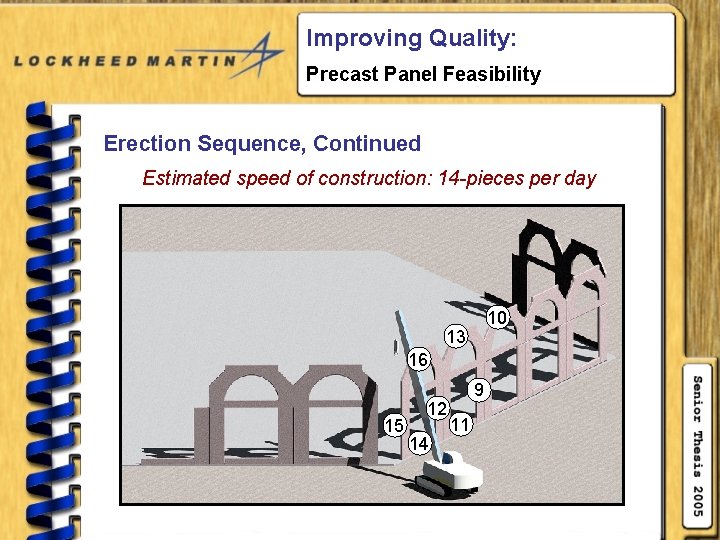
Improving Quality: Precast Panel Feasibility Erection Sequence, Continued Estimated speed of construction: 14 -pieces per day 10 13 16 15 12 14 9 11

Improving Quality: Precast Panel Feasibility Comparison Summary Panel Type Cost Duration Tilt-up $356, 000 24 days Precast $305, 000 12 days Note: Tilt-up cost includes $79, 000 for Tnemec© paint to achieve the same quality surface finish • Direct savings: $51, 000 • Indirect savings from reduced general conditions: $14, 000 • CPM schedule savings: 7 days
Presentation Outline Project Overview Reducing Risk Improving Quality • Precast Panel Feasibility • Acoustical Review Conclusions

Improving Quality: Acoustical Review Importance of the Auditorium • Provide gathering area for exchange of ideas • Present new technologies to prospective clients • Leave a lasting impression Overview • Reverse fan-shape, 46, 000 ft 3 volume • 14° sloped seating for 96 audience members • Suitable for speech & presentation audio

Improving Quality: Acoustical Review Reverberation Time Occupancy 125 Hz 500 Hz 4000 Hz Fully Occupied 0. 93 sec 1. 00 sec 0. 78 sec Half Occupied 1. 00 sec 1. 09 sec 0. 84 sec Assessment • Long reverberations at 500 Hz, target 0. 8 - 0. 9 sec • May hinder speech intelligibility

Improving Quality: Acoustical Review Reverberation Time, Continued • Replace maple veneer with fabric panels Ø Increase room absorption for mid-range frequencies Occupancy Half Occupied 125 Hz 500 Hz 4000 Hz 1. 00 sec 0. 86 sec 0. 73 sec Ø Reduces cost & coordination with millworker Material Cost ½” Maple paneling $12, 100 1” Fabric panel $6, 950
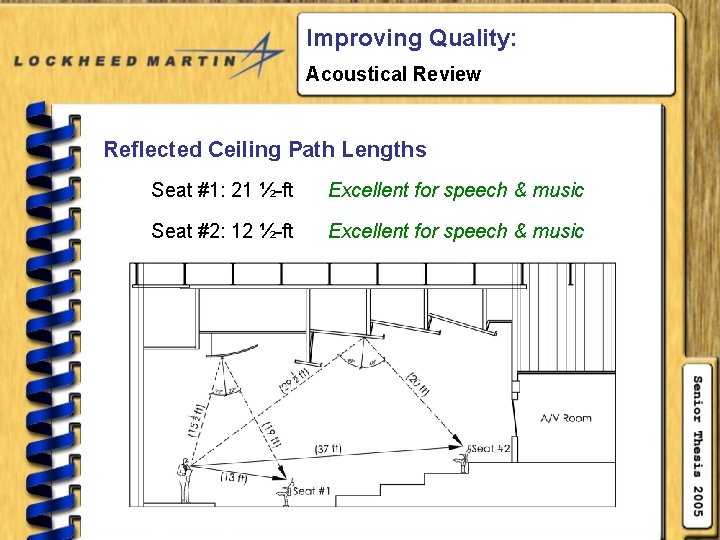
Improving Quality: Acoustical Review Reflected Ceiling Path Lengths Seat #1: 21 ½-ft Excellent for speech & music Seat #2: 12 ½-ft Excellent for speech & music

Improving Quality: Acoustical Review Reflected Wall Path Lengths Seat #1: 42 ½-ft Marginal Seat #2: 16 -ft Excellent for speech & music Assessment • Distinct echoes from wall reflections at Seat #1
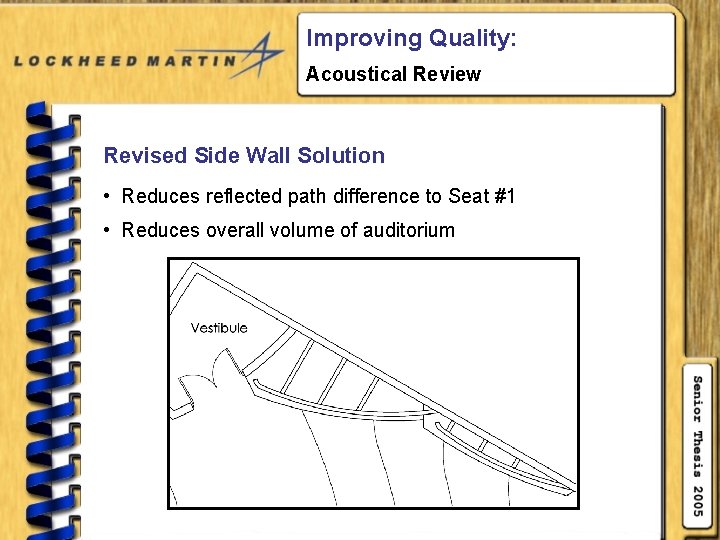
Improving Quality: Acoustical Review Revised Side Wall Solution • Reduces reflected path difference to Seat #1 • Reduces overall volume of auditorium
Improving Quality: Acoustical Review Recommendations to Improve Listening Quality • Reduce auditorium volume Ø 480 ft 3 person causes loss of intimacy • Revise shape & depth of side walls Ø Eliminate distinct echoes to front row seating • Replace wood veneer with fabric panels Ø Lower reverberation times in speaking frequencies
Presentation Outline Project Overview Reducing Risk Improving Quality Conclusions
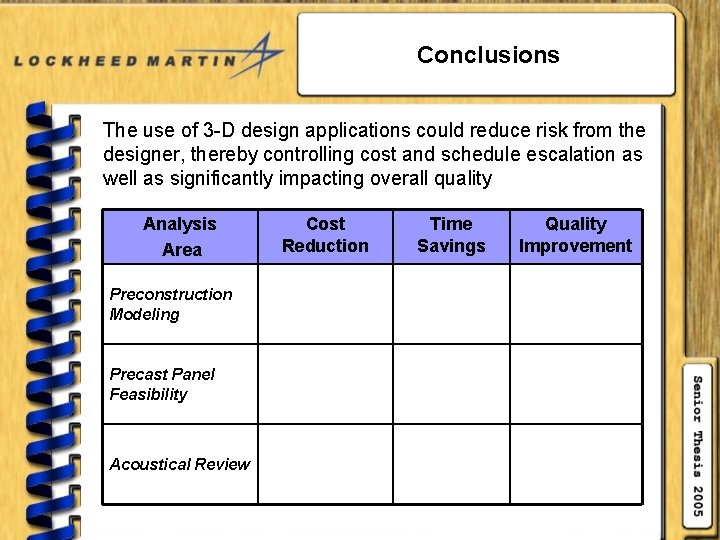
Conclusions The use of 3 -D design applications could reduce risk from the designer, thereby controlling cost and schedule escalation as well as significantly impacting overall quality Analysis Area Preconstruction Modeling Precast Panel Feasibility Acoustical Review Cost Reduction Time Savings Quality Improvement
Conclusions Questions?
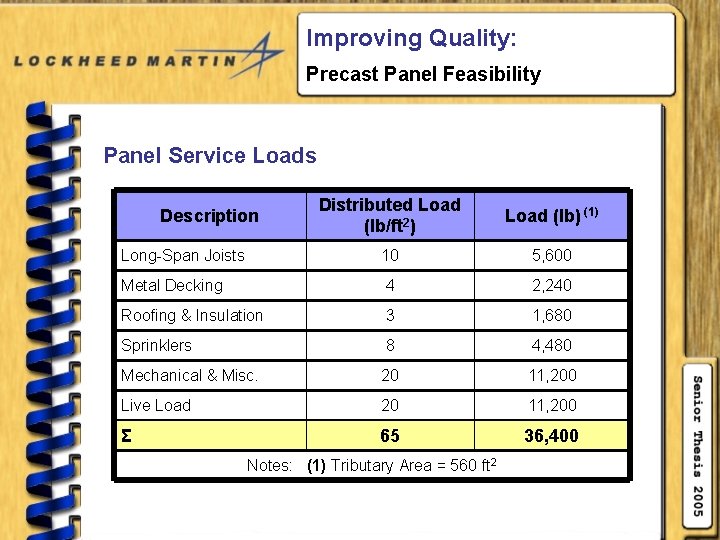
Improving Quality: Precast Panel Feasibility Panel Service Loads Distributed Load (lb/ft 2) Load (lb) (1) Long-Span Joists 10 5, 600 Metal Decking 4 2, 240 Roofing & Insulation 3 1, 680 Sprinklers 8 4, 480 Mechanical & Misc. 20 11, 200 Live Load 20 11, 200 Σ 65 36, 400 Description Notes: (1) Tributary Area = 560 ft 2
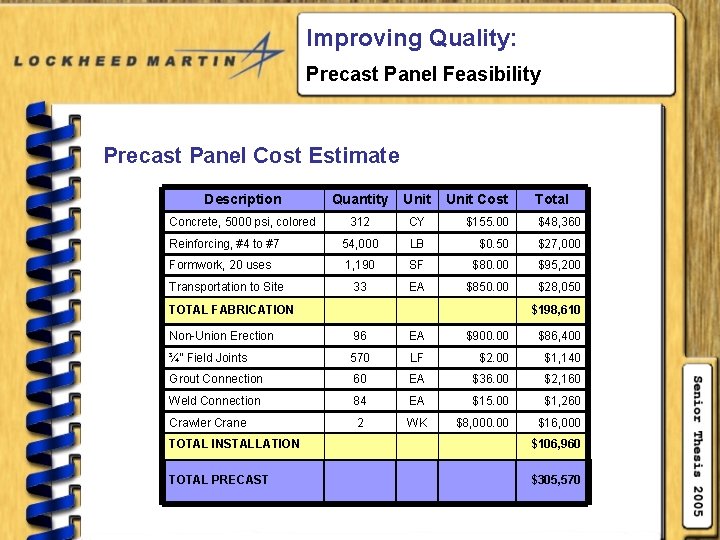
Improving Quality: Precast Panel Feasibility Precast Panel Cost Estimate Description Quantity Unit Concrete, 5000 psi, colored 312 CY $155. 00 $48, 360 Reinforcing, #4 to #7 54, 000 LB $0. 50 $27, 000 Formwork, 20 uses 1, 190 SF $80. 00 $95, 200 33 EA $850. 00 $28, 050 Transportation to Site Unit Cost TOTAL FABRICATION Total $198, 610 Non-Union Erection 96 EA $900. 00 $86, 400 ¾” Field Joints 570 LF $2. 00 $1, 140 Grout Connection 60 EA $36. 00 $2, 160 Weld Connection 84 EA $15. 00 $1, 260 Crawler Crane 2 WK $8, 000. 00 $16, 000 TOTAL INSTALLATION $106, 960 TOTAL PRECAST $305, 570
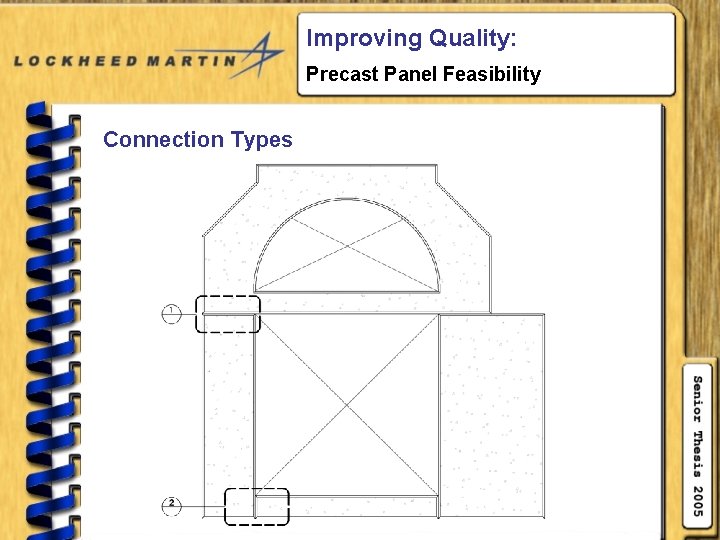
Improving Quality: Precast Panel Feasibility Connection Types
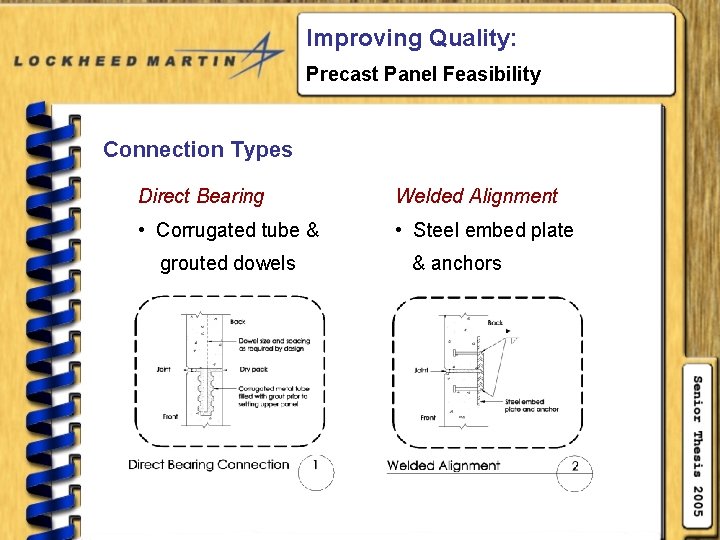
Improving Quality: Precast Panel Feasibility Connection Types Direct Bearing Welded Alignment • Corrugated tube & • Steel embed plate grouted dowels & anchors
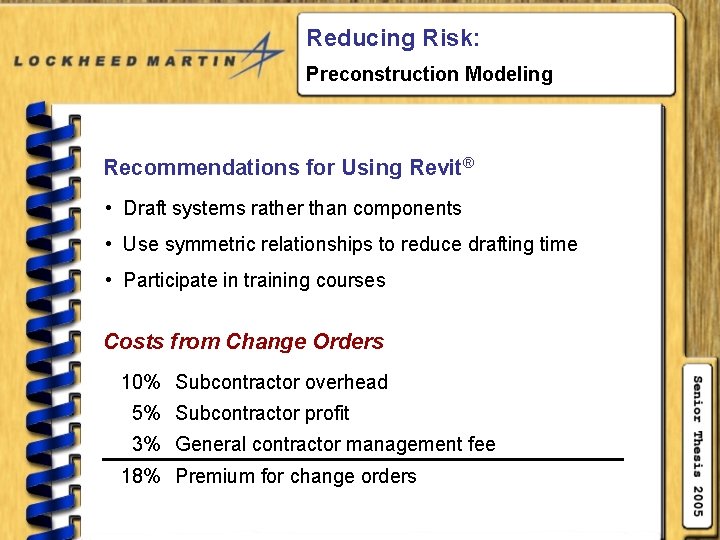
Reducing Risk: Preconstruction Modeling Recommendations for Using Revit® • Draft systems rather than components • Use symmetric relationships to reduce drafting time • Participate in training courses Costs from Change Orders 10% Subcontractor overhead 5% Subcontractor profit 3% General contractor management fee 18% Premium for change orders
- Slides: 39