
PRESENTATION GUIDE Dear School District Administrator This Power
- Slides: 75
PRESENTATION GUIDE Dear School District Administrator, This Power. Point presentation is intended to help understand the latest changes to the state’s education funding and accountability system. The information included in this presentation is an example of what would be helpful to share with your Local Control & Accountability Plan team, staff, and community. Feel free to add or omit information to tailor this presentation to the specific context of your district. This presentation is a companion to the LCFF 101 Guide: Understanding California’s Education Funding System document. Sincerely, CASBO Staff
Local Control Funding Formula 101 Demystifying California’s Education Finance & Accountability System
Outline of Presentation LCFF 101: How Does LCFF Work? LCAP: Local Control & Accountability Plan The Evaluation Rubrics How the Evaluation Rubrics Works Technical Assistance & Support Reference Charts
Local Control Funding Formula 101 How Does LCFF Work?
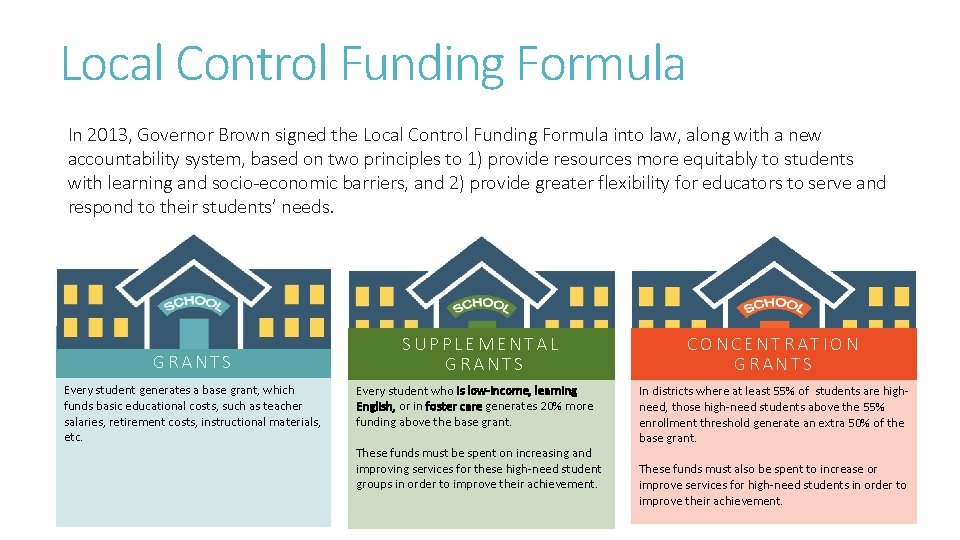
Local Control Funding Formula In 2013, Governor Brown signed the Local Control Funding Formula into law, along with a new accountability system, based on two principles to 1) provide resources more equitably to students with learning and socio-economic barriers, and 2) provide greater flexibility for educators to serve and respond to their students’ needs. BASE GRANTS Every student generates a base grant, which funds basic educational costs, such as teacher salaries, retirement costs, instructional materials, etc. SUPPLEMENTAL GRANTS Every student who is low-income, learning English, or in foster care generates 20% more funding above the base grant. These funds must be spent on increasing and improving services for these high-need student groups in order to improve their achievement. CONCENTRATION GRANTS In districts where at least 55% of students are highneed, those high-need students above the 55% enrollment threshold generate an extra 50% of the base grant. These funds must also be spent to increase or improve services for high-need students in order to improve their achievement.
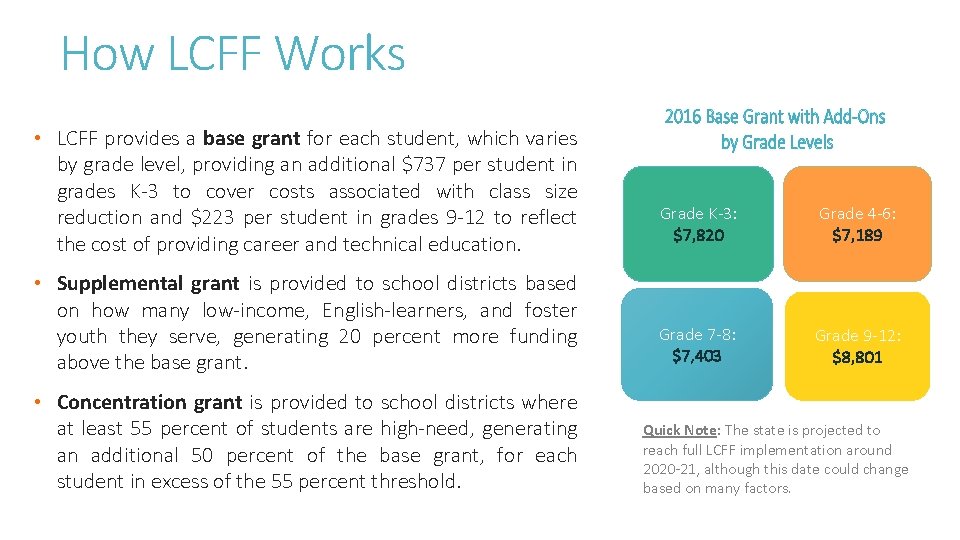
How LCFF Works • LCFF provides a base grant for each student, which varies by grade level, providing an additional $737 per student in grades K-3 to cover costs associated with class size reduction and $223 per student in grades 9 -12 to reflect the cost of providing career and technical education. • Supplemental grant is provided to school districts based on how many low-income, English-learners, and foster youth they serve, generating 20 percent more funding above the base grant. • Concentration grant is provided to school districts where at least 55 percent of students are high-need, generating an additional 50 percent of the base grant, for each student in excess of the 55 percent threshold. Grade K-3: $7, 820 Grade 4 -6: $7, 189 Grade 7 -8: $7, 403 Grade 9 -12: $8, 801 Quick Note: The state is projected to reach full LCFF implementation around 2020 -21, although this date could change based on many factors.
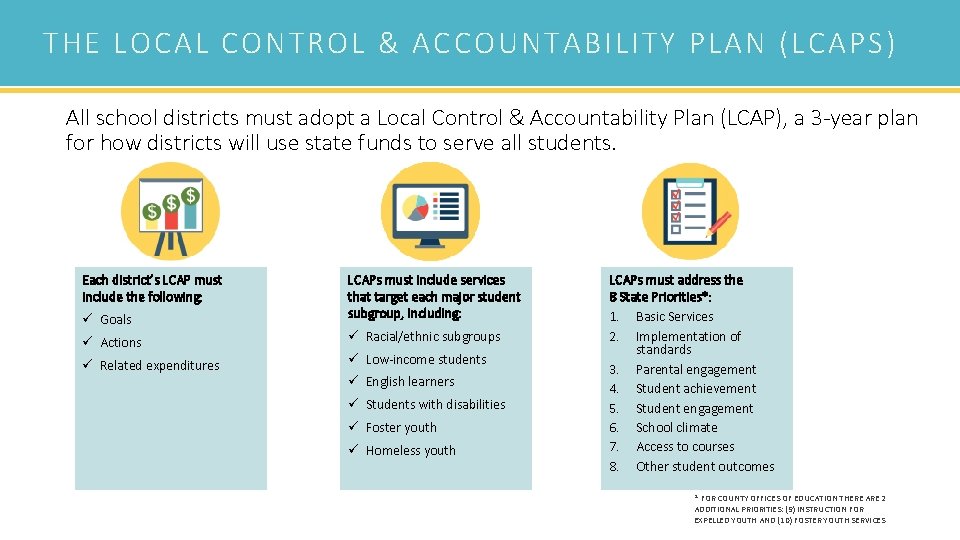
THE LOCAL CONTROL & ACCOUNTABILITY PLAN (LCAPS) All school districts must adopt a Local Control & Accountability Plan (LCAP), a 3 -year plan for how districts will use state funds to serve all students. Each district’s LCAP must include the following: ü Goals ü Actions ü Related expenditures LCAPs must include services that target each major student subgroup, including: ü Racial/ethnic subgroups ü Low-income students ü English learners ü Students with disabilities ü Foster youth ü Homeless youth LCAPs must address the 8 State Priorities*: 1. Basic Services 2. Implementation of standards 3. Parental engagement 4. Student achievement 5. Student engagement 6. School climate 7. Access to courses 8. Other student outcomes * FOR COUNTY OFFICES OF EDUCATION THERE ARE 2 ADDITIONAL PRIORITIES: (9) INSTRUCTION FOR EXPELLED YOUTH AND (10) FOSTER YOUTH SERVICES
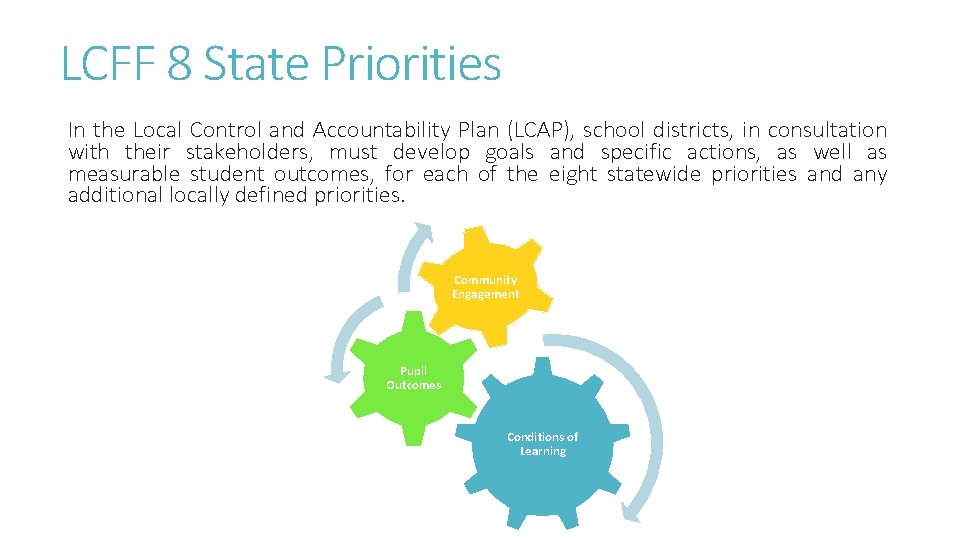
LCFF 8 State Priorities In the Local Control and Accountability Plan (LCAP), school districts, in consultation with their stakeholders, must develop goals and specific actions, as well as measurable student outcomes, for each of the eight statewide priorities and any additional locally defined priorities. Community Engagement Pupil Outcomes Conditions of Learning
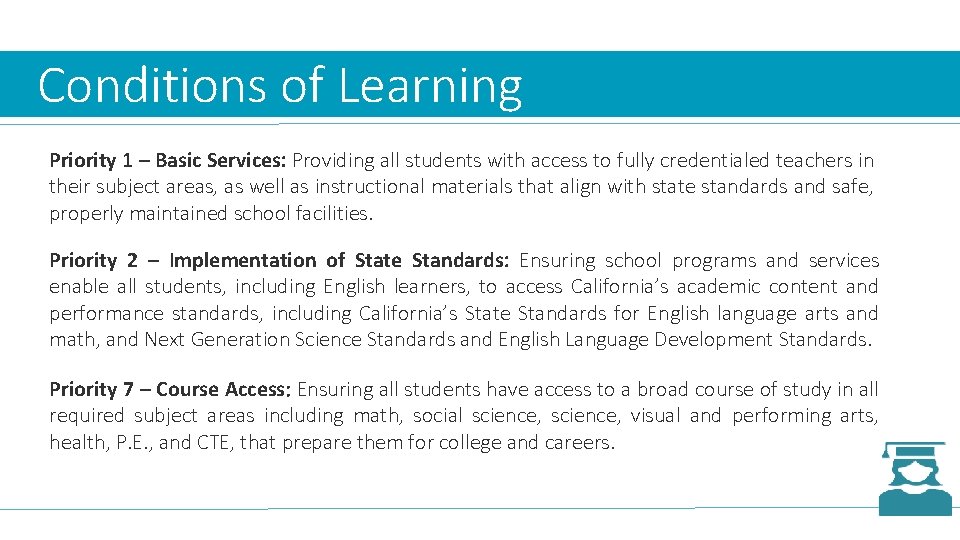
Conditions of Learning Priority 1 – Basic Services: Providing all students with access to fully credentialed teachers in their subject areas, as well as instructional materials that align with state standards and safe, properly maintained school facilities. Priority 2 – Implementation of State Standards: Ensuring school programs and services enable all students, including English learners, to access California’s academic content and performance standards, including California’s State Standards for English language arts and math, and Next Generation Science Standards and English Language Development Standards. Priority 7 – Course Access: Ensuring all students have access to a broad course of study in all required subject areas including math, social science, visual and performing arts, health, P. E. , and CTE, that prepare them for college and careers.
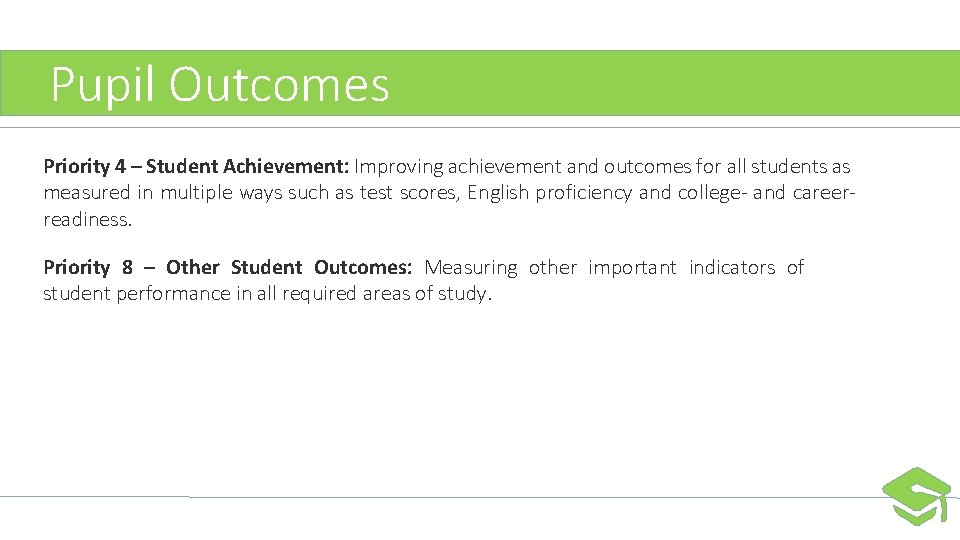
Pupil Outcomes Priority 4 – Student Achievement: Improving achievement and outcomes for all students as measured in multiple ways such as test scores, English proficiency and college- and careerreadiness. Priority 8 – Other Student Outcomes: Measuring other important indicators of student performance in all required areas of study.
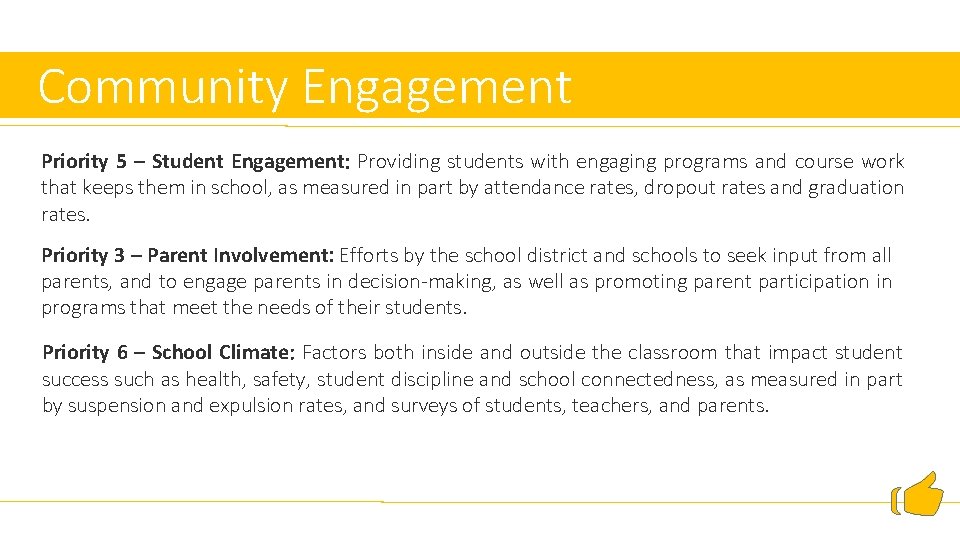
Community Engagement Priority 5 – Student Engagement: Providing students with engaging programs and course work that keeps them in school, as measured in part by attendance rates, dropout rates and graduation rates. Priority 3 – Parent Involvement: Efforts by the school district and schools to seek input from all parents, and to engage parents in decision-making, as well as promoting parent participation in programs that meet the needs of their students. Priority 6 – School Climate: Factors both inside and outside the classroom that impact student success such as health, safety, student discipline and school connectedness, as measured in part by suspension and expulsion rates, and surveys of students, teachers, and parents.
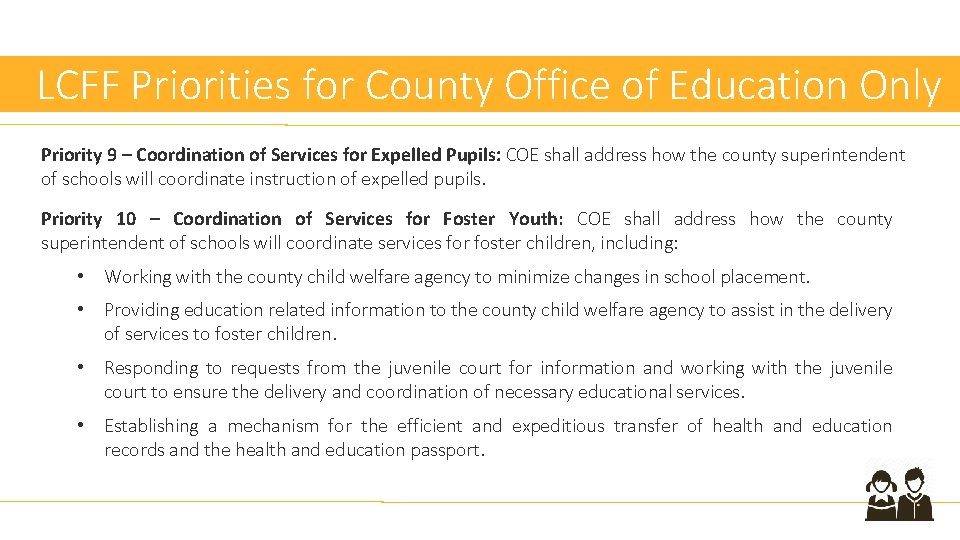
LCFF Priorities for County Office of Education Only Priority 9 – Coordination of Services for Expelled Pupils: COE shall address how the county superintendent of schools will coordinate instruction of expelled pupils. Priority 10 – Coordination of Services for Foster Youth: COE shall address how the county superintendent of schools will coordinate services for foster children, including: • Working with the county child welfare agency to minimize changes in school placement. • Providing education related information to the county child welfare agency to assist in the delivery of services to foster children. • Responding to requests from the juvenile court for information and working with the juvenile court to ensure the delivery and coordination of necessary educational services. • Establishing a mechanism for the efficient and expeditious transfer of health and education records and the health and education passport.
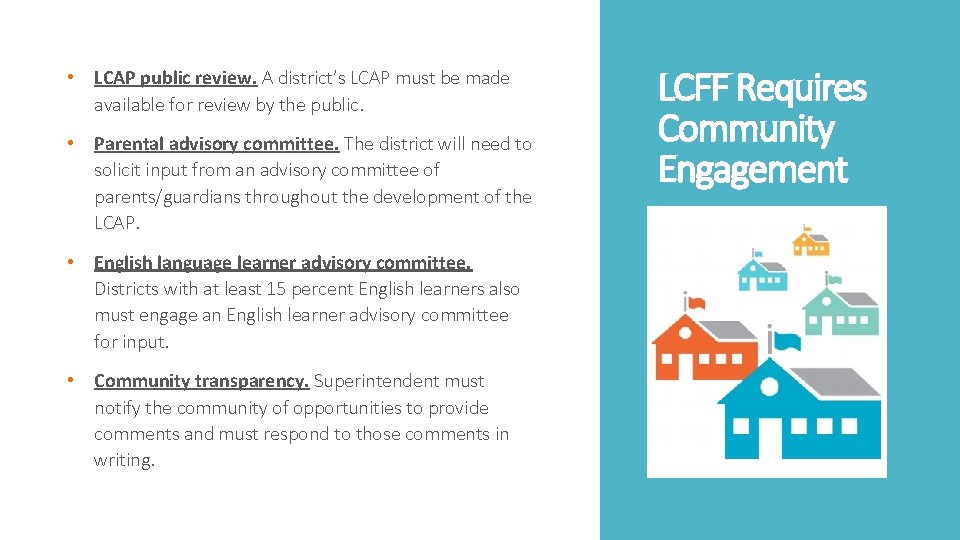
• LCAP public review. A district’s LCAP must be made available for review by the public. • Parental advisory committee. The district will need to solicit input from an advisory committee of parents/guardians throughout the development of the LCAP. • English language learner advisory committee. Districts with at least 15 percent English learners also must engage an English learner advisory committee for input. • Community transparency. Superintendent must notify the community of opportunities to provide comments and must respond to those comments in writing. LCFF Requires Community Engagement
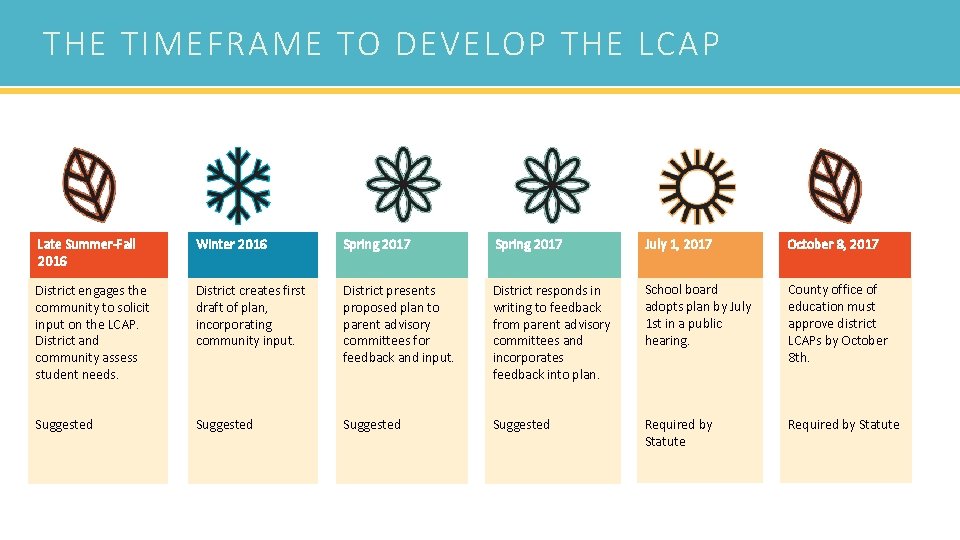
THE TIMEFRAME TO DEVELOP THE LCAP Late Summer-Fall 2016 Winter 2016 Spring 2017 July 1, 2017 October 8, 2017 District engages the community to solicit input on the LCAP. District and community assess student needs. District creates first draft of plan, incorporating community input. District presents proposed plan to parent advisory committees for feedback and input. District responds in writing to feedback from parent advisory committees and incorporates feedback into plan. School board adopts plan by July 1 st in a public hearing. County office of education must approve district LCAPs by October 8 th. Suggested Required by Statute
Local Control Funding Formula 101 Local Control & Accountability Plan (LCAP)
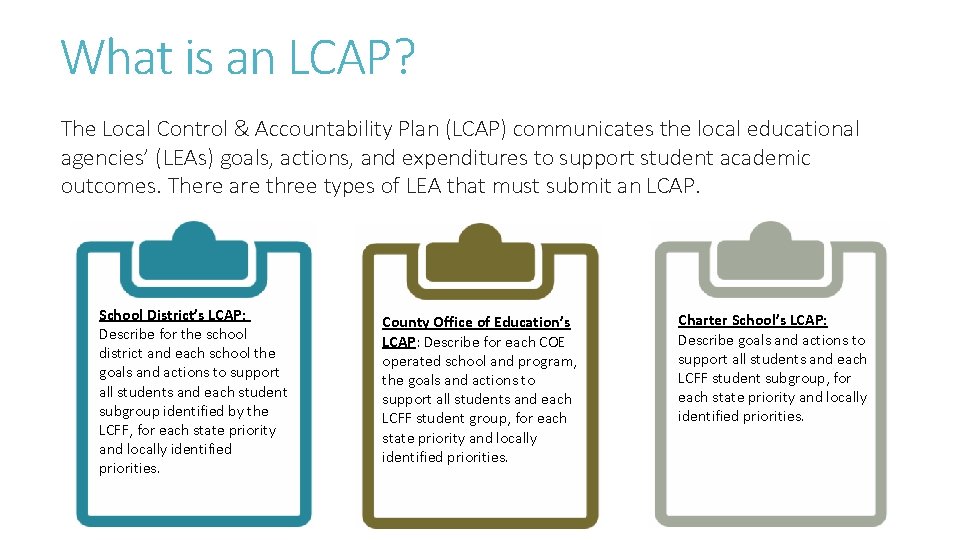
What is an LCAP? The Local Control & Accountability Plan (LCAP) communicates the local educational agencies’ (LEAs) goals, actions, and expenditures to support student academic outcomes. There are three types of LEA that must submit an LCAP. School District’s LCAP: Describe for the school district and each school the goals and actions to support all students and each student subgroup identified by the LCFF, for each state priority and locally identified priorities. County Office of Education’s LCAP: Describe for each COE operated school and program, the goals and actions to support all students and each LCFF student group, for each state priority and locally identified priorities. Charter School’s LCAP: Describe goals and actions to support all students and each LCFF student subgroup, for each state priority and locally identified priorities.
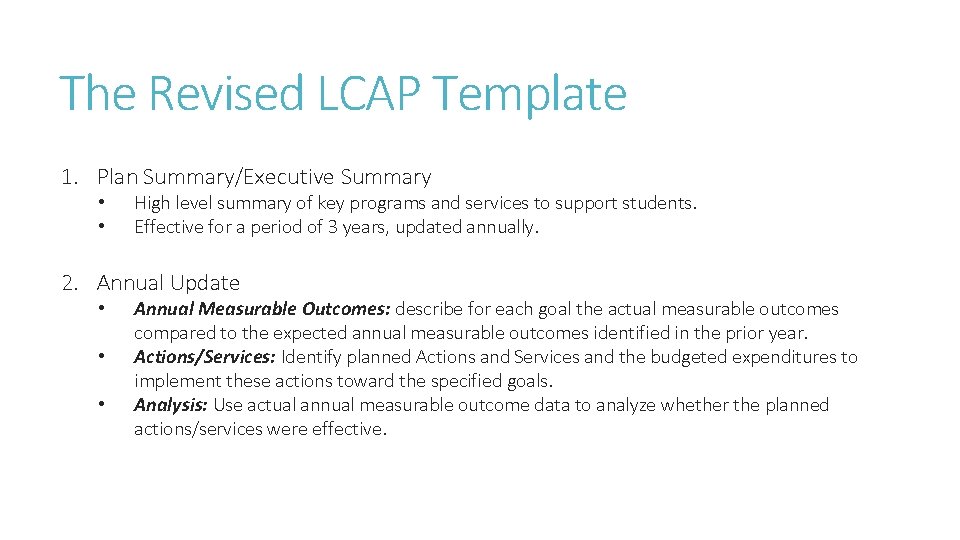
The Revised LCAP Template 1. Plan Summary/Executive Summary • • High level summary of key programs and services to support students. Effective for a period of 3 years, updated annually. 2. Annual Update • • • Annual Measurable Outcomes: describe for each goal the actual measurable outcomes compared to the expected annual measurable outcomes identified in the prior year. Actions/Services: Identify planned Actions and Services and the budgeted expenditures to implement these actions toward the specified goals. Analysis: Use actual annual measurable outcome data to analyze whether the planned actions/services were effective.
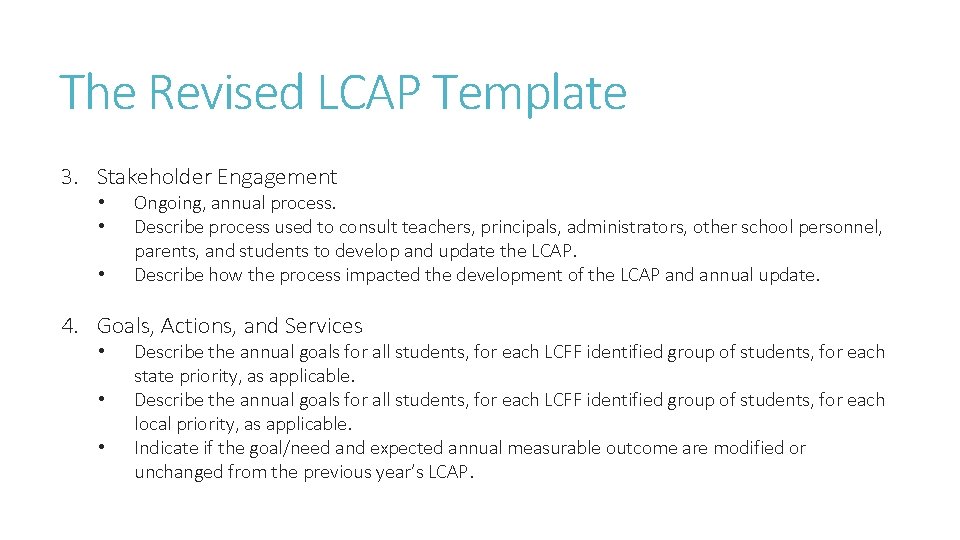
The Revised LCAP Template 3. Stakeholder Engagement • • • Ongoing, annual process. Describe process used to consult teachers, principals, administrators, other school personnel, parents, and students to develop and update the LCAP. Describe how the process impacted the development of the LCAP and annual update. 4. Goals, Actions, and Services • • • Describe the annual goals for all students, for each LCFF identified group of students, for each state priority, as applicable. Describe the annual goals for all students, for each LCFF identified group of students, for each local priority, as applicable. Indicate if the goal/need and expected annual measurable outcome are modified or unchanged from the previous year’s LCAP.
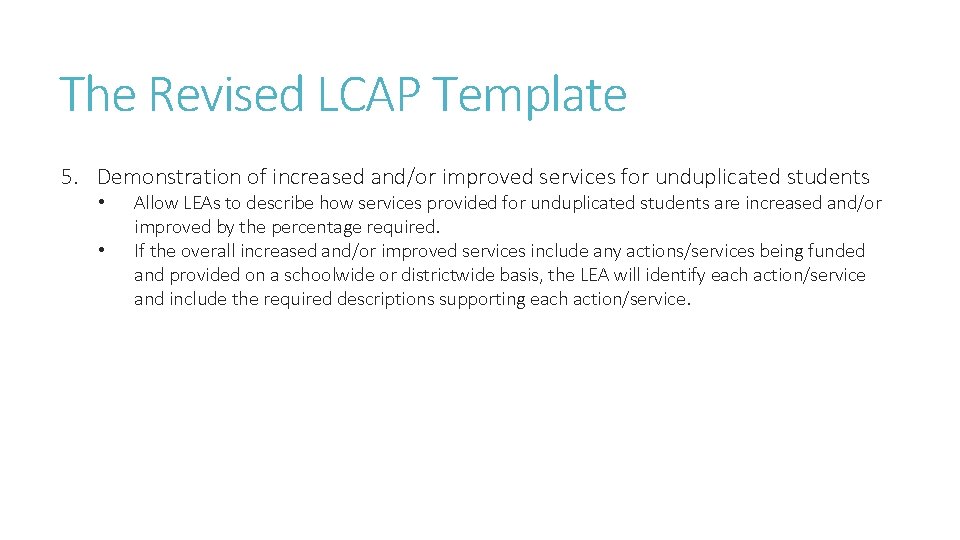
The Revised LCAP Template 5. Demonstration of increased and/or improved services for unduplicated students • • Allow LEAs to describe how services provided for unduplicated students are increased and/or improved by the percentage required. If the overall increased and/or improved services include any actions/services being funded and provided on a schoolwide or districtwide basis, the LEA will identify each action/service and include the required descriptions supporting each action/service.
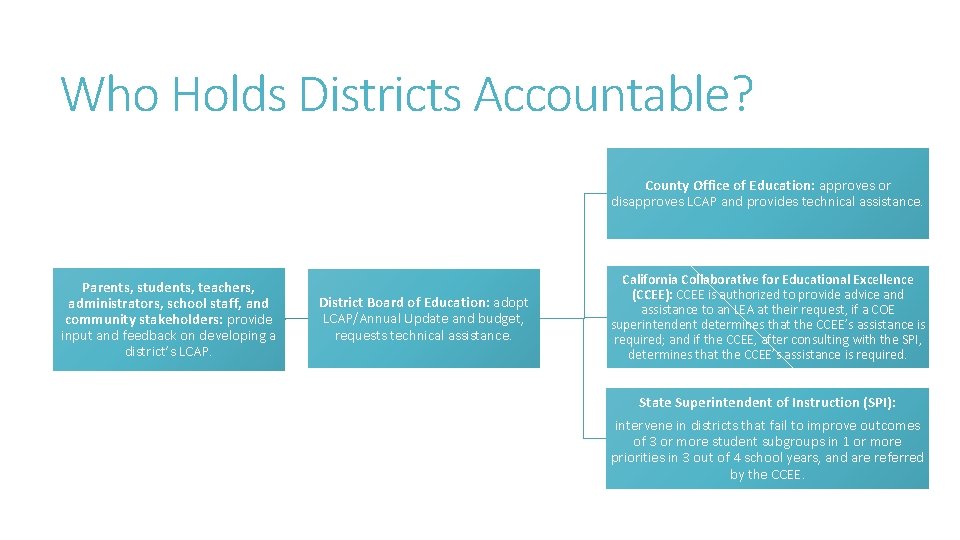
Who Holds Districts Accountable? County Office of Education: approves or disapproves LCAP and provides technical assistance. Parents, students, teachers, administrators, school staff, and community stakeholders: provide input and feedback on developing a district’s LCAP. District Board of Education: adopt LCAP/Annual Update and budget, requests technical assistance. California Collaborative for Educational Excellence (CCEE): CCEE is authorized to provide advice and assistance to an LEA at their request, if a COE superintendent determines that the CCEE’s assistance is required; and if the CCEE, after consulting with the SPI, determines that the CCEE’s assistance is required. State Superintendent of Instruction (SPI): intervene in districts that fail to improve outcomes of 3 or more student subgroups in 1 or more priorities in 3 out of 4 school years, and are referred by the CCEE.
Local Control Funding Formula 101 The Evaluation Rubrics
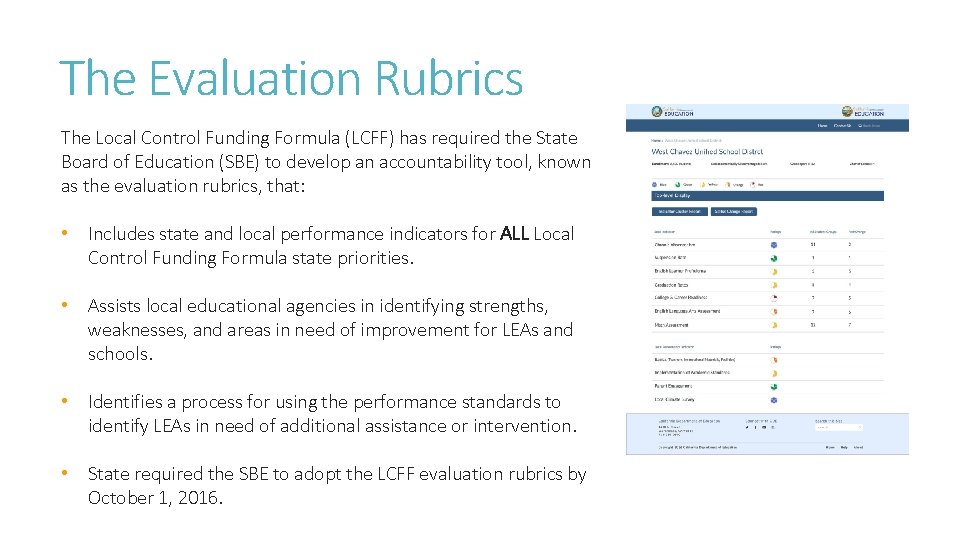
The Evaluation Rubrics The Local Control Funding Formula (LCFF) has required the State Board of Education (SBE) to develop an accountability tool, known as the evaluation rubrics, that: • Includes state and local performance indicators for ALL Local Control Funding Formula state priorities. • Assists local educational agencies in identifying strengths, weaknesses, and areas in need of improvement for LEAs and schools. • Identifies a process for using the performance standards to identify LEAs in need of additional assistance or intervention. • State required the SBE to adopt the LCFF evaluation rubrics by October 1, 2016.
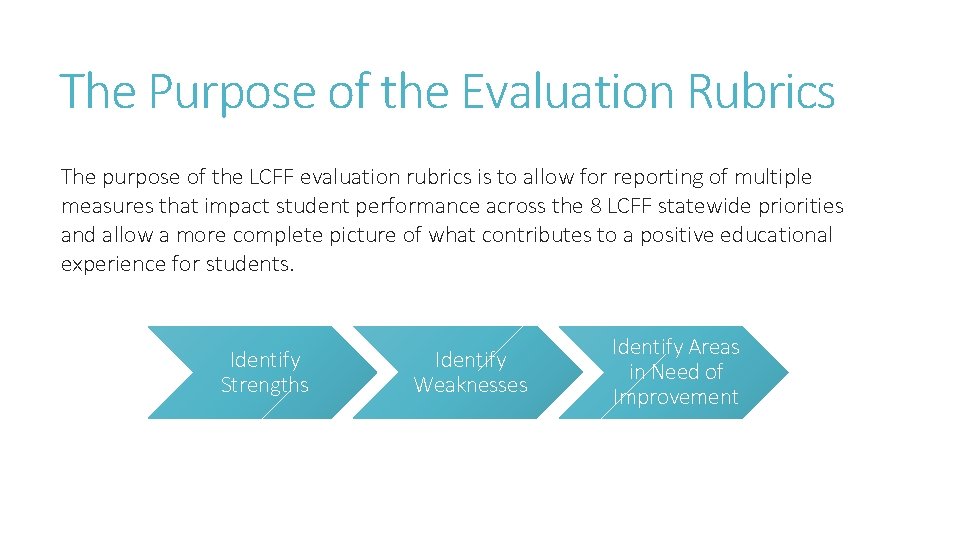
The Purpose of the Evaluation Rubrics The purpose of the LCFF evaluation rubrics is to allow for reporting of multiple measures that impact student performance across the 8 LCFF statewide priorities and allow a more complete picture of what contributes to a positive educational experience for students. Identify Strengths Identify Weaknesses Identify Areas in Need of Improvement
Purpose of LCFF Evaluation Rubrics 1. Measure LCFF State Priorities. The evaluation rubrics is the state’s new accountability tool that includes state and local performance standards for all LCFF priorities. 2. Multi-dimensional Picture. The new accountability system will provide a more complete picture of what contributes to a positive educational experience for students and promotes equity by clearly identifying where there are disparities among student groups. 3. Identify Need for Technical Assistance & Intervention. The evaluation rubrics will assist LEAs in identifying strengths, weaknesses, and areas in need of improvement for LEAs and schools.
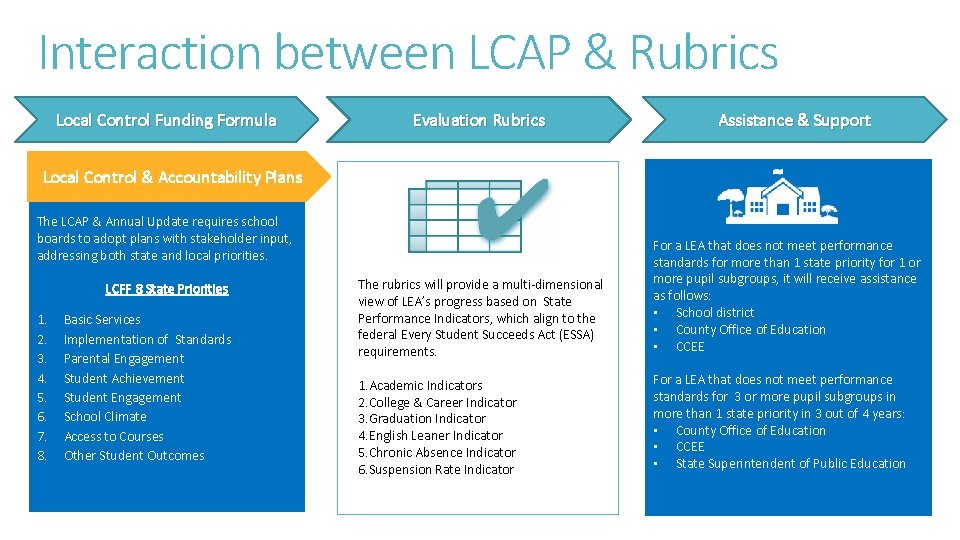
Interaction between LCAP & Rubrics Local Control Funding Formula Evaluation Rubrics Assistance & Support Local Control & Accountability Plans The LCAP & Annual Update requires school boards to adopt plans with stakeholder input, addressing both state and local priorities. LCFF 8 State Priorities 1. 2. 3. 4. 5. 6. 7. 8. Basic Services Implementation of Standards Parental Engagement Student Achievement Student Engagement School Climate Access to Courses Other Student Outcomes The rubrics will provide a multi-dimensional view of LEA’s progress based on State Performance Indicators, which align to the federal Every Student Succeeds Act (ESSA) requirements. For a LEA that does not meet performance standards for more than 1 state priority for 1 or more pupil subgroups, it will receive assistance as follows: • School district • County Office of Education • CCEE 1. Academic Indicators 2. College & Career Indicator 3. Graduation Indicator 4. English Leaner Indicator 5. Chronic Absence Indicator 6. Suspension Rate Indicator For a LEA that does not meet performance standards for 3 or more pupil subgroups in more than 1 state priority in 3 out of 4 years: • County Office of Education • CCEE • State Superintendent of Public Education
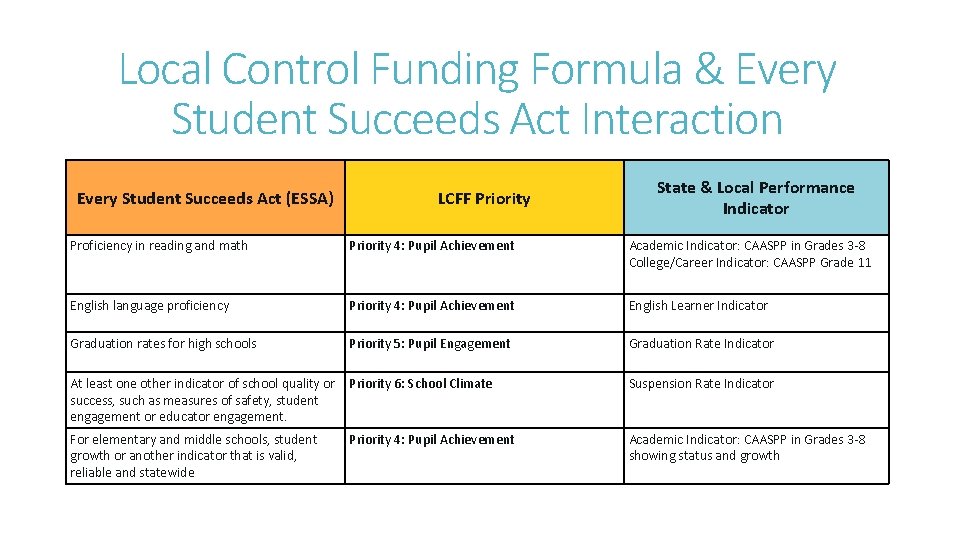
Local Control Funding Formula & Every Student Succeeds Act Interaction Every Student Succeeds Act (ESSA) LCFF Priority State & Local Performance Indicator Proficiency in reading and math Priority 4: Pupil Achievement Academic Indicator: CAASPP in Grades 3 -8 College/Career Indicator: CAASPP Grade 11 English language proficiency Priority 4: Pupil Achievement English Learner Indicator Graduation rates for high schools Priority 5: Pupil Engagement Graduation Rate Indicator At least one other indicator of school quality or Priority 6: School Climate success, such as measures of safety, student engagement or educator engagement. Suspension Rate Indicator For elementary and middle schools, student growth or another indicator that is valid, reliable and statewide Academic Indicator: CAASPP in Grades 3 -8 showing status and growth Priority 4: Pupil Achievement
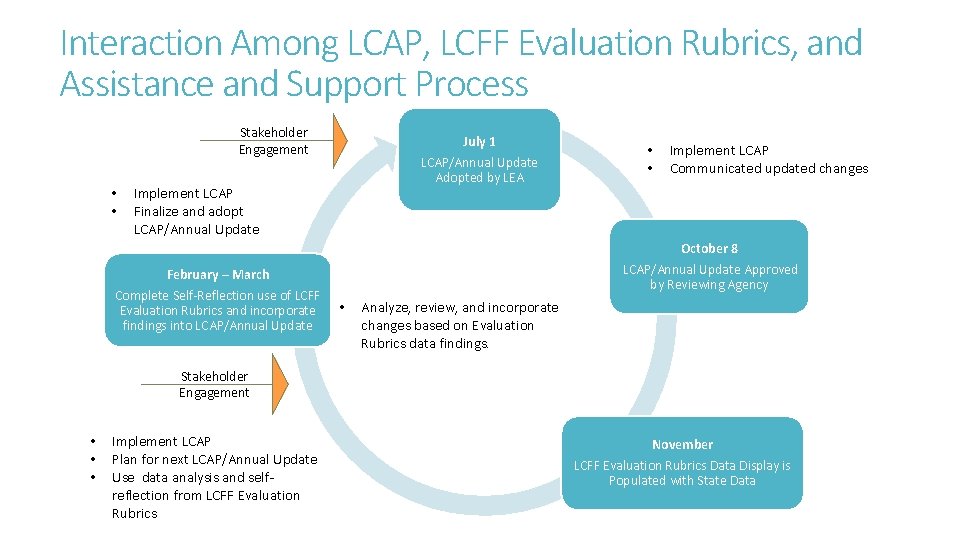
Interaction Among LCAP, LCFF Evaluation Rubrics, and Assistance and Support Process Stakeholder Engagement • • July 1 LCAP/Annual Update Adopted by LEA Implement LCAP Finalize and adopt LCAP/Annual Update February – March Complete Self-Reflection use of LCFF Evaluation Rubrics and incorporate findings into LCAP/Annual Update • • Implement LCAP Communicated updated changes October 8 LCAP/Annual Update Approved by Reviewing Agency • Analyze, review, and incorporate changes based on Evaluation Rubrics data findings. Stakeholder Engagement • • • Implement LCAP Plan for next LCAP/Annual Update Use data analysis and selfreflection from LCFF Evaluation Rubrics November LCFF Evaluation Rubrics Data Display is Populated with State Data
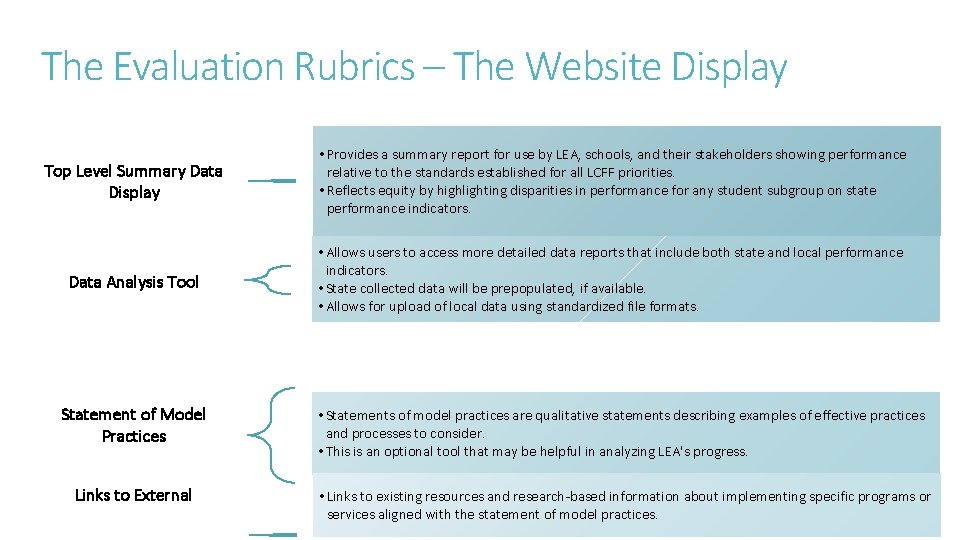
The Evaluation Rubrics – The Website Display Top Level Summary Data Display • Provides a summary report for use by LEA, schools, and their stakeholders showing performance relative to the standards established for all LCFF priorities. • Reflects equity by highlighting disparities in performance for any student subgroup on state performance indicators. Data Analysis Tool • Allows users to access more detailed data reports that include both state and local performance indicators. • State collected data will be prepopulated, if available. • Allows for upload of local data using standardized file formats. Statement of Model Practices • Statements of model practices are qualitative statements describing examples of effective practices and processes to consider. • This is an optional tool that may be helpful in analyzing LEA's progress. Links to External • Links to existing resources and research-based information about implementing specific programs or services aligned with the statement of model practices.
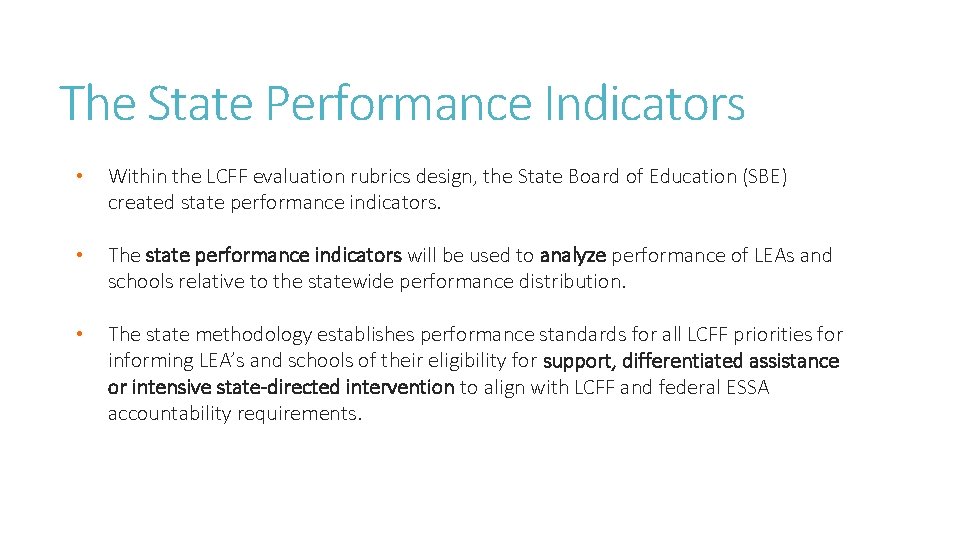
The State Performance Indicators • Within the LCFF evaluation rubrics design, the State Board of Education (SBE) created state performance indicators. • The state performance indicators will be used to analyze performance of LEAs and schools relative to the statewide performance distribution. • The state methodology establishes performance standards for all LCFF priorities for informing LEA’s and schools of their eligibility for support, differentiated assistance or intensive state-directed intervention to align with LCFF and federal ESSA accountability requirements.
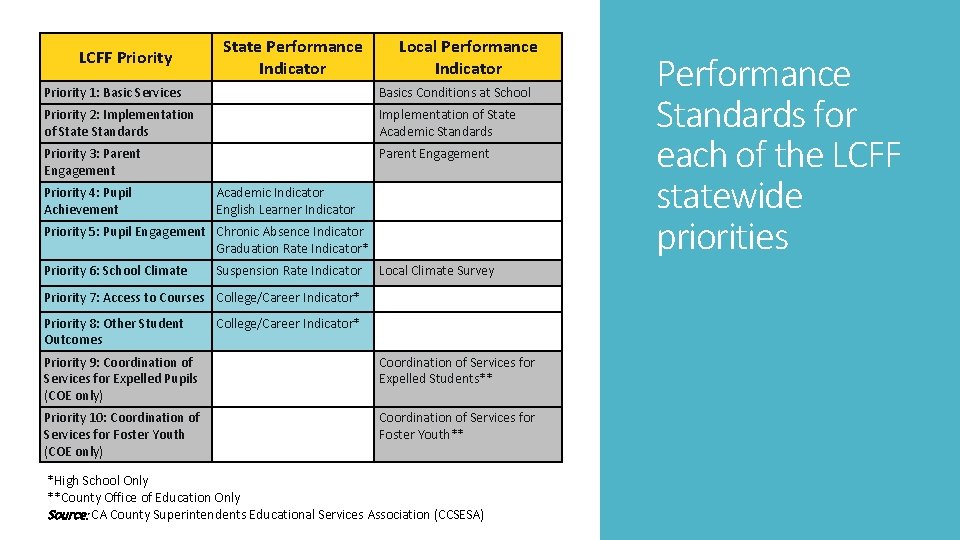
LCFF Priority State Performance Indicator Local Performance Indicator Priority 1: Basic Services Basics Conditions at School Priority 2: Implementation of State Standards Implementation of State Academic Standards Priority 3: Parent Engagement Priority 4: Pupil Achievement Academic Indicator English Learner Indicator Priority 5: Pupil Engagement Chronic Absence Indicator Graduation Rate Indicator* Priority 6: School Climate Suspension Rate Indicator Local Climate Survey Priority 7: Access to Courses College/Career Indicator* Priority 8: Other Student Outcomes College/Career Indicator* Priority 9: Coordination of Services for Expelled Pupils (COE only) Coordination of Services for Expelled Students** Priority 10: Coordination of Services for Foster Youth (COE only) Coordination of Services for Foster Youth** *High School Only **County Office of Education Only Source: CA County Superintendents Educational Services Association (CCSESA) Performance Standards for each of the LCFF statewide priorities
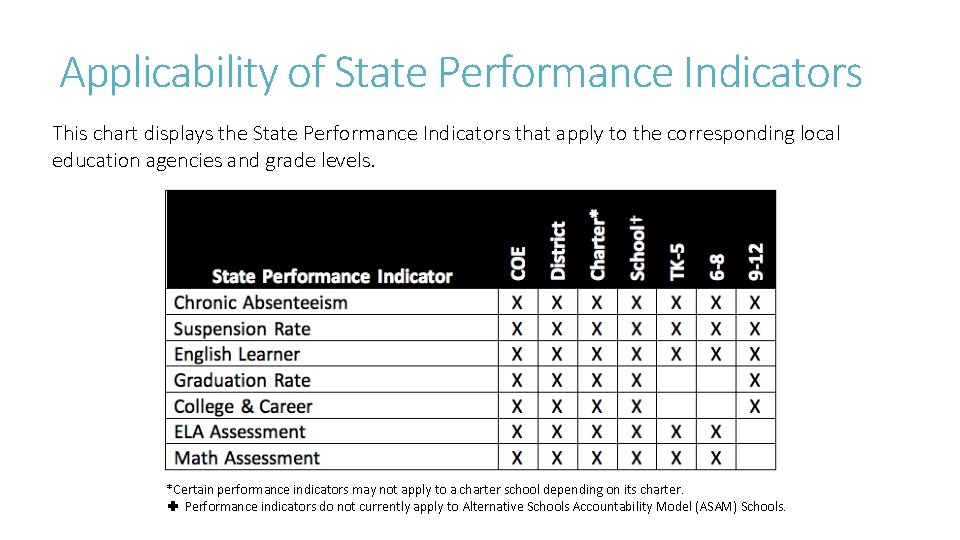
Applicability of State Performance Indicators This chart displays the State Performance Indicators that apply to the corresponding local education agencies and grade levels. *Certain performance indicators may not apply to a charter school depending on its charter. ✚ Performance indicators do not currently apply to Alternative Schools Accountability Model (ASAM) Schools.
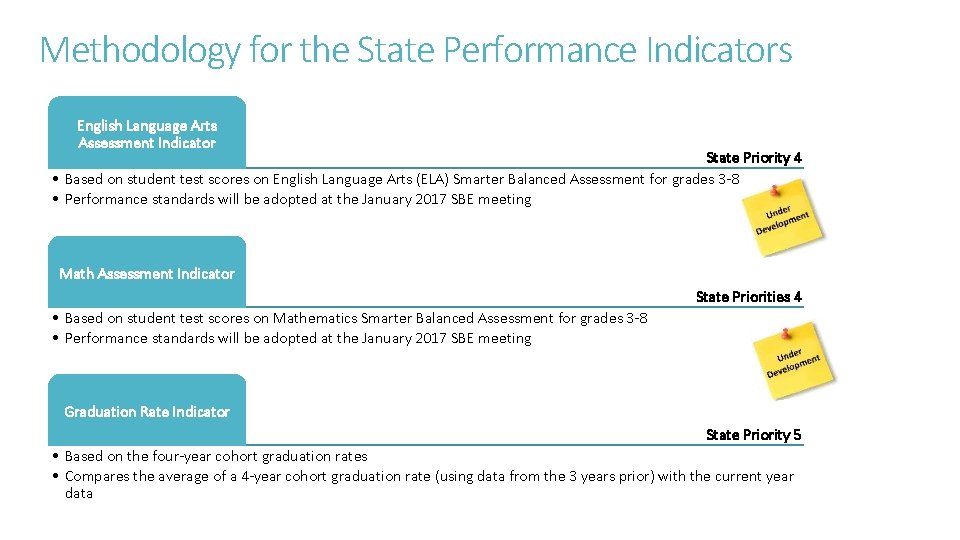
Methodology for the State Performance Indicators English Language Arts Assessment Indicator State Priority 4 • Based on student test scores on English Language Arts (ELA) Smarter Balanced Assessment for grades 3 -8 • Performance standards will be adopted at the January 2017 SBE meeting Math Assessment Indicator State Priorities 4 • Based on student test scores on Mathematics Smarter Balanced Assessment for grades 3 -8 • Performance standards will be adopted at the January 2017 SBE meeting Graduation Rate Indicator State Priority 5 • Based on the four-year cohort graduation rates • Compares the average of a 4 -year cohort graduation rate (using data from the 3 years prior) with the current year data
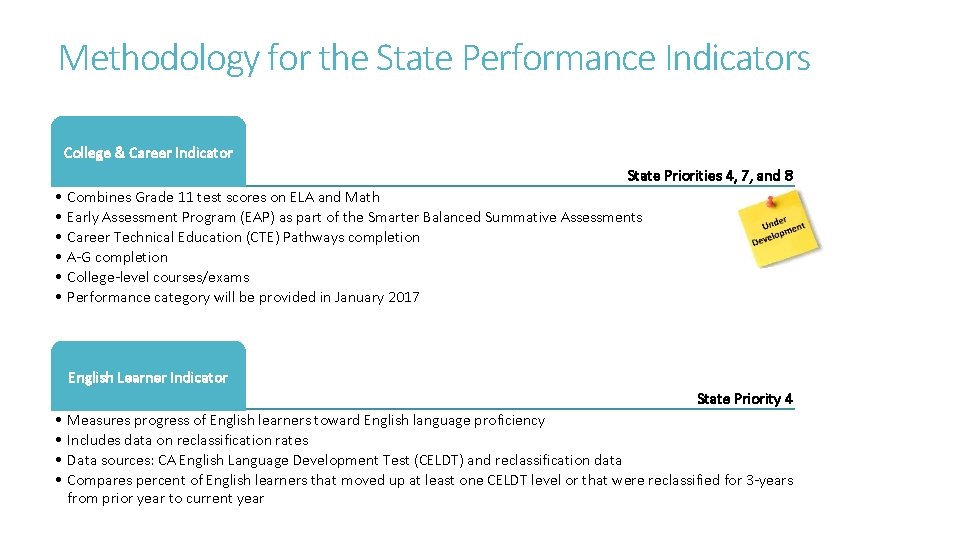
Methodology for the State Performance Indicators College & Career Indicator State Priorities 4, 7, and 8 • • • Combines Grade 11 test scores on ELA and Math Early Assessment Program (EAP) as part of the Smarter Balanced Summative Assessments Career Technical Education (CTE) Pathways completion A-G completion College-level courses/exams Performance category will be provided in January 2017 English Learner Indicator State Priority 4 • • Measures progress of English learners toward English language proficiency Includes data on reclassification rates Data sources: CA English Language Development Test (CELDT) and reclassification data Compares percent of English learners that moved up at least one CELDT level or that were reclassified for 3 -years from prior year to current year
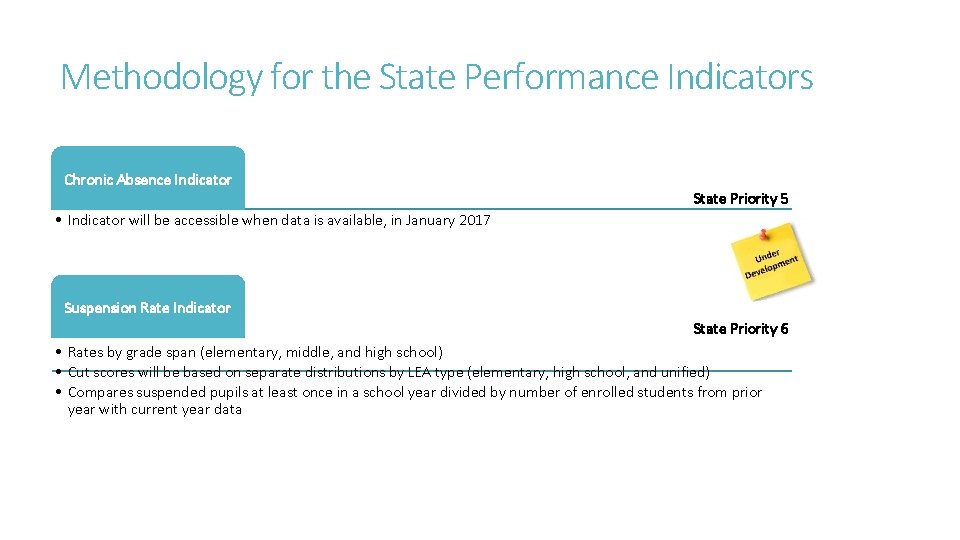
Methodology for the State Performance Indicators Chronic Absence Indicator State Priority 5 • Indicator will be accessible when data is available, in January 2017 Suspension Rate Indicator State Priority 6 • Rates by grade span (elementary, middle, and high school) • Cut scores will be based on separate distributions by LEA type (elementary, high school, and unified) • Compares suspended pupils at least once in a school year divided by number of enrolled students from prior year with current year data
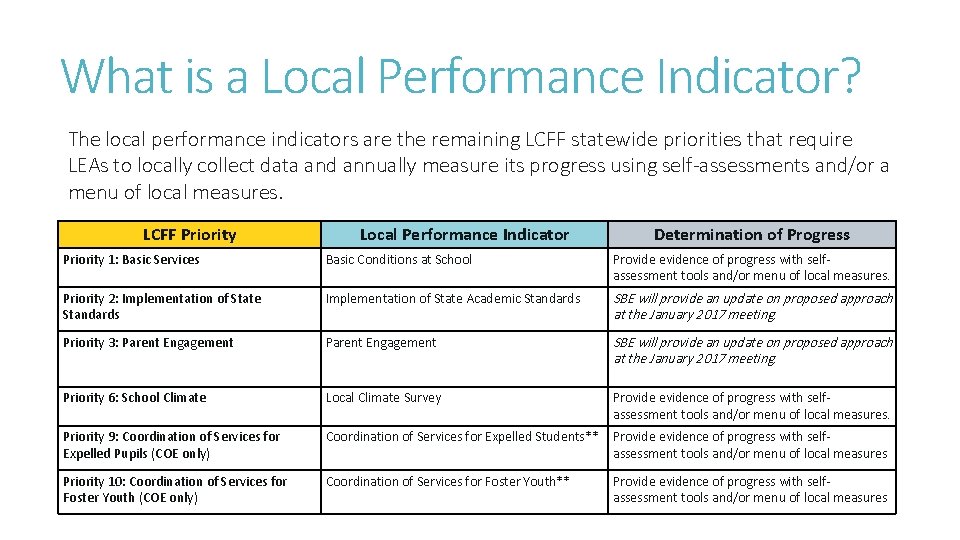
What is a Local Performance Indicator? The local performance indicators are the remaining LCFF statewide priorities that require LEAs to locally collect data and annually measure its progress using self-assessments and/or a menu of local measures. LCFF Priority Local Performance Indicator Determination of Progress Priority 1: Basic Services Basic Conditions at School Provide evidence of progress with selfassessment tools and/or menu of local measures. Priority 2: Implementation of State Standards Implementation of State Academic Standards SBE will provide an update on proposed approach at the January 2017 meeting. Priority 3: Parent Engagement SBE will provide an update on proposed approach at the January 2017 meeting. Priority 6: School Climate Local Climate Survey Provide evidence of progress with selfassessment tools and/or menu of local measures. Priority 9: Coordination of Services for Expelled Pupils (COE only) Coordination of Services for Expelled Students** Provide evidence of progress with selfassessment tools and/or menu of local measures Priority 10: Coordination of Services for Foster Youth (COE only) Coordination of Services for Foster Youth** Provide evidence of progress with selfassessment tools and/or menu of local measures
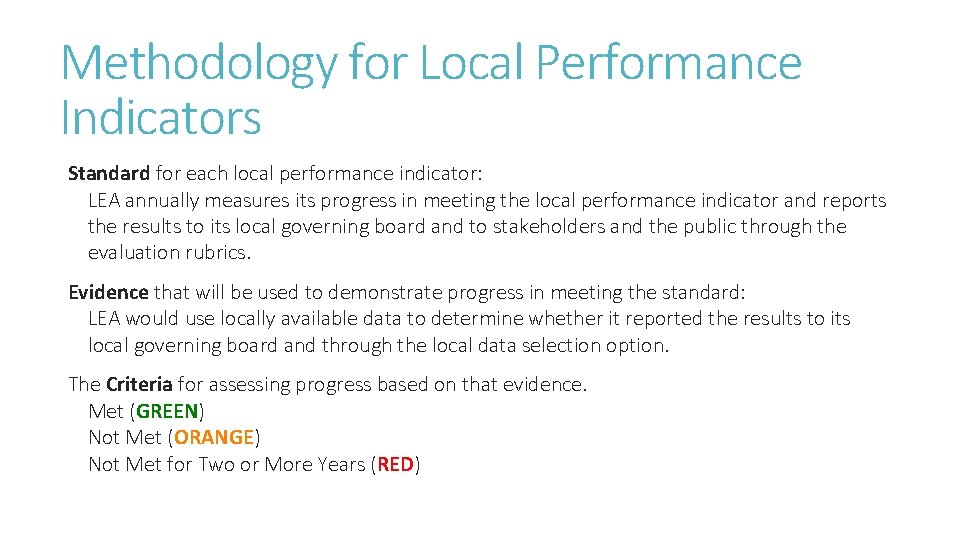
Methodology for Local Performance Indicators Standard for each local performance indicator: LEA annually measures its progress in meeting the local performance indicator and reports the results to its local governing board and to stakeholders and the public through the evaluation rubrics. Evidence that will be used to demonstrate progress in meeting the standard: LEA would use locally available data to determine whether it reported the results to its local governing board and through the local data selection option. The Criteria for assessing progress based on that evidence. Met (GREEN) Not Met (ORANGE) Not Met for Two or More Years (RED)
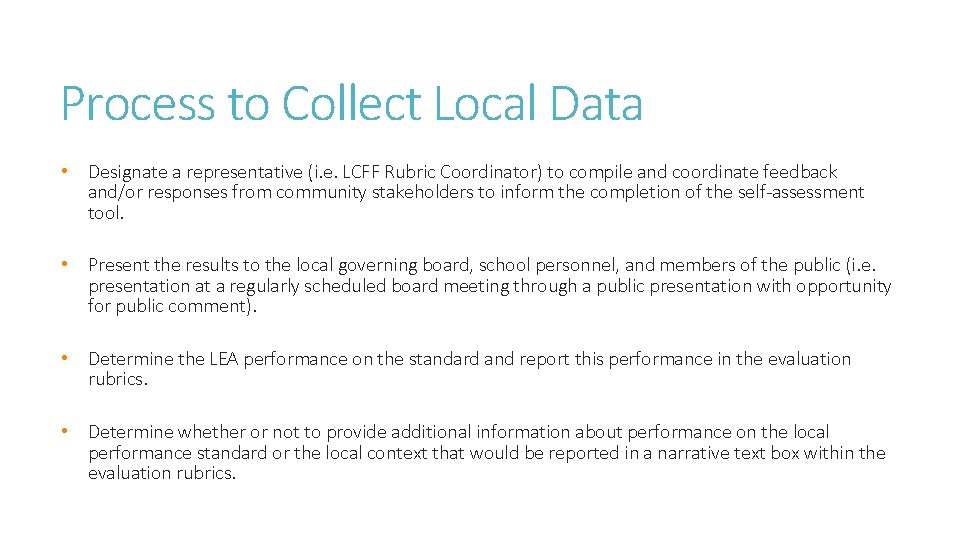
Process to Collect Local Data • Designate a representative (i. e. LCFF Rubric Coordinator) to compile and coordinate feedback and/or responses from community stakeholders to inform the completion of the self-assessment tool. • Present the results to the local governing board, school personnel, and members of the public (i. e. presentation at a regularly scheduled board meeting through a public presentation with opportunity for public comment). • Determine the LEA performance on the standard and report this performance in the evaluation rubrics. • Determine whether or not to provide additional information about performance on the local performance standard or the local context that would be reported in a narrative text box within the evaluation rubrics.
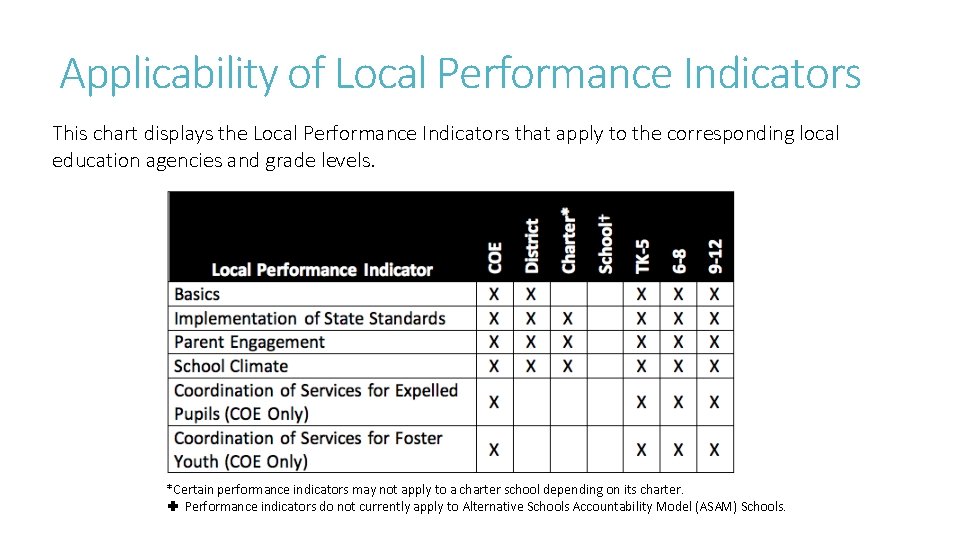
Applicability of Local Performance Indicators This chart displays the Local Performance Indicators that apply to the corresponding local education agencies and grade levels. *Certain performance indicators may not apply to a charter school depending on its charter. ✚ Performance indicators do not currently apply to Alternative Schools Accountability Model (ASAM) Schools.
Priority 1 – Basic Services Standard: The LEA will measure the progress of meeting the Williams settlement requirements at 100% at all of its school sites, as applicable. The LEA promptly addresses any complaints or other deficiencies identified throughout the academic year, as applicable. The LEA reports the results to its local governing board and to stakeholders and the public through the evaluation rubrics. Evidence: Use data currently reported through the School Accountability Report Card (SARC), as well as additional local data selection.
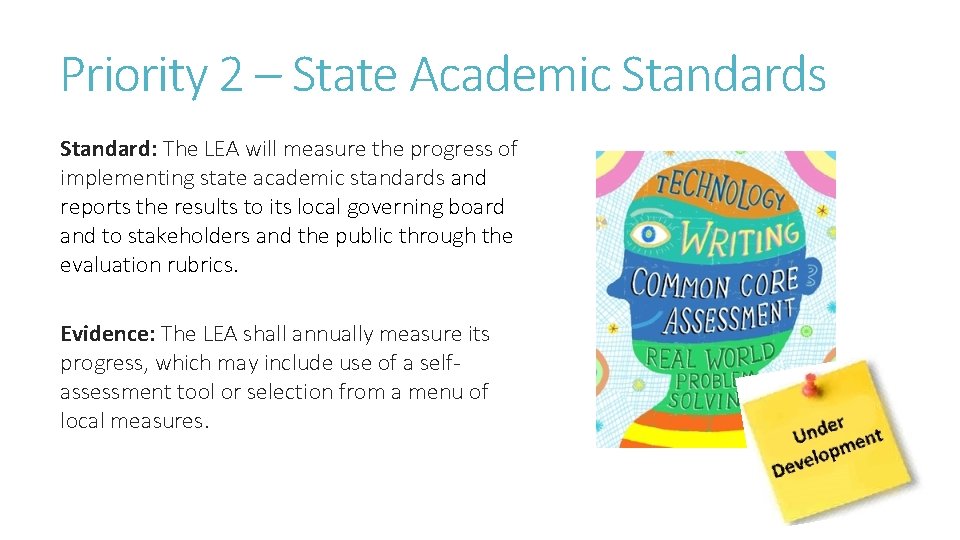
Priority 2 – State Academic Standards Standard: The LEA will measure the progress of implementing state academic standards and reports the results to its local governing board and to stakeholders and the public through the evaluation rubrics. Evidence: The LEA shall annually measure its progress, which may include use of a selfassessment tool or selection from a menu of local measures.
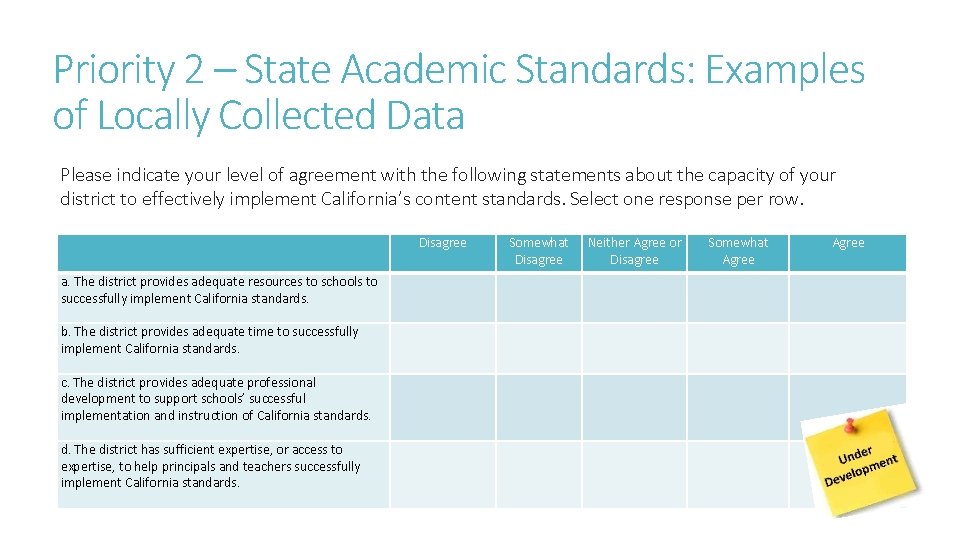
Priority 2 – State Academic Standards: Examples of Locally Collected Data Please indicate your level of agreement with the following statements about the capacity of your district to effectively implement California’s content standards. Select one response per row. a. The district provides adequate resources to schools to successfully implement California standards. b. The district provides adequate time to successfully implement California standards. c. The district provides adequate professional development to support schools’ successful implementation and instruction of California standards. d. The district has sufficient expertise, or access to expertise, to help principals and teachers successfully implement California standards. Disagree Somewhat Disagree Neither Agree or Disagree Somewhat Agree
Priority 3 – Parent Engagement Standard: LEA annually measures its progress in (1) seeking input from parents in decision making and (2) promoting parental participation in programs, and reports the results to its local governing board and to stakeholders and the public through the evaluation rubrics. Evidence: LEA would determine whether it annually measured its progress, which may include use of a self-assessment tool and/or selection from a menu of local measures that will be included in the evaluation rubrics web-based user interface, and reported the results to its local governing board and through the local data selection option in the evaluation rubrics.
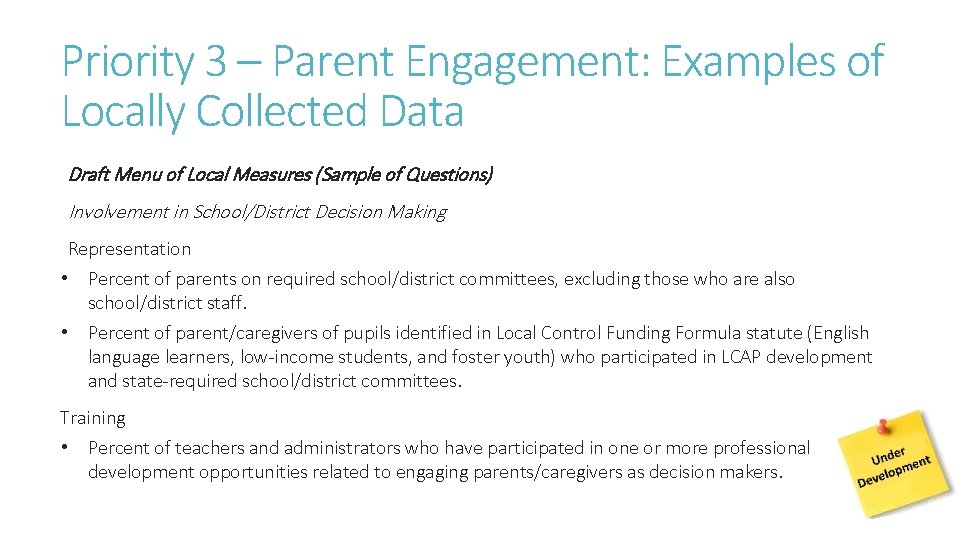
Priority 3 – Parent Engagement: Examples of Locally Collected Data Draft Menu of Local Measures (Sample of Questions) Involvement in School/District Decision Making Representation • Percent of parents on required school/district committees, excluding those who are also school/district staff. • Percent of parent/caregivers of pupils identified in Local Control Funding Formula statute (English language learners, low-income students, and foster youth) who participated in LCAP development and state-required school/district committees. Training • Percent of teachers and administrators who have participated in one or more professional development opportunities related to engaging parents/caregivers as decision makers.
Priority 6 – School Climate Standard: LEA administers a local climate survey at least every other year that provides a valid measure of perceptions of school safety and connectedness, such as the California Healthy Kids Survey, to students in at least one grade within the grade span(s) that the LEA serves (e. g. , K-5, 6 -8, 9 -12), and reports the results to its local governing board and to stakeholders and the public through the evaluation rubrics. Evidence: LEA would determine whether it administered a survey as specified and reported the results to its local governing board and through the local data selection option in the evaluation rubrics.
Priority 6 – School Climate: Examples of Locally Collected Data Examples of the type of information that LEAs could provide through the local data selection option in the evaluation rubrics include: • Brief narrative description of key findings, including differences in results among student groups. • For surveys that provide an overall score, such as the School Climate Index for the California Healthy Kids Survey, report of overall score for all student and student groups. • Analysis of a subset of specific items on survey that are particularly relevant to student safety and connectedness.
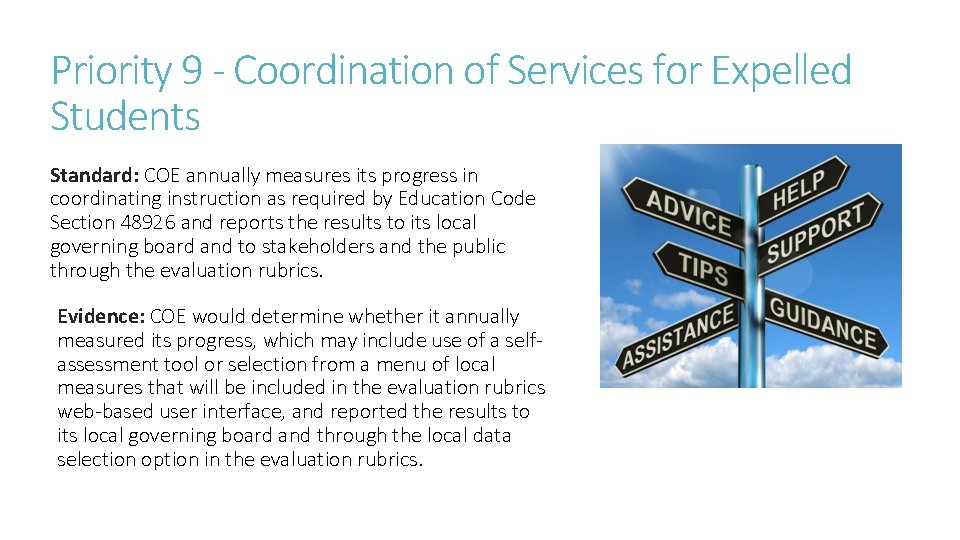
Priority 9 - Coordination of Services for Expelled Students Standard: COE annually measures its progress in coordinating instruction as required by Education Code Section 48926 and reports the results to its local governing board and to stakeholders and the public through the evaluation rubrics. Evidence: COE would determine whether it annually measured its progress, which may include use of a selfassessment tool or selection from a menu of local measures that will be included in the evaluation rubrics web-based user interface, and reported the results to its local governing board and through the local data selection option in the evaluation rubrics.
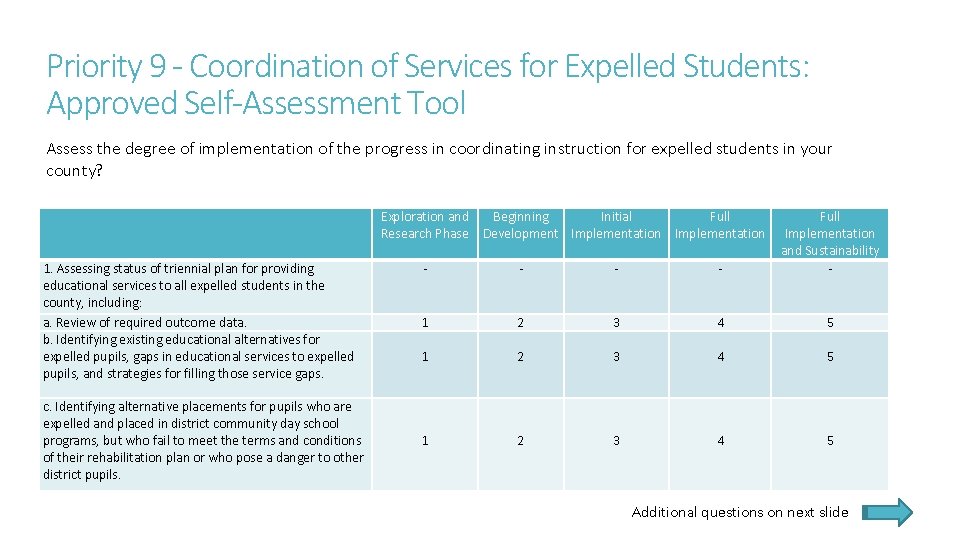
Priority 9 - Coordination of Services for Expelled Students: Approved Self-Assessment Tool Assess the degree of implementation of the progress in coordinating instruction for expelled students in your county? 1. Assessing status of triennial plan for providing educational services to all expelled students in the county, including: a. Review of required outcome data. b. Identifying existing educational alternatives for expelled pupils, gaps in educational services to expelled pupils, and strategies for filling those service gaps. c. Identifying alternative placements for pupils who are expelled and placed in district community day school programs, but who fail to meet the terms and conditions of their rehabilitation plan or who pose a danger to other district pupils. Exploration and Beginning Initial Full Research Phase Development Implementation - - Full Implementation and Sustainability - 1 1 2 2 3 3 4 4 5 5 1 2 3 4 5 Additional questions on next slide
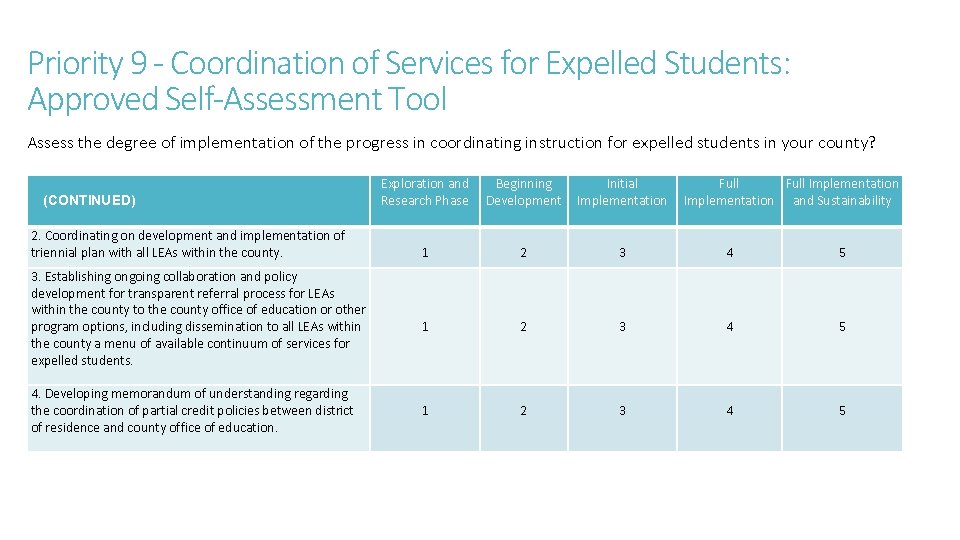
Priority 9 - Coordination of Services for Expelled Students: Approved Self-Assessment Tool Assess the degree of implementation of the progress in coordinating instruction for expelled students in your county? (CONTINUED) Exploration and Beginning Research Phase Development Initial Implementation Full Implementation and Sustainability 2. Coordinating on development and implementation of triennial plan with all LEAs within the county. 1 2 3 4 5 3. Establishing ongoing collaboration and policy development for transparent referral process for LEAs within the county to the county office of education or other program options, including dissemination to all LEAs within the county a menu of available continuum of services for expelled students. 1 2 3 4 5 4. Developing memorandum of understanding regarding the coordination of partial credit policies between district of residence and county office of education. 1 2 3 4 5
Priority 10 - Coordination of Services for Foster Youth Standard: COE annually measures its progress in coordinating services for foster youth. The LEA will report the results to its local governing board and to stakeholders at a regularly scheduled meeting of the local governing board and the public through the evaluation rubrics. Evidence: COE would determine its progress through the use of a self-assessment tool that will be included in the evaluation rubrics web-based user interface, and report the results to its local governing board and through the local data selection option in the evaluation rubrics.
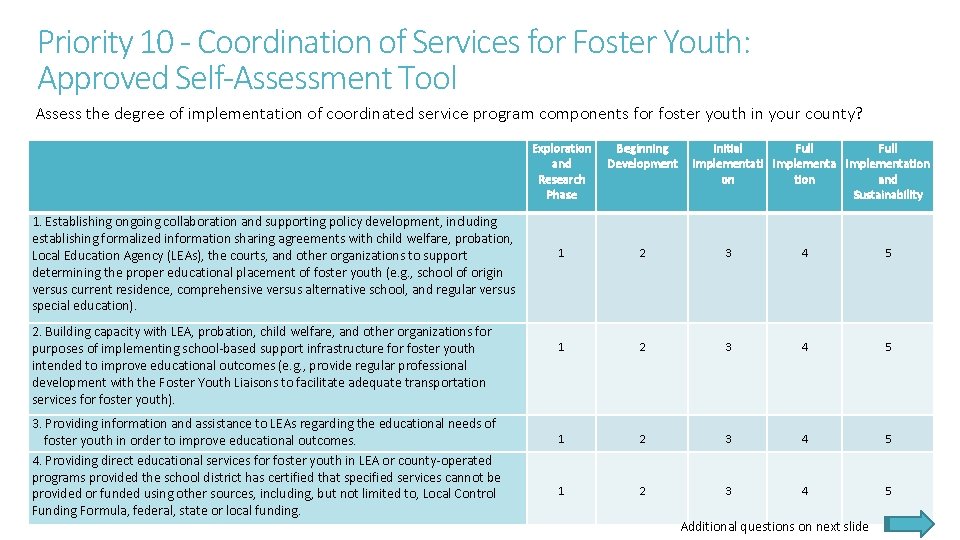
Priority 10 - Coordination of Services for Foster Youth: Approved Self-Assessment Tool Assess the degree of implementation of coordinated service program components for foster youth in your county? Exploration Beginning and Development Research Phase Initial Full Implementation on tion and Sustainability 1. Establishing ongoing collaboration and supporting policy development, including establishing formalized information sharing agreements with child welfare, probation, Local Education Agency (LEAs), the courts, and other organizations to support determining the proper educational placement of foster youth (e. g. , school of origin versus current residence, comprehensive versus alternative school, and regular versus special education). 1 2 3 4 5 2. Building capacity with LEA, probation, child welfare, and other organizations for purposes of implementing school-based support infrastructure for foster youth intended to improve educational outcomes (e. g. , provide regular professional development with the Foster Youth Liaisons to facilitate adequate transportation services for foster youth). 1 2 3 4 5 3. Providing information and assistance to LEAs regarding the educational needs of foster youth in order to improve educational outcomes. 4. Providing direct educational services for foster youth in LEA or county-operated programs provided the school district has certified that specified services cannot be provided or funded using other sources, including, but not limited to, Local Control Funding Formula, federal, state or local funding. 1 2 3 4 5 1 2 3 4 5 Additional questions on next slide
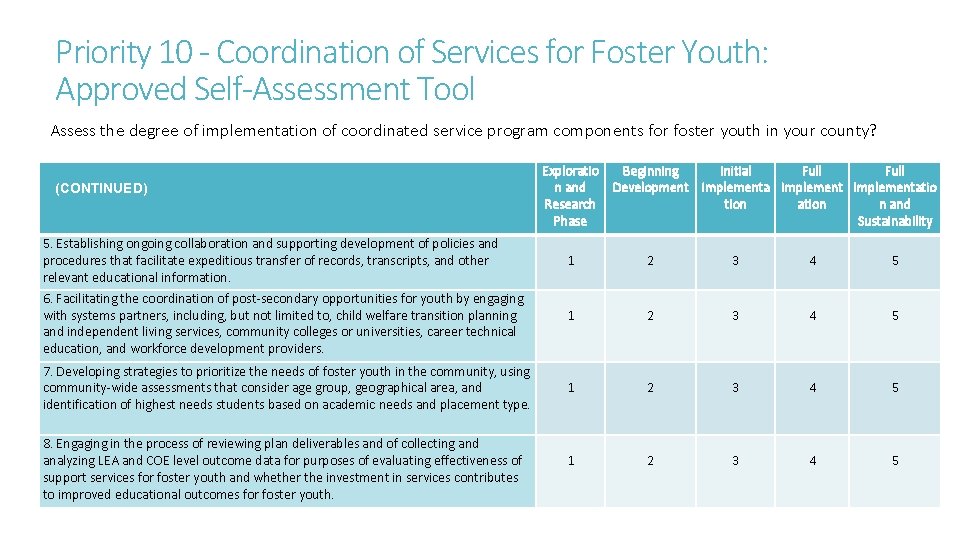
Priority 10 - Coordination of Services for Foster Youth: Approved Self-Assessment Tool Assess the degree of implementation of coordinated service program components for foster youth in your county? (CONTINUED) Exploratio Beginning Initial Full n and Development Implementatio Research tion ation n and Phase Sustainability 5. Establishing ongoing collaboration and supporting development of policies and procedures that facilitate expeditious transfer of records, transcripts, and other relevant educational information. 1 2 3 4 5 6. Facilitating the coordination of post-secondary opportunities for youth by engaging with systems partners, including, but not limited to, child welfare transition planning and independent living services, community colleges or universities, career technical education, and workforce development providers. 1 2 3 4 5 7. Developing strategies to prioritize the needs of foster youth in the community, using community-wide assessments that consider age group, geographical area, and identification of highest needs students based on academic needs and placement type. 1 2 3 4 5 8. Engaging in the process of reviewing plan deliverables and of collecting and analyzing LEA and COE level outcome data for purposes of evaluating effectiveness of support services for foster youth and whether the investment in services contributes to improved educational outcomes for foster youth. 1 2 3 4 5
Local Control Funding Formula 101 How the Evaluation Rubrics Works
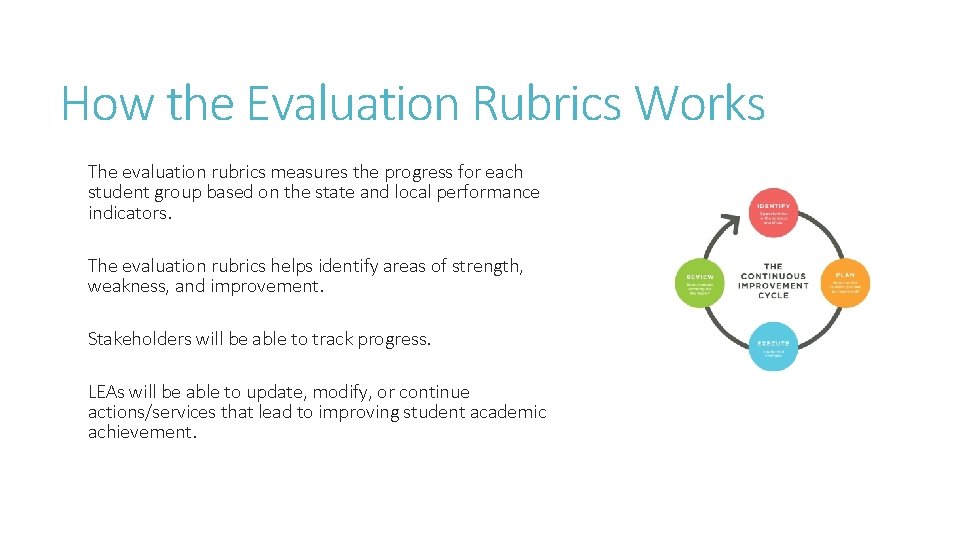
How the Evaluation Rubrics Works The evaluation rubrics measures the progress for each student group based on the state and local performance indicators. The evaluation rubrics helps identify areas of strength, weakness, and improvement. Stakeholders will be able to track progress. LEAs will be able to update, modify, or continue actions/services that lead to improving student academic achievement.
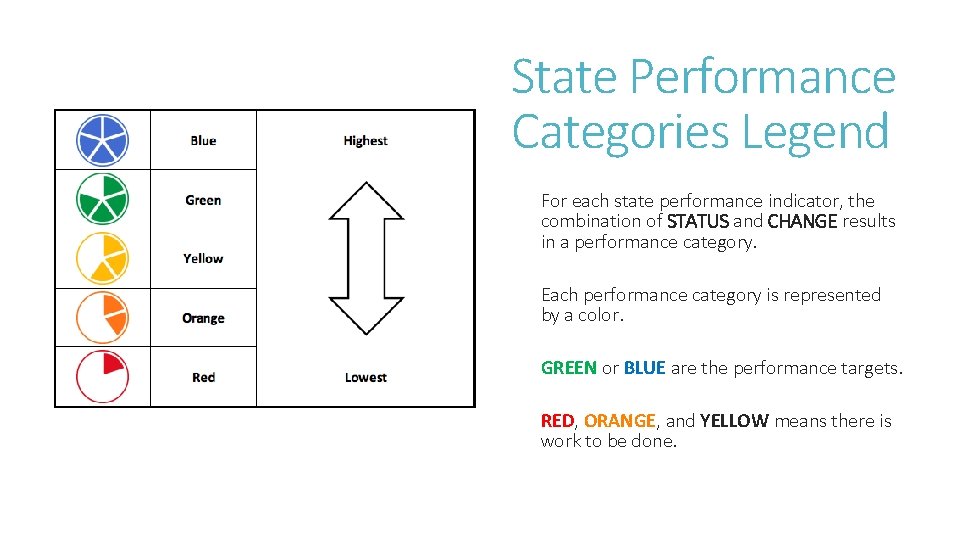
State Performance Categories Legend For each state performance indicator, the combination of STATUS and CHANGE results in a performance category. Each performance category is represented by a color. GREEN or BLUE are the performance targets. RED, ORANGE, and YELLOW means there is work to be done.
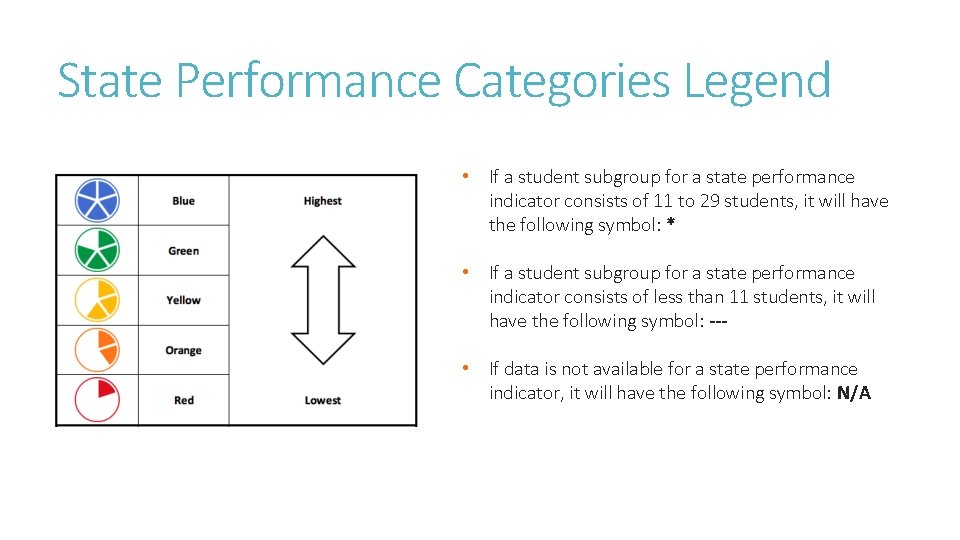
State Performance Categories Legend • If a student subgroup for a state performance indicator consists of 11 to 29 students, it will have the following symbol: * • If a student subgroup for a state performance indicator consists of less than 11 students, it will have the following symbol: -- • If data is not available for a state performance indicator, it will have the following symbol: N/A
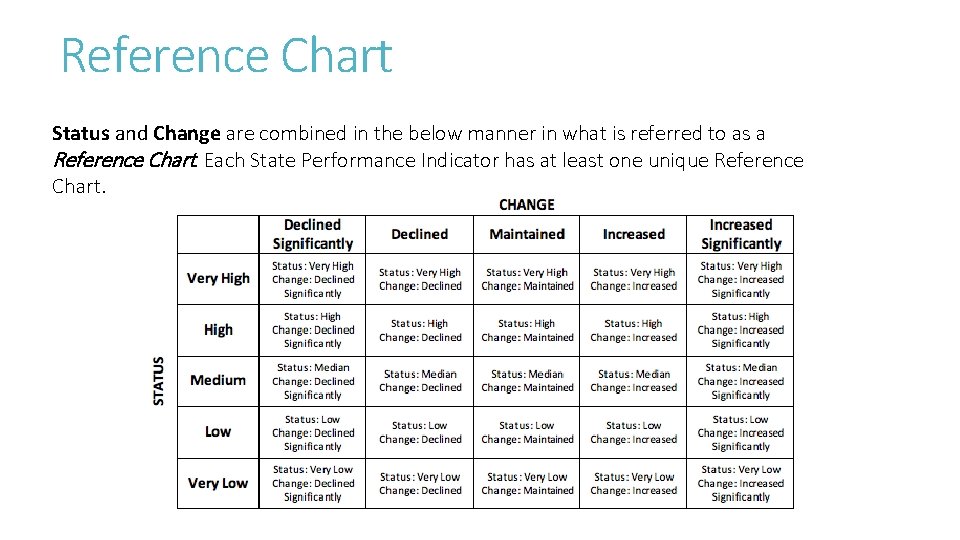
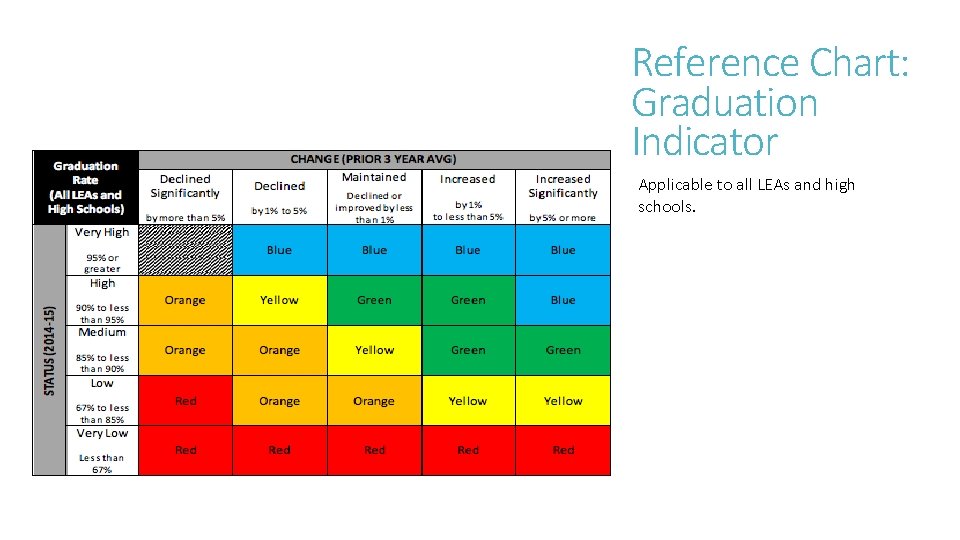
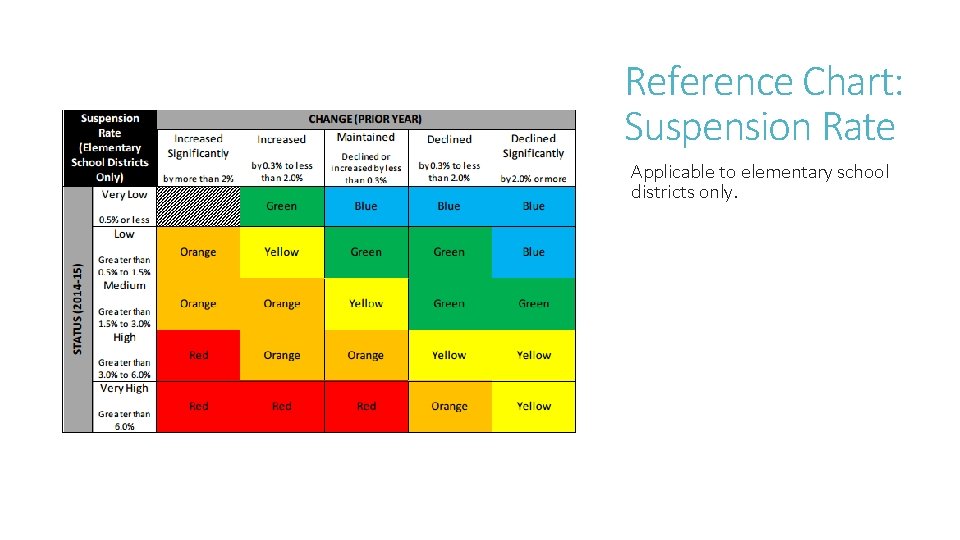
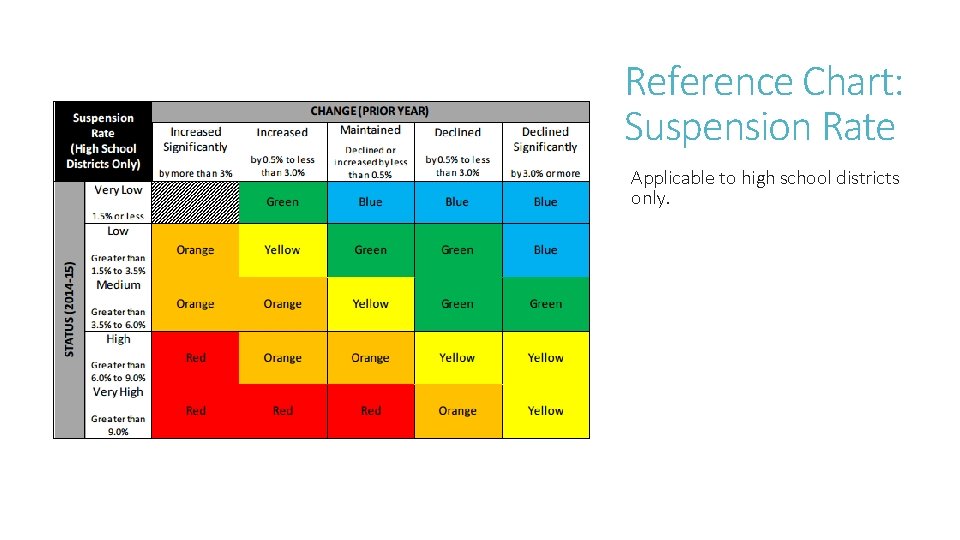
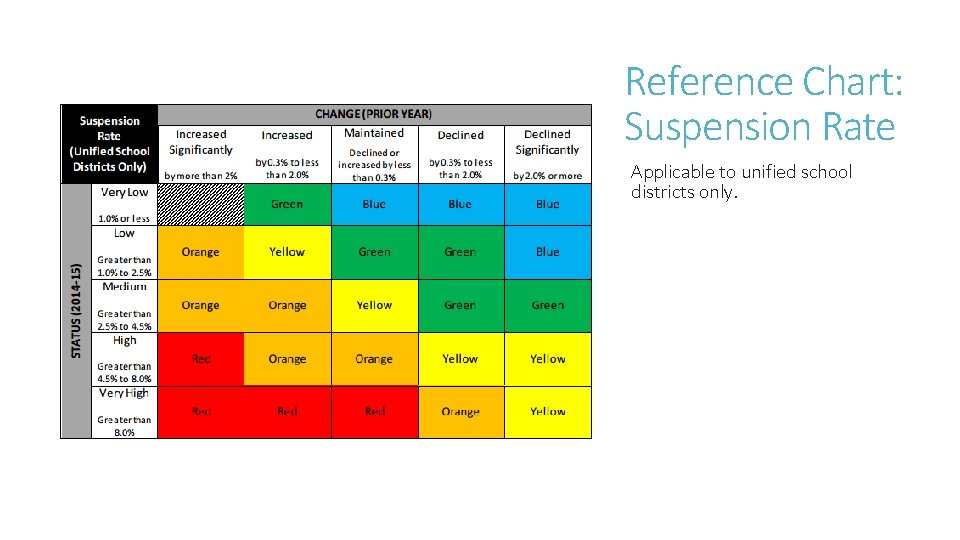
Establishing the Performance Category STATUS Determined using the outcomes from the year in which the data is most recently available. There are 5 levels for Status: § Very High § Medium § Low § Very Low Very High is not necessarily better than Very Low. It depends on the type of State Performance Indicator (i. e. Very High is good for graduation rate but not for suspension rate). CHANGE The difference between performance from the prior year and current year, or between the current year and a multi-year average (if available). There are 5 levels for Change: § Increased Significantly § Increased § Maintained § Declined Significantly Increased Significantly is not necessarily better than Declined Significantly. It depends on the type of State Performance Indicator (i. e. Increased Significantly is good for Graduation rate but not for suspension rate).
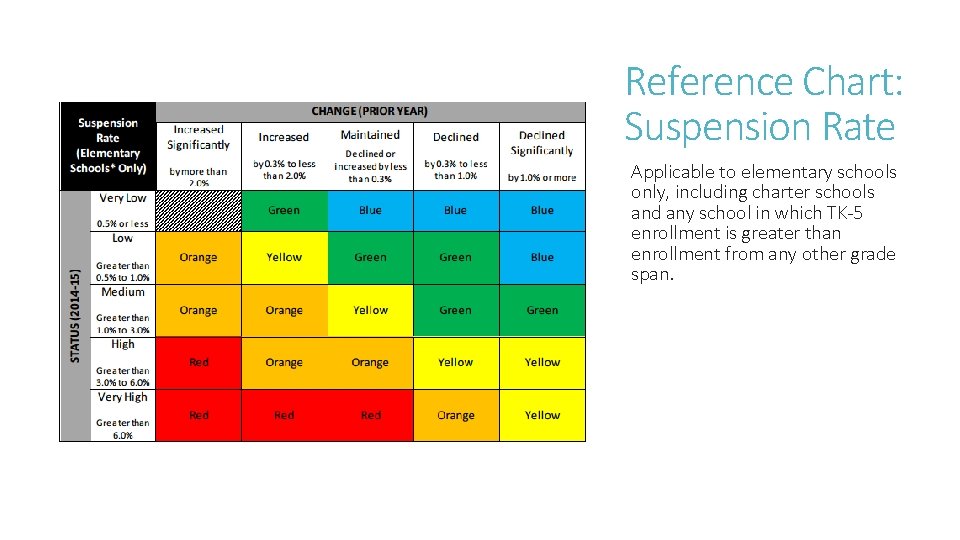
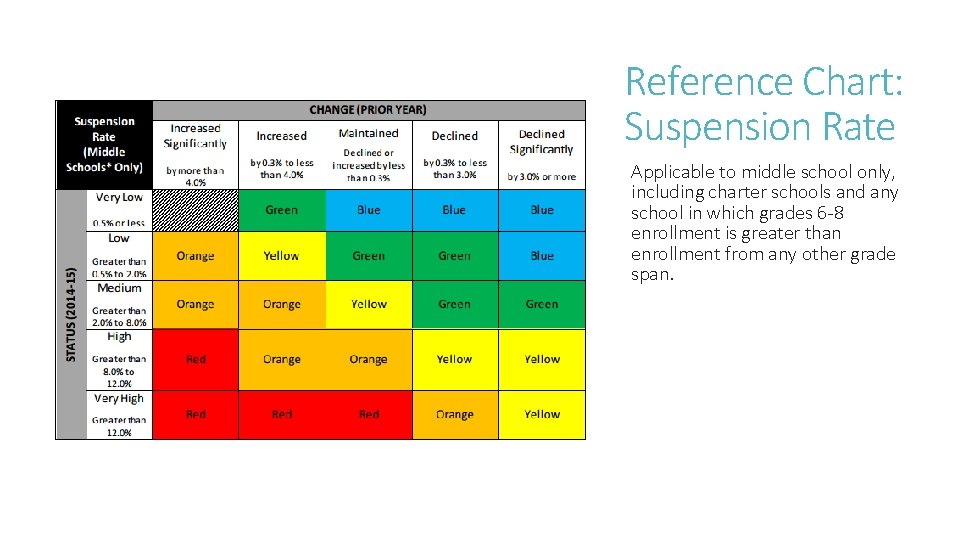
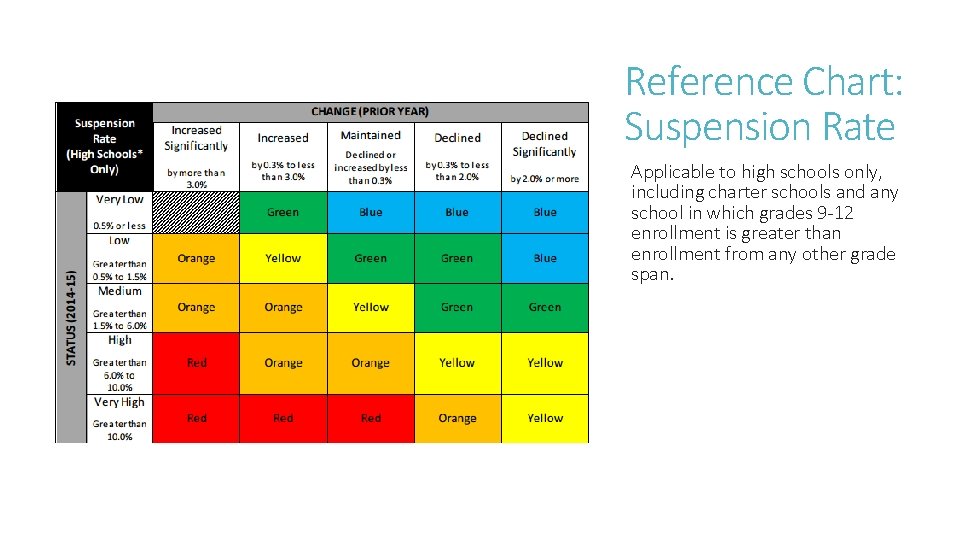
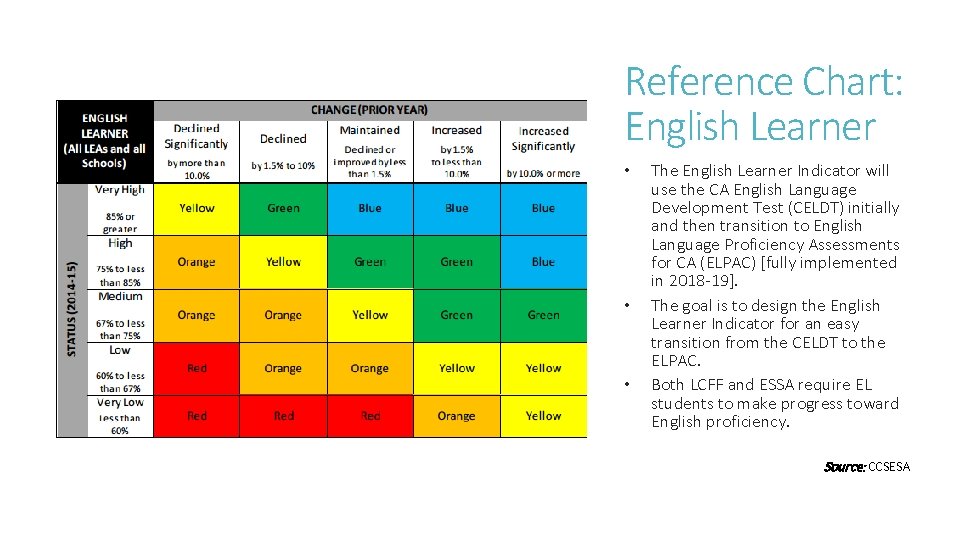
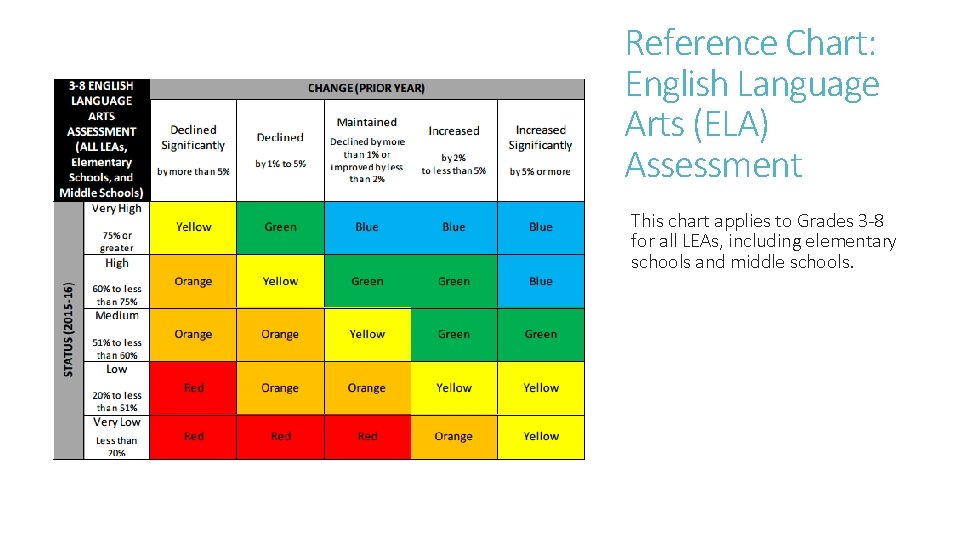
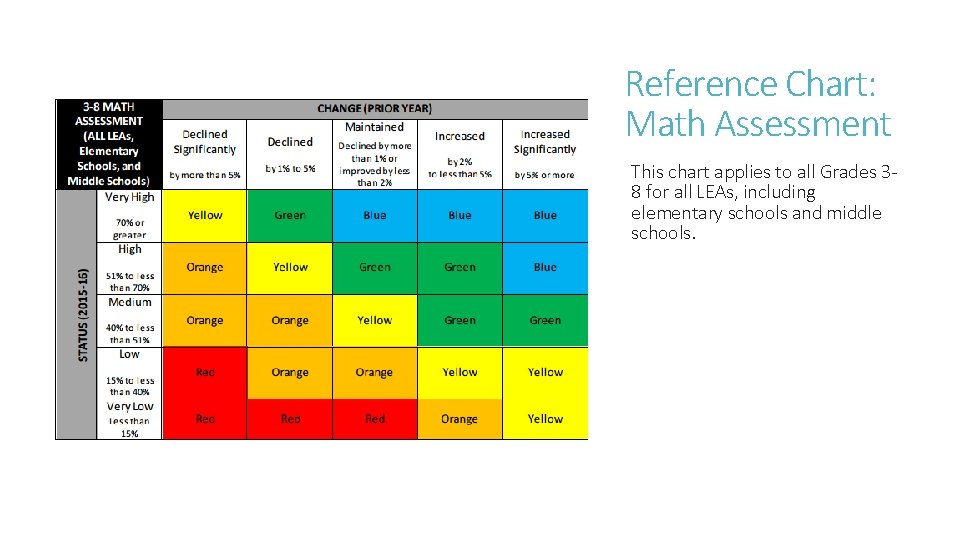
Reference Chart Status and Change are combined in the below manner in what is referred to as a Reference Chart. Each State Performance Indicator has at least one unique Reference Chart.
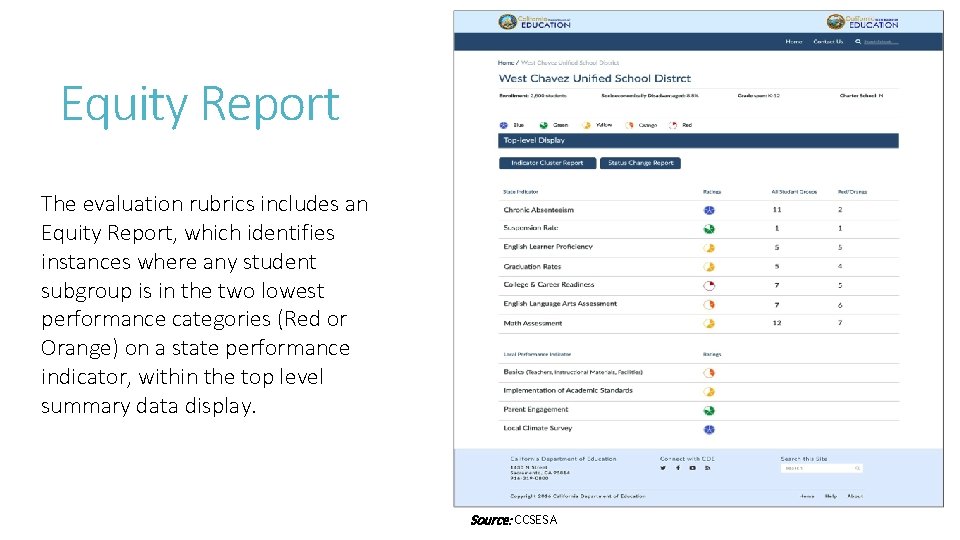
Equity Report The evaluation rubrics includes an Equity Report, which identifies instances where any student subgroup is in the two lowest performance categories (Red or Orange) on a state performance indicator, within the top level summary data display. Source: CCSESA
Local Control Funding Formula 101 Support & Technical Assistance
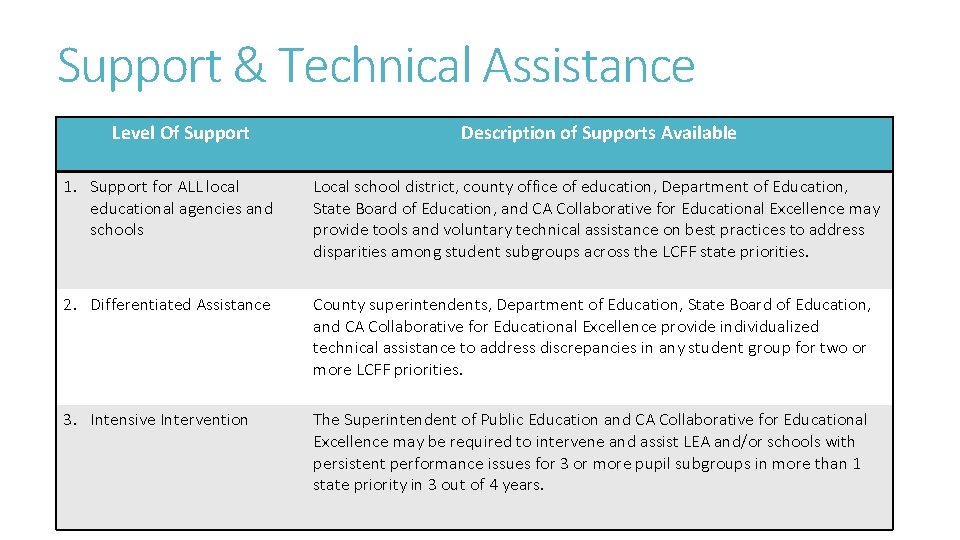
Support & Technical Assistance Level Of Support Description of Supports Available 1. Support for ALL local educational agencies and schools Local school district, county office of education, Department of Education, State Board of Education, and CA Collaborative for Educational Excellence may provide tools and voluntary technical assistance on best practices to address disparities among student subgroups across the LCFF state priorities. 2. Differentiated Assistance County superintendents, Department of Education, State Board of Education, and CA Collaborative for Educational Excellence provide individualized technical assistance to address discrepancies in any student group for two or more LCFF priorities. 3. Intensive Intervention The Superintendent of Public Education and CA Collaborative for Educational Excellence may be required to intervene and assist LEA and/or schools with persistent performance issues for 3 or more pupil subgroups in more than 1 state priority in 3 out of 4 years.
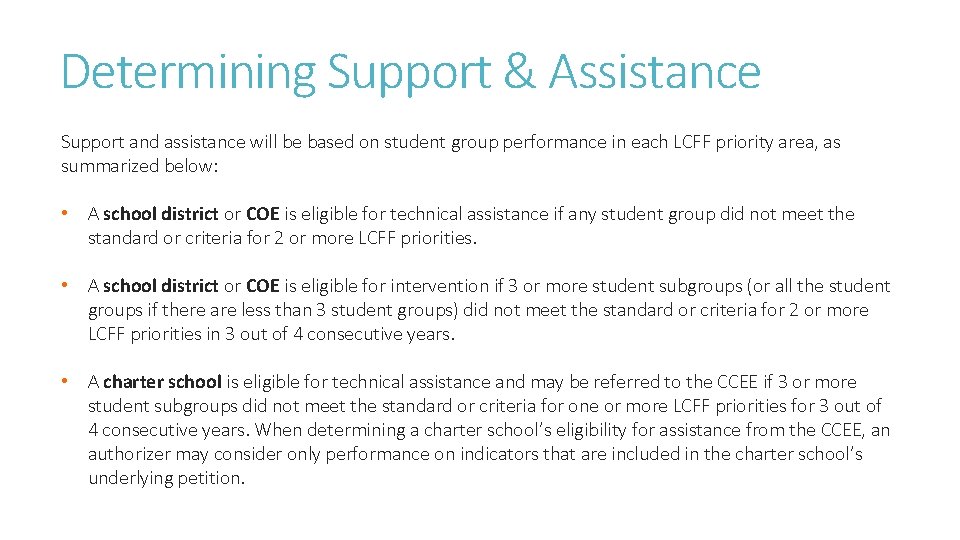
Determining Support & Assistance Support and assistance will be based on student group performance in each LCFF priority area, as summarized below: • A school district or COE is eligible for technical assistance if any student group did not meet the standard or criteria for 2 or more LCFF priorities. • A school district or COE is eligible for intervention if 3 or more student subgroups (or all the student groups if there are less than 3 student groups) did not meet the standard or criteria for 2 or more LCFF priorities in 3 out of 4 consecutive years. • A charter school is eligible for technical assistance and may be referred to the CCEE if 3 or more student subgroups did not meet the standard or criteria for one or more LCFF priorities for 3 out of 4 consecutive years. When determining a charter school’s eligibility for assistance from the CCEE, an authorizer may consider only performance on indicators that are included in the charter school’s underlying petition.
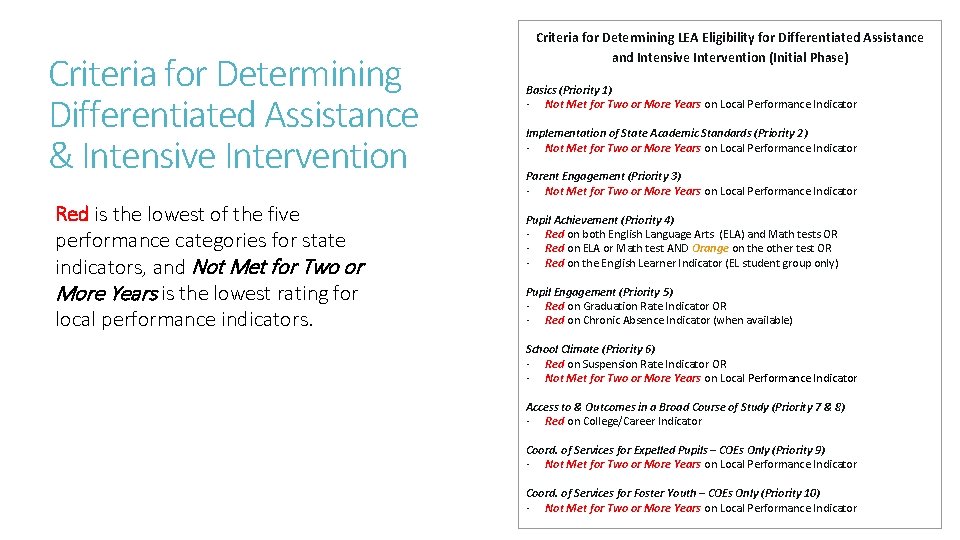
Criteria for Determining Differentiated Assistance & Intensive Intervention Red is the lowest of the five performance categories for state indicators, and Not Met for Two or More Years is the lowest rating for local performance indicators. Criteria for Determining LEA Eligibility for Differentiated Assistance and Intensive Intervention (Initial Phase) Basics (Priority 1) · Not Met for Two or More Years on Local Performance Indicator Implementation of State Academic Standards (Priority 2) · Not Met for Two or More Years on Local Performance Indicator Parent Engagement (Priority 3) · Not Met for Two or More Years on Local Performance Indicator Pupil Achievement (Priority 4) · Red on both English Language Arts (ELA) and Math tests OR · Red on ELA or Math test AND Orange on the other test OR · Red on the English Learner Indicator (EL student group only) Pupil Engagement (Priority 5) · Red on Graduation Rate Indicator OR · Red on Chronic Absence Indicator (when available) School Climate (Priority 6) · Red on Suspension Rate Indicator OR · Not Met for Two or More Years on Local Performance Indicator Access to & Outcomes in a Broad Course of Study (Priority 7 & 8) · Red on College/Career Indicator Coord. of Services for Expelled Pupils – COEs Only (Priority 9) · Not Met for Two or More Years on Local Performance Indicator Coord. of Services for Foster Youth – COEs Only (Priority 10) · Not Met for Two or More Years on Local Performance Indicator
Local Control Funding Formula 101 Reference Charts
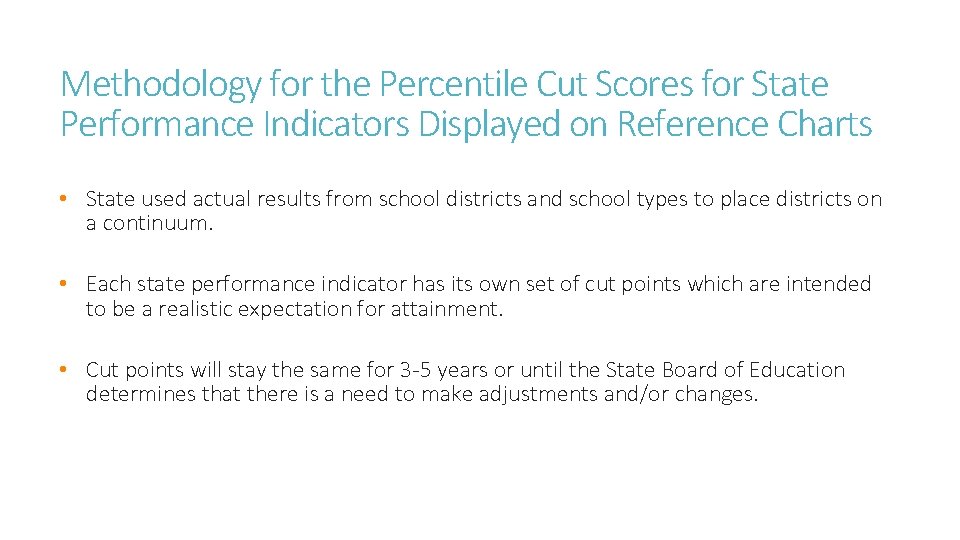
Methodology for the Percentile Cut Scores for State Performance Indicators Displayed on Reference Charts • State used actual results from school districts and school types to place districts on a continuum. • Each state performance indicator has its own set of cut points which are intended to be a realistic expectation for attainment. • Cut points will stay the same for 3 -5 years or until the State Board of Education determines that there is a need to make adjustments and/or changes.
Reference Chart: Graduation Indicator Applicable to all LEAs and high schools.
Reference Chart: Suspension Rate Applicable to elementary school districts only.
Reference Chart: Suspension Rate Applicable to high school districts only.
Reference Chart: Suspension Rate Applicable to unified school districts only.
Reference Chart: Suspension Rate Applicable to elementary schools only, including charter schools and any school in which TK-5 enrollment is greater than enrollment from any other grade span.
Reference Chart: Suspension Rate Applicable to middle school only, including charter schools and any school in which grades 6 -8 enrollment is greater than enrollment from any other grade span.
Reference Chart: Suspension Rate Applicable to high schools only, including charter schools and any school in which grades 9 -12 enrollment is greater than enrollment from any other grade span.
Reference Chart: English Learner • • • The English Learner Indicator will use the CA English Language Development Test (CELDT) initially and then transition to English Language Proficiency Assessments for CA (ELPAC) [fully implemented in 2018 -19]. The goal is to design the English Learner Indicator for an easy transition from the CELDT to the ELPAC. Both LCFF and ESSA require EL students to make progress toward English proficiency. Source: CCSESA
Reference Chart: English Language Arts (ELA) Assessment This chart applies to Grades 3 -8 for all LEAs, including elementary schools and middle schools.
Reference Chart: Math Assessment This chart applies to all Grades 38 for all LEAs, including elementary schools and middle schools.
Thank you! Sara C. Bachez Assistant Executive Director of Governmental Relations CASBO sbachez@casbo. org Elizabeth Munguia Legislative Advocate CASBO emunguia@casbo. org