
Presentation for use with the textbook Data Structures
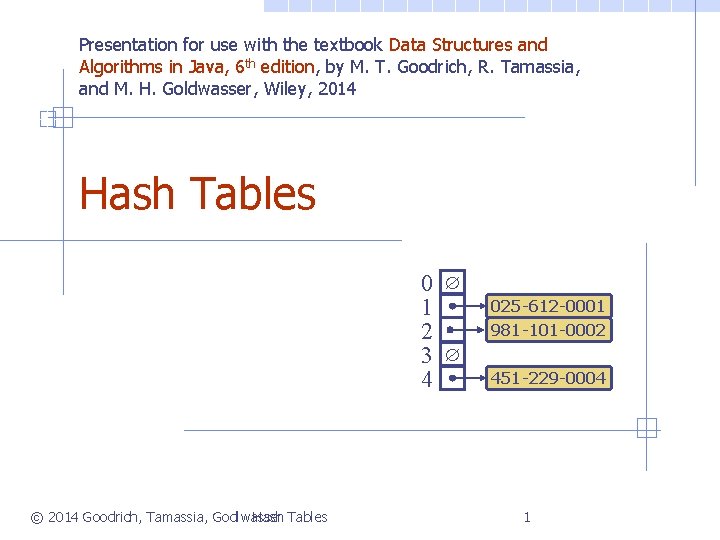
Presentation for use with the textbook Data Structures and Algorithms in Java, 6 th edition, by M. T. Goodrich, R. Tamassia, and M. H. Goldwasser, Wiley, 2014 Hash Tables 0 1 2 3 4 © 2014 Goodrich, Tamassia, Godlwasser Hash Tables 025 -612 -0001 981 -101 -0002 451 -229 -0004 1
Recall the Map ADT get(k): if the map M has an entry with key k, return its associated value; else, return null put(k, v): insert entry (k, v) into the map M; if key k is not already in M, then return null; else, return old value associated with k remove(k): if the map M has an entry with key k, remove it from M and return its associated value; else, return null size(), is. Empty() entry. Set(): return an iterable collection of the entries in M key. Set(): return an iterable collection of the keys in M values(): return an iterator of the values in M © 2014 Goodrich, Tamassia, Godlwasser Hash Tables 2
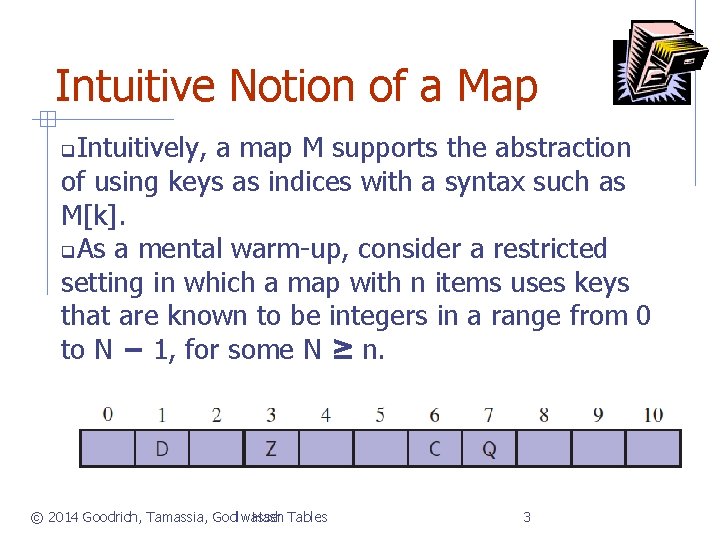
Intuitive Notion of a Map Intuitively, a map M supports the abstraction of using keys as indices with a syntax such as M[k]. As a mental warm-up, consider a restricted setting in which a map with n items uses keys that are known to be integers in a range from 0 to N − 1, for some N ≥ n. © 2014 Goodrich, Tamassia, Godlwasser Hash Tables 3
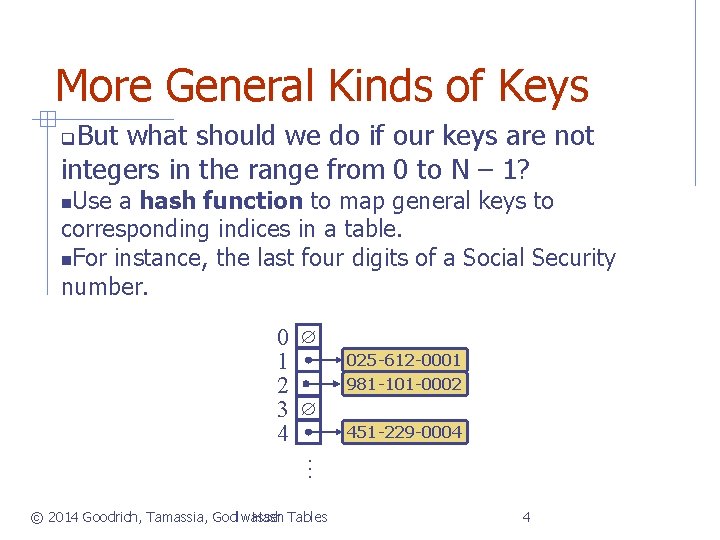
More General Kinds of Keys But what should we do if our keys are not integers in the range from 0 to N – 1? Use a hash function to map general keys to corresponding indices in a table. For instance, the last four digits of a Social Security number. 0 1 2 3 4 025 -612 -0001 981 -101 -0002 451 -229 -0004 … © 2014 Goodrich, Tamassia, Godlwasser Hash Tables 4
Hash Functions and Hash Tables A hash function h maps keys of a given type to integers in a fixed interval [0, N - 1] Example: h(x) = x mod N is a hash function for integer keys The integer h(x) is called the hash value of key x A hash table for a given key type consists of Hash function h Array (called table) of size N When implementing a map with a hash table, the goal is to store item (k, o) at index i = h(k) © 2014 Goodrich, Tamassia, Godlwasser Hash Tables 5
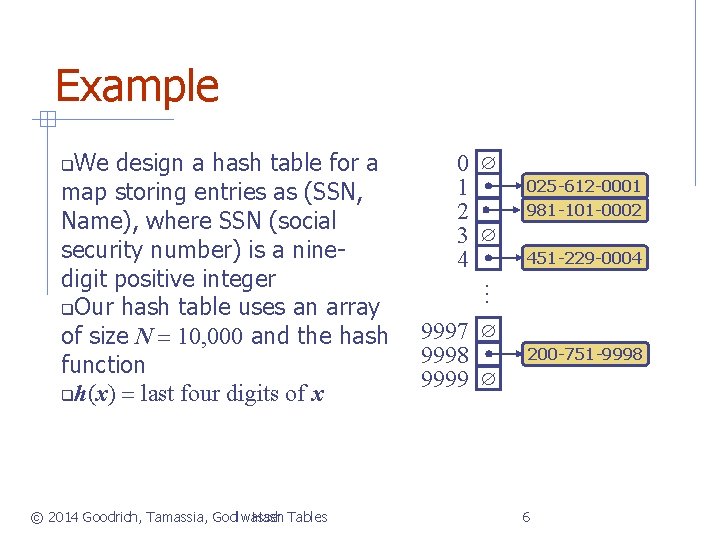
Example © 2014 Goodrich, Tamassia, Godlwasser Hash Tables 0 1 2 3 4 025 -612 -0001 981 -101 -0002 451 -229 -0004 … We design a hash table for a map storing entries as (SSN, Name), where SSN (social security number) is a ninedigit positive integer Our hash table uses an array of size N = 10, 000 and the hash function h(x) = last four digits of x 9997 9998 9999 200 -751 -9998 6
Hash Functions A hash function is usually specified as the composition of two functions: Hash code: h 1: keys integers Compression function: h 2: integers [0, N - 1] © 2014 Goodrich, Tamassia, Godlwasser Hash Tables The hash code is applied first, and the compression function is applied next on the result, i. e. , h(x) = h 2(h 1(x)) The goal of the hash function is to “disperse” the keys in an apparently random way 7
Hash Codes Memory address: We reinterpret the memory address of the key object as an integer (default hash code of all Java objects) Good in general, except for numeric and string keys Component sum: We partition the bits of the key into components of fixed length (e. g. , 16 or 32 bits) and we sum the components Integer cast: (ignoring overflows) We reinterpret the bits of the key Suitable for numeric keys of as an integer fixed length greater than or equal to the number of bits of Suitable for keys of length less than or equal to the number of bits the integer type (e. g. , long and double in Java) of the integer type (e. g. , byte, short, int and float in Java) © 2014 Goodrich, Tamassia, Godlwasser Hash Tables 8
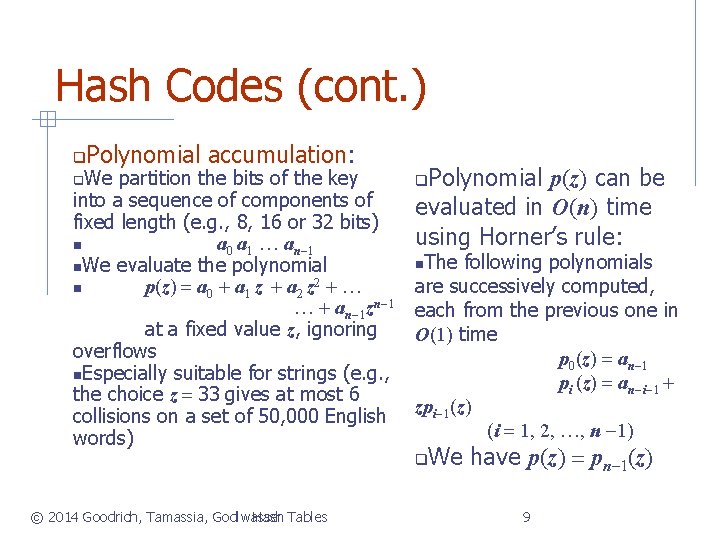
Hash Codes (cont. ) Polynomial accumulation: We partition the bits of the key into a sequence of components of fixed length (e. g. , 8, 16 or 32 bits) a 0 a 1 … an-1 We evaluate the polynomial p(z) = a 0 + a 1 z + a 2 z 2 + … … + an-1 zn-1 at a fixed value z, ignoring overflows Especially suitable for strings (e. g. , the choice z = 33 gives at most 6 collisions on a set of 50, 000 English words) Polynomial p(z) can be evaluated in O(n) time using Horner’s rule: The following polynomials are successively computed, each from the previous one in O(1) time p 0(z) = an-1 pi (z) = an-i-1 + zpi-1(z) (i = 1, 2, …, n -1) © 2014 Goodrich, Tamassia, Godlwasser Hash Tables We have p(z) = pn-1(z) 9
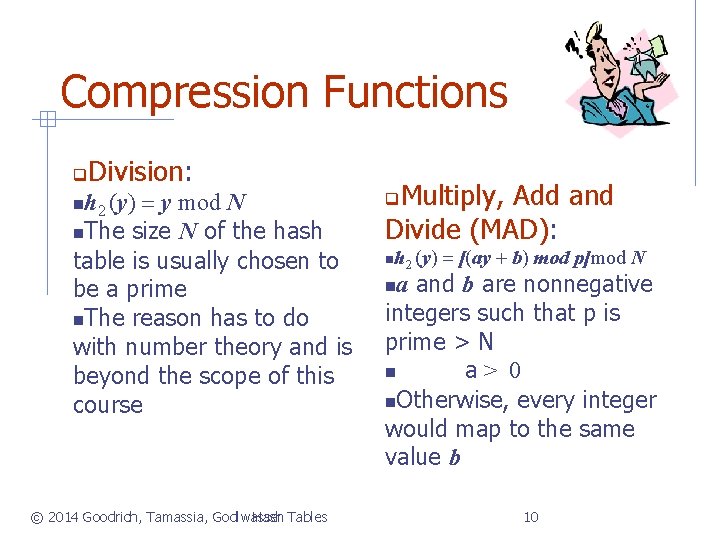
Compression Functions Division: h (y) = y mod N The size N of the hash table is usually chosen to be a prime The reason has to do with number theory and is beyond the scope of this course 2 © 2014 Goodrich, Tamassia, Godlwasser Hash Tables Multiply, Add and Divide (MAD): h (y) = [(ay + b) mod p]mod N 2 a and b are nonnegative integers such that p is prime > N a> 0 Otherwise, every integer would map to the same value b 10
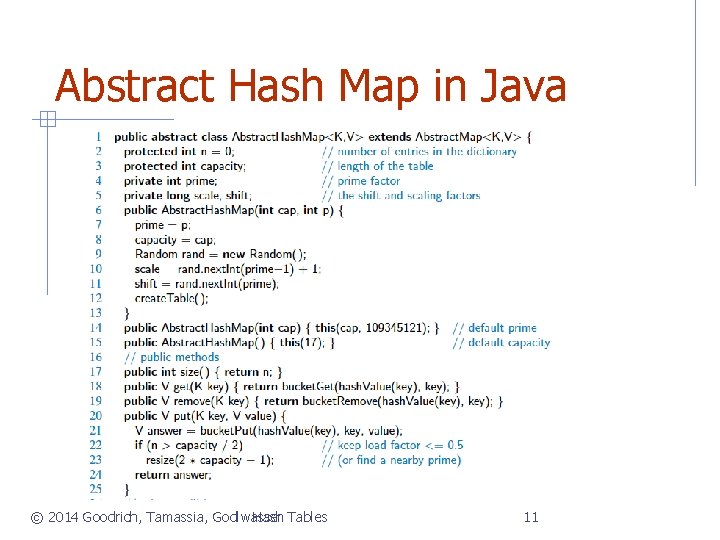
Abstract Hash Map in Java © 2014 Goodrich, Tamassia, Godlwasser Hash Tables 11

Abstract Hash Map in Java, 2 © 2014 Goodrich, Tamassia, Godlwasser Hash Tables 12
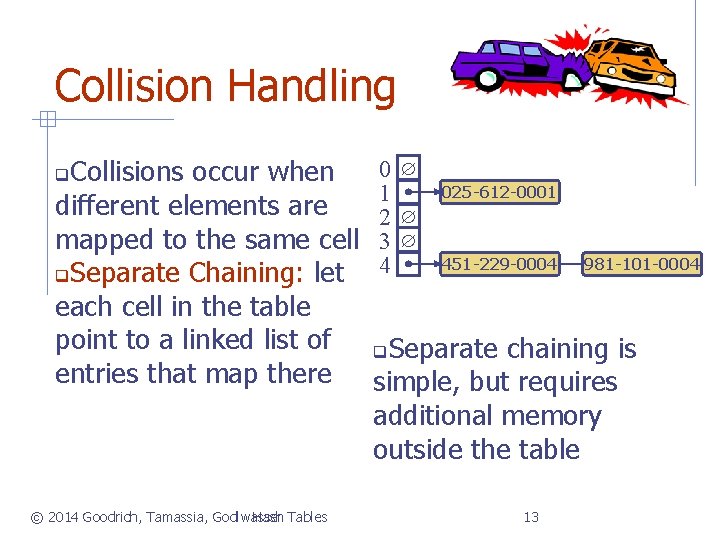
Collision Handling Collisions occur when different elements are mapped to the same cell Separate Chaining: let each cell in the table point to a linked list of entries that map there © 2014 Goodrich, Tamassia, Godlwasser Hash Tables 0 1 2 3 4 025 -612 -0001 451 -229 -0004 981 -101 -0004 Separate chaining is simple, but requires additional memory outside the table 13
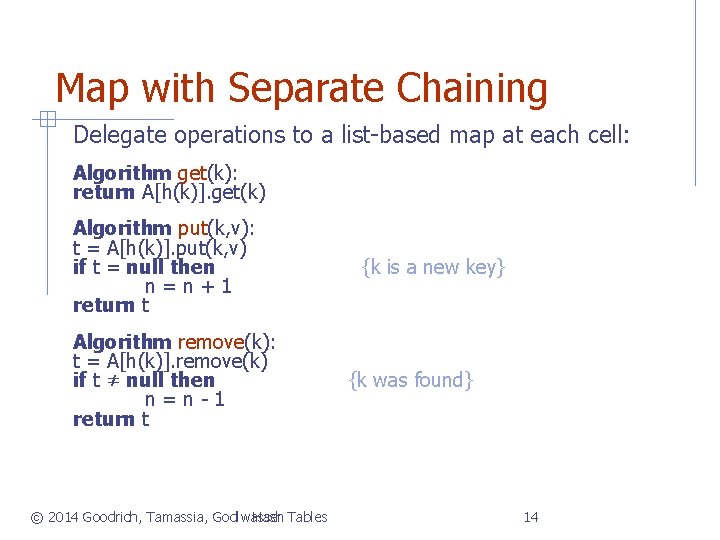
Map with Separate Chaining Delegate operations to a list-based map at each cell: Algorithm get(k): return A[h(k)]. get(k) Algorithm put(k, v): t = A[h(k)]. put(k, v) if t = null then n=n+1 return t Algorithm remove(k): t = A[h(k)]. remove(k) if t ≠ null then n=n-1 return t © 2014 Goodrich, Tamassia, Godlwasser Hash Tables {k is a new key} {k was found} 14
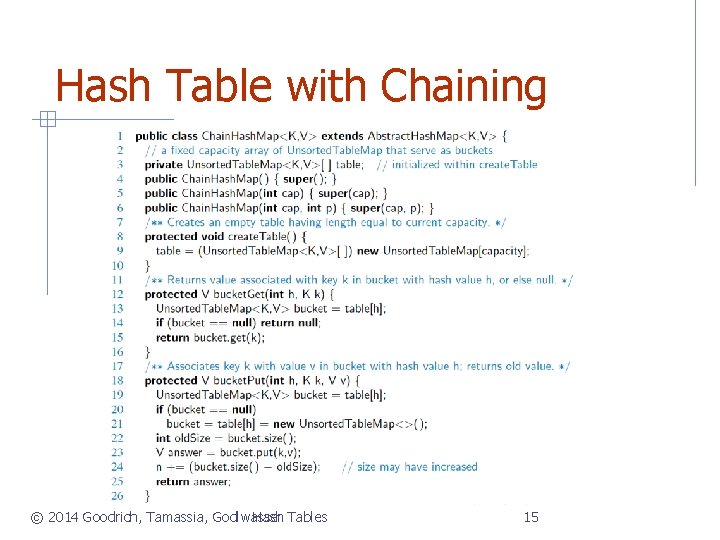
Hash Table with Chaining © 2014 Goodrich, Tamassia, Godlwasser Hash Tables 15
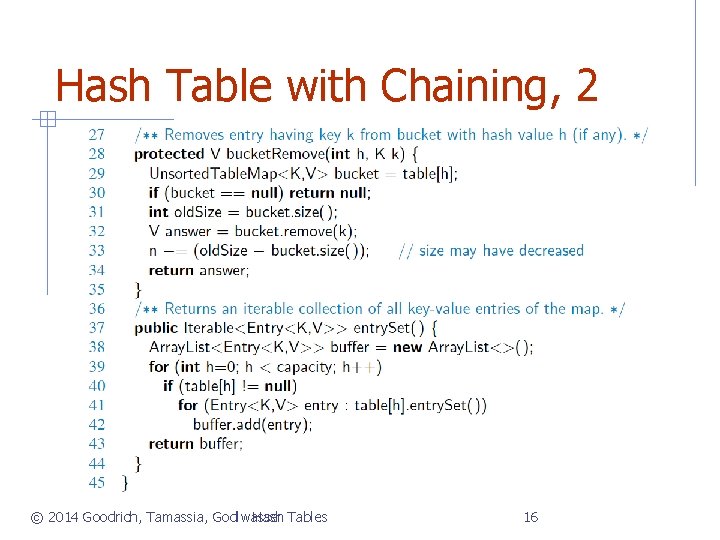
Hash Table with Chaining, 2 © 2014 Goodrich, Tamassia, Godlwasser Hash Tables 16
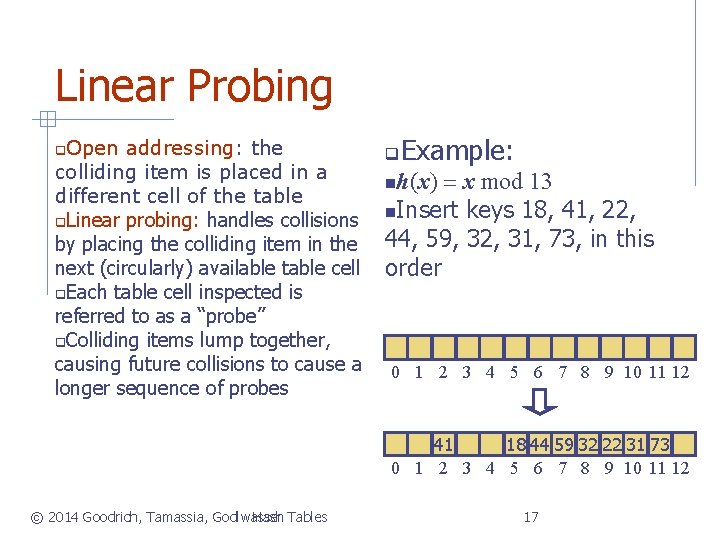
Linear Probing Open addressing: the colliding item is placed in a different cell of the table Linear probing: handles collisions by placing the colliding item in the next (circularly) available table cell Each table cell inspected is referred to as a “probe” Colliding items lump together, causing future collisions to cause a longer sequence of probes Example: h(x) = x mod 13 Insert keys 18, 41, 22, 44, 59, 32, 31, 73, in this order 0 1 2 3 4 5 6 7 8 9 10 11 12 41 18 44 59 32 22 31 73 0 1 2 3 4 5 6 7 8 9 10 11 12 © 2014 Goodrich, Tamassia, Godlwasser Hash Tables 17
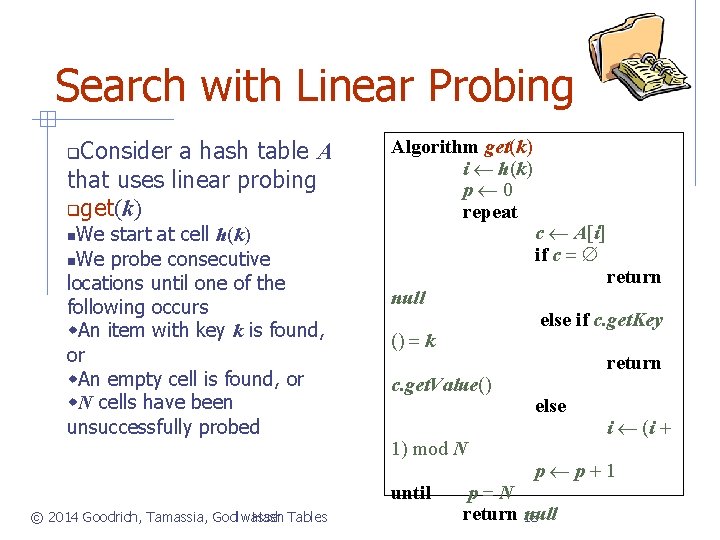
Search with Linear Probing Consider a hash table A that uses linear probing get(k) We start at cell h(k) We probe consecutive locations until one of the following occurs An item with key k is found, or An empty cell is found, or N cells have been unsuccessfully probed Algorithm get(k) i h(k) p 0 repeat null © 2014 Goodrich, Tamassia, Godlwasser Hash Tables return else if c. get. Key () = k c. get. Value() 1) mod N until c A[i] if c = return else i (i + p p+1 p=N return 18 null
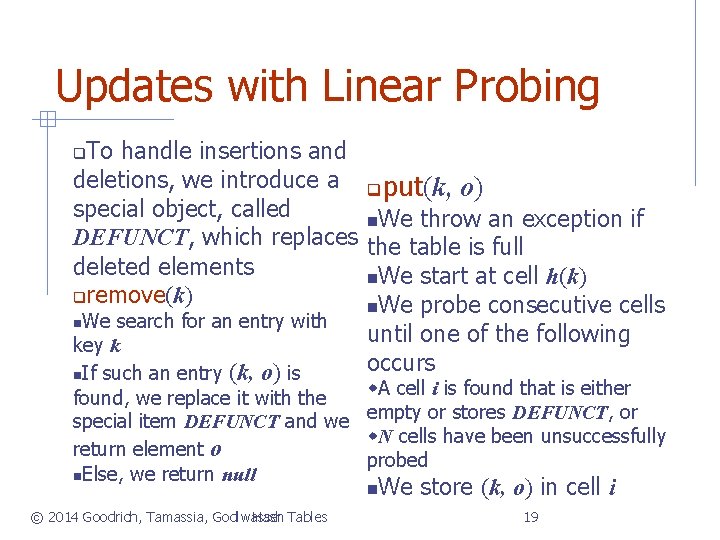
Updates with Linear Probing To handle insertions and deletions, we introduce a special object, called DEFUNCT, which replaces deleted elements remove(k) We search for an entry with key k If such an entry (k, o) is found, we replace it with the special item DEFUNCT and we return element o Else, we return null © 2014 Goodrich, Tamassia, Godlwasser Hash Tables put(k, o) We throw an exception if the table is full We start at cell h(k) We probe consecutive cells until one of the following occurs A cell i is found that is either empty or stores DEFUNCT, or N cells have been unsuccessfully probed We store (k, o) in cell i 19
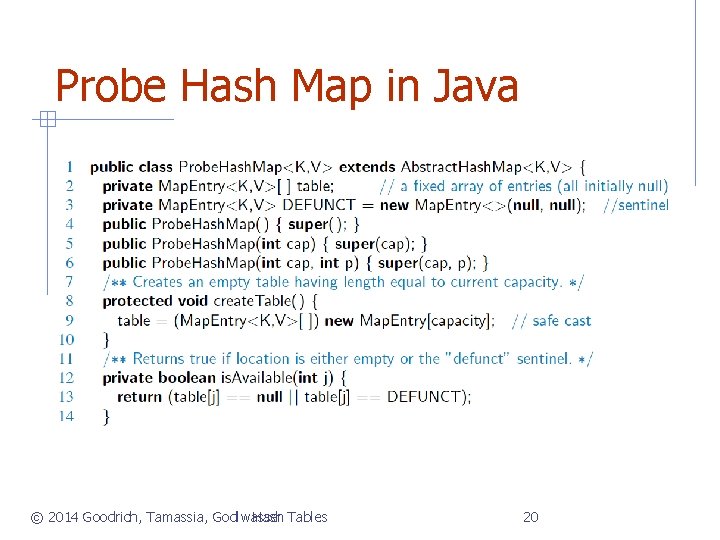
Probe Hash Map in Java © 2014 Goodrich, Tamassia, Godlwasser Hash Tables 20
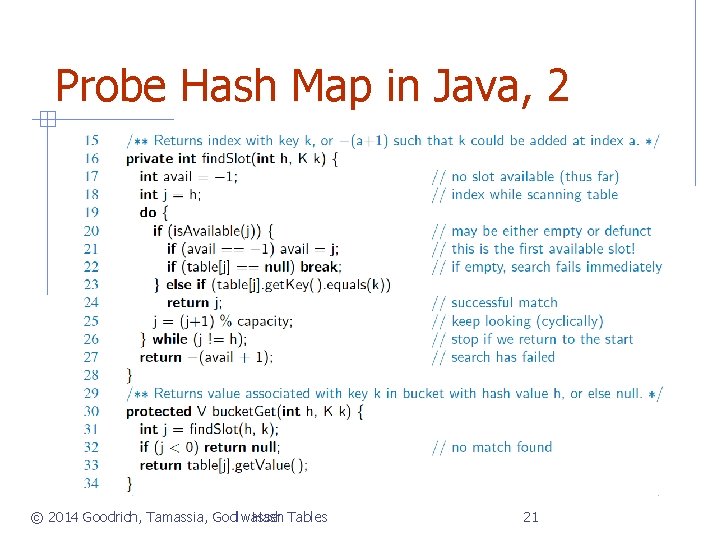
Probe Hash Map in Java, 2 © 2014 Goodrich, Tamassia, Godlwasser Hash Tables 21
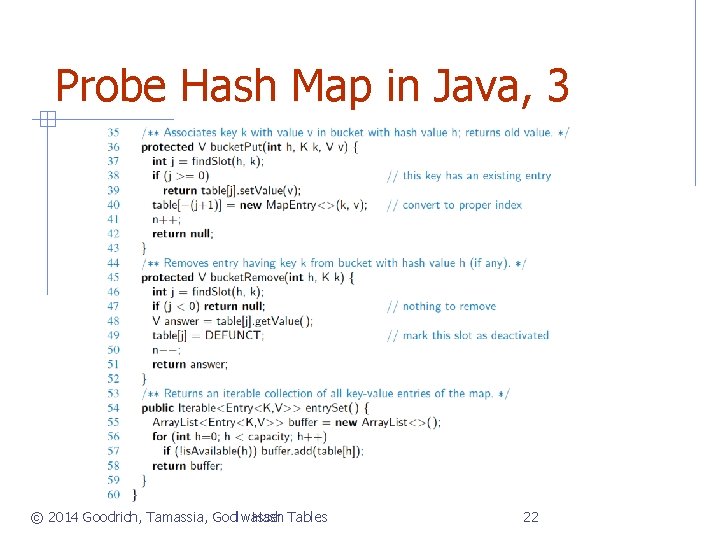
Probe Hash Map in Java, 3 © 2014 Goodrich, Tamassia, Godlwasser Hash Tables 22
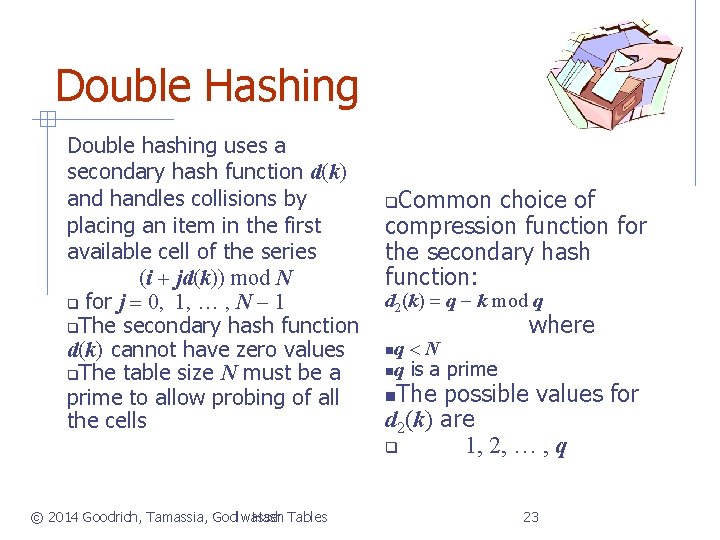
Double Hashing Double hashing uses a secondary hash function d(k) and handles collisions by placing an item in the first available cell of the series (i + jd(k)) mod N for j = 0, 1, … , N - 1 The secondary hash function d(k) cannot have zero values The table size N must be a prime to allow probing of all the cells © 2014 Goodrich, Tamassia, Godlwasser Hash Tables Common choice of compression function for the secondary hash function: d 2(k) = q - k mod q q<N q is a prime where The possible values for d 2(k) are 1, 2, … , q 23

Example of Double Hashing Consider a hash table storing integer keys that handles collision with double hashing N = 13 h(k) = k mod 13 d(k) = 7 - k mod 7 Insert keys 18, 41, 22, 44, 59, 32, 31, 73, in this order 0 1 2 3 4 5 6 7 8 9 10 11 12 31 41 18 32 59 73 22 44 0 1 2 3 4 5 6 7 8 9 10 11 12 © 2014 Goodrich, Tamassia, Godlwasser Hash Tables 24
Performance of Hashing In the worst case, searches, insertions and removals on a hash table take O(n) time The worst case occurs when all the keys inserted into the map collide The load factor a = n/N affects the performance of a hash table Assuming that the hash values are like random numbers, it can be shown that the expected number of probes for an insertion with open addressing is 1 / (1 - a) © 2014 Goodrich, Tamassia, Godlwasser Hash Tables The expected running time of all the dictionary ADT operations in a hash table is O(1) In practice, hashing is very fast provided the load factor is not close to 100% Applications of hash tables: small databases compilers browser caches 25
- Slides: 25