
Presentation for use with the textbook Data Structures
Presentation for use with the textbook Data Structures and Algorithms in Java, 6 th edition, by M. T. Goodrich, R. Tamassia, and M. H. Goldwasser, Wiley, 2014 Selection © 2014 Goodrich, Tamassia, Goldwasser Selection 1
The Selection Problem Given an integer k and n elements x 1, x 2, …, xn, taken from a total order, find the k-th smallest element in this set. Of course, we can sort the set in O(n log n) time and then index the k-th element. k=3 7 4 9 6 2 2 4 6 7 9 Can we solve the selection problem faster? © 2014 Goodrich, Tamassia, Goldwasser Selection 2
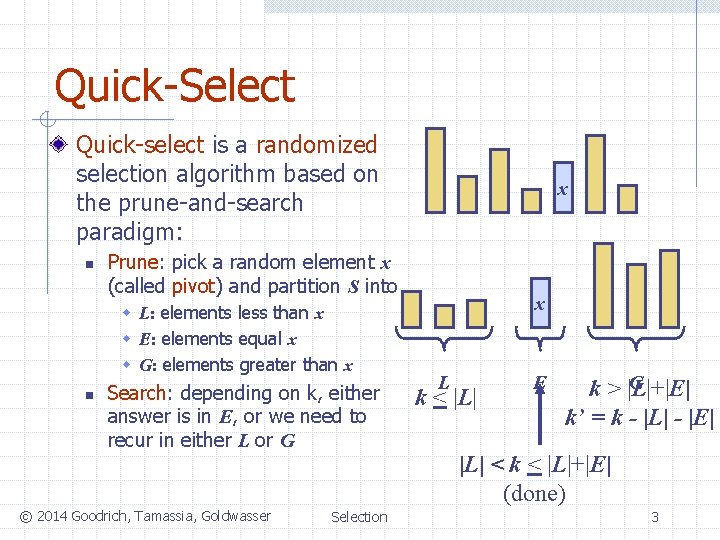
Quick-Select Quick-select is a randomized selection algorithm based on the prune-and-search paradigm: n Prune: pick a random element x (called pivot) and partition S into w L: elements less than x w E: elements equal x w G: elements greater than x Search: depending on k, either answer is in E, or we need to recur in either L or G © 2014 Goodrich, Tamassia, Goldwasser Selection x L k < |L| E G k > |L|+|E| k’ = k - |L| - |E| |L| < k < |L|+|E| (done) 3
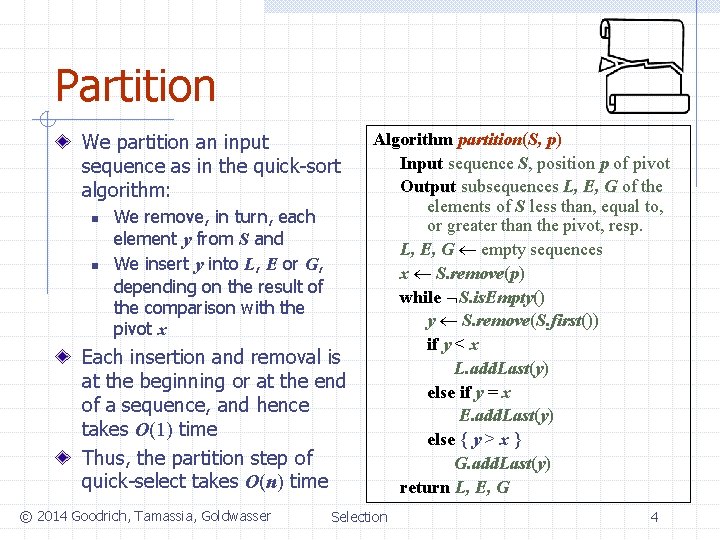
Partition We partition an input sequence as in the quick-sort algorithm: n n We remove, in turn, each element y from S and We insert y into L, E or G, depending on the result of the comparison with the pivot x Each insertion and removal is at the beginning or at the end of a sequence, and hence takes O(1) time Thus, the partition step of quick-select takes O(n) time © 2014 Goodrich, Tamassia, Goldwasser Algorithm partition(S, p) Input sequence S, position p of pivot Output subsequences L, E, G of the elements of S less than, equal to, or greater than the pivot, resp. L, E, G empty sequences x S. remove(p) while S. is. Empty() y S. remove(S. first()) if y < x L. add. Last(y) else if y = x E. add. Last(y) else { y > x } G. add. Last(y) return L, E, G Selection 4
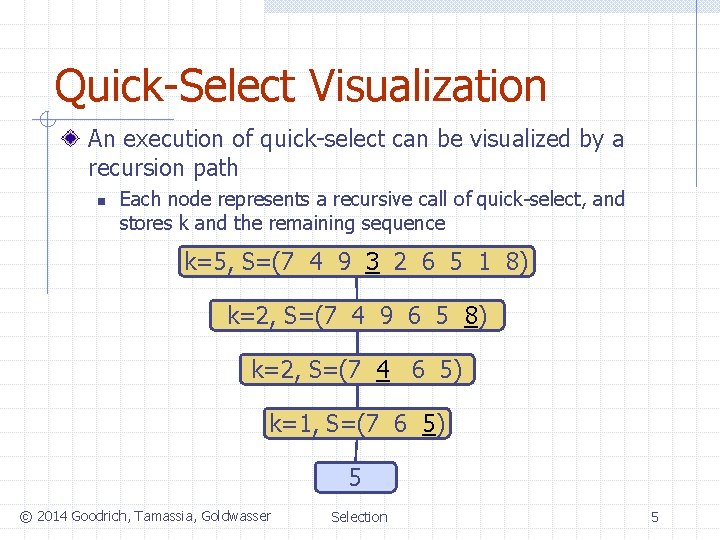
Quick-Select Visualization An execution of quick-select can be visualized by a recursion path n Each node represents a recursive call of quick-select, and stores k and the remaining sequence k=5, S=(7 4 9 3 2 6 5 1 8) k=2, S=(7 4 9 6 5 8) k=2, S=(7 4 6 5) k=1, S=(7 6 5) 5 © 2014 Goodrich, Tamassia, Goldwasser Selection 5
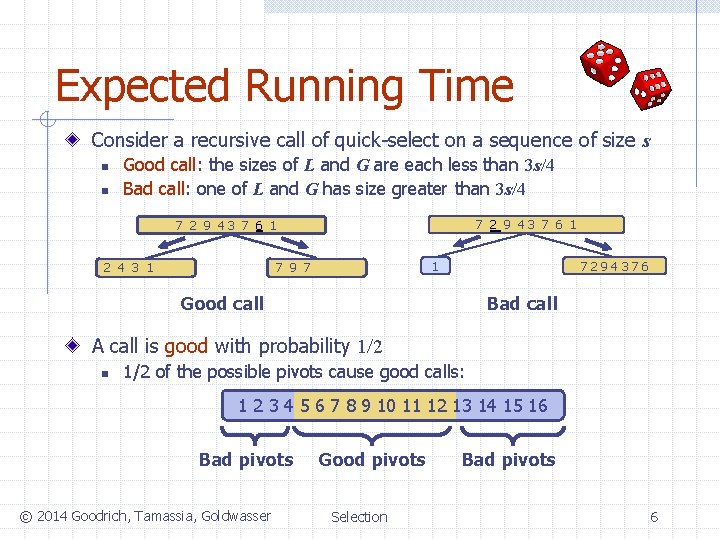
Expected Running Time Consider a recursive call of quick-select on a sequence of size s n n Good call: the sizes of L and G are each less than 3 s/4 Bad call: one of L and G has size greater than 3 s/4 7 2 9 43 7 6 19 7 1 1 2 4 3 1 1 7294376 Good call Bad call A call is good with probability 1/2 n 1/2 of the possible pivots cause good calls: 1 2 3 4 5 6 7 8 9 10 11 12 13 14 15 16 Bad pivots © 2014 Goodrich, Tamassia, Goldwasser Good pivots Selection Bad pivots 6
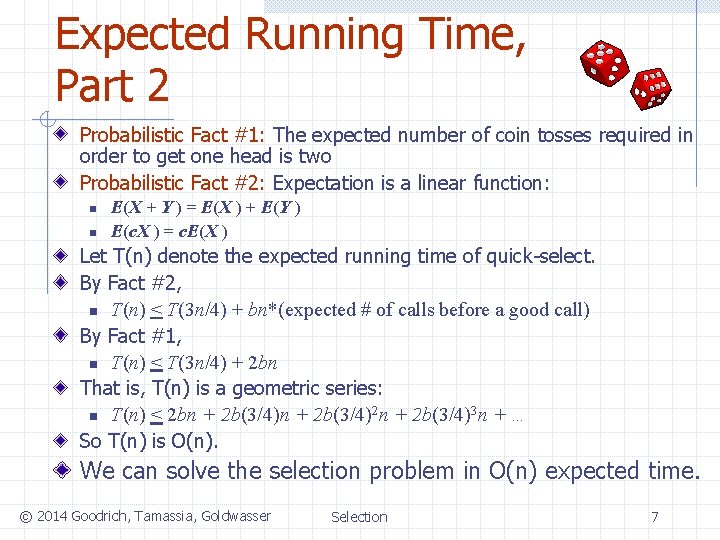
Expected Running Time, Part 2 Probabilistic Fact #1: The expected number of coin tosses required in order to get one head is two Probabilistic Fact #2: Expectation is a linear function: n n E(X + Y ) = E(X ) + E(Y ) E(c. X ) = c. E(X ) Let T(n) denote the expected running time of quick-select. By Fact #2, n T(n) < T(3 n/4) + bn*(expected # of calls before a good call) By Fact #1, n T(n) < T(3 n/4) + 2 bn That is, T(n) is a geometric series: n T(n) < 2 bn + 2 b(3/4)2 n + 2 b(3/4)3 n + … So T(n) is O(n). We can solve the selection problem in O(n) expected time. © 2014 Goodrich, Tamassia, Goldwasser Selection 7
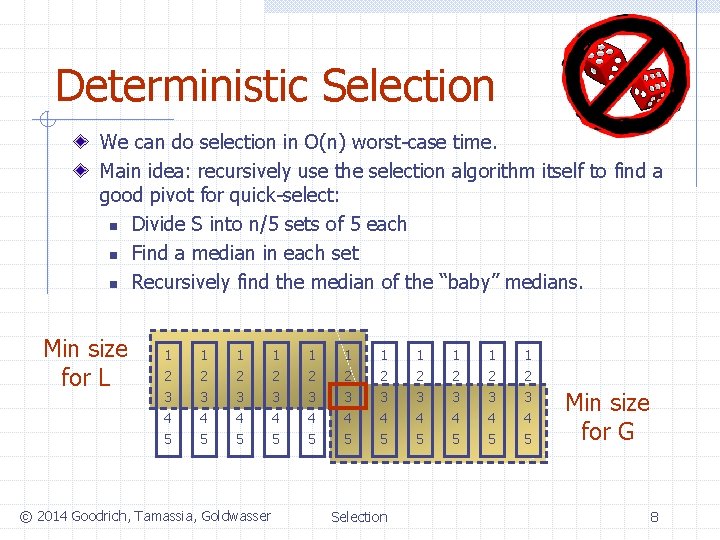
Deterministic Selection We can do selection in O(n) worst-case time. Main idea: recursively use the selection algorithm itself to find a good pivot for quick-select: n Divide S into n/5 sets of 5 each n Find a median in each set n Recursively find the median of the “baby” medians. Min size for L 1 1 1 2 3 4 2 3 4 2 3 4 5 5 5 © 2014 Goodrich, Tamassia, Goldwasser Selection Min size for G 8
- Slides: 8