
Presentation for use with the textbook Data Structures
Presentation for use with the textbook Data Structures and Algorithms in Java, 6 th edition, by M. T. Goodrich, R. Tamassia, and M. H. Goldwasser, Wiley, 2014 Priority Queues © 2014 Goodrich, Tamassia, Goldwasser Priority Queues 1
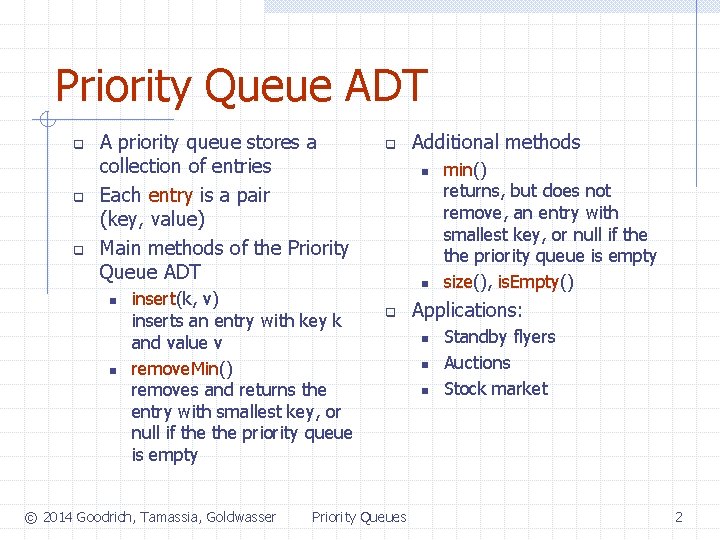
Priority Queue ADT q q q A priority queue stores a collection of entries Each entry is a pair (key, value) Main methods of the Priority Queue ADT n n insert(k, v) inserts an entry with key k and value v remove. Min() removes and returns the entry with smallest key, or null if the priority queue is empty © 2014 Goodrich, Tamassia, Goldwasser q Additional methods n n q Priority Queues min() returns, but does not remove, an entry with smallest key, or null if the priority queue is empty size(), is. Empty() Applications: n n n Standby flyers Auctions Stock market 2
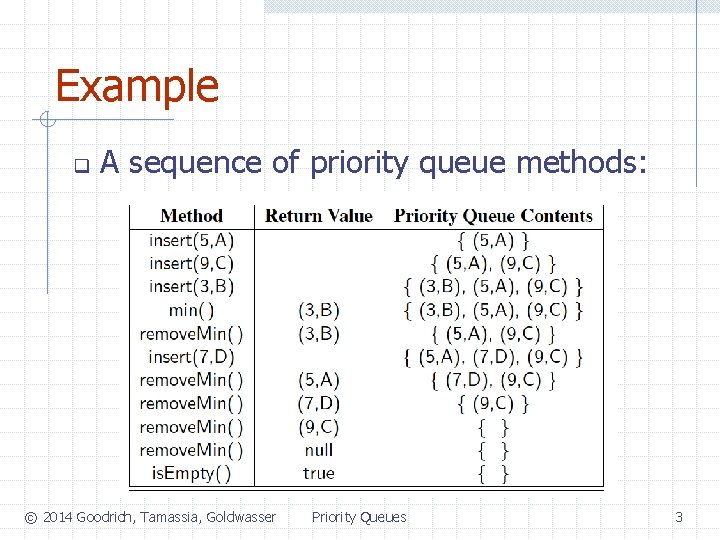
Example q A sequence of priority queue methods: © 2014 Goodrich, Tamassia, Goldwasser Priority Queues 3
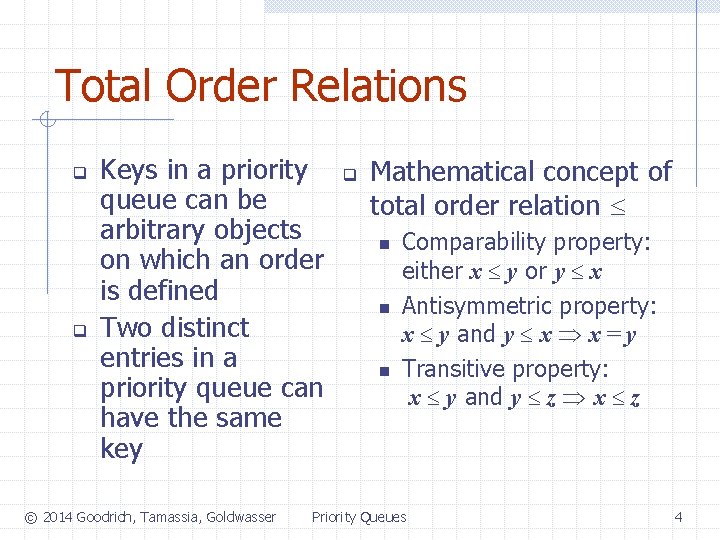
Total Order Relations q q Keys in a priority queue can be arbitrary objects on which an order is defined Two distinct entries in a priority queue can have the same key © 2014 Goodrich, Tamassia, Goldwasser q Mathematical concept of total order relation n n n Comparability property: either x y or y x Antisymmetric property: x y and y x x = y Transitive property: x y and y z x z Priority Queues 4
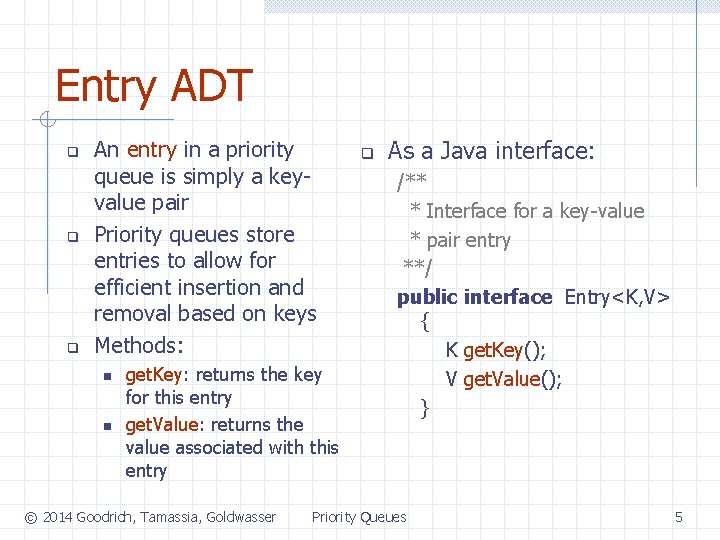
Entry ADT q q q An entry in a priority queue is simply a keyvalue pair Priority queues store entries to allow for efficient insertion and removal based on keys Methods: n n get. Key: returns the key for this entry get. Value: returns the value associated with this entry © 2014 Goodrich, Tamassia, Goldwasser q As a Java interface: /** * Interface for a key-value * pair entry **/ public interface Entry<K, V> { K get. Key(); V get. Value(); } Priority Queues 5
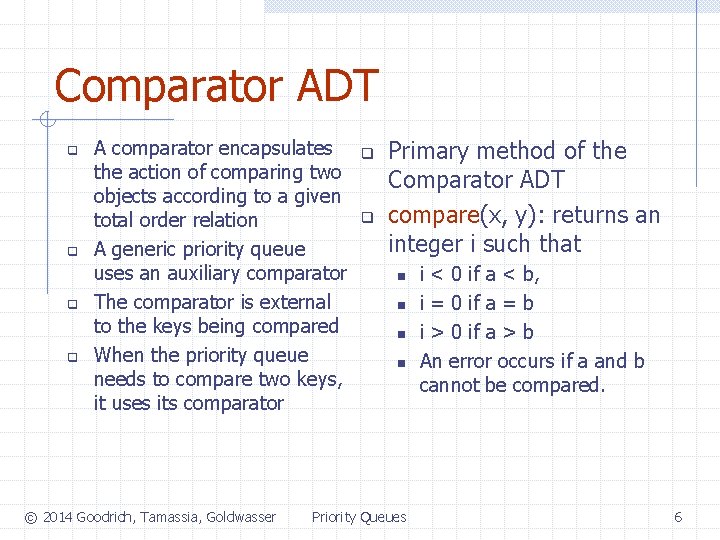
Comparator ADT q q A comparator encapsulates the action of comparing two objects according to a given total order relation A generic priority queue uses an auxiliary comparator The comparator is external to the keys being compared When the priority queue needs to compare two keys, it uses its comparator © 2014 Goodrich, Tamassia, Goldwasser q q Primary method of the Comparator ADT compare(x, y): returns an integer i such that n n Priority Queues i < 0 if a < b, i = 0 if a = b i > 0 if a > b An error occurs if a and b cannot be compared. 6
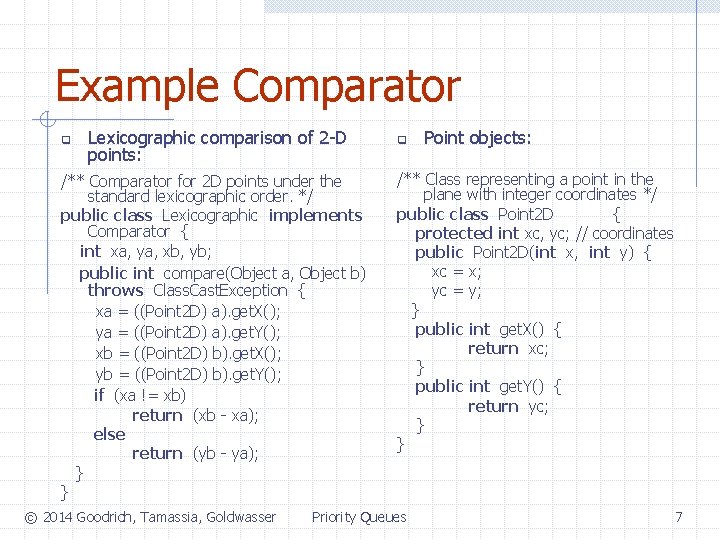
Example Comparator q Lexicographic comparison of 2 -D points: /** Comparator for 2 D points under the standard lexicographic order. */ public class Lexicographic implements Comparator { int xa, ya, xb, yb; public int compare(Object a, Object b) throws Class. Cast. Exception { xa = ((Point 2 D) a). get. X(); ya = ((Point 2 D) a). get. Y(); xb = ((Point 2 D) b). get. X(); yb = ((Point 2 D) b). get. Y(); if (xa != xb) return (xb - xa); else return (yb - ya); } } © 2014 Goodrich, Tamassia, Goldwasser q Point objects: /** Class representing a point in the plane with integer coordinates */ public class Point 2 D { protected int xc, yc; // coordinates public Point 2 D(int x, int y) { xc = x; yc = y; } public int get. X() { return xc; } public int get. Y() { return yc; } } Priority Queues 7
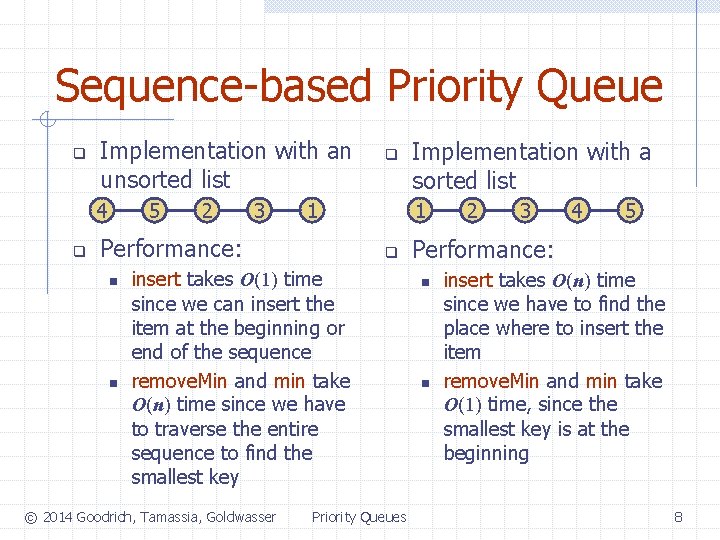
Sequence-based Priority Queue q Implementation with an unsorted list 4 q 5 2 3 1 Performance: n n q 1 q insert takes O(1) time since we can insert the item at the beginning or end of the sequence remove. Min and min take O(n) time since we have to traverse the entire sequence to find the smallest key © 2014 Goodrich, Tamassia, Goldwasser Implementation with a sorted list Priority Queues 2 3 4 5 Performance: n n insert takes O(n) time since we have to find the place where to insert the item remove. Min and min take O(1) time, since the smallest key is at the beginning 8
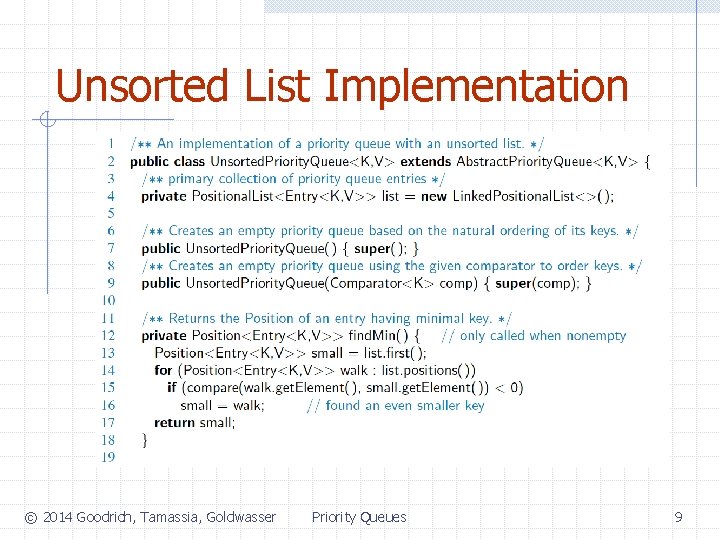
Unsorted List Implementation © 2014 Goodrich, Tamassia, Goldwasser Priority Queues 9
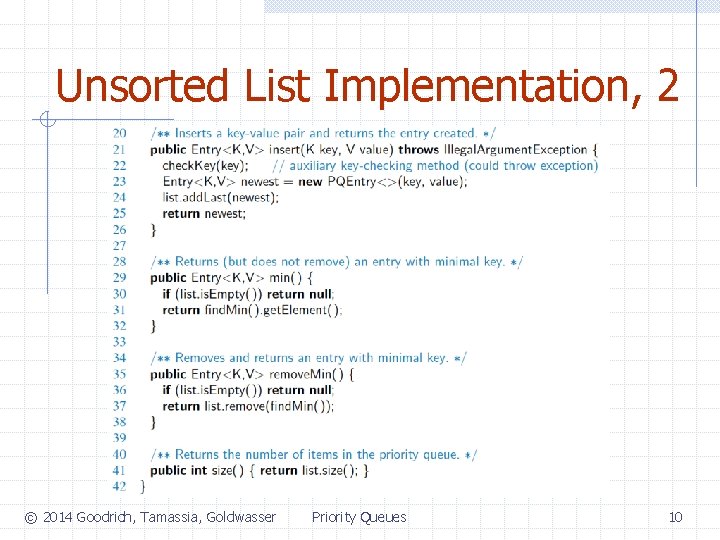
Unsorted List Implementation, 2 © 2014 Goodrich, Tamassia, Goldwasser Priority Queues 10
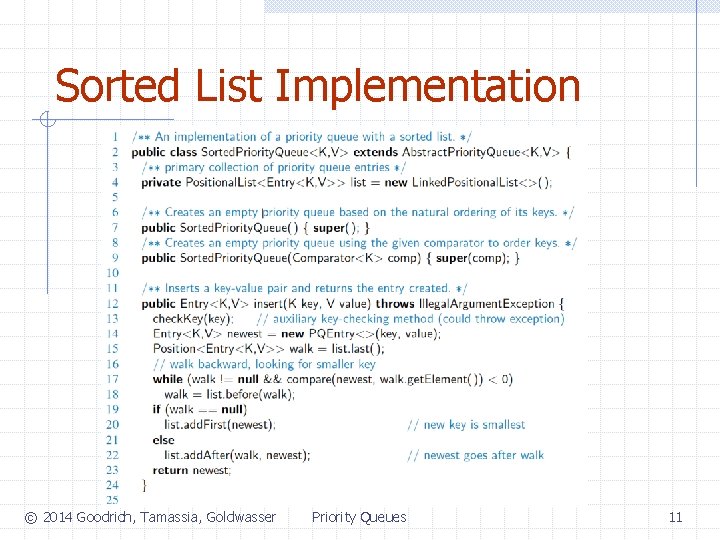
Sorted List Implementation © 2014 Goodrich, Tamassia, Goldwasser Priority Queues 11
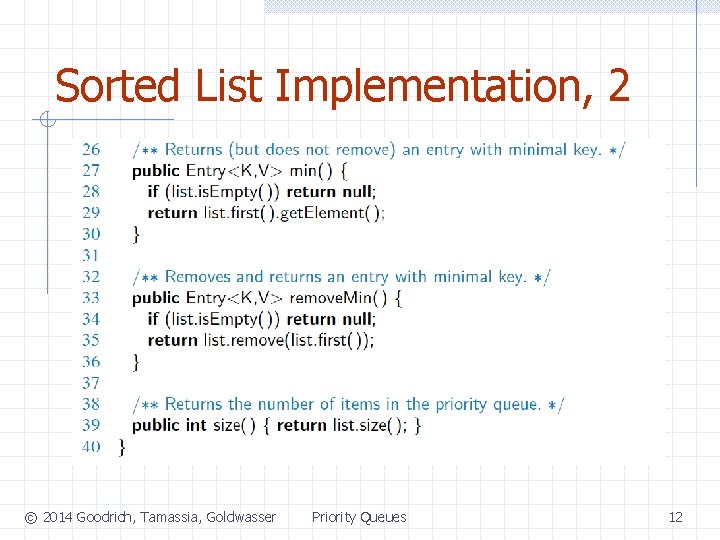
Sorted List Implementation, 2 © 2014 Goodrich, Tamassia, Goldwasser Priority Queues 12
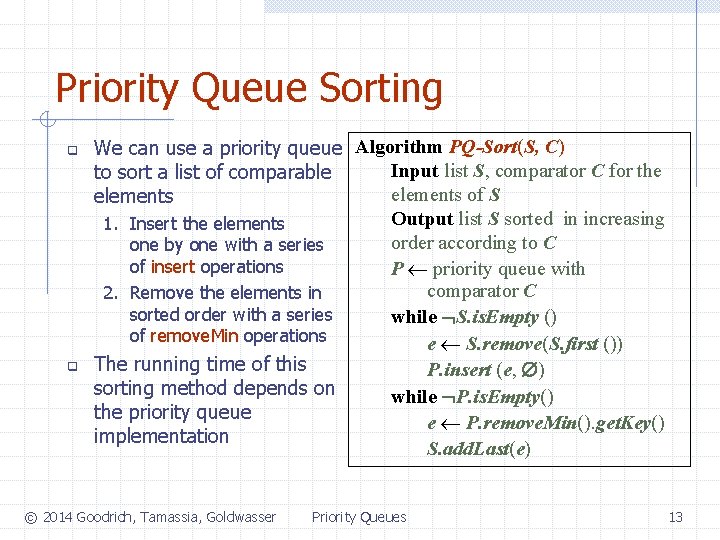
Priority Queue Sorting q q We can use a priority queue Algorithm PQ-Sort(S, C) Input list S, comparator C for the to sort a list of comparable elements of S elements Output list S sorted in increasing 1. Insert the elements order according to C one by one with a series of insert operations P priority queue with comparator C 2. Remove the elements in sorted order with a series while S. is. Empty () of remove. Min operations e S. remove(S. first ()) The running time of this P. insert (e, ) sorting method depends on while P. is. Empty() the priority queue e P. remove. Min(). get. Key() implementation S. add. Last(e) © 2014 Goodrich, Tamassia, Goldwasser Priority Queues 13
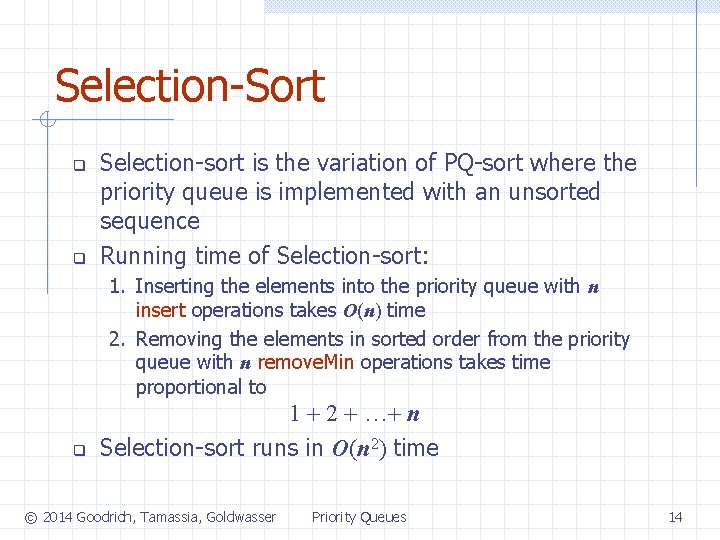
Selection-Sort q q Selection-sort is the variation of PQ-sort where the priority queue is implemented with an unsorted sequence Running time of Selection-sort: 1. Inserting the elements into the priority queue with n insert operations takes O(n) time 2. Removing the elements in sorted order from the priority queue with n remove. Min operations takes time proportional to q 1 + 2 + …+ n Selection-sort runs in O(n 2) time © 2014 Goodrich, Tamassia, Goldwasser Priority Queues 14
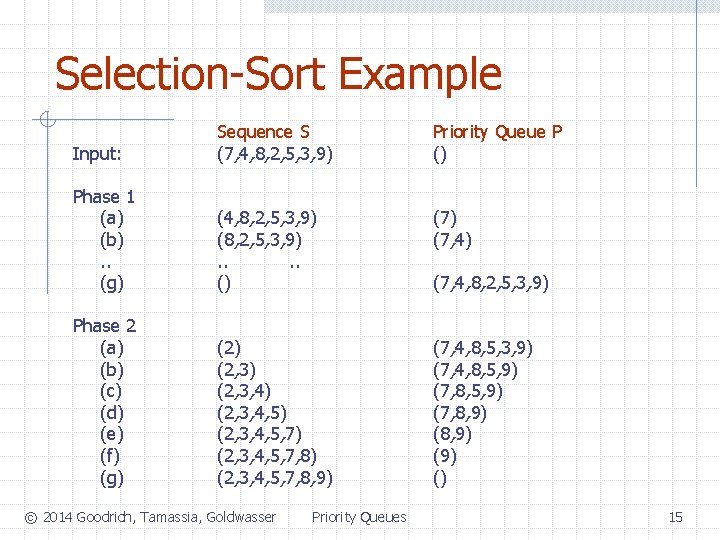
Selection-Sort Example Input: Sequence S (7, 4, 8, 2, 5, 3, 9) Priority Queue P () Phase 1 (a) (b). . (g) (4, 8, 2, 5, 3, 9) (8, 2, 5, 3, 9). . () (7, 4) Phase 2 (a) (b) (c) (d) (e) (f) (g) (2, 3) (2, 3, 4, 5) (2, 3, 4, 5, 7, 8) (2, 3, 4, 5, 7, 8, 9) (7, 4, 8, 5, 3, 9) (7, 4, 8, 5, 9) (7, 8, 9) (9) () © 2014 Goodrich, Tamassia, Goldwasser Priority Queues (7, 4, 8, 2, 5, 3, 9) 15
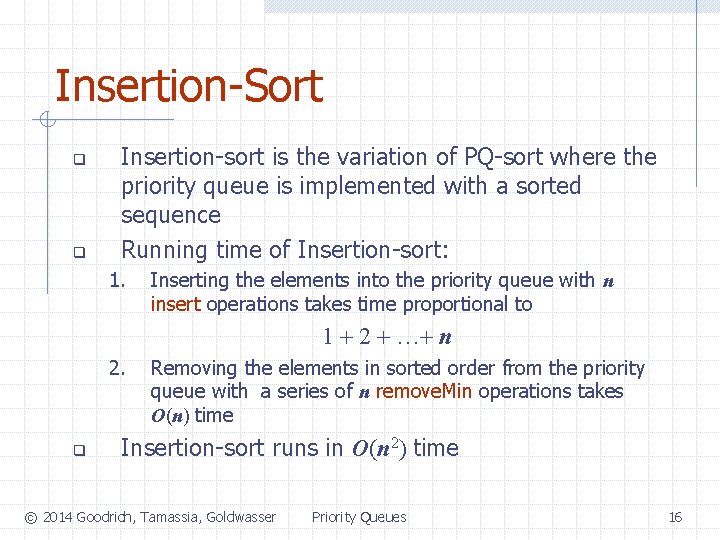
Insertion-Sort q q Insertion-sort is the variation of PQ-sort where the priority queue is implemented with a sorted sequence Running time of Insertion-sort: 1. Inserting the elements into the priority queue with n insert operations takes time proportional to 1 + 2 + …+ n 2. q Removing the elements in sorted order from the priority queue with a series of n remove. Min operations takes O(n) time Insertion-sort runs in O(n 2) time © 2014 Goodrich, Tamassia, Goldwasser Priority Queues 16
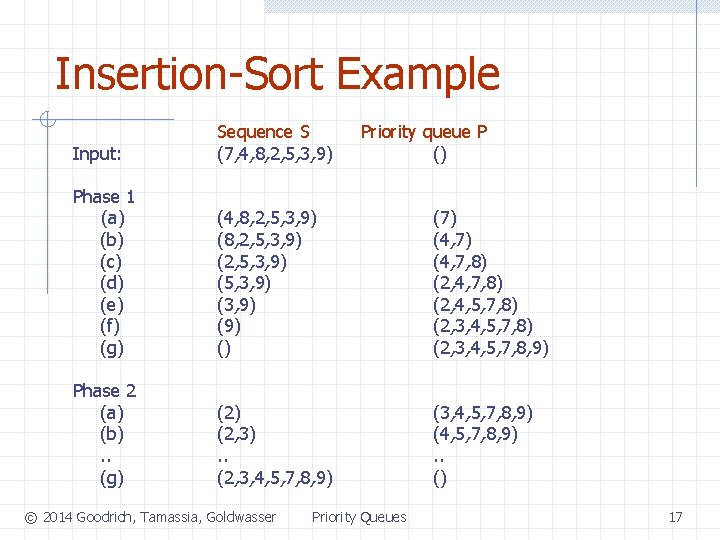
Insertion-Sort Example Input: Sequence S (7, 4, 8, 2, 5, 3, 9) Phase 1 (a) (b) (c) (d) (e) (f) (g) (4, 8, 2, 5, 3, 9) (2, 5, 3, 9) (3, 9) () (7) (4, 7, 8) (2, 4, 5, 7, 8) (2, 3, 4, 5, 7, 8, 9) Phase 2 (a) (b). . (g) (2, 3). . (2, 3, 4, 5, 7, 8, 9) (4, 5, 7, 8, 9). . () © 2014 Goodrich, Tamassia, Goldwasser Priority queue P () Priority Queues 17
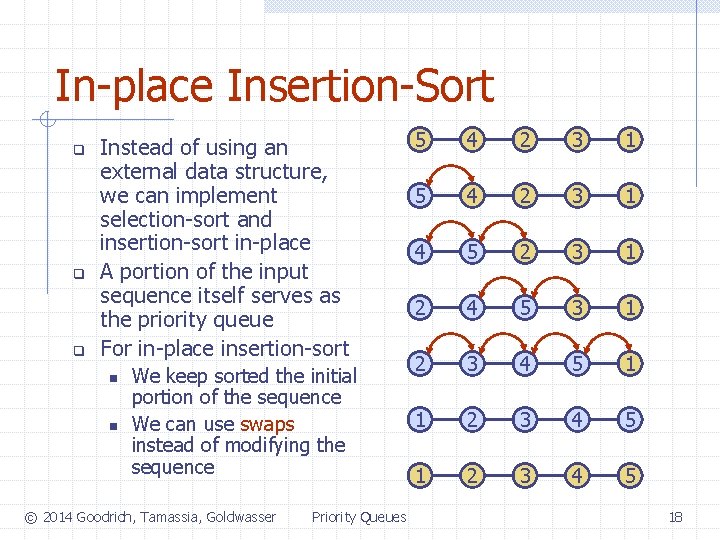
In-place Insertion-Sort q q q Instead of using an external data structure, we can implement selection-sort and insertion-sort in-place A portion of the input sequence itself serves as the priority queue For in-place insertion-sort n n We keep sorted the initial portion of the sequence We can use swaps instead of modifying the sequence © 2014 Goodrich, Tamassia, Goldwasser Priority Queues 5 4 2 3 1 4 5 2 3 1 2 4 5 3 1 2 3 4 5 18
- Slides: 18