
Presentation for use with the textbook Data Structures
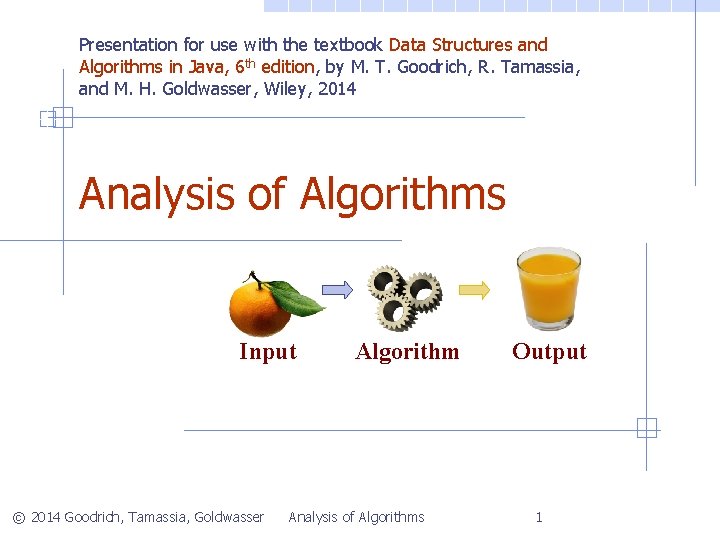
Presentation for use with the textbook Data Structures and Algorithms in Java, 6 th edition, by M. T. Goodrich, R. Tamassia, and M. H. Goldwasser, Wiley, 2014 Analysis of Algorithms Input © 2014 Goodrich, Tamassia, Goldwasser Algorithm Analysis of Algorithms Output 1
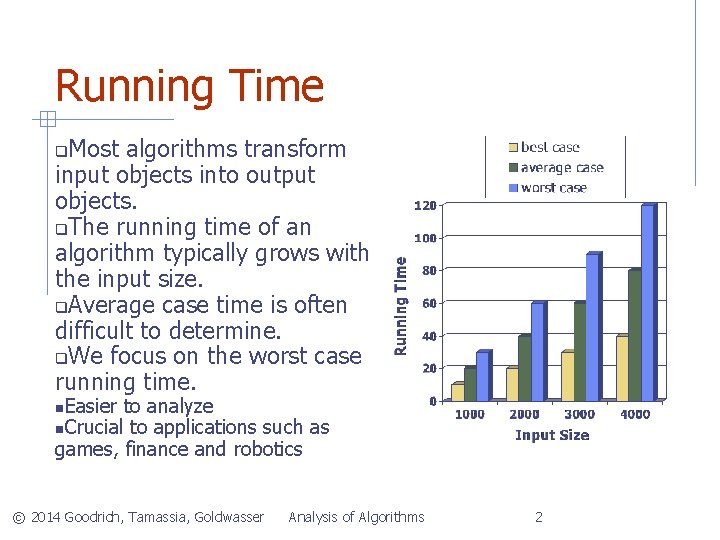
Running Time Most algorithms transform input objects into output objects. The running time of an algorithm typically grows with the input size. Average case time is often difficult to determine. We focus on the worst case running time. Easier to analyze Crucial to applications such as games, finance and robotics © 2014 Goodrich, Tamassia, Goldwasser Analysis of Algorithms 2
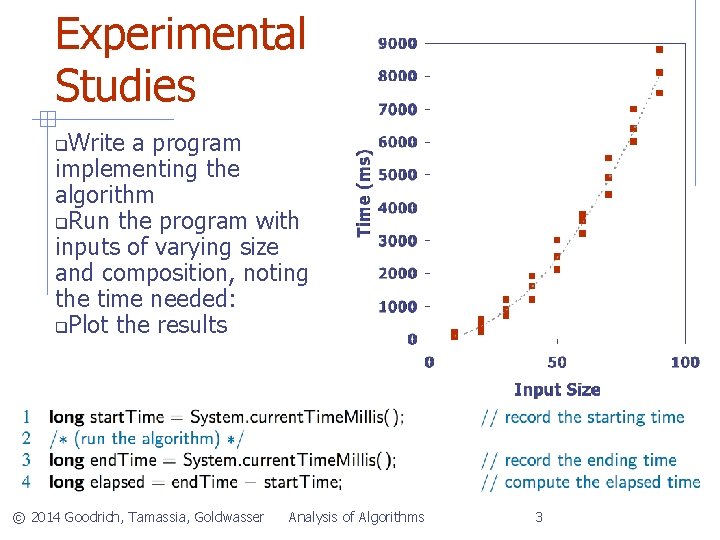
Experimental Studies Write a program implementing the algorithm Run the program with inputs of varying size and composition, noting the time needed: Plot the results © 2014 Goodrich, Tamassia, Goldwasser Analysis of Algorithms 3
Limitations of Experiments It is necessary to implement the algorithm, which may be difficult Results may not be indicative of the running time on other inputs not included in the experiment. In order to compare two algorithms, the same hardware and software environments must be used © 2014 Goodrich, Tamassia, Goldwasser Analysis of Algorithms 4
Theoretical Analysis Uses a high-level description of the algorithm instead of an implementation Characterizes running time as a function of the input size, n Takes into account all possible inputs Allows us to evaluate the speed of an algorithm independent of the hardware/software environment © 2014 Goodrich, Tamassia, Goldwasser Analysis of Algorithms 5

Pseudocode High-level description of an algorithm More structured than English prose Less detailed than a program Preferred notation for describing algorithms Programming language independent © 2014 Goodrich, Tamassia, Goldwasser Analysis of Algorithms 6
![Pseudocode Details Control flow if … then … [else …] while … do …](http://slidetodoc.com/presentation_image_h/35b4292993c642b4cbf78fa13647ca7a/image-7.jpg "Pseudocode Details Control flow if … then … [else …] while … do …")
Pseudocode Details Control flow if … then … [else …] while … do … repeat … until … for … do … Indentation replaces braces Method declaration Algorithm method (arg [, arg…]) Input … Output … © 2014 Goodrich, Tamassia, Goldwasser Method call method (arg [, arg…]) Return value return expression Expressions: ¬Assignment =Equality testing n 2 Superscripts and other mathematical formatting allowed Analysis of Algorithms 7
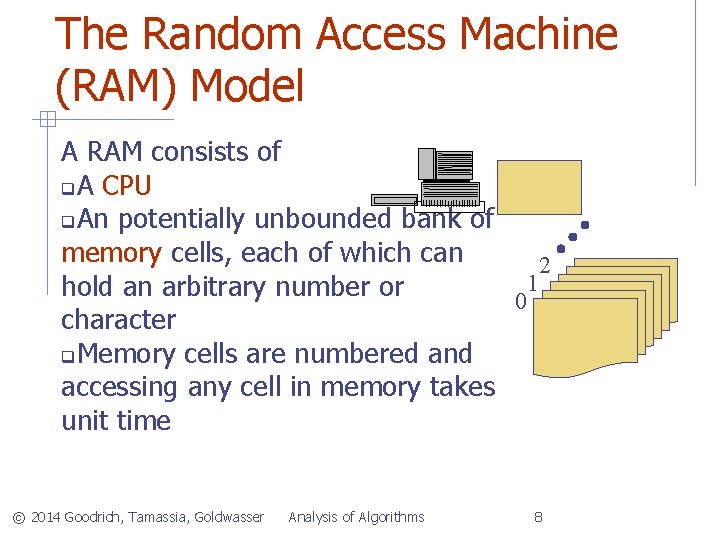
The Random Access Machine (RAM) Model A RAM consists of A CPU An potentially unbounded bank of memory cells, each of which can 2 1 hold an arbitrary number or 0 character Memory cells are numbered and accessing any cell in memory takes unit time © 2014 Goodrich, Tamassia, Goldwasser Analysis of Algorithms 8
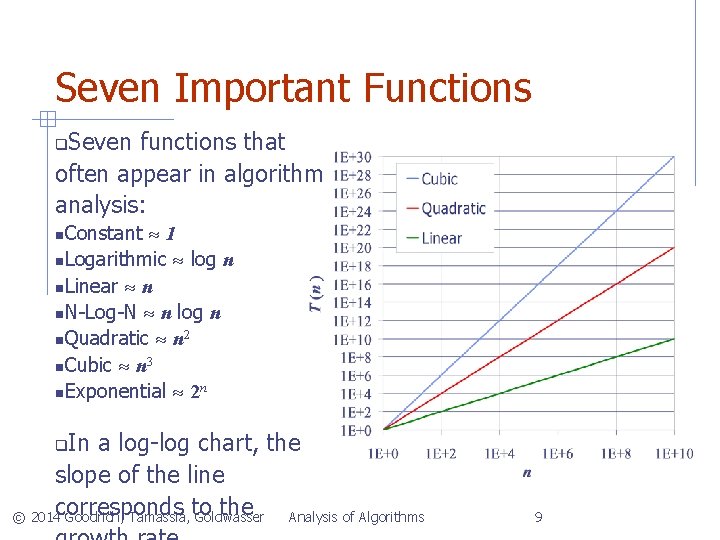
Seven Important Functions Seven functions that often appear in algorithm analysis: Constant 1 Logarithmic log n Linear n N-Log-N n log n Quadratic n 2 Cubic n 3 Exponential 2 n In a log-log chart, the slope of the line the Analysis of Algorithms © 2014 corresponds Goodrich, Tamassia, to Goldwasser 9
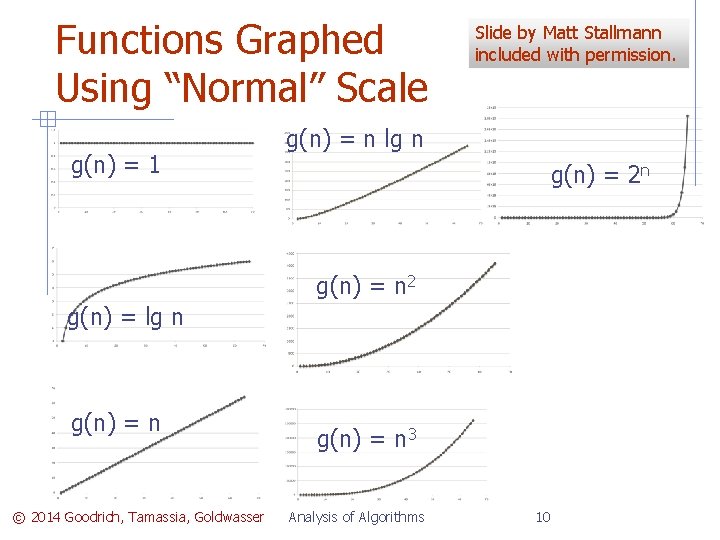
Functions Graphed Using “Normal” Scale g(n) = 1 Slide by Matt Stallmann included with permission. g(n) = n lg n g(n) = 2 n g(n) = n 2 g(n) = lg n g(n) = n © 2014 Goodrich, Tamassia, Goldwasser g(n) = n 3 Analysis of Algorithms 10
Primitive Operations Basic computations performed by an algorithm Identifiable in pseudocode Largely independent from the programming language Exact definition not important (we will see why later) Assumed to take a constant amount of time in the RAM model © 2014 Goodrich, Tamassia, Goldwasser Analysis of Algorithms Examples: Evaluating an expression Assigning a value to a variable Indexing into an array Calling a method Returning from a method 11
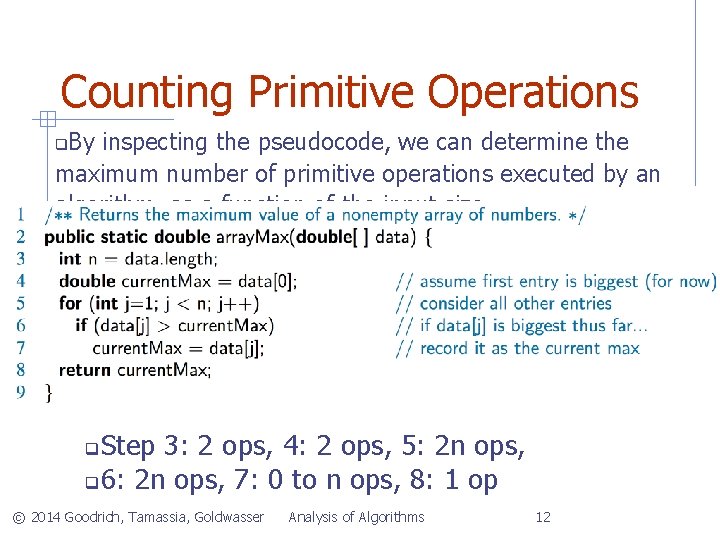
Counting Primitive Operations By inspecting the pseudocode, we can determine the maximum number of primitive operations executed by an algorithm, as a function of the input size Step 3: 2 ops, 4: 2 ops, 5: 2 n ops, 6: 2 n ops, 7: 0 to n ops, 8: 1 op © 2014 Goodrich, Tamassia, Goldwasser Analysis of Algorithms 12
Estimating Running Time Algorithm array. Max executes 5 n + 5 primitive operations in the worst case, 4 n + 5 in the best case. Define: a b = Time taken by the fastest primitive operation = Time taken by the slowest primitive operation Let T(n) be worst-case time of array. Max. Then a (4 n + 5) T(n) b(5 n + 5) Hence, the running time T(n) is bounded by two linear functions © 2014 Goodrich, Tamassia, Goldwasser Analysis of Algorithms 13
Growth Rate of Running Time Changing the hardware/ software environment Affects T(n) by a constant factor, but Does not alter the growth rate of T(n) The linear growth rate of the running time T(n) is an intrinsic property of algorithm array. Max © 2014 Goodrich, Tamassia, Goldwasser Analysis of Algorithms 14
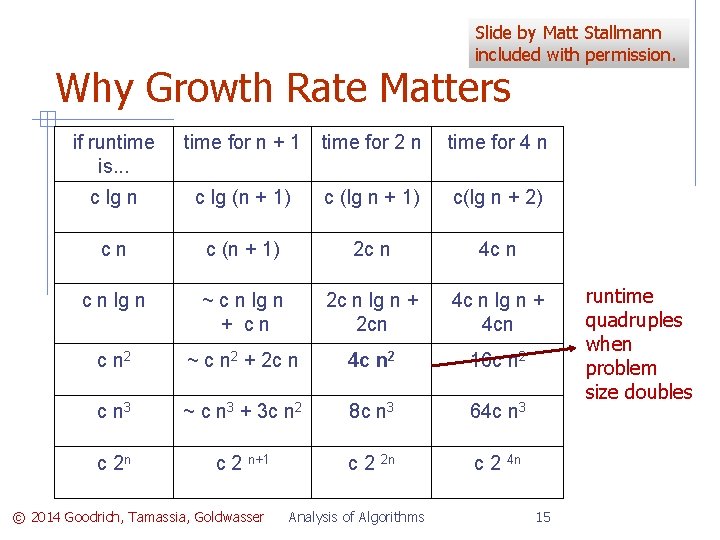
Slide by Matt Stallmann included with permission. Why Growth Rate Matters if runtime is. . . time for n + 1 time for 2 n time for 4 n c lg (n + 1) c (lg n + 1) c(lg n + 2) cn c (n + 1) 2 c n 4 c n lg n ~ c n lg n + cn 2 c n lg n + 2 cn 4 c n lg n + 4 cn c n 2 ~ c n 2 + 2 c n 4 c n 2 16 c n 2 c n 3 ~ c n 3 + 3 c n 2 8 c n 3 64 c n 3 c 2 n c 2 n+1 c 2 2 n c 2 4 n © 2014 Goodrich, Tamassia, Goldwasser Analysis of Algorithms 15 runtime quadruples when problem size doubles
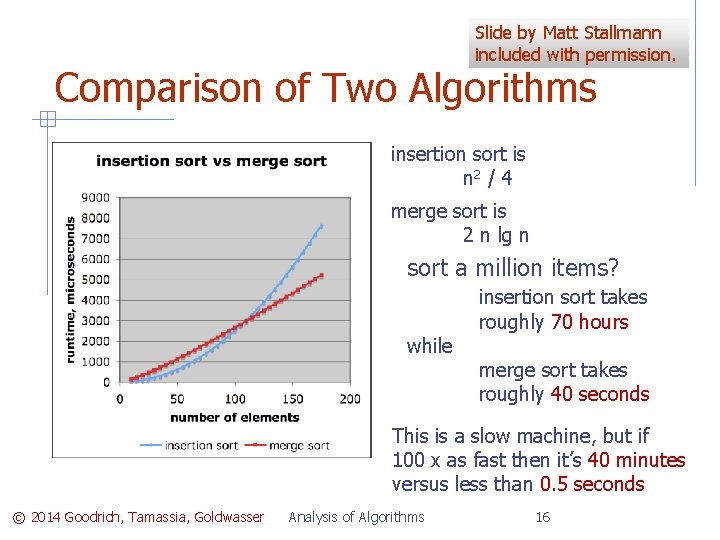
Slide by Matt Stallmann included with permission. Comparison of Two Algorithms insertion sort is n 2 / 4 merge sort is 2 n lg n sort a million items? while insertion sort takes roughly 70 hours merge sort takes roughly 40 seconds This is a slow machine, but if 100 x as fast then it’s 40 minutes versus less than 0. 5 seconds © 2014 Goodrich, Tamassia, Goldwasser Analysis of Algorithms 16
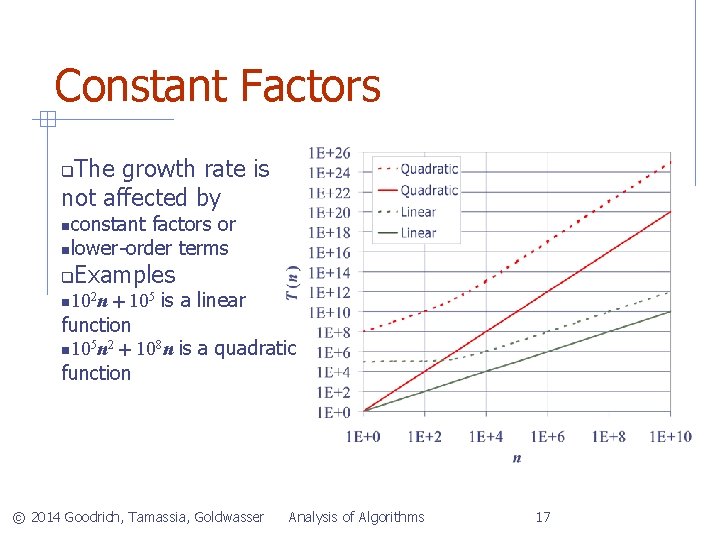
Constant Factors The growth rate is not affected by constant factors or lower-order terms Examples 102 n + 105 is a linear function 105 n 2 + 108 n is a quadratic function © 2014 Goodrich, Tamassia, Goldwasser Analysis of Algorithms 17
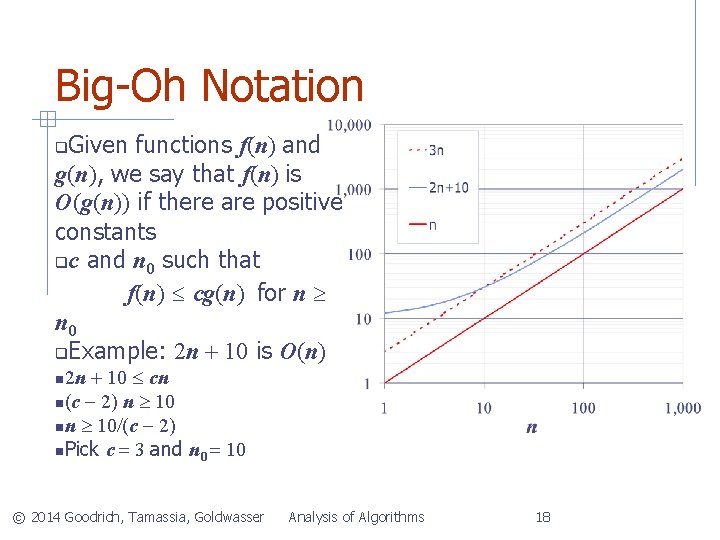
Big-Oh Notation Given functions f(n) and g(n), we say that f(n) is O(g(n)) if there are positive constants c and n 0 such that f(n) cg(n) for n n 0 Example: 2 n + 10 is O(n) 2 n + 10 cn (c 2) n 10/(c 2) Pick c = 3 and n 0 = 10 © 2014 Goodrich, Tamassia, Goldwasser Analysis of Algorithms 18
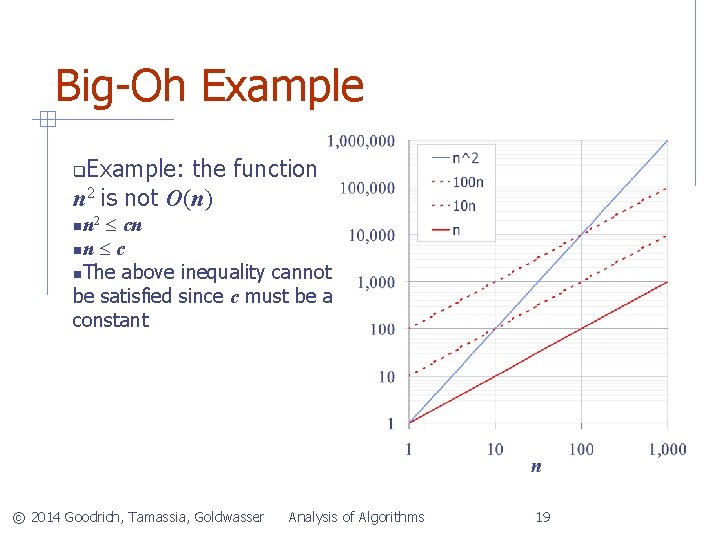
Big-Oh Example: the function n 2 is not O(n) n cn n c The above inequality cannot be satisfied since c must be a constant 2 © 2014 Goodrich, Tamassia, Goldwasser Analysis of Algorithms 19
More Big-Oh Examples 7 n -2 7 n-2 is O(n) need c > 0 and n 0 1 such that 7 n - 2 c n for n n 0 this is true for c = 7 and n 0 = 1 3 n 3 + 20 n 2 + 5 is O(n 3) need c > 0 and n 0 1 such that 3 n 3 + 20 n 2 + 5 c n 3 for n n 0 this is true for c = 4 and n 0 = 21 3 log n + 5 is O(log n) need c > 0 and n 0 1 such that 3 log n + 5 c log n for n n 0 this is true for c = 8 and n 0 = 2 © 2014 Goodrich, Tamassia, Goldwasser Analysis of Algorithms 20
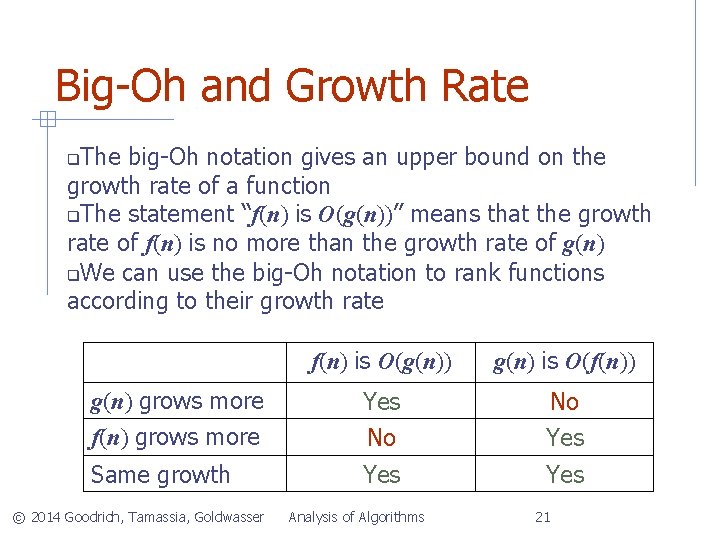
Big-Oh and Growth Rate The big-Oh notation gives an upper bound on the growth rate of a function The statement “f(n) is O(g(n))” means that the growth rate of f(n) is no more than the growth rate of g(n) We can use the big-Oh notation to rank functions according to their growth rate f(n) is O(g(n)) g(n) is O(f(n)) g(n) grows more Yes No f(n) grows more No Yes Same growth Yes © 2014 Goodrich, Tamassia, Goldwasser Analysis of Algorithms 21
Big-Oh Rules If is f(n) a polynomial of degree d, then f(n) is O(nd), i. e. , Drop lower-order terms 2. Drop constant factors 1. Say “ 2 n is O(n)” instead of “ 2 n is O(n 2)” Use the smallest possible class of functions Use the simplest expression of the class Say “ 3 n + 5 is O(n)” instead of “ 3 n + 5 is O(3 n)” © 2014 Goodrich, Tamassia, Goldwasser Analysis of Algorithms 22
Asymptotic Algorithm Analysis The asymptotic analysis of an algorithm determines the running time in big-Oh notation To perform the asymptotic analysis We find the worst-case number of primitive operations executed as a function of the input size We express this function with big-Oh notation Example: We say that algorithm array. Max “runs in O(n) time” Since constant factors and lower-order terms are eventually dropped anyhow, we can disregard them when counting primitive operations © 2014 Goodrich, Tamassia, Goldwasser Analysis of Algorithms 23
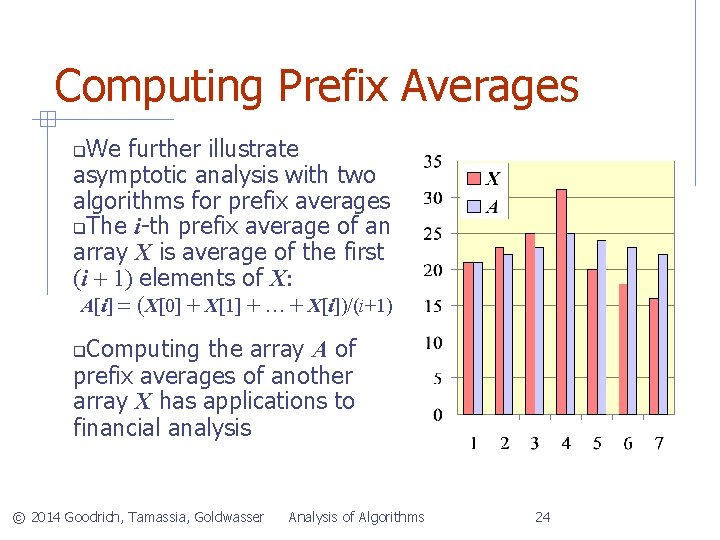
Computing Prefix Averages We further illustrate asymptotic analysis with two algorithms for prefix averages The i-th prefix average of an array X is average of the first (i + 1) elements of X: A[i] = (X[0] + X[1] + … + X[i])/(i+1) Computing the array A of prefix averages of another array X has applications to financial analysis © 2014 Goodrich, Tamassia, Goldwasser Analysis of Algorithms 24
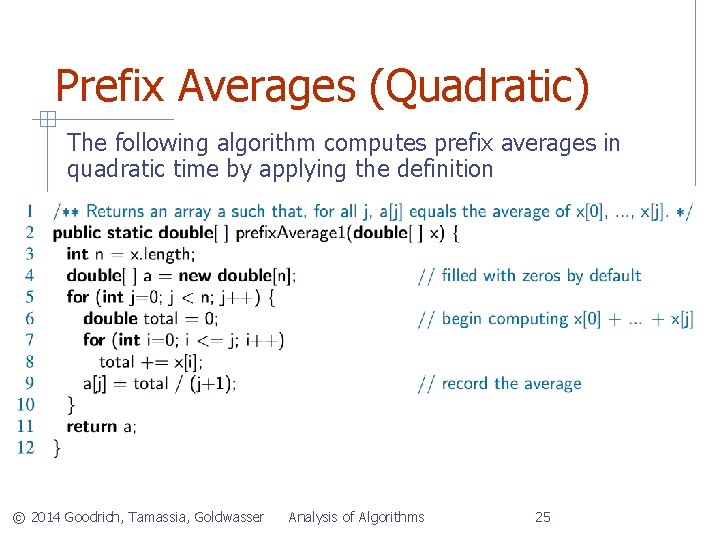
Prefix Averages (Quadratic) The following algorithm computes prefix averages in quadratic time by applying the definition © 2014 Goodrich, Tamassia, Goldwasser Analysis of Algorithms 25
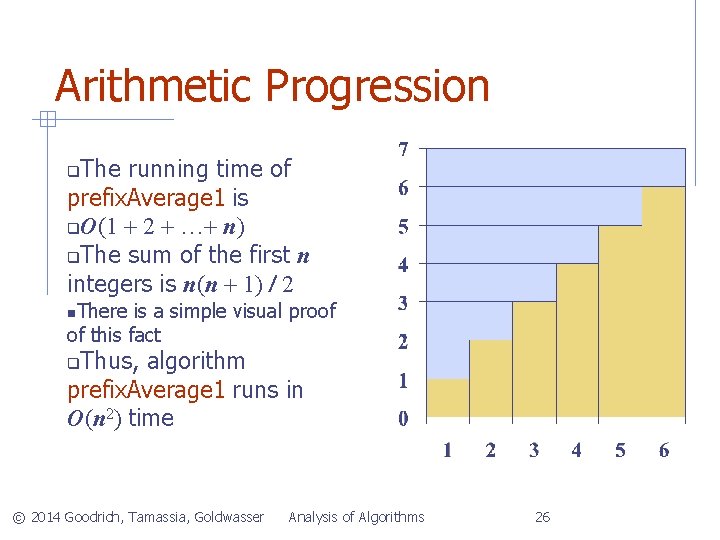
Arithmetic Progression The running time of prefix. Average 1 is O(1 + 2 + …+ n) The sum of the first n integers is n(n + 1) / 2 There is a simple visual proof of this fact Thus, algorithm prefix. Average 1 runs in O(n 2) time © 2014 Goodrich, Tamassia, Goldwasser Analysis of Algorithms 26
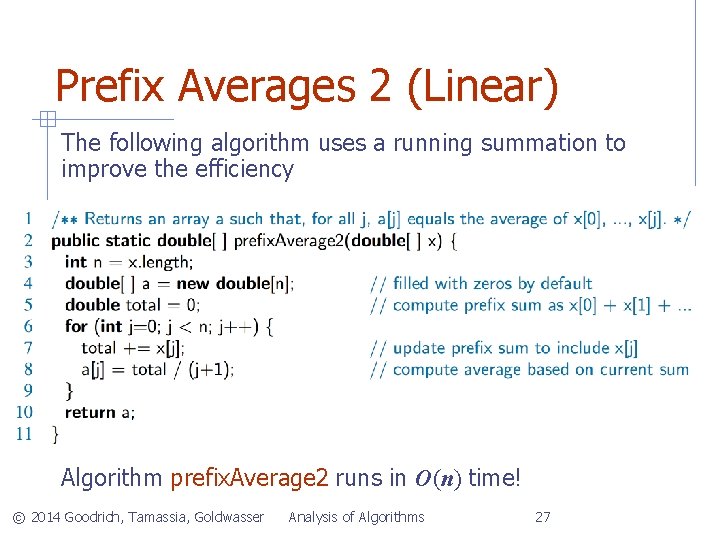
Prefix Averages 2 (Linear) The following algorithm uses a running summation to improve the efficiency Algorithm prefix. Average 2 runs in O(n) time! © 2014 Goodrich, Tamassia, Goldwasser Analysis of Algorithms 27
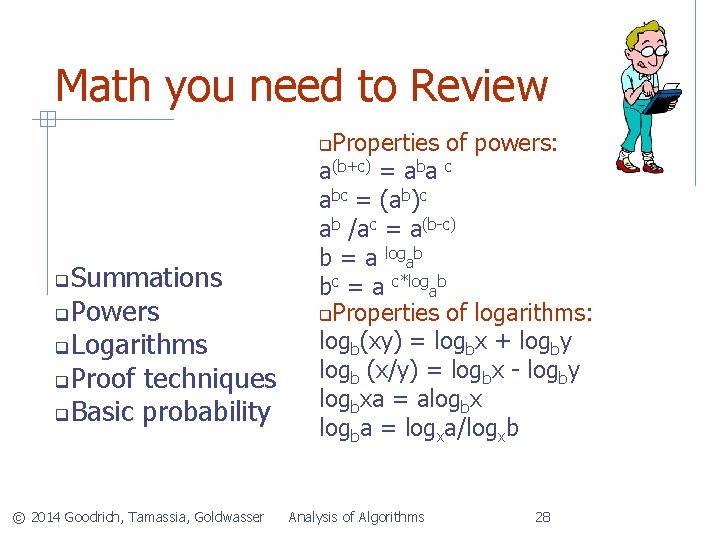
Math you need to Review Properties of powers: a(b+c) = aba c abc = (ab)c ab /ac = a(b-c) b = a logab bc = a c*logab Properties of logarithms: logb(xy) = logbx + logby logb (x/y) = logbx - logby logbxa = alogbx logba = logxa/logxb Summations Powers Logarithms Proof techniques Basic probability © 2014 Goodrich, Tamassia, Goldwasser Analysis of Algorithms 28
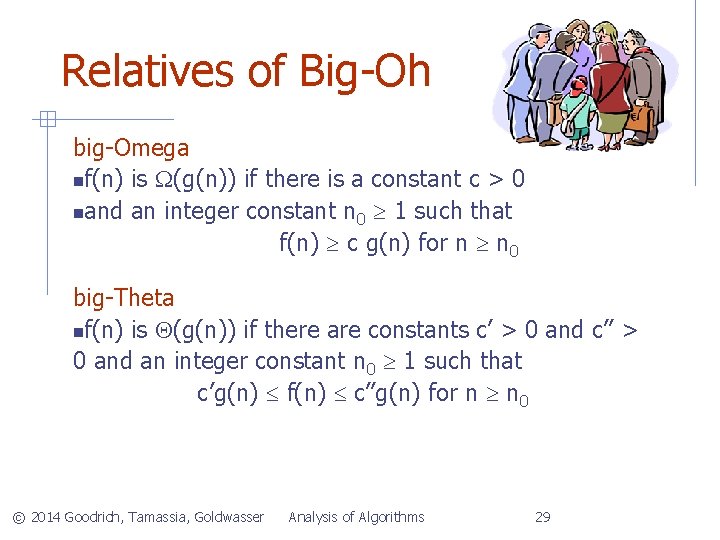
Relatives of Big-Oh big-Omega f(n) is (g(n)) if there is a constant c > 0 and an integer constant n 0 1 such that f(n) c g(n) for n n 0 big-Theta f(n) is (g(n)) if there are constants c’ > 0 and c’’ > 0 and an integer constant n 0 1 such that c’g(n) f(n) c’’g(n) for n n 0 © 2014 Goodrich, Tamassia, Goldwasser Analysis of Algorithms 29
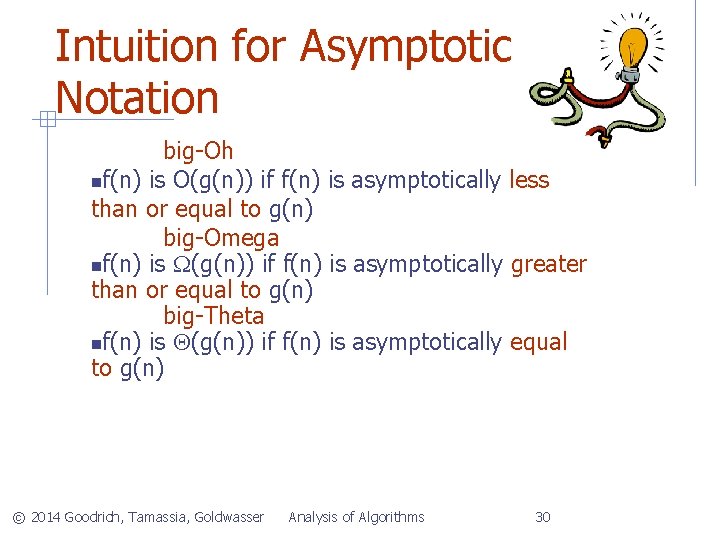
Intuition for Asymptotic Notation big-Oh f(n) is O(g(n)) if f(n) is asymptotically less than or equal to g(n) big-Omega f(n) is (g(n)) if f(n) is asymptotically greater than or equal to g(n) big-Theta f(n) is (g(n)) if f(n) is asymptotically equal to g(n) © 2014 Goodrich, Tamassia, Goldwasser Analysis of Algorithms 30
Example Uses of the Relatives of Big-Oh 5 n 2 is (n 2) f(n) is (g(n)) if there is a constant c > 0 and an integer constant n 0 1 such that f(n) c g(n) for n n 0 let c = 5 and n 0 = 1 5 n 2 is (n) f(n) is (g(n)) if there is a constant c > 0 and an integer constant n 0 1 such that f(n) c g(n) for n n 0 let c = 1 and n 0 = 1 is (n 2) f(n) is (g(n)) if it is (n 2) and O(n 2). We have already seen the former, for the latter recall that f(n) is O(g(n)) if there is a constant c > 0 and an integer constant n 0 1 such that f(n) < c g(n) for n n 0 Let c = 5 and n 0 = 1 5 n 2 © 2014 Goodrich, Tamassia, Goldwasser Analysis of Algorithms 31
- Slides: 31