
Presentation for CE 100 Brasil member use TODAYS
Presentation for CE 100 Brasil member use
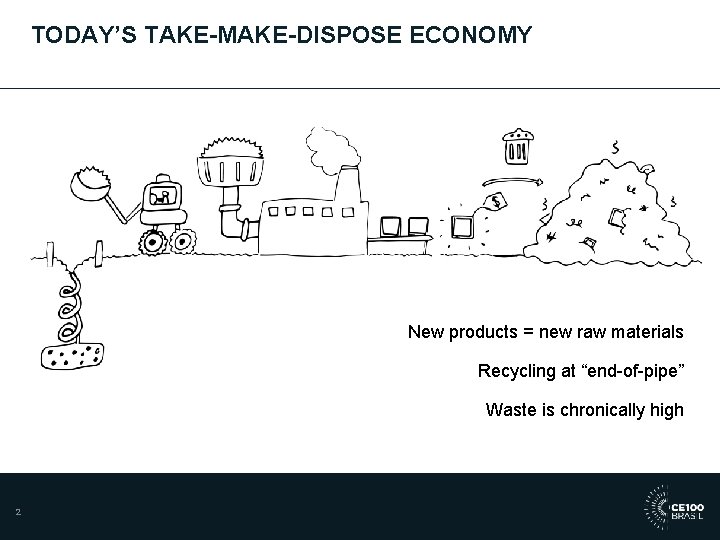
TODAY’S TAKE-MAKE-DISPOSE ECONOMY New products = new raw materials Recycling at “end-of-pipe” Waste is chronically high 2
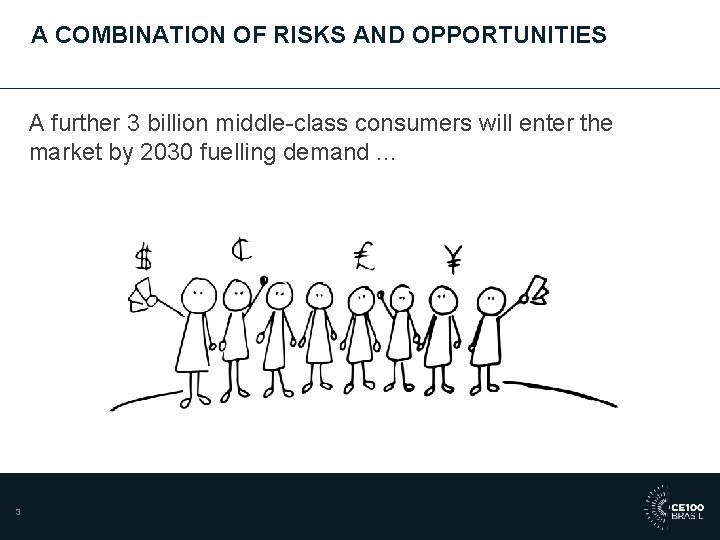
A COMBINATION OF RISKS AND OPPORTUNITIES A further 3 billion middle-class consumers will enter the market by 2030 fuelling demand. . . 3
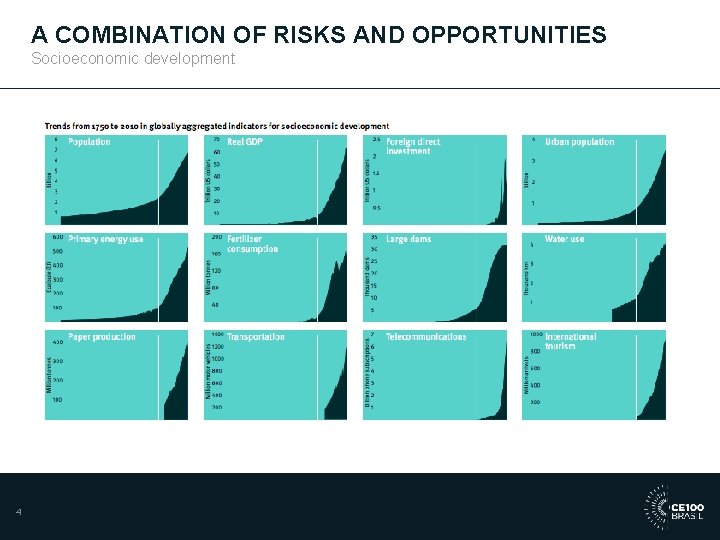
A COMBINATION OF RISKS AND OPPORTUNITIES Socioeconomic development 4
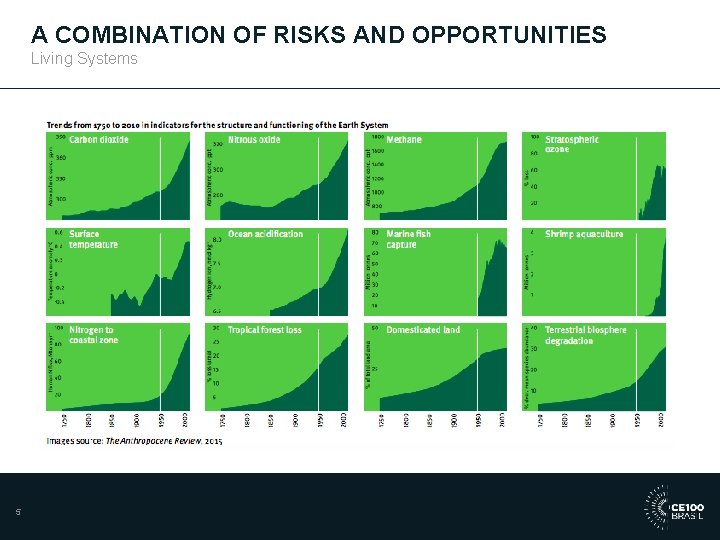
A COMBINATION OF RISKS AND OPPORTUNITIES Living Systems 5
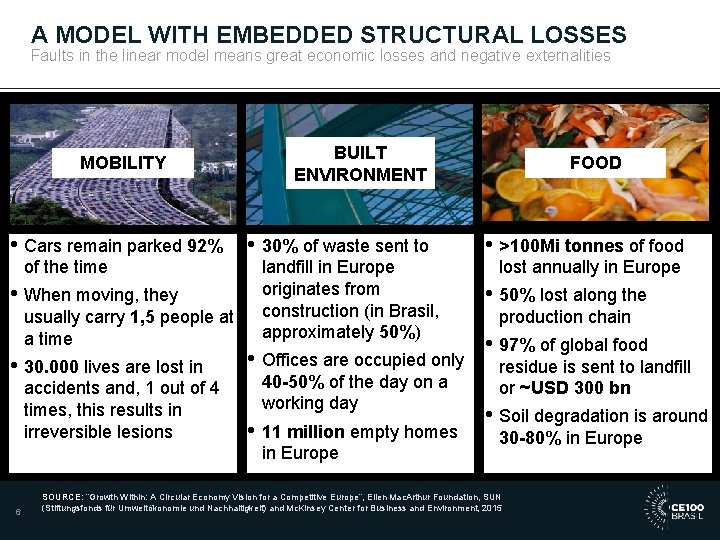
A MODEL WITH EMBEDDED STRUCTURAL LOSSES Faults in the linear model means great economic losses and negative externalities MOBILITY • Cars remain parked 92% of the time • When moving, they usually carry 1, 5 people at a time • 30. 000 lives are lost in accidents and, 1 out of 4 times, this results in irreversible lesions BUILT ENVIRONMENT • 30% of waste sent to landfill in Europe originates from construction (in Brasil, approximately 50%) • Offices are occupied only 40 -50% of the day on a working day • 11 million empty homes in Europe 6 FOOD • >100 Mi tonnes of food lost annually in Europe • 50% lost along the production chain • 97% of global food residue is sent to landfill or ~USD 300 bn • Soil degradation is around 30 -80% in Europe SOURCE: “Growth Within: A Circular Economy Vision for a Competitive Europe”, Ellen Mac. Arthur Foundation, SUN (Stiftungsfonds für Umweltökonomie und Nachhaltigkeit) and Mc. Kinsey Center for Business and Environment, 2015
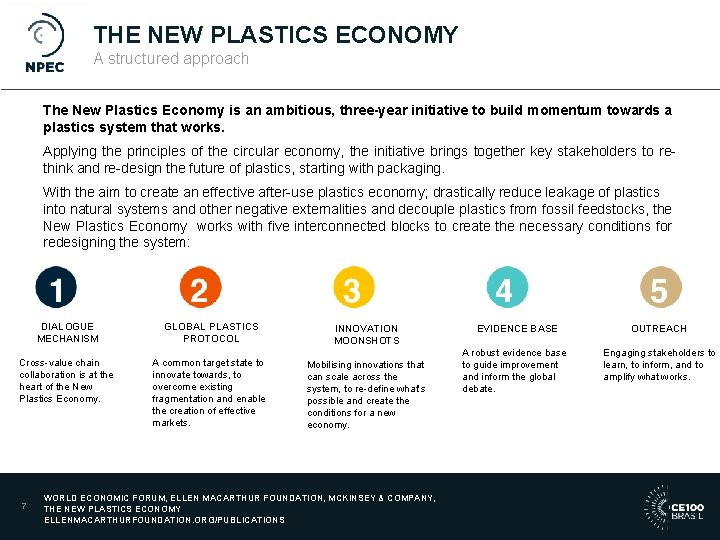
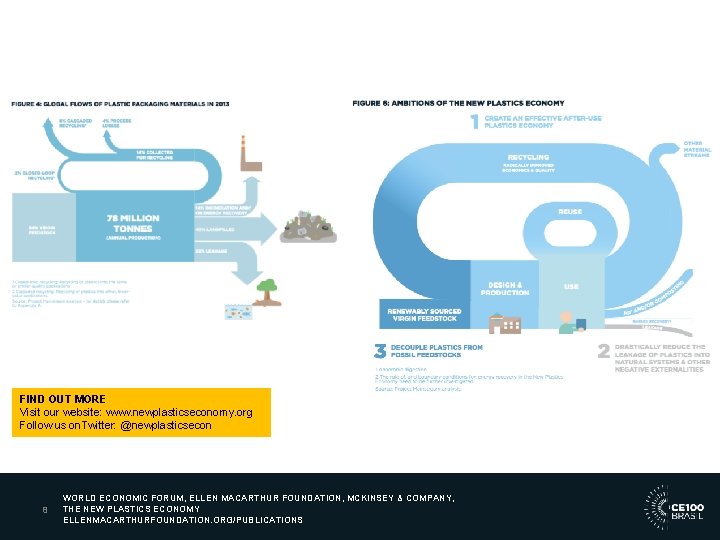
THE NEW PLASTICS ECONOMY A structured approach The New Plastics Economy is an ambitious, three-year initiative to build momentum towards a plastics system that works. Applying the principles of the circular economy, the initiative brings together key stakeholders to rethink and re-design the future of plastics, starting with packaging. With the aim to create an effective after-use plastics economy; drastically reduce leakage of plastics into natural systems and other negative externalities and decouple plastics from fossil feedstocks, the New Plastics Economy works with five interconnected blocks to create the necessary conditions for redesigning the system: DIALOGUE MECHANISM GLOBAL PLASTICS PROTOCOL Cross-value chain collaboration is at the heart of the New Plastics Economy. A common target state to innovate towards, to overcome existing fragmentation and enable the creation of effective markets. 7 INNOVATION MOONSHOTS Mobilising innovations that can scale across the system, to re-define what’s possible and create the conditions for a new economy. WORLD ECONOMIC FORUM, ELLEN MACARTHUR FOUNDATION, MCKINSEY & COMPANY, THE NEW PLASTICS ECONOMY ELLENMACARTHURFOUNDATION. ORG/PUBLICATIONS EVIDENCE BASE OUTREACH A robust evidence base to guide improvement and inform the global debate. Engaging stakeholders to learn, to inform, and to amplify what works.
FIND OUT MORE Visit our website: www. newplasticseconomy. org Follow us on. Twitter: @newplasticsecon 8 WORLD ECONOMIC FORUM, ELLEN MACARTHUR FOUNDATION, MCKINSEY & COMPANY, THE NEW PLASTICS ECONOMY ELLENMACARTHURFOUNDATION. ORG/PUBLICATIONS
DRIVERS FOR CHANGE Various factors challenge the linear model ECONOMIC AND STRUCTURAL LOSSES 9 PRICE VOLATILITY DEMOGRAPHIC TRENDS
DRIVERS FOR CHANGE Various factors challenge the linear model URBANISATION 10 ACCEPTANCE OF NEW BUSINESS MODELS TECHNOLOGICAL ADVANCES
CIRCULAR ECONOMY: REGENERATIVE AND RESTORATIVE BY DESIGN 9
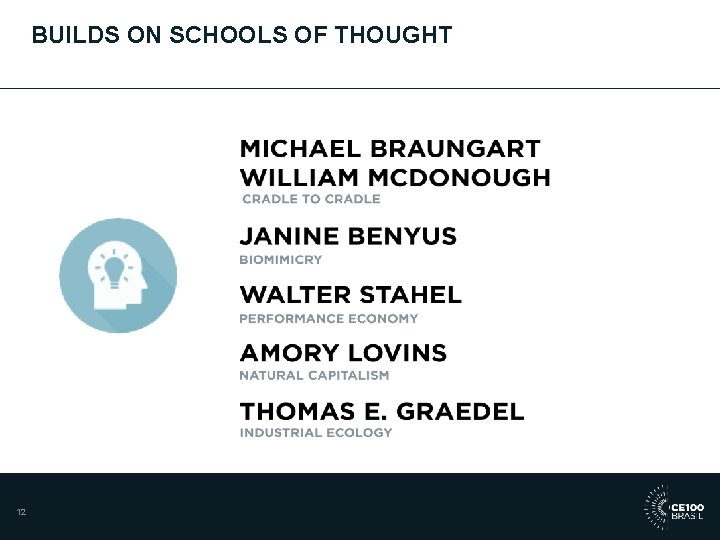
BUILDS ON SCHOOLS OF THOUGHT 12
A REGENERATIVE ECONOMY …keeping products, components and materials at their highest utility and value, at all times …eliminating the concept of waste, with materials ultimately re-entering the economy at end of use as defined, valuable technical or biological nutrients
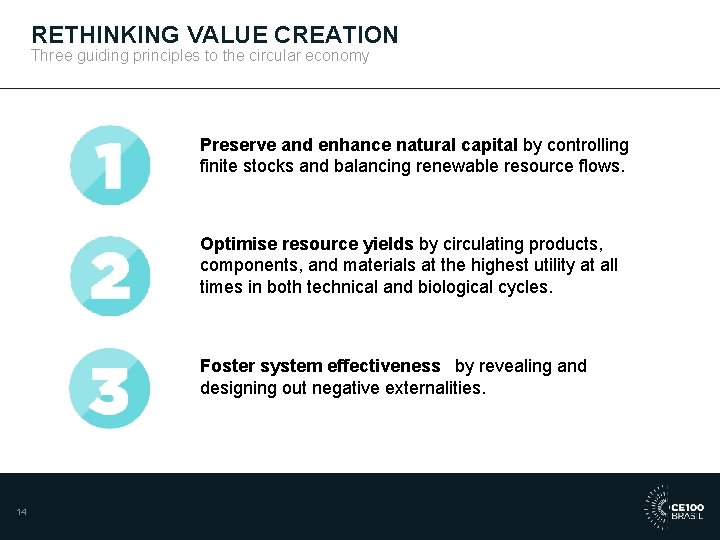
RETHINKING VALUE CREATION Three guiding principles to the circular economy Preserve and enhance natural capital by controlling finite stocks and balancing renewable resource flows. Optimise resource yields by circulating products, components, and materials at the highest utility at all times in both technical and biological cycles. Foster system effectiveness by revealing and designing out negative externalities. 14
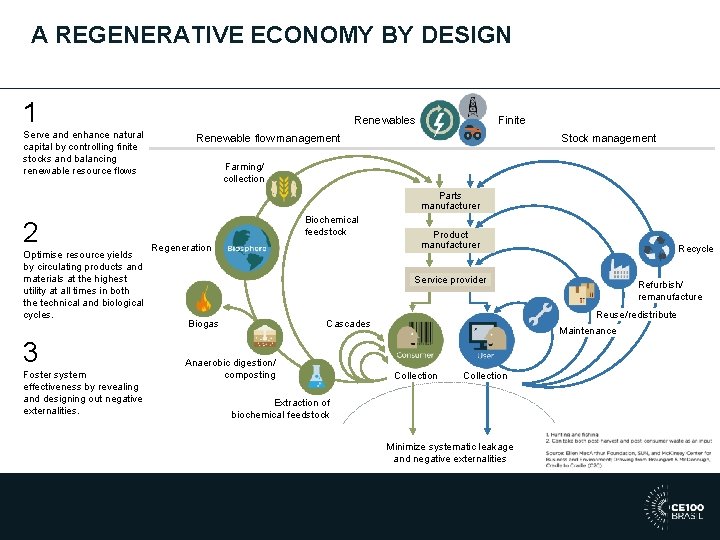
A REGENERATIVE ECONOMY BY DESIGN 1 Serve and enhance natural capital by controlling finite stocks and balancing renewable resource flows Renewables Finite Renewable flow management Stock management Farming/ collection Parts manufacturer 2 Optimise resource yields by circulating products and materials at the highest utility at all times in both the technical and biological cycles. 3 Foster system effectiveness by revealing and designing out negative externalities. Biochemical feedstock Regeneration Product manufacturer Recycle Service provider Reuse/redistribute Cascades Biogas Anaerobic digestion/ composting Refurbish/ remanufacture Maintenance Collection Extraction of biochemical feedstock Minimize systematic leakage and negative externalities
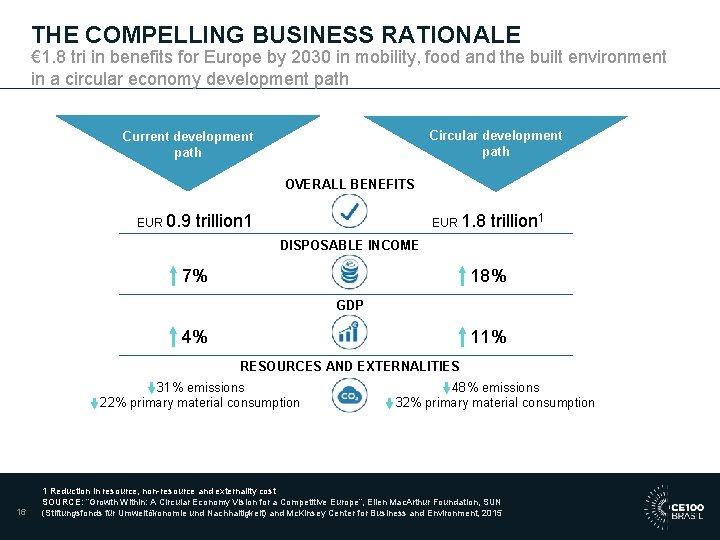
THE COMPELLING BUSINESS RATIONALE € 1. 8 tri in benefits for Europe by 2030 in mobility, food and the built environment in a circular economy development path Trajetória de desenvolvimento Current development atual path Circular development path OVERALL BENEFITS EUR 0. 9 trillion 1 EUR 1. 8 trillion 1 DISPOSABLE INCOME 7% 18% GDP 4% 11% RESOURCES AND EXTERNALITIES 31% emissions 22% primary material consumption 16 48% emissions 32% primary material consumption 1 Reduction in resource, non-resource and externality cost SOURCE: “Growth Within: A Circular Economy Vision for a Competitive Europe”, Ellen Mac. Arthur Foundation, SUN (Stiftungsfonds für Umweltökonomie und Nachhaltigkeit) and Mc. Kinsey Center for Business and Environment, 2015
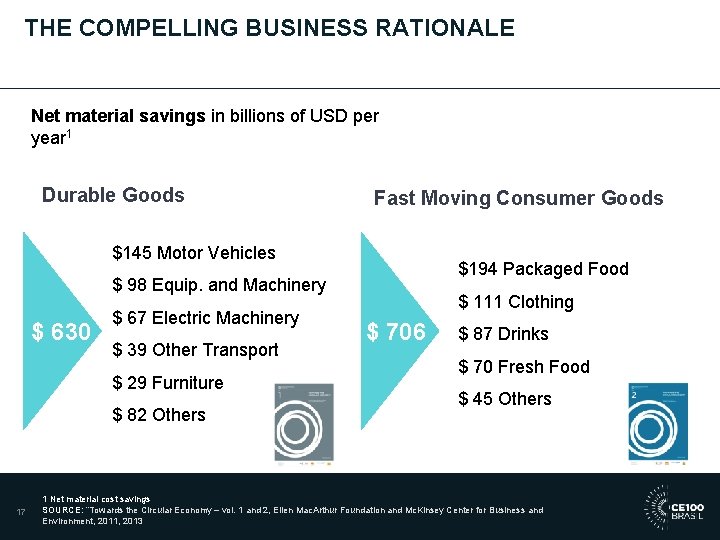
THE COMPELLING BUSINESS RATIONALE Net material savings in billions of USD per year 1 Durable Goods Fast Moving Consumer Goods $145 Motor Vehicles $194 Packaged Food $ 98 Equip. and Machinery $ 630 $ 67 Electric Machinery $ 39 Other Transport $ 29 Furniture $ 82 Others 17 $ 111 Clothing $ 706 $ 87 Drinks $ 70 Fresh Food $ 45 Others 1 Net material cost savings SOURCE: “Towards the Circular Economy – vol. 1 and 2, Ellen Mac. Arthur Foundation and Mc. Kinsey Center for Business and Environment, 2011, 2013
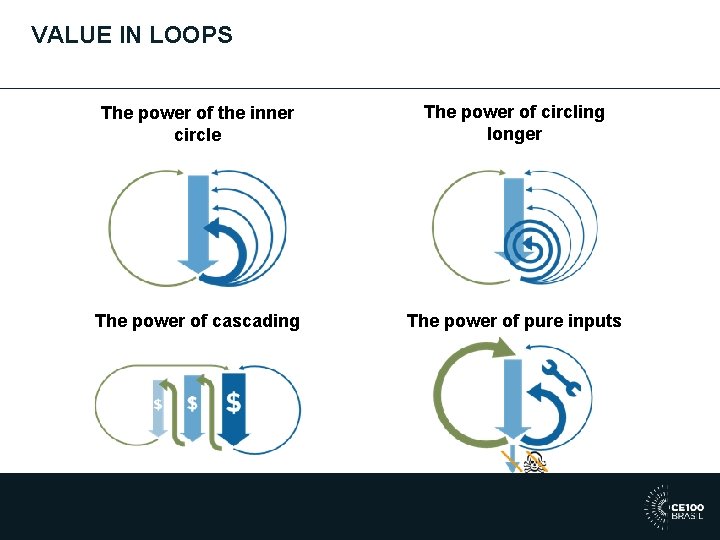
VALUE IN LOOPS The power of the inner circle The power of circling longer The power of cascading The power of pure inputs
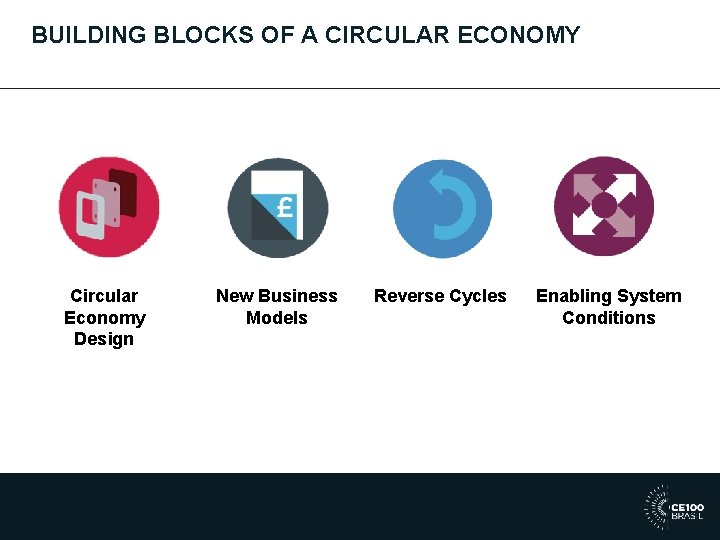
BUILDING BLOCKS OF A CIRCULAR ECONOMY Circular Economy Design New Business Models Reverse Cycles Enabling System Conditions
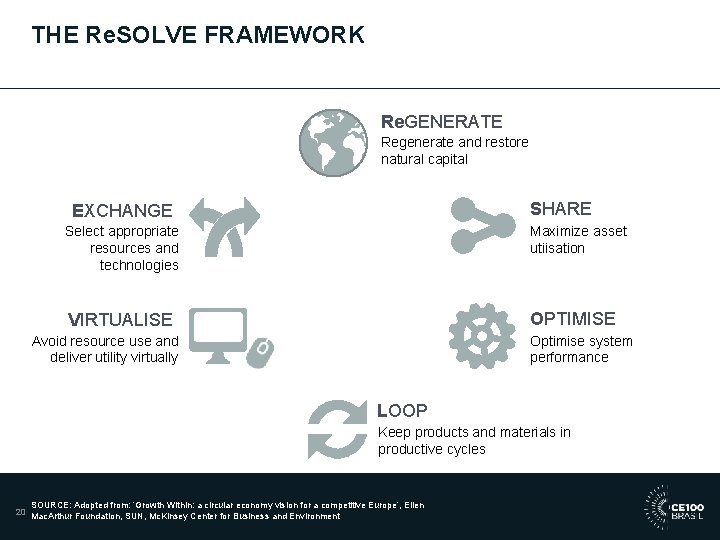
THE Re. SOLVE FRAMEWORK Re. GENERATE Regenerate and restore natural capital SHARE EXCHANGE Select appropriate resources and technologies Maximize asset utiisation VIRTUALISE OPTIMISE Avoid resource use and deliver utility virtually Optimise system performance LOOP Keep products and materials in productive cycles SOURCE: Adopted from: ‘Growth Within: a circular economy vision for a competitive Europe’, Ellen 20 Mac. Arthur Foundation, SUN, Mc. Kinsey Center for Business and Environment
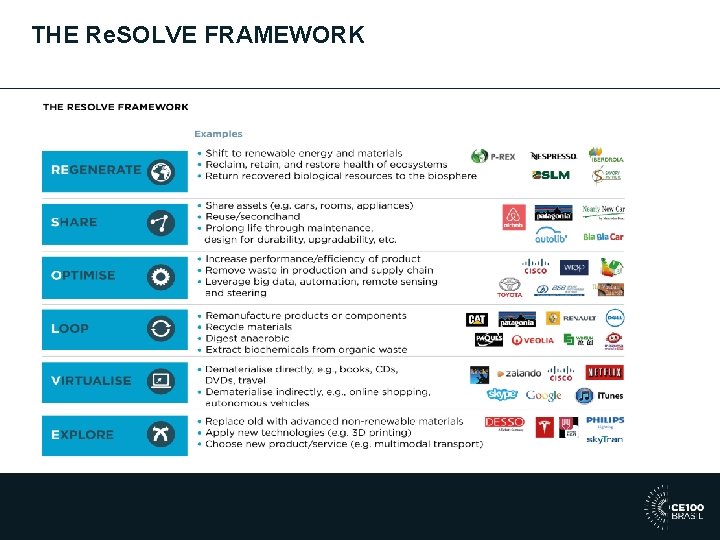
THE Re. SOLVE FRAMEWORK
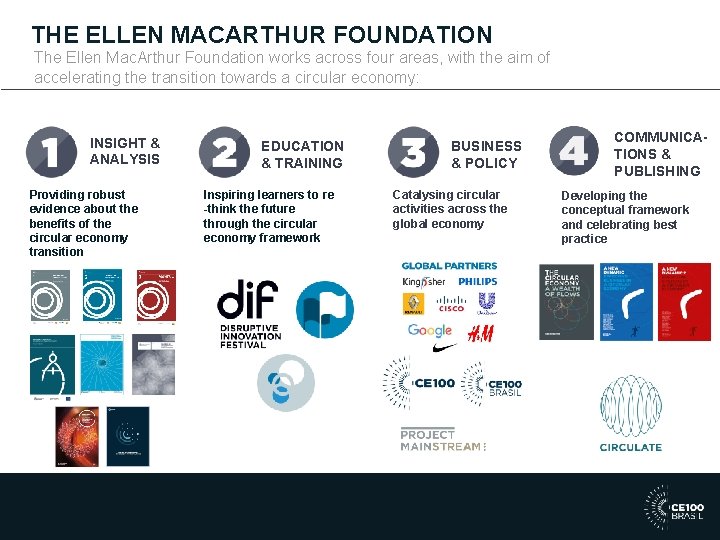
THE ELLEN MACARTHUR FOUNDATION The Ellen Mac. Arthur Foundation works across four areas, with the aim of accelerating the transition towards a circular economy: INSIGHT & ANALYSIS Providing robust evidence about the benefits of the circular economy transition EDUCATION & TRAINING Inspiring learners to re -think the future through the circular economy framework BUSINESS & POLICY Catalysing circular activities across the global economy COMMUNICATIONS & PUBLISHING Developing the conceptual framework and celebrating best practice
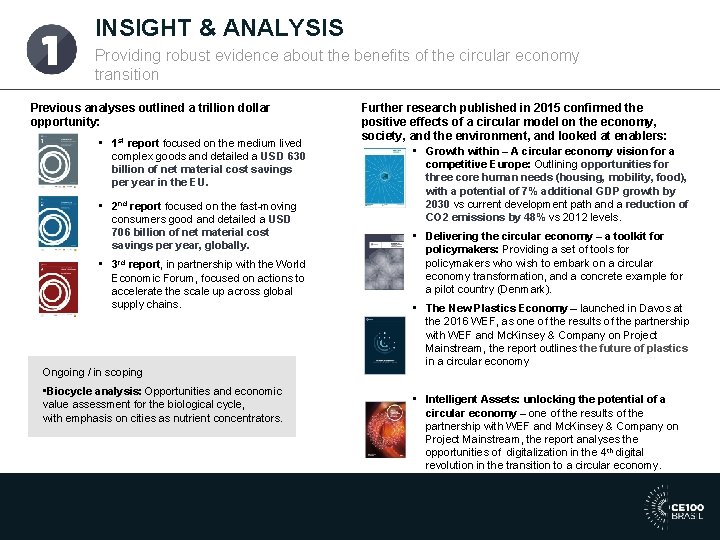
INSIGHT & ANALYSIS Providing robust evidence about the benefits of the circular economy transition Previous analyses outlined a trillion dollar opportunity: • 1 st report focused on the medium lived complex goods and detailed a USD 630 billion of net material cost savings per year in the EU. • 2 nd report focused on the fast-moving consumers good and detailed a USD 706 billion of net material cost savings per year, globally. • 3 rd report, in partnership with the World Economic Forum, focused on actions to accelerate the scale up across global supply chains. Ongoing / in scoping • Biocycle analysis: Opportunities and economic value assessment for the biological cycle, with emphasis on cities as nutrient concentrators. Further research published in 2015 confirmed the positive effects of a circular model on the economy, society, and the environment, and looked at enablers: • Growth within – A circular economy vision for a competitive Europe: Outlining opportunities for three core human needs (housing, mobility, food), with a potential of 7% additional GDP growth by 2030 vs current development path and a reduction of CO 2 emissions by 48% vs 2012 levels. • Delivering the circular economy – a toolkit for policymakers: Providing a set of tools for policymakers who wish to embark on a circular economy transformation, and a concrete example for a pilot country (Denmark). • The New Plastics Economy – launched in Davos at the 2016 WEF, as one of the results of the partnership with WEF and Mc. Kinsey & Company on Project Mainstream, the report outlines the future of plastics in a circular economy • Intelligent Assets: unlocking the potential of a circular economy – one of the results of the partnership with WEF and Mc. Kinsey & Company on Project Mainstream, the report analyses the opportunities of digitalization in the 4 th digital revolution in the transition to a circular economy.
EDUCATION & TRAINING Inspiring a generation to re-think the future Pioneer Universities Pioneering new approaches to teaching, learning & research programme around CE Schmidt Mac. Arthur Fellowship Programme Building a global partner university ‘network of excellence’ in the top design engineering and business schools Disruptive Innovation Festival Exploiting informal education as a global ideas dissemination model in an online month long festival /MOOC
BUSINESS & POLICY Catalysing circular activities across the global economy Global Partners Close collaboration of the Foundation with its Global Partners Google, Cisco, Kingfisher, Philips, Renault, Intesa Sanpaolo, H&M, Unilever and Nike. Goal: Demonstrate circular solutions at scale. CE 100 (international and local networks) Global innovation platform bringing together leading corporations, emerging innovators, governments & cities, SMEs, and academic institutions, working both internationally (CE 100) and regionally (CE 100 Brasil and CE 100 USA). Goal: Build capacity, share knowledge and best practices, and develop cross-company, cross-sector, pre-competitive collaboration initiatives. Project Main. Stream A World Economic Forum hosted, multi-industry initiative in collaboration with the Ellen Mac. Arthur Foundation and supported by Mc. Kinsey & Co. Goal: Unlock the stalemates that individual organisations cannot resolve.
COMMUNICATIONS & PUBLISHING Developing the conceptual framework and celebrating best practice Publications A series of publications written by the Foundation’s Head of Innovation, Ken Webster that explore and develop the conceptual framework of the circular economy. These books propose that the time is right to move towards a circular economy and provide a stimulating overview of this emerging framework for economic prosperity reinvented. Circulate A new online location for editorial, news and insight on the circular economy and related subjects. Circulate is the go-to location for circular economy related news and insight. Publishing fortnightly featured articles, regular updates from a team of international correspondents, daily news pieces and recommended reading from other writers and publications.
Global Partners of the Ellen Mac. Arthur Foundation:
- Slides: 27