
Presentation Empowering you why equal access to education
- Slides: 21
Presentation Empowering you: why equal access to education matters to persons with disabilities? March 25, 2020 By Zephania Matanga, Ph. D.
Education can be a powerful equalizer, integrator, and transformer. It can actually transform and improve the quality of lives of the people with disabilities and those with literacy challenges. It can help integrate them fully into society and make them equal and empowered members of Society.
Even though, there has been major initiatives undertaken in the education field and advanced policies enacted and implemented, access to education is still a daunting task for persons with disabilities and CRPD is an excellent welcome instrument which persons with disabilities can utilize in their struggle to access education. In this presentation we will identify barriers to education in al forms and propose remedies
Presentation Outline Introduction. n Past and current initiatives in special education. n Identified major gaps in impeding students with disabilities to access quality learning. n Future initiatives. n Conclusion. n
Conceptualization of Disability The medical model The psychological model The rehabilitation model The special education model The charity model
Conceptualization of Disability (cont’) The scientific study of persons with a disability has roots in anatomy, neurology, and germ theory in medicine. The disabled have been deemed uneducable, sent to segregated institutions, subjected to sterilization, and denied access to public schools. In Canada, free compulsory education was first provided for blind and deaf in the 1880 s.
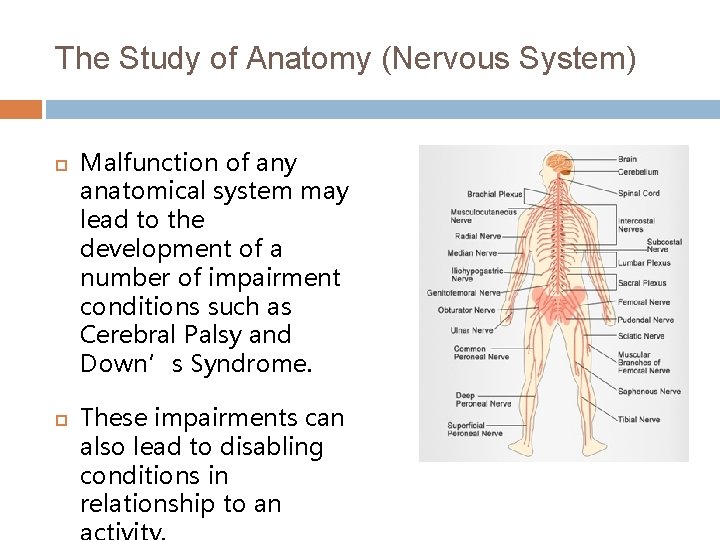
The Study of Anatomy (Nervous System) Malfunction of any anatomical system may lead to the development of a number of impairment conditions such as Cerebral Palsy and Down’s Syndrome. These impairments can also lead to disabling conditions in relationship to an
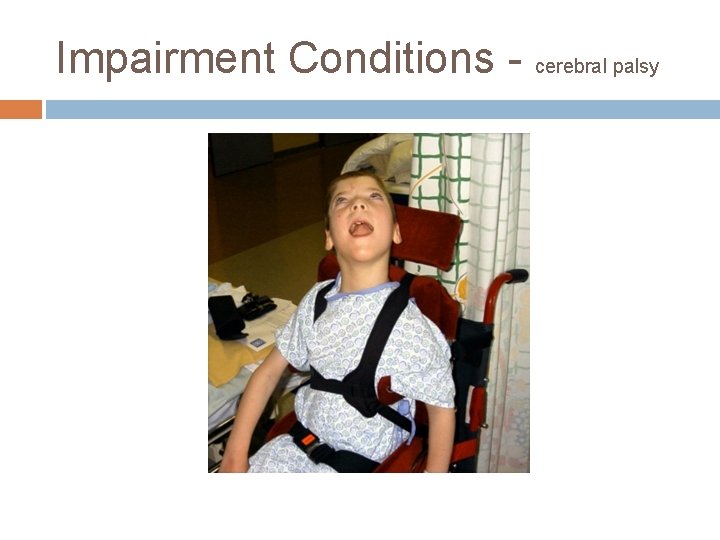
Impairment Conditions - cerebral palsy
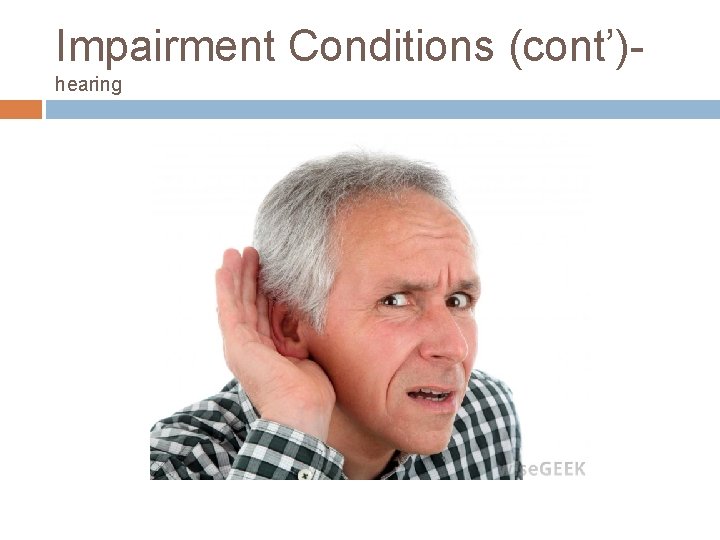
Impairment Conditions (cont’)hearing
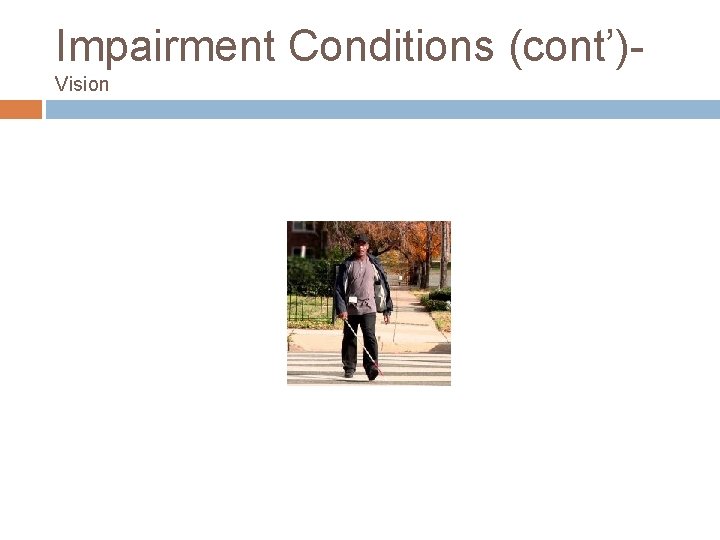
Impairment Conditions (cont’)Vision
What is Exclusion? Exclusion is a manifestation of a complex phenomenon, created in part by features of the physical and social world. There are three components defining functioning and disability: Environment Body Functions and Structures Activities and Participation.
Challenges of Inclusion Teachers are supportive of inclusion in the abstract but argue that they find it unrealistic in their daily dealings with the disabled (Smith and Smith. 2000). Teachers identified inclusion as a challenge because of lack of adequate professional development, material, and human resources (Sadhu. 2002). Teachers perceive that accommodating students with a disability when taking a test
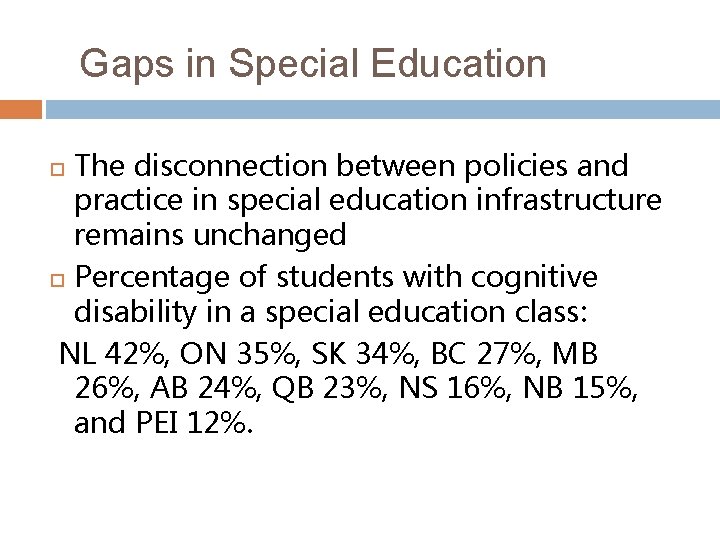
Gaps in Special Education The disconnection between policies and practice in special education infrastructure remains unchanged Percentage of students with cognitive disability in a special education class: NL 42%, ON 35%, SK 34%, BC 27%, MB 26%, AB 24%, QB 23%, NS 16%, NB 15%, and PEI 12%.
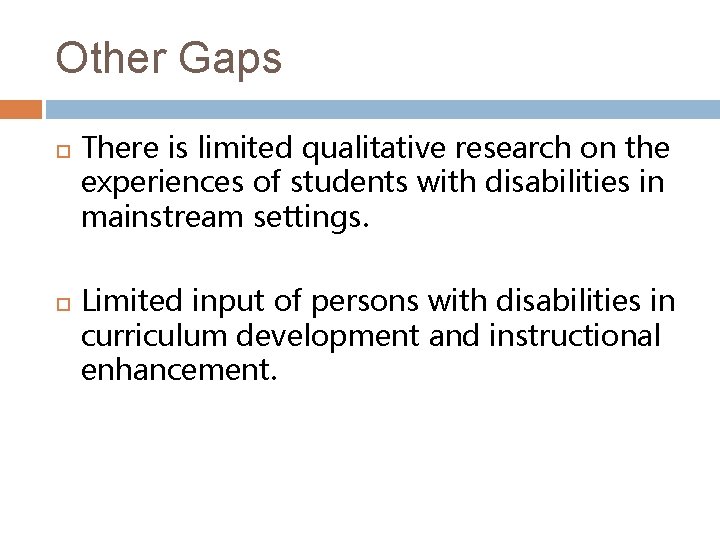
Other Gaps There is limited qualitative research on the experiences of students with disabilities in mainstream settings. Limited input of persons with disabilities in curriculum development and instructional enhancement.
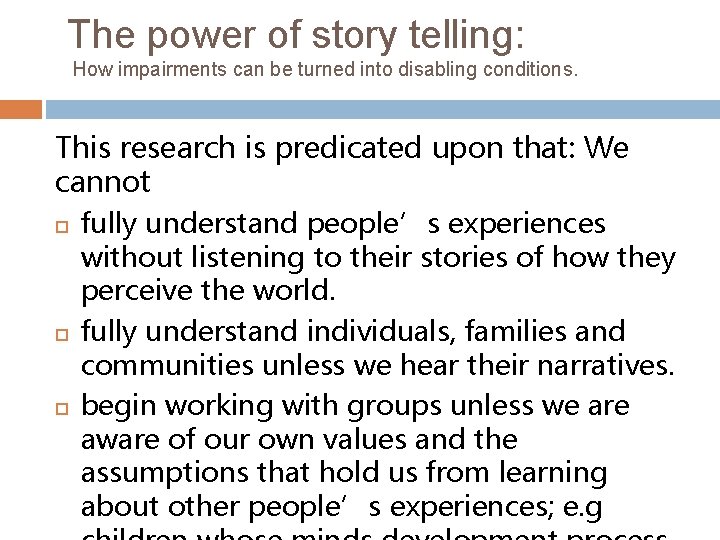
The power of story telling: How impairments can be turned into disabling conditions. This research is predicated upon that: We cannot fully understand people’s experiences without listening to their stories of how they perceive the world. fully understand individuals, families and communities unless we hear their narratives. begin working with groups unless we are aware of our own values and the assumptions that hold us from learning about other people’s experiences; e. g
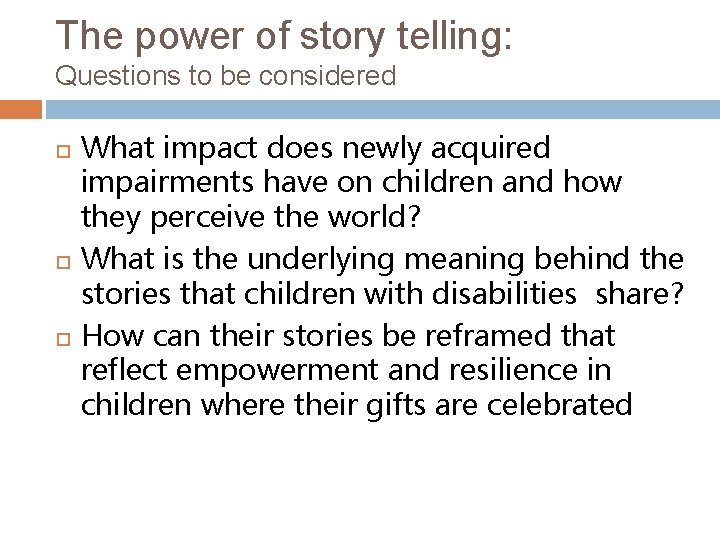
The power of story telling: Questions to be considered What impact does newly acquired impairments have on children and how they perceive the world? What is the underlying meaning behind the stories that children with disabilities share? How can their stories be reframed that reflect empowerment and resilience in children where their gifts are celebrated
Towards understanding Nested process of Inclusion: Family, Neighborhood, Ethnic Community The inquiry will investigate as to whether people with disabilities are multi-faceted individuals whose life circumstances are made up of a variety of experiences It is equally important to try and understand people with disabilities in light of all of the forces that impact on their lives Looking only at disability limits a person's identity and does little to help us understand how a person's ethnicity,
Overcoming exclusion: I. The overarching goal of the research is to assist the immigrant and refugee youth experiencing pre-migration traumas and post-migration settlement challenges. The objectives of this research are motivated to: Enhancing the strengths and resources to improve the capacity of the immigrant and refugee youth to develop coping strategies and skills to work through the difficulties that arise and to realize their
Overcoming exclusion (cont’) I. Assist immigrant and refugee youth who are struggling against the odds, unfulfilled potential to retell their stories leading to self-transformation and get empowered to seek and access needed support, adopt active engagement behavior in preventive care consequently realize more productive lives. For example, reunite them with their families, going back to school and accessing gainful employment.
Policy initiatives Manitoba Bill 13, The Amendment to the Public Schools Act introduced in November, 2003 and proclaimed on October 28, 2005. Section 15 of The Canadian Charter of Rights and Freedom. United Nations Convention on the Rights of Persons with Disabilities. . The purpose of the CRPD is to 'promote, protect and ensure the full and equal enjoyment of all human rights and fundamental freedoms by all persons with disabilities, and to promote respect for their inherent dignity'.
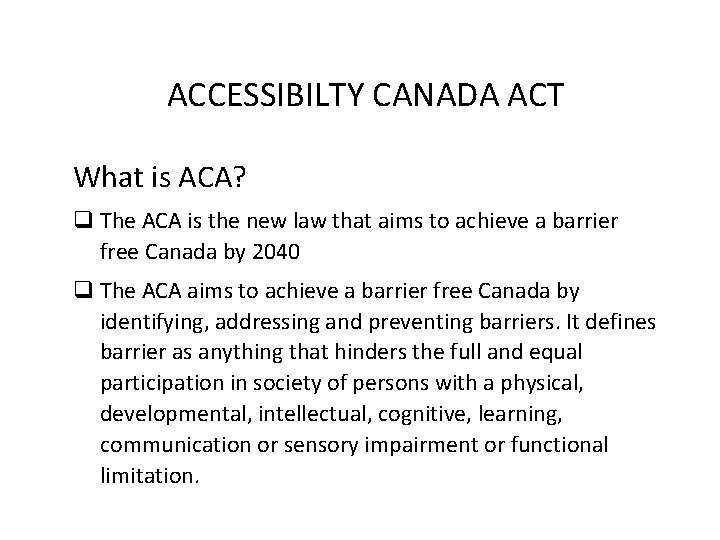
ACCESSIBILTY CANADA ACT hat is the ACA? What is ACA? • The ACA is a new law that aims to achieve a Canada 2040. q The ACA barrier is thefree new law by that aims to achieve a barrier • The ACA aims to achieve a barrier free Canada byby 2040 Canada identifying, addressing and barriers. It defines barrier as q The ACA preventing aims to achieve a barrier free Canada by anything that hinders the full and equal identifying, addressing andofpreventing participation in society persons with abarriers. It defines mental, intellectual, barrier asphysical, anything that hinderscognitive, the full and equal learning, communication or sensory impairment participation in society of persons with a physical, or functional limitation developmental, intellectual, cognitive, learning, communication or sensory impairment or functional limitation.