
Presentation DRC 101 Title Goes Here DRC 101

- Slides: 31
Presentation DRC 101 Title Goes Here DRC 101 Subtitle of Presentation
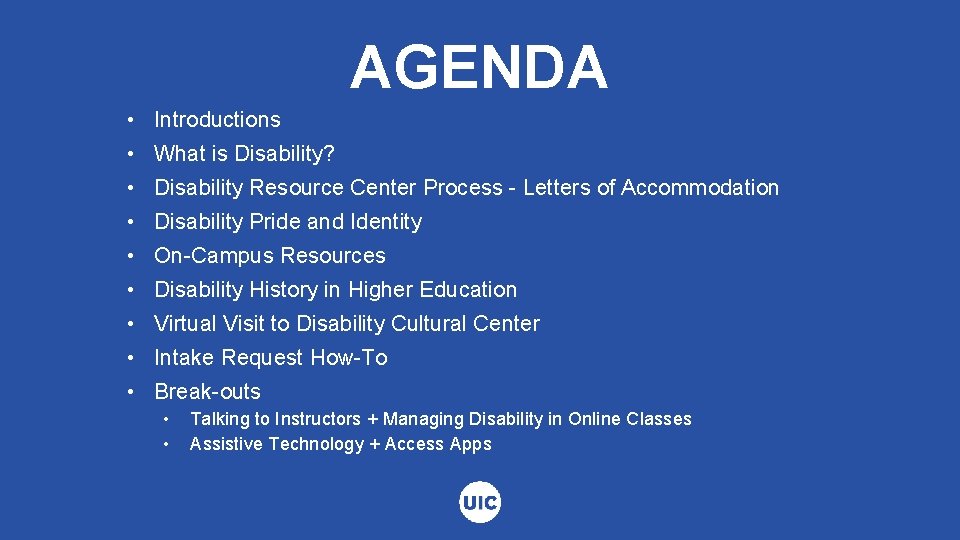
AGENDA • Introductions • What is Disability? • Disability Resource Center Process - Letters of Accommodation • Disability Pride and Identity • On-Campus Resources • Disability History in Higher Education • Virtual Visit to Disability Cultural Center • Intake Request How-To • Break-outs • • Talking to Instructors + Managing Disability in Online Classes Assistive Technology + Access Apps
INTRODUCTIONS
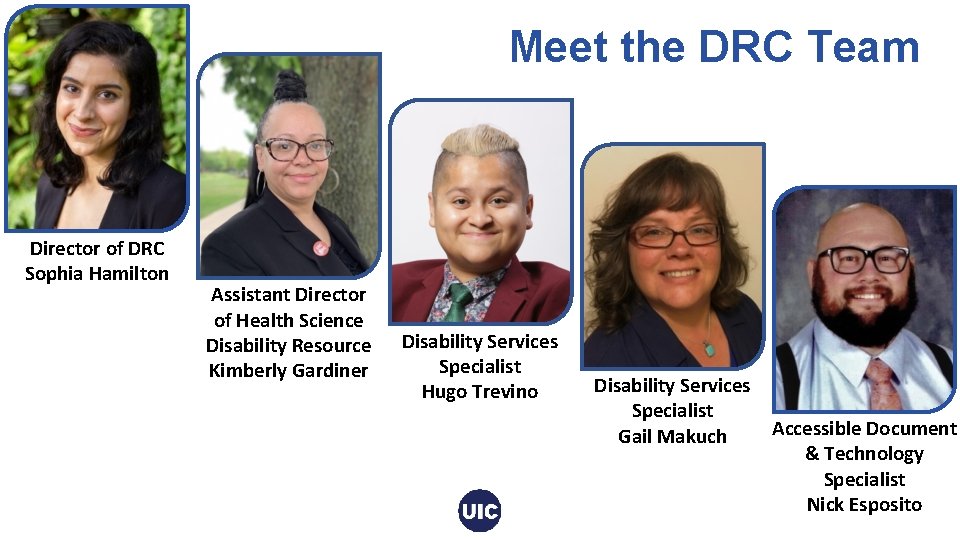
Meet the DRC Team Director of DRC Sophia Hamilton Assistant Director of Health Science Disability Resource Kimberly Gardiner Disability Services Specialist Hugo Trevino Disability Services Specialist Gail Makuch Accessible Document & Technology Specialist Nick Esposito
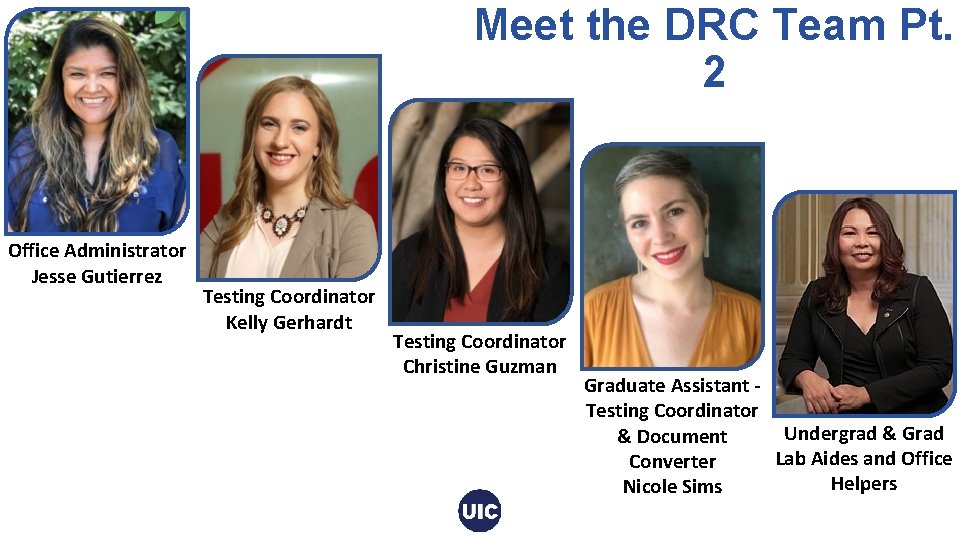
Meet the DRC Team Pt. 2 Office Administrator Jesse Gutierrez Testing Coordinator Kelly Gerhardt Testing Coordinator Christine Guzman Graduate Assistant Testing Coordinator Undergrad & Grad & Document Lab Aides and Office Converter Helpers Nicole Sims
WHAT IS DISABILITY?
GROUP DISCUSSION: What is disability? What does disability mean to you, and where did you get that information?
HOW DO WE DEFINE DISABILITY? Legally: a physical or mental impairment that substantially limits a major life function Medical Model: a diagnosis; a problem within a person that needs to be “fixed” Social model: environmental, attitudinal, and societal barriers cause disability Universal Design: building environments without barriers benefits everyone
DISABILITY RESOURCE CENTER PROCESS
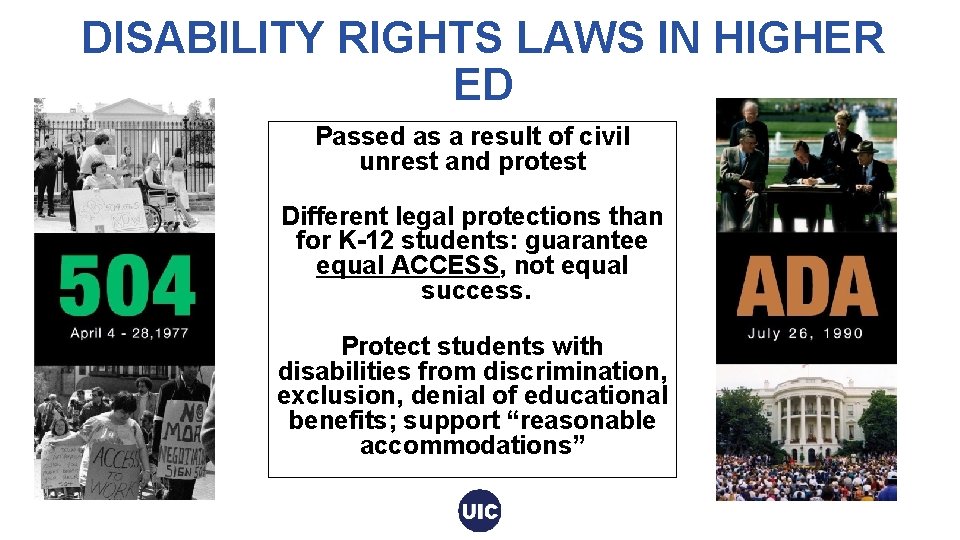
DISABILITY RIGHTS LAWS IN HIGHER ED Passed as a result of civil unrest and protest Different legal protections than for K-12 students: guarantee equal ACCESS, not equal success. Protect students with disabilities from discrimination, exclusion, denial of educational benefits; support “reasonable accommodations”
DIFFERENCES BETWEEN HIGH SCHOOL AND COLLEGE • IDEA: equal SUCCESS paradigm • School can change requirements for students with disabilities • School can assign special classes or teachers for students with disabilities • Less responsibility to selfadvocate – school and/or parents will take care of it • ADA/504: equal ACCESS paradigm • School cannot change standards or requirements as accommodation • About removing the barrier to access • Tutoring, office hours, TAs • More responsibility to selfadvocate: help is available, but you have to ask if you need it!
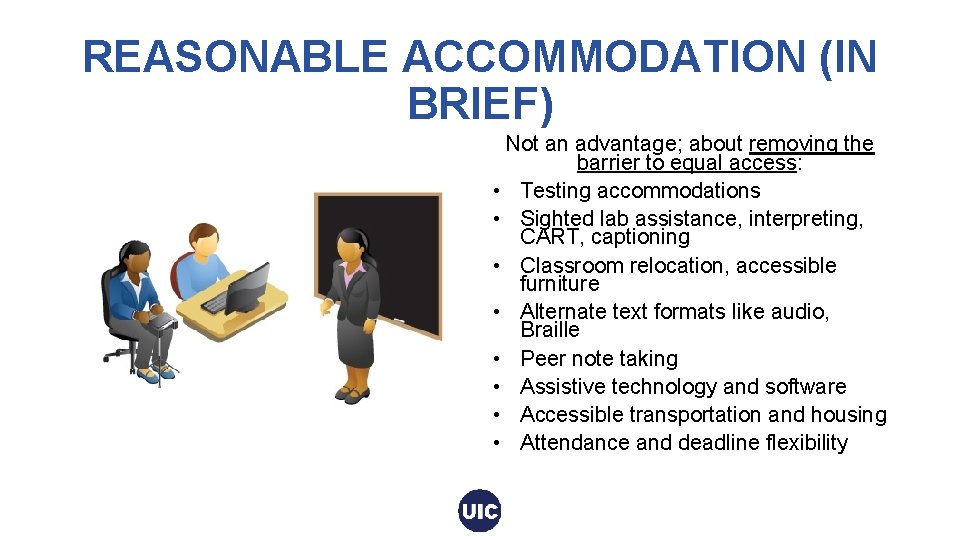
REASONABLE ACCOMMODATION (IN BRIEF) Not an advantage; about removing the barrier to equal access: • Testing accommodations • Sighted lab assistance, interpreting, CART, captioning • Classroom relocation, accessible furniture • Alternate text formats like audio, Braille • Peer note taking • Assistive technology and software • Accessible transportation and housing • Attendance and deadline flexibility
REASONABLE ACCOMMODATIONS • NOT of a personal nature (personal care attendant, mobility equipment, speech therapy, etc. ) • CANNOT pose a direct threat to student or others • CANNOT significantly alter curriculum (essential elements of course) • Ex) EMT Test
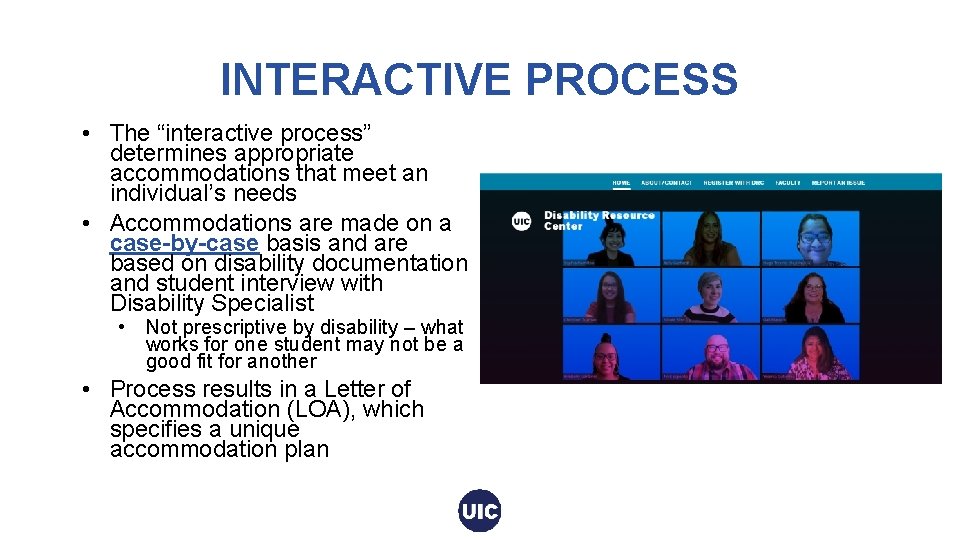
INTERACTIVE PROCESS • The “interactive process” determines appropriate accommodations that meet an individual’s needs • Accommodations are made on a case-by-case basis and are based on disability documentation and student interview with Disability Specialist • Not prescriptive by disability – what works for one student may not be a good fit for another • Process results in a Letter of Accommodation (LOA), which specifies a unique accommodation plan
LETTER OF ACCOMMODATION Share your Letter of Accommodation (LOA) with course instructor-- LOAs do not expire and instructors may receive them at any point during the semester. Accommodations are not retroactive – they are provided going forward from receipt of the LOA. The DRC is available if there any questions or issues with implementation for your particular course at drc@uic. edu and at (312) 413 -2183.
Implementing Accommodations • Engage in a private conversation about the your accommodations and unique needs in the class • Focus on accommodations: you do not have to disclose disability, instead say, • “I am a student with a disability and I am registered with the DRC. ” • Clearly express how you and the instructor will work together to implement the accommodations. • Your accommodations are your “Tool Kit” • Record expectations, arrangements, or agreements in writing or email. This is particularly important for assignment extensions. • We want you to be self advocates but we are here to advocate for you too. NOTE: Some accommodations may be implemented in different ways for different classes!
Online Learning: Accommodations Your accommodations still apply for online courses. Talk to professor: in person, email, or video chat. Online forms https: //tinyurl. com/DRCforms • Testing - Exams are now online, remind your professor to extend time. DRC can lend support. All online platforms support accommodations. • CART or ASL • Alternate format document conversion • Peer notetaker
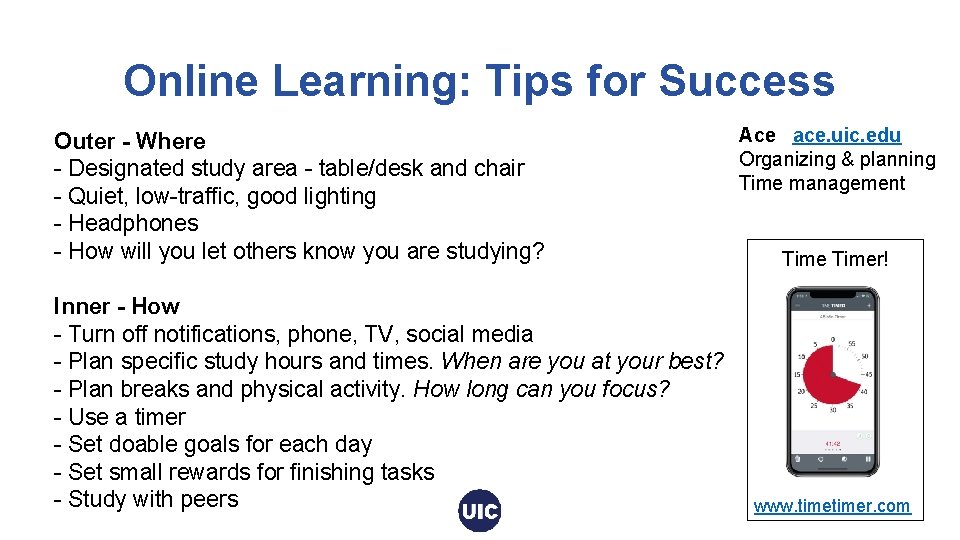
Online Learning: Tips for Success Ace ace. uic. edu Outer - Where Organizing & planning - Designated study area - table/desk and chair Time management - Quiet, low-traffic, good lighting - Headphones - How will you let others know you are studying? Timer! Inner - How - Turn off notifications, phone, TV, social media - Plan specific study hours and times. When are you at your best? - Plan breaks and physical activity. How long can you focus? - Use a timer - Set doable goals for each day - Set small rewards for finishing tasks - Study with peers www. timer. com
DISABILITY PRIDE AND IDENTITY
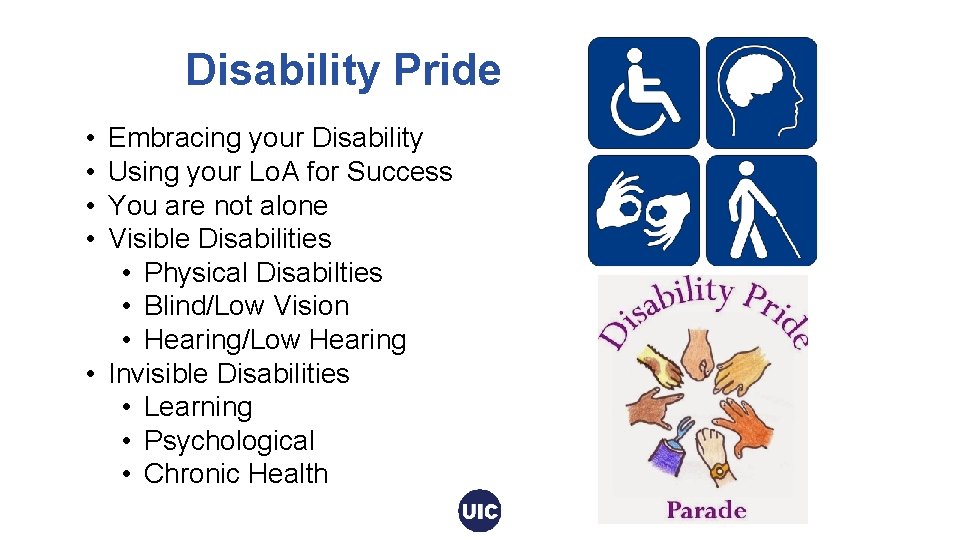
Disability Pride • • Embracing your Disability Using your Lo. A for Success You are not alone Visible Disabilities • Physical Disabilties • Blind/Low Vision • Hearing/Low Hearing • Invisible Disabilities • Learning • Psychological • Chronic Health
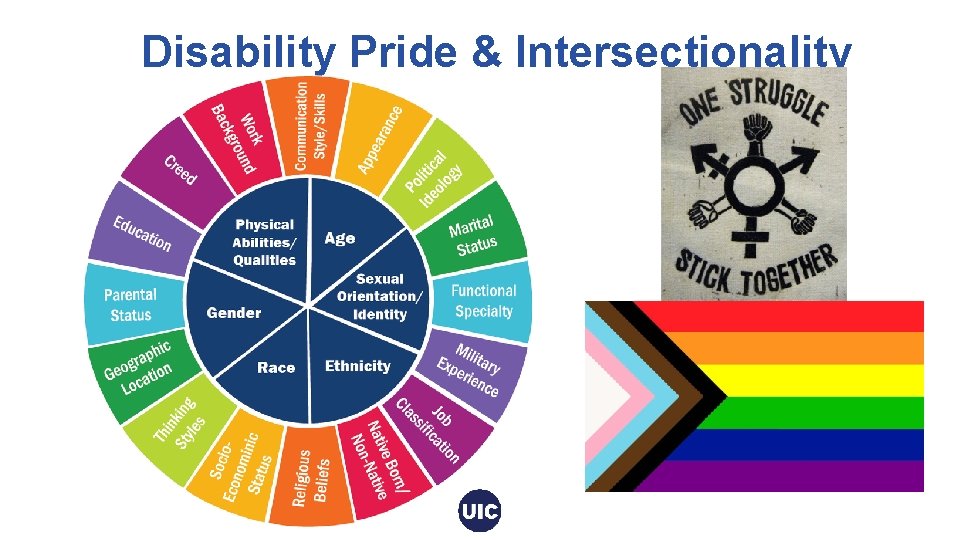
Disability Pride & Intersectionality
ON-CAMPUS RESOURCES • Academic Center for Excellence (ACE) • Disability Cultural Center (DCC) • Dean of Student Affairs • Career Services • Counseling Center • Veteran’s Services • Latin American Recruitment and Educational Services (LARES) • African American Academic Network (AAAN) • TRIO • Disability and Human Development Department
OFF-CAMPUS RESOURCES • Access Living • Anixter Center -- Chicago Hearing Society • CAIRS (Central Area Interpreter Referral Service) • The Center on Halsted • Chicago Lighthouse • Chicagoland Autism Connection • Disability Rights Bureau - Illinois Attorney General • • • Equip for Equality Housing Action Illinois Mayor's Office of People with Disabilities Mental Health America - Illinois Wounded Warrior Project IDES/IDHS
DISABILITY HISTORY IN HIGHER EDUCATION
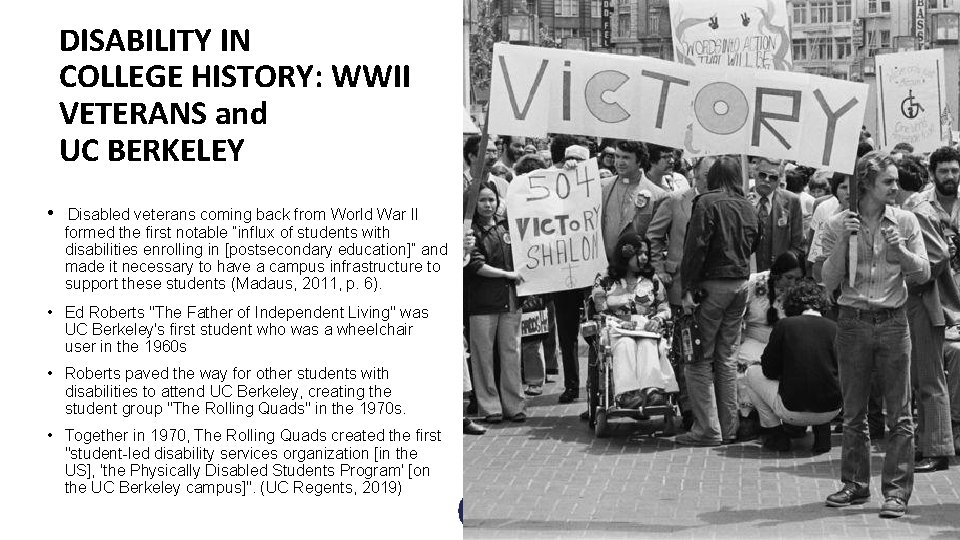
DISABILITY IN COLLEGE HISTORY: WWII VETERANS and UC BERKELEY • Disabled veterans coming back from World War II formed the first notable “influx of students with disabilities enrolling in [postsecondary education]” and made it necessary to have a campus infrastructure to support these students (Madaus, 2011, p. 6). • Ed Roberts "The Father of Independent Living" was UC Berkeley's first student who was a wheelchair user in the 1960 s • Roberts paved the way for other students with disabilities to attend UC Berkeley, creating the student group "The Rolling Quads" in the 1970 s. • Together in 1970, The Rolling Quads created the first "student-led disability services organization [in the US], 'the Physically Disabled Students Program' [on the UC Berkeley campus]". (UC Regents, 2019)
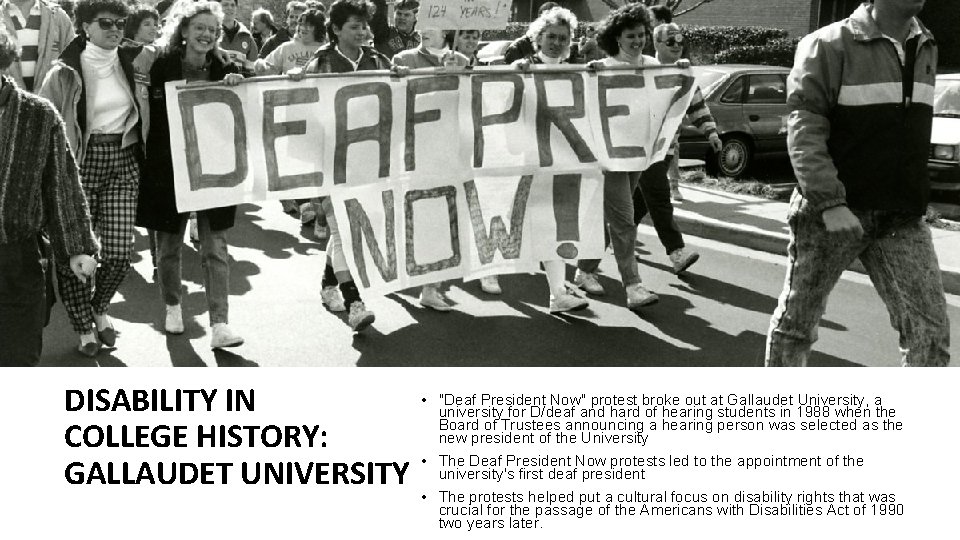
DISABILITY IN COLLEGE HISTORY: GALLAUDET UNIVERSITY • "Deaf President Now" protest broke out at Gallaudet University, a university for D/deaf and hard of hearing students in 1988 when the Board of Trustees announcing a hearing person was selected as the new president of the University • The Deaf President Now protests led to the appointment of the university's first deaf president • The protests helped put a cultural focus on disability rights that was crucial for the passage of the Americans with Disabilities Act of 1990 two years later.
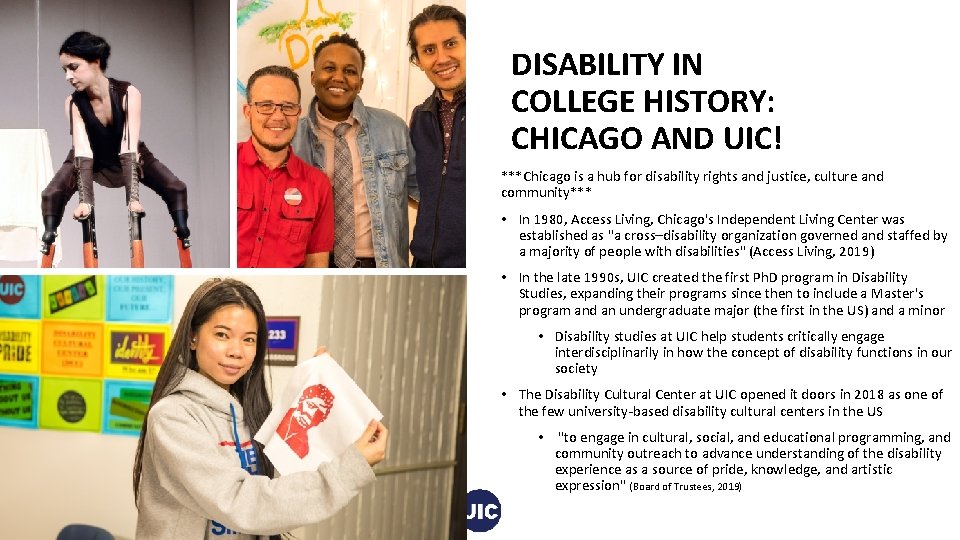
DISABILITY IN COLLEGE HISTORY: CHICAGO AND UIC! ***Chicago is a hub for disability rights and justice, culture and community*** • In 1980, Access Living, Chicago's Independent Living Center was established as "a cross–disability organization governed and staffed by a majority of people with disabilities" (Access Living, 2019) • In the late 1990 s, UIC created the first Ph. D program in Disability Studies, expanding their programs since then to include a Master's program and an undergraduate major (the first in the US) and a minor • Disability studies at UIC help students critically engage interdisciplinarily in how the concept of disability functions in our society • The Disability Cultural Center at UIC opened it doors in 2018 as one of the few university-based disability cultural centers in the US • "to engage in cultural, social, and educational programming, and community outreach to advance understanding of the disability experience as a source of pride, knowledge, and artistic expression" (Board of Trustees, 2019)
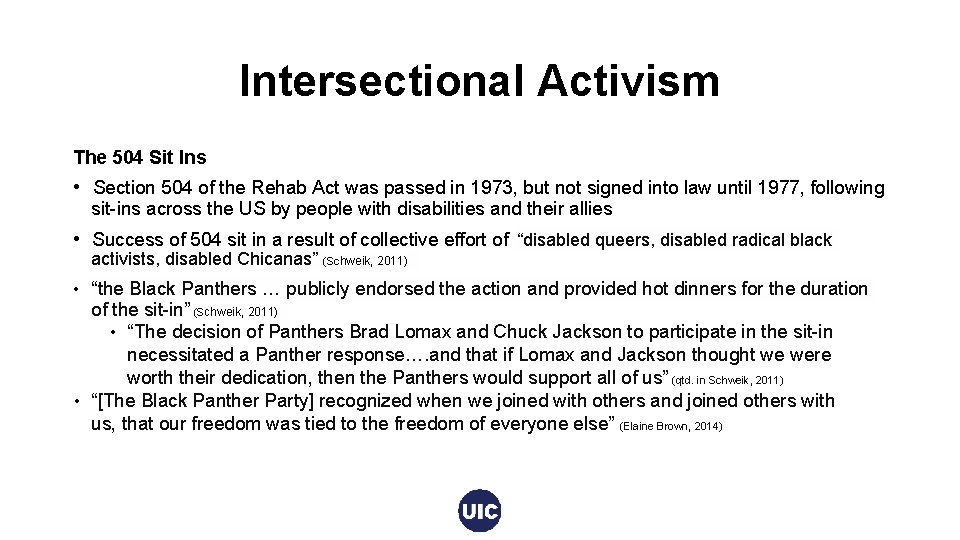
Intersectional Activism The 504 Sit Ins • Section 504 of the Rehab Act was passed in 1973, but not signed into law until 1977, following sit-ins across the US by people with disabilities and their allies • Success of 504 sit in a result of collective effort of “disabled queers, disabled radical black activists, disabled Chicanas” (Schweik, 2011) • “the Black Panthers … publicly endorsed the action and provided hot dinners for the duration of the sit-in” (Schweik, 2011) • “The decision of Panthers Brad Lomax and Chuck Jackson to participate in the sit-in necessitated a Panther response…. and that if Lomax and Jackson thought we were worth their dedication, then the Panthers would support all of us” (qtd. in Schweik, 2011) • “[The Black Panther Party] recognized when we joined with others and joined others with us, that our freedom was tied to the freedom of everyone else” (Elaine Brown, 2014)
DISABILITY CULTURAL CENTER
Next Steps: To schedule an intake, email drc@uic. edu with the subject line “Intake, ” and your phone number, and we will call you to schedule an intake! OR: send your number to Kelly in the chat and we will call you right away!
BREAKOUTS To join, type the number of the breakout in the chat and we will assign you: 1. Talking to Instructors/Access Online 2. Assistive Tech and Access Apps