
Presentation by Steffie Denton UWE Cares Coordinator Jo
Presentation by Steffie Denton UWE Cares Coordinator Jo Lewis Peer Assisted Learning (PAL) Manager June 2019 Peer Mentoring WP Students through Transition: An Evidence Based Approach
Aims • Demonstrate the need of peer to peer support for Widening Participation (WP) groups • Explore partnership working between UWE Cares and Peer Assisted Learning (PAL) Team to deliver PAL Mentoring scheme • Highlight the PAL Mentor’s experience • Review scheme success and challenges to date • Identify opportunities for scheme enhancement
Widening Participation (WP) § Strategy that aims to encourage and support underrepresented groups to take up and succeed in Higher Education. § Monitored through Access and Participation Plans from the Office for Students. § UWE Cares is part of UWE Bristol’s approach, providing care leavers, estranged students and student carers with a range of support.
The Evidence Base • “Moving On Up”: care leavers over a third more likely to withdraw • Recommendation for HEIs to develop mentoring for care leavers to improve transition, retention and success • Supported by recent government policy paper around improving care leavers access and participation in H. E. • Stand Alone: 41% estranged students had considered or had suspended or withdrawn from studies • Estranged students more likely to want a mentor and did not know what support services were available to them. • The Carers Trust reports that 29% of young carers have dropped out of uni’ or college because of their caring role.
Applying Research to Peer Mentoring for UWE Cares Students Aims of our pilot peer mentoring project are to help UWE Cares first year students: • settle in, meet people and reduce feelings of isolation and loneliness by promoting extra curricular and social opportunities • feel empowered to access support services by signposting • overcome low academic confidence by promoting professional development courses, study skills and employment awards • engage with the wider H. E. community.
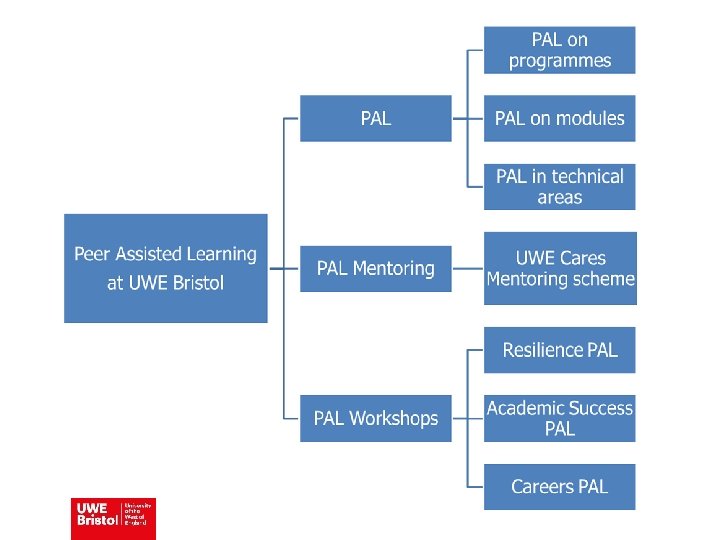
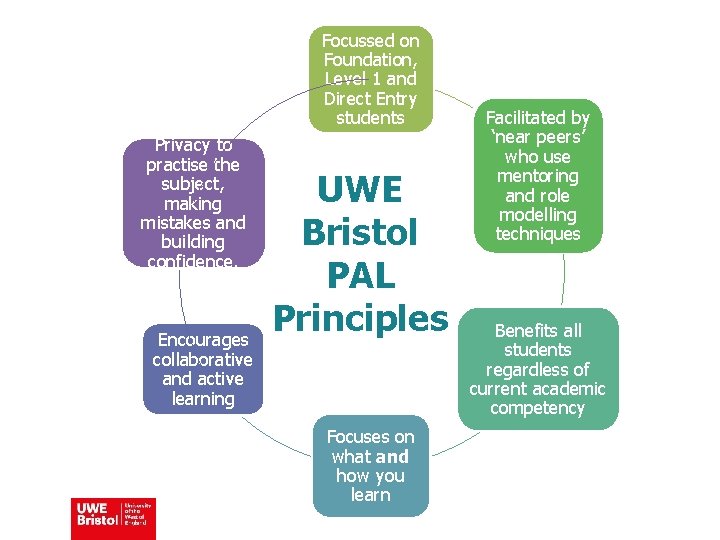
Focussed on Foundation, Level 1 and Direct Entry students Privacy to practise the subject, making mistakes and building confidence. Encourages collaborative and active learning UWE Bristol PAL Principles Focuses on what and how you learn Facilitated by ‘near peers’ who use mentoring and role modelling techniques Benefits all students regardless of current academic competency
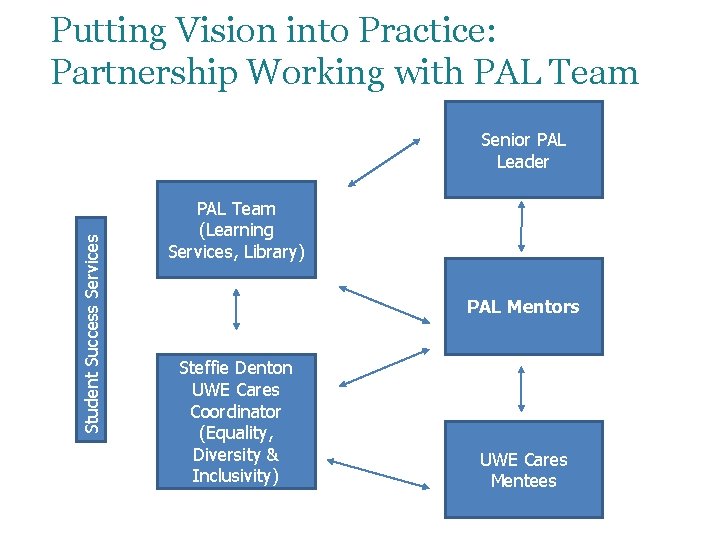
Putting Vision into Practice: Partnership Working with PAL Team Student Success Services Senior PAL Leader PAL Team (Learning Services, Library) PAL Mentors Steffie Denton UWE Cares Coordinator (Equality, Diversity & Inclusivity) UWE Cares Mentees

UWE Cares PAL Mentor: Role & Responsibilities o Provide peer-to-peer, one-to-one support to 4 or 5 UWE Cares students o Meet each mentee up to 6 times in the academic year o Help mentees set and work towards their individual goals o Empower them to overcome any barriers and ask for help o Help mentees make the most of the opportunities UWE Bristol offers. This will help them meet people, gain confidence and become more independent.
My PAL Mentor Experience Isla Kouassi-Kan, BA (Hons) History, final year
Evaluation & Monitoring - PAL Mentor training feedback - On-going analysis of records of mentoring - January review (interim feedback from PAL Mentors) - Mentee survey - Testimonials from mentees - Exit interviews with PAL Mentors
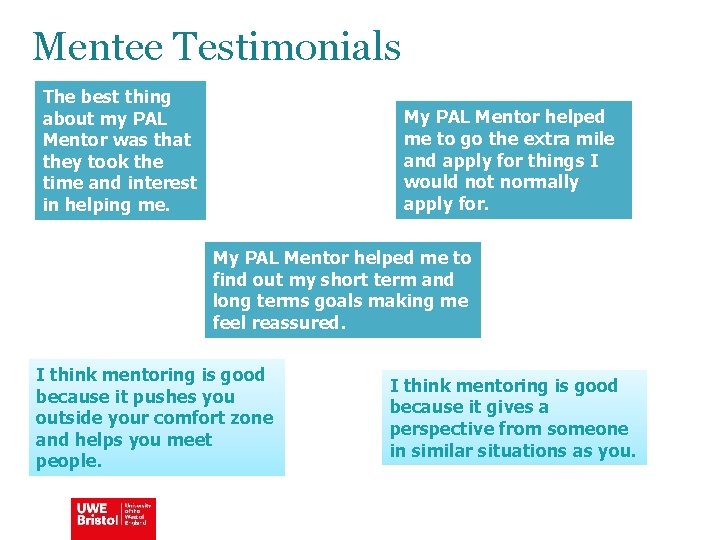
Mentee Testimonials The best thing about my PAL Mentor was that they took the time and interest in helping me. My PAL Mentor helped me to go the extra mile and apply for things I would not normally apply for. My PAL Mentor helped me to find out my short term and long terms goals making me feel reassured. I think mentoring is good because it pushes you outside your comfort zone and helps you meet people. I think mentoring is good because it gives a perspective from someone in similar situations as you.
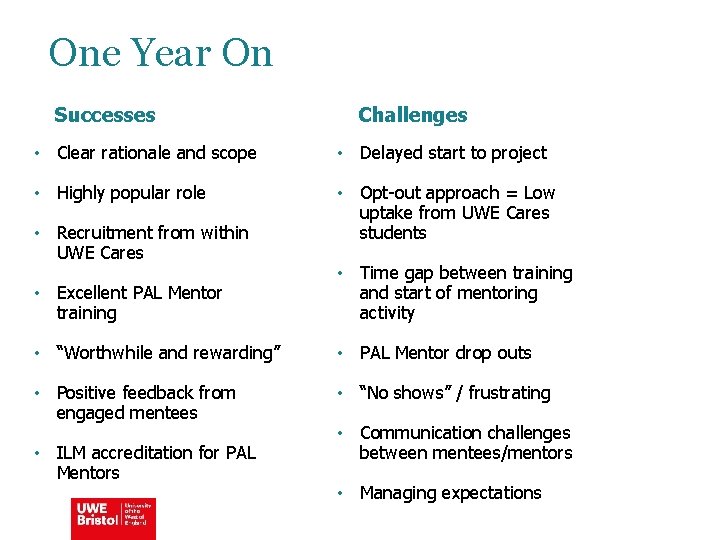
One Year On Successes Challenges • Clear rationale and scope • Delayed start to project • Highly popular role • Opt-out approach = Low uptake from UWE Cares students • Recruitment from within UWE Cares • Excellent PAL Mentor training • Time gap between training and start of mentoring activity • “Worthwhile and rewarding” • PAL Mentor drop outs • Positive feedback from engaged mentees • “No shows” / frustrating • ILM accreditation for PAL Mentors • Communication challenges between mentees/mentors • Managing expectations
Developing & Enhancing • • • Pre-arrival communications with applicants Change to “opt-in” PAL Mentor role induction Regular group debriefs (facilitated by Senior PAL) Mentors encouraged to use alternative methods of communication with mentees More explicit/ on-going contracting Mentoring diary to support more robust and consistent mentoring activity PAL Team to track mentee engagement (or lack of) more closely Regular evaluation touch points
Summary v Context integrated with external evidence v Collaboratively developed, implemented & evaluated v Success indicators: self efficacy & personal development.
References Carers Trust (2015) Supporting Students with Caring Responsibilities: Ideas and Practice for Universities to Help Student Carers Access and Succeed in Higher Education Available from: https: //professionals. carers. org/sites/default/files/supporting_students_with_caring_res ponsibilities_ideas_and_practice_for_universities_to_help_student_carers. pdf [Accessed 12 February 2018] Harrison, N. (2017) Moving on up: Pathways of care leavers and care-experienced students into and through higher education. Project Report. National Network for the Education of Care Leavers, Winchester. Available from: http: //eprints. uwe. ac. uk/34008 Department for Education (2019) Policy Paper: Principles to Guide Higher Education Providers on Improving Care Leavers Access and Participation in HE. London: Department for Education. Available from: https: //www. gov. uk/government/publications/principles-to-guide-he-providers-onimproving-care-leavers-access-and-participation-in-he/principles-to-guide-highereducation-providers-on-improving-care-leavers-access-and-participation-in-he [Accessed 5 March 2018]
References Stand. Alone (2015) Focus on access and retention: risk for students who are estranged or disowned by their family. Available from: http: //www. thestandalonepledge. org. uk/menu/resources-research/9 research-piece-4 [Accessed 22 January 2018] Stand. Alone (2015) Unite Foundation and Stand Alone - New Starts, the challenges of Higher Education without the support of a family network. Available from: http: //www. nnecl. org/resources/unite-foundation-andstand-alone? topic=guides-and-toolkits [Accessed 28 January 2018] Stand. Alone (2015) Hidden Voices: Family Estrangement in Students. Available from: https: //www. standalone. org. uk/wpcontent/uploads/2015/12/Hidden. Voices. Final. Report. pdf [Accessed 28 January 2018]
- Slides: 17