
Presentation by Laura Jan Kuller Government Affairs Counsel

Presentation by: • Laura Jan Kuller, Government Affairs Counsel • Kerry Lange, Government Relations Specialist
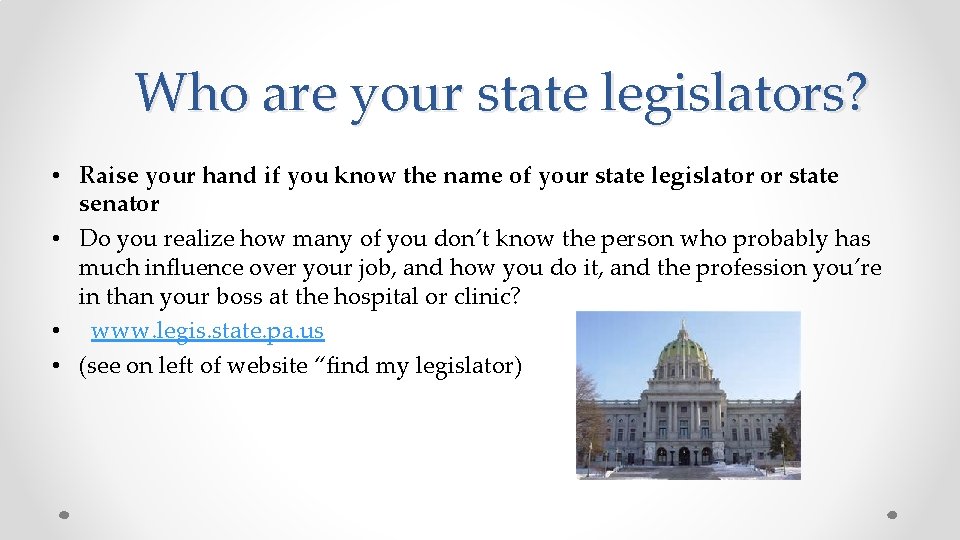
Who are your state legislators? • Raise your hand if you know the name of your state legislator or state senator • Do you realize how many of you don’t know the person who probably has much influence over your job, and how you do it, and the profession you’re in than your boss at the hospital or clinic? • www. legis. state. pa. us • (see on left of website “find my legislator)
Continued… Knowledge Is Power: So Know Your Legislator • When it comes to advocacy, knowledge is the first of several keys to success. Knowing your legislator, the legislative process, PANA’s position on issues, and the basis of a key legislative or policy proposal increases your credibility --- and therefore your power of persuasion and chance of success at Capitol Day. • At the state level, one representative represents approximately 60, 000 people in each of the 203 legislative districts, and one senator represents approximately 244, 000 people in each of the 50 senatorial districts. Obviously, not everyone can know every state legislator. That’s why grassroots advocacy is so important and so effective. • When PANA members across the state connect at Capitol Day with their individual legislators, they create a web of communication as a group that far exceeds what would otherwise be possible as an individual.
Get to Know the Staff Continued… • Getting to know the staff in your legislator’s office can be just as important as getting to know the senator or representative. • If your legislator is called into a last-minute meeting, you may find yourself meeting or talking with a legislative aide instead. Don’t let this discourage you. • Legislative aides often are assigned to research different topics and report back to the legislator. They become the experts on an issue, and you can provide them with valuable insight, even becoming a trusted resource they seek out for information. • These staff members are the gatekeepers in any legislative office, and developing a relationship of mutual trust and respect with them will help you do the same with the legislator.
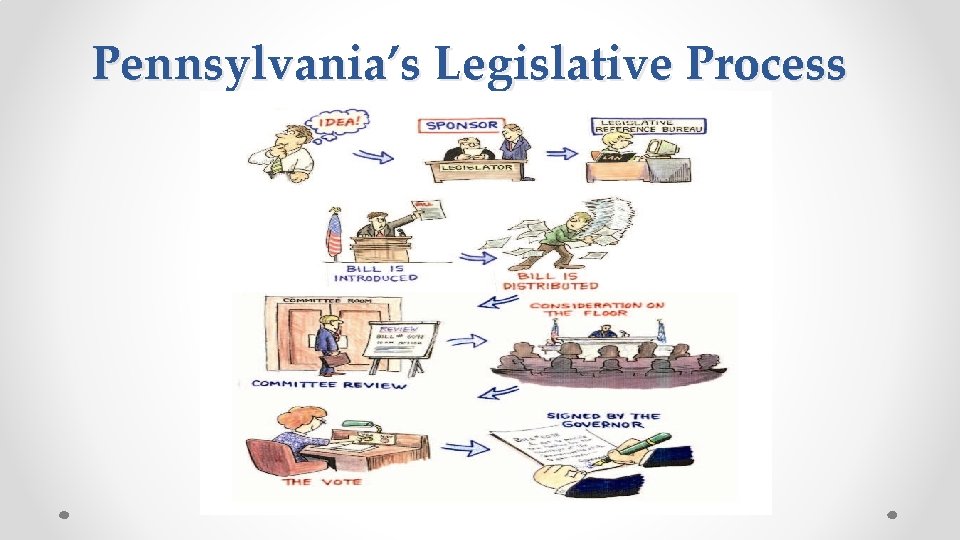
Pennsylvania’s Legislative Process
Legislative structure • Pennsylvania’s General Assembly is bicameral, meaning it consists of two bodies: the 203 -member House of Representatives and the 50 -member Senate. • Each chamber has a majority and minority caucus with elected leaders who control floor activity within their parties. • The Speaker of the House presides over all actions in the House of Representatives, and the Lieutenant Governor serves as president of the Senate.
Committees • Any legislator can introduce a bill in his/her respective chamber, either the House or Senate. After being introduced, the bill is assigned a number and referred to a committee. • Members of each chamber are assigned to standing committees that cover a variety of topics and that serve as the workshops of the legislature. The state constitution requires that every bill be referred to a committee, which studies the bills, may hold hearings for input, and then, if it supports a bill, votes it out of committee and sends it to the full chamber for consideration.
Continued… • The committee chairman, appointed by the House Speaker and Senate President Pro Tempore, decides what bills the committee will consider --- a tremendous power. • If the chairman is opposed to a bill, he or she may never allow it to come before the committee, essentially “killing” it. Any bill brought before the committee is subject to review, debate and possible hearings, and eventually will reach one of four possible outcomes: 1. Receive a “favorable report” and go to the floor of the chamber where it was introduced for consideration. 2. Be reported with changes. These amendments are usually added to make the bill more favorable to committee members and almost always hasten its favorable report to the chamber. 3. Be tabled, or set aside, rendering it inactive. 4. Be defeated and not reported from committee, essentially “killing” it.
Floor activity • Once out of committee, a bill still has to clear many hurdles before it can become a law. • Amendments can be added to a bill by any member during floor debates, contingent on a majority of members approving that amendment. Debate is held before final passage. • After a bill is approved in one chamber, it is sent to the other chamber, where it is again referred to a committee and, if approved, considered by the whole chamber. The whole process begins anew in this chamber. • Bills approved by both chambers without amendment go to the governor for enactment. But, if one chamber approves the bill with new amendments, it is sent back to its chamber of origin for concurrence. • After the bill is approved and signed in both houses, it is sent to the governor, who may sign it into law, allow it to become law without signing it, or veto it.
![What is Grassroots Advocacy? • grass·roots [gras-roots] noun ( used with a singular or](http://slidetodoc.com/presentation_image_h2/703bad2c0d9cbf94a3f93953c022ee90/image-10.jpg "What is Grassroots Advocacy? • grass·roots [gras-roots] noun ( used with a singular or")
What is Grassroots Advocacy? • grass·roots [gras-roots] noun ( used with a singular or plural verb) the common or ordinary people, especially as contrasted with the leadership or elite of a political party, social organization, etc. ; the rank and file. • ad·vo·ca·cy [ad-vuh-kuh-see] noun, plural ad·vo·ca·cies. the act of pleading for, supporting, or recommending; active espousal: He was known for his advocacy of states' rights.
Continued. . • • • It’s what you make it. It takes just a few minutes to write up a personal email, or a letter, and send it to your local legislator. It takes just a few minutes to place a call into their district office to leave a message with staff about an issue. It takes hardly any time at all. But it all adds up. In fact, for an association with 3, 000 members, you are incredibly powerful. Legislators talk to each other. And if enough legislators share stories about how the CRNAs are contacting them, that has tremendous influence on decisions at the Capitol.
Key points of advocacy planning • What do you hope to accomplish? o Example: getting CRNA designation
Who is your target audience? o Example: key law makers working on health care/licensing issues, legislative leadership, Governor’s office, Committee members
Who and what do you need to accomplish your goal? o Example: do you need a law change or a regulatory change and who needs to make that change?
Who are the people who can help? o Examples: grassroots, CRNAs, SRNAs, other similar advocacy groups, schools, legislators, state agencies, state government staff

Key messaging o Example: Why do you need this designation?
Timing o Example: When is the best time to advocate?

Who will deliver the message? o Example: CRNAs, SRNAs, hospitals, surgical centers, gastro doctors, RNs, other APRNS
How do we deliver the message? o Example: Day at the Capitol? Day in the District Office? Letters or email? Meeting with others? o Present as a strong team. o Have consistent messaging. o Be creative; tell stories. o Be confident in the decision making that has been done to get to this point. o Be a resource to decision makers for information and knowledge. o Don’t expect to have all the answers.
Why engage so many? • You are a statewide association. Your power is in your numbers and your broad reach. • There may be a constituent of the President Pro Tempore or the Speaker’s in this room right now. • You may have a Board member who grew up with the new Chair (yet to be named) of the House Professional Licensure Committee. • The community (as you define it) needs to want and support the effort. • PANA members need to reach out to your local legislators. • Without community support, Association legislation can’t move forward as easily.
Role Play! Meeting your legislator oneon-one. • During Capitol Day, your part in the overall effort is to lend personal commitment and critical involvement to educate and inform your local legislator, whether a state representative or senator. • Remember: YOU are the expert on these issues; you know more about your profession than the legislators, because they are generalists due to heavy workloads and their requirement to manage a variety of issues. • Don’t presume they know all about you and what you do. Help them understand the issues. • Listening to constituents is an essential part of their job. Legislators need a barometer on constituent thoughts and opinions, which you provide. Try and gauge their level of knowledge so you aren’t being too elementary or talking over their heads.
It doesn’t end in the Capitol • Early and frequent contact with your representative and senator while they are home in their district is extremely important. Don’t be afraid to visit or call a district office. • Once the legislature is in session, CRNAs sometimes are requested by PANA to swing into action with visits, phone calls, e-mails or letters whenever a key bill is scheduled for a vote. In this effort, it helps immensely that relationships have already been established through Capitol Day or district contact.
Remember: • Sometimes politics can be messy. • Always deliver a positive message. • Make your case!
- Slides: 23