
PRESENTATION BATTLE FOR PLANET EARTH THE STRUCTURE AND

PRESENTATION BATTLE FOR PLANET EARTH THE STRUCTURE AND FUNCTION OF CELLS BY BIOLOGYGUY
THANK YOU Thank you for purchasing this problem and project based resource on cells, “Battle For Planet Earth; the structure and function of cells”. This resource is designed to engage your students and immerse them in real life scenarios which forces them to explore, collaborate and research to find the solution to a problem. This resource uses 21 st Century Learning Skills, Next Generation Science Standards and develops students questioning and problem solving skills. This is Chapter One, in a series of units that surround theme of “Battle For Planet Earth”. Students are given the scenario that Planet Earth has been invaded by alien life, of which we know very little about. They are working with the US Government and US Army, to piece together the puzzle and find a solution to the alien invasion which is destroying the planet. In this particular lesson unit students will need to determine the cellular structure of the alien life form, in order to help the US Army.
STANDARDS Cell Biology 1. All living organisms are composed of cells, from just one to many trillions, whose details usually are visible only through a microscope. As a basis for understanding this concept: a. Students know cells function similarly in all living organisms. b. Students know the characteristics that distinguish plant cells from animal cells, including chloroplasts and cell walls. c. Students know the nucleus is the repository for genetic information in plant and animal cells. d. Students know that mitochondria liberate energy for the work that cells do and that chloroplasts capture sunlight energy for photosynthesis.
NGSS Structure, Function and Information Processing MS-LS 1 -1: Conduct an investigation to provide evidence that living things are made of cells, either one cell or many different numbers and types of cells. [Clarification Statement: Emphasis is on developing evidence that living things are made of cells, distinguishing between living and non-living cells, and understanding that living things may be made of one cell or many and varied cells. ] MS-LS 1 -2. Develop and use a model to describe the function of a cell as a whole and ways parts of cells contribute to the function. [Clarification Statement: Emphasis is on the cell functioning as a whole system and the primary role of identified parts of the cell, specifically the nucleus, chloroplasts, mitochondria, cell membrane, and cell wall. ] [Assessment Boundary: Assessment of organelle structure/function relationships is limited to the cell wall and cell membrane. Assessment of the function of the other organelles is limited to their relationship to the whole cell. Assessment does not include the biochemical function of cells or cell parts. ] MS-LS 1 -3. Use argument supported by evidence for how the body is a system of interacting subsystems composed of groups of cells. MS-LS 1 -8. Gather and synthesize information that sensory receptors respond to stimuli by sending messages to the brain for immediate behavior or storage as memories.
NGSS LS 1. A: Structure and Function of all living things are made up of cells, which is the smallest unit that can be said to be alive. An organism may consist of one single cell (unicellular) or many different numbers and types of cells (multicellular). (MS-LS 1 -1) Within cells, special structures are responsible for particular functions, and the cell membrane forms the boundary that controls what enters and leaves the cell. (MS-LS 1 -2) In multicellular organisms, the body is a system of multiple interacting subsystems. These subsystems are groups of cells that work together to form tissues and organs that are specialized for particular body functions. (MS-LS 1 -3)
TEACHER NOTES All of the notes for this project are provided in the printable project pack. This Presentation, includes agendas and lesson objectives that I used in my class. Please feel free to delete them or adjust them as needed.
BATTLE FOR PLANET EARTH: DAY 1 BIG QUESTION: What role would scientists play if the planet was invaded by aliens? AGENDA: 1. DO NOW: What can you see in the scene? State your observations and then write inferences as to what you think has happened. 2. Read scenario 3. Complete Team contracts and Team patch LESSON OBJECTIVES: SWBAT Describe the scenario, demonstrate the ability to make observations, create inferences and generate questions that relate to this project. STANDARD:
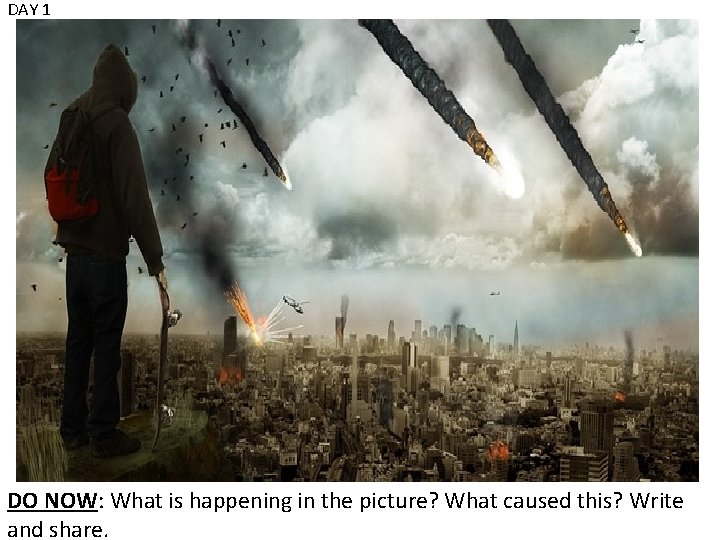
DAY 1 THANK YOU I would like to thank the following people: 1. Pixabay. com for great images. DO NOW: What is happening in the picture? What caused this? Write and share.
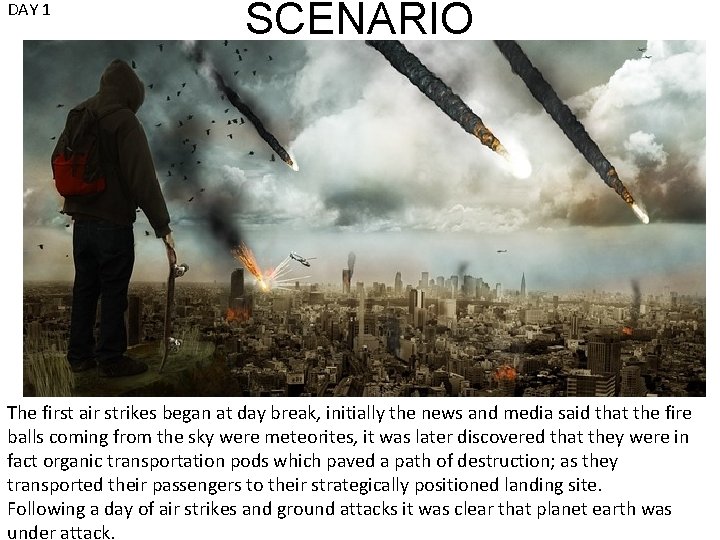
DAY 1 SCENARIO The first air strikes began at day break, initially the news and media said that the fire balls coming from the sky were meteorites, it was later discovered that they were in fact organic transportation pods which paved a path of destruction; as they transported their passengers to their strategically positioned landing site. Following a day of air strikes and ground attacks it was clear that planet earth was under attack.
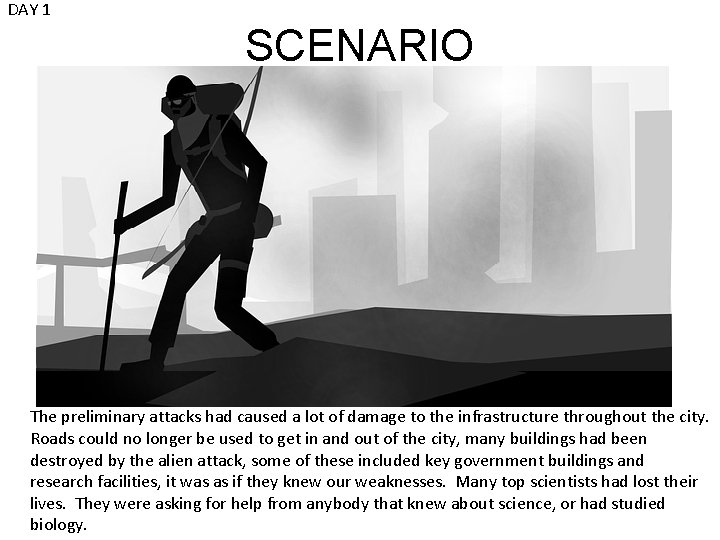
DAY 1 SCENARIO The preliminary attacks had caused a lot of damage to the infrastructure throughout the city. Roads could no longer be used to get in and out of the city, many buildings had been destroyed by the alien attack, some of these included key government buildings and research facilities, it was as if they knew our weaknesses. Many top scientists had lost their lives. They were asking for help from anybody that knew about science, or had studied biology.
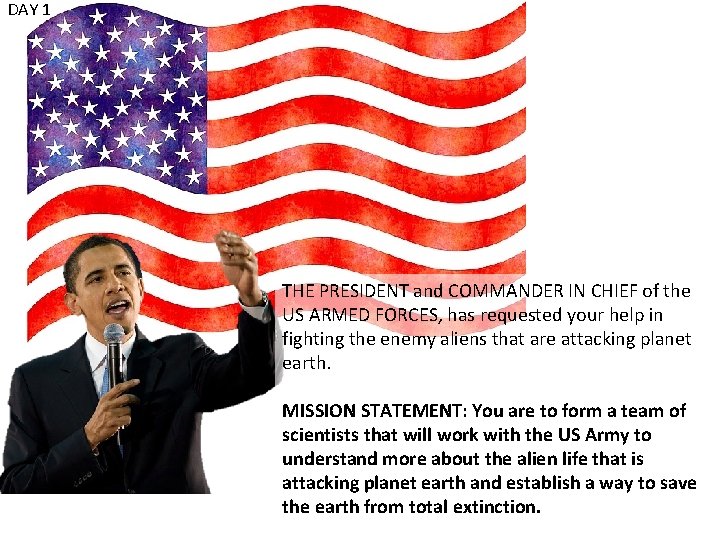
DAY 1 THE PRESIDENT and COMMANDER IN CHIEF of the US ARMED FORCES, has requested your help in fighting the enemy aliens that are attacking planet earth. MISSION STATEMENT: You are to form a team of scientists that will work with the US Army to understand more about the alien life that is attacking planet earth and establish a way to save the earth from total extinction.
DAY 1 Forming a Team 1. Read and complete the team contract, you will use this to ensure that each member of the team contributes to the overall good of the team.
DAY 1 ASKING QUESTIONS You are to form a team of scientists that will work with the US Army to understand more about the alien life that is attacking planet earth and establish a way to save the earth from total extinction. 1. In your team take it in turns to generate questions. 2. For each closed ended question (yes no answer) turn the question into an open ended question 3. In your group select the top 3 most important questions.
DAY 1 TEAM SPIRIT! Because you are working for the US military and are part of a team, you need to create a team patch, which reflects your group and their mission. Remember the TEAM patch is a work in progress and you should spend your whole time designing the patch. The world needs you help! Concentrate on the task in hand.
DAY 1 TEAM SPIRIT! Your patch should include the following: • Who is in the group • Your mission • Something that unifies you as a group
BATTLE FOR PLANET EARTH: DAY 2 BIG QUESTION: What are cells and what are they made of? AGENDA: 1. DO NOW: Review scenario. 2. Read the classified documents on cells 3. Complete Problem # 1. “What is this alien made of”. 4. Present your findings. LESSON OBJECTIVES: SWBAT Describe the structure of cells. Identify and label basic organelles in a cell STANDARD: Students know cells function similarly in all living organisms. LS 1. A: Structure and Function of cells.
DAY 2 PROBLEM # 1: What is this Alien made of? Ground soldiers were in pursuit of an alien life form. They have still not had a visual on what the aliens look like, but they did manage to wound one of the aliens as it fled the scene. You and your team have a tissue sample of the alien. The US Government want to know what the alien is made of? If they can work out what type of cells it has they might have a better understanding of where it came from.
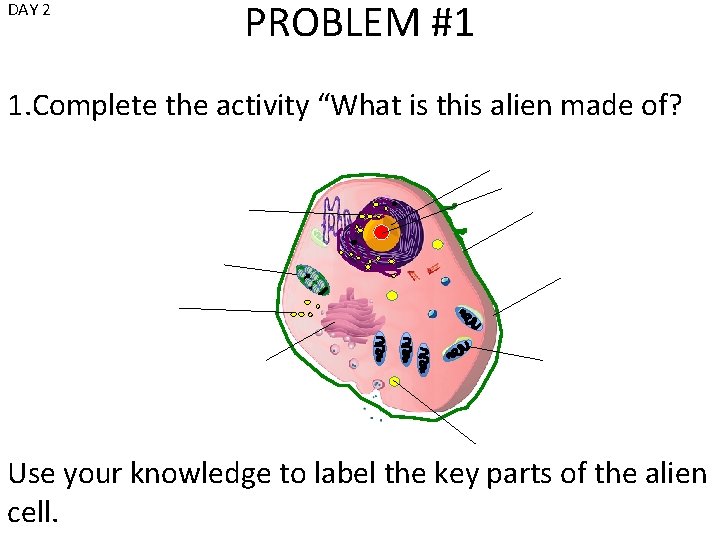
DAY 2 PROBLEM #1 1. Complete the activity “What is this alien made of? Use your knowledge to label the key parts of the alien cell.
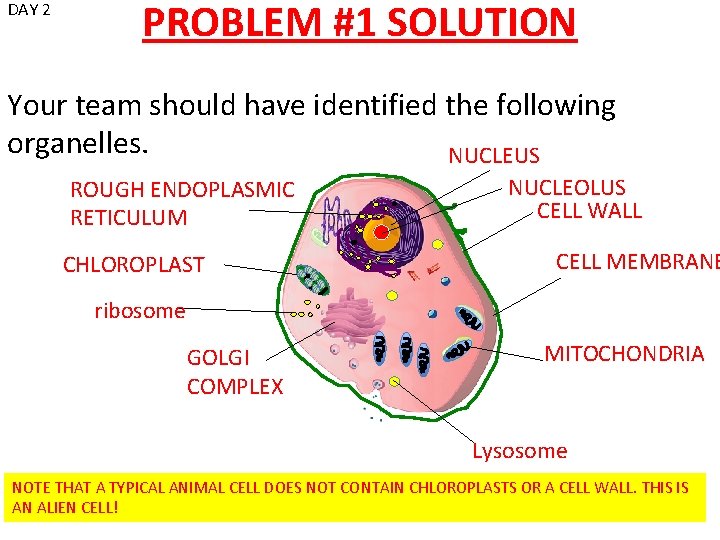
DAY 2 PROBLEM #1 SOLUTION Your team should have identified the following organelles. NUCLEUS ROUGH ENDOPLASMIC RETICULUM CHLOROPLAST NUCLEOLUS CELL WALL CELL MEMBRANE ribosome GOLGI COMPLEX MITOCHONDRIA Lysosome NOTE THAT A TYPICAL ANIMAL CELL DOES NOT CONTAIN CHLOROPLASTS OR A CELL WALL. THIS IS AN ALIEN CELL!
BATTLE FOR PLANET EARTH: DAY 3 -4 Prokaryotes Vs Eukaryotes BIG QUESTION: are all cells the same? What are the different types of cells? AGENDA: 1. DO NOW: Review scenario. 2. Complete Problem #1. 1 “What is this alien made of? : Planning” 3. Complete Problem # 1. 1 “What is this alien made of”. 4. Present your findings. LESSON OBJECTIVES: SWBAT Explain the difference between prokaryotic and eukaryotic cells Describe the functions of basic organelles. STANDARD: Students know cells function similarly in all living organisms. LS 1. A: Structure and Function of cells
PROBLEM #1. 1 The results of the lab are back. You and your team managed to examine the cell and identify the key structures. You now need to determine whether the cell is prokaryotic or eukaryotic. 1. Complete the activity “What is this alien made of? PLANNING” 2. Complete the activity “What is this alien made of? PLANNING” 3. Present your findings on a poster or other media.
BATTLE FOR PLANET EARTH: DAY 5 -8 BIG QUESTION: are all cells the same? What are the different types of cells? What do all parts of the cell do? AGENDA: 1. DO NOW: what is happening in the lab? Make observations and form questions. 2. Complete Problem # 2 “Is this a Plant or Animal Cell? ” LESSON OBJECTIVES: SWBAT Explain the difference between plant and animal cells, explain what each part of the cell does STANDARD: students know the difference between plant and animal cells. They know the different parts of the cell and their function. (MS-LS 1 -2)
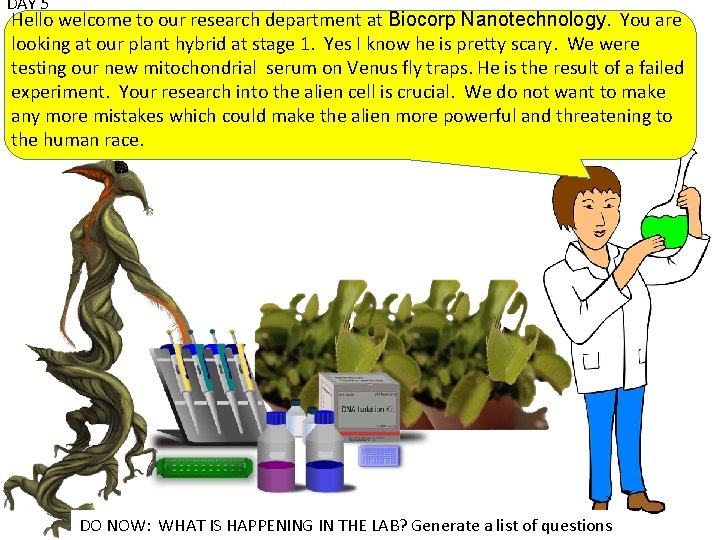
DAY 5 Hello welcome to our research department at Biocorp Nanotechnology. You are looking at our plant hybrid at stage 1. Yes I know he is pretty scary. We were testing our new mitochondrial serum on Venus fly traps. He is the result of a failed experiment. Your research into the alien cell is crucial. We do not want to make any more mistakes which could make the alien more powerful and threatening to the human race. DO NOW: WHAT IS HAPPENING IN THE LAB? Generate a list of questions
Problem #2: Is This a Plant Or Animal Cell? Mission Scenario: You and your team have established that the cell is mainly eukaryotic, based on its cellular structure. Biocorp Nanotechnology, has been working on a serum which can shut down the mitochondria of cells in animals, however if it is administered to plants it has the reverse effect making the plants extremely powerful. MISSION STATEMENT: Using your cell sample determine whether the cell is from a plant or animal cell. You will also need to locate the mitochondria of the cell. Present your findings to your fellow scientists.
PROBLEM #2 BRIEFING 1. With your group read the scenario; Problem #2 “Is this an animal or plant cell? ” 2. Review the classified documents “Features of a plant and animal cell”. 3. Complete the planning sheet Problem # 2 “Is this an animal or plant cell? : PLANNING”. 4. Use your research to create a 3 D model or visual poster of the Alien Cell. Include labels of each of the organelles and their function, highlighting the mitochondria. Explain to your fellow scientists whether it is an animal or plant cell. Explain whether you think Biocorp Nantechnology should use the mitochondrial serum or not.
BATTLE FOR PLANET EARTH: DAY 9 BIG QUESTION: are all cells the same? What are the different types of cells? What do all parts of the cell do? AGENDA: 1. DO NOW: Review the rubric for this mission 2. Present your findings for this mission. 3. Complete Gallery walk LESSON OBJECTIVES: SWBAT Explain the difference between plant and animal cells, explain what each part of the cell does. Use evidence to argue whether Biocorp Nanotechnology should inject the serum into the mitochondria or not. STANDARD: students know the difference between plant and animal cells. They know the different parts of the cell and their function. (MS-LS 1 -2)
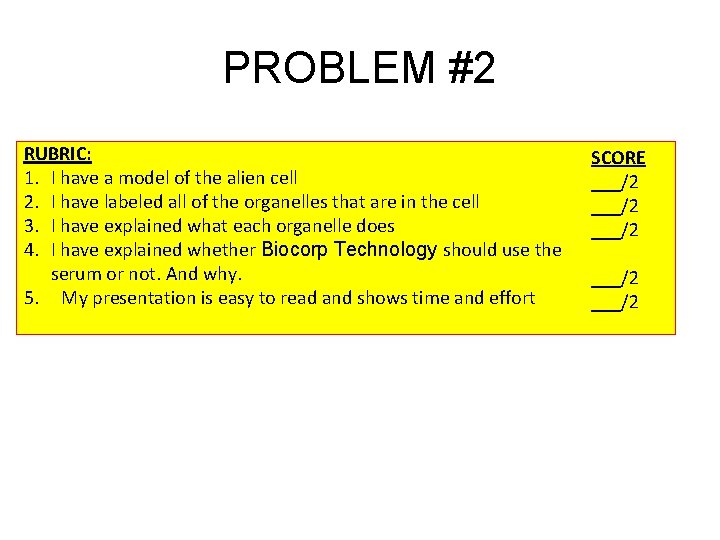
PROBLEM #2 RUBRIC: 1. I have a model of the alien cell 2. I have labeled all of the organelles that are in the cell 3. I have explained what each organelle does 4. I have explained whether Biocorp Technology should use the serum or not. And why. 5. My presentation is easy to read and shows time and effort SCORE ___/2 ___/2
PRESENTING FINDINGS 3 groups will present their work. These groups will be selected randomly. Listen carefully to the groups, observe their presentation techniques and visuals. At the end of the presentation raise your hand to ask questions or comment on their work.
Gallery Walk You will be exploring your fellow scientists research and presentations. 1. Rotate around the class in your team 2. Using Postit notes. Write one positive and one area for improvement for each of the presentations.
BATTLE FOR PLANET EARTH: DAY 10 BIG QUESTION: are all cells the same? What are the different types of cells? What do all parts of the cell do? AGENDA: 1. DO NOW: review notes. 2. Complete the quiz “Battle For Planet Earth: Cells”. 3. Complete the reflection and evaluation. LESSON OBJECTIVES: SWBAT Describe the structure and function of cells. Explain the function of cell organelles. STANDARD: students know the difference between plant and animal cells. They know the different parts of the cell and their function. (MS-LS 1 -2)
- Slides: 30