
PRESENTATION ABOUT DIGLOSSIA AND LANGUAGE VARIATION BY CHAARI
PRESENTATION ABOUT DIGLOSSIA AND LANGUAGE VARIATION BY CHAARI FATMA
PLAN v BASIC TERMS’DEFINITIONS v FERGUSON’S ARTICLE 1959 : Diglossia v YOUSSEF IDRISS’S ARTICLE AS AN EXAMPLE
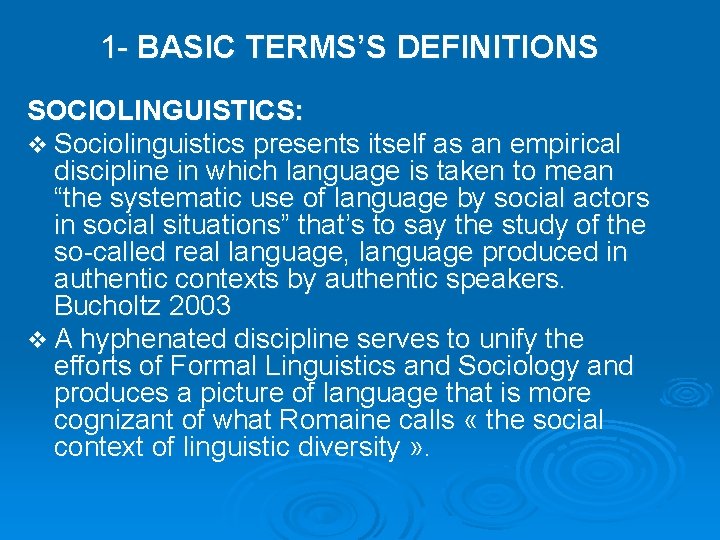
1 - BASIC TERMS’S DEFINITIONS SOCIOLINGUISTICS: v Sociolinguistics presents itself as an empirical discipline in which language is taken to mean “the systematic use of language by social actors in social situations” that’s to say the study of the so-called real language, language produced in authentic contexts by authentic speakers. Bucholtz 2003 v A hyphenated discipline serves to unify the efforts of Formal Linguistics and Sociology and produces a picture of language that is more cognizant of what Romaine calls « the social context of linguistic diversity » .
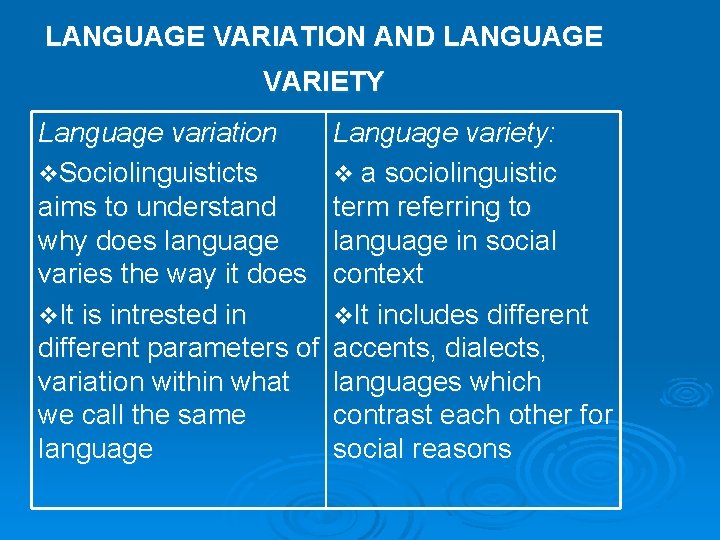
LANGUAGE VARIATION AND LANGUAGE VARIETY Language variation v. Sociolinguisticts aims to understand why does language varies the way it does v. It is intrested in different parameters of variation within what we call the same language Language variety: v a sociolinguistic term referring to language in social context v. It includes different accents, dialects, languages which contrast each other for social reasons
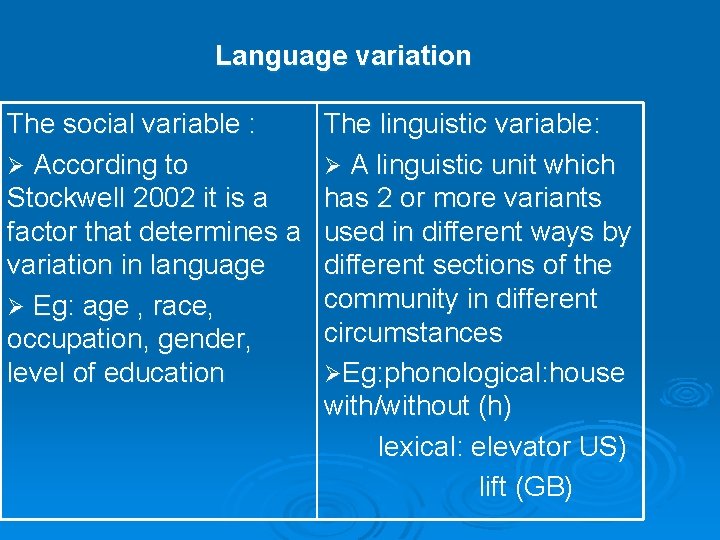
Language variation The social variable : Ø According to Stockwell 2002 it is a factor that determines a variation in language Ø Eg: age , race, occupation, gender, level of education The linguistic variable: Ø A linguistic unit which has 2 or more variants used in different ways by different sections of the community in different circumstances ØEg: phonological: house with/without (h) lexical: elevator US) lift (GB)
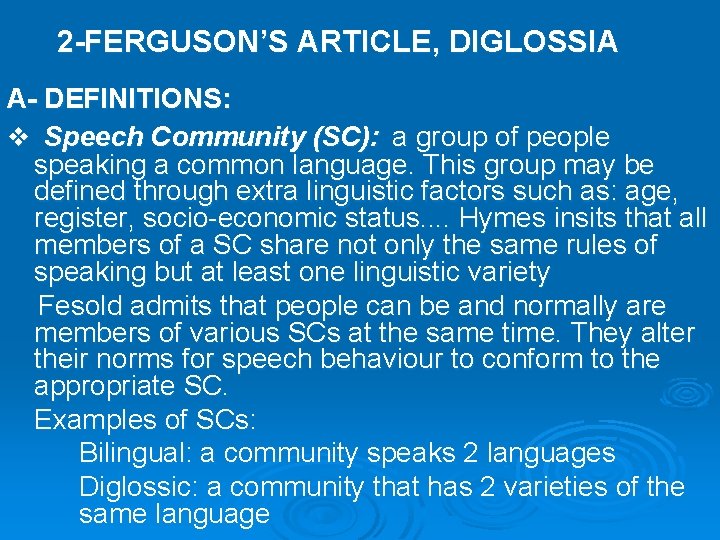
2 -FERGUSON’S ARTICLE, DIGLOSSIA A- DEFINITIONS: v Speech Community (SC): a group of people speaking a common language. This group may be defined through extra linguistic factors such as: age, register, socio-economic status. . Hymes insits that all members of a SC share not only the same rules of speaking but at least one linguistic variety Fesold admits that people can be and normally are members of various SCs at the same time. They alter their norms for speech behaviour to conform to the appropriate SC. Examples of SCs: Bilingual: a community speaks 2 languages Diglossic: a community that has 2 varieties of the same language
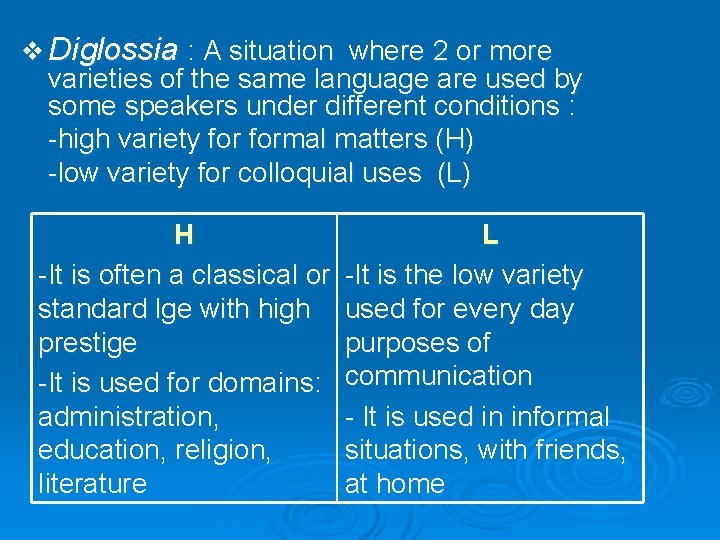
v Diglossia : A situation where 2 or more varieties of the same language are used by some speakers under different conditions : -high variety formal matters (H) -low variety for colloquial uses (L) H -It is often a classical or standard lge with high prestige -It is used for domains: administration, education, religion, literature L -It is the low variety used for every day purposes of communication - It is used in informal situations, with friends, at home

Hence according to Ferguson; Diglossia is: v A relatively stable language situation v There is a very divergent, highly codified superposed variety, the vehicle of a large and respected body of written literature v This high variety is learned by formal education v It is used for written and formal spoken purposes v It is not used by any sector of the community for ordinary conversation
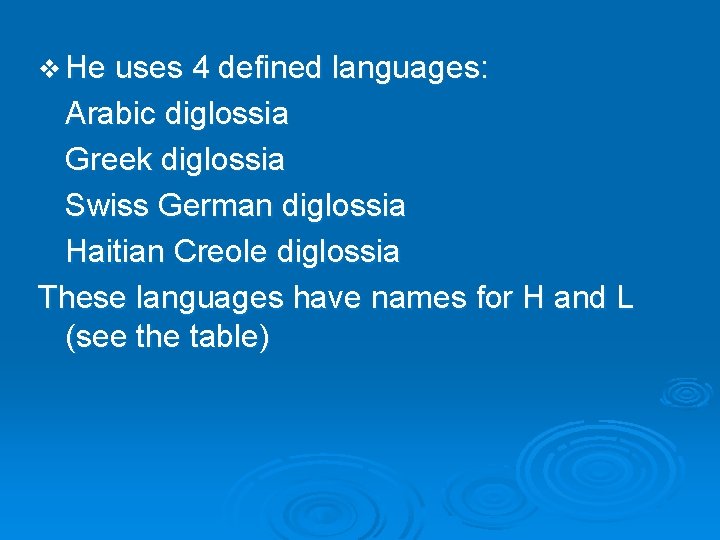
v He uses 4 defined languages: Arabic diglossia Greek diglossia Swiss German diglossia Haitian Creole diglossia These languages have names for H and L (see the table)
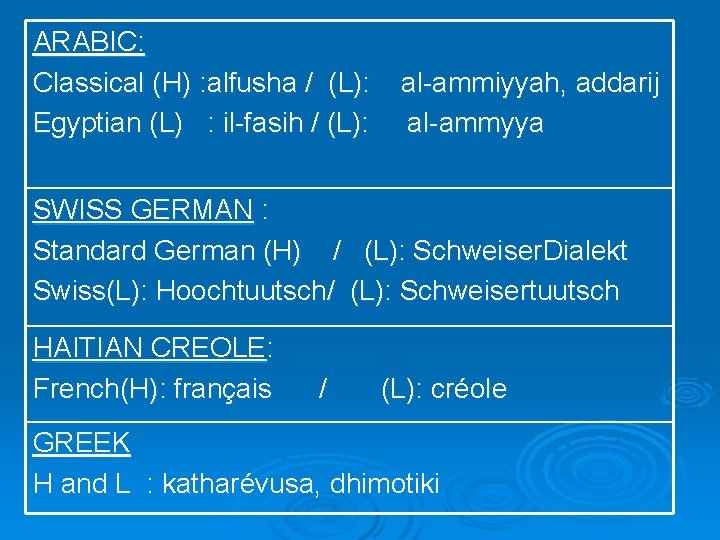
ARABIC: Classical (H) : alfusha / (L): Egyptian (L) : il-fasih / (L): SWISS GERMAN : Standard German (H) / Swiss(L): Hoochtuutsch/ HAITIAN CREOLE: French(H): français / al-ammiyyah, addarij al-ammyya (L): Schweiser. Dialekt (L): Schweisertuutsch (L): créole GREEK H and L : katharévusa, dhimotiki
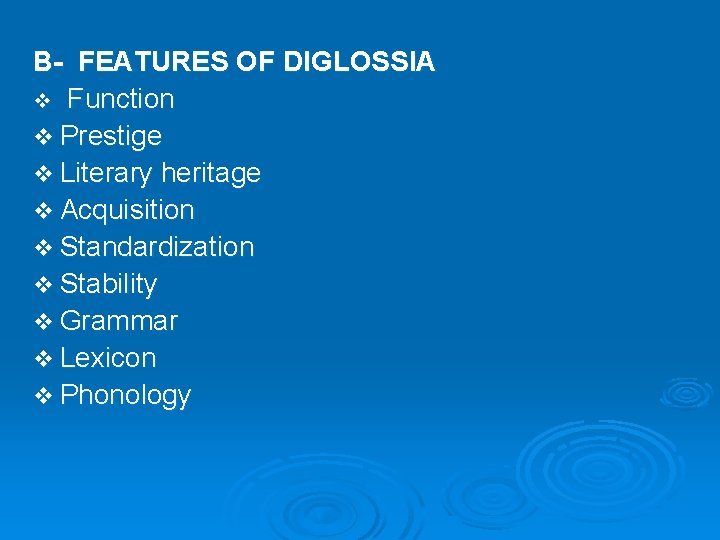
B- FEATURES OF DIGLOSSIA v Function v Prestige v Literary heritage v Acquisition v Standardization v Stability v Grammar v Lexicon v Phonology
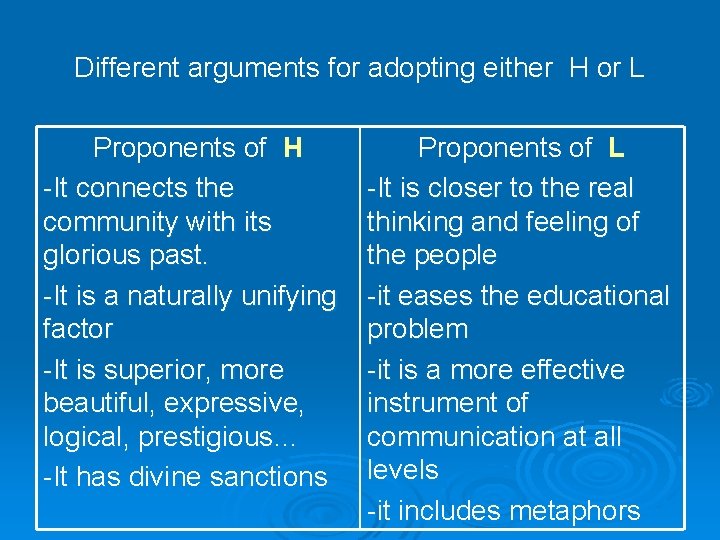
Different arguments for adopting either H or L Proponents of H -It connects the community with its glorious past. -It is a naturally unifying factor -It is superior, more beautiful, expressive, logical, prestigious… -It has divine sanctions Proponents of L -It is closer to the real thinking and feeling of the people -it eases the educational problem -it is a more effective instrument of communication at all levels -it includes metaphors
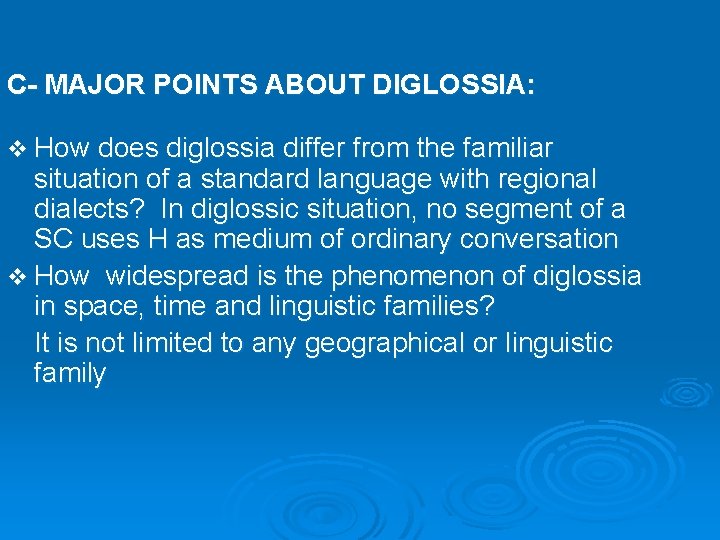
C- MAJOR POINTS ABOUT DIGLOSSIA: v How does diglossia differ from the familiar situation of a standard language with regional dialects? In diglossic situation, no segment of a SC uses H as medium of ordinary conversation v How widespread is the phenomenon of diglossia in space, time and linguistic families? It is not limited to any geographical or linguistic family
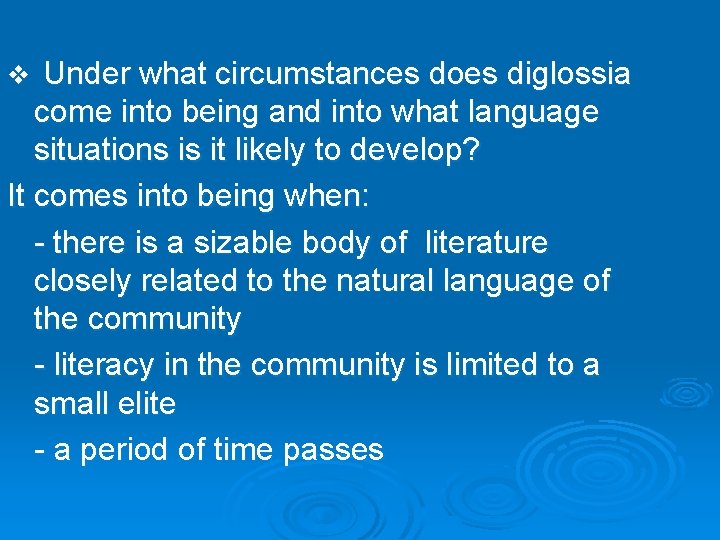
Under what circumstances does diglossia come into being and into what language situations is it likely to develop? It comes into being when: - there is a sizable body of literature closely related to the natural language of the community - literacy in the community is limited to a small elite - a period of time passes v
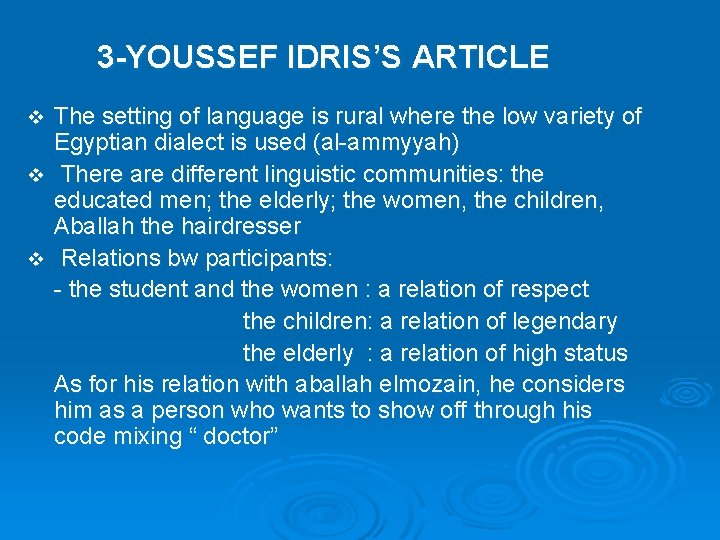
3 -YOUSSEF IDRIS’S ARTICLE The setting of language is rural where the low variety of Egyptian dialect is used (al-ammyyah) v There are different linguistic communities: the educated men; the elderly; the women, the children, Aballah the hairdresser v Relations bw participants: - the student and the women : a relation of respect the children: a relation of legendary the elderly : a relation of high status As for his relation with aballah elmozain, he considers him as a person who wants to show off through his code mixing “ doctor” v
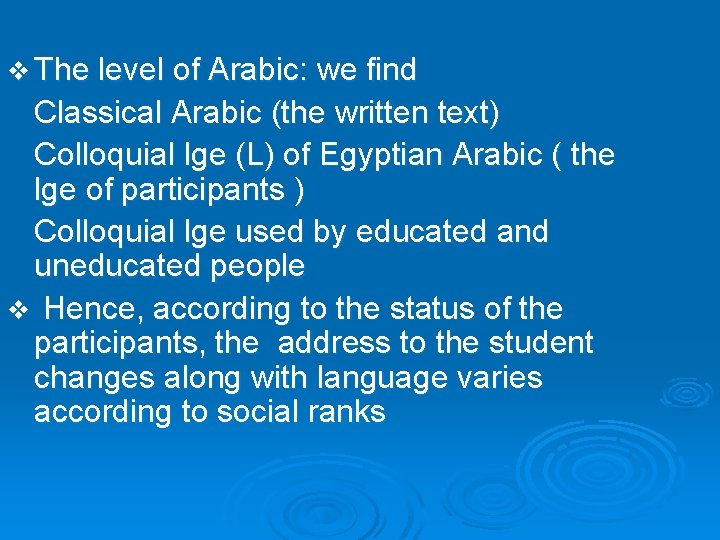
v The level of Arabic: we find Classical Arabic (the written text) Colloquial lge (L) of Egyptian Arabic ( the lge of participants ) Colloquial lge used by educated and uneducated people v Hence, according to the status of the participants, the address to the student changes along with language varies according to social ranks
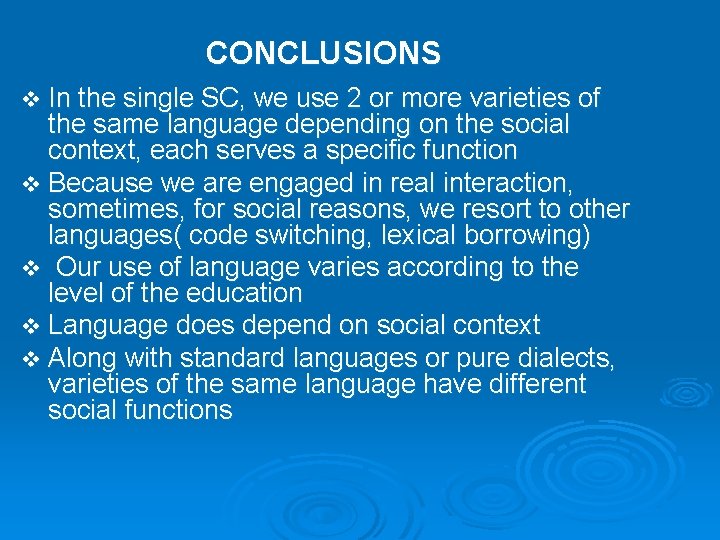
CONCLUSIONS v In the single SC, we use 2 or more varieties of the same language depending on the social context, each serves a specific function v Because we are engaged in real interaction, sometimes, for social reasons, we resort to other languages( code switching, lexical borrowing) v Our use of language varies according to the level of the education v Language does depend on social context v Along with standard languages or pure dialects, varieties of the same language have different social functions
REFERENCES v C. A Ferguson, ‘Diglossia’ 1959 v Sociolinguistics course (2007 - 2008/2008 - 2009) v Spoken discourse (2008 -2009)

THANK YOU FOR YOUR PATIENCE
- Slides: 19