
Presentation 13 D RVSM APPROVALS DATABASE AND MONITORING
Presentation 13 D RVSM APPROVALS DATABASE AND MONITORING Separation Standards Group FAA Technical Center Atlantic City, New Jersey DRVSM SEMINAR Oct 11, 2004 V. 1. 6

Access to Information on RVSM Approvals Database D QInformation on RVSM approvals databases is posted on the RVSM Documentation Webpage QSee “Registration on RVSM Approvals Databases” in the Table of Contents QUS aircraft and operators are registered on “US Operator/Aircraft RVSM Approvals Database” primarily through FAA inspector inputs to PTRS Q Normally no action required of operators DRVSM SEMINAR Oct 11, 2004 2
D CONTACT FOR U. S. OPERATORS QFor U. S. operators and AFS field offices, contact for RVSM Approvals Database or RVSM Monitoring questions is: Q “U. S. Operator/Aircraft: RVSM Approvals DB and Monitoring Coordinator”: Q Wayne. Smoot@faa. gov Q Ph 609 -485 -5475 Q Fax 609 -485 -5078 DRVSM SEMINAR Oct 11, 2004 3
Contact For Non-U. S. Operators D Q NAARMO Website is linked from FAA RVSM Homepage Q Also linked from RVSM Documentation Webpage “Registration” section Q http: //www. tc. faa. gov/act-500/niaab/rvsm/naarmo_intro. asp Q Contact: Richard Soper, NAARMO Operations Coordinator, at: NAARMO@faa. gov DRVSM SEMINAR Oct 11, 2004 4
D Monitoring Requirements and Procedures DRVSM SEMINAR Oct 11, 2004 5

Access to Information D QSee Monitoring Requirements/Procedures section on RVSM Documentation Webpage: Q “Instructions for Using Minimum Monitoring Charts and Procedures from Different Regions” Q “Monitoring Procedures for US Operators” Q “North American RVSM Minimum Monitoring Requirements” and requirements for other regions QICAO group working to harmonize requirements DRVSM SEMINAR Oct 11, 2004 6
D TWO ASPECTS OF MONITORING GOALS QNeed to ensure that individual operators and aircraft meet applicable safety goals QNeed to ensure that North American airspace system as a whole meets applicable safety goal the Target Level of Safety (TLS) QMonitoring of aircraft height-keeping performance assists in confirming that both aspects of safety goals are satisfied DRVSM SEMINAR Oct 11, 2004 7
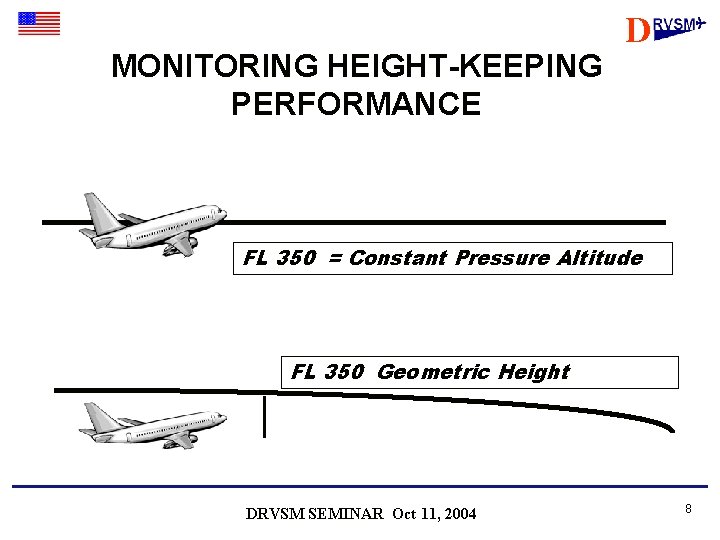
MONITORING HEIGHT-KEEPING PERFORMANCE D FL 350 = Constant Pressure Altitude FL 350 Geometric Height DRVSM SEMINAR Oct 11, 2004 8

HEIGHT-KEEPING PERFORMANCE ERRORS D FL 350 Geometric Height Aircraft geometric height Total Vertical Error (TVE) = Altimetry System Error + Assigned Altitude Deviation = ASE +AAD DRVSM SEMINAR Oct 11, 2004 9

D GMS MONITORING AND THE STATE APPROVAL PROCESS GPS-based Monitoring System (GMS), improved with enhanced GPS Monitoring Unit, plays a prominent role in supporting operator/aircraft satisfaction of monitoring requirements associated with RVSM approval process--including those for DRVSM SEMINAR Oct 11, 2004 10

GPS Monitoring Unit (GMU) DRVSM SEMINAR Oct 11, 2004 D 11

Enhanced GPS Monitoring Unit (EGMU) DRVSM SEMINAR Oct 11, 2004 D 12
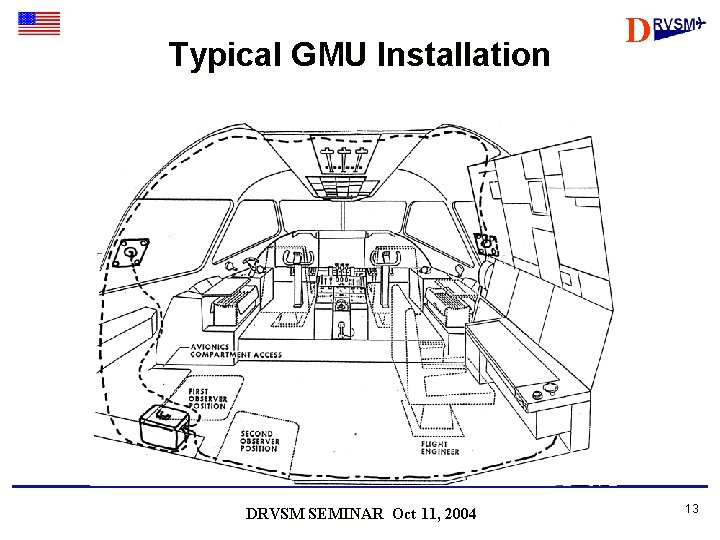
Typical GMU Installation DRVSM SEMINAR Oct 11, 2004 D 13

D GPS-Based Monitoring System Data Flow Airborne GPS-based Monitoring Unit (GMU) Remote Reference Station Differential Data Flight Information Form (FIF) Post-flight Processing Station Flight Information Form (FIF) Data Transmitted Post-Flight Mode C Data Via Internet/Direct Vertical Error Processing FAA Technical Center ASE Results FAA Technical Center Database Meteorological Data (Height of flight level) DRVSM SEMINAR Oct 11, 2004 Database (Monitoring Results) Queries 14

D GMS Vertical Error Calculation Process GMU GPS Reference Station Meteorological Data Cleared FL (FIF) Mode C Data Cleared FL (FIF) Determine Aircraft Geometric Height Determine Flight Level (FL) Height Compare Cleared FL to Actual Altitude DRVSM SEMINAR Oct 11, 2004 TVE (Total Vertical Error) ASE (Altimetry System Error) AAD (Assigned Altitude Deviation) 15
Height Monitoring Unit (HMU) D QEUROCONTROL and North Atlantic Ground-based system capable of monitoring height-keeping performance of an aircraft within (roughly) 40 -nm of ground stations and producing estimate of ASE in near real-time QAdvantage: able to monitor large number of aircraft per day (conceptually, all which pass over ground stations) QDisadvantage: aircraft must fly over HMU site DRVSM SEMINAR Oct 11, 2004 16

D DRVSM SEMINAR Oct 11, 2004 17
DRVSM Monitoring System D QAircraft Geometric Height Measurement Element (AGHME) Atlantic City prototype in final stages of testing QWichita AGHME shipped to site QCleveland Roanoke, Va. AGHME constellations scheduled for deployment QAGHME constellations to be located near Ottawa and Lethbridge in Canada. QAircraft should fly straight and level at or above FL 290 over the AGHME monitoring area. DRVSM SEMINAR Oct 11, 2004 18
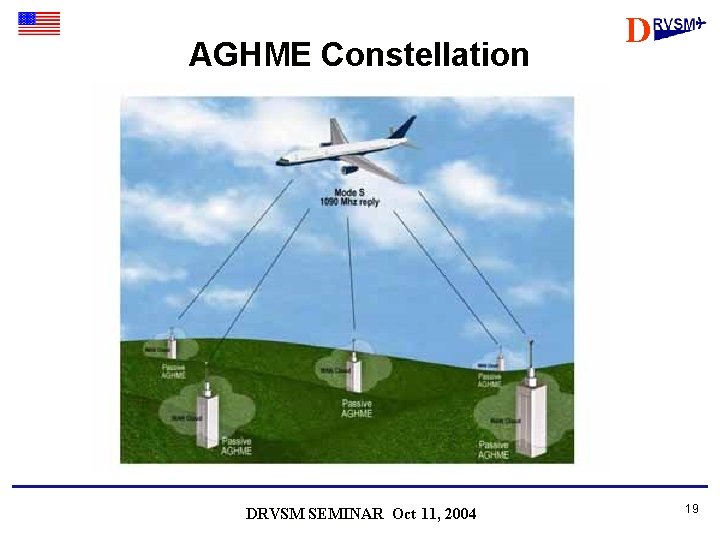
AGHME Constellation DRVSM SEMINAR Oct 11, 2004 D 19
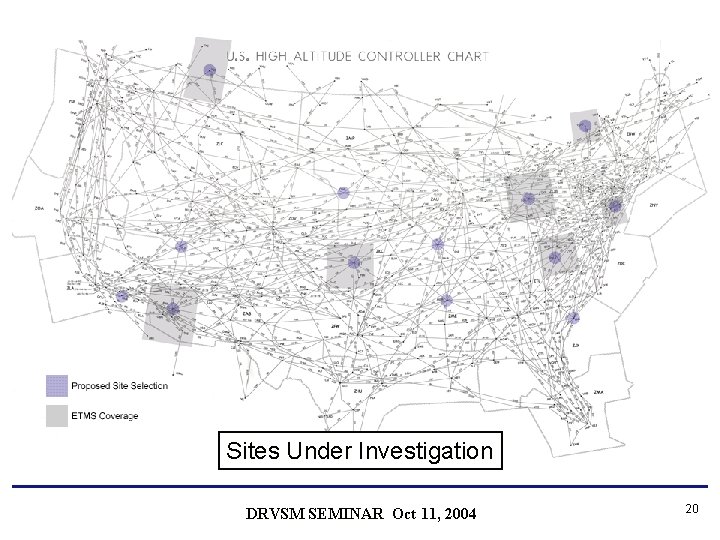
D Sites Under Investigation DRVSM SEMINAR Oct 11, 2004 20
MONITORING GOALS ASSOCIATED WITH STATE RVSM APPROVAL DRVSM SEMINAR Oct 11, 2004
MINIMUM AIRCRAFT SYSTEM PERFORMANCE SPECIFICATION (MASPS) D Q Performance which aircraft group must be capable of achieving in service, regardless of airspace where RVSM is applied Q Mean altimetry system error (ASE) of the group < 80 ft in magnitude Q Sum of the absolute value of the mean plus 3 standard deviations of ASE for group < 245 ft Q Errors in altitude-keeping symmetric about a mean of 0 ft, have a standard deviation < 43 ft and have error frequency which decreases at least exponentially with increasing error magnitude DRVSM SEMINAR Oct 11, 2004 22
D Monitoring Policies QINITIAL MONITORING. In application to the appropriate State authority for RVSM approval, operators must show plan for meeting monitoring requirements necessary to receive RVSM approval. QAIRCRAFT STATUS FOR MONITORING. Aircraft engineering work that is required to bring the aircraft into compliance with RVSM standards must be completed prior to the aircraft being monitored. QParticipation in an approved monitoring program is required in accordance with the chart, however, monitoring not required prior to the grant of RVSM operational approval DRVSM SEMINAR Oct 11, 2004 23
Monitoring Policies (cont. ) D QAPPLICABILTY OF MONITORING FROM OTHER REGIONS. Operator monitoring results obtained from one region may be used to satisfy other regions’ requirements. QTRAILING CONE DATA. If aircraft documented to be in approved RVSM configuration, trailing cone data can be used to fulfill monitoring requirements QFOLLOW-ON MONITORING. Monitoring will continue after initial RVSM implementation. A follow-on program will be coordinated after reviewing results. DRVSM SEMINAR Oct 11, 2004 24
D BACKGROUND TO ESTABLISHMENT OF CURRENT MONITORING GOALS QFAA participated actively in the introduction of the North Atlantic (NAT) and Pacific RVSM QNAT, Pacific and European monitoring has produced substantial number of height-keeping performance estimates for aircraft types typically observed QMonitoring requirements reduced substantially from original 1997 set as monitoring results for individual aircraft types became available and compliance with requirements was established with high confidence DRVSM SEMINAR Oct 11, 2004 25
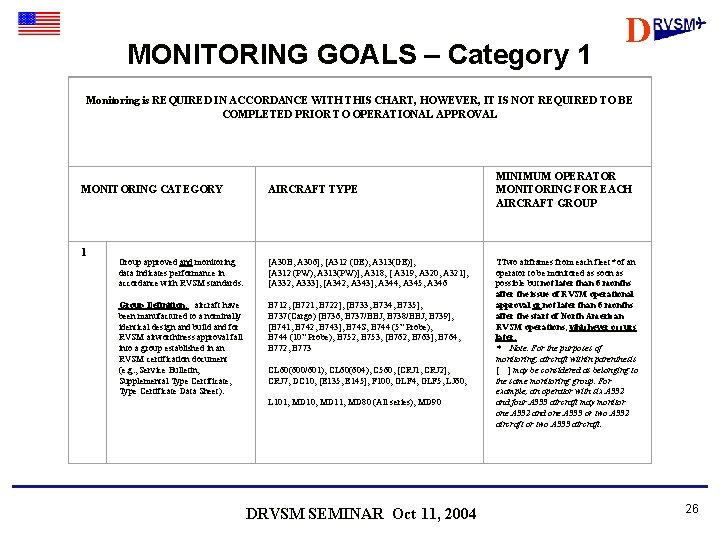
MONITORING GOALS – Category 1 D Monitoring is REQUIRED IN ACCORDANCE WITH THIS CHART, HOWEVER, IT IS NOT REQUIRED TO BE COMPLETED PRIOR TO OPERATIONAL APPROVAL MONITORING CATEGORY 1 AIRCRAFT TYPE Group approved and monitoring data indicates performance in accordance with RVSM standards. [A 30 B, A 306], [A 312 (GE), A 313(GE)], [A 312 (PW), A 313(PW)], A 318, [ A 319, A 320, A 321], [A 332, A 333], [A 342, A 343], A 344, A 345, A 346 Group Definition: aircraft have been manufactured to a nominally identical design and build and for RVSM airworthiness approval fall into a group established in an RVSM certification document (e. g. , Service Bulletin, Supplemental Type Certificate, Type Certificate Data Sheet). B 712, [B 721, B 722], [B 733, B 734, B 735], B 737(Cargo) [B 736, B 737/BBJ, B 738/BBJ, B 739], [B 741, B 742, B 743], B 74 S, B 744 (5” Probe), B 744 (10” Probe), B 752, B 753, [B 762, B 763], B 764, B 772, B 773 CL 60(600/601), CL 60(604), C 560, [CRJ 1, CRJ 2], CRJ 7, DC 10, [E 135, E 145], F 100, GLF 4, GLF 5, LJ 60, L 101, MD 10, MD 11, MD 80 (All series), MD 90 DRVSM SEMINAR Oct 11, 2004 MINIMUM OPERATOR MONITORING FOR EACH AIRCRAFT GROUP TTwo airframes from each fleet* of an operator to be monitored as soon as possible but not later than 6 months after the issue of RVSM operational approval or not later than 6 months after the start of North American RVSM operations, whichever occurs later. * Note. For the purposes of monitoring, aircraft within parenthesis [ ] may be considered as belonging to the same monitoring group. For example, an operator with six A 332 and four A 333 aircraft may monitor one A 332 and one A 333 or two A 332 aircraft or two A 333 aircraft. 26
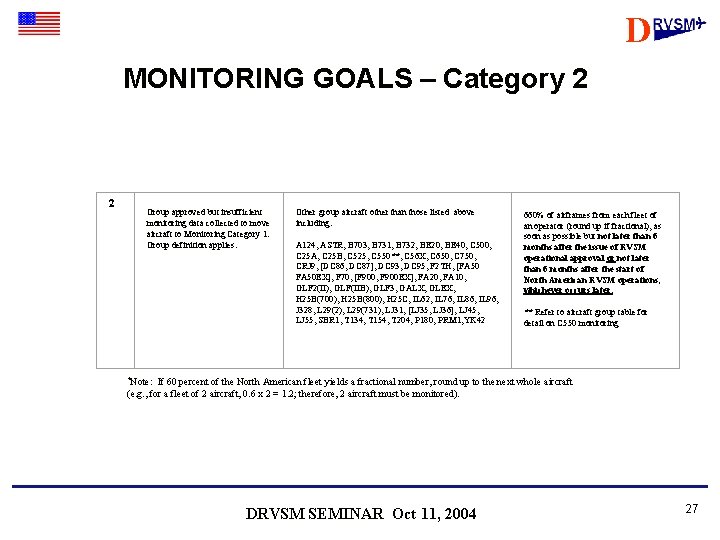
D MONITORING GOALS – Category 2 2 Group approved but insufficient monitoring data collected to move aircraft to Monitoring Category 1. Group definition applies. Other group aircraft other than those listed above including: A 124, ASTR, B 703, B 731, B 732, BE 20, BE 40, C 500, C 25 A, C 25 B, C 525, C 550**, C 56 X, C 650, C 750, CRJ 9, [DC 86, DC 87], DC 93, DC 95, F 2 TH, [FA 50 EX], F 70, [F 900, F 900 EX], FA 20, FA 10, GLF 2(II), GLF(IIB), GLF 3, GALX, GLEX, H 25 B(700), H 25 B(800), H 25 C, IL 62, IL 76, IL 86, IL 96, J 328, L 29(2), L 29(731), LJ 31, [LJ 35, LJ 36], LJ 45, LJ 55, SBR 1, T 134, T 154, T 204, P 180, PRM 1, YK 42 660% of airframes from each fleet of an operator (round up if fractional), as soon as possible but not later than 6 months after the issue of RVSM operational approval or not later than 6 months after the start of North American RVSM operations, whichever occurs later. ** Refer to aircraft group table for detail on C 550 monitoring *Note: If 60 percent of the North American fleet yields a fractional number, round up to the next whole aircraft (e. g. , for a fleet of 2 aircraft, 0. 6 x 2 = 1. 2; therefore, 2 aircraft must be monitored). DRVSM SEMINAR Oct 11, 2004 27
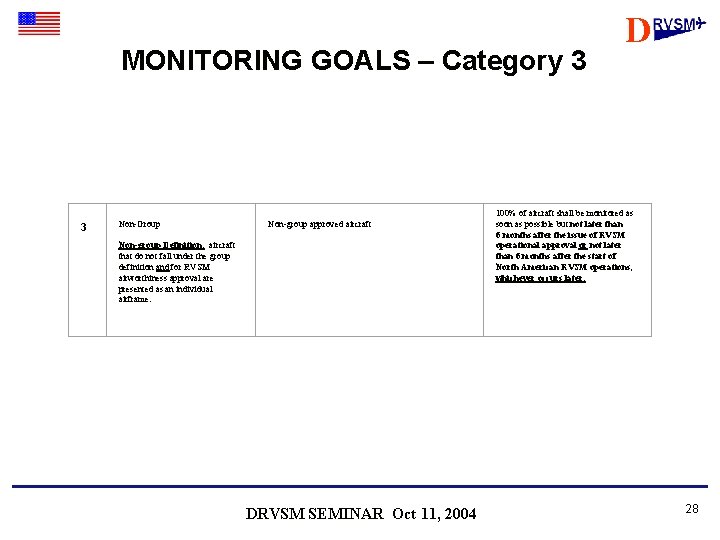
MONITORING GOALS – Category 3 3 Non-Group Non-group approved aircraft Non-group Definition: aircraft that do not fall under the group definition and for RVSM airworthiness approval are presented as an individual airframe. DRVSM SEMINAR Oct 11, 2004 D 100% of aircraft shall be monitored as soon as possible but not later than 6 months after the issue of RVSM operational approval or not later than 6 months after the start of North American RVSM operations, whichever occurs later. 28
Process to Perform Monitoring D QSee RVSM Documentation Webpage QSee “Monitoring Requirements and Procedures” section DRVSM SEMINAR Oct 11, 2004 29
- Slides: 29