
Present simple vs present continuous Compare the present
- Slides: 24
Present simple vs present continuous Compare the present simple and continuous.
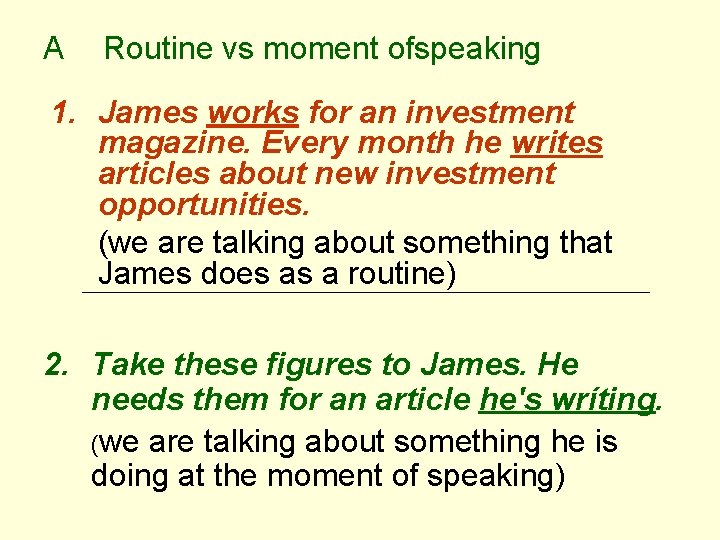
A Routine vs moment ofspeaking 1. James works for an investment magazine. Every month he writes articles about new investment opportunities. (we are talking about something that James does as a routine) 2. Take these figures to James. He needs them for an article he's wríting. (we are talking about something he is doing at the moment of speaking)
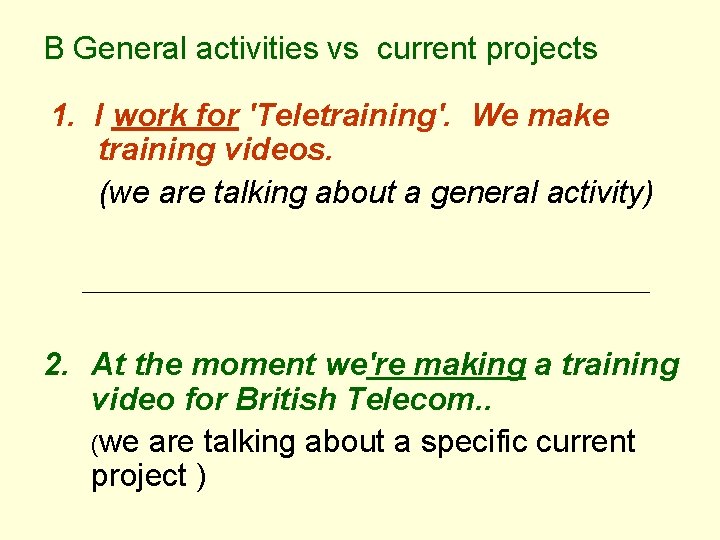
B General activities vs current projects 1. l work for 'Teletraining'. We make training videos. (we are talking about a general activity) 2. At the moment we're making a training video for British Telecom. . (we are talking about a specific current project )
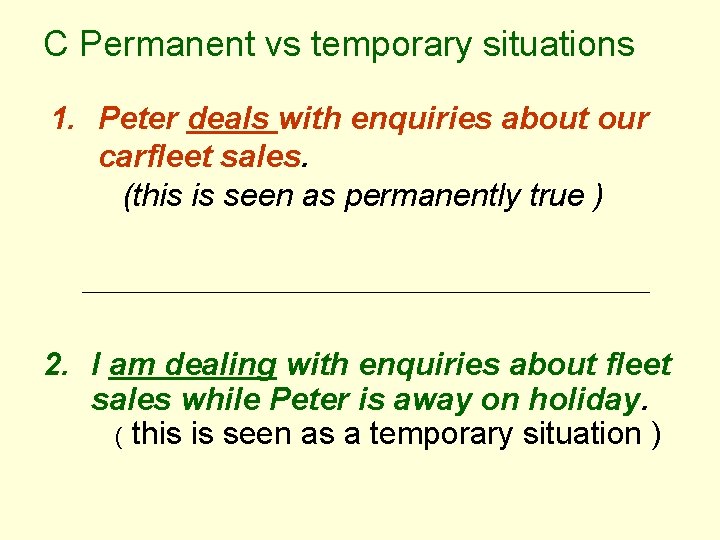
C Permanent vs temporary situations 1. Peter deals with enquiries about our carfleet sales. (this is seen as permanently true ) 2. I am dealing with enquiries about fleet sales while Peter is away on holiday. ( this is seen as a temporary situation )
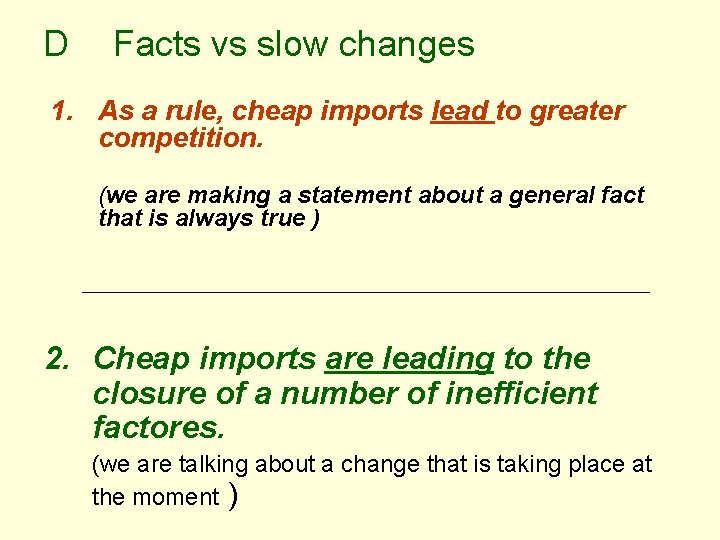
D Facts vs slow changes 1. As a rule, cheap imports lead to greater competition. (we are making a statement about a general fact that is always true ) 2. Cheap imports are leading to the closure of a number of inefficient factores. (we are talking about a change that is taking place at the moment )
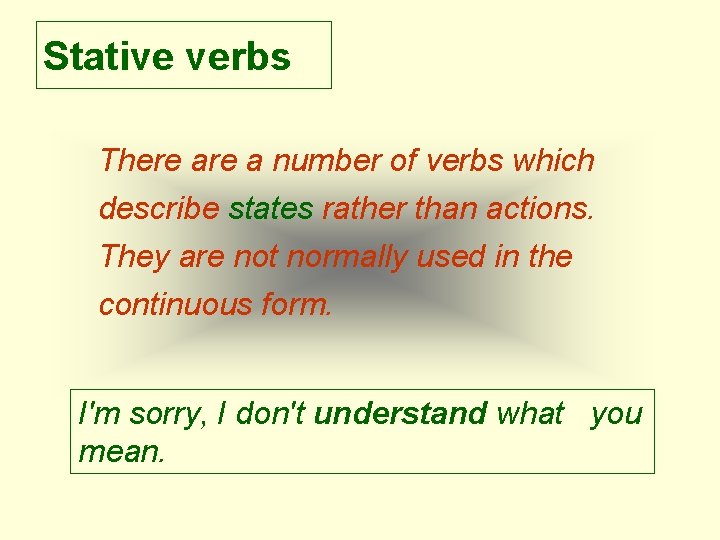
Stative verbs There a number of verbs which describe states rather than actions. They are not normally used in the continuous form. I'm sorry, I don't understand what you mean.
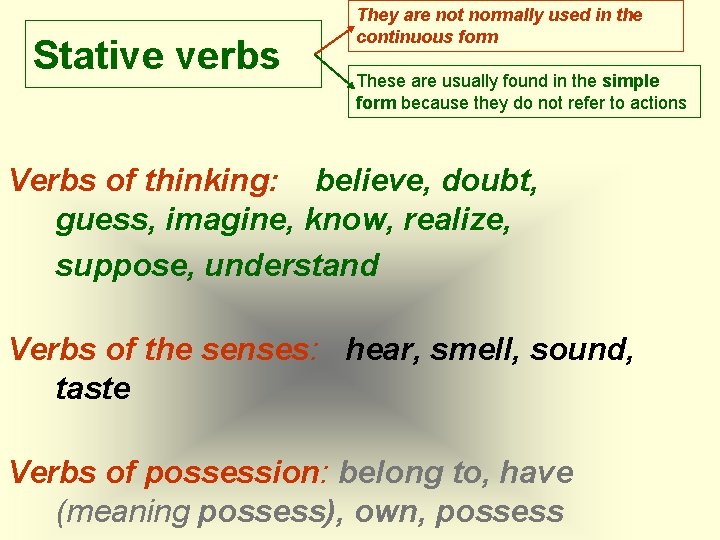
Stative verbs They are not normally used in the continuous form These are usually found in the simple form because they do not refer to actions Verbs of thinking: believe, doubt, guess, imagine, know, realize, suppose, understand Verbs of the senses: hear, smell, sound, taste Verbs of possession: belong to, have (meaning possess), own, possess
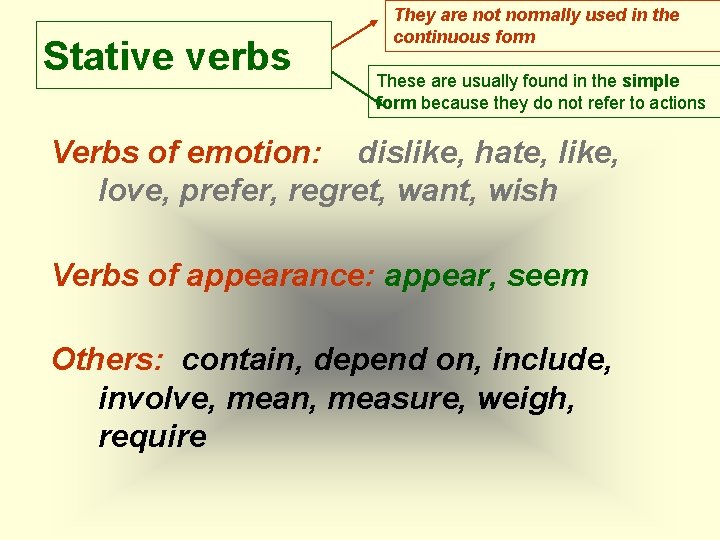
Stative verbs They are not normally used in the continuous form These are usually found in the simple form because they do not refer to actions Verbs of emotion: dislike, hate, like, love, prefer, regret, want, wish Verbs of appearance: appear, seem Others: contain, depend on, include, involve, mean, measure, weigh, require
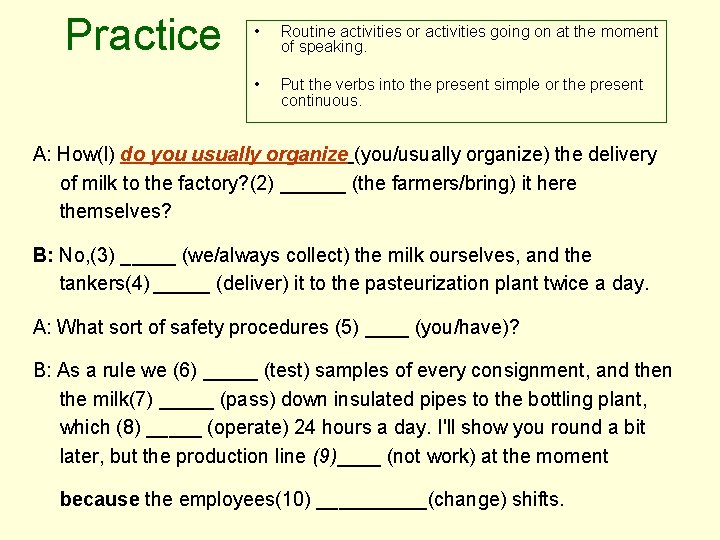
Practice • Routine activities or activities going on at the moment of speaking. • Put the verbs into the present simple or the present continuous. A: How(l) do you usually organize (you/usually organize) the delivery of milk to the factory? (2) ______ (the farmers/bring) it here themselves? B: No, (3) _____ (we/always collect) the milk ourselves, and the tankers(4) _____ (deliver) it to the pasteurization plant twice a day. A: What sort of safety procedures (5) ____ (you/have)? B: As a rule we (6) _____ (test) samples of every consignment, and then the milk(7) _____ (pass) down insulated pipes to the bottling plant, which (8) _____ (operate) 24 hours a day. I'll show you round a bit later, but the production line (9)____ (not work) at the moment because the employees(10) _____(change) shifts.
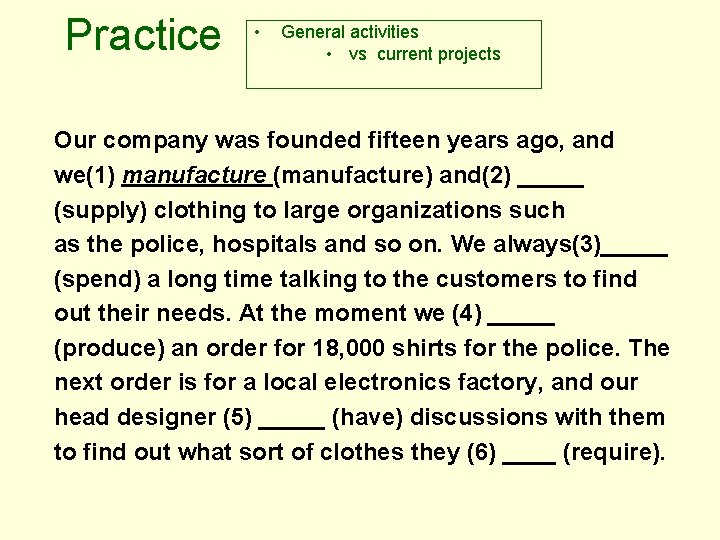
Practice • General activities • vs current projects Our company was founded fifteen years ago, and we(1) manufacture (manufacture) and(2) _____ (supply) clothing to large organizations such as the police, hospitals and so on. We always(3)_____ (spend) a long time talking to the customers to find out their needs. At the moment we (4) _____ (produce) an order for 18, 000 shirts for the police. The next order is for a local electronics factory, and our head designer (5) _____ (have) discussions with them to find out what sort of clothes they (6) ____ (require).
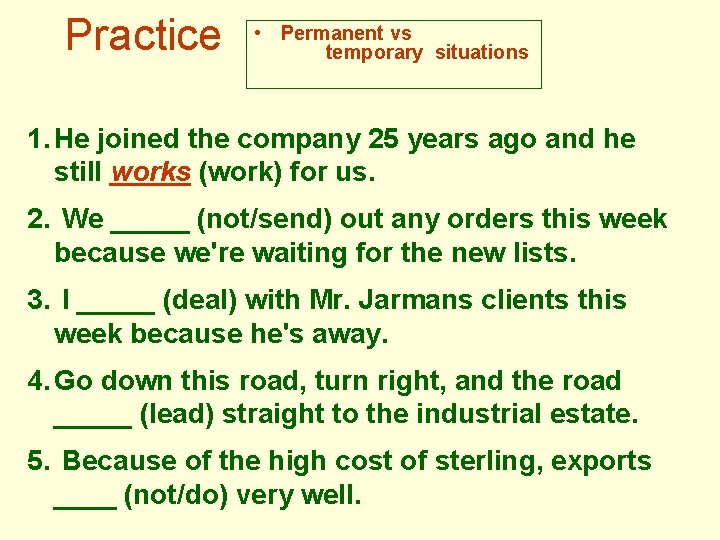
Practice • Permanent vs temporary situations 1. He joined the company 25 years ago and he still works (work) for us. 2. We _____ (not/send) out any orders this week because we're waiting for the new lists. 3. I _____ (deal) with Mr. Jarmans clients this week because he's away. 4. Go down this road, turn right, and the road _____ (lead) straight to the industrial estate. 5. Because of the high cost of sterling, exports ____ (not/do) very well.
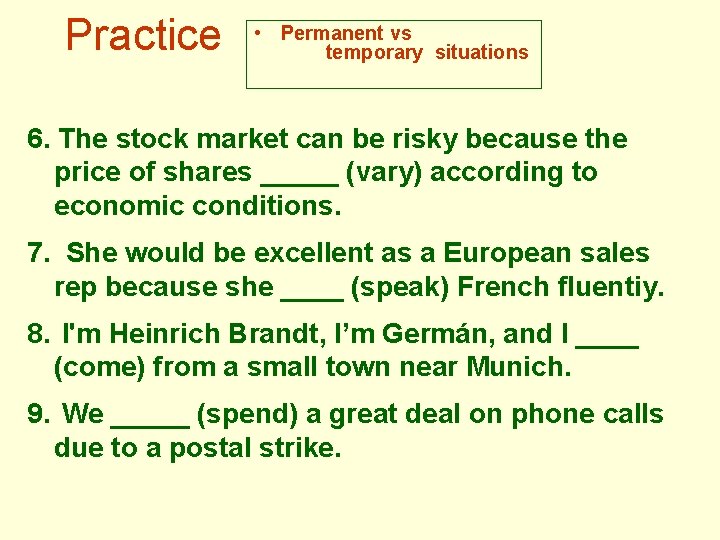
Practice • Permanent vs temporary situations 6. The stock market can be risky because the price of shares _____ (vary) according to economic conditions. 7. She would be excellent as a European sales rep because she ____ (speak) French fluentiy. 8. I'm Heinrich Brandt, I’m Germán, and I ____ (come) from a small town near Munich. 9. We _____ (spend) a great deal on phone calls due to a postal strike.
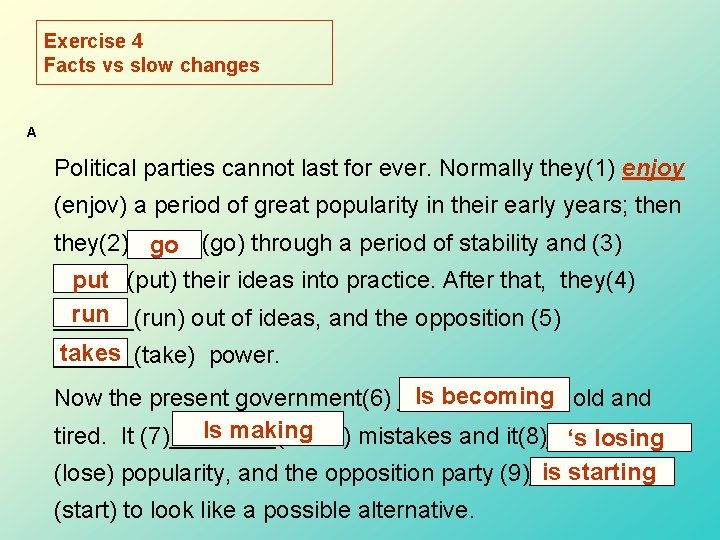
Exercise 4 Facts vs slow changes A Political parties cannot last for ever. Normally they(1) enjoy (enjov) a period of great popularity in their early years; then they(2)_____ go (go) through a period of stability and (3) put (put) their ideas into practice. After that, they(4) _____ run ______(run) out of ideas, and the opposition (5) takes ______(take) power. Is becoming old and Now the present government(6) _____(become) Is making tired. It (7)____(make) mistakes and it(8)____ ‘s losing is starting (lose) popularity, and the opposition party (9)_____ (start) to look like a possible alternative.
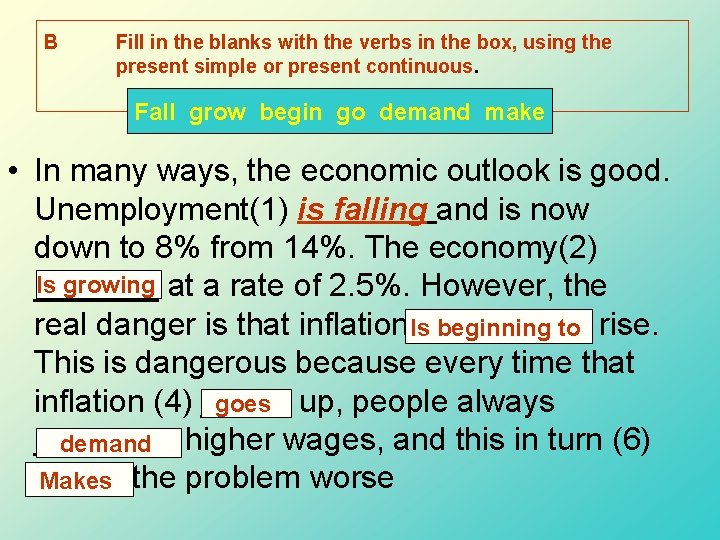
B Fill in the blanks with the verbs in the box, using the present simple or present continuous. Fall grow begin go demand make • In many ways, the economic outlook is good. Unemployment(1) is falling and is now down to 8% from 14%. The economy(2) Is growing at a rate of 2. 5%. However, the _______ real danger is that inflation Is(3) _____ to to rise. beginning This is dangerous because every time that inflation (4) _____ goes up, people always ____ demand higher wages, and this in turn (6) _____ Makes the problem worse
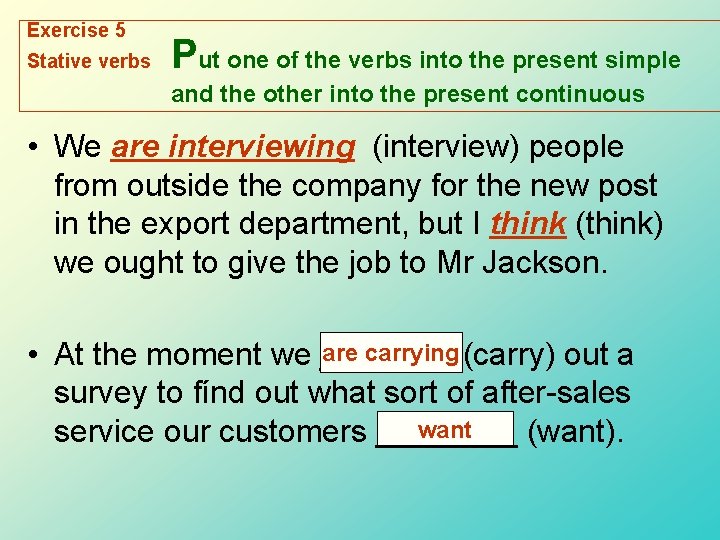
Exercise 5 Stative verbs Put one of the verbs into the present simple and the other into the present continuous • We are interviewing (interview) people from outside the company for the new post in the export department, but I think (think) we ought to give the job to Mr Jackson. are carrying • At the moment we ____(carry) out a survey to fínd out what sort of after-sales want service our customers ____ (want).
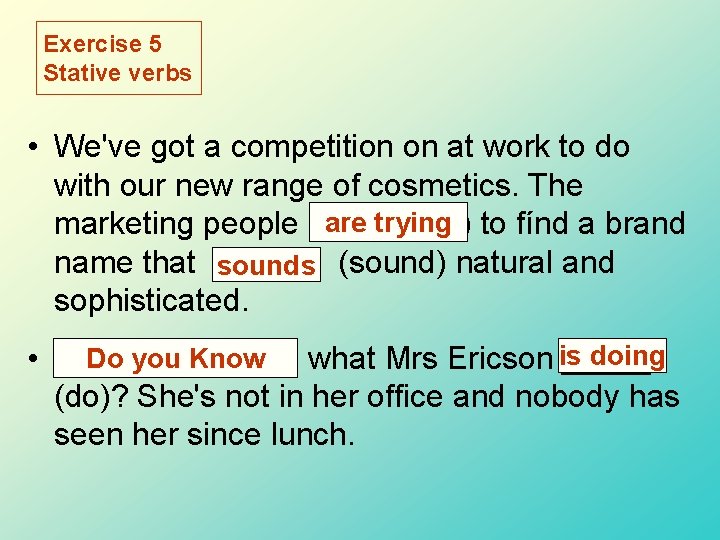
Exercise 5 Stative verbs • We've got a competition on at work to do with our new range of cosmetics. The are trying marketing people _____ (try) to fínd a brand name that _____ sounds (sound) natural and sophisticated. doing Do you Know • _____(you/know) what Mrs Ericson is _____ (do)? She's not in her office and nobody has seen her since lunch.
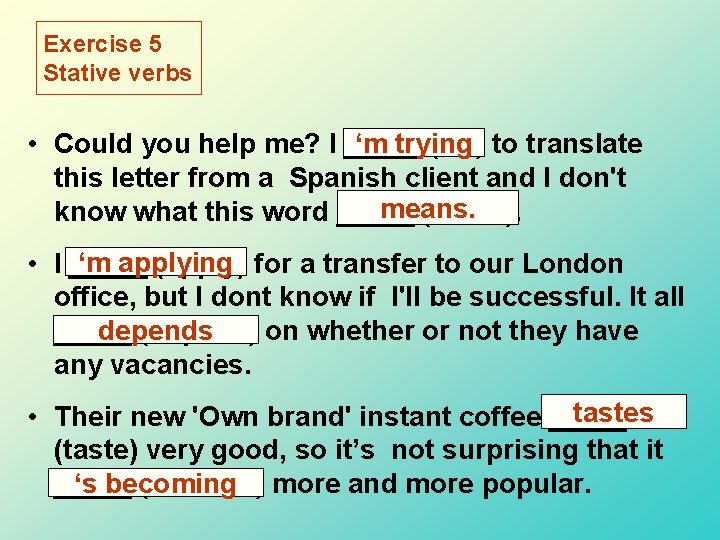
Exercise 5 Stative verbs ‘m trying • Could you help me? I _____ (try) to translate this letter from a Spanish client and I don't means. know what this word _____ (mean). ‘m applying • I _____ (apply) for a transfer to our London office, but I dont know if I'll be successful. It all _____ (depend) on whether or not they have depends any vacancies. tastes • Their new 'Own brand' instant coffee _____ (taste) very good, so it’s not surprising that it _____ (become) more and more popular. ‘s becoming
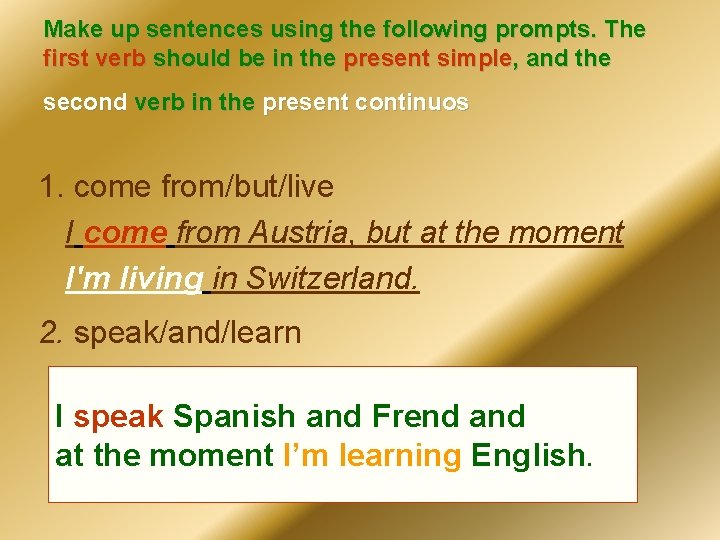
Make up sentences using the following prompts. The first verb should be in the present simple, and the second verb in the present continuos 1. come from/but/live I come from Austria, but at the moment I'm living in Switzerland. 2. speak/and/learn I speak Spanish and Frend at the moment I’m learning English.
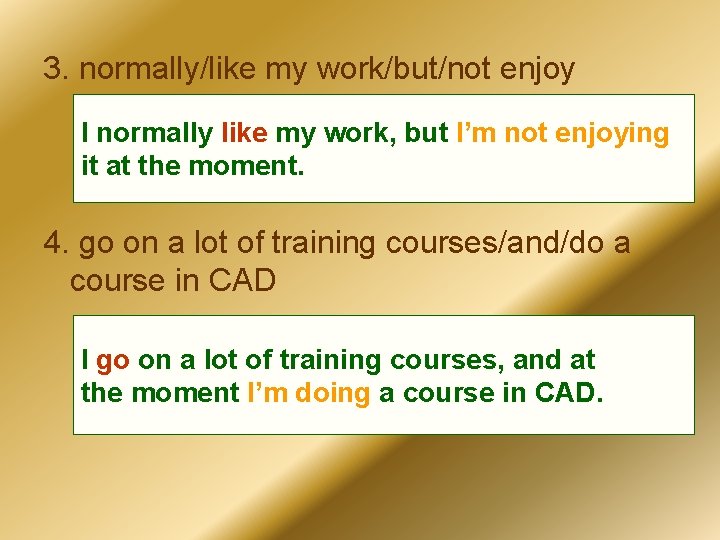
3. normally/like my work/but/not enjoy I normally like my work, but I’m not enjoying it at the moment. 4. go on a lot of training courses/and/do a course in CAD I go on a lot of training courses, and at the moment I’m doing a course in CAD.
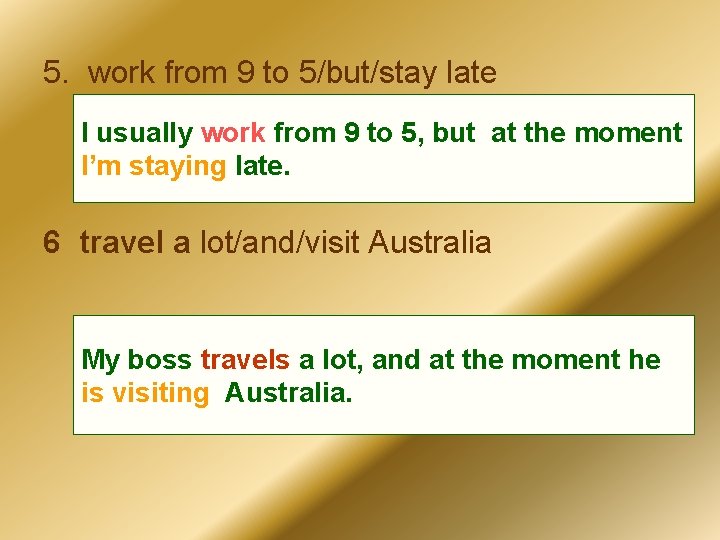
5. work from 9 to 5/but/stay late I usually work from 9 to 5, but at the moment I’m staying late. 6 travel a lot/and/visit Australia My boss travels a lot, and at the moment he is visiting Australia.
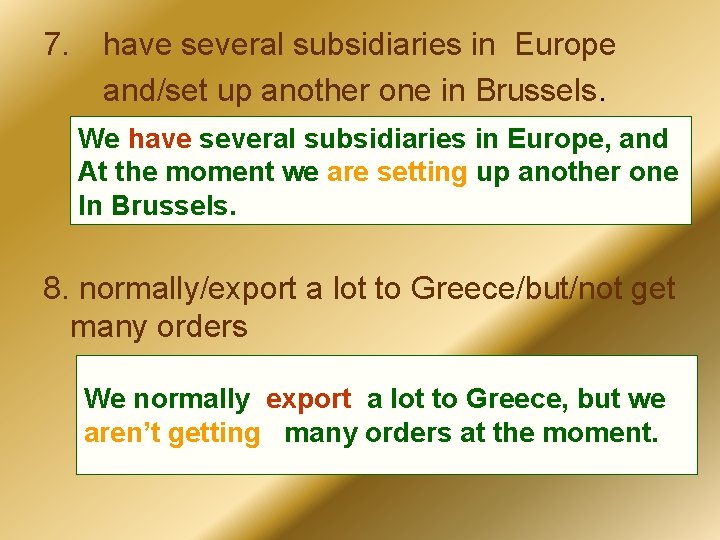
7. have several subsidiaries in Europe and/set up another one in Brussels. We have several subsidiaries in Europe, and At the moment we are setting up another one In Brussels. 8. normally/export a lot to Greece/but/not get many orders We normally export a lot to Greece, but we aren’t getting many orders at the moment.
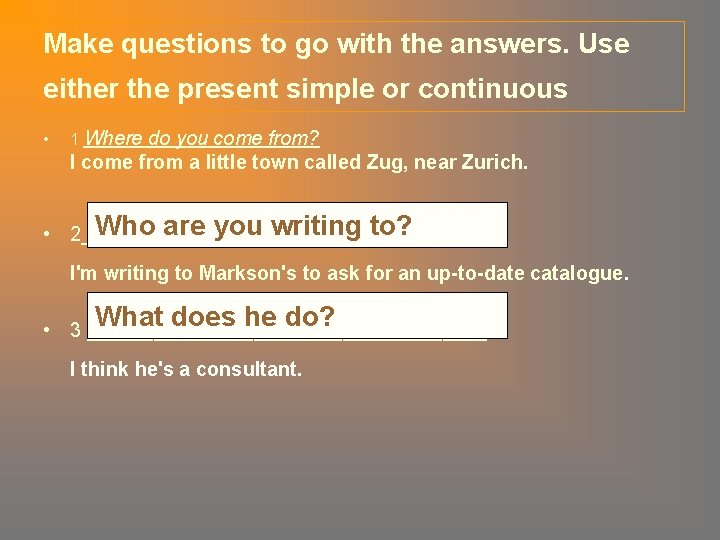
Make questions to go with the answers. Use either the present simple or continuous • 1 Where do you come from? I come from a little town called Zug, near Zurich. Who are you writing to? • 2___________________ I'm writing to Markson's to ask for an up-to-date catalogue. What does he do? • 3 __________________ I think he's a consultant.
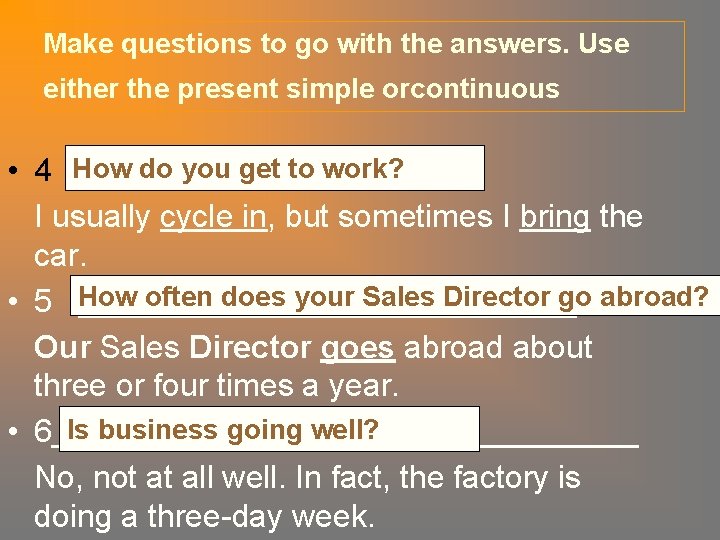
Make questions to go with the answers. Use either the present simple orcontinuous do you get to work? • 4 How _______ I usually cycle in, but sometimes I bring the car. often does your Sales Director go abroad? • 5 How ______________ Our Sales Director goes abroad about three or four times a year. Is business going well? • 6_________________ No, not at all well. In fact, the factory is doing a three-day week.
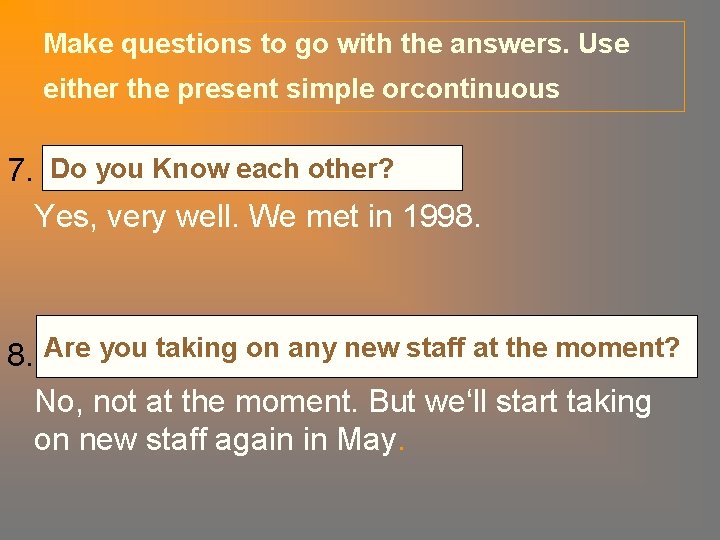
Make questions to go with the answers. Use either the present simple orcontinuous you Know each other? 7. Do ____________ Yes, very well. We met in 1998. 8. Are you taking on any new staff at the moment? No, not at the moment. But we‘ll start taking on new staff again in May.