
Present Simple STRUCTURE AND USES CONJUGATION Present Simple

- Slides: 13
Present Simple STRUCTURE AND USES
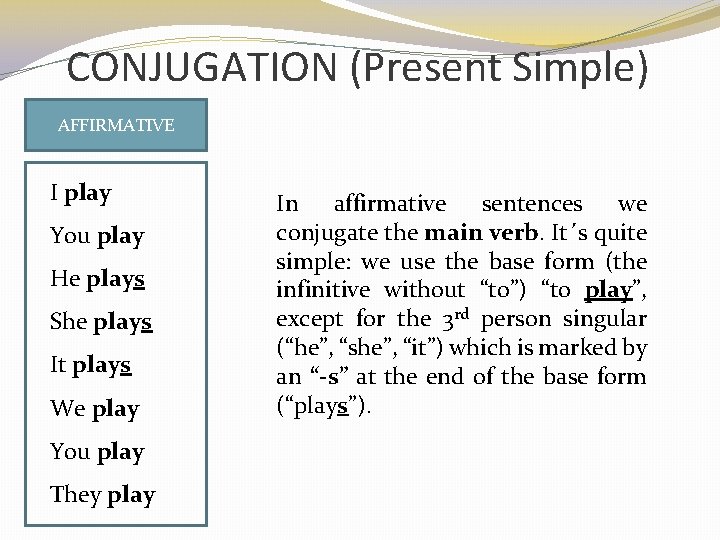
CONJUGATION (Present Simple) AFFIRMATIVE I play You play He plays She plays It plays We play You play They play In affirmative sentences we conjugate the main verb. It´s quite simple: we use the base form (the infinitive without “to”) “to play”, except for the 3 rd person singular (“he”, “she”, “it”) which is marked by an “-s” at the end of the base form (“plays”).
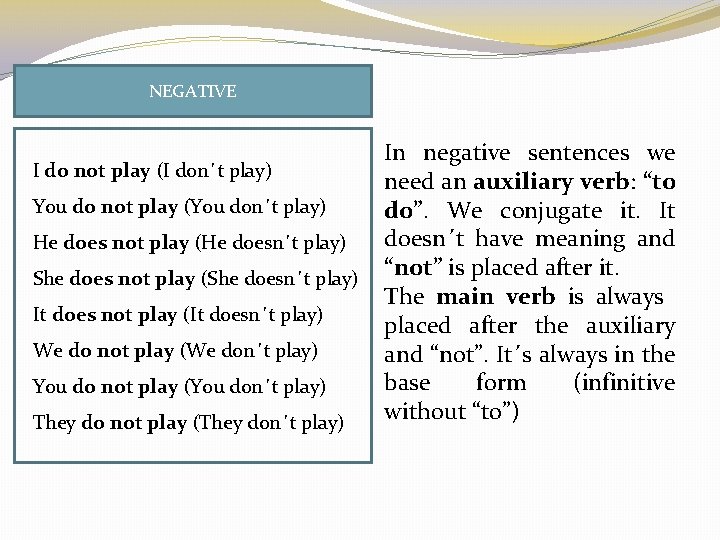
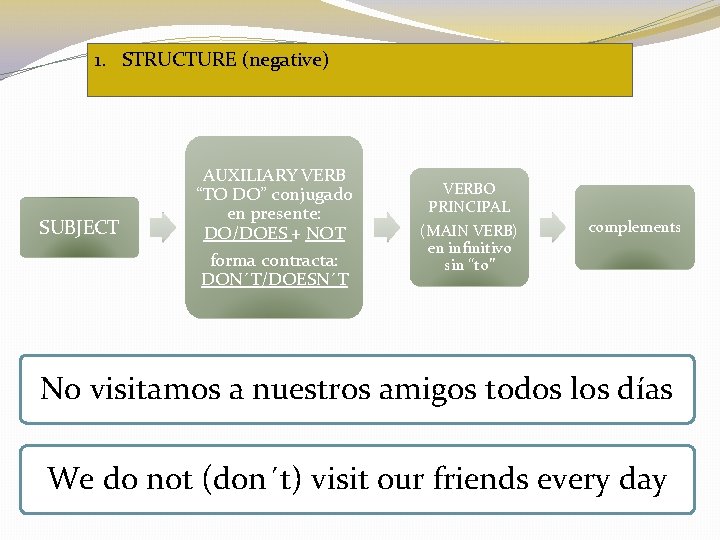
NEGATIVE I do not play (I don´t play) You do not play (You don´t play) He does not play (He doesn´t play) She does not play (She doesn´t play) It does not play (It doesn´t play) We do not play (We don´t play) You do not play (You don´t play) They do not play (They don´t play) In negative sentences we need an auxiliary verb: “to do”. We conjugate it. It doesn´t have meaning and “not” is placed after it. The main verb is always placed after the auxiliary and “not”. It´s always in the base form (infinitive without “to”)
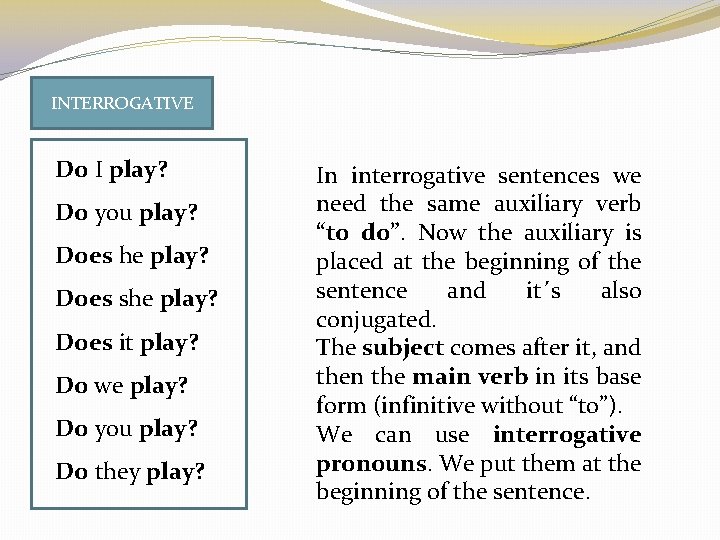
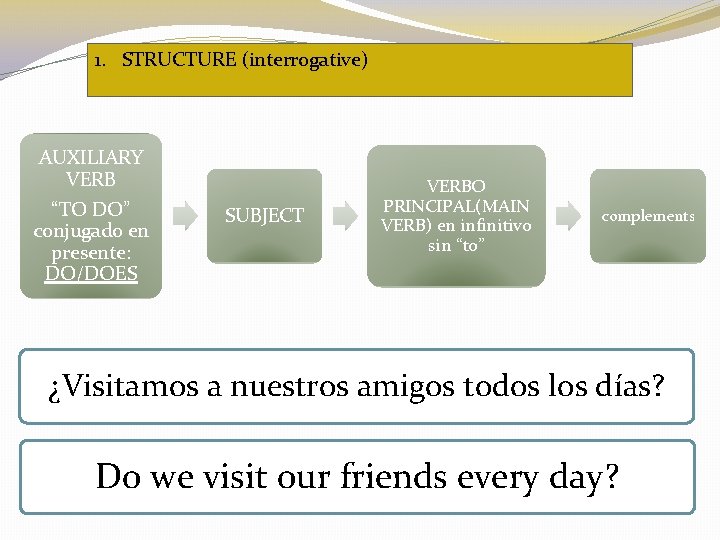
INTERROGATIVE Do I play? Do you play? Does he play? Does she play? Does it play? Do we play? Do you play? Do they play? In interrogative sentences we need the same auxiliary verb “to do”. Now the auxiliary is placed at the beginning of the sentence and it´s also conjugated. The subject comes after it, and then the main verb in its base form (infinitive without “to”). We can use interrogative pronouns. We put them at the beginning of the sentence.
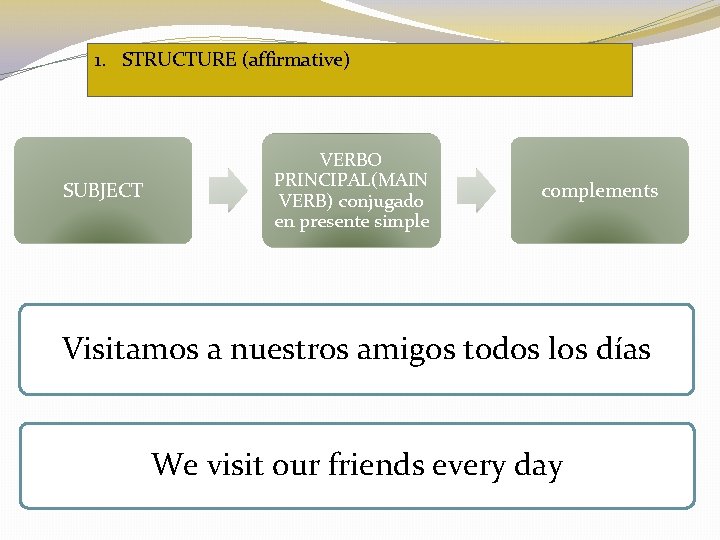
1. STRUCTURE (affirmative) SUBJECT VERBO PRINCIPAL(MAIN VERB) conjugado en presente simple complements Visitamos a nuestros amigos todos los días We visit our friends every day
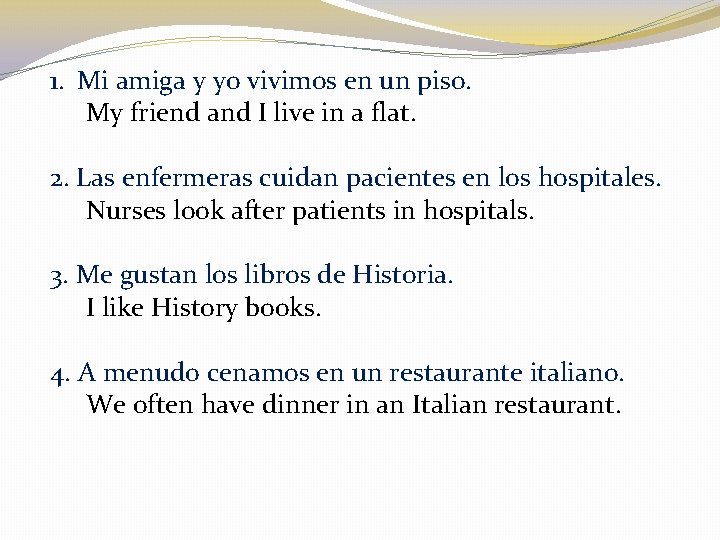
1. Mi amiga y yo vivimos en un piso. My friend and I live in a flat. 2. Las enfermeras cuidan pacientes en los hospitales. Nurses look after patients in hospitals. 3. Me gustan los libros de Historia. I like History books. 4. A menudo cenamos en un restaurante italiano. We often have dinner in an Italian restaurant.
1. STRUCTURE (negative) SUBJECT AUXILIARY VERB “TO DO” conjugado en presente: DO/DOES + NOT forma contracta: DON´T/DOESN´T VERBO PRINCIPAL (MAIN VERB) en infinitivo sin “to” complements No visitamos a nuestros amigos todos los días We do not (don´t) visit our friends every day
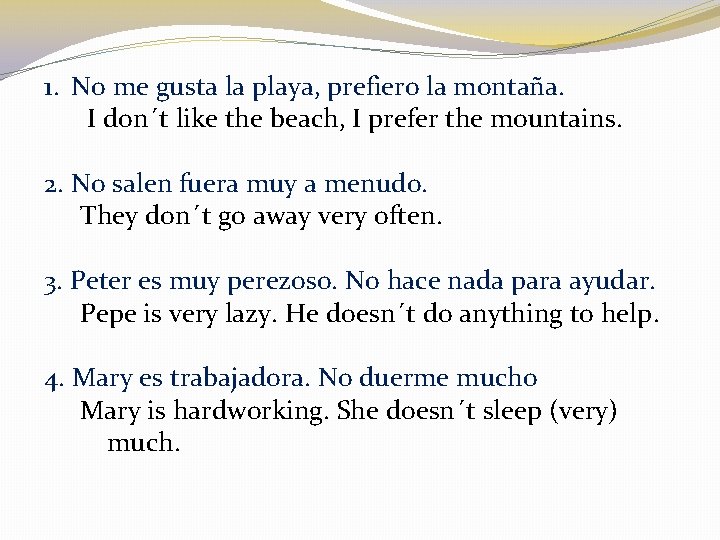
1. No me gusta la playa, prefiero la montaña. I don´t like the beach, I prefer the mountains. 2. No salen fuera muy a menudo. They don´t go away very often. 3. Peter es muy perezoso. No hace nada para ayudar. Pepe is very lazy. He doesn´t do anything to help. 4. Mary es trabajadora. No duerme mucho Mary is hardworking. She doesn´t sleep (very) much.
1. STRUCTURE (interrogative) AUXILIARY VERB “TO DO” conjugado en presente: DO/DOES SUBJECT VERBO PRINCIPAL(MAIN VERB) en infinitivo sin “to” complements ¿Visitamos a nuestros amigos todos los días? Do we visit our friends every day?
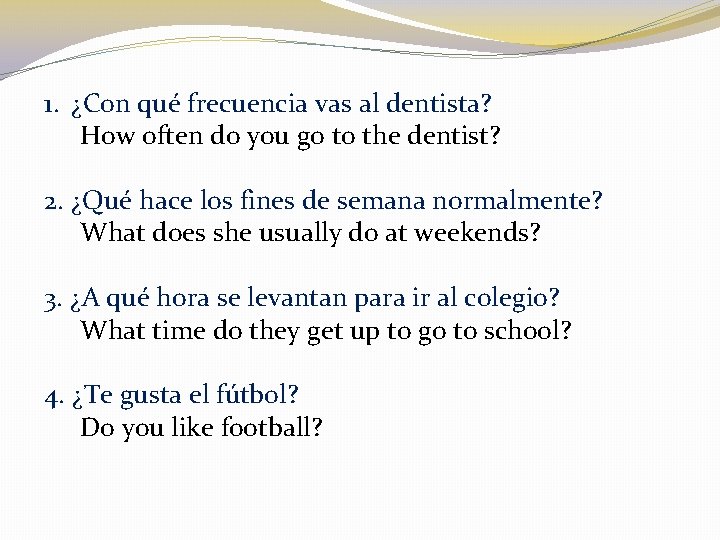
1. ¿Con qué frecuencia vas al dentista? How often do you go to the dentist? 2. ¿Qué hace los fines de semana normalmente? What does she usually do at weekends? 3. ¿A qué hora se levantan para ir al colegio? What time do they get up to go to school? 4. ¿Te gusta el fútbol? Do you like football?
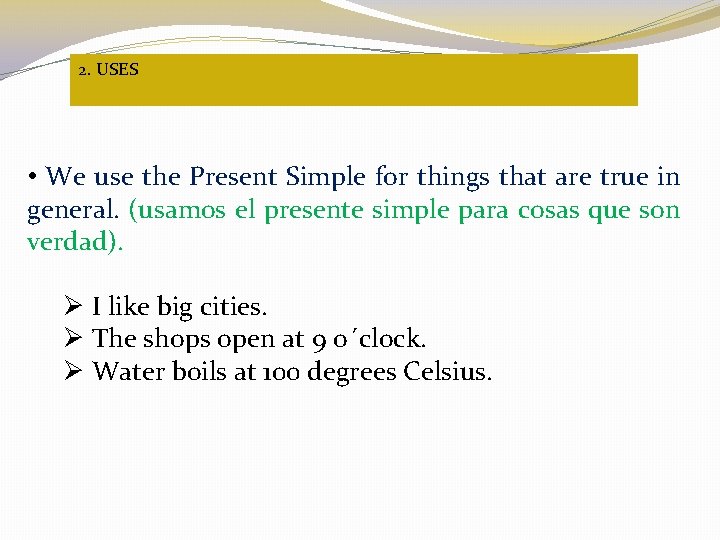
2. USES • We use the Present Simple for things that are true in general. (usamos el presente simple para cosas que son verdad). Ø I like big cities. Ø The shops open at 9 o´clock. Ø Water boils at 100 degrees Celsius.
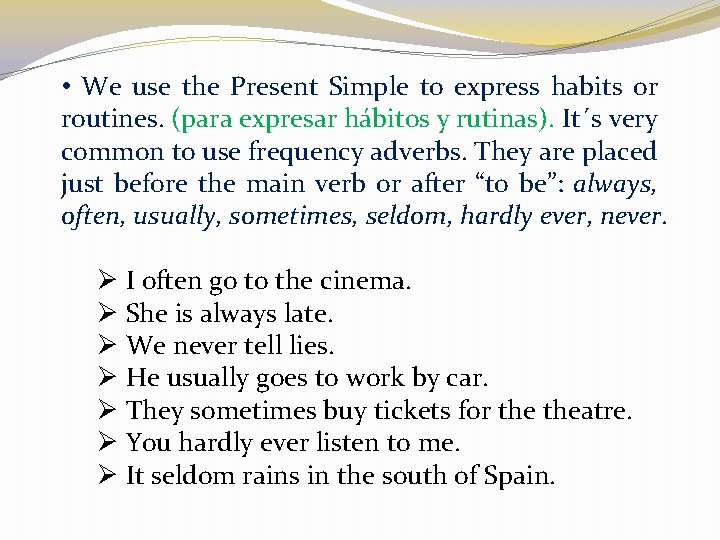
• We use the Present Simple to express habits or routines. (para expresar hábitos y rutinas). It´s very common to use frequency adverbs. They are placed just before the main verb or after “to be”: always, often, usually, sometimes, seldom, hardly ever, never. Ø I often go to the cinema. Ø She is always late. Ø We never tell lies. Ø He usually goes to work by car. Ø They sometimes buy tickets for theatre. Ø You hardly ever listen to me. Ø It seldom rains in the south of Spain.
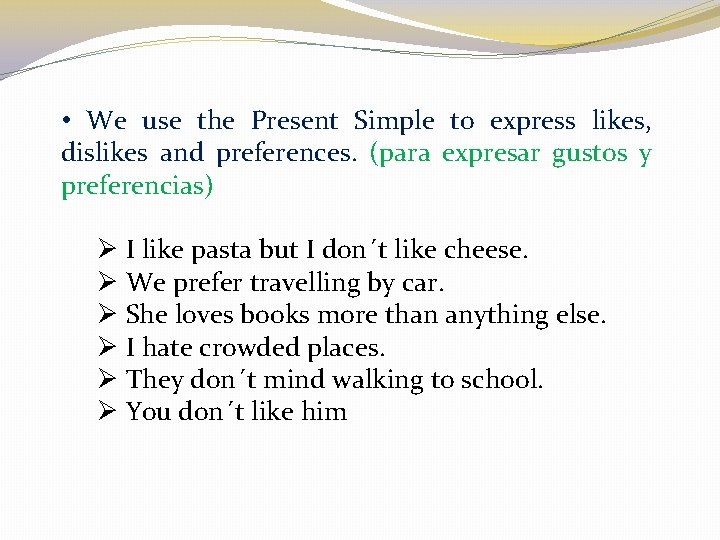
• We use the Present Simple to express likes, dislikes and preferences. (para expresar gustos y preferencias) Ø I like pasta but I don´t like cheese. Ø We prefer travelling by car. Ø She loves books more than anything else. Ø I hate crowded places. Ø They don´t mind walking to school. Ø You don´t like him