
Present Simple and Present Continuous How Theyre Made
- Slides: 6
Present Simple and Present Continuous
How They’re Made • The present simple tense is the base form of the verb: - I work in London. • But with the third person singular (he / she / it), we add an –s: - She works in London. • The present continuous is made from the present tense of the verb be and the –ing form of a verb: - I am working in London.
The Difference • We use the present simple tense when we want to talk about fixed habits or routines – things that don’t change. • We use the present continuous to talk about actions which are happening at the present moment, but will soon finish. • Compare these two statements: - (present simple) I play tennis. - (present continuous) I am playing tennis.
• (present simple) ‘I play tennis’ tells us that playing tennis is something the speaker always does. It is part of a routine or habit. We can call this a permanent situation. • (present continuous/ progressive) ‘I am playing tennis’ tells us that the speaker is playing tennis right now. Soon the game will be over. We call this a temporary
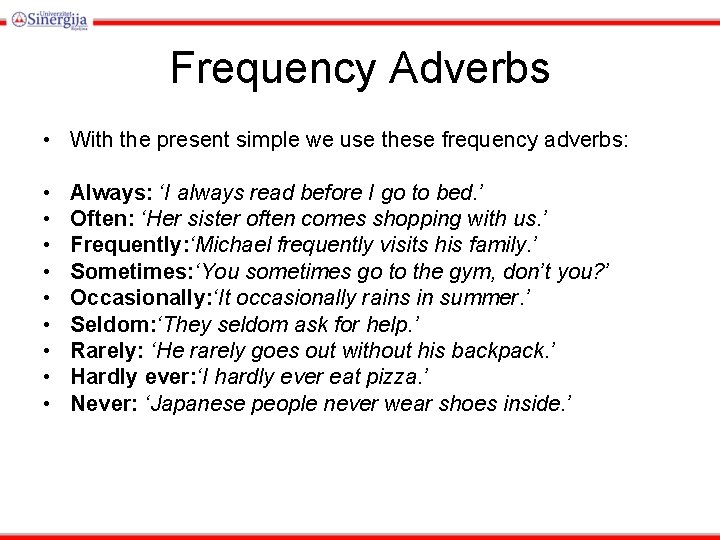
Frequency Adverbs • With the present simple we use these frequency adverbs: • • • Always: ‘I always read before I go to bed. ’ Often: ‘Her sister often comes shopping with us. ’ Frequently: ‘Michael frequently visits his family. ’ Sometimes: ‘You sometimes go to the gym, don’t you? ’ Occasionally: ‘It occasionally rains in summer. ’ Seldom: ‘They seldom ask for help. ’ Rarely: ‘He rarely goes out without his backpack. ’ Hardly ever: ‘I hardly ever eat pizza. ’ Never: ‘Japanese people never wear shoes inside. ’
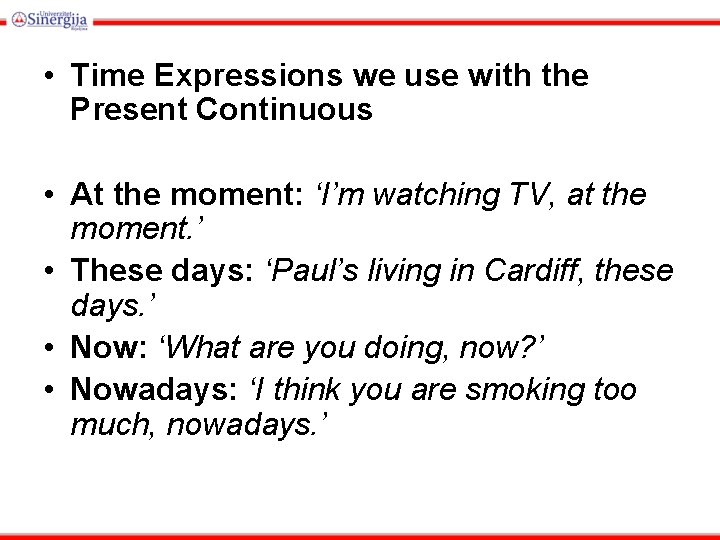
• Time Expressions we use with the Present Continuous • At the moment: ‘I’m watching TV, at the moment. ’ • These days: ‘Paul’s living in Cardiff, these days. ’ • Now: ‘What are you doing, now? ’ • Nowadays: ‘I think you are smoking too much, nowadays. ’