
Present Levels of Academic Achievement and Functional Performance


- Slides: 11
Present Levels of Academic Achievement and Functional Performance (PLAAFP) Professional Development Video Brent C. Elder, Ph. D. Assistant Professor Interdisciplinary and Inclusive Education Rowan University
Agenda ● Overview of strength-based language ● Fast Facts ● Writing PLAAFPs
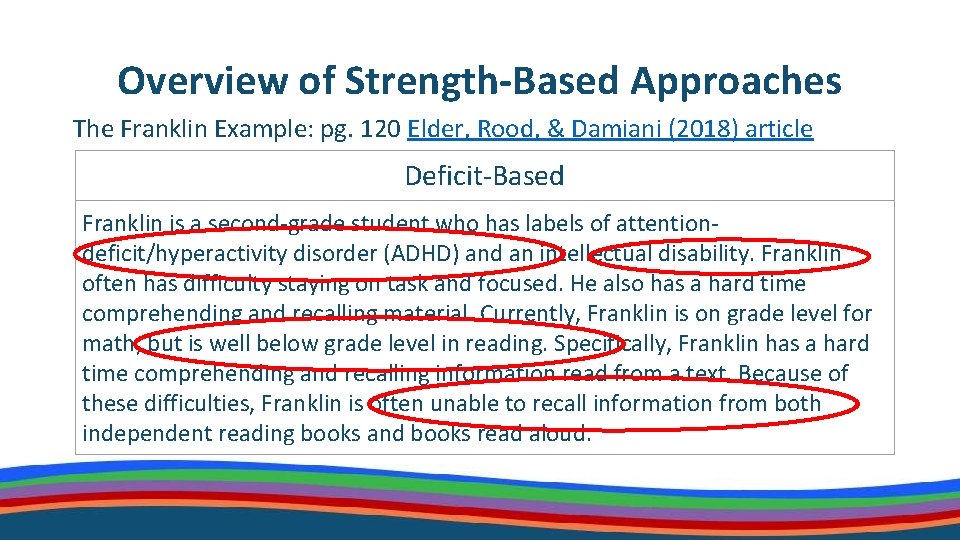
Overview of Strength-Based Approaches The Franklin Example: pg. 120 Elder, Rood, & Damiani (2018) article Deficit-Based Franklin is a second-grade student who has labels of attentiondeficit/hyperactivity disorder (ADHD) and an intellectual disability. Franklin often has difficulty staying on task and focused. He also has a hard time comprehending and recalling material. Currently, Franklin is on grade level for math, but is well below grade level in reading. Specifically, Franklin has a hard time comprehending and recalling information read from a text. Because of these difficulties, Franklin is often unable to recall information from both independent reading books and books read aloud.
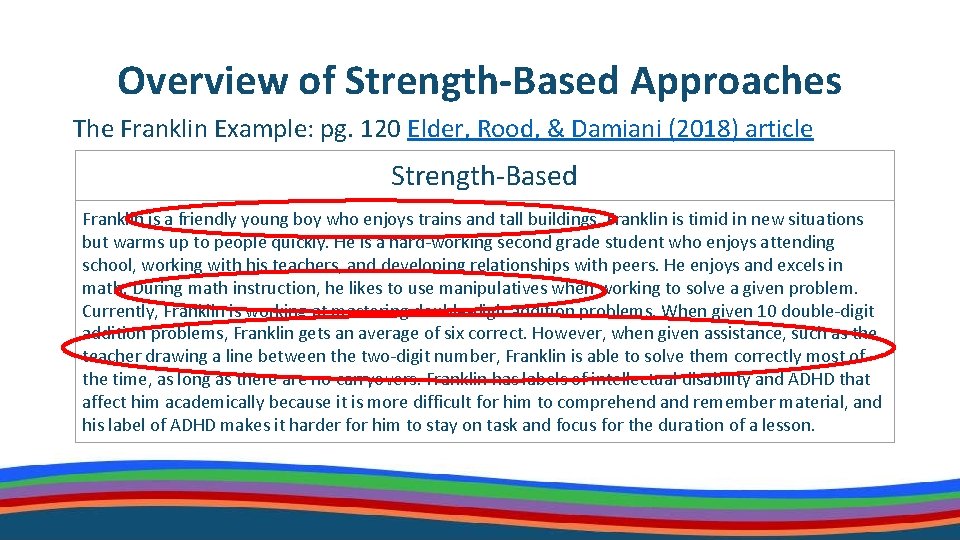
Overview of Strength-Based Approaches The Franklin Example: pg. 120 Elder, Rood, & Damiani (2018) article Strength-Based Franklin is a friendly young boy who enjoys trains and tall buildings. Franklin is timid in new situations but warms up to people quickly. He is a hard-working second grade student who enjoys attending school, working with his teachers, and developing relationships with peers. He enjoys and excels in math. During math instruction, he likes to use manipulatives when working to solve a given problem. Currently, Franklin is working at mastering double-digit addition problems. When given 10 double-digit addition problems, Franklin gets an average of six correct. However, when given assistance, such as the teacher drawing a line between the two-digit number, Franklin is able to solve them correctly most of the time, as long as there are no carryovers. Franklin has labels of intellectual disability and ADHD that affect him academically because it is more difficult for him to comprehend and remember material, and his label of ADHD makes it harder for him to stay on task and focus for the duration of a lesson.
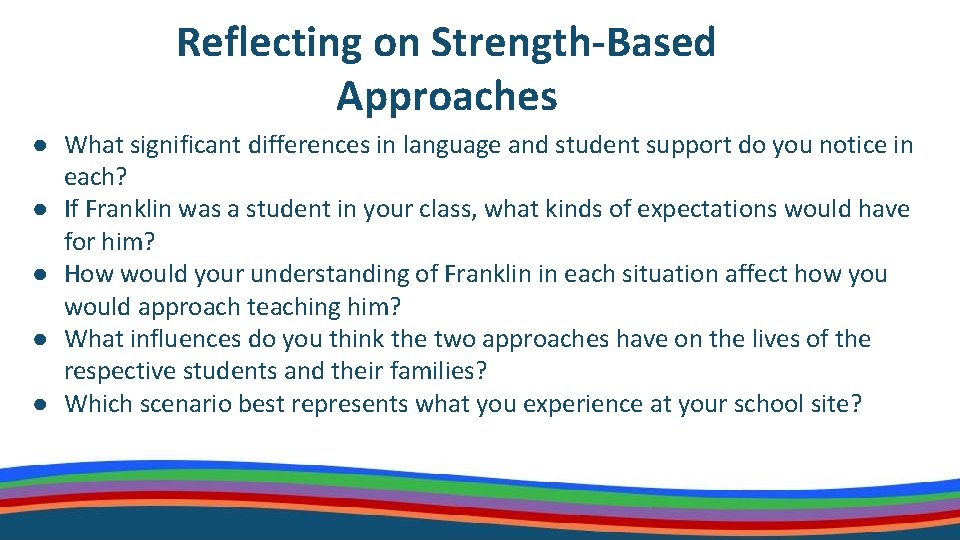
Reflecting on Strength-Based Approaches ● What significant differences in language and student support do you notice in each? ● If Franklin was a student in your class, what kinds of expectations would have for him? ● How would your understanding of Franklin in each situation affect how you would approach teaching him? ● What influences do you think the two approaches have on the lives of the respective students and their families? ● Which scenario best represents what you experience at your school site?
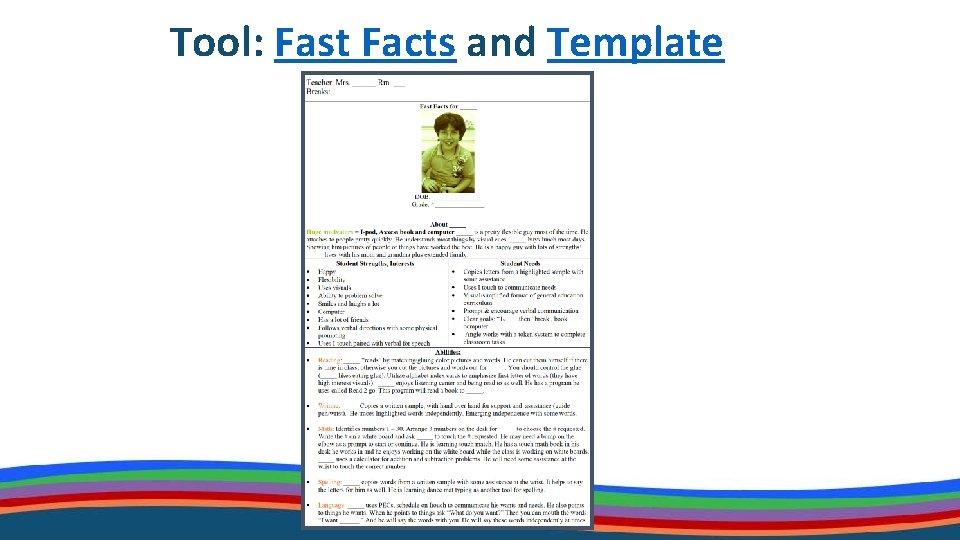
Tool: Fast Facts and Template
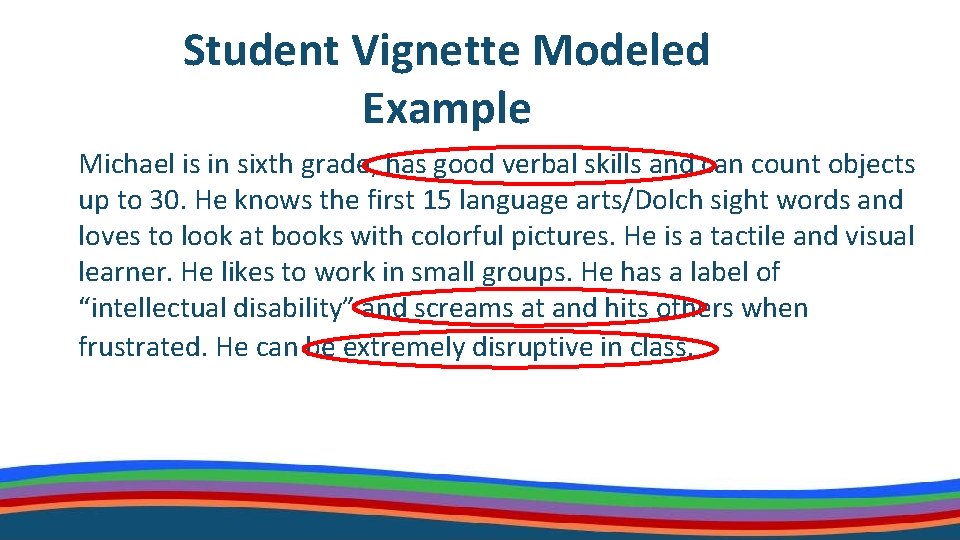
Student Vignette Modeled Example Michael is in sixth grade, has good verbal skills and can count objects up to 30. He knows the first 15 language arts/Dolch sight words and loves to look at books with colorful pictures. He is a tactile and visual learner. He likes to work in small groups. He has a label of “intellectual disability” and screams at and hits others when frustrated. He can be extremely disruptive in class.
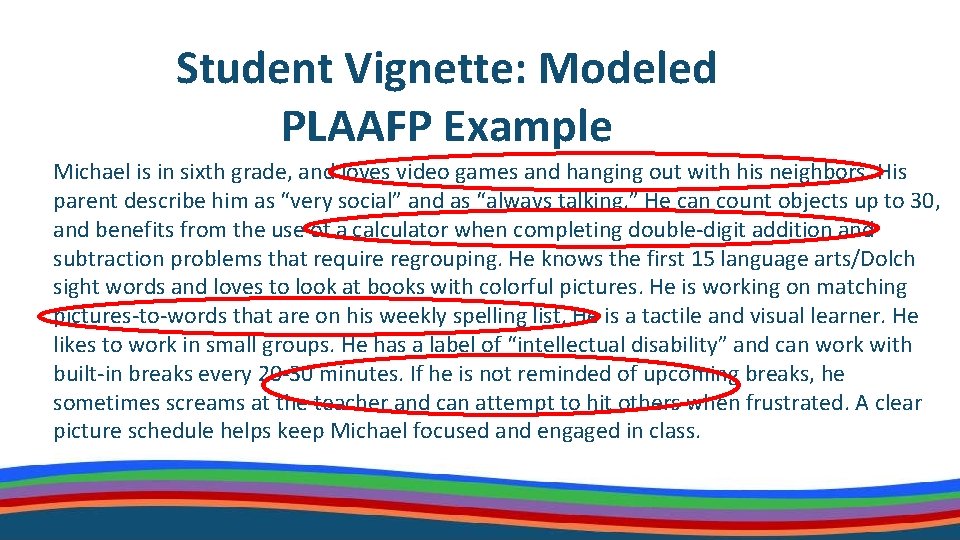
Student Vignette: Modeled PLAAFP Example Michael is in sixth grade, and loves video games and hanging out with his neighbors. His parent describe him as “very social” and as “always talking. ” He can count objects up to 30, and benefits from the use of a calculator when completing double-digit addition and subtraction problems that require regrouping. He knows the first 15 language arts/Dolch sight words and loves to look at books with colorful pictures. He is working on matching pictures-to-words that are on his weekly spelling list. He is a tactile and visual learner. He likes to work in small groups. He has a label of “intellectual disability” and can work with built-in breaks every 20 -30 minutes. If he is not reminded of upcoming breaks, he sometimes screams at the teacher and can attempt to hit others when frustrated. A clear picture schedule helps keep Michael focused and engaged in class.
A Deeper Dive • For a more in-depth explanation of strength-based language and PLAAFPs, see pgs. 122 -123 and pgs. 132 -134 in Elder, Rood, & Damiani (2018)
References Elder, B. C. , Rood, C. E. , & Damiani, M. L. (2018). Writing strength-based IEPs for students with disabilities in inclusive classrooms. International Journal of Whole Schooling, 14(1), 116 -153.
go. rowan. edu/lrcsouth