
PRESENT AND DISPLAY FOOD PRODUCTS D 1 HCC

- Slides: 56
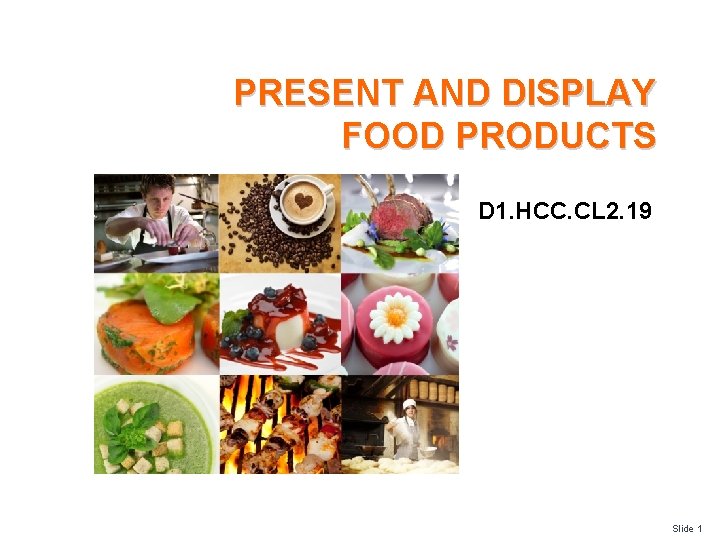
PRESENT AND DISPLAY FOOD PRODUCTS D 1. HCC. CL 2. 19 Slide 1
Present and display food products This unit comprises 3 elements: 1 Prepare garnishes and accompaniments 2 Plate and present foods 3 Store garnishes and accompaniments Slide 2
Assessments for this unit may include: � Oral questions � Written questions � Work projects � Workplace observation of practical skills � Practical exercises � Formal report from employer or supervisor Slide 3
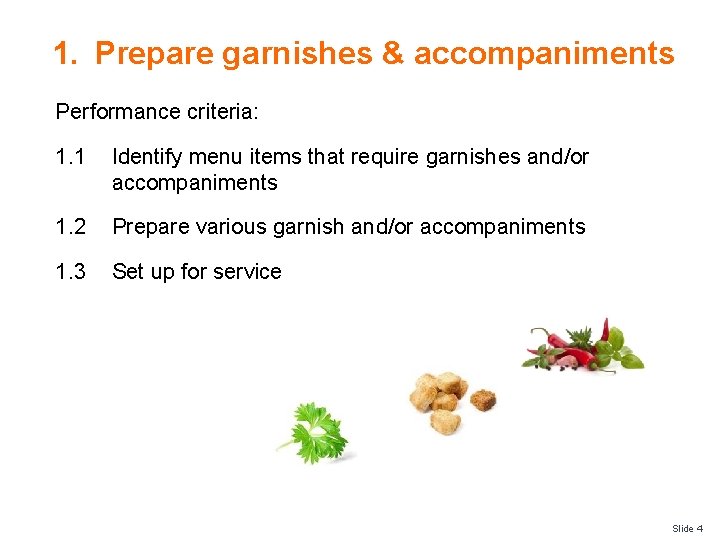
1. Prepare garnishes & accompaniments Performance criteria: 1. 1 Identify menu items that require garnishes and/or accompaniments 1. 2 Prepare various garnish and/or accompaniments 1. 3 Set up for service Slide 4
Present and display food products Terminology: � Read through the glossary of terms � Which terms are you familiar with? � Highlight these terms Slide 5
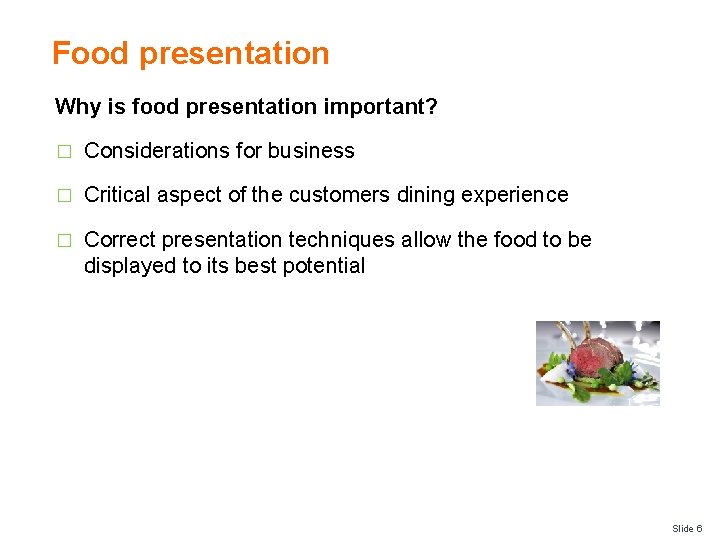
Food presentation Why is food presentation important? � Considerations for business � Critical aspect of the customers dining experience � Correct presentation techniques allow the food to be displayed to its best potential Slide 6
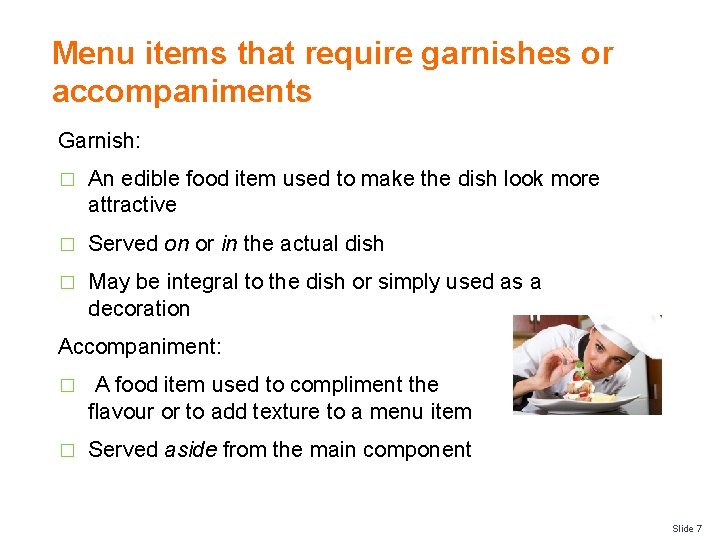
Menu items that require garnishes or accompaniments Garnish: � An edible food item used to make the dish look more attractive � Served on or in the actual dish � May be integral to the dish or simply used as a decoration Accompaniment: � A food item used to compliment the flavour or to add texture to a menu item � Served aside from the main component Slide 7
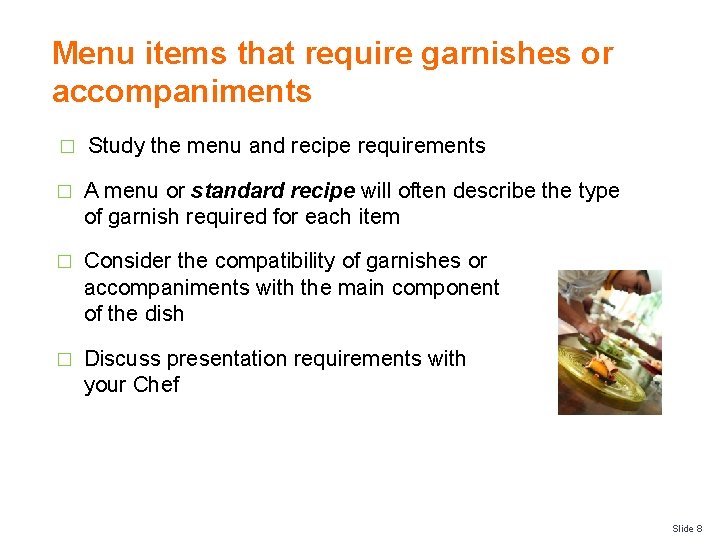
Menu items that require garnishes or accompaniments � Study the menu and recipe requirements � A menu or standard recipe will often describe the type of garnish required for each item � Consider the compatibility of garnishes or accompaniments with the main component of the dish � Discuss presentation requirements with your Chef Slide 8
Menu items that require garnishes or accompaniments � Some garnishes or accompaniments may not be described on the menu or in the recipe � These may be placed (at the Chef’s discretion) as a decoration to enhance the presentation of the dish � This may include items such as picked herbs, lemon wedges, or fruit garnishes for desserts Slide 9
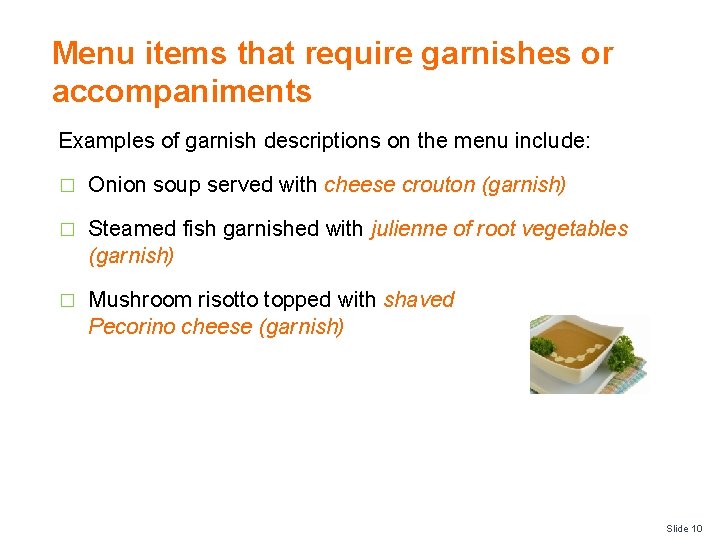
Menu items that require garnishes or accompaniments Examples of garnish descriptions on the menu include: � Onion soup served with cheese crouton (garnish) � Steamed fish garnished with julienne of root vegetables (garnish) � Mushroom risotto topped with shaved Pecorino cheese (garnish) Slide 10
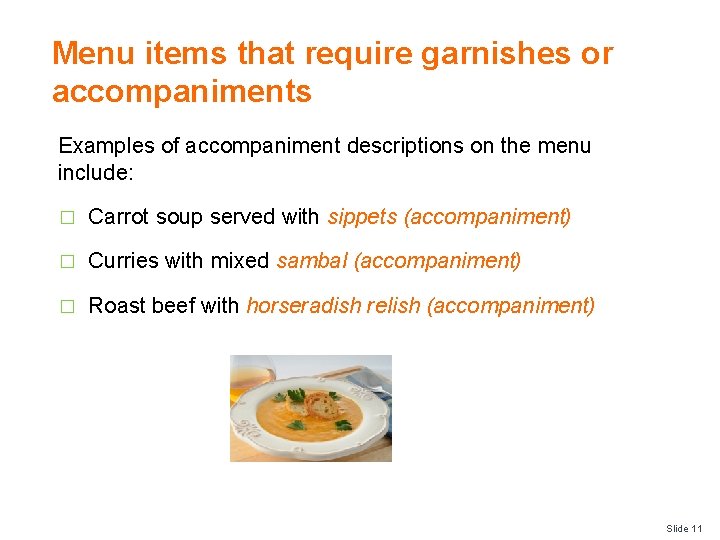
Menu items that require garnishes or accompaniments Examples of accompaniment descriptions on the menu include: � Carrot soup served with sippets (accompaniment) � Curries with mixed sambal (accompaniment) � Roast beef with horseradish relish (accompaniment) Slide 11
Menu items that require garnishes or accompaniments Other considerations when selecting garnishes or accompaniments include: � Type of cuisine � Cultural theme and compatibility � Traditional/classical style � Style of service Slide 12
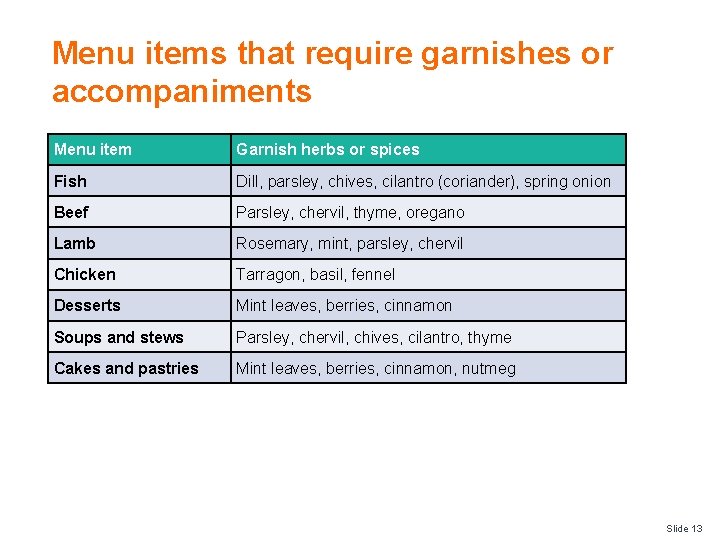
Menu items that require garnishes or accompaniments Menu item Garnish herbs or spices Fish Dill, parsley, chives, cilantro (coriander), spring onion Beef Parsley, chervil, thyme, oregano Lamb Rosemary, mint, parsley, chervil Chicken Tarragon, basil, fennel Desserts Mint leaves, berries, cinnamon Soups and stews Parsley, chervil, chives, cilantro, thyme Cakes and pastries Mint leaves, berries, cinnamon, nutmeg Slide 13
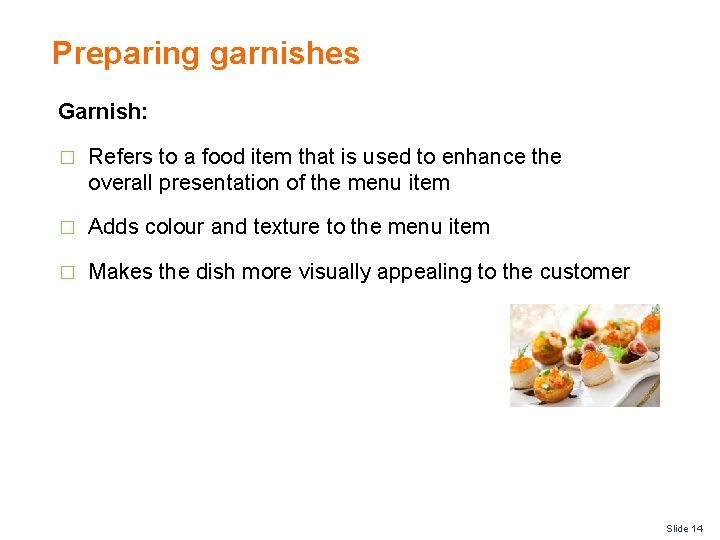
Preparing garnishes Garnish: � Refers to a food item that is used to enhance the overall presentation of the menu item � Adds colour and texture to the menu item � Makes the dish more visually appealing to the customer Slide 14
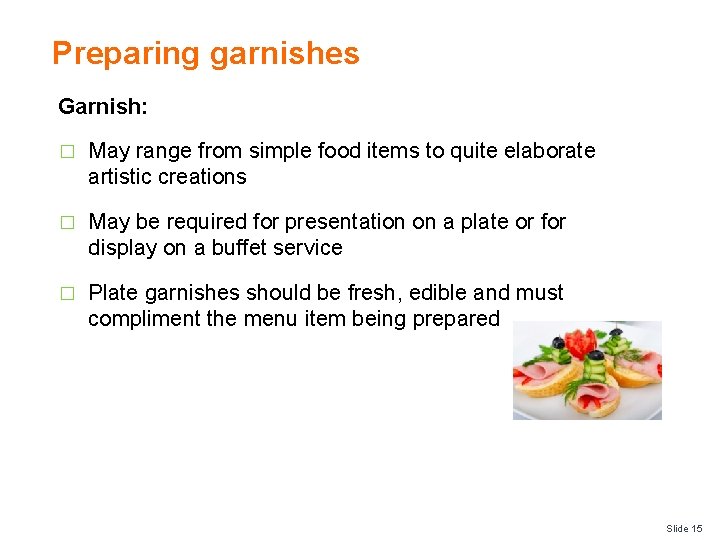
Preparing garnishes Garnish: � May range from simple food items to quite elaborate artistic creations � May be required for presentation on a plate or for display on a buffet service � Plate garnishes should be fresh, edible and must compliment the menu item being prepared Slide 15
Preparing garnishes Considerations for selection of garnishes: � The menu item, style and cuisine � The cost and selling price of the menu item � Availability, cost and freshness of products used for garnishes � Equipment required for preparing garnish items � Standard recipe requirements Slide 16
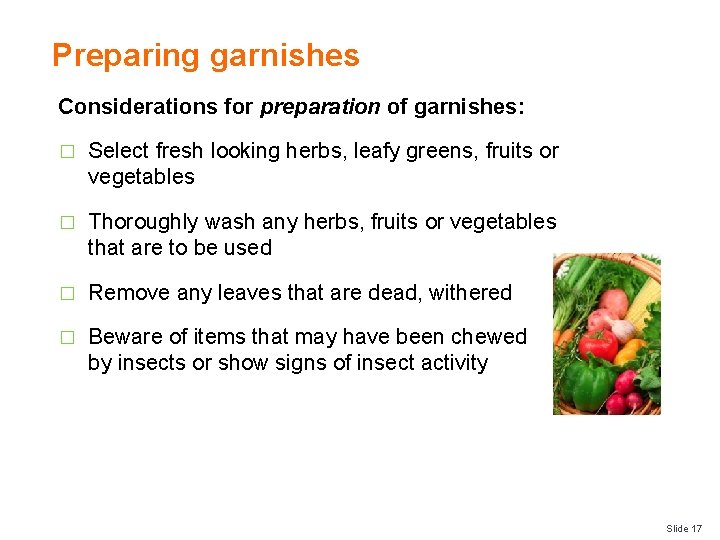
Preparing garnishes Considerations for preparation of garnishes: � Select fresh looking herbs, leafy greens, fruits or vegetables � Thoroughly wash any herbs, fruits or vegetables that are to be used � Remove any leaves that are dead, withered � Beware of items that may have been chewed by insects or show signs of insect activity Slide 17
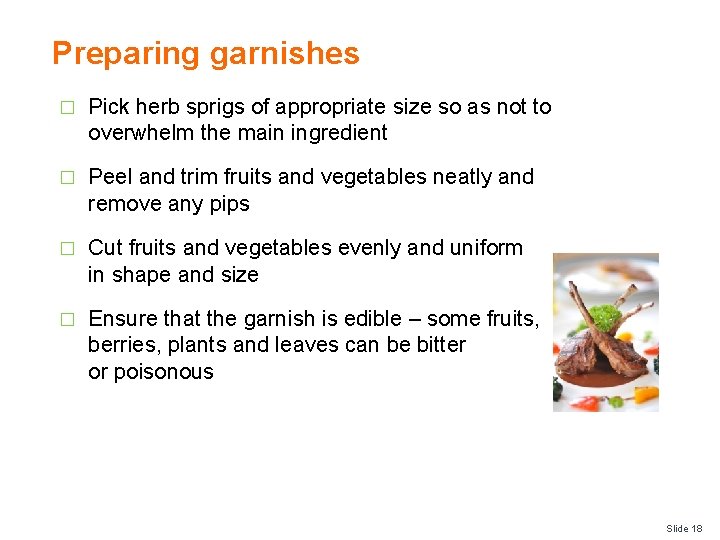
Preparing garnishes � Pick herb sprigs of appropriate size so as not to overwhelm the main ingredient � Peel and trim fruits and vegetables neatly and remove any pips � Cut fruits and vegetables evenly and uniform in shape and size � Ensure that the garnish is edible – some fruits, berries, plants and leaves can be bitter or poisonous Slide 18
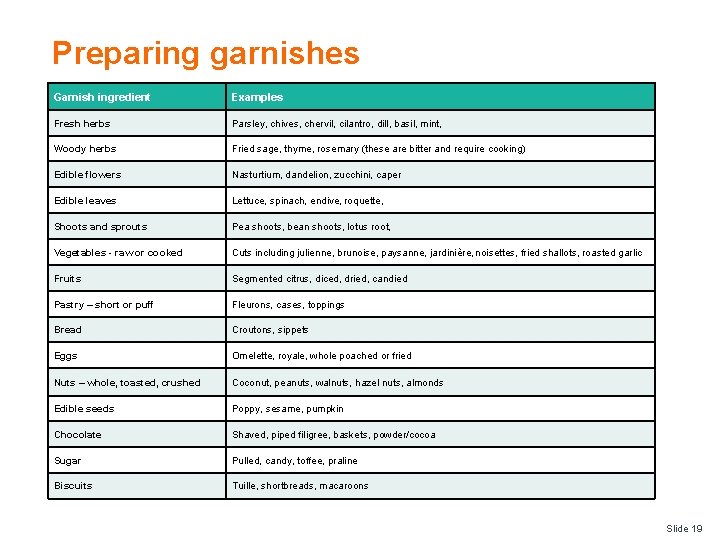
Preparing garnishes Garnish ingredient Examples Fresh herbs Parsley, chives, chervil, cilantro, dill, basil, mint, Woody herbs Fried sage, thyme, rosemary (these are bitter and require cooking) Edible flowers Nasturtium, dandelion, zucchini, caper Edible leaves Lettuce, spinach, endive, roquette, Shoots and sprouts Pea shoots, bean shoots, lotus root, Vegetables - raw or cooked Cuts including julienne, brunoise, paysanne, jardinière, noisettes, fried shallots, roasted garlic Fruits Segmented citrus, diced, dried, candied Pastry – short or puff Fleurons, cases, toppings Bread Croutons, sippets Eggs Omelette, royale, whole poached or fried Nuts – whole, toasted, crushed Coconut, peanuts, walnuts, hazel nuts, almonds Edible seeds Poppy, sesame, pumpkin Chocolate Shaved, piped filigree, baskets, powder/cocoa Sugar Pulled, candy, toffee, praline Biscuits Tuille, shortbreads, macaroons Slide 19
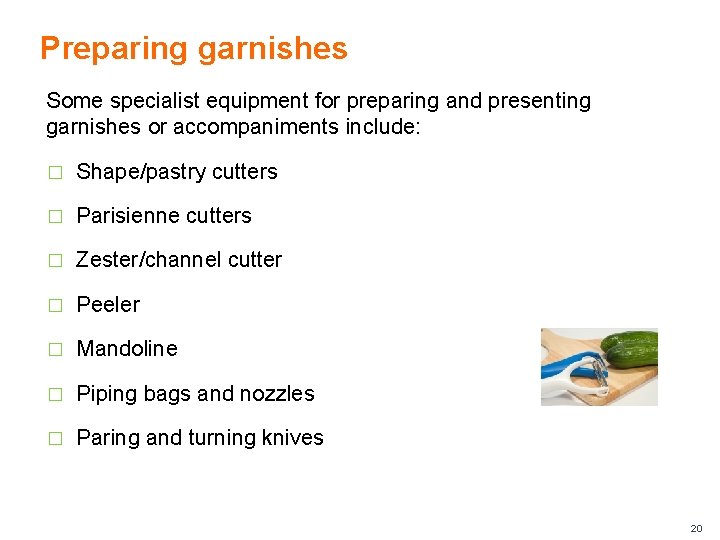
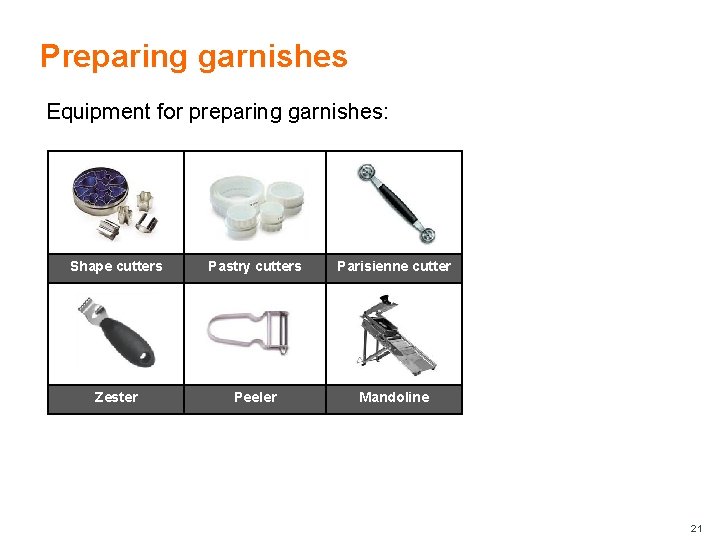
Preparing garnishes Some specialist equipment for preparing and presenting garnishes or accompaniments include: � Shape/pastry cutters � Parisienne cutters � Zester/channel cutter � Peeler � Mandoline � Piping bags and nozzles � Paring and turning knives 20
Preparing garnishes Equipment for preparing garnishes: Shape cutters Pastry cutters Parisienne cutter Zester Peeler Mandoline 21
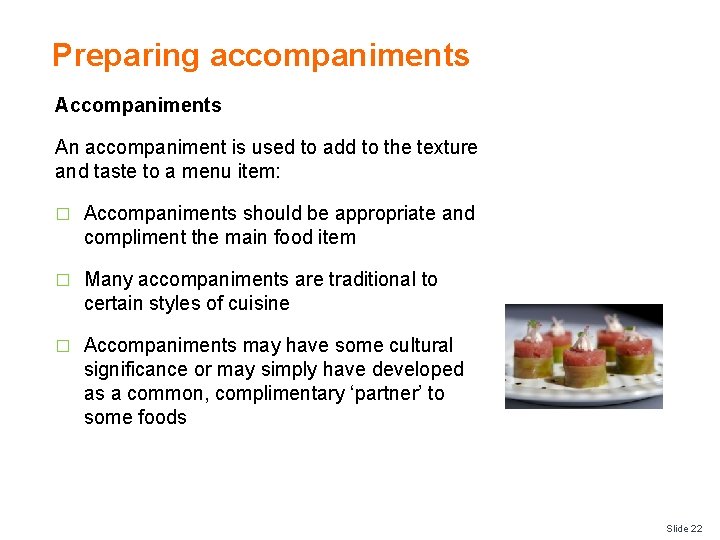
Preparing accompaniments An accompaniment is used to add to the texture and taste to a menu item: � Accompaniments should be appropriate and compliment the main food item � Many accompaniments are traditional to certain styles of cuisine � Accompaniments may have some cultural significance or may simply have developed as a common, complimentary ‘partner’ to some foods Slide 22
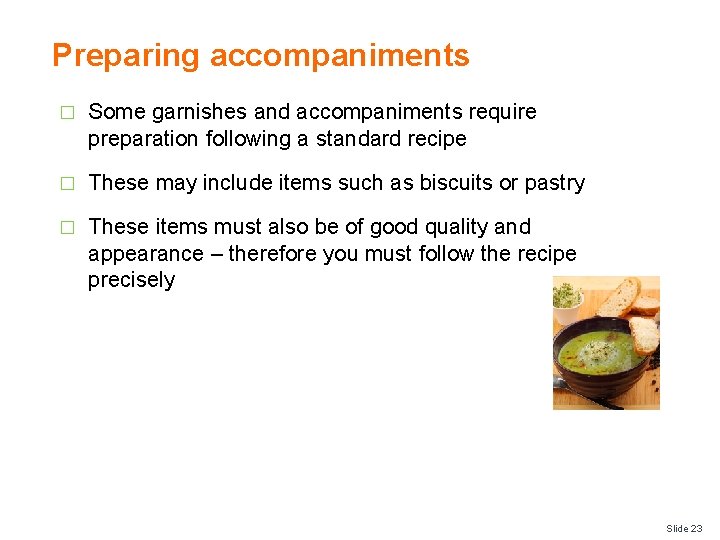
Preparing accompaniments � Some garnishes and accompaniments require preparation following a standard recipe � These may include items such as biscuits or pastry � These items must also be of good quality and appearance – therefore you must follow the recipe precisely Slide 23
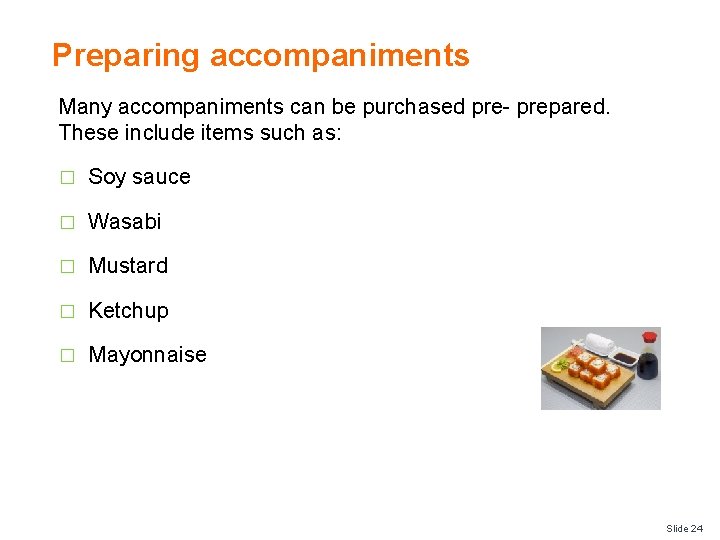
Preparing accompaniments Many accompaniments can be purchased pre- prepared. These include items such as: � Soy sauce � Wasabi � Mustard � Ketchup � Mayonnaise Slide 24
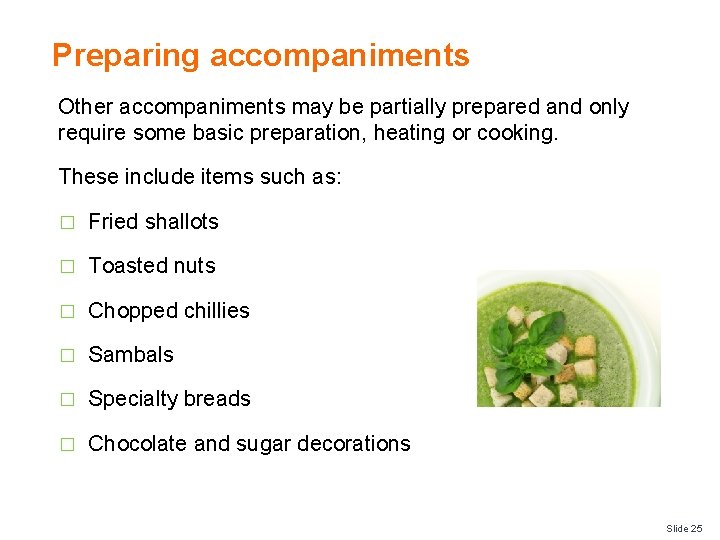
Preparing accompaniments Other accompaniments may be partially prepared and only require some basic preparation, heating or cooking. These include items such as: � Fried shallots � Toasted nuts � Chopped chillies � Sambals � Specialty breads � Chocolate and sugar decorations Slide 25
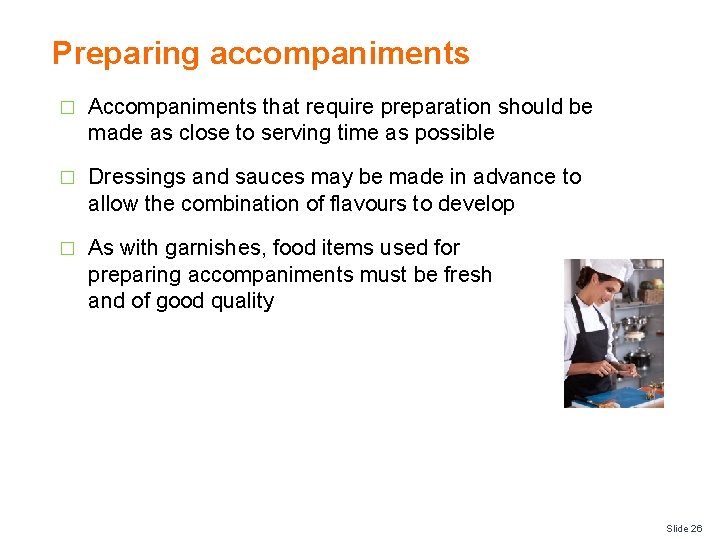
Preparing accompaniments � Accompaniments that require preparation should be made as close to serving time as possible � Dressings and sauces may be made in advance to allow the combination of flavours to develop � As with garnishes, food items used for preparing accompaniments must be fresh and of good quality Slide 26
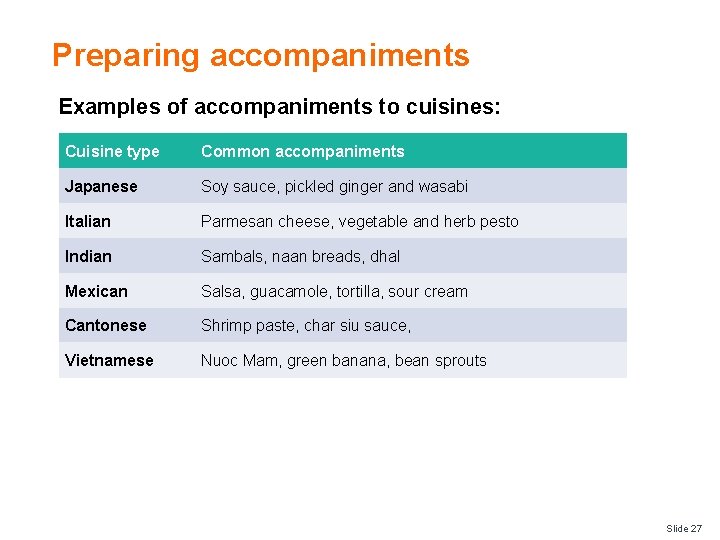
Preparing accompaniments Examples of accompaniments to cuisines: Cuisine type Common accompaniments Japanese Soy sauce, pickled ginger and wasabi Italian Parmesan cheese, vegetable and herb pesto Indian Sambals, naan breads, dhal Mexican Salsa, guacamole, tortilla, sour cream Cantonese Shrimp paste, char siu sauce, Vietnamese Nuoc Mam, green banana, bean sprouts Slide 27
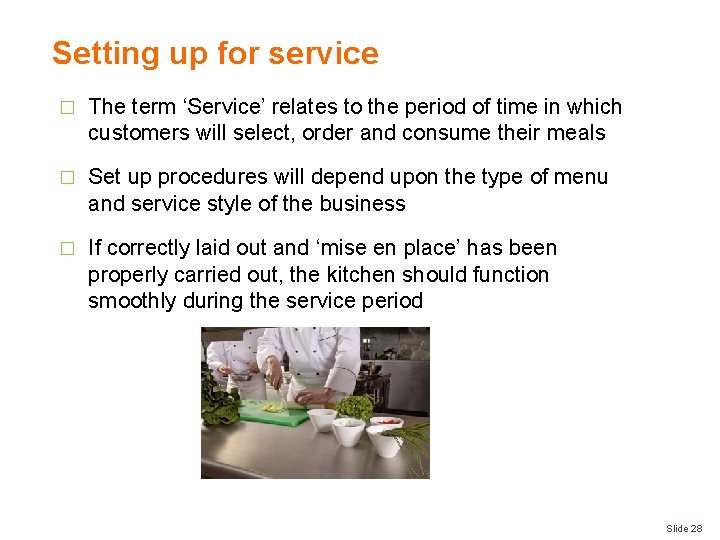
Setting up for service � The term ‘Service’ relates to the period of time in which customers will select, order and consume their meals � Set up procedures will depend upon the type of menu and service style of the business � If correctly laid out and ‘mise en place’ has been properly carried out, the kitchen should function smoothly during the service period Slide 28
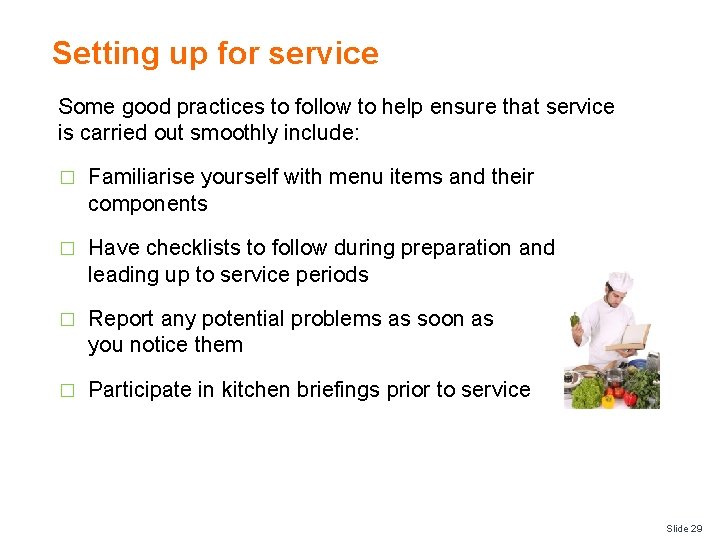
Setting up for service Some good practices to follow to help ensure that service is carried out smoothly include: � Familiarise yourself with menu items and their components � Have checklists to follow during preparation and leading up to service periods � Report any potential problems as soon as you notice them � Participate in kitchen briefings prior to service Slide 29
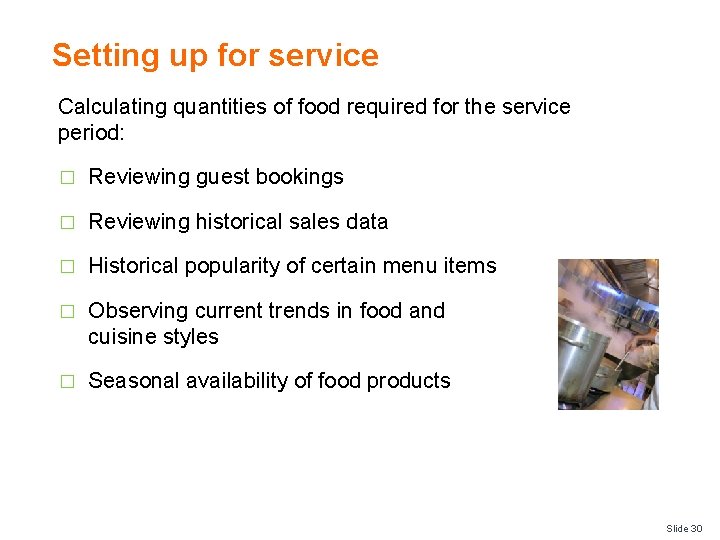
Setting up for service Calculating quantities of food required for the service period: � Reviewing guest bookings � Reviewing historical sales data � Historical popularity of certain menu items � Observing current trends in food and cuisine styles � Seasonal availability of food products Slide 30
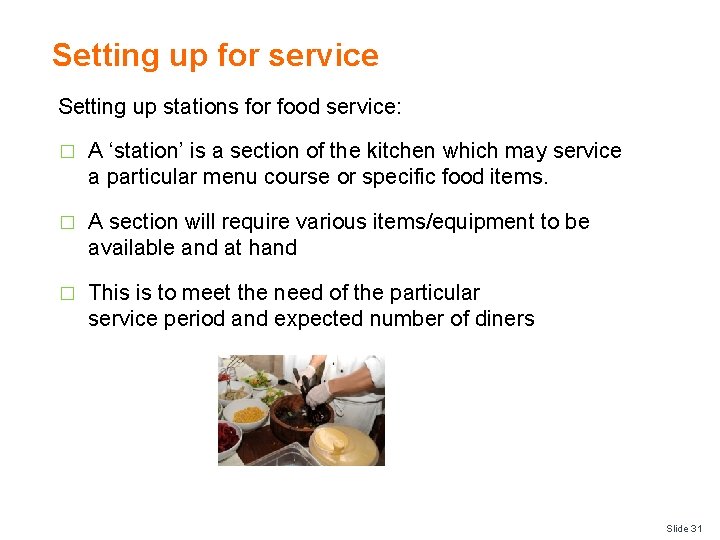
Setting up for service Setting up stations for food service: � A ‘station’ is a section of the kitchen which may service a particular menu course or specific food items. � A section will require various items/equipment to be available and at hand � This is to meet the need of the particular service period and expected number of diners Slide 31
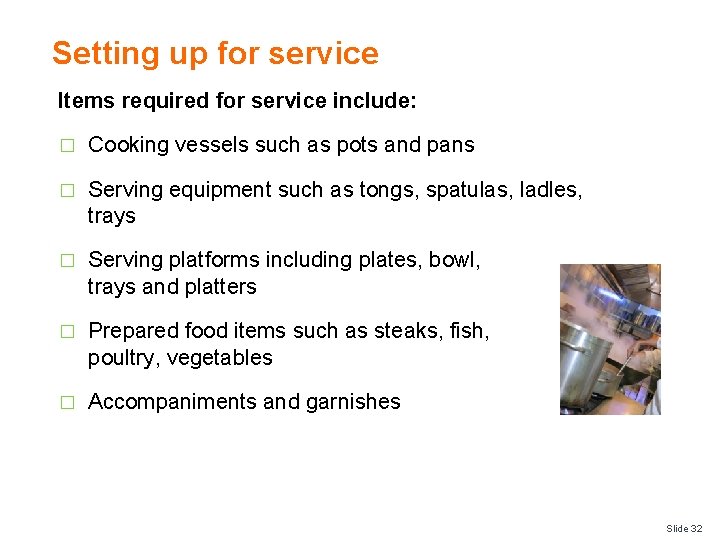
Setting up for service Items required for service include: � Cooking vessels such as pots and pans � Serving equipment such as tongs, spatulas, ladles, trays � Serving platforms including plates, bowl, trays and platters � Prepared food items such as steaks, fish, poultry, vegetables � Accompaniments and garnishes Slide 32
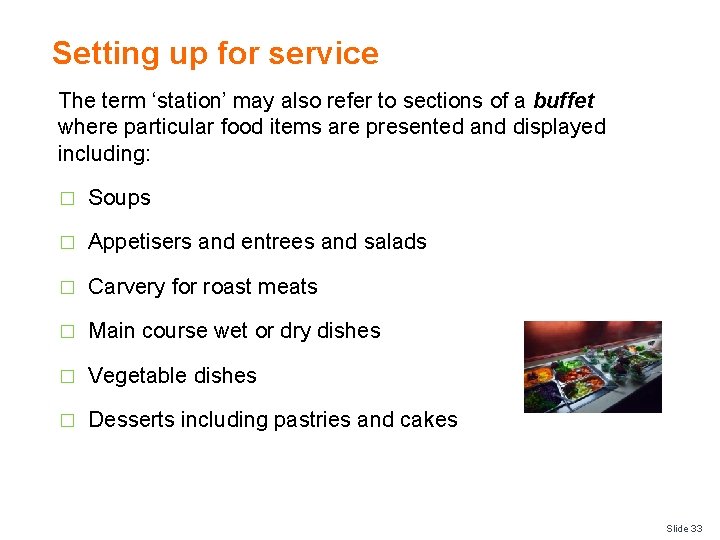
Setting up for service The term ‘station’ may also refer to sections of a buffet where particular food items are presented and displayed including: � Soups � Appetisers and entrees and salads � Carvery for roast meats � Main course wet or dry dishes � Vegetable dishes � Desserts including pastries and cakes Slide 33
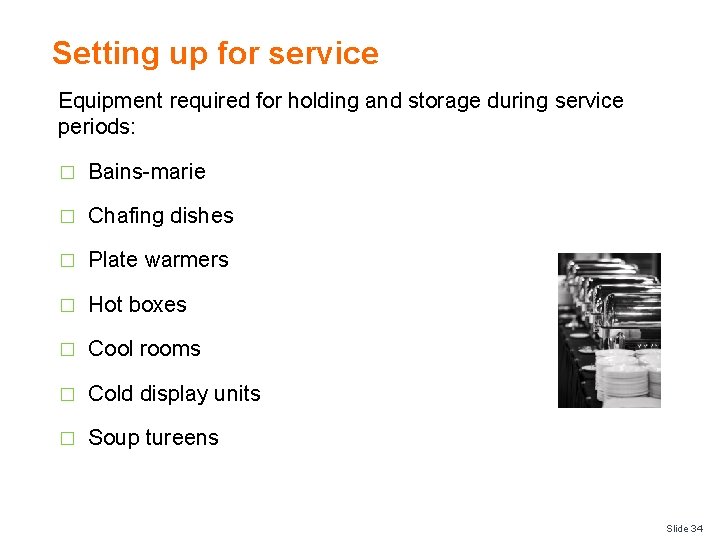
Setting up for service Equipment required for holding and storage during service periods: � Bains-marie � Chafing dishes � Plate warmers � Hot boxes � Cool rooms � Cold display units � Soup tureens Slide 34
Setting up for service Back up food items for service periods: � Having back up food items prepared is an important consideration for any service period � This is a common aspect of mise en place � Ensures that food items will not run out � Ensures that customers will not be waiting for long periods for items to be prepared Slide 35
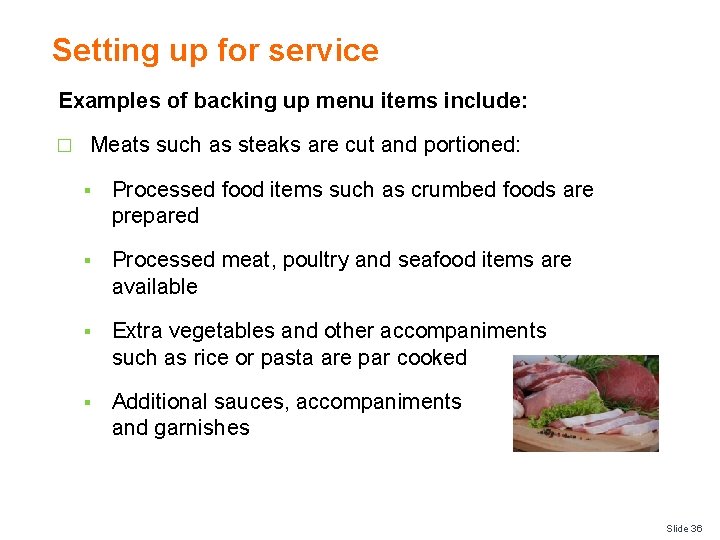
Setting up for service Examples of backing up menu items include: � Meats such as steaks are cut and portioned: § Processed food items such as crumbed foods are prepared § Processed meat, poultry and seafood items are available § Extra vegetables and other accompaniments such as rice or pasta are par cooked § Additional sauces, accompaniments and garnishes Slide 36
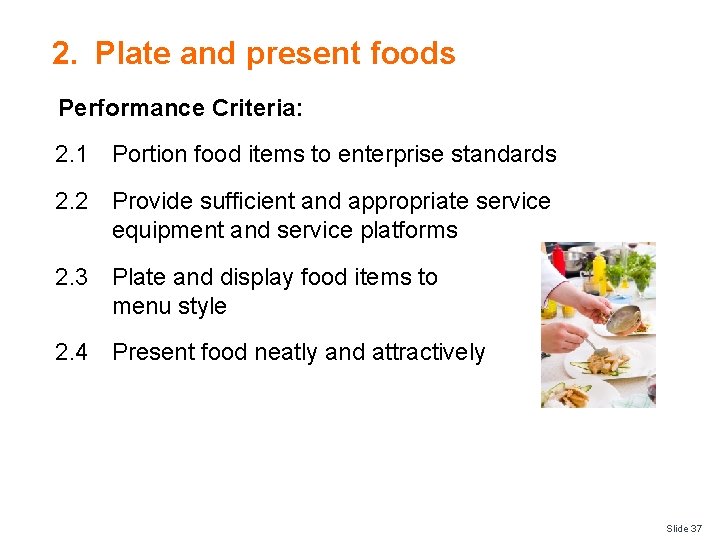
2. Plate and present foods Performance Criteria: 2. 1 Portion food items to enterprise standards 2. 2 Provide sufficient and appropriate service equipment and service platforms 2. 3 Plate and display food items to menu style 2. 4 Present food neatly and attractively Slide 37
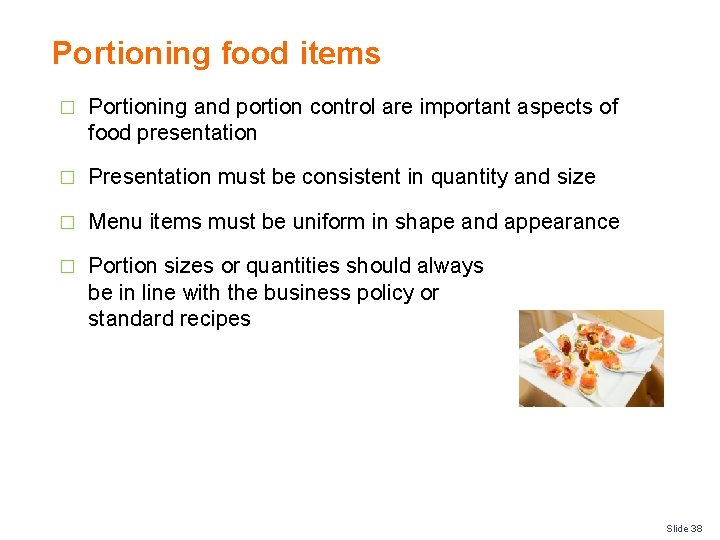
Portioning food items � Portioning and portion control are important aspects of food presentation � Presentation must be consistent in quantity and size � Menu items must be uniform in shape and appearance � Portion sizes or quantities should always be in line with the business policy or standard recipes Slide 38
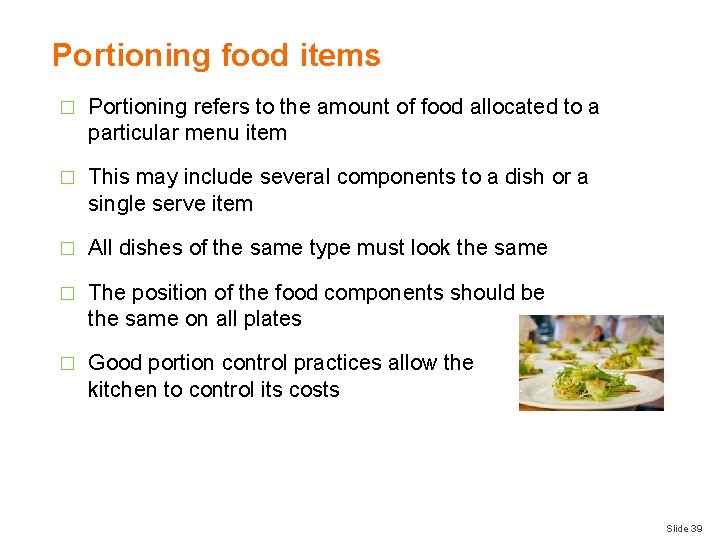
Portioning food items � Portioning refers to the amount of food allocated to a particular menu item � This may include several components to a dish or a single serve item � All dishes of the same type must look the same � The position of the food components should be the same on all plates � Good portion control practices allow the kitchen to control its costs Slide 39
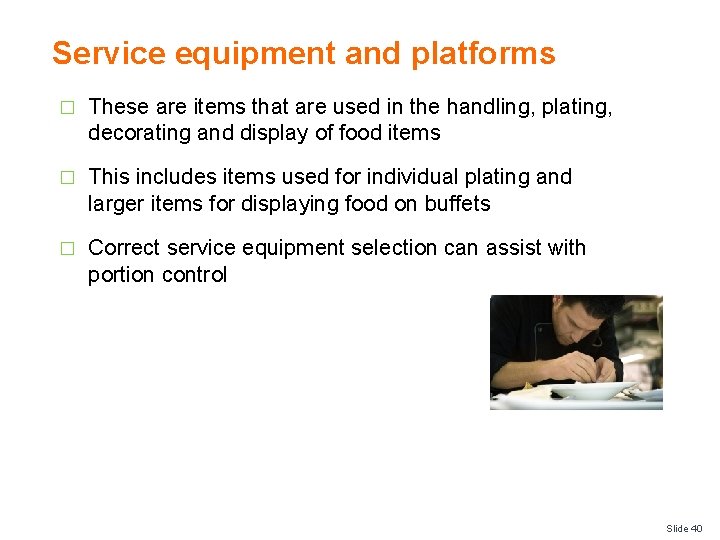
Service equipment and platforms � These are items that are used in the handling, plating, decorating and display of food items � This includes items used for individual plating and larger items for displaying food on buffets � Correct service equipment selection can assist with portion control Slide 40
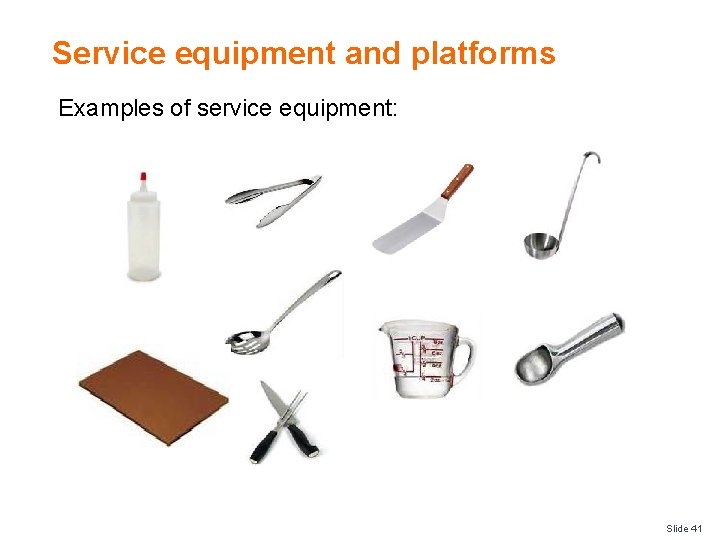
Service equipment and platforms Examples of service equipment: Slide 41
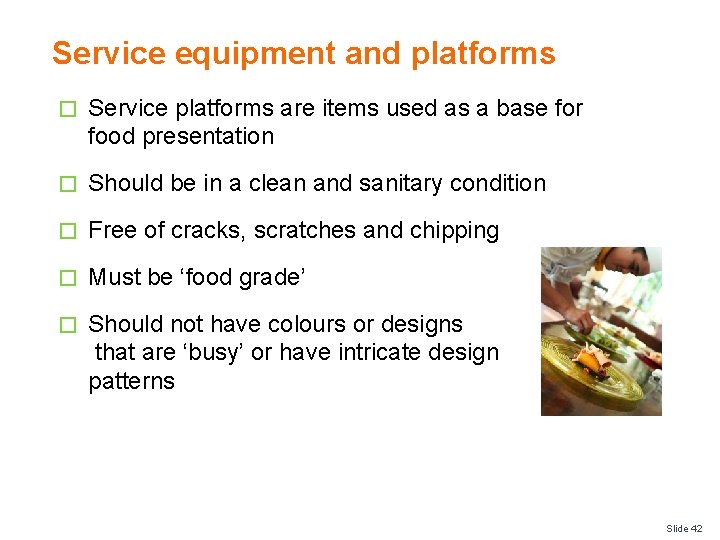
Service equipment and platforms � Service platforms are items used as a base for food presentation � Should be in a clean and sanitary condition � Free of cracks, scratches and chipping � Must be ‘food grade’ � Should not have colours or designs that are ‘busy’ or have intricate design patterns Slide 42
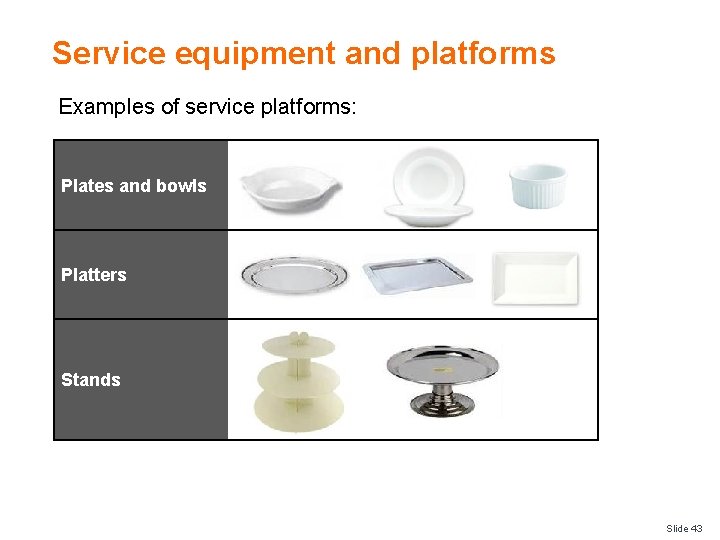
Service equipment and platforms Examples of service platforms: Plates and bowls Platters Stands Slide 43
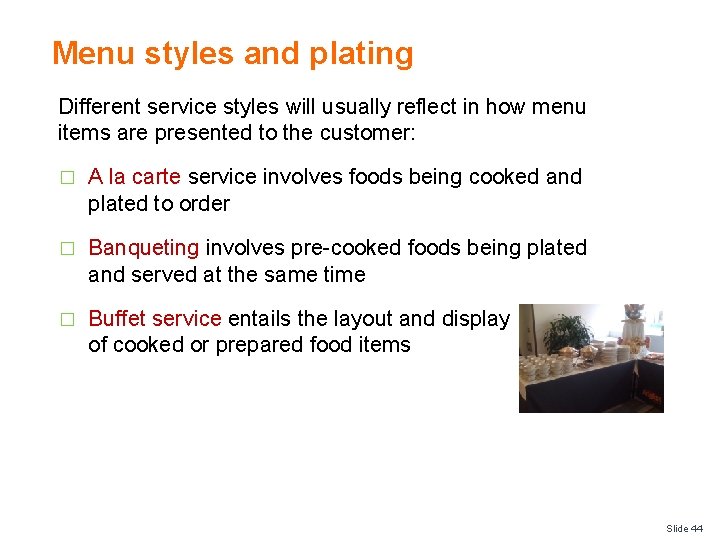
Menu styles and plating Different service styles will usually reflect in how menu items are presented to the customer: � A la carte service involves foods being cooked and plated to order � Banqueting involves pre-cooked foods being plated and served at the same time � Buffet service entails the layout and display of cooked or prepared food items Slide 44
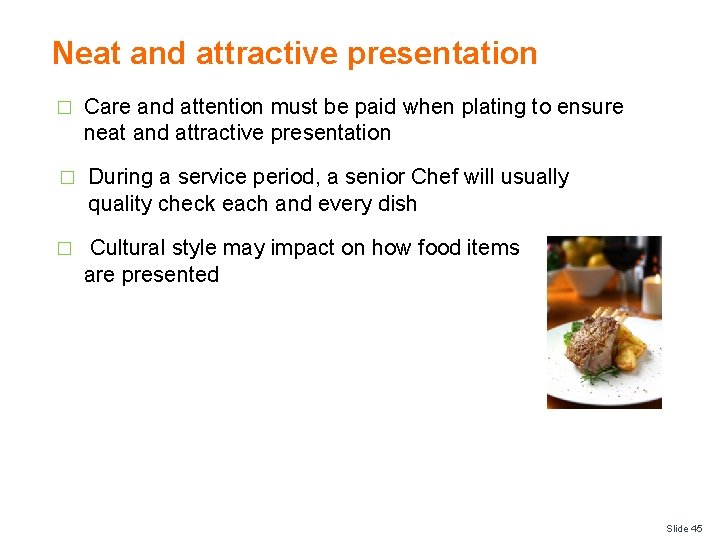
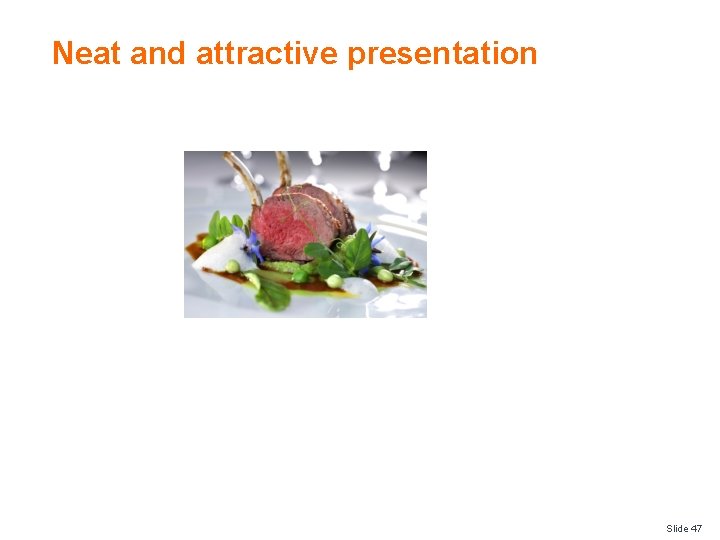
Neat and attractive presentation � Care and attention must be paid when plating to ensure neat and attractive presentation � During a service period, a senior Chef will usually quality check each and every dish � Cultural style may impact on how food items are presented Slide 45
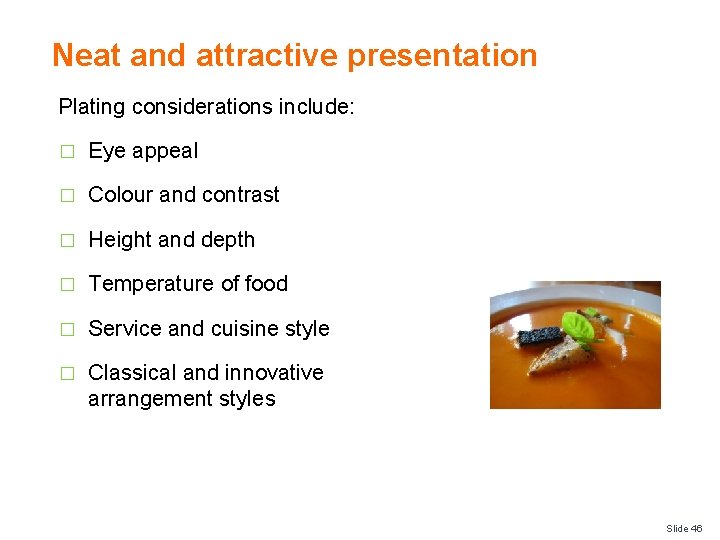
Neat and attractive presentation Plating considerations include: � Eye appeal � Colour and contrast � Height and depth � Temperature of food � Service and cuisine style � Classical and innovative arrangement styles Slide 46
Neat and attractive presentation Slide 47
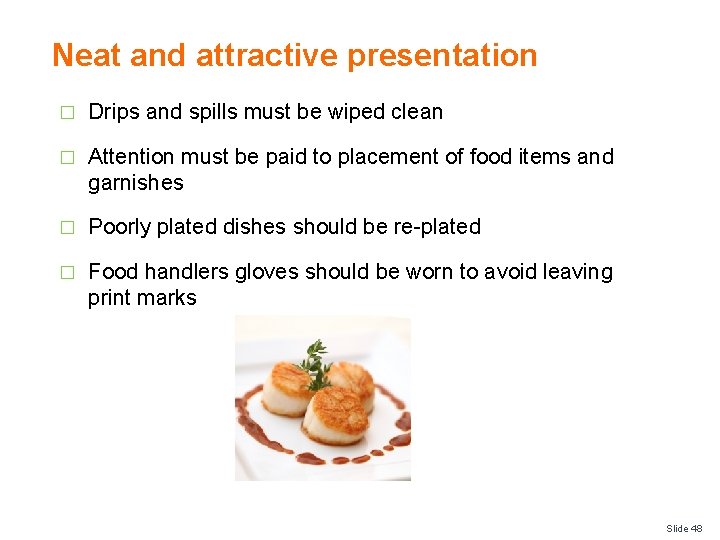
Neat and attractive presentation � Drips and spills must be wiped clean � Attention must be paid to placement of food items and garnishes � Poorly plated dishes should be re-plated � Food handlers gloves should be worn to avoid leaving print marks Slide 48
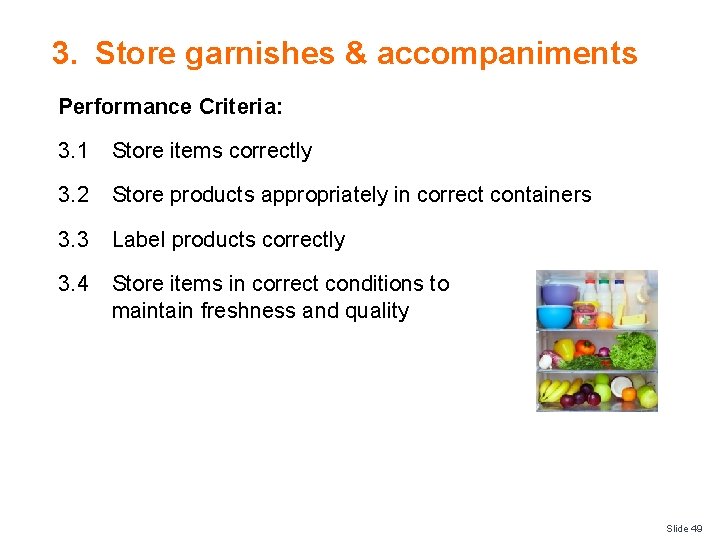
3. Store garnishes & accompaniments Performance Criteria: 3. 1 Store items correctly 3. 2 Store products appropriately in correct containers 3. 3 Label products correctly 3. 4 Store items in correct conditions to maintain freshness and quality Slide 49
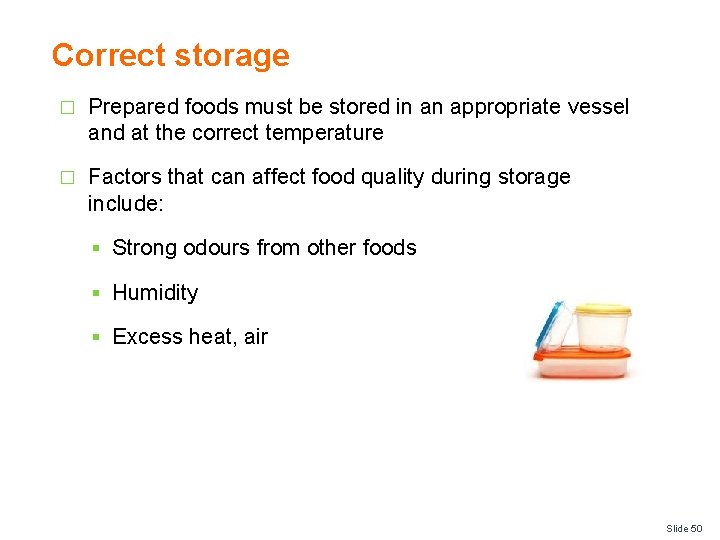
Correct storage � Prepared foods must be stored in an appropriate vessel and at the correct temperature � Factors that can affect food quality during storage include: § Strong odours from other foods § Humidity § Excess heat, air Slide 50
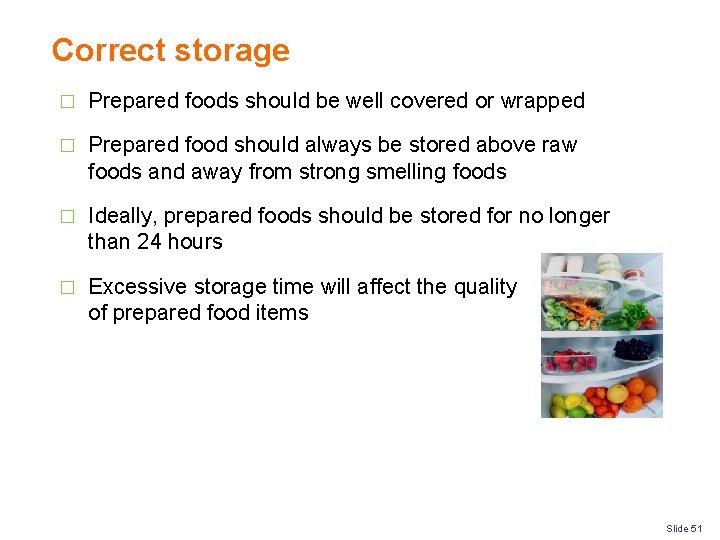
Correct storage � Prepared foods should be well covered or wrapped � Prepared food should always be stored above raw foods and away from strong smelling foods � Ideally, prepared foods should be stored for no longer than 24 hours � Excessive storage time will affect the quality of prepared food items Slide 51
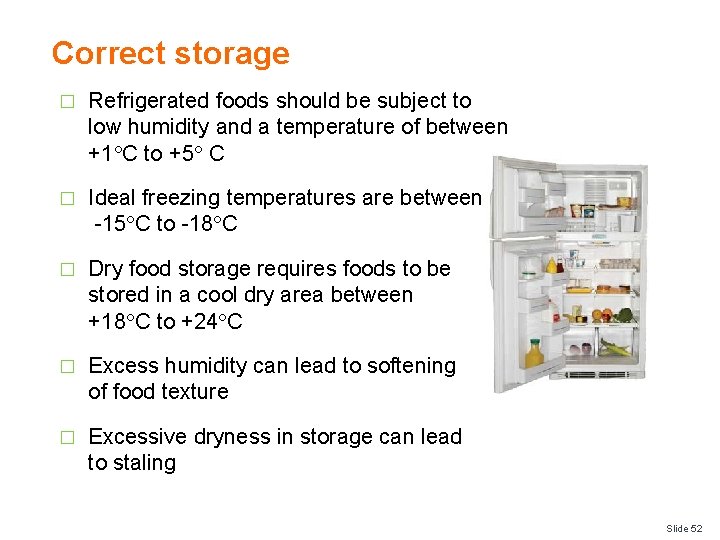
Correct storage � Refrigerated foods should be subject to low humidity and a temperature of between +1 C to +5 C � Ideal freezing temperatures are between -15 C to -18 C � Dry food storage requires foods to be stored in a cool dry area between +18 C to +24 C � Excess humidity can lead to softening of food texture � Excessive dryness in storage can lead to staling Slide 52
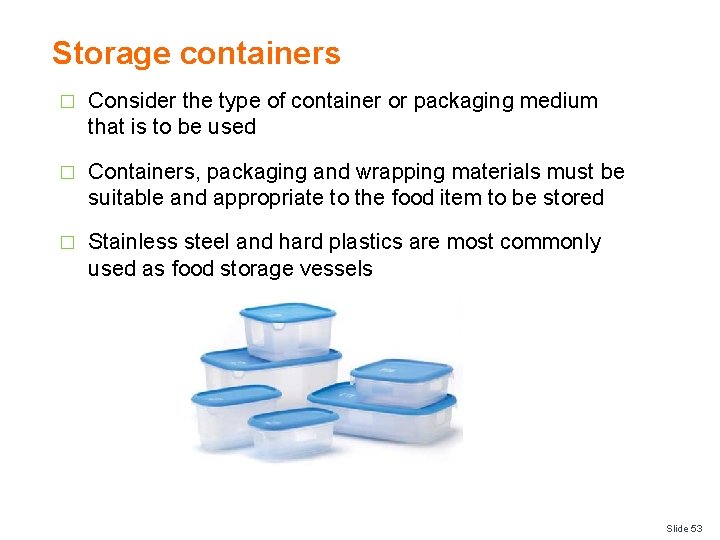
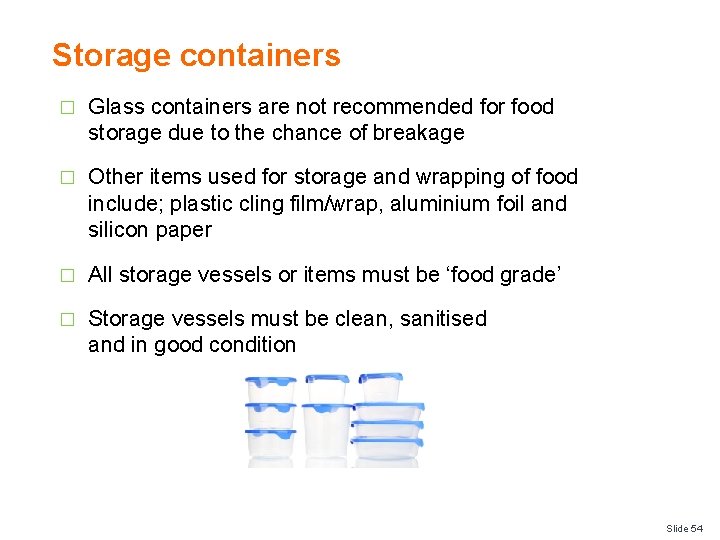
Storage containers � Consider the type of container or packaging medium that is to be used � Containers, packaging and wrapping materials must be suitable and appropriate to the food item to be stored � Stainless steel and hard plastics are most commonly used as food storage vessels Slide 53
Storage containers � Glass containers are not recommended for food storage due to the chance of breakage � Other items used for storage and wrapping of food include; plastic cling film/wrap, aluminium foil and silicon paper � All storage vessels or items must be ‘food grade’ � Storage vessels must be clean, sanitised and in good condition Slide 54
Labeling food items All prepared foods should be clearly labelled prior to storage. This practice will assist to: � Identify potentially contaminated food � Indicate poor or low quality food � Identify freshness of prepared food items in storage Slide 55
Labeling food items Label information should include: � Name of the item � Date the item was first stored � Time the item was first stored � Temperature – if being process-tested � Type of storage – chilled, frozen, thawing � Writing must be legible and the label must be some fixed to the container in some way Slide 56