
Presence of Wolbachia in Savannah Georgia BY CAITLYN

Presence of Wolbachia in Savannah, Georgia BY: CAITLYN BEAVERS AND CAMERON BOWLES DR. DEMARS BIOLOGY LAB 1107 H CB(2)
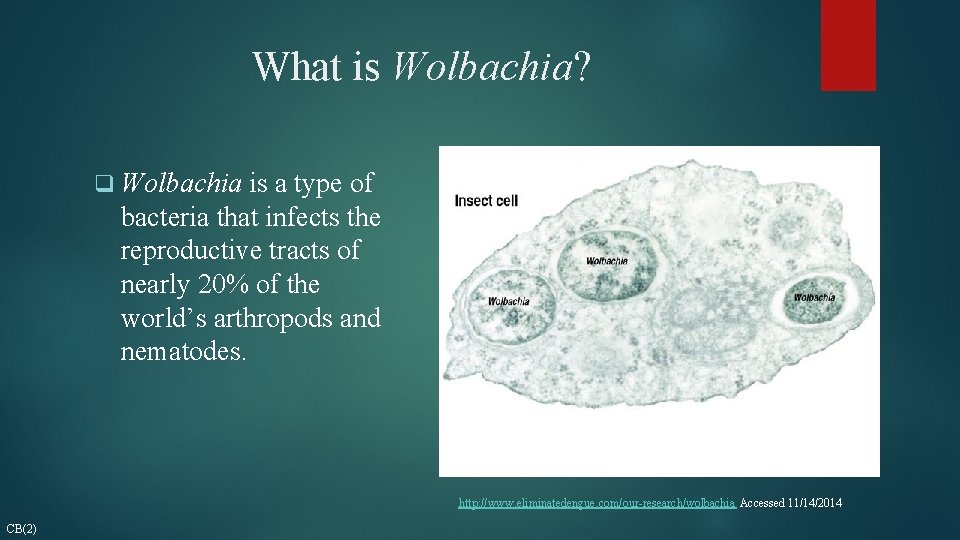
What is Wolbachia? q Wolbachia is a type of bacteria that infects the reproductive tracts of nearly 20% of the world’s arthropods and nematodes. http: //www. eliminatedengue. com/our-research/wolbachia Accessed 11/14/2014 CB(2)
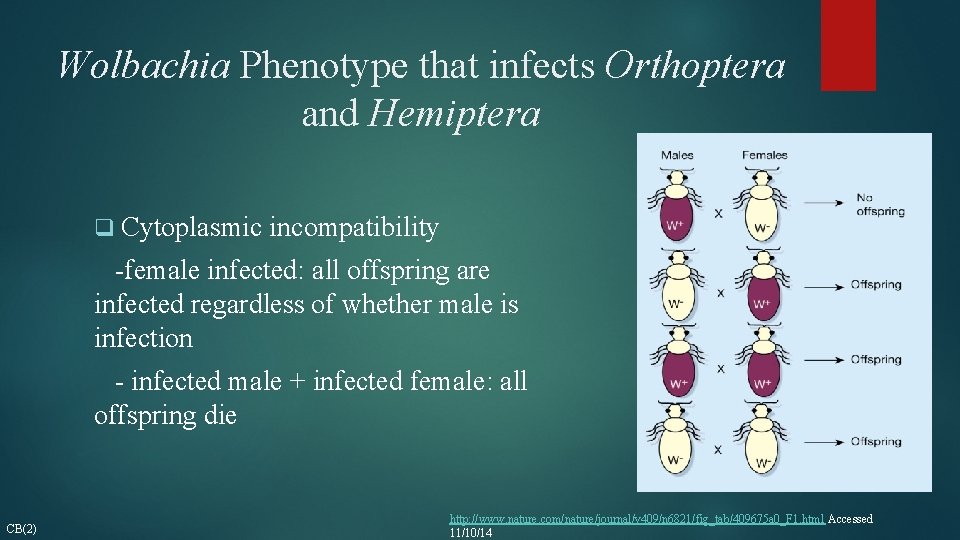
Wolbachia Phenotype that infects Orthoptera and Hemiptera q Cytoplasmic incompatibility -female infected: all offspring are infected regardless of whether male is infection - infected male + infected female: all offspring die CB(2) http: //www. nature. com/nature/journal/v 409/n 6821/fig_tab/409675 a 0_F 1. html Accessed 11/10/14
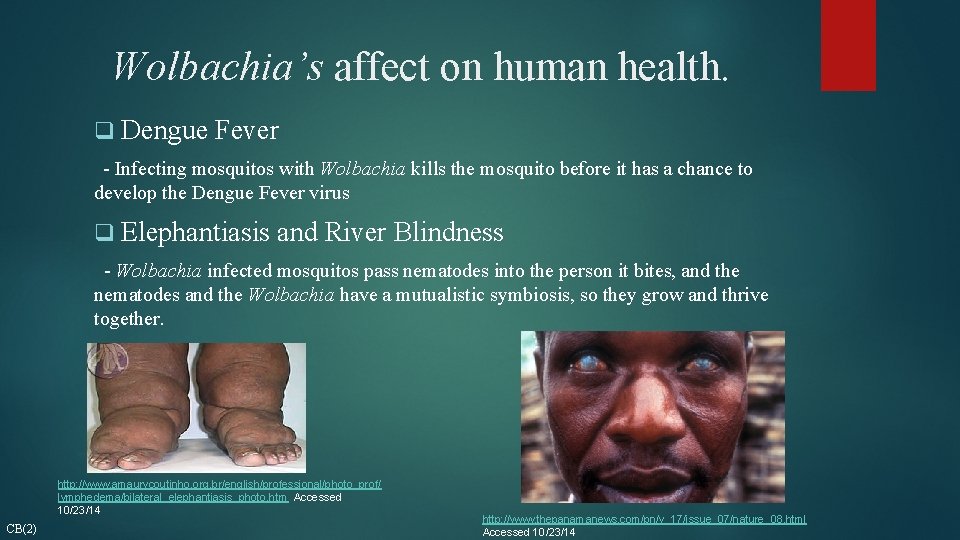
Wolbachia’s affect on human health. q Dengue Fever - Infecting mosquitos with Wolbachia kills the mosquito before it has a chance to develop the Dengue Fever virus q Elephantiasis and River Blindness - Wolbachia infected mosquitos pass nematodes into the person it bites, and the nematodes and the Wolbachia have a mutualistic symbiosis, so they grow and thrive together. http: //www. amaurycoutinho. org. br/english/professional/photo_prof/ lymphedema/bilateral_elephantiasis_photo. htm Accessed 10/23/14 CB(2) http: //www. thepanamanews. com/pn/v_17/issue_07/nature_08. html Accessed 10/23/14

Why are Armstrong students participating in this project, and why is it important? q So few scientists are committed to studying Wolbachia q To potentially discover new strands of Wolbachia that could help progress the study CB(2) http: //www. careersinpublichealth. net/schools/armstrong-atlantic-state-university Accessed 10/23/14
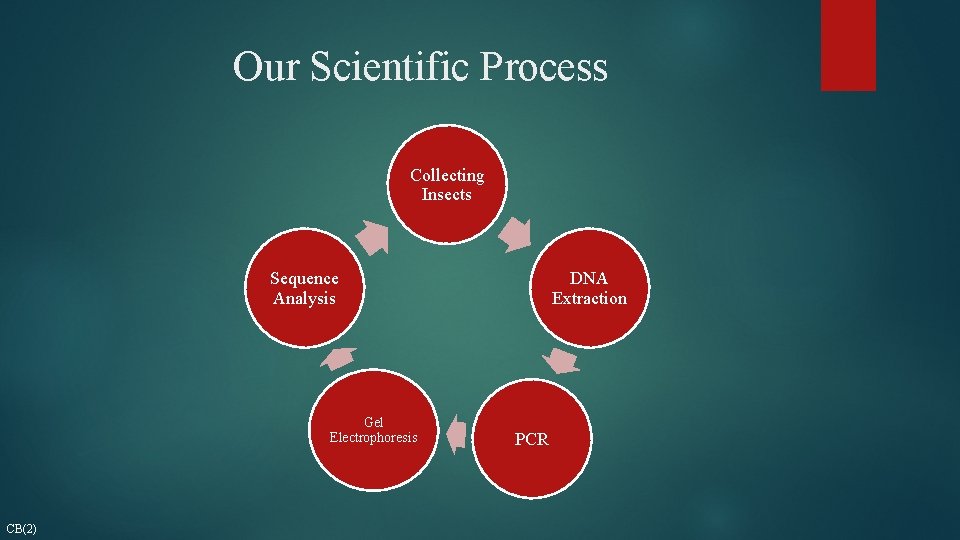
Our Scientific Process Collecting Insects Sequence Analysis Gel Electrophoresis CB(2) DNA Extraction PCR
Gathering the Insect q Date: August 25 th, 2014 q Time: Around 2: 45 q Where: Pond and surrounding area on the outskirts of the Armstrong State University Campus q Weather: q Method: hot, muggy, sunny day The method used to collect the insects was using a net to sweep through the tall grass by the pond. CB(2)
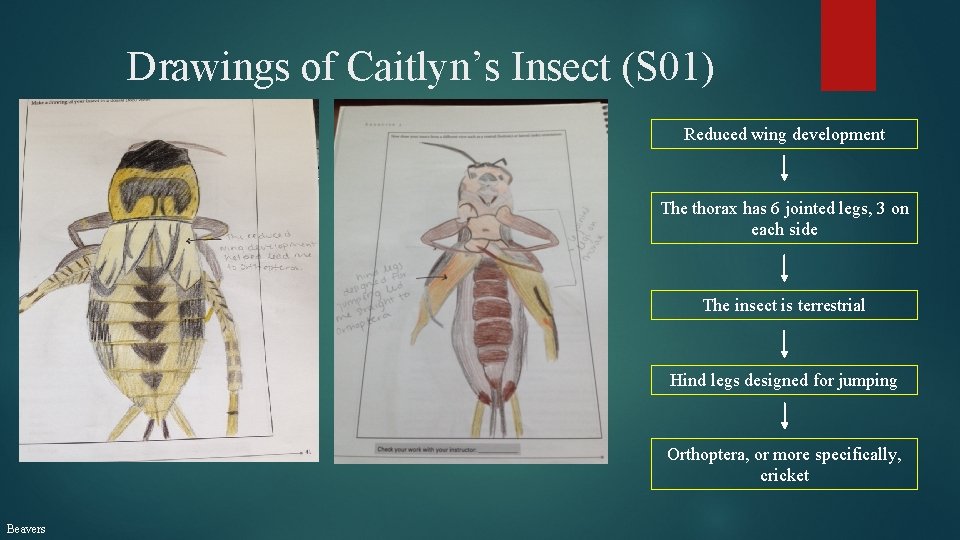
Drawings of Caitlyn’s Insect (S 01) Reduced wing development The thorax has 6 jointed legs, 3 on each side The insect is terrestrial Hind legs designed for jumping Orthoptera, or more specifically, cricket Beavers
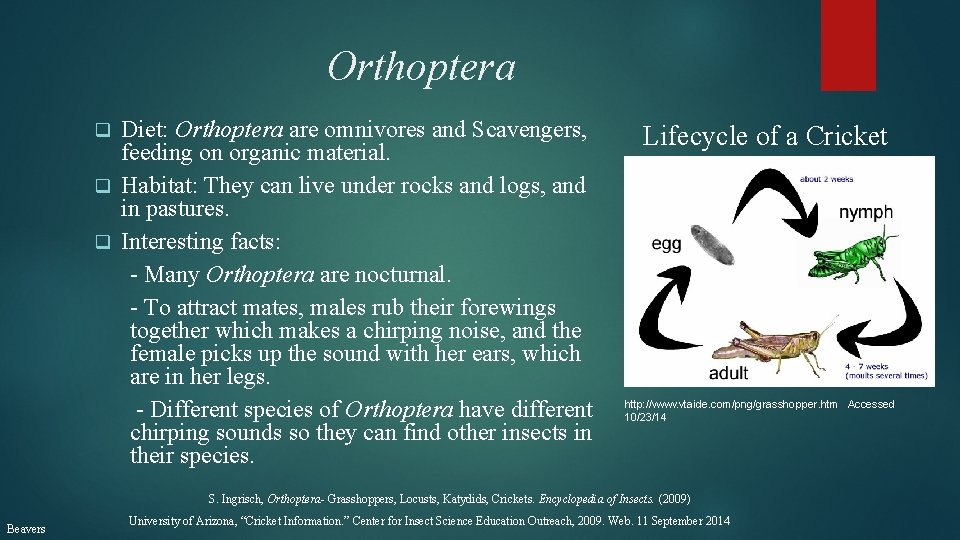
Orthoptera Diet: Orthoptera are omnivores and Scavengers, feeding on organic material. q Habitat: They can live under rocks and logs, and in pastures. q Interesting facts: - Many Orthoptera are nocturnal. - To attract mates, males rub their forewings together which makes a chirping noise, and the female picks up the sound with her ears, which are in her legs. - Different species of Orthoptera have different chirping sounds so they can find other insects in their species. q Lifecycle of a Cricket http: //www. vtaide. com/png/grasshopper. htm Accessed 10/23/14 S. Ingrisch, Orthoptera- Grasshoppers, Locusts, Katydids, Crickets. Encyclopedia of Insects. (2009) Beavers University of Arizona, “Cricket Information. ” Center for Insect Science Education Outreach, 2009. Web. 11 September 2014
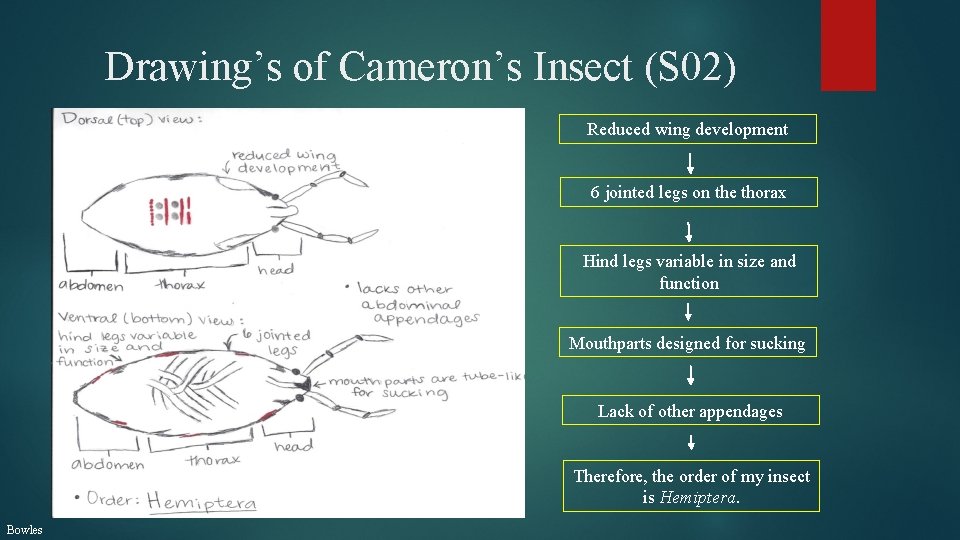
Drawing’s of Cameron’s Insect (S 02) Reduced wing development 6 jointed legs on the thorax Hind legs variable in size and function Mouthparts designed for sucking Lack of other appendages Therefore, the order of my insect is Hemiptera. Bowles
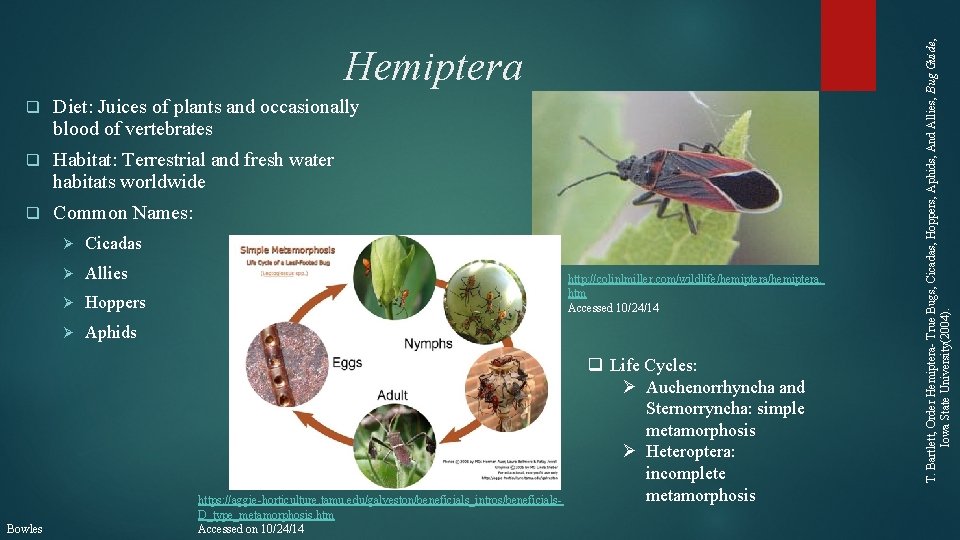
q Diet: Juices of plants and occasionally blood of vertebrates q Habitat: Terrestrial and fresh water habitats worldwide q Common Names: Bowles Ø Cicadas Ø Allies Ø Hoppers Ø Aphids http: //colinlmiller. com/wildlife/hemiptera. htm Accessed 10/24/14 https: //aggie-horticulture. tamu. edu/galveston/beneficials_intros/beneficials. D_type_metamorphosis. htm Accessed on 10/24/14 q Life Cycles: Ø Auchenorrhyncha and Sternorryncha: simple metamorphosis Ø Heteroptera: incomplete metamorphosis T. Bartlett, Order Hemiptera- True Bugs, Cicadas, Hoppers, Aphids, And Allies, Bug Guide, Iowa State University(2004). Hemiptera
Wolbachia in Orthoptera and Hemiptera q Crickets researched in Korea have been found to be infected with Wolbachia. q The scientists believed that the crickets have the phenotype of cytoplasmic incompatibility. q Orius Strigicollis has been found to be superinfected with Wolbachia strands w. Ous 1 and w. Ous 2 q Scientists believe the Wolbachia- induced phenotype to be cytoplasmic incompatibility in w. Ous 2 but little to no CI in w. Ous 1. G. Jeong et al. , Wolbachia infection in the Loxoblemmus complex (Orthoptera: Gryllidae) in Korea, Journal of Asia-Pacific Entomology 15(4): 563 -566(2012). M. Watanabe, K. Miura, et al. , Superinfection of cytoplasmic incompatability- including Wolbachia is not additive in Orius strigicollis, Heredity 106(4): 642 -648(2011). CB(2)
Our Hypotheses q. I do not think my insect will be infected with Wolbachia because the research that has been done to see if crickets were infected with Wolbachia, was all the way in Korea. q. I predict that my insect will not be infected with Wolbachia because there has been little research conducted on the presence of Wolbachia within the order Hemiptera. CB(2)
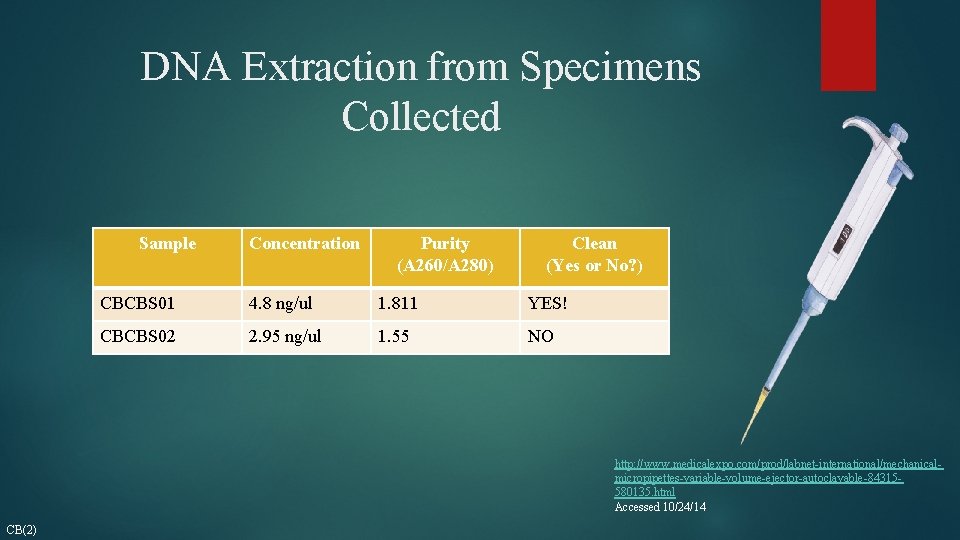
DNA Extraction from Specimens Collected Sample Concentration Purity (A 260/A 280) Clean (Yes or No? ) CBCBS 01 4. 8 ng/ul 1. 811 YES! CBCBS 02 2. 95 ng/ul 1. 55 NO http: //www. medicalexpo. com/prod/labnet-international/mechanicalmicropipettes-variable-volume-ejector-autoclavable-84315580135. html Accessed 10/24/14 CB(2)
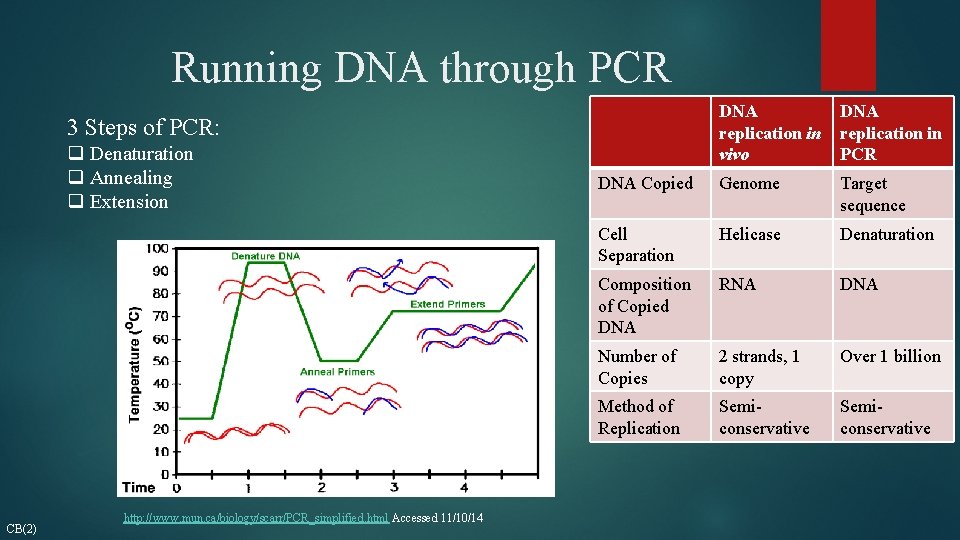
Running DNA through PCR DNA replication in vivo DNA replication in PCR DNA Copied Genome Target sequence Cell Separation Helicase Denaturation Composition of Copied DNA RNA DNA Number of Copies 2 strands, 1 copy Over 1 billion Method of Replication Semiconservative 3 Steps of PCR: q Denaturation q Annealing q Extension CB(2) http: //www. mun. ca/biology/scarr/PCR_simplified. html Accessed 11/10/14
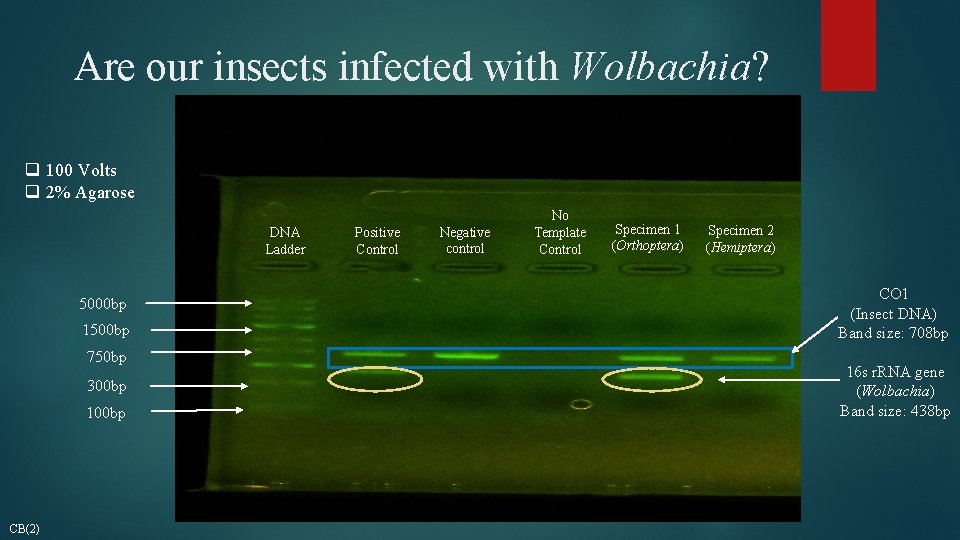
Are our insects infected with Wolbachia? q 100 Volts q 2% Agarose DNA Ladder 5000 bp 1500 bp 750 bp 300 bp 100 bp CB(2) Positive Control Negative control No Template Control Specimen 1 (Orthoptera) Specimen 2 (Hemiptera) CO 1 (Insect DNA) Band size: 708 bp 16 s r. RNA gene (Wolbachia) Band size: 438 bp
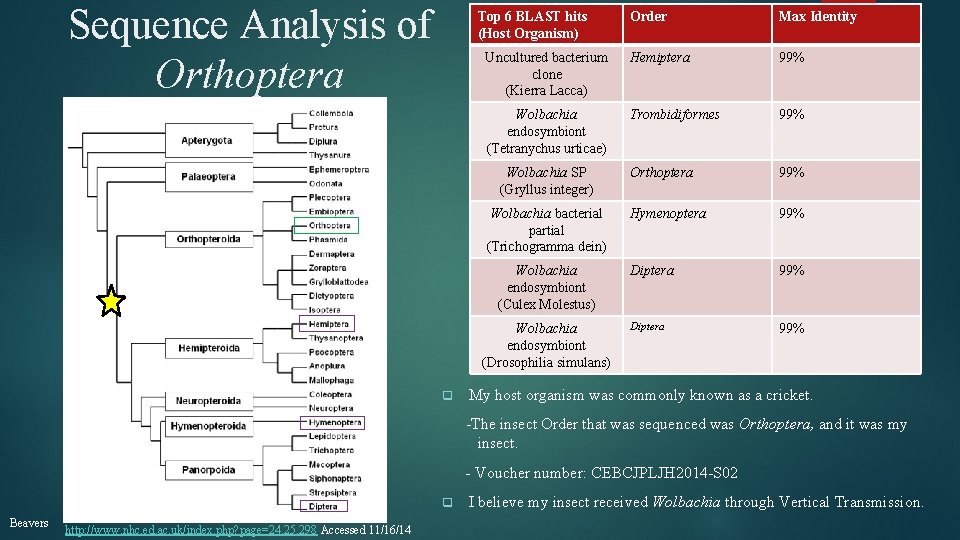
Sequence Analysis of Orthoptera Top 6 BLAST hits (Host Organism) Order Max Identity Uncultured bacterium clone (Kierra Lacca) Hemiptera 99% Wolbachia endosymbiont (Tetranychus urticae) Trombidiformes 99% Orthoptera 99% Hymenoptera 99% Diptera 99% Wolbachia SP (Gryllus integer) Wolbachia bacterial partial (Trichogramma dein) Wolbachia endosymbiont (Culex Molestus) Wolbachia endosymbiont (Drosophilia simulans) q My host organism was commonly known as a cricket. -The insect Order that was sequenced was Orthoptera, and it was my insect. - Voucher number: CEBCJPLJH 2014 -S 02 q Beavers http: //www. nhc. ed. ac. uk/index. php? page=24. 25. 298 Accessed 11/16/14 I believe my insect received Wolbachia through Vertical Transmission.
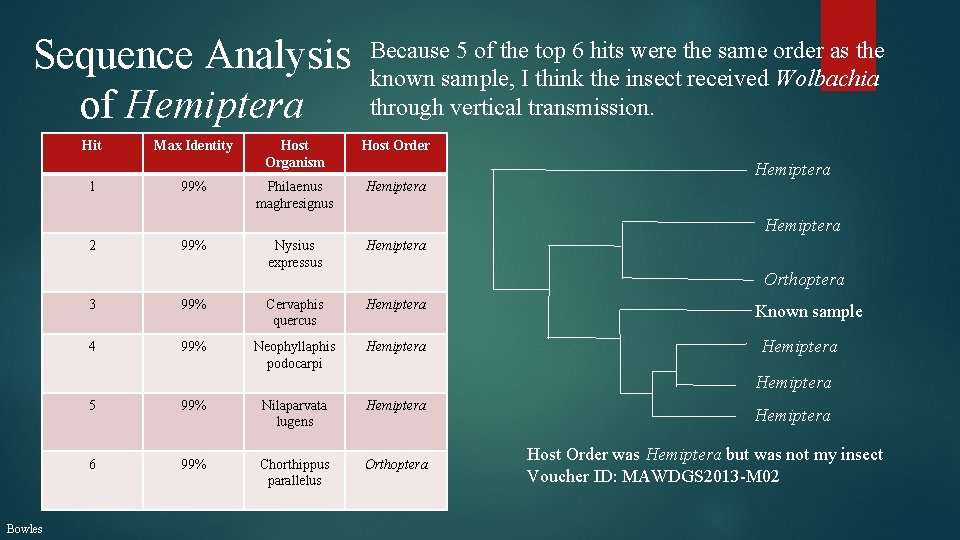
Sequence Analysis of Hemiptera Hit 1 Max Identity 99% Because 5 of the top 6 hits were the same order as the known sample, I think the insect received Wolbachia through vertical transmission. Host Organism Host Order Philaenus maghresignus Hemiptera 2 99% Nysius expressus Hemiptera Orthoptera 3 99% Cervaphis quercus Hemiptera 4 99% Neophyllaphis podocarpi Hemiptera Known sample Hemiptera Bowles 5 99% Nilaparvata lugens Hemiptera 6 99% Chorthippus parallelus Orthoptera Hemiptera Host Order was Hemiptera but was not my insect Voucher ID: MAWDGS 2013 -M 02
Results of the Wolbachia project CB(2) q At the end of the experiment we discovered that insect S 01 (Orthoptera) was infected with Wolbachia. q All of our controls came out as just what we were expecting them to. q Although insect S 02 was not infected with Wolbachia, the experiment is still considered to be a success because important data was collected.

What Happens After Our Discovery? q Our samples will be sent to be further analyzed q The study of Wolbachia has been strengthened q. A new wealth of knowledge is added to the community q Scientists may focus more of their attention towards a certain area and/or Order CB(2)
Citations CB(2) q G. Jeong et al. , Wolbachia infection in the Loxoblemmus complex (Orthoptera: Gryllidae) in Korea, Journal of Asia-Pacific Entomology 15(4): 563 -566(2012). q S. Ingrisch, Orthoptera- Grasshoppers, Locusts, Katydids, Crickets. Encyclopedia of Insects. (2009) q M. Watanabe, K. Miura, et al. , Superinfection of cytoplasmic incompatability- including Wolbachia is not additive in Orius strigicollis, Heredity 106(4): 642 -648(2011). q T. Bartlett, Order Hemiptera- True Bugs, Cicadas, Hoppers, Aphids, And Allies, Bug Guide, Iowa State University(2004). q University of Arizona, “Cricket Information. ” Center for Insect Science Education Outreach, 2009. Web. 11 September 2014
- Slides: 21