
PRESCRIBING BUPRENORPHINE IN PRIMARY CARE Julie Kmiec DO

PRESCRIBING BUPRENORPHINE IN PRIMARY CARE Julie Kmiec, DO Assistant Professor of Psychiatry University of Pittsburgh kmiecj@upmc. edu April 10, 2018 1
Objectives � � � Review prevalence of opioid use disorders Discuss the unmet needs for those with OUD Provide information on buprenorphine for opioid use disorder Discuss barriers to providing buprenorphine treatment Review model programs that have been implemented to improve access to treatment Review overdose risk factors and naloxone 2
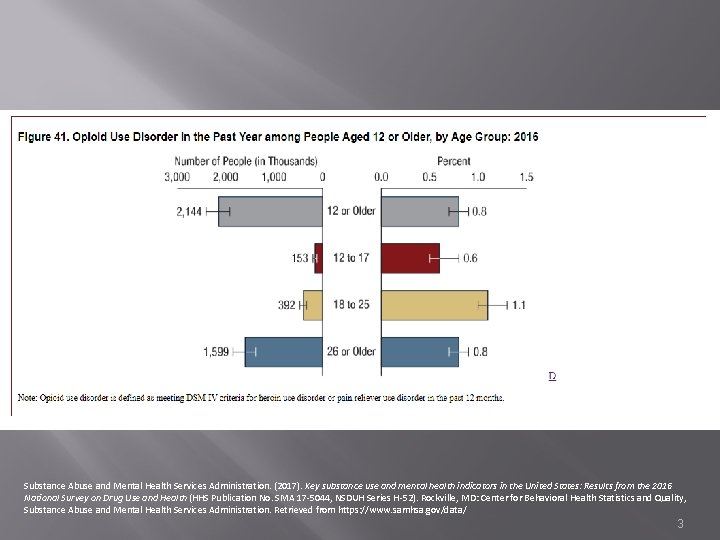
Substance Abuse and Mental Health Services Administration. (2017). Key substance use and mental health indicators in the United States: Results from the 2016 National Survey on Drug Use and Health (HHS Publication No. SMA 17 -5044, NSDUH Series H-52). Rockville, MD: Center for Behavioral Health Statistics and Quality, Substance Abuse and Mental Health Services Administration. Retrieved from https: //www. samhsa. gov/data/ 3
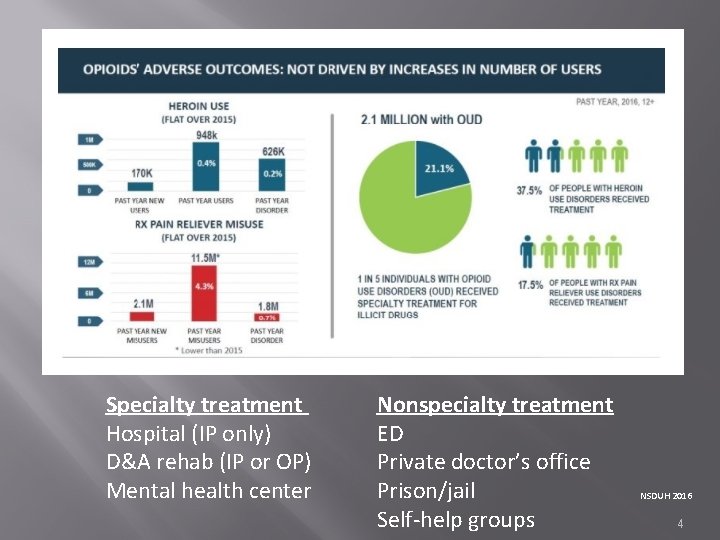
Specialty treatment Hospital (IP only) D&A rehab (IP or OP) Mental health center Nonspecialty treatment ED Private doctor’s office Prison/jail Self-help groups NSDUH 2016 4
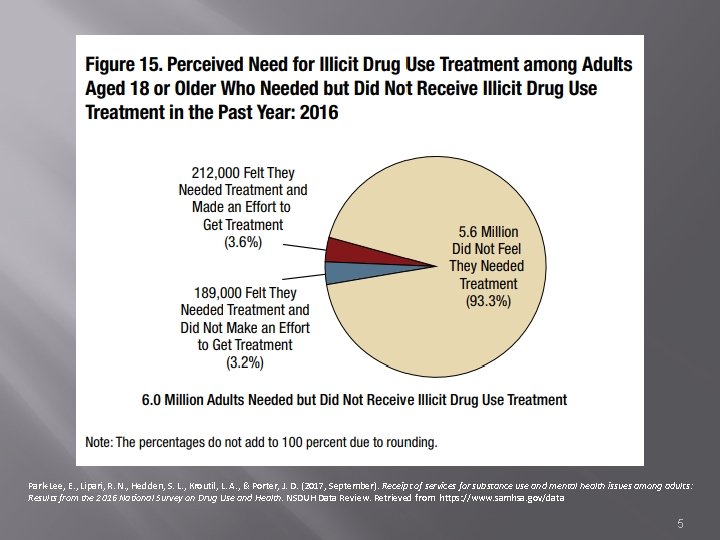
Park-Lee, E. , Lipari, R. N. , Hedden, S. L. , Kroutil, L. A. , & Porter, J. D. (2017, September). Receipt of services for substance use and mental health issues among adults: Results from the 2016 National Survey on Drug Use and Health. NSDUH Data Review. Retrieved from https: //www. samhsa. gov/data 5
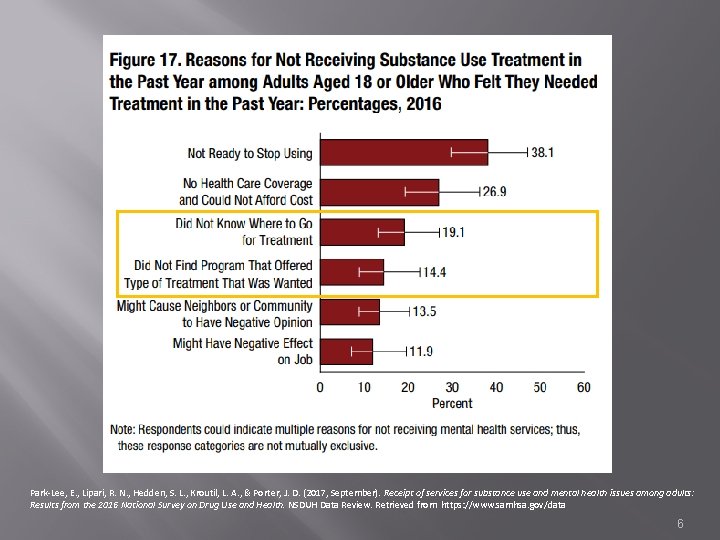
Park-Lee, E. , Lipari, R. N. , Hedden, S. L. , Kroutil, L. A. , & Porter, J. D. (2017, September). Receipt of services for substance use and mental health issues among adults: Results from the 2016 National Survey on Drug Use and Health. NSDUH Data Review. Retrieved from https: //www. samhsa. gov/data 6
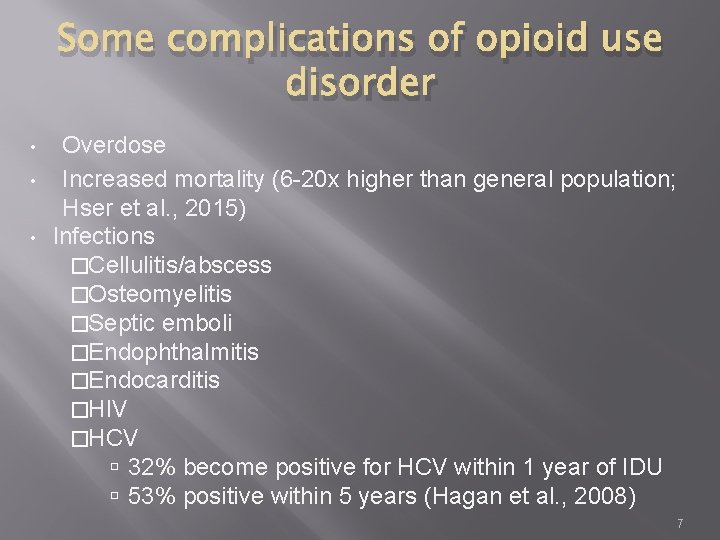
Some complications of opioid use disorder • • • Overdose Increased mortality (6 -20 x higher than general population; Hser et al. , 2015) Infections �Cellulitis/abscess �Osteomyelitis �Septic emboli �Endophthalmitis �Endocarditis �HIV �HCV 32% become positive for HCV within 1 year of IDU 53% positive within 5 years (Hagan et al. , 2008) 7
Pharmacotherapy for OUD � � � One of many tools in the “recovery toolbox” we can offer to patients Reduce cravings which can help stabilize and strengthen coping capacity Allow patients to focus on behavioral therapies Increase periods of abstinence and instill a sense of self-efficacy to help sustain recovery Improve clinical outcomes for patients and reduce impact on families/loved ones 8
Pharmacotherapy for OUD • Evidence based treatments to �Decrease opioid and injection drug use �Reduce transmission of hepatitis C and HIV �Decrease criminal behavior �Retain people in treatment �Decrease overdose �Reduce sexual risk behaviors (e. g. , trading sex for money/drugs) �Improve in physical and mental health and social functioning References 3 -17 9
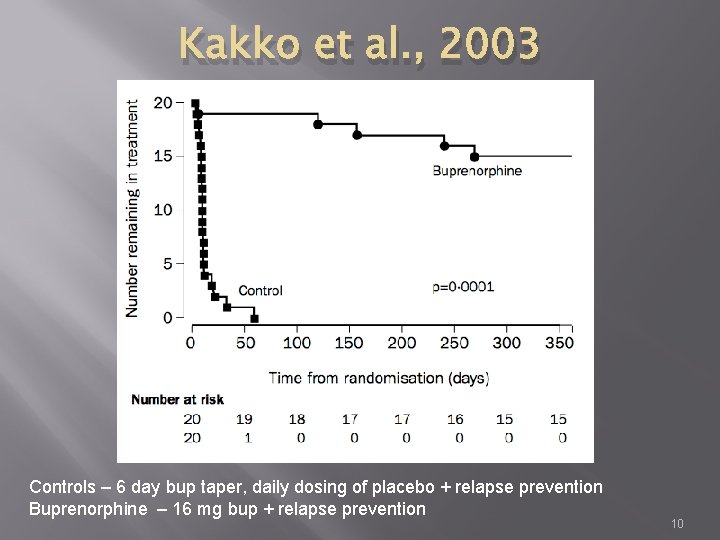
Kakko et al. , 2003 Controls – 6 day bup taper, daily dosing of placebo + relapse prevention Buprenorphine – 16 mg bup + relapse prevention 10
Buprenorphine Prescribers in the U. S. 11
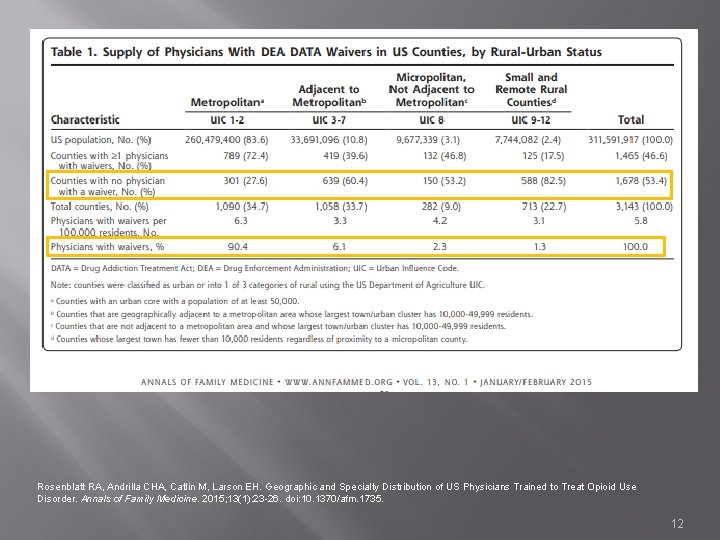
Rosenblatt RA, Andrilla CHA, Catlin M, Larson EH. Geographic and Specialty Distribution of US Physicians Trained to Treat Opioid Use Disorder. Annals of Family Medicine. 2015; 13(1): 23 -26. doi: 10. 1370/afm. 1735. 12
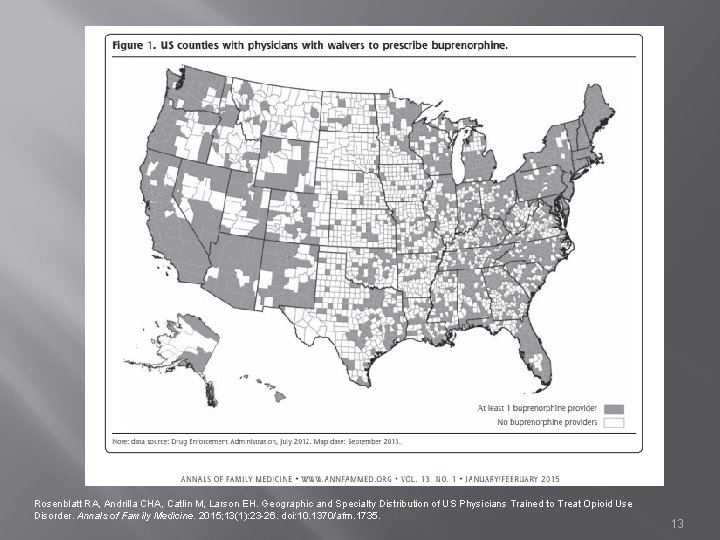
Rosenblatt RA, Andrilla CHA, Catlin M, Larson EH. Geographic and Specialty Distribution of US Physicians Trained to Treat Opioid Use Disorder. Annals of Family Medicine. 2015; 13(1): 23 -26. doi: 10. 1370/afm. 1735. 13
Change in Patient Limit for Buprenorphine � The Department of Health and Human Services published final rule which was effective 8/8/16 which increased the highest patient limit for qualified physicians to treat opioid use disorder to 275 Medication Assisted Treatment for Opioid Use Disorders: A Rule by the Health and Human Services Department on 07/08/2016 https: //www. federalregister. gov/d/2016 -16120. Accessed Sept 2, 2017.
Change in Patient Limit for Buprenorphine � Licensed physicians who have had a waiver to treat 100 patients for at least 1 year can become eligible for the patient limit of 275 in one of two ways: � By holding additional credentialing Board certification in addiction medicine or addiction psychiatry � By practicing in a “qualified practice setting” Understanding the Final Rule for a Patient Limit of 275. https: //www. samhsa. gov/sites/default/files/programs_campaigns/medication_assisted/understanding-patient-limit 275. pdf. Accessed Sept 2, 2017.
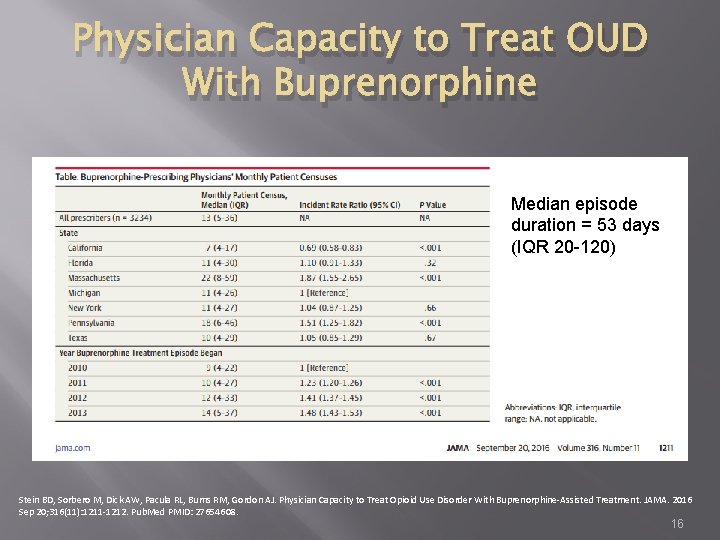
Physician Capacity to Treat OUD With Buprenorphine Median episode duration = 53 days (IQR 20 -120) Stein BD, Sorbero M, Dick AW, Pacula RL, Burns RM, Gordon AJ. Physician Capacity to Treat Opioid Use Disorder With Buprenorphine-Assisted Treatment. JAMA. 2016 Sep 20; 316(11): 1211 -1212. Pub. Med PMID: 27654608. 16
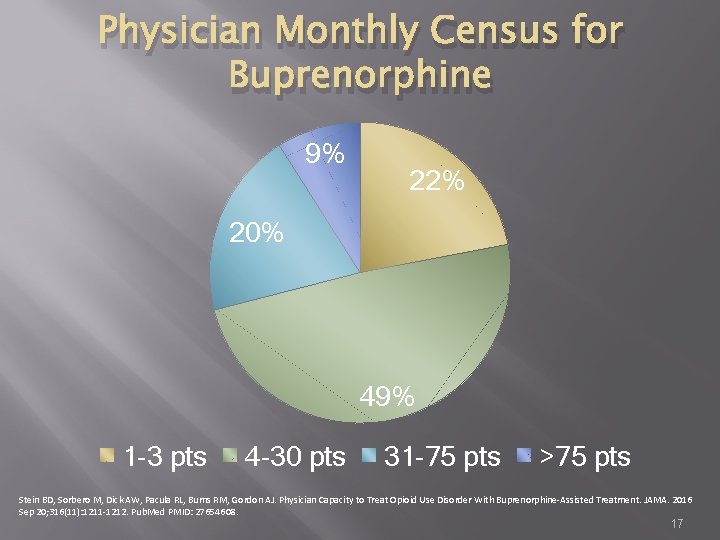
Physician Monthly Census for Buprenorphine 9% 22% 20% 49% 1 -3 pts 4 -30 pts 31 -75 pts >75 pts Stein BD, Sorbero M, Dick AW, Pacula RL, Burns RM, Gordon AJ. Physician Capacity to Treat Opioid Use Disorder With Buprenorphine-Assisted Treatment. JAMA. 2016 Sep 20; 316(11): 1211 -1212. Pub. Med PMID: 27654608. 17
CARA Allows Additional Prescribers q q Qualifying APRNs and PA-Cs given ability to prescribe buprenorphine for OUD until 10/1/21 Have to complete 24 hours of training to be eligible for a waiver q 8 of the hours can be the course that physicians have traditionally taken Follow the 30 and 100 patient limits Works with, or is supervised by, a qualifying physician if required by state law Public Law 114 -198. https: //www. congress. gov/114/plaws/publ 198/PLAW-114 publ 198. pdf. Accessed Sept 2, 2017.
Additional Prescribers � 30 patient waivers as of 8/29/17: � Nurse practitioners: 2, 471 � Physician assistants: 687 19
Ambulatory Visits � In 2015, � 990. 8 million ambulatory care visits in the US � 51. 2% of these visits were to primary care � � Primary care providers see the largest percentage of outpatients Primary care providers have an opportunity to provide treatment and have an impact on the opioid epidemic Rui P, Okeyode T. National Ambulatory Medical Care Survey: 2015 State and National Summary Tables. Available from: http: //www. cdc. gov/nchs/ahcd_ products. htm. 20
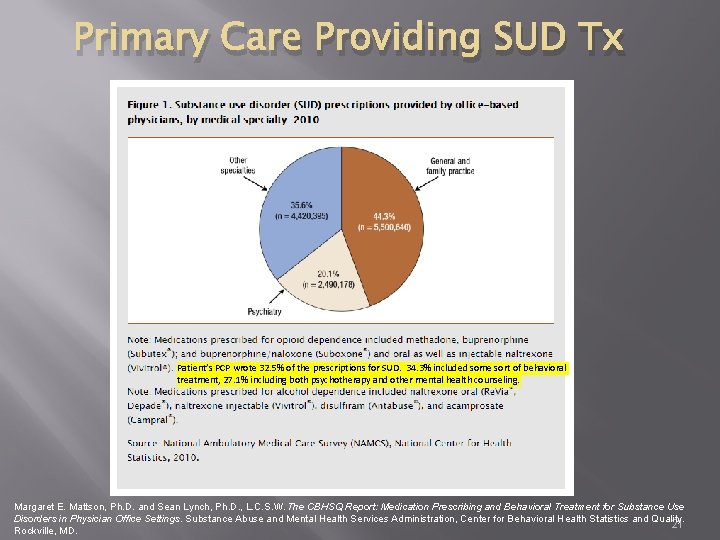
Primary Care Providing SUD Tx Patient’s PCP wrote 32. 5% of the prescriptions for SUD. 34. 3% included some sort of behavioral treatment, 27. 1% including both psychotherapy and other mental health counseling. Margaret E. Mattson, Ph. D. and Sean Lynch, Ph. D. , L. C. S. W. The CBHSQ Report: Medication Prescribing and Behavioral Treatment for Substance Use Disorders in Physician Office Settings. Substance Abuse and Mental Health Services Administration, Center for Behavioral Health Statistics and Quality. 21 Rockville, MD.
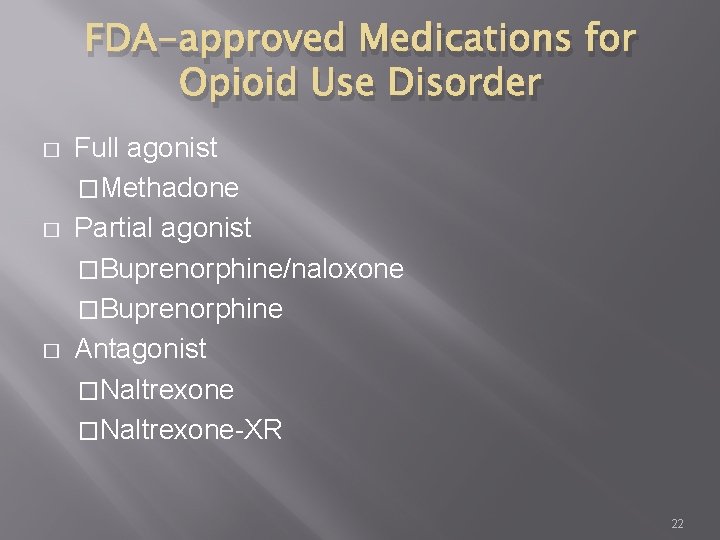
FDA-approved Medications for Opioid Use Disorder � � � Full agonist �Methadone Partial agonist �Buprenorphine/naloxone �Buprenorphine Antagonist �Naltrexone-XR 22
Buprenorphine � � In 2000, DATA was passed which allowed physicians to treat patients with opioid use disorder with schedule III-V drugs which were specifically approved by the FDA for opioid use disorder In 2002, FDA approved buprenorphine and buprenorphine/naloxone for treatment of opioid use disorder 23
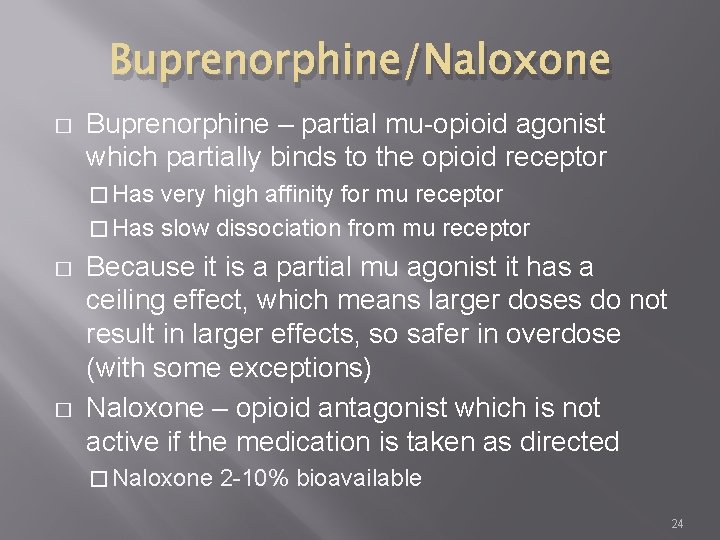
Buprenorphine/Naloxone � Buprenorphine – partial mu-opioid agonist which partially binds to the opioid receptor � Has very high affinity for mu receptor � Has slow dissociation from mu receptor � � Because it is a partial mu agonist it has a ceiling effect, which means larger doses do not result in larger effects, so safer in overdose (with some exceptions) Naloxone – opioid antagonist which is not active if the medication is taken as directed � Naloxone 2 -10% bioavailable 24
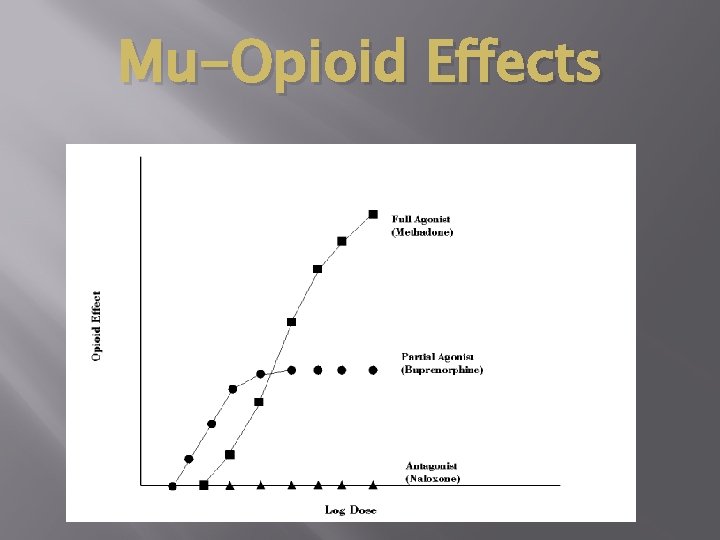
Mu-Opioid Effects
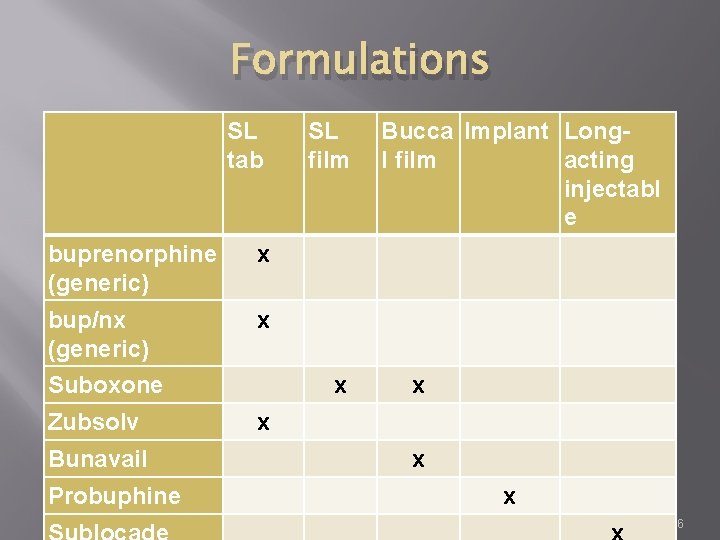
Formulations SL tab SL film Bucca Implant Longl film acting injectabl e buprenorphine (generic) x bup/nx (generic) x Suboxone Zubsolv x x Bunavail Probuphine x x x 26
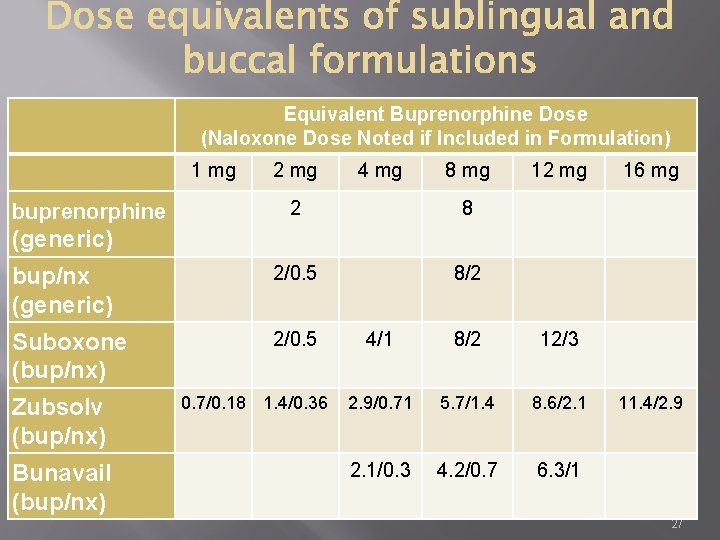
Equivalent Buprenorphine Dose (Naloxone Dose Noted if Included in Formulation) 1 mg 2 mg buprenorphine 4 mg 8 mg 12 mg 16 mg 2 8 8/2 (generic) bup/nx (generic) 2/0. 5 Suboxone (bup/nx) 2/0. 5 Zubsolv (bup/nx) Bunavail (bup/nx) 4/1 8/2 12/3 0. 7/0. 18 1. 4/0. 36 2. 9/0. 71 5. 7/1. 4 8. 6/2. 1/0. 3 4. 2/0. 7 6. 3/1 11. 4/2. 9 27
Buprenorphine Induction � � � To start on buprenorphine, patients need to be in visible opioid withdrawal otherwise risk precipitated withdrawal Induction is typically 4 -8 mg of buprenorphine Induction and stabilization is usually accomplished in a matter of 7 days 28
Buprenorphine � � � Patients usually come to office weekly at first Get 1 -week supply of medication Give urine specimen each visit Need to do some form of psychosocial treatment When stable, advance treatment, giving 2 -week supply of medication If there is a lapse, then resume weekly visits 29
Implantable buprenorphine (Probuphine) � � 4 rods implanted in arm, 74. 2 mg each (equivalent to 80 mg of buprenorphine HCl) Patients stable on 8 mg of buprenorphine or less Implanted and removed by someone who can perform minor surgical procedures Removed after 6 months, new rods can be implanted in the other arm 30
Long-acting injectable buprenorphine (Sublocade) � � � 7 days with transmucosal buprenorphine (8 -24 mg) 300 mg SC x 2 months 100 mg SC monthly thereafter for maintenance � � Minimum time between doses = 26 days Steady state in 4 -6 months If missed dose, give as soon as possible � � � May increase to 300 mg monthly if suboptimal response to 100 mg (+UDS, self-reported use) Noted that occasional delays up to 2 weeks may not have clinically significant impact After steady state is achieved, patients stopping injections may have buprenorphine detectable in plasma for up to 12 months Correlation between plasma and urine concentrations not studied 31
Barriers to PCPs Prescribing Buprenorphine � � � Provided wavier training to 120 physicians in WA Surveyed 7 months after course 92 responded � 78 responses included � � 50 (64. 1%) obtained their waiver 22 (28. 2%) started prescribing buprenorphine � 21 (95%) were family medicine � 1 psychiatrist � 9 placed their name on SAMHSA treatment locator Hutchinson E, Catlin M, Andrilla CH, Baldwin LM, Rosenblatt RA. Barriers to primary care physicians prescribing buprenorphine. Ann Fam Med. 2014 Mar-Apr; 12(2): 128 -33. Pub. Med PMID: 24615308 32
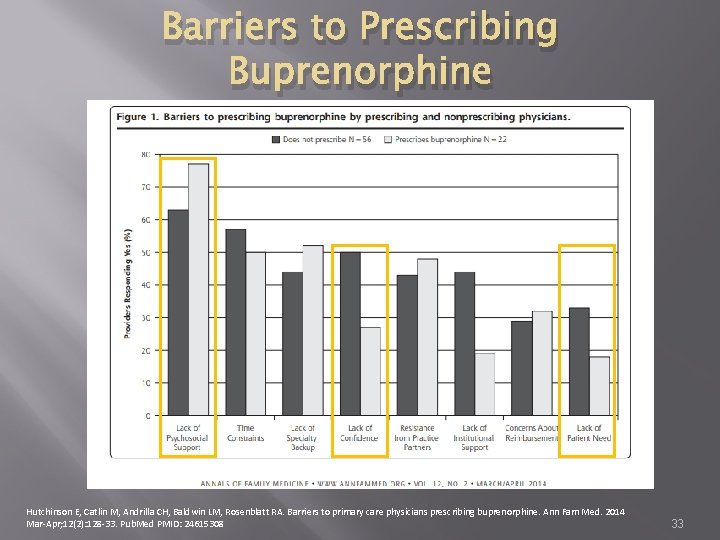
Barriers to Prescribing Buprenorphine Hutchinson E, Catlin M, Andrilla CH, Baldwin LM, Rosenblatt RA. Barriers to primary care physicians prescribing buprenorphine. Ann Fam Med. 2014 Mar-Apr; 12(2): 128 -33. Pub. Med PMID: 24615308 33
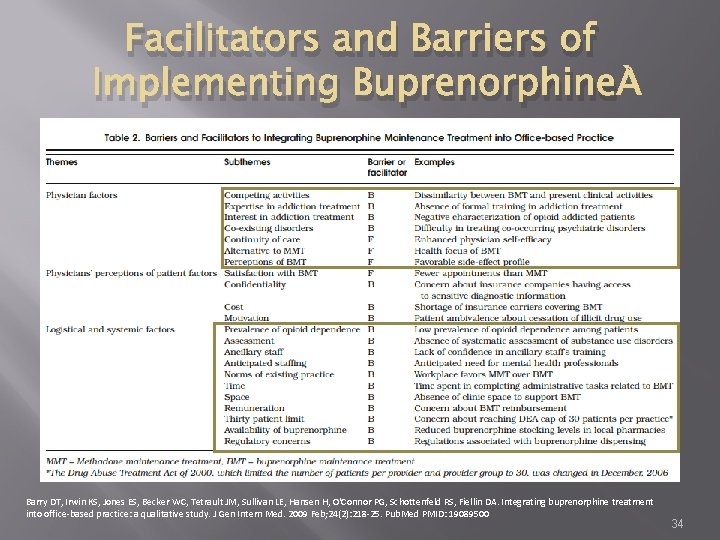
Facilitators and Barriers of Implementing Buprenorphine Barry DT, Irwin KS, Jones ES, Becker WC, Tetrault JM, Sullivan LE, Hansen H, O'Connor PG, Schottenfeld RS, Fiellin DA. Integrating buprenorphine treatment into office-based practice: a qualitative study. J Gen Intern Med. 2009 Feb; 24(2): 218 -25. Pub. Med PMID: 19089500 34
Massachusetts: Nurse Care Manager (NCM) Model Alford DP, La. Belle CT, Kretsch N, Bergeron A, Winter M, Botticelli M, Samet JH. Collaborative care of opioid-addicted patients in primary care using buprenorphine: five-year experience. Arch Intern Med. 2011 Mar 14; 171(5): 425 -31. Pub. Med PMID: 21403039 35
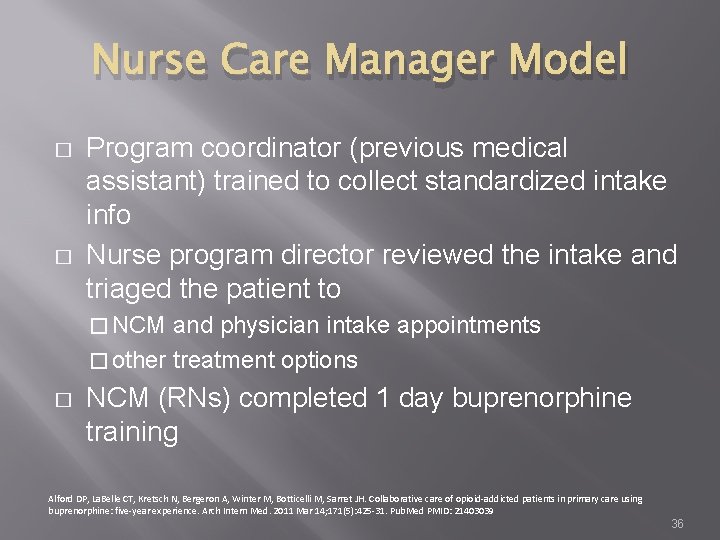
Nurse Care Manager Model � � Program coordinator (previous medical assistant) trained to collect standardized intake info Nurse program director reviewed the intake and triaged the patient to � NCM and physician intake appointments � other treatment options � NCM (RNs) completed 1 day buprenorphine training Alford DP, La. Belle CT, Kretsch N, Bergeron A, Winter M, Botticelli M, Samet JH. Collaborative care of opioid-addicted patients in primary care using buprenorphine: five-year experience. Arch Intern Med. 2011 Mar 14; 171(5): 425 -31. Pub. Med PMID: 21403039 36
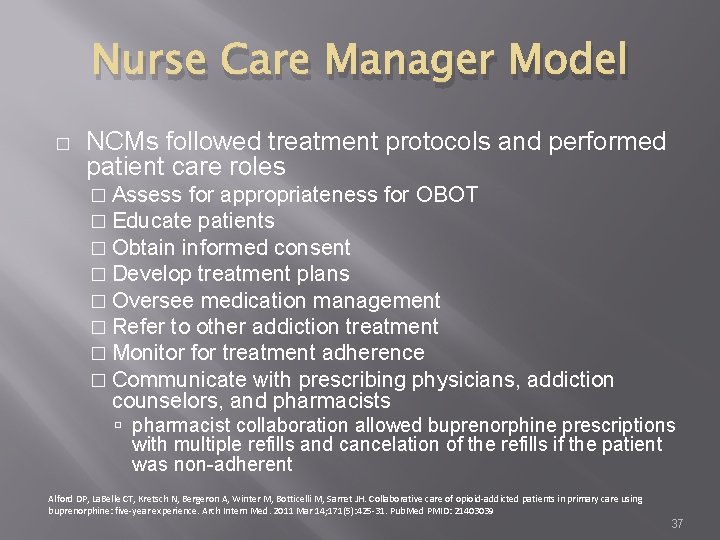
Nurse Care Manager Model � NCMs followed treatment protocols and performed patient care roles � Assess for appropriateness for OBOT � Educate patients � Obtain informed consent � Develop treatment plans � Oversee medication management � Refer to other addiction treatment � Monitor for treatment adherence � Communicate with prescribing physicians, addiction counselors, and pharmacists pharmacist collaboration allowed buprenorphine prescriptions with multiple refills and cancelation of the refills if the patient was non-adherent Alford DP, La. Belle CT, Kretsch N, Bergeron A, Winter M, Botticelli M, Samet JH. Collaborative care of opioid-addicted patients in primary care using buprenorphine: five-year experience. Arch Intern Med. 2011 Mar 14; 171(5): 425 -31. Pub. Med PMID: 21403039 37
Nurse Care Manager Model � Physicians � Reviewed and supplemented the NCM assessments � Reviewed lab results � Performed physical exams � Prescribed buprenorphine � Followed patients at least every 6 months, more frequently if needed � Co-management with psychiatrist if needed Alford DP, La. Belle CT, Kretsch N, Bergeron A, Winter M, Botticelli M, Samet JH. Collaborative care of opioid-addicted patients in primary care using buprenorphine: five-year experience. Arch Intern Med. 2011 Mar 14; 171(5): 425 -31. Pub. Med PMID: 21403039 38
Nurse Care Manager Model � 3 stages of treatment � NCM and physician assessment (appropriateness for OBOT and intake evaluations) � NCM supervised induction and stabilization � Maintenance (buprenorphine treatment with monitoring for illicit drug use and weekly counseling) or discharge Alford DP, La. Belle CT, Kretsch N, Bergeron A, Winter M, Botticelli M, Samet JH. Collaborative care of opioid-addicted patients in primary care using buprenorphine: five-year experience. Arch Intern Med. 2011 Mar 14; 171(5): 425 -31. Pub. Med PMID: 21403039 39
Nurse Care Manager Model � � Physician prescribed buprenorphine, following induction protocol Office induction, NCM observed for signs of opioid withdrawal � prior to the first dose of buprenorphine � precipitated withdrawal after the first dose � Physicians not present during induction but available by pager Alford DP, La. Belle CT, Kretsch N, Bergeron A, Winter M, Botticelli M, Samet JH. Collaborative care of opioid-addicted patients in primary care using buprenorphine: five-year experience. Arch Intern Med. 2011 Mar 14; 171(5): 425 -31. Pub. Med PMID: 21403039 40
Nurse Care Manager Model � During stabilization (days 2– 7), patients took dose at home � At least daily phone contact with the NCM to assess for withdrawal and adverse effects � Dose adjustments were made based on program protocols � All patients had a follow-up NCM visit on day 8 or sooner Alford DP, La. Belle CT, Kretsch N, Bergeron A, Winter M, Botticelli M, Samet JH. Collaborative care of opioid-addicted patients in primary care using buprenorphine: five-year experience. Arch Intern Med. 2011 Mar 14; 171(5): 425 -31. Pub. Med PMID: 21403039 41
Nurse Care Manager Model � Maintenance � Weekly follow-up with NCM for 4– 6 weeks, then every 2 weeks if adherent to treatment , decreasing frequency with stability � Urine drug tests at every NCM visit and physician visit; typically unsupervised � If seen less than monthly, had up to 6 random “call-backs” per year � Patients with unexpected urine drug tests were called to meet with the NCM � Nonadherence resulted in NCM intensifying treatment � Patients encouraged to attend self help groups and mandatory weekly addiction counseling Alford DP, La. Belle CT, Kretsch N, Bergeron A, Winter M, Botticelli M, Samet JH. Collaborative care of opioid-addicted patients in primary care using buprenorphine: five-year experience. Arch Intern Med. 2011 Mar 14; 171(5): 425 -31. Pub. Med PMID: 21403039 42
Nurse Care Manager Model � Discharge � Referred to methadone maintenance treatment if they continued to use illicit opiates or needed more structured care � Involuntarily discharged if declined transfer to MMT � Involuntarily discharged if disruptive behavior � Could request taper at any time, encouraged to wait for at least 6 months of recovery Alford DP, La. Belle CT, Kretsch N, Bergeron A, Winter M, Botticelli M, Samet JH. Collaborative care of opioid-addicted patients in primary care using buprenorphine: five-year experience. Arch Intern Med. 2011 Mar 14; 171(5): 425 -31. Pub. Med PMID: 21403039 43
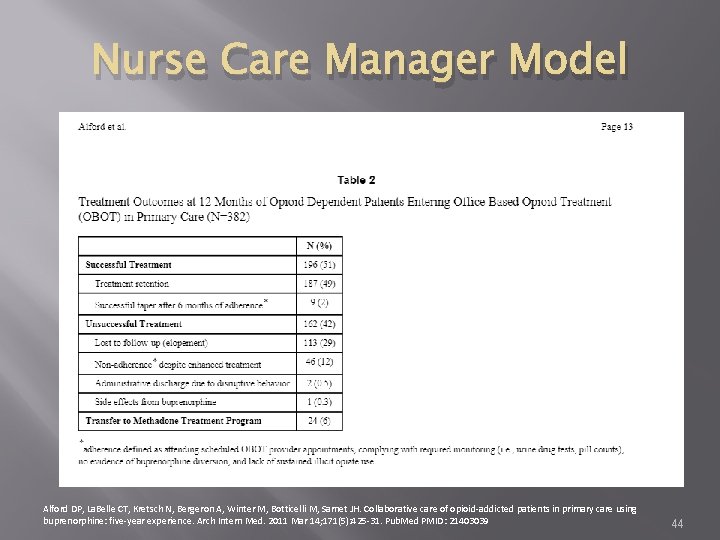
Nurse Care Manager Model Alford DP, La. Belle CT, Kretsch N, Bergeron A, Winter M, Botticelli M, Samet JH. Collaborative care of opioid-addicted patients in primary care using buprenorphine: five-year experience. Arch Intern Med. 2011 Mar 14; 171(5): 425 -31. Pub. Med PMID: 21403039 44
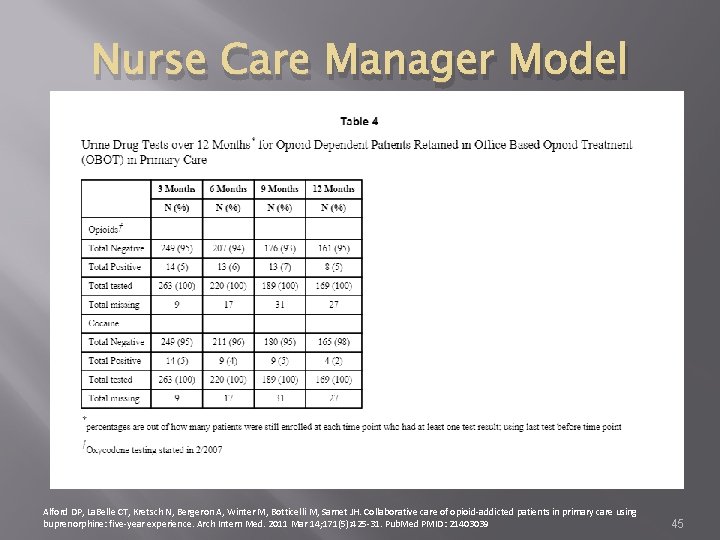
Nurse Care Manager Model Alford DP, La. Belle CT, Kretsch N, Bergeron A, Winter M, Botticelli M, Samet JH. Collaborative care of opioid-addicted patients in primary care using buprenorphine: five-year experience. Arch Intern Med. 2011 Mar 14; 171(5): 425 -31. Pub. Med PMID: 21403039 45

Vermont: Hub and Spoke Model 46
Vermont Hub & Spoke Model � � � Vermont was historically underserved, first OTP opened in 2002 Patients on wait-list Somewhat alleviated with introduction of buprenorphine, but still unmet need due to physicians treating small numbers of patients due to concerns related to buprenorphine OTP wait-list grew Noted need for specialized clinic to � Perform buprenorphine induction and stabilization � Treat complicated patients � Treat unstable patients Brooklyn JR, Sigmon SC. Vermont Hub-and-Spoke Model of Care for Opioid Use Disorder: Development, Implementation, and Impact. J Addict Med. 2017 Jul/Aug; 11(4): 286 -292. Pub. Med PMID: 28379862 47
Vermont Hub & Spoke Model � � � Developed hub and spoke model Hub in 5 regions of Vermont Spokes are buprenorphine providers Spokes can seek consultation from hub, regarding screening, induction, referrals Idea that spokes will expand their capacity if they have extra support Support for spoke includes MAT team: 1 fulltime equivalent RN and 1 master’s level BH provider per 100 Medicaid patients Brooklyn JR, Sigmon SC. Vermont Hub-and-Spoke Model of Care for Opioid Use Disorder: Development, Implementation, and Impact. J Addict Med. 2017 Jul/Aug; 11(4): 286 -292. Pub. Med PMID: 28379862 48
Vermont Hub & Spoke Model � RN role: � Meets with new patients � Reviews contracts and consents � Arranges for insurance authorization � Arranges for urine drug testing � Authorizes buprenorphine refills to pharmacies � Monitors the PDMP � Oversees diversion control (random call-backs) Brooklyn JR, Sigmon SC. Vermont Hub-and-Spoke Model of Care for Opioid Use Disorder: Development, Implementation, and Impact. J Addict Med. 2017 Jul/Aug; 11(4): 286 -292. Pub. Med PMID: 28379862 49

Vermont Hub & Spoke Model � Behavioral health provider role: � Coordinates counseling � Crisis managment � � � Brief supportive counseling Assists with practical issues Coordinates referrals between the spoke and hub Brooklyn JR, Sigmon SC. Vermont Hub-and-Spoke Model of Care for Opioid Use Disorder: Development, Implementation, and Impact. J Addict Med. 2017 Jul/Aug; 11(4): 286 -292. Pub. Med PMID: 28379862 50
Vermont Hub & Spoke Model � � From 2012 to 2016, there was a 64% increase in waivered physicians (173 to 283) The number prescribed buprenorphine by individual physicians increased More than 50% of spoke providers treated more than 10 patients By September 2015, � 23% had more than 30 patients � 10% had more than 50 patients Brooklyn JR, Sigmon SC. Vermont Hub-and-Spoke Model of Care for Opioid Use Disorder: Development, Implementation, and Impact. J Addict Med. 2017 Jul/Aug; 11(4): 286 -292. Pub. Med PMID: 28379862 51
52
53
54
Additional Resources � PCSS-now. org � Webinars (upcoming and archived) Buprenorphine waiver training (online or live) � Clinical coaching (one: one coaching, small group discussions) � Resources (e. g. , clinical tools) � AAAP received SAMHSA grant to provide training and technical assistance on evidencebased practices to combat opioid crisis 55
Overdose & Naloxone 56
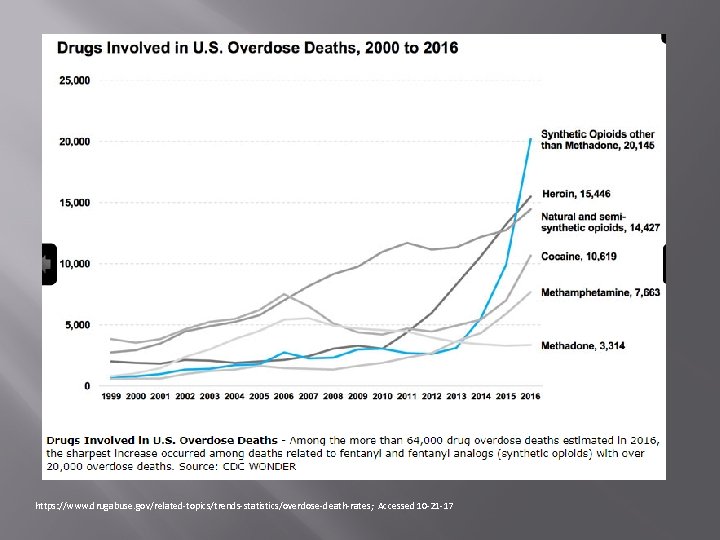
https: //www. drugabuse. gov/related-topics/trends-statistics/overdose-death-rates; Accessed 10 -21 -17
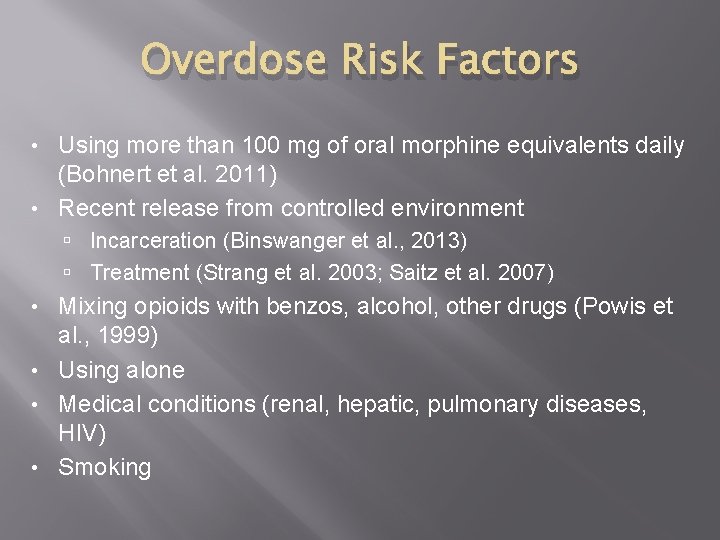
Overdose Risk Factors Using more than 100 mg of oral morphine equivalents daily (Bohnert et al. 2011) • Recent release from controlled environment • Incarceration (Binswanger et al. , 2013) Treatment (Strang et al. 2003; Saitz et al. 2007) Mixing opioids with benzos, alcohol, other drugs (Powis et al. , 1999) • Using alone • Medical conditions (renal, hepatic, pulmonary diseases, HIV) • Smoking •
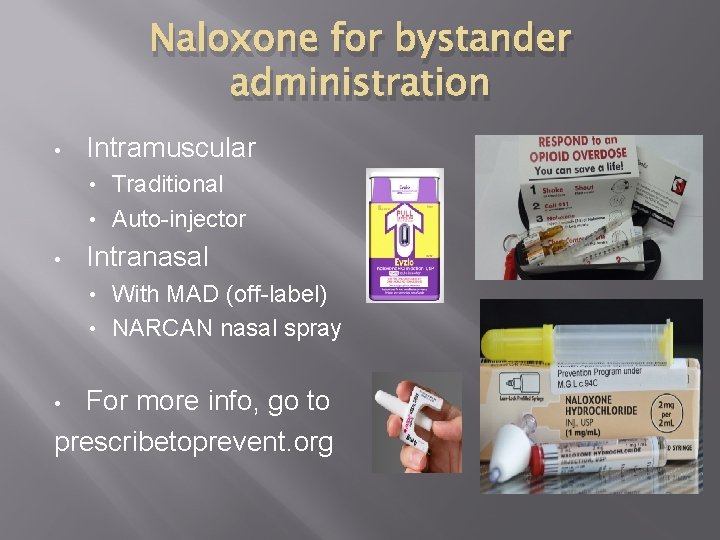
Naloxone for bystander administration • Intramuscular Traditional • Auto-injector • • Intranasal With MAD (off-label) • NARCAN nasal spray • For more info, go to prescribetoprevent. org •
Questions/Discussion 60
References 1. 2. 3. 4. 5. 6. 7. 8. 9. 10. 11. Hagan H, Pouget ER, Des Jarlais DC, Lelutiu-Weinberger C. Meta-regression of hepatitis C virus infection in relation to time since onset of illicit drug injection: the influence of time and place. Am J Epidemiol 2008; 168: 1099 -109. Hser YI, Evans E, Grella C, Ling W, Anglin D. Long-term course of opioid addiction. Harv Rev Psychiatry. 2015 Mar-Apr; 23(2): 76 -89. doi: 10. 1097/HRP. 000000052. Review. Pub. Med PMID: 25747921. Marsch LA. The efficacy of methadone maintenance interventions in reducing illicit opiate use, HIV risk behavior and criminality: a meta-analysis. Addiction. 1998 Apr; 93(4): 515 -32. Committee on the Prevention of HIV Infection Among Injecting Drug Users in High-Risk Countries. Preventing HIV Infection Among Injecting Drug Users in High-Risk Countries: An Assessment of the Evidence. In: Tilson H, Aramrattana A, Bozzette S, editors. Washington, DC: Institute of Medicine of the National Academy of Sciences, 2007. WHO. Guidelines for the psychosocially assisted pharmacological treatment of opioid dependence. Geneva: World Health Organization, 2009. Gowing L, Farrell M, Bornemann R, Sullivan LE, Ali R. Substitution treatment of injecting opioid users for prevention of HIV infection (Review). The Cochrane Library: The Cochrane Collaboration, 2009. WHO. Evidence for Action Technical Papers: Effectiveness of drug dependence treatment in preventing HIV among injecting drug users. In: World Health Organization, editor. Geneva, 2005. Faggiano F, Vigna-Taglianti F, Versino E, Lemma P. Methadone maintenance at different dosages for opioid dependence. Cochrane Database Syst Rev 2009; 3: CD 002208. Mattick RP, Breen C, Kimber J, Davoli M. Methadone maintenance therapy versus no opioid replacement therapy for opioid dependence. Cochrane Database Syst Rev 2009; 1: CD 002209. Sullivan LE, Metzger DS, Fudala PJ, Fiellin DA. Decreasing international HIV transmission: the role of expanding access to opioid agonist therapies for injection drug users. Addiction 2005; 100(2): 150 - 58. Amato L, Davoli M, Perucci CA, Ferri M, Faggiano F, Mattick RP. An overview of systematic reviews of the effectiveness of opiate maintenance therapies: available evidence to inform clinical practice and research. J Subst Abuse Treat 2005; 28: 321 -29. 61
References 12. 13. 14. 15. 16. 17. 18. 19. 20. 21. Mattick RP, Breen C, Kimber J, Davoli M. Buprenorphine maintenance versus placebo or methadone maintenance for opioid dependence. Cochrane Database Syst Rev 2009; 3: CD 002207. WHO, UNODC, UNAIDS. WHO/UNODC/UNAIDS position paper: Substitution maintenance therapy in the management of opioid dependence and HIV/AIDs prevention. Geneva: World Health Organisation, 2004. Ward J, Mattick RP, Hall W, editors. Methadone Maintenance Treatment and Other Opioid Replacement Therapies. Amsterdam: Harwood Academic Publishers, 1998. Wong K-h, Lee S-s, Lim W-l, Low H-k. Adherence to methadone is associated with a lower level of HIV related risk behaviors in drug users. J Subst Abuse Treat 2003; 24(3): 233 -9. Nolan S, Dias Lima V, Fairbairn N, Kerr T, Montaner J, Grebely J, Wood E. The impact of methadone maintenance therapy on hepatitis C incidence among illicit drug users. Addiction. 2014 Dec; 109(12): 2053 -9. doi: 10. 1111/add. 12682. Epub 2014 Aug 14. Kakko J, Svanborg KD, Kreek MJ, Heilig M. 1 -year retention and social function after buprenorphine-assisted relapse prevention treatment for heroin dependence in Sweden: a randomised, placebo-controlled trial. Lancet. 2003 Feb 22; 361(9358): 662 -8. Harris DS, Jones RT, Welm S, Upton RA, Lin E, Mendelson J. Buprenorphine and naloxone co-administration in opiatedependent patients stabilized on sublingual buprenorphine. Drug Alcohol Depend. 2000 Dec 22; 61(1): 85 -94. Pub. Med PMID: 11064186. Greenwald MK, Johanson CE, Moody DE, Woods JH, Kilbourn MR, Koeppe RA, Schuster CR, Zubieta JK. Effects of buprenorphine maintenance dose on mu-opioid receptor availability, plasma concentrations, and antagonist blockade in heroin-dependent volunteers. Neuropsychopharmacology. 2003 Nov; 28(11): 2000 -9. Pub. Med PMID: 12902992. Clark RE, Baxter JD, Aweh G, O'Connell E, Fisher WH, Barton BA. Risk Factors or Relapse and Higher Costs Among Medicaid Members with Opioid Dependence or Abuse: Opioid Agonists, Comorbidities, and Treatment History. J Subst Abuse Treat. 2015 Oct; 57: 75 -80. doi: 10. 1016/j. jsat. 2015. 001. Epub 2015 May 7. Pub. Med PMID: 25997674; Pub. Med Central PMCID: PMC 4560989. Center for Substance Abuse Treatment. Medication-Assisted Treatment for Opioid Addiction in Opioid Treatment Programs. Rockville (MD): Substance Abuse and Mental Health Services Administration (US); 2005. Pub. Med PMID: 22514849. 62
- Slides: 62