
PRESCHOOLERS PRAGMATIC AND SEMANTIC DEVELOPMENT 2 5 years










- Slides: 72
PRESCHOOLERS: PRAGMATIC AND SEMANTIC DEVELOPMENT (2 -5 years)
Outline • • • I. Developmental Milestones II. Semantic Development III. Pragmatic Development IV. Social Skils Training V. Emergent Literacy VI. Bilingual Language Learning • VII. Impact of Poverty
I. DEVELOPMENTAL MILESTONES • A. Cognitive Development
B. Social Development** • 27 mos— communicates desire and orders others around • 30 mos—demands caregiver’s attention, throws tantrums when needs are not understood
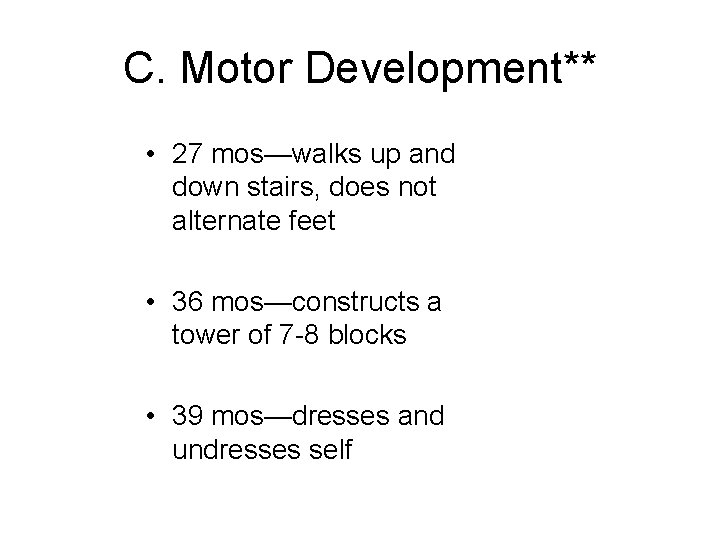
C. Motor Development** • 27 mos—walks up and down stairs, does not alternate feet • 36 mos—constructs a tower of 7 -8 blocks • 39 mos—dresses and undresses self
II. SEMANTIC DEVELOPMENT** • A. Introduction • Semantic development is closely related to development in motor, social, and cognitive abilities • The better a child’s abilities in those areas, the more language he receives and practices
Preschoolers’ vocabularies grow fast:
youtube • 3 -year-old girl tells hilarious nonsensical stories • Notice how long her sentences are and how many different words she uses • Write down at least 5 -6 vocabulary words you hear
youtube • Mixed Receptive-Expressive Language Delay • Ashley Repking Brickey • Start at one minute in • What do you notice about his speech (how understandable he is). Write down 5 -6 words he uses.
• Children learn words exposed to in their environments** • 3 -year old farm girl: “Mommy, I think we are having difficulty milking Flicker because her orifices are too small. ”
B. Word Learning
For example: ** • A child might learn the word “horse” when he goes on a merry-go-round with his dad • Then, he extends his understanding as he sees horses in pastures and reads about them in books
Extended mapping “pumpkin” for a 4 -year old with LI: • For example, the child sees a pumpkin in a book • How can you extend her understanding of and exposure to pumpkins?
Children learn new words more quickly when these words…
We can help children learn new words faster by:
Let’s say you want to teach “pig; ” you’d want to make sure it was the only new word in that context**
C. Dimensional Words
D. Development of Relational Terms** • These terms express relationships in domains such as color, location, size, family roles, and temporal sequences • These terms can be hard because they are often relative • For example, whose mom is the skinniest? Whose dad is the tallest?
E. Color Words** • By 4 -5 years old, most preschoolers can name blue, red, yellow • More subtle color shades are acquired later
F. Spatial Words** • Indicate location of a referent in relation to some item • in, out, behind, under • By 5 yrs, most preschoolers have mastered most spatial relations • Important for math!
G. Kinship Words** • The first ones to develop usually refer to immediate family—mother, father, sister, brother • Then, children gradually learn other layers of relatives
H. Temporal Words
Come up with activities and then we’ll share: • You are serving a 5 -year old with a language impairment • She is in kindergarten, and does not understand the concept of until • How will you teach this concept? What activities will you do, and what materials will you use?
• III. PRAGMATIC DEVELOPMENT** A. Introduction • For optimal development of pragmatic skills, children need both varied and routine experiences
B. Private and Socialized Speech** • Monologues: private speech-children talk to selves • Socialized speech-acknowledge partners’ utterances, ↑ concern re: transmitting info
C. Discourse Skills** • Discourse, or conversation, is a series of consecutive utterances shared by at least 2 people • Cohesion refers to the relatedness of successive utterances in discourse
• The Big Bang Theory Sheldon and Amy's date night please pass the butter • How are Sheldon’s cohesion skills?
Children need to develop Theory of Mind (To. M) skills:
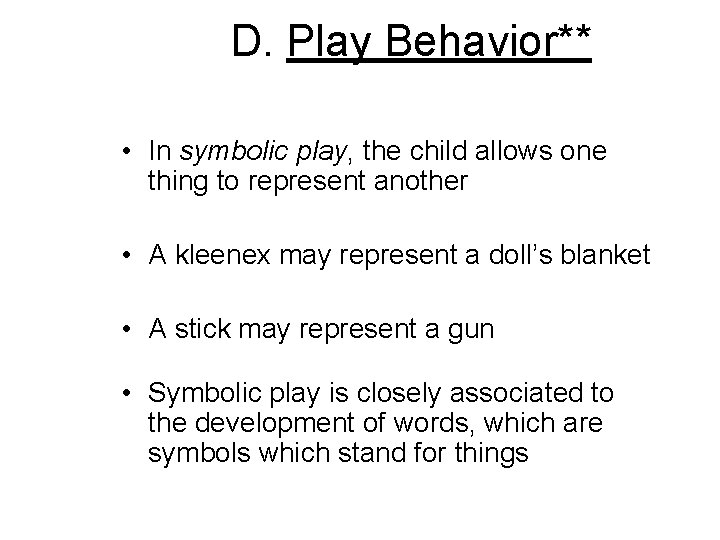
D. Play Behavior** • In symbolic play, the child allows one thing to represent another • A kleenex may represent a doll’s blanket • A stick may represent a gun • Symbolic play is closely associated to the development of words, which are symbols which stand for things
In solitary play…
In parallel play…
In associative play…
In cooperative play…
E. Preschoolers’ Storytelling
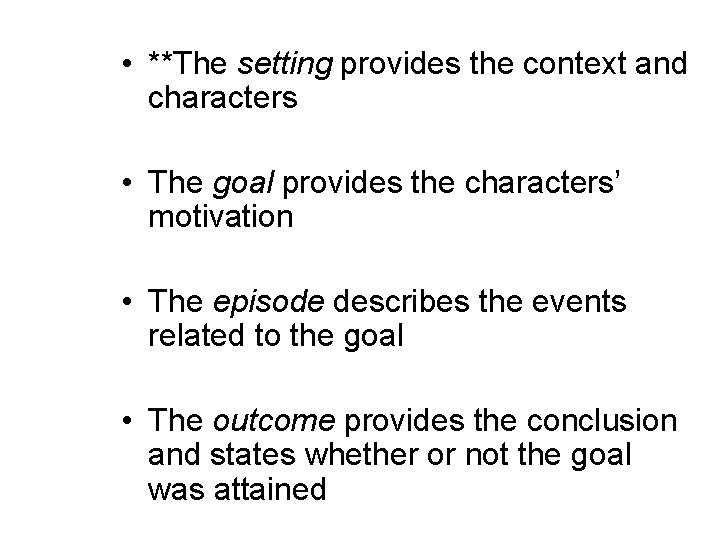
• **The setting provides the context and characters • The goal provides the characters’ motivation • The episode describes the events related to the goal • The outcome provides the conclusion and states whether or not the goal was attained
Bliss, Mc. Cabe, & Mahecha :
Youtube video • Crabetha • Preschooler talking about his day • Even something this basic is a precursor to narrative and reading skills
F. Narrative Levels** (p. 243) • PRIMITIVE NARRATIVES/CENTERING— 4 yrs. —there is an identifiable theme and elements are conceptually related to the core topic • • SEQUENCES/CHAINING— 3 yrs. —elements of story are related to a central topic, but are not necessarily chronologically sequenced • • HEAPS— 30 mos. —collections of unrelated utterances
G. Behaviors that contribute to cohesion: ** • 1. Topic Introduction —young preschoolers physically intro topics (e. g. , pointing, putting an object in someone’s hand) • Intro topics with listener’s name (Mommy…)
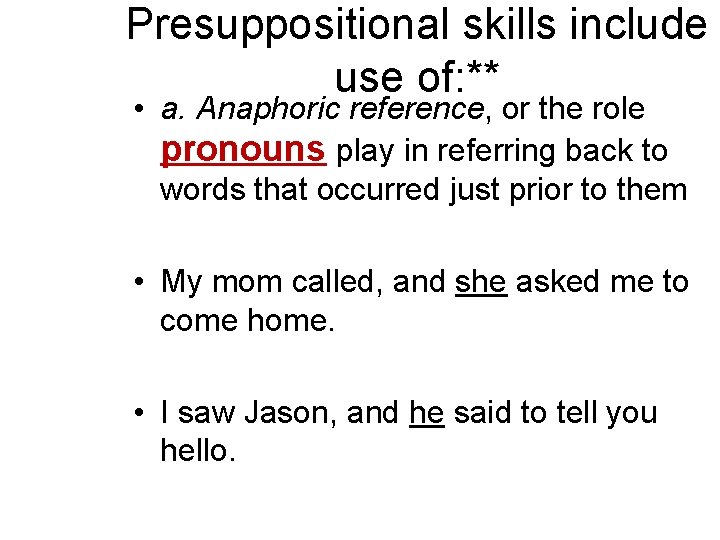
2. Presupposition** • Young preschoolers often give info with no apparent context • But after 3, most preschoolers have appropriate presuppositional skills • 3 aspects of presuppositional skills
Presuppositional skills include use of: ** • a. Anaphoric reference, or the role pronouns play in referring back to words that occurred just prior to them • My mom called, and she asked me to come home. • I saw Jason, and he said to tell you hello.
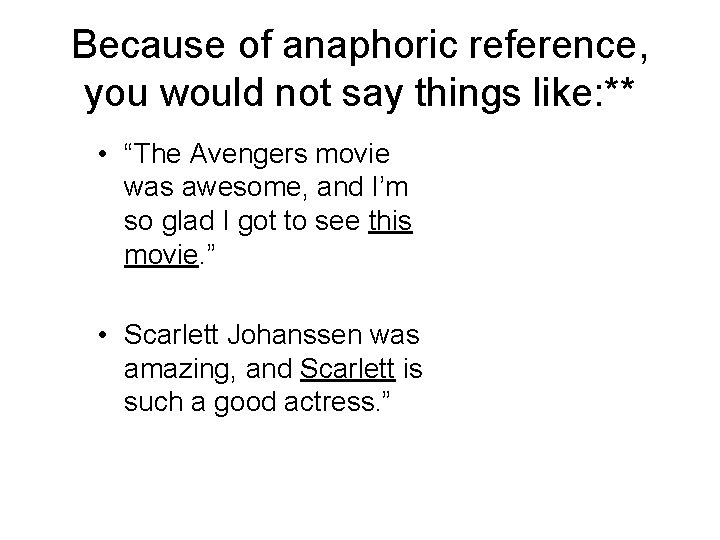
Because of anaphoric reference, you would not say things like: ** • “The Avengers movie was awesome, and I’m so glad I got to see this movie. ” • Scarlett Johanssen was amazing, and Scarlett is such a good actress. ”
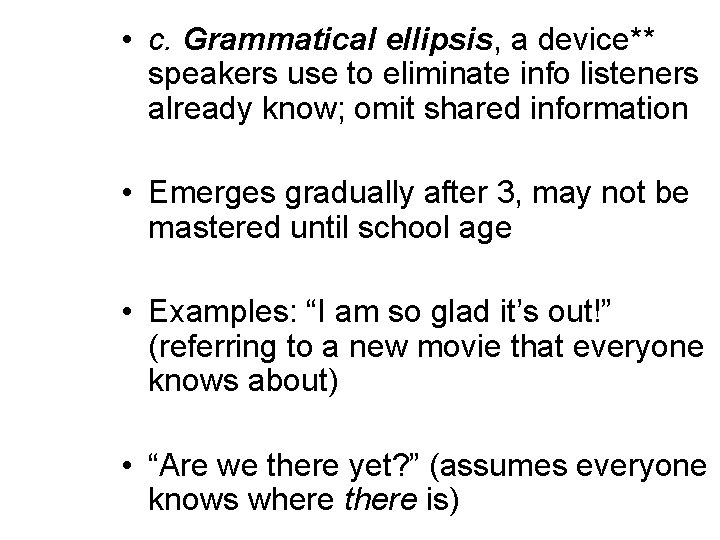
• c. Grammatical ellipsis, a device** speakers use to eliminate info listeners already know; omit shared information • Emerges gradually after 3, may not be mastered until school age • Examples: “I am so glad it’s out!” (referring to a new movie that everyone knows about) • “Are we there yet? ” (assumes everyone knows where there is)
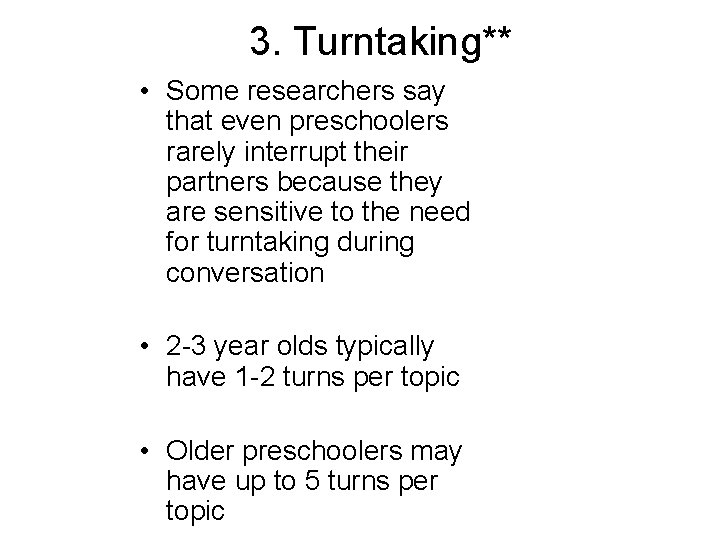
3. Turntaking** • Some researchers say that even preschoolers rarely interrupt their partners because they are sensitive to the need for turntaking during conversation • 2 -3 year olds typically have 1 -2 turns per topic • Older preschoolers may have up to 5 turns per topic
4. Topic maintenance
Aspects of topic maintenance include: ** • a. conversational repairs —behaviors that result in clarification of previous utterances and help maintain conversational flow of accurate info • . • Usually preschoolers do not request conversational repairs--just look confused
IV. SOCIAL SKILLS TRAINING** • ASHA Schools Conference: Pamela Wiley • Said we need to begin early—even in preschool • Problems in social skills can lead to negative consequences that can last a lifetime
Wiley—possible consequences of poor social skills:
Wiley—Skill steps:
Fogle 2019:
V. EMERGENT LITERACY** • One way to enhance preschoolers’ emergent literacy skills is through print referencing • This occurs when an adult uses verbal and nonverbal cues to direct a child to the features of written language during shared storybook reading
When adults are reading with children, they can:
If young children are fairly hyper and don’t sit well during book reading: ** • Be exciting and dramatic when you read—use different funny voices • Use books with manipulable parts like flaps, buttons • Short books that have lots of pictures
Print awareness:
Research has shown that…
Youtube video • Working on print awareness with Angelo • Youtube Celeste Roseberry channel
VI. Bilingual Language Learning** • Simultaneous acquisition is the development of 2 languages prior to age 3 • The social experience of bilingualism may provide children with the opportunity of taking another person’s linguistic perspective early in the language development process
Successive bilingual acquisition…
For children who use African American English (AAE)….
VII. Impact of Poverty** • Parents with more formal education use more diverse vocabulary with their children • These parents engage in verbal interaction more and use more complex utterances • By 18 months of age, there already gaps in vocab and lang processing efficiency between high- and low-SES children
A recent study found:
Good news-research shows that: ** • Parents experiencing poverty and/or homelessness can be successfully trained to converse and share books with their children
Outline • • • I. Developmental Milestones II. Semantic Development III. Pragmatic Development IV. Social Skils Training V. Emergent Literacy VI. Bilingual Language Learning • VII. Impact of Poverty