
Preschool Learning Foundations and Curriculum Framework Literacy for



![33 “[Early intervention] does not look very different from primary prevention, differing primarily in](https://slidetodoc.com/presentation_image_h/d9f41ab935d5c638e781dd892d5f4f4c/image-33.jpg "33 “[Early intervention] does not look very different from primary prevention, differing primarily in")
- Slides: 43
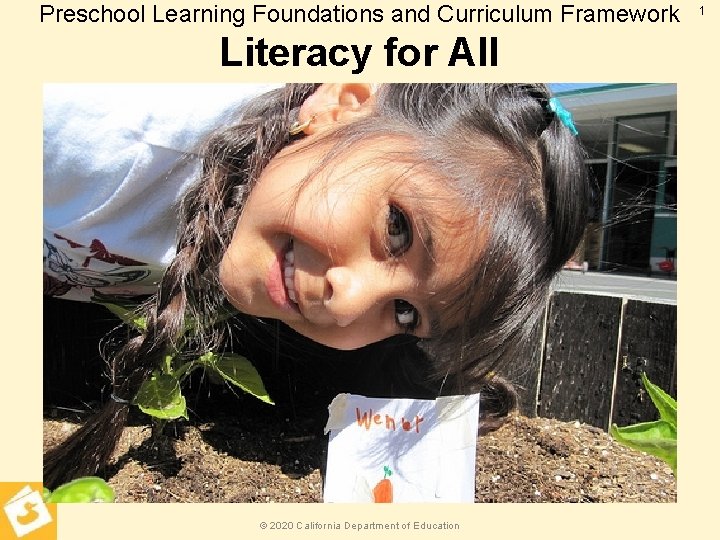
Preschool Learning Foundations and Curriculum Framework Literacy for All © 2020 California Department of Education 1
2 Outcomes Explore: • The idea literacy for all • Law that supports literacy for all • How California’s preschool resources embody literacy for all children • Strategies to support literacy for all students © 2020 California Department of Education
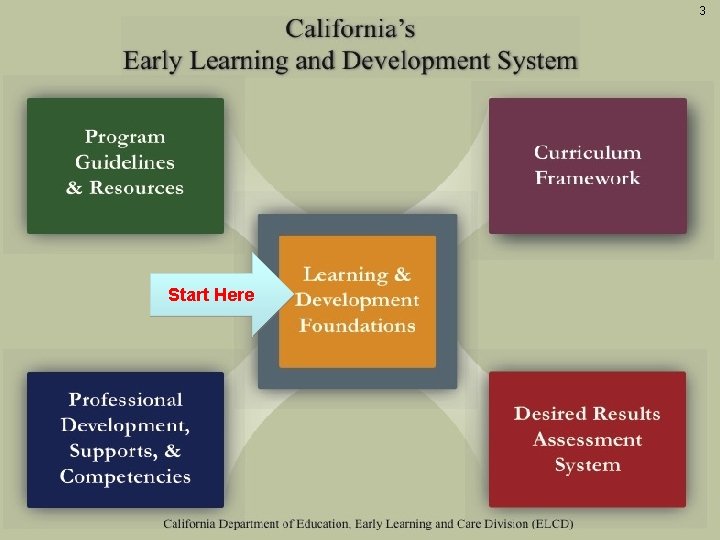
3 Early Learning Development System Start Here © 2020 California Department of Education
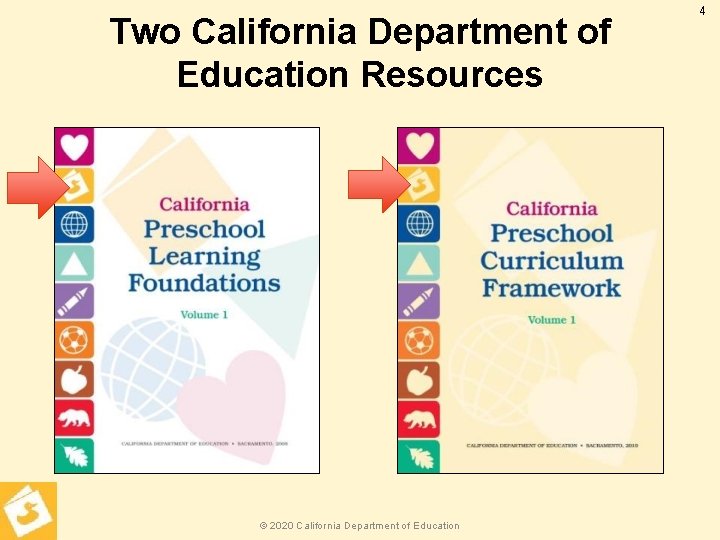
Two California Department of Education Resources © 2020 California Department of Education 4
Ice What does literacy for all mean to you? Breaker
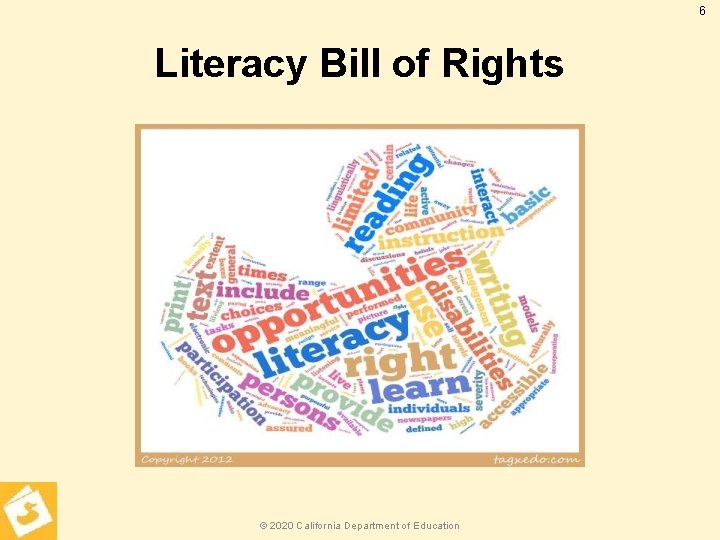
6 Literacy Bill of Rights © 2020 California Department of Education
Reflection: Literacy Bill of Rights Handout In your small groups: • Discuss the Literacy Bill of Rights handout. • How does this document influence your idea of what “literacy for all” means? • Be sure each person has time to contribute their ideas. • Choose someone to report back to the group. © 2020 California Department of Education 7
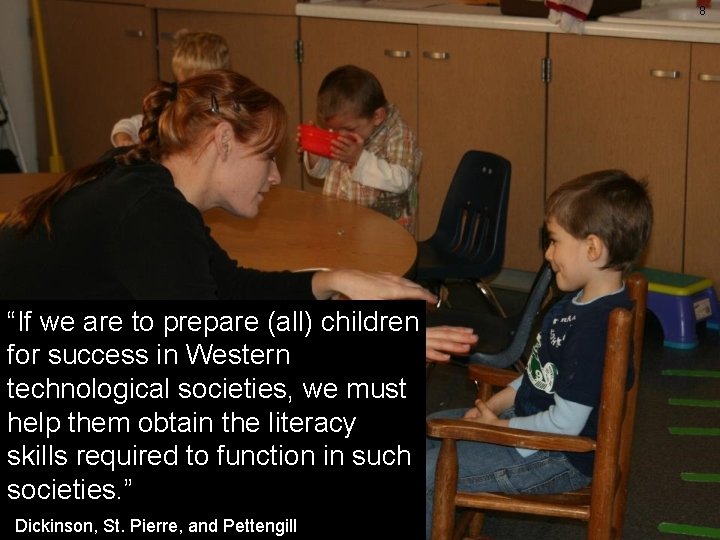
8 Societal Outcomes “If we are to prepare (all) children for success in Western technological societies, we must help them obtain the literacy skills required to function in such societies. ” Dickinson, St. Pierre, and Pettengill
9 What is Literacy? © 2020 California Department of Education
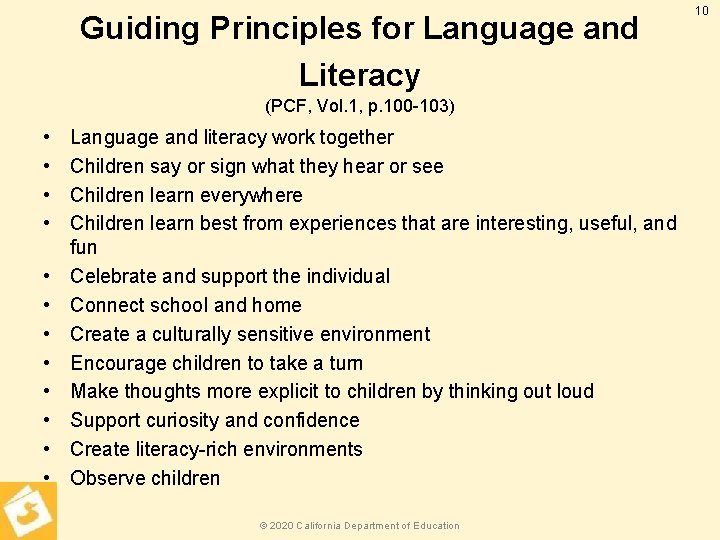
Guiding Principles for Language and Literacy (PCF, Vol. 1, p. 100 -103) • • • Language and literacy work together Children say or sign what they hear or see Children learn everywhere Children learn best from experiences that are interesting, useful, and fun Celebrate and support the individual Connect school and home Create a culturally sensitive environment Encourage children to take a turn Make thoughts more explicit to children by thinking out loud Support curiosity and confidence Create literacy-rich environments Observe children © 2020 California Department of Education 10
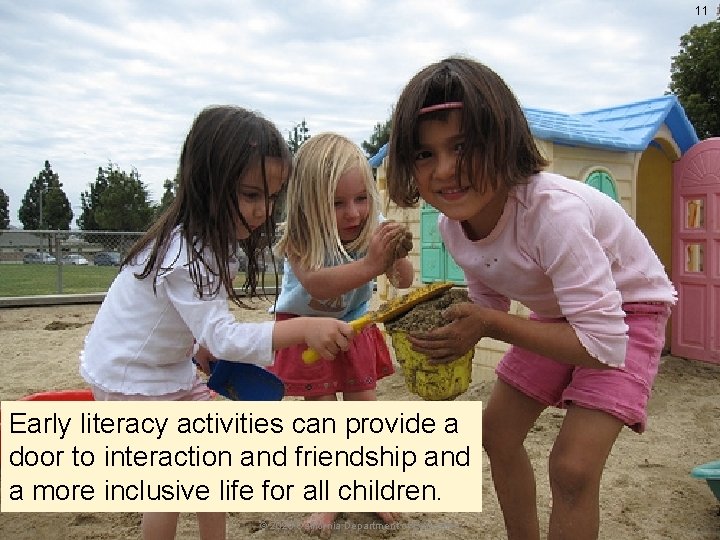
11 Expanding Our Definition of Literacy Early literacy activities can provide a door to interaction and friendship and a more inclusive life for all children. © 2020 California Department of Education
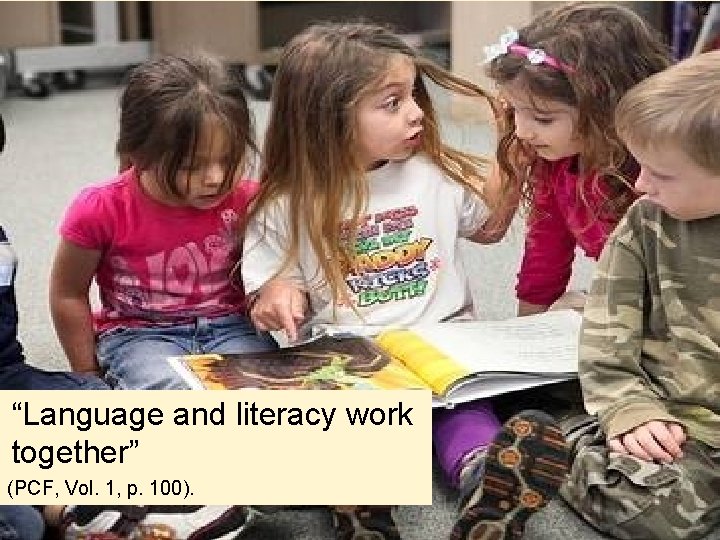
12 Guiding Principle “Language and literacy work together” (PCF, Vol. 1, p. 100).
13 What do you wish for our children? © 2020 California Department of Education
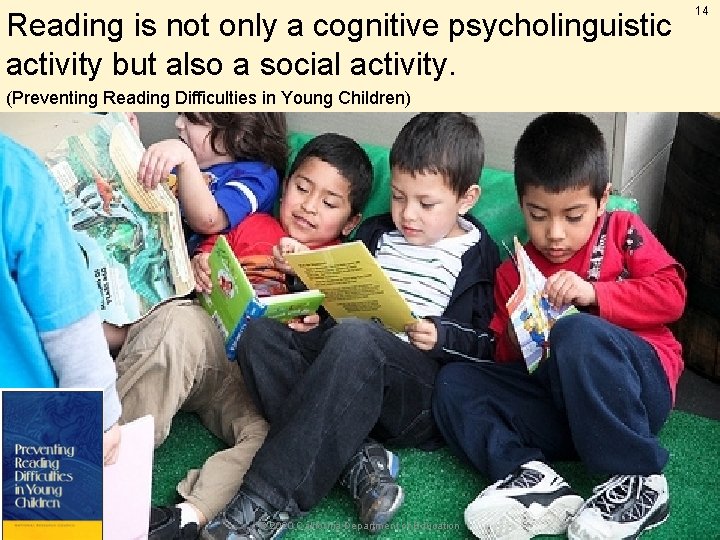
Reading is not only a cognitive psycholinguistic Reading is social and activity but also a social activity. independent (Preventing Reading Difficulties in Young Children) © 2020 California Department of Education 14
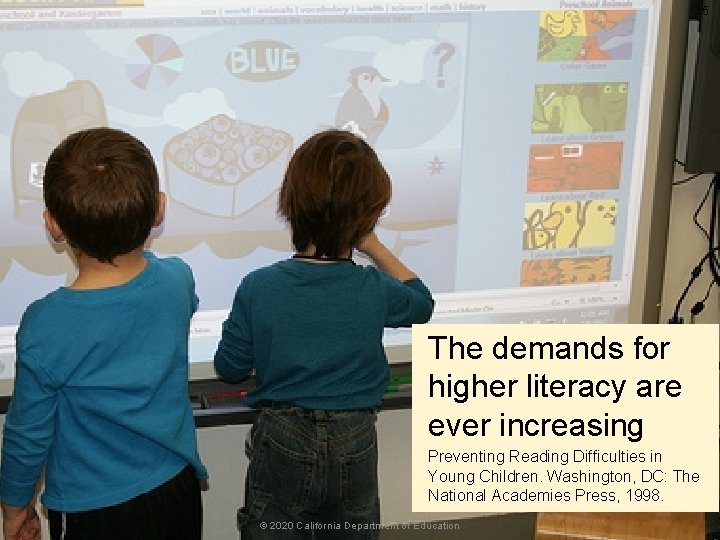
15 Increasing literacy demands The demands for higher literacy are ever increasing Preventing Reading Difficulties in Young Children. Washington, DC: The National Academies Press, 1998. © 2020 California Department of Education
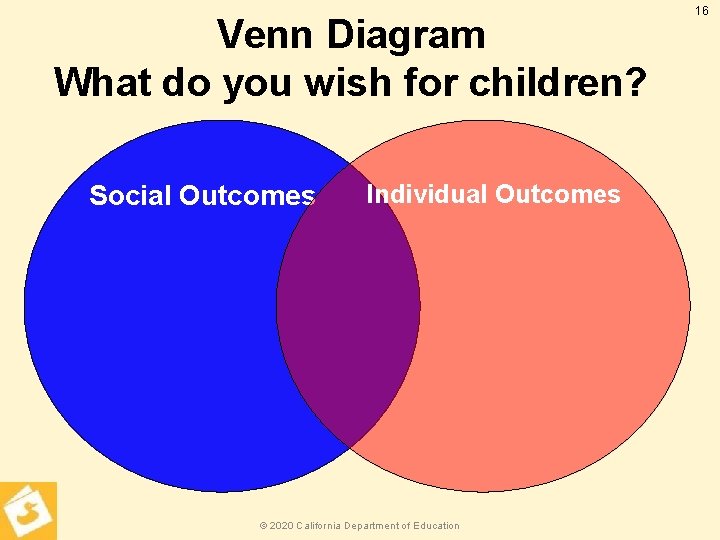
Venn Diagram What do you wish for children? Social Outcomes Individual Outcomes © 2020 California Department of Education 16
17 What do you wish for children? • Individually reflect on what you wish for children in terms of literacy and or life skills. • In your group: – Share your ideas. – Combine your ideas and enter on the whiteboard. – What are the social emotional benefits of early literacy? © 2020 California Department of Education
18 IDEA 2004 The goal of the Individuals with Disabilities Education Act (IDEA) is no longer simply to make services available to young children with disabilities and their families, but also to ensure that those services lead to enhanced outcomes for participating children and families. © 2020 California Department of Education
19 Law and Beliefs PL 94 -142 (1975): Public education for all children ADA (1991): Access to full participation in society IDEA (2004) Access to education for all “The desired results of inclusive experiences for children with and without disabilities and their families include a sense of belonging and membership, positive social relationships and friendships, and development and learning to reach their full potential” (DEC/NAEYC position statement) © 2020 California Department of Education
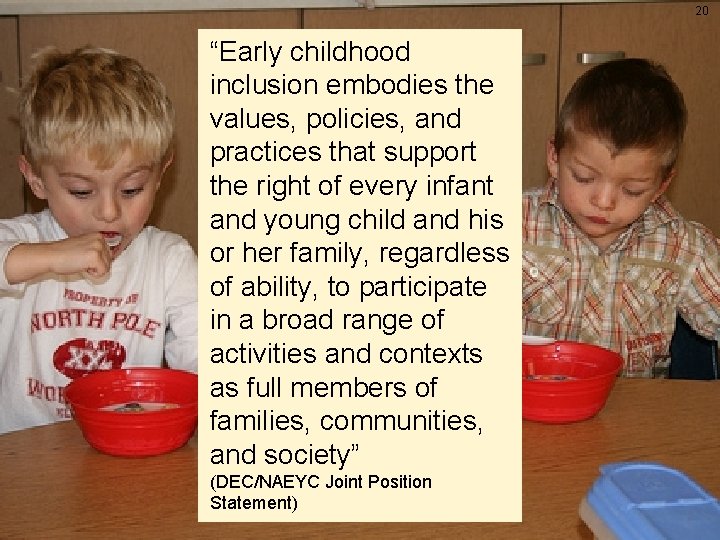
20 “Early childhood Jointinclusion Position Statement embodies the values, policies, and practices that support the right of every infant and young child and his or her family, regardless of ability, to participate in a broad range of activities and contexts as full members of families, communities, and society” (DEC/NAEYC Joint Position Statement)
21 Reflection Handout 3 • Scan the Joint Position Statement handout that you read before the session • What did you learn? • How will you use this information in your work with young children • Enter ideas and thoughts about the statement into the chat box. © 2020 California Department of Education
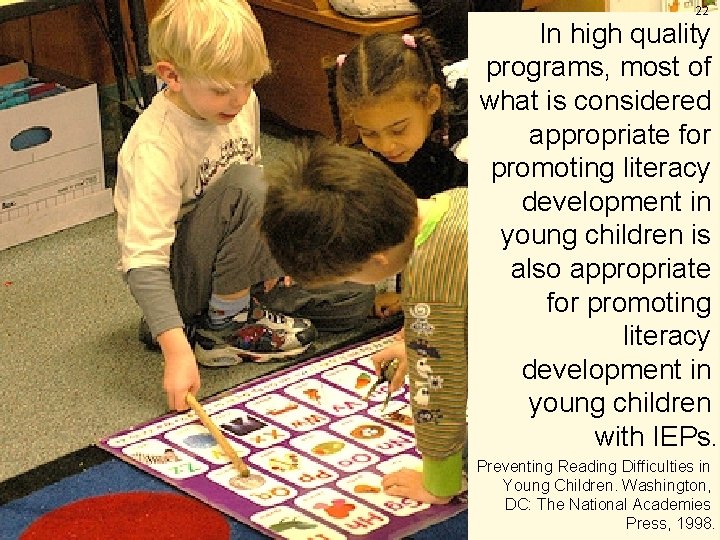
22 In high quality programs, most of what is considered appropriate for promoting literacy development in young children is also appropriate for promoting literacy development in young children with IEPs. Preventing Reading Difficulties in Young Children. Washington, DC: The National Academies Press, 1998.
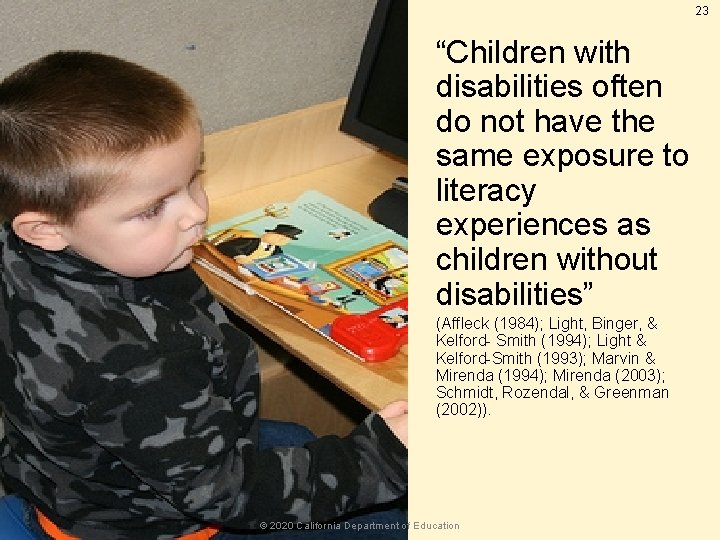
23 Literacy for All “Children with disabilities often do not have the same exposure to literacy experiences as children without disabilities” (Affleck (1984); Light, Binger, & Kelford- Smith (1994); Light & Kelford-Smith (1993); Marvin & Mirenda (1994); Mirenda (2003); Schmidt, Rozendal, & Greenman (2002)). © 2020 California Department of Education
24 Guiding Principle: Guiding“Children Principle say (2) or sign what they hear and see” (PCF, Vol. 1, p. 100).
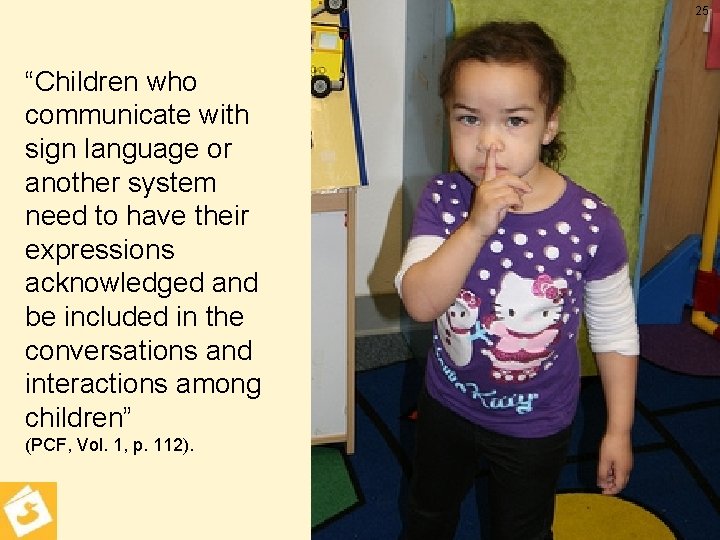
25 “Children who communicate with sign language or another system need to have their expressions acknowledged and be included in the conversations and interactions among children” (PCF, Vol. 1, p. 112). Alternative Communication
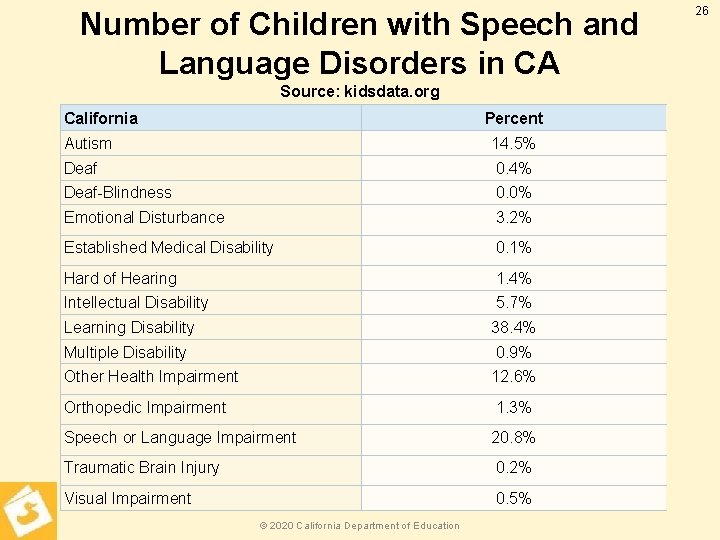
Number of Children with Speech and Language Disorders in CA Source: kidsdata. org California Percent Autism 14. 5% Deaf 0. 4% Deaf-Blindness 0. 0% Emotional Disturbance 3. 2% Established Medical Disability 0. 1% Hard of Hearing 1. 4% Intellectual Disability 5. 7% Learning Disability 38. 4% Multiple Disability 0. 9% Other Health Impairment 12. 6% Orthopedic Impairment 1. 3% Speech or Language Impairment 20. 8% Traumatic Brain Injury 0. 2% Visual Impairment 0. 5% © 2020 California Department of Education 26
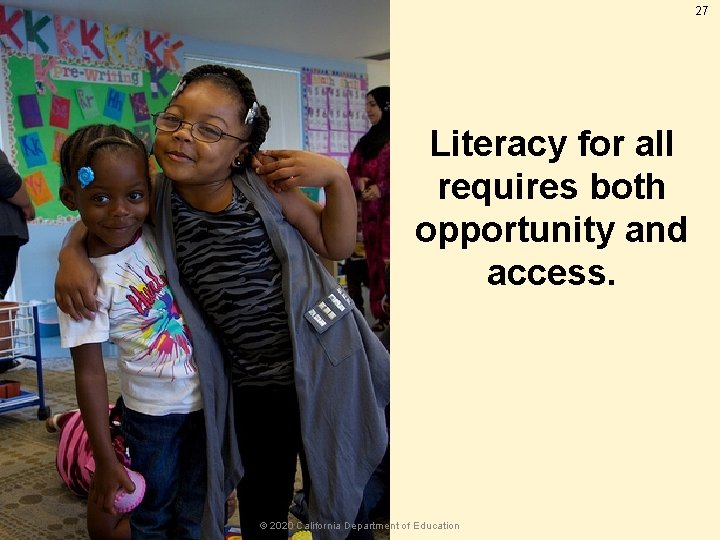
27 Literacy for all requires both opportunity and access. © 2020 California Department of Education
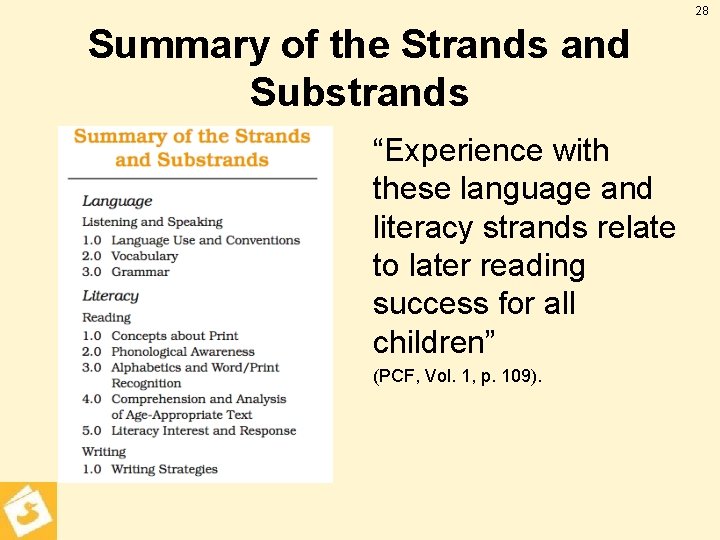
28 Summary of the Strands and Substrands “Experience with these language and literacy strands relate to later reading success for all children” (PCF, Vol. 1, p. 109).
29 Reflect and Adapt • Each breakout group will be assigned a substrand of the language & literacy domain. • Discuss what strategies you would use to adapt this strand for children with diagnosed special needs. • Think of examples of children with whom you have worked. • Select someone to share out your strategies. © 2020 California Department of Education
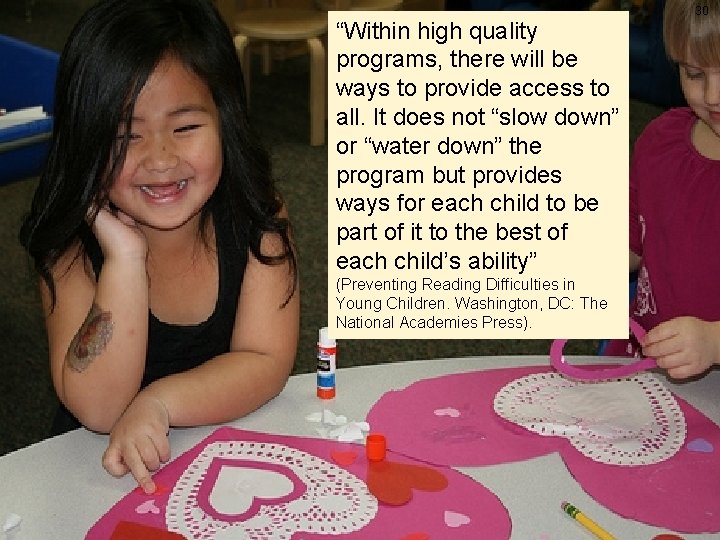
Best Practice for All Children “Within high quality programs, there will be ways to provide access to all. It does not “slow down” or “water down” the program but provides ways for each child to be part of it to the best of each child’s ability” (Preventing Reading Difficulties in Young Children. Washington, DC: The National Academies Press). 30
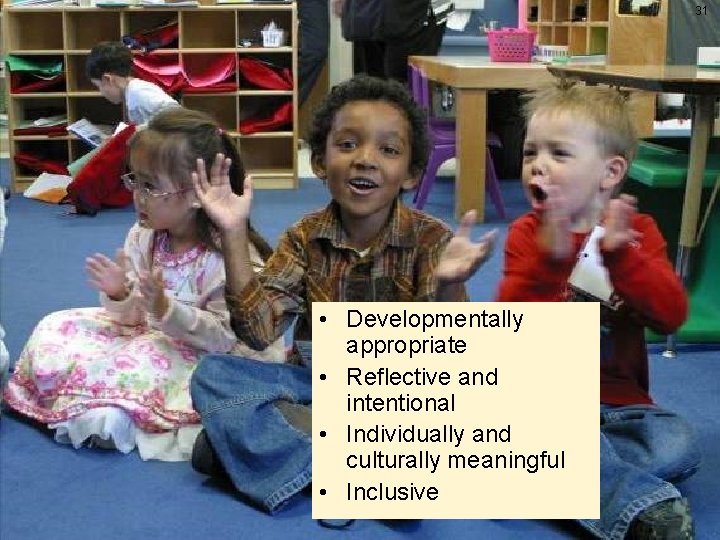
31 Framework Strategies • Developmentally appropriate • Reflective and intentional • Individually and culturally meaningful • Inclusive
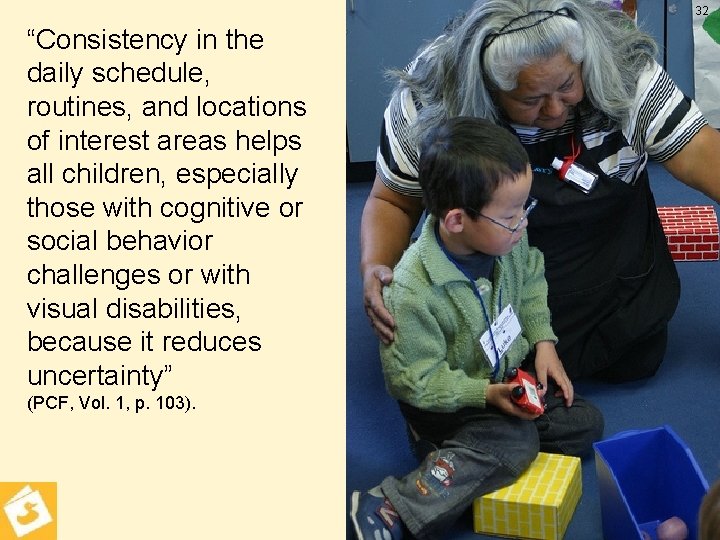
32 “Consistency in the daily schedule, routines, and locations of interest areas helps all children, especially those with cognitive or social behavior challenges or with visual disabilities, because it reduces uncertainty” (PCF, Vol. 1, p. 103). Daily Schedule
33 “[Early intervention] does not look very different from primary prevention, differing primarily in intensity, quantity, and maintenance of the highest possible quality of interactions around language and literacy” Literacy for All (2) (Preventing Reading Difficulties in Young Children. Washington, DC: The National Academies Press, 1998). © 2020 California Department of Education
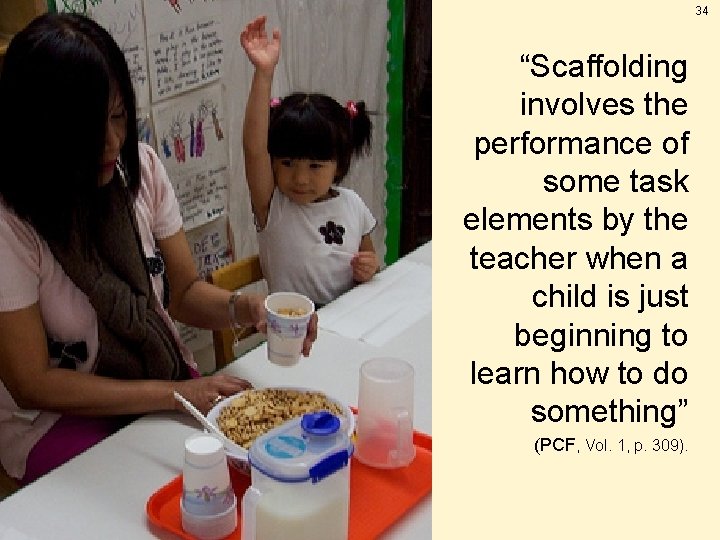
Scaffolding for Instruction 34 “Scaffolding involves the performance of some task elements by the teacher when a child is just beginning to learn how to do something” (PCF, Vol. 1, p. 309).
35 Effective Scaffolding Example © 2020 California Department of Education
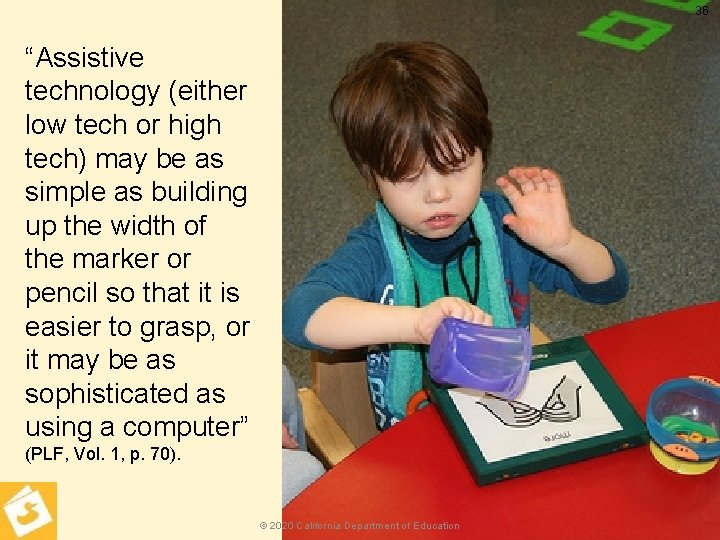
36 “Assistive technology (either low tech or high tech) may be as simple as building up the width of the marker or pencil so that it is easier to grasp, or it may be as sophisticated as using a computer” Assistive Technology (PLF, Vol. 1, p. 70). © 2020 California Department of Education
Consult these resources to help with planning First, consider appropriate early literacy experiences for all children. © 2020 California Department of Education 37
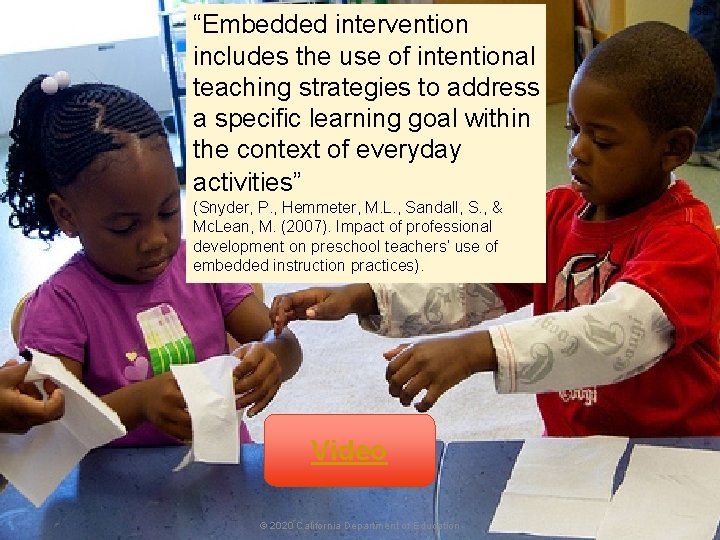
“Embedded intervention includes the use of intentional Embedded Intervention teaching strategies to address a specific learning goal within the context of everyday activities” (Snyder, P. , Hemmeter, M. L. , Sandall, S. , & Mc. Lean, M. (2007). Impact of professional development on preschool teachers’ use of embedded instruction practices). Video © 2020 California Department of Education 38
39 Embedded Interventions • Look at the Providing Literacy for All Teachers handout. • Choose one idea that you could enhance and embed during the day. • Remember to consider: – Child interest – Family – IEP goals © 2020 California Department of Education
40 “Sometimes the questions are complicated, and the answers are simple. ” ‒Dr. Seuss © 2020 California Department of Education
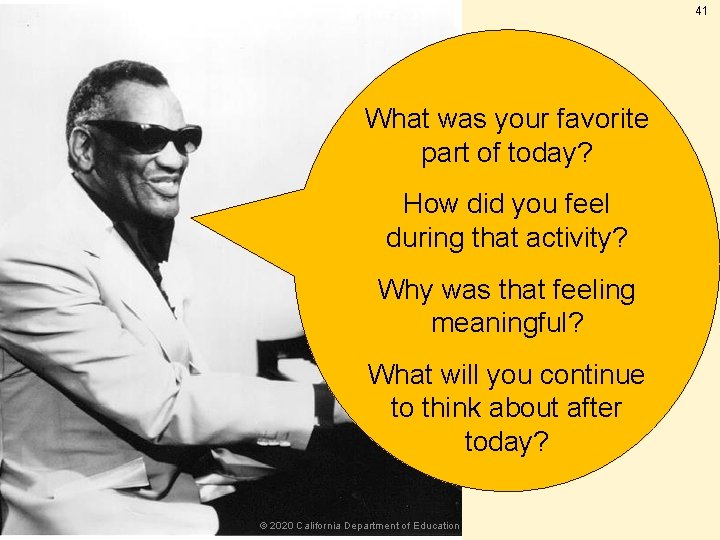
41 Focused Conversation What was your favorite part of today? How did you feel during that activity? Why was that feeling meaningful? What will you continue to think about after today? © 2012 California Department of Education (CDE) California Preschool Instructional Network (CPIN) 04/17/2012 © 2020 California Department of Education
42 See you later… Thank you for coming! © 2020 California Department of Education
43 Resources • • • California Preschool Learning Foundations California Preschool Curriculum Framework SWEET Tool Kit CELL Center for Early Language Learning Seeds of Partnership Snyder, P. , Hemmeter, M. L. , Sandall, S. , & Mc. Lean, M. (2007). Impact of professional development on preschool teachers’ use of embedded instruction practices. • National Research Council (1998). Preventing reading difficulties in young children. Washington, D. C. : National Academy Press © 2020 California Department of Education