
PRESCHOOL CURRICULUM Philosophy HOW CHILDREN DEVELOP CLASSROOM APPROACH
- Slides: 27
PRESCHOOL CURRICULUM
Philosophy HOW CHILDREN DEVELOP CLASSROOM APPROACH
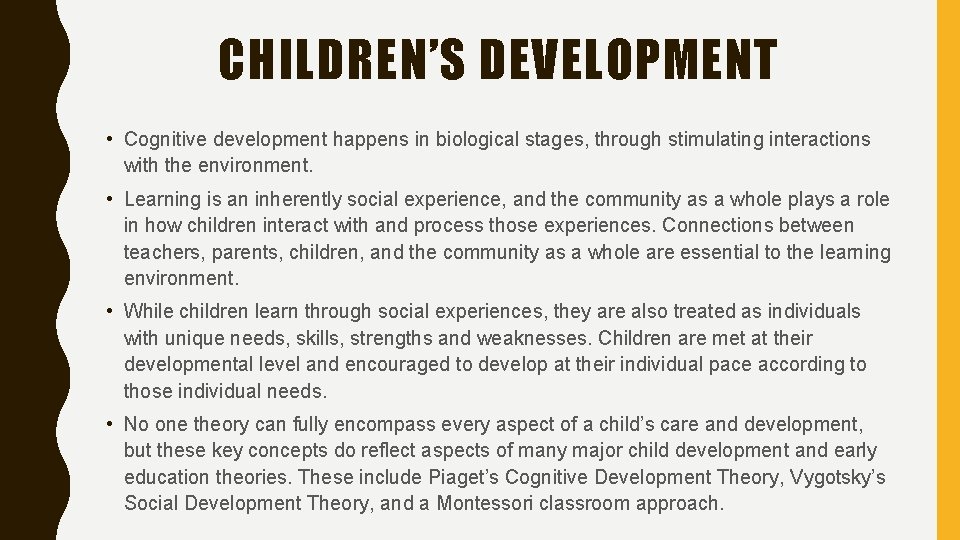
CHILDREN’S DEVELOPMENT • Cognitive development happens in biological stages, through stimulating interactions with the environment. • Learning is an inherently social experience, and the community as a whole plays a role in how children interact with and process those experiences. Connections between teachers, parents, children, and the community as a whole are essential to the learning environment. • While children learn through social experiences, they are also treated as individuals with unique needs, skills, strengths and weaknesses. Children are met at their developmental level and encouraged to develop at their individual pace according to those individual needs. • No one theory can fully encompass every aspect of a child’s care and development, but these key concepts do reflect aspects of many major child development and early education theories. These include Piaget’s Cognitive Development Theory, Vygotsky’s Social Development Theory, and a Montessori classroom approach.
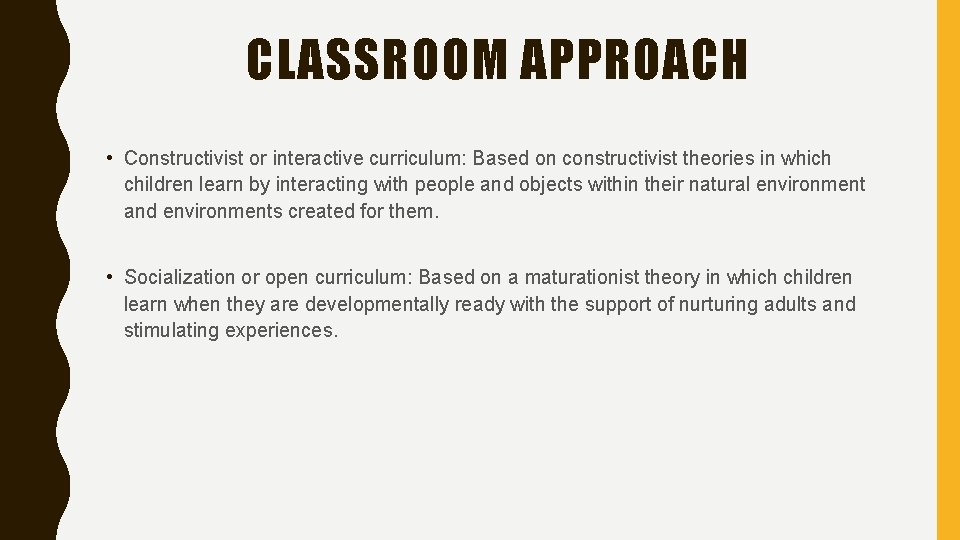
CLASSROOM APPROACH • Constructivist or interactive curriculum: Based on constructivist theories in which children learn by interacting with people and objects within their natural environment and environments created for them. • Socialization or open curriculum: Based on a maturationist theory in which children learn when they are developmentally ready with the support of nurturing adults and stimulating experiences.
Implementation
IMPLEMENTATION • Play and Experience Based: – The environment is designed to facilitate positive, constructive play. – Learning centers are set up in the classroom with purposeful materials that lead to a child’s development. Children rotate through learning centers as their interest guides them. – Teachers facilitate that play through a high level of purposeful teacher-child interaction. Some activities require more teacher guidance while others are self-guided. – Teachers encourage children to investigate, find their own answers, and solve their own problems by remaining flexible and allowing them to introduce new topics as their personal experiences open them to new interests. – Enrichment classes are provided each year in which preschoolers are taught outside of the classroom for a broader spectrum of interactive experiences.
IMPLEMENTATION • Constructive and Open Curriculum: – The school is assigned monthly unit concepts broad enough to allow the teacher in each age group to strike a balance of structured teacher-guided activities with more free-play, child-directed activities as is appropriate for each age group. – Monthly units are based on concepts the child will need to know for school as well as life experiences they need to be able to process and react to. – Activities, materials, and classroom set up are planned based on the monthly unit to teach children new lessons as well as keep them engaged in their environment. – Teachers set up the activities in the room and allow children to rotate between activities freely as they choose. – Difficulty levels are adjusted to meet every child at his/her individual level.
IMPLEMENTATION • Community Based: – GCCDC is a non-profit, community-based program in which all tuition goes directly back towards operating and improving the program. – Our policies aim to retain as much flexibility as possible within the confines of childcare regulations in order to reflect families’ individual cultures and lifestyles in their daily care. – We strive for a high level of communication and involvement with parents, for example maintaining an “open door” policy where parents are invited to stop in to observe their child at any time. – We build our resources from within community rather than outside sources, for example drawing on skills and strengths of our existing staff to create enrichment programs rather than charging parents for an outside class.
KINDERGARTEN READINESS FOUNDATION BLOCKS OF EARLY LEARNING
Foundation Blocks of Early Learning HOW DO WE MEASURE KINDERGARTEN READINESS?
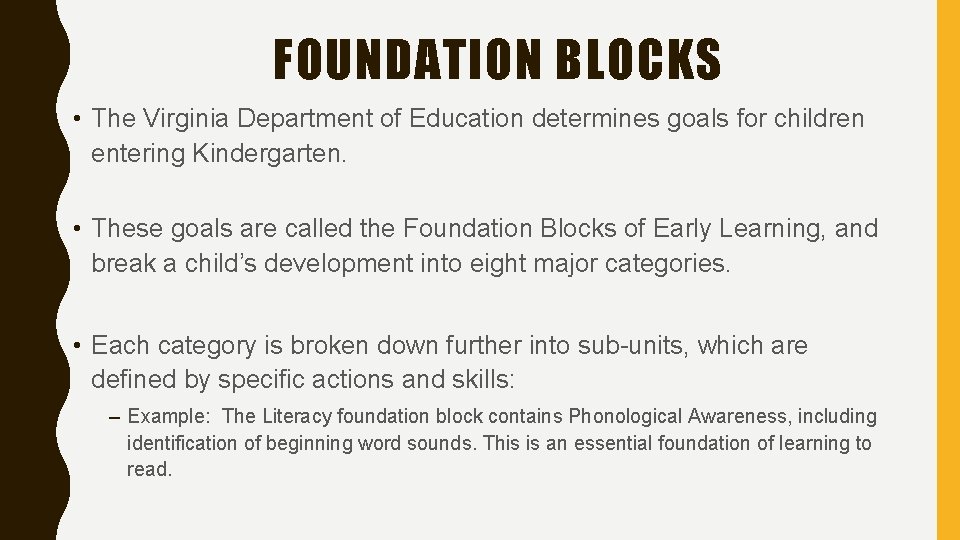
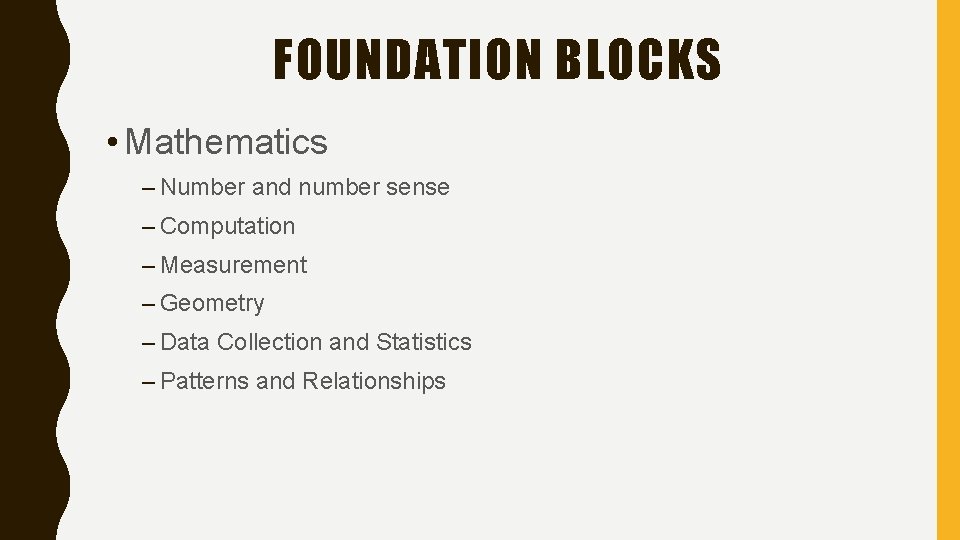
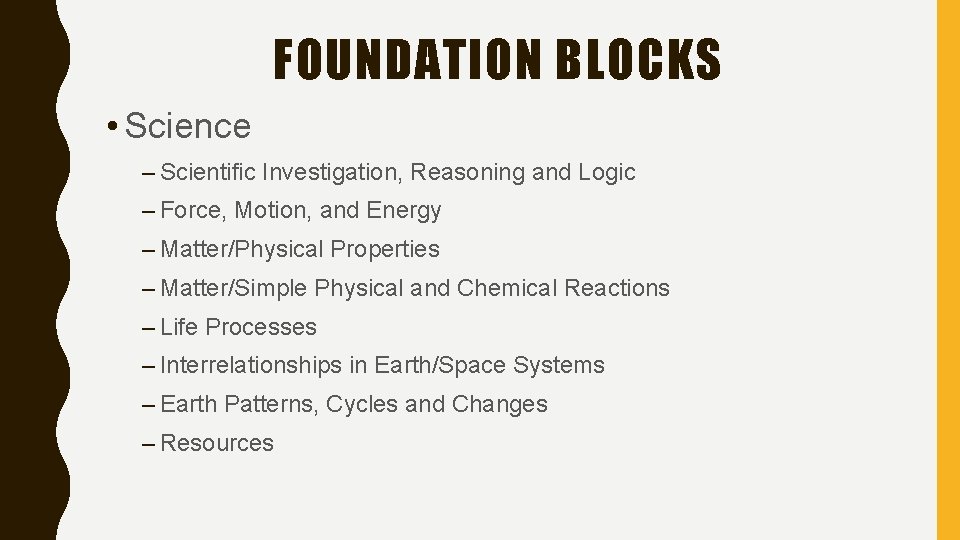
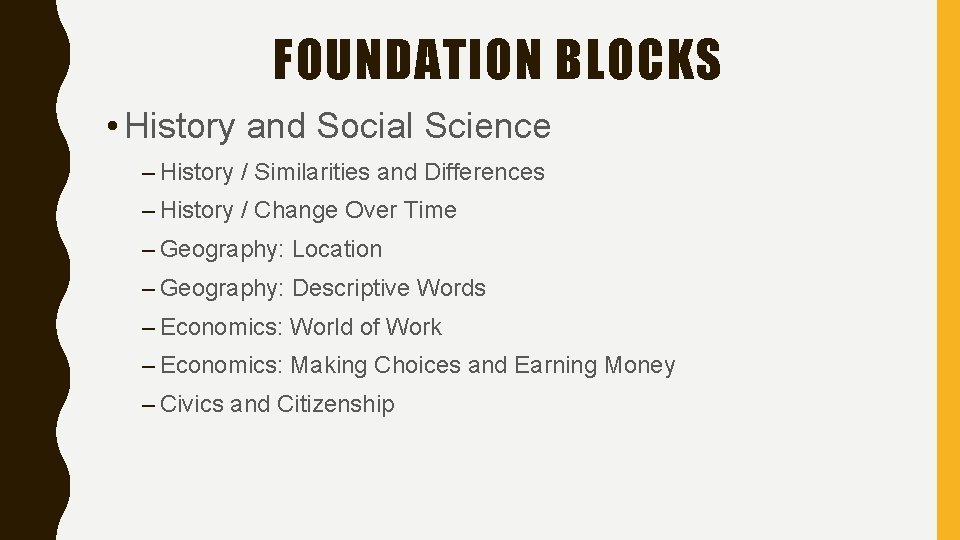
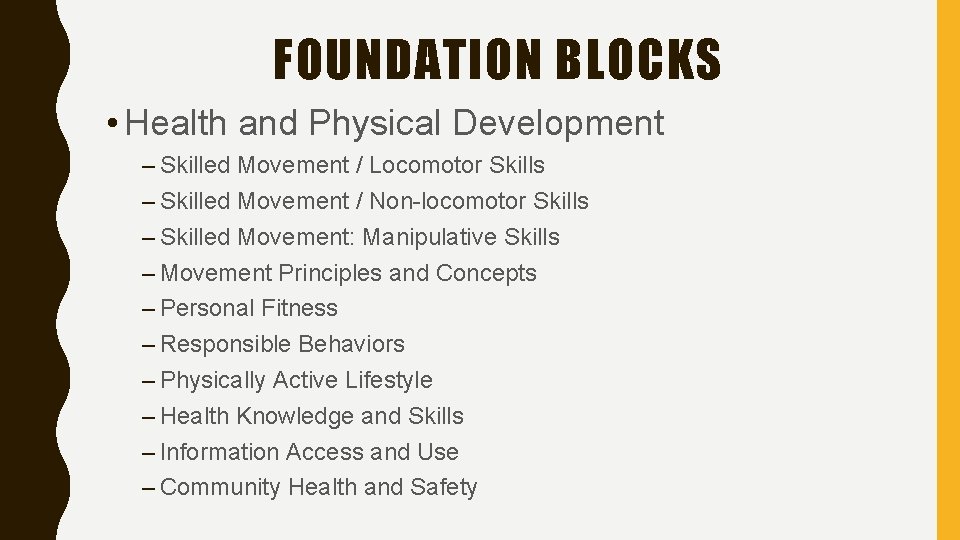
FOUNDATION BLOCKS • The Virginia Department of Education determines goals for children entering Kindergarten. • These goals are called the Foundation Blocks of Early Learning, and break a child’s development into eight major categories. • Each category is broken down further into sub-units, which are defined by specific actions and skills: – Example: The Literacy foundation block contains Phonological Awareness, including identification of beginning word sounds. This is an essential foundation of learning to read.
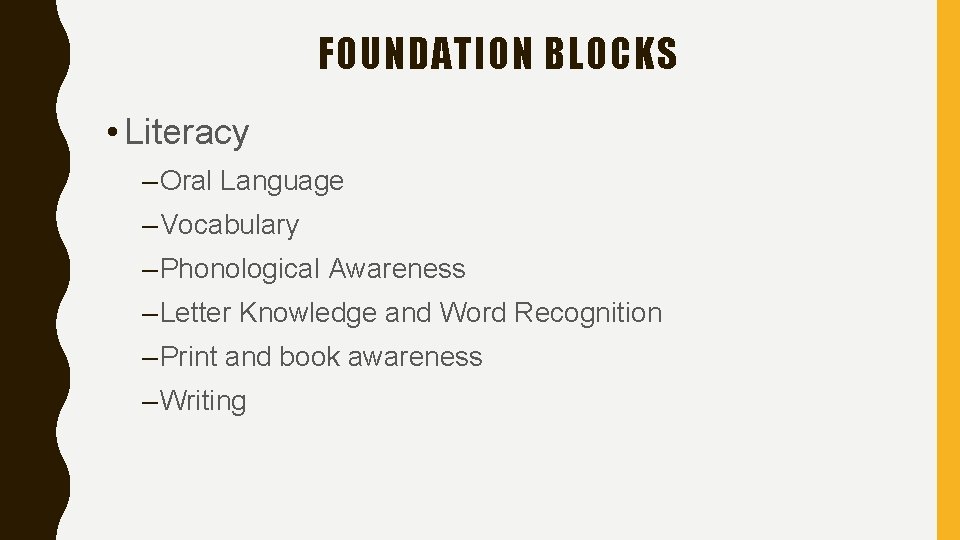
FOUNDATION BLOCKS • Literacy – Oral Language – Vocabulary – Phonological Awareness – Letter Knowledge and Word Recognition – Print and book awareness – Writing
FOUNDATION BLOCKS • Mathematics – Number and number sense – Computation – Measurement – Geometry – Data Collection and Statistics – Patterns and Relationships
FOUNDATION BLOCKS • Science – Scientific Investigation, Reasoning and Logic – Force, Motion, and Energy – Matter/Physical Properties – Matter/Simple Physical and Chemical Reactions – Life Processes – Interrelationships in Earth/Space Systems – Earth Patterns, Cycles and Changes – Resources
FOUNDATION BLOCKS • History and Social Science – History / Similarities and Differences – History / Change Over Time – Geography: Location – Geography: Descriptive Words – Economics: World of Work – Economics: Making Choices and Earning Money – Civics and Citizenship
FOUNDATION BLOCKS • Health and Physical Development – Skilled Movement / Locomotor Skills – Skilled Movement / Non-locomotor Skills – Skilled Movement: Manipulative Skills – Movement Principles and Concepts – Personal Fitness – Responsible Behaviors – Physically Active Lifestyle – Health Knowledge and Skills – Information Access and Use – Community Health and Safety
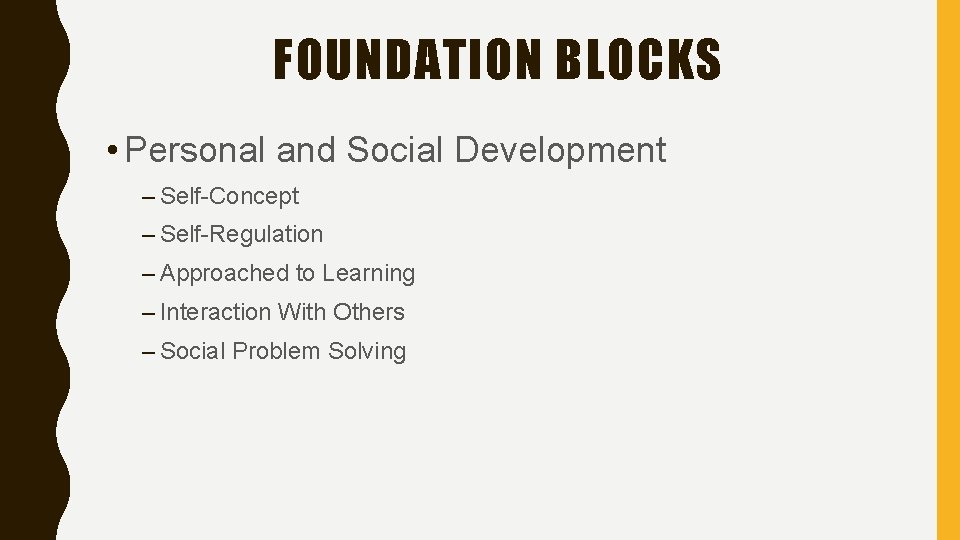
FOUNDATION BLOCKS • Personal and Social Development – Self-Concept – Self-Regulation – Approached to Learning – Interaction With Others – Social Problem Solving
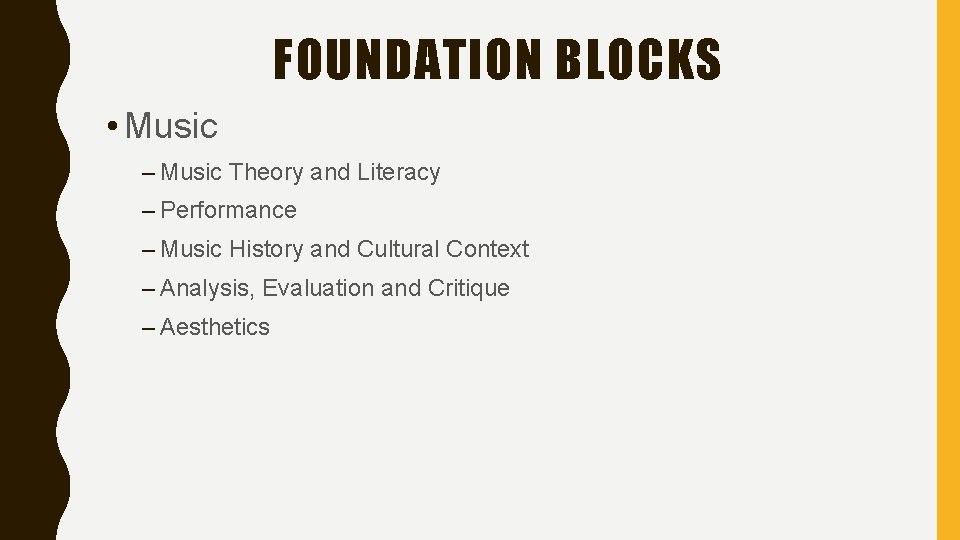
FOUNDATION BLOCKS • Music – Music Theory and Literacy – Performance – Music History and Cultural Context – Analysis, Evaluation and Critique – Aesthetics
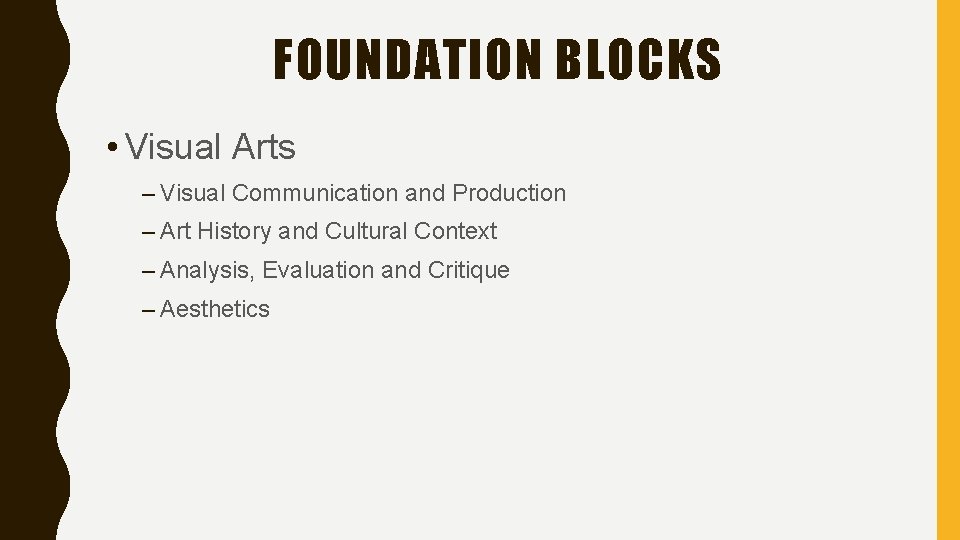
FOUNDATION BLOCKS • Visual Arts – Visual Communication and Production – Art History and Cultural Context – Analysis, Evaluation and Critique – Aesthetics
Wholistic approach
WHOLISTIC APPROACH • The Foundation Blocks are a continuation of our infant, toddler, and advanced toddler Milestone goals and build on earlier accomplishments. – Recognizing beginning sounds builds on the infancy and toddler milestones of repeating rhymes and fingerplays, recognizing words that rhyme, and early letter recognition. • This applies to all areas of development including physical, social, cognitive, language, etcetera. • Kindergarten readiness begins in infancy!
2017 ENRICHMENT PROGRAMS M O N D A Y – F R I D A Y 4 : 1 5 P M - 5 : 0 0 P M P A R E N T S A R E E N C O U R A G E D T O C O M E , O B S E R V E , A N D A V A I L A B L E ! P A R T I C I P A T E I N T H E C L A S S E S W H E N
MONDAY: SPORTS FOUNDATIONS • Program Goal: Sports Foundations aims to engage children in age-appropriate gross motor activities that introduce and teach basic skillsets and concepts required for playing group sports. Some examples of basic skill sets and concepts are control of a ball with hands or feet specifically, the concept of precise aim when throwing, kicking, or handling balls of all sizes, use of tools to control the movement of a ball, and regulating behavior (like refraining from touching a ball with your hands) to function within the rules of any given game. The class also aims to incorporate the social and emotional foundation of sportsmanship through lessons like winning and losing, taking turns, performing functions in the group that may not be first choice to the player, positive attitudes and resiliency in the face of a potentially disappointing outcome, and many more. • Teacher: Mr. Travis has experience as a Junior Soccer coach to children under five as well as over ten years of high level sports and athletic performance. Mr. Travis will prepare activities for each week that focus on meeting the goals stated in the program and communicate those weekly activities to parents for extended follow up at home. • Location: Fellowship Hall of Church at 4: 15
TUESDAY: JUNIOR DRAMA • Junior Drama aims to give children a fun, interactive experience that will teach the foundations of drama as an art form, help children develop higher methods of self-expression and regulation, and reinforce curriculum units they experience in the classroom. Curriculum units are based on a combination of concept goals identified in the Foundation Blocks of Learning and life experiences children commonly face and encounter. • Teacher: Christopher Tweel is the Associate Pastor of Grace Covenant Presbyterian Church. In addition to his many Pastoral qualifications, he also has an extensive background in drama and theater with more than 15 years drama experience in community and semi-professional theater as an actor and drama leader. For 4 years Christopher also wrote and directed the drama arm of a touring arts group based out of West Virginia Welseyan College. Christopher will prepare weekly drama exercises based on the classroom’s monthly units that meet the goals of the program. Children from Three’s and Early Pre K will be invited to join as audience for a practice performance to at the end of each lesson unit. • Location: Fellowship hall of the church building at 4: 15
WEDNESDAY: DEVELOPMENTAL MUSIC • Developmental Music aims to introduce basic music theory concepts through interactive and age appropriate activities. Some of the music concepts they work on are rhythm, pitch, music vocabulary, written music and symbols, instrument exposure, music as a group task, music as a tool to express emotion and thought, aesthetics and preferences, musical ear and listening, and performance. • Teacher: Mr. Martin is the music director for Grace Covenant Presbyterian Church. Mr. Martin holds a Master’s in Sacred Music, a BA in Organ Performance, and attends annual workshops and other professional development training related to early music education. He has been employed at Grace Covenant for seventeen years, and working with the CDC for more than five. • Music class is held in the choir room on Wednesday afternoons for the Pre K group, though all ages Toddler 2 and up do attend the music enrichment class.
THURSDAY: SPANISH SESSION • The Spanish class aims to introduce to children the concept of a second language as well as beginning vocabulary of that language. By introducing these concepts, children will build the foundation for learning a second language as well as increasing the same skills required for literacy and music development. • Ms. Mauricia has been with GCCDC for almost three years and is currently the lead teacher of the Three’s class. She is close to completing her certification in child development and will utilize a Spanish curriculum researched and purchased by the GCCDC to complete the classes. • Spanish classes will be held in the Library of Grace Covenant Presbyterian Church on Thurday afternoons at 4: 15. *We are still researching Spanish curricula. We may have to adjust this class depending on the curriculum and resources available. We will keep you posted!
FRIDAY: SCIENCE DISCOVERY • The science discovery class aims to introduce children to basic science concepts using exciting and hands on activities like experiments, chemical reactions, scientific creations, and more! The activities will focus on scientific reasoning and investigation; force, motion and energy; physical properties of matter; chemical reactions; life processes; Earth and Space Systems; Resource Use; and Earth patterns. These are also the science goals identified by the Foundation Blocks of Early Learning. • Teacher: Latasha Evans is currently the Assistant Director of Grace Covenant Child Development Center. She has an Associate’s Degree in Early Childhood Development and has worked for • Science Class will be held in the Vanguard Room (meeting room next to Preschool Class) on Friday afternoons at 4: 15.