
PREPOSITIONS What is a preposition Shows the relationship
- Slides: 10
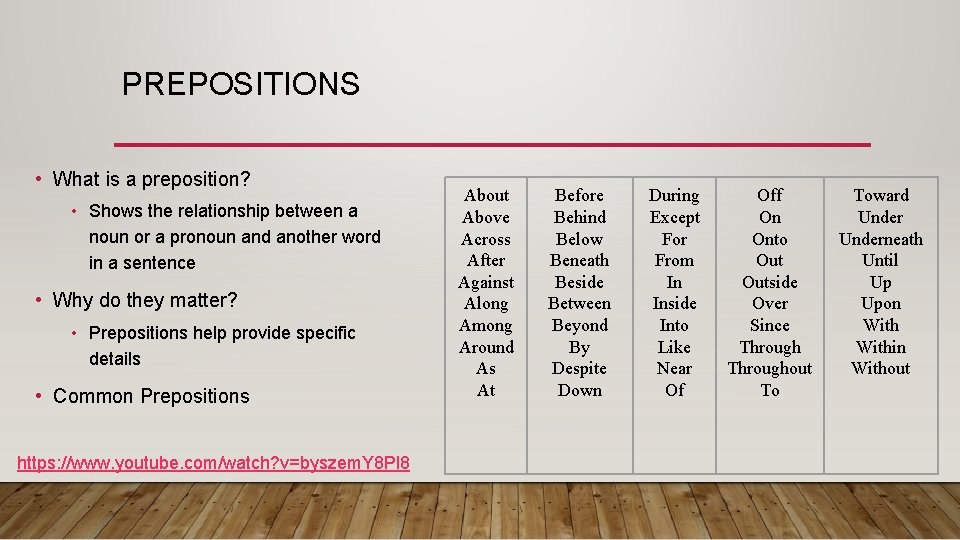
PREPOSITIONS • What is a preposition? • Shows the relationship between a noun or a pronoun and another word in a sentence • Why do they matter? • Prepositions help provide specific details • Common Prepositions https: //www. youtube. com/watch? v=byszem. Y 8 Pl 8 About Above Across After Against Along Among Around As At Before Behind Below Beneath Beside Between Beyond By Despite Down During Except For From In Inside Into Like Near Of Off On Onto Outside Over Since Throughout To Toward Underneath Until Up Upon Within Without
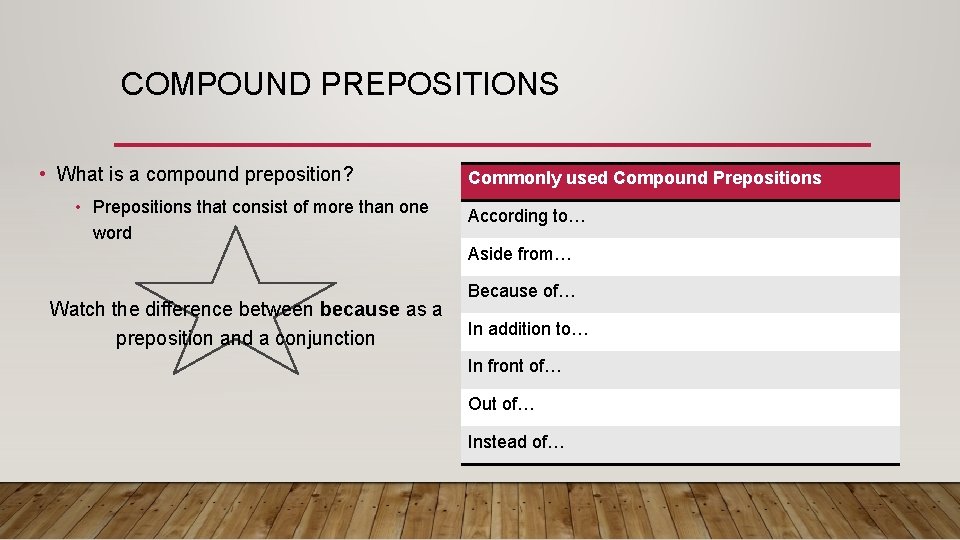
COMPOUND PREPOSITIONS • What is a compound preposition? • Prepositions that consist of more than one word Commonly used Compound Prepositions According to… Aside from… Watch the difference between because as a preposition and a conjunction Because of… In addition to… In front of… Out of… Instead of…
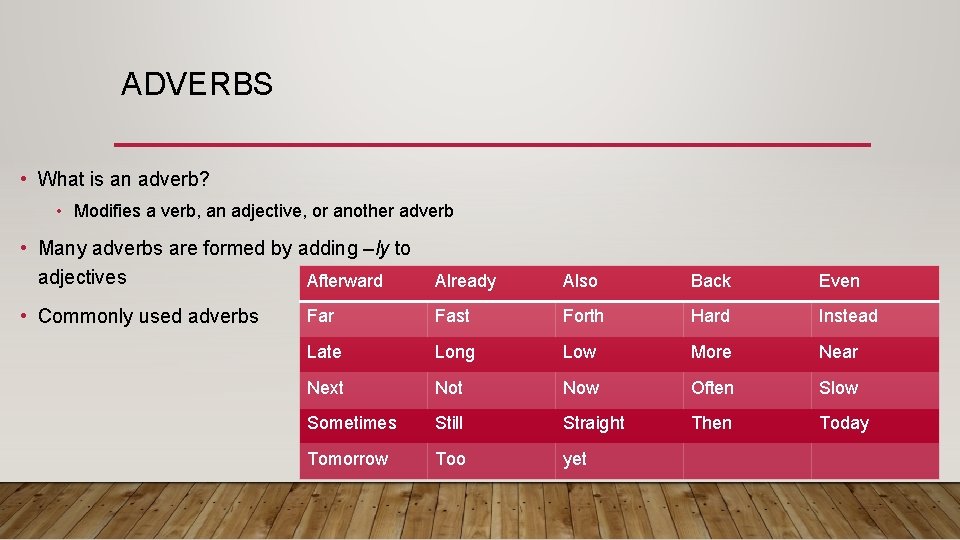
ADVERBS • What is an adverb? • Modifies a verb, an adjective, or another adverb • Many adverbs are formed by adding –ly to adjectives Afterward Already Also Back Even • Commonly used adverbs Far Fast Forth Hard Instead Late Long Low More Near Next Now Often Slow Sometimes Still Straight Then Today Tomorrow Too yet
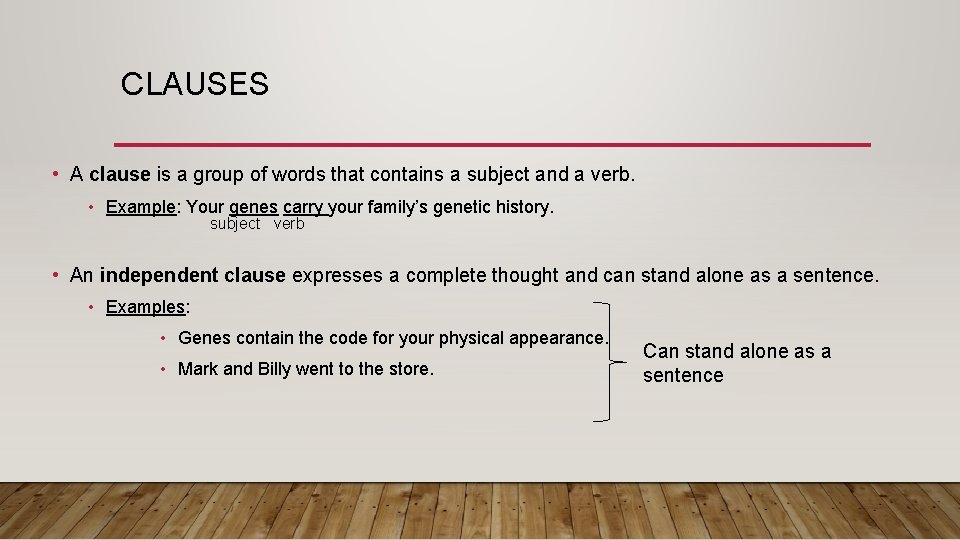
CLAUSES • A clause is a group of words that contains a subject and a verb. • Example: Your genes carry your family’s genetic history. subject verb • An independent clause expresses a complete thought and can stand alone as a sentence. • Examples: • Genes contain the code for your physical appearance. • Mark and Billy went to the store. Can stand alone as a sentence
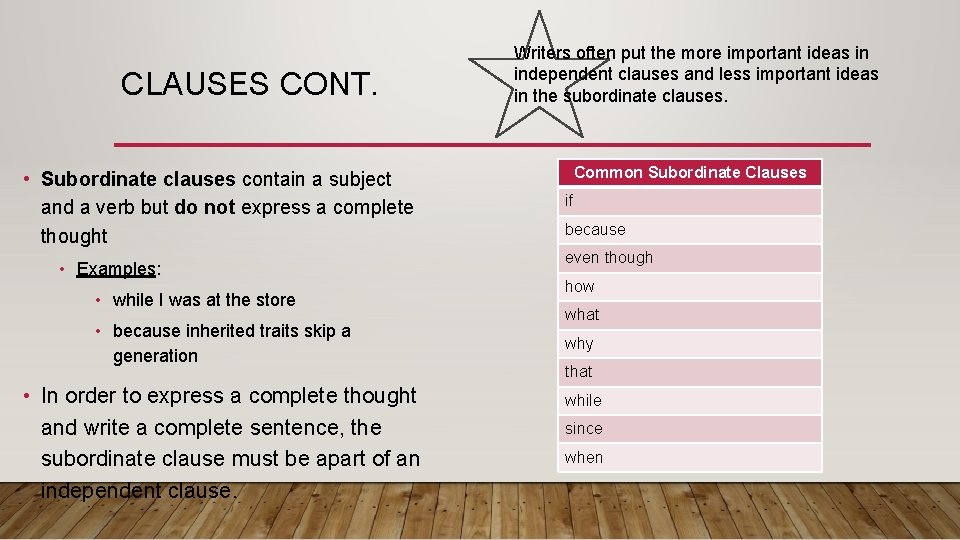
CLAUSES CONT. • Subordinate clauses contain a subject and a verb but do not express a complete thought • Examples: • while I was at the store • because inherited traits skip a generation • In order to express a complete thought and write a complete sentence, the subordinate clause must be apart of an independent clause. Writers often put the more important ideas in independent clauses and less important ideas in the subordinate clauses. Common Subordinate Clauses if because even though how what why that while since when
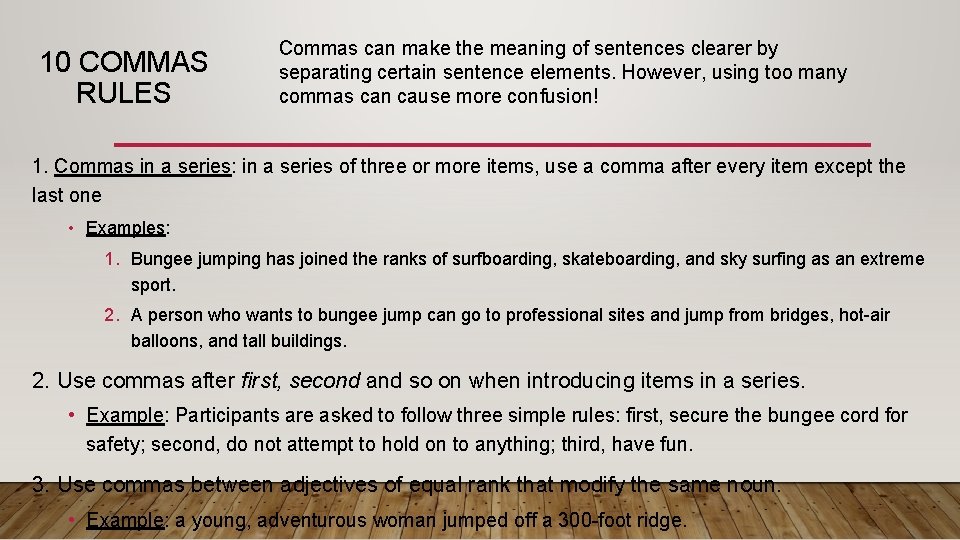
10 COMMAS RULES Commas can make the meaning of sentences clearer by separating certain sentence elements. However, using too many commas can cause more confusion! 1. Commas in a series: in a series of three or more items, use a comma after every item except the last one • Examples: 1. Bungee jumping has joined the ranks of surfboarding, skateboarding, and sky surfing as an extreme sport. 2. A person who wants to bungee jump can go to professional sites and jump from bridges, hot-air balloons, and tall buildings. 2. Use commas after first, second and so on when introducing items in a series. • Example: Participants are asked to follow three simple rules: first, secure the bungee cord for safety; second, do not attempt to hold on to anything; third, have fun. 3. Use commas between adjectives of equal rank that modify the same noun. • Example: a young, adventurous woman jumped off a 300 -foot ridge.
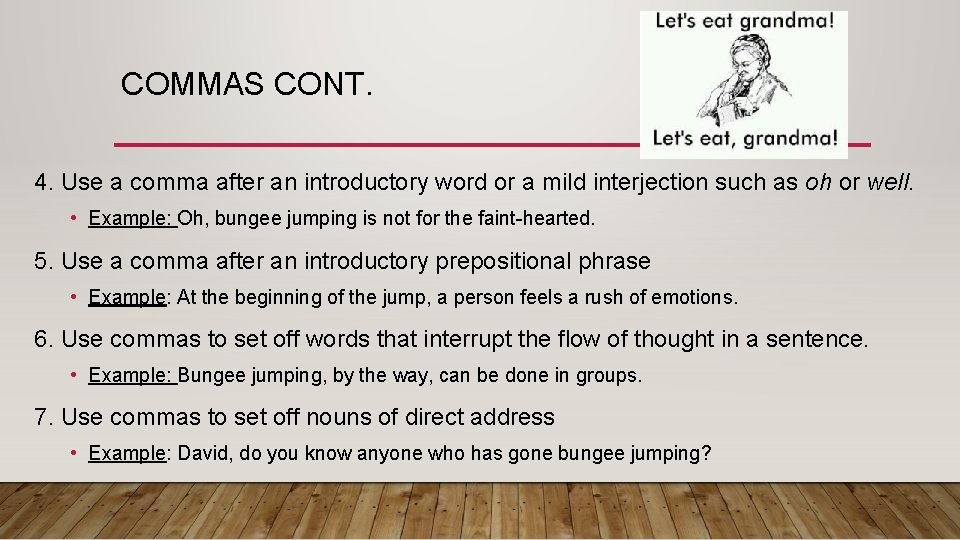
COMMAS CONT. 4. Use a comma after an introductory word or a mild interjection such as oh or well. • Example: Oh, bungee jumping is not for the faint-hearted. 5. Use a comma after an introductory prepositional phrase • Example: At the beginning of the jump, a person feels a rush of emotions. 6. Use commas to set off words that interrupt the flow of thought in a sentence. • Example: Bungee jumping, by the way, can be done in groups. 7. Use commas to set off nouns of direct address • Example: David, do you know anyone who has gone bungee jumping?
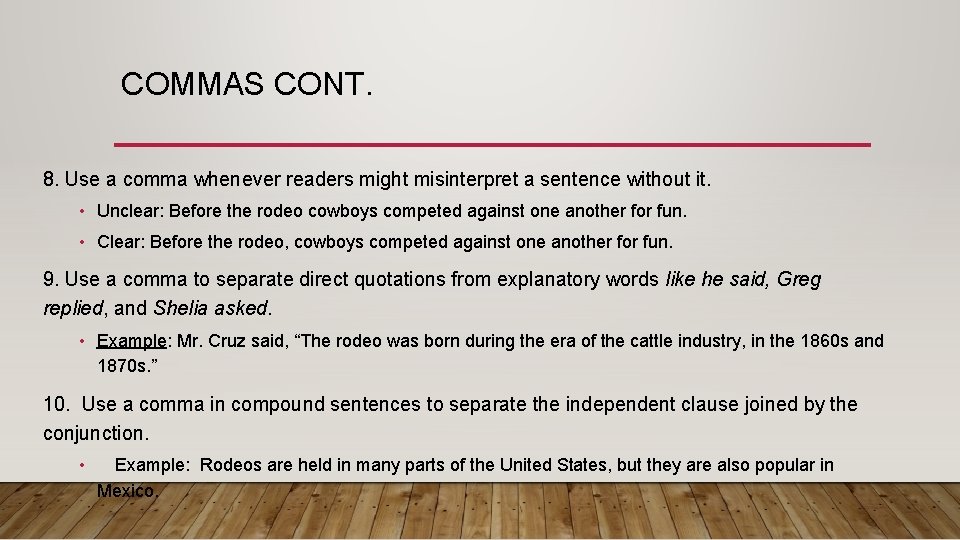
COMMAS CONT. 8. Use a comma whenever readers might misinterpret a sentence without it. • Unclear: Before the rodeo cowboys competed against one another for fun. • Clear: Before the rodeo, cowboys competed against one another for fun. 9. Use a comma to separate direct quotations from explanatory words like he said, Greg replied, and Shelia asked. • Example: Mr. Cruz said, “The rodeo was born during the era of the cattle industry, in the 1860 s and 1870 s. ” 10. Use a comma in compound sentences to separate the independent clause joined by the conjunction. • Example: Rodeos are held in many parts of the United States, but they are also popular in Mexico.
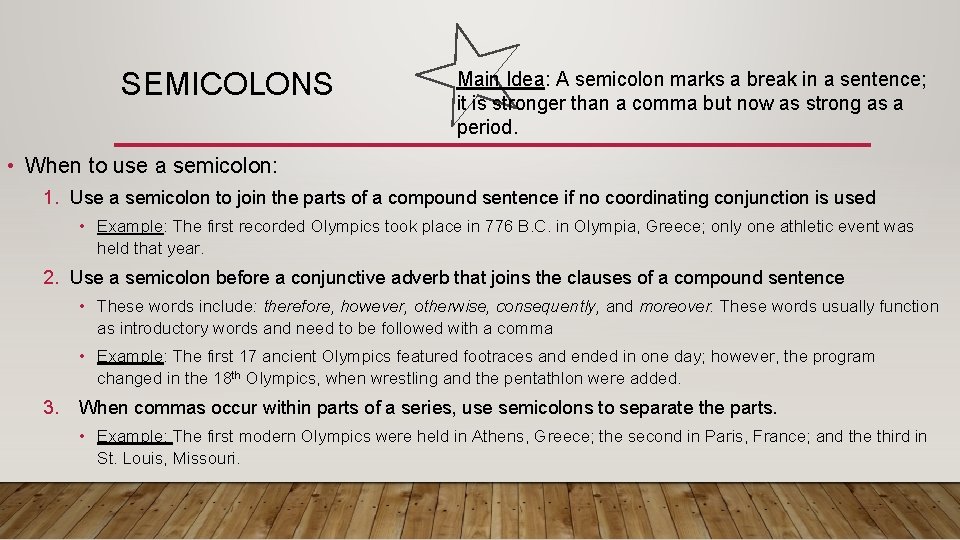
SEMICOLONS Main Idea: A semicolon marks a break in a sentence; it is stronger than a comma but now as strong as a period. • When to use a semicolon: 1. Use a semicolon to join the parts of a compound sentence if no coordinating conjunction is used • Example: The first recorded Olympics took place in 776 B. C. in Olympia, Greece; only one athletic event was held that year. 2. Use a semicolon before a conjunctive adverb that joins the clauses of a compound sentence • These words include: therefore, however, otherwise, consequently, and moreover. These words usually function as introductory words and need to be followed with a comma • Example: The first 17 ancient Olympics featured footraces and ended in one day; however, the program changed in the 18 th Olympics, when wrestling and the pentathlon were added. 3. When commas occur within parts of a series, use semicolons to separate the parts. • Example: The first modern Olympics were held in Athens, Greece; the second in Paris, France; and the third in St. Louis, Missouri.
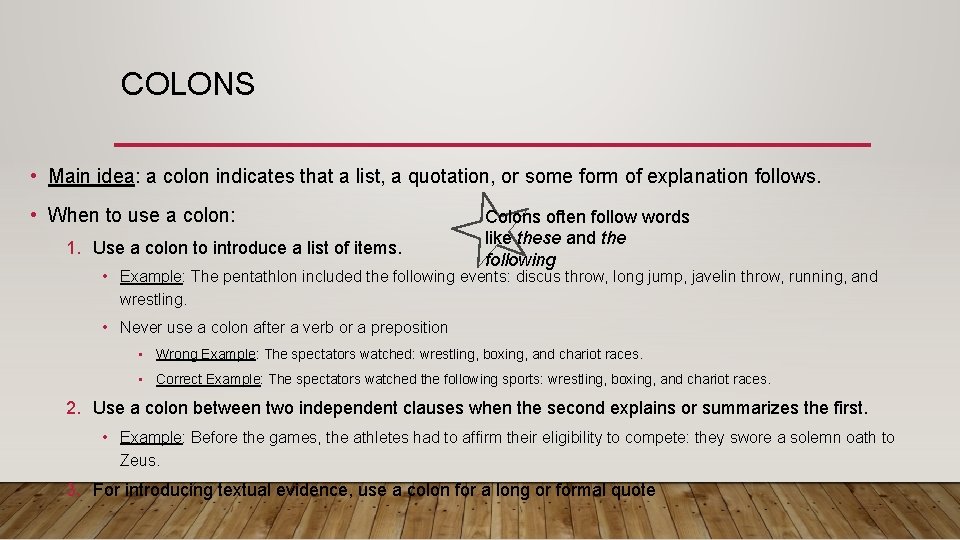
COLONS • Main idea: a colon indicates that a list, a quotation, or some form of explanation follows. • When to use a colon: 1. Use a colon to introduce a list of items. Colons often follow words like these and the following • Example: The pentathlon included the following events: discus throw, long jump, javelin throw, running, and wrestling. • Never use a colon after a verb or a preposition • Wrong Example: The spectators watched: wrestling, boxing, and chariot races. • Correct Example: The spectators watched the following sports: wrestling, boxing, and chariot races. 2. Use a colon between two independent clauses when the second explains or summarizes the first. • Example: Before the games, the athletes had to affirm their eligibility to compete: they swore a solemn oath to Zeus. 3. For introducing textual evidence, use a colon for a long or formal quote