
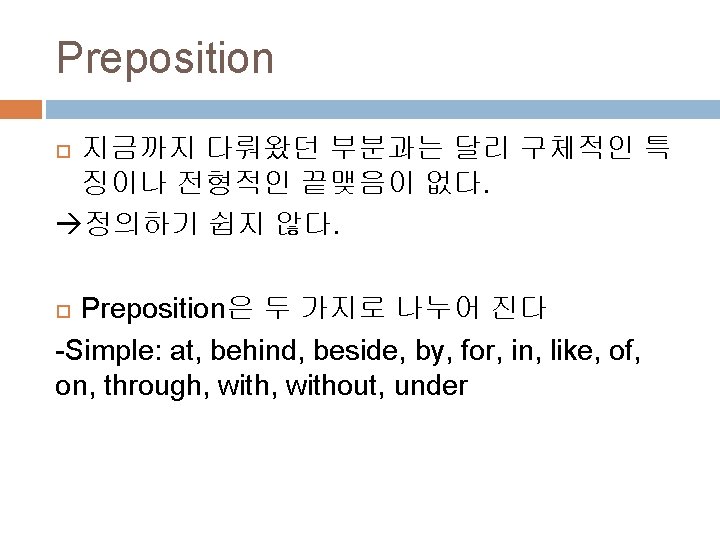
Preposition Adverbs Conjunctions Interjections Preposition complex by means

목차 Preposition(전치사) Adverbs(부사) Conjunctions(접속사) Interjections(감탄사)
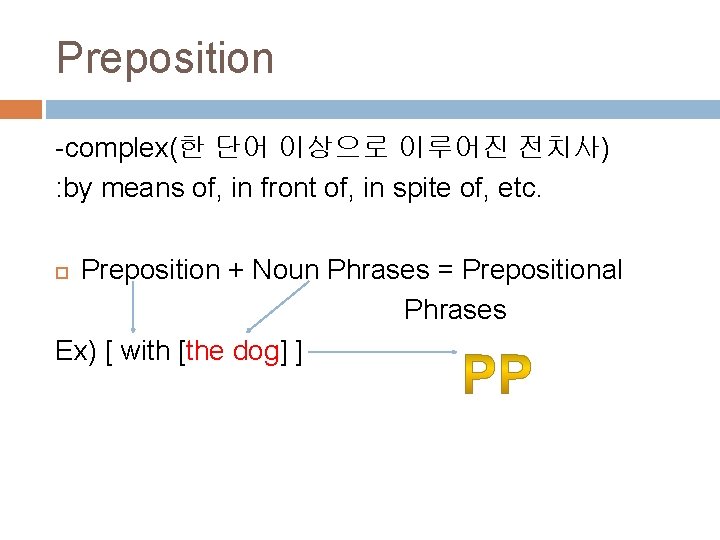
Preposition -complex(한 단어 이상으로 이루어진 전치사) : by means of, in front of, in spite of, etc. Preposition + Noun Phrases = Prepositional Phrases Ex) [ with [the dog] ]
![Preposition + Noun Phrases = Prepositional Phrase Ex) [on [her bicycle]] 전치사구에 삽입되어있는 NP들은](http://slidetodoc.com/presentation_image_h/ee37073dab65a77907bf1d31e2703adf/image-5.jpg "Preposition + Noun Phrases = Prepositional Phrase Ex) [on [her bicycle]] 전치사구에 삽입되어있는 NP들은")
Preposition + Noun Phrases = Prepositional Phrase Ex) [on [her bicycle]] 전치사구에 삽입되어있는 NP들은 Prepositional object 혹은 Prepositional Complement라고 부른다
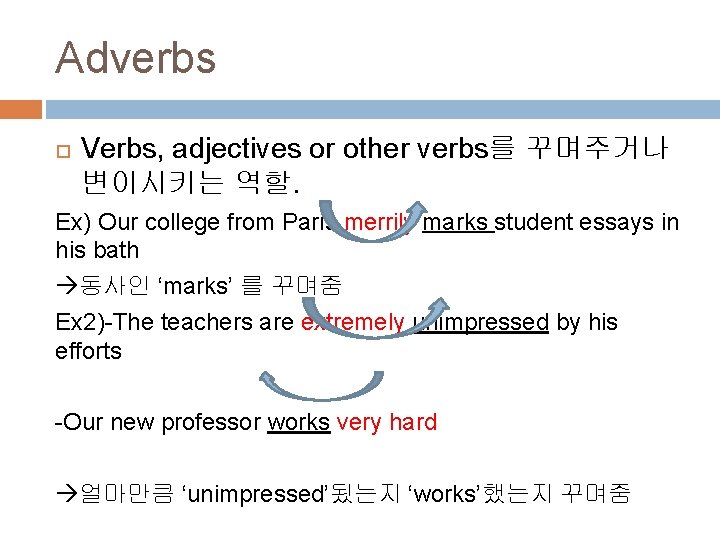
Adverbs Verbs, adjectives or other verbs를 꾸며주거나 변이시키는 역할. Ex) Our college from Paris merrily marks student essays in his bath 동사인 ‘marks’ 를 꾸며줌 Ex 2)-The teachers are extremely unimpressed by his efforts -Our new professor works very hard 얼마만큼 ‘unimpressed’됬는지 ‘works’했는지 꾸며줌
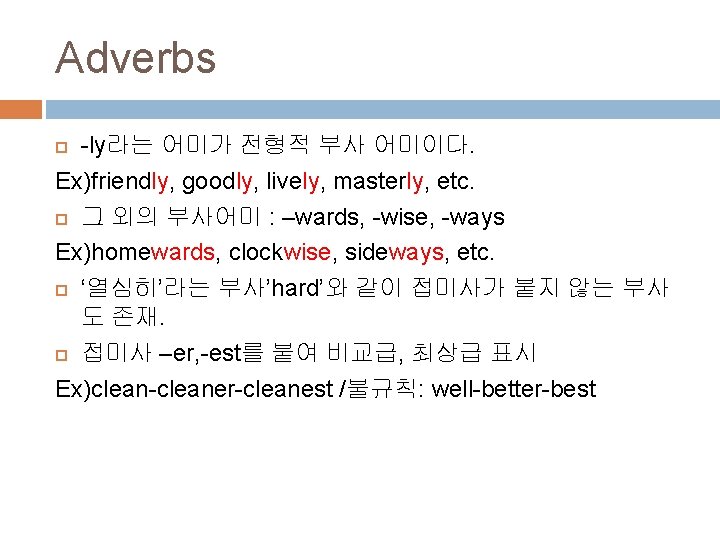
Adverbs -ly라는 어미가 전형적 부사 어미이다. Ex)friendly, goodly, lively, masterly, etc. 그 외의 부사어미 : –wards, -wise, -ways Ex)homewards, clockwise, sideways, etc. ‘열심히’라는 부사’hard’와 같이 접미사가 붙지 않는 부사 도 존재. 접미사 –er, -est를 붙여 비교급, 최상급 표시 Ex)clean-cleaner-cleanest /불규칙: well-better-best
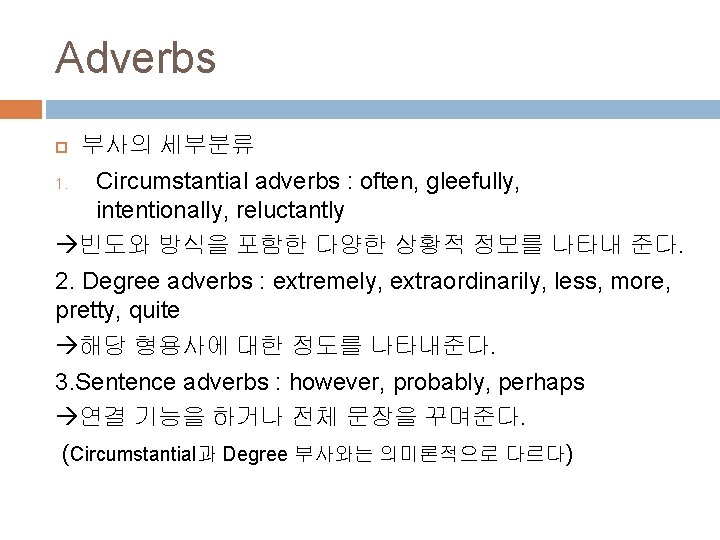
Adverbs 부사의 세부분류 1. Circumstantial adverbs : often, gleefully, intentionally, reluctantly 빈도와 방식을 포함한 다양한 상황적 정보를 나타내 준다. 2. Degree adverbs : extremely, extraordinarily, less, more, pretty, quite 해당 형용사에 대한 정도를 나타내준다. 3. Sentence adverbs : however, probably, perhaps 연결 기능을 하거나 전체 문장을 꾸며준다. (Circumstantial과 Degree 부사와는 의미론적으로 다르다)
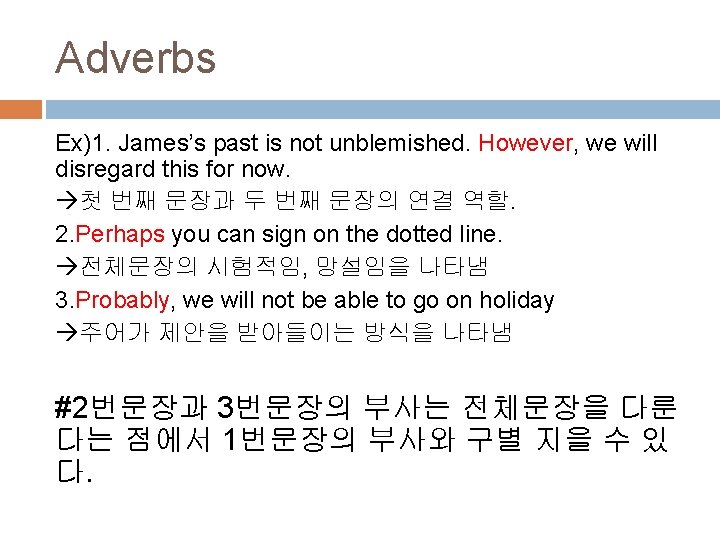
Adverbs 문법 구성에 따른 차이점. -degree adverbs는 서로를 수정할 수 없다. Ex) very extremely * -circumstantial과 sentence 부사들은 서로 수정할 수 있다. Ex) very often, quite intentionally, very probably -sentence adverbs만 유일하게 그들이 수정한 문장 에서 문제 없이 분리 될 수 있다. Adverbs는 Adverb Phrases(Adv. P)의 head로 기능.
Conjunctions 연결 역할을 하는 ‘접속사’ -coordinating conjunctions : and, or, but -sub-ordinating conjunctions: that, if, whether, for, because, although, when, etc.
![Conjunctions Ex)<coordinating conjunctions> -I bought [[a computer] and [a keyboard] NP -These articles were[[old]](http://slidetodoc.com/presentation_image_h/ee37073dab65a77907bf1d31e2703adf/image-13.jpg "Conjunctions Ex)<coordinating conjunctions> -I bought [[a computer] and [a keyboard] NP -These articles were[[old]")
Conjunctions Ex)<coordinating conjunctions> -I bought [[a computer] and [a keyboard] NP -These articles were[[old] and [useless] AP -He is [[pretty stupid] but [quite eager] AP -She [[likes tea] but [hates coffee] VP -The books are [[on the table] or[in the cupboard] PP -He killed the fly [[wilfully] and quite mercilessly]] Adv. P -[[they arrived at 10 a. m. ] and [they left at 6 p. m] S #병치된 하나의 유닛 ’conjoins’ (equal syntactic status) ‘syntactic side-by-side arrangement’
Conjunctions Ex)sub-ordinating conjunctions. -elements that introduce subordinate clauses(sentences within sentences) -link units of unequal syntactic status. =‘syntactic underneath arrangement. Complementisers + adjuntisers
Conjunctions Complementisers는 직접 목적어가 되는 clauses(완전한 절)를 이끄는 전치사를 뜻함 Ex)He thinks [that we will agree] I wonder [if it will ever change] We don’t know [whether he will come] I am hoping [for Helen to arrive today]
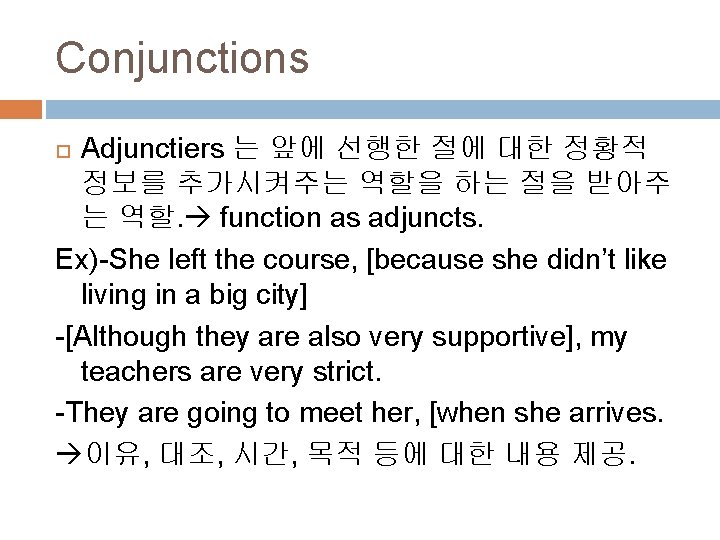
Conjunctions Adjunctiers 는 앞에 선행한 절에 대한 정황적 정보를 추가시켜주는 역할을 하는 절을 받아주 는 역할. function as adjuncts. Ex)-She left the course, [because she didn’t like living in a big city] -[Although they are also very supportive], my teachers are very strict. -They are going to meet her, [when she arrives. 이유, 대조, 시간, 목적 등에 대한 내용 제공.
- Slides: 17