
Preparing your Child for Starting April 2020 Effective
- Slides: 18
Preparing your Child for Starting April 2020 Effective ways to encourage reading skills and prepare children for learning.
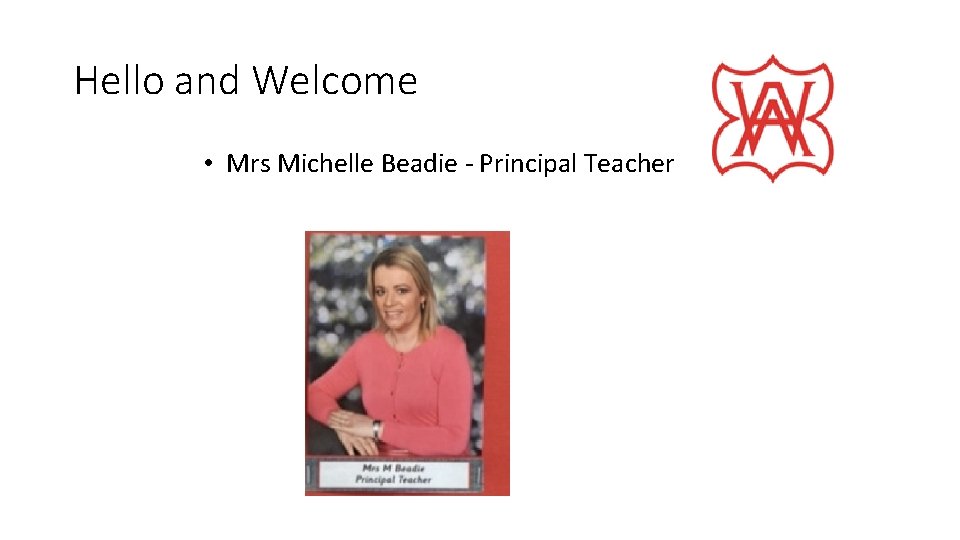
Hello and Welcome • Mrs Michelle Beadie - Principal Teacher
Starting School with a Smile Starting school is an exciting time for young children and their parents/carers. It can also be a daunting time too. But with a little preparation and encouragement, most children will settle in easily at school. Today we want to share with you some of the top tips we have put together at WAPS to encourage reading skills and prepare children for learning. We hope they help you both start school with a smile!
Don't Worry Your child doesn’t need to be able to read, write or do sums before they start school. Children start school with a wide range of abilities and their teacher will be skilled at helping children progress at their own level. What’s most important is that you and your child have fun together in those pre-school months and years – sharing stories, singing songs, playing games and talking about anything and everything.
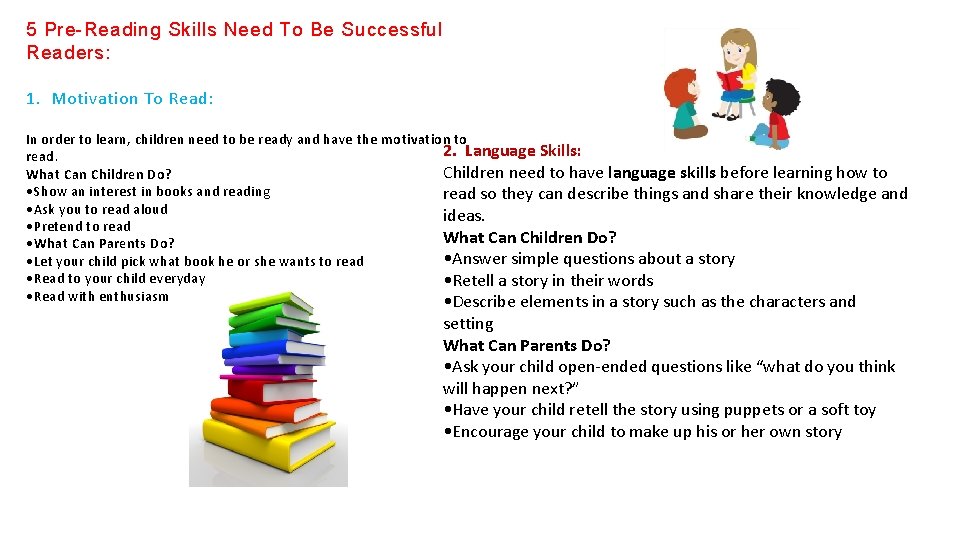
5 Pre-Reading Skills Need To Be Successful Readers: 1. Motivation To Read: In order to learn, children need to be ready and have the motivation to 2. Language Skills: read. Children need to have language skills before learning how to What Can Children Do? • Show an interest in books and reading read so they can describe things and share their knowledge and • Ask you to read aloud ideas. • Pretend to read What Can Children Do? • What Can Parents Do? • Answer simple questions about a story • Let your child pick what book he or she wants to read • Read to your child everyday • Retell a story in their words • Read with enthusiasm • Describe elements in a story such as the characters and setting What Can Parents Do? • Ask your child open-ended questions like “what do you think will happen next? ” • Have your child retell the story using puppets or a soft toy • Encourage your child to make up his or her own story
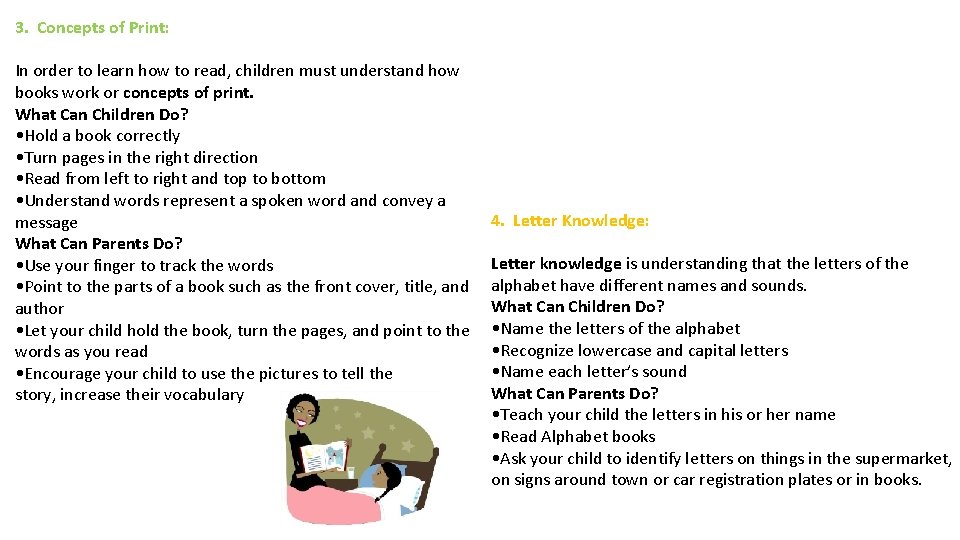
3. Concepts of Print: In order to learn how to read, children must understand how books work or concepts of print. What Can Children Do? • Hold a book correctly • Turn pages in the right direction • Read from left to right and top to bottom • Understand words represent a spoken word and convey a message What Can Parents Do? • Use your finger to track the words • Point to the parts of a book such as the front cover, title, and author • Let your child hold the book, turn the pages, and point to the words as you read • Encourage your child to use the pictures to tell the story, increase their vocabulary 4. Letter Knowledge: Letter knowledge is understanding that the letters of the alphabet have different names and sounds. What Can Children Do? • Name the letters of the alphabet • Recognize lowercase and capital letters • Name each letter’s sound What Can Parents Do? • Teach your child the letters in his or her name • Read Alphabet books • Ask your child to identify letters on things in the supermarket, on signs around town or car registration plates or in books.
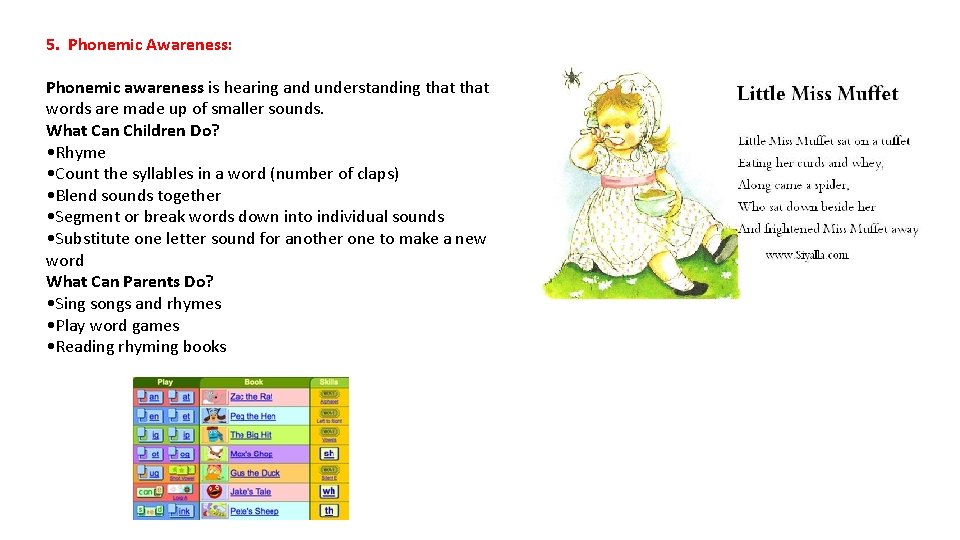
5. Phonemic Awareness: Phonemic awareness is hearing and understanding that words are made up of smaller sounds. What Can Children Do? • Rhyme • Count the syllables in a word (number of claps) • Blend sounds together • Segment or break words down into individual sounds • Substitute one letter sound for another one to make a new word What Can Parents Do? • Sing songs and rhymes • Play word games • Reading rhyming books
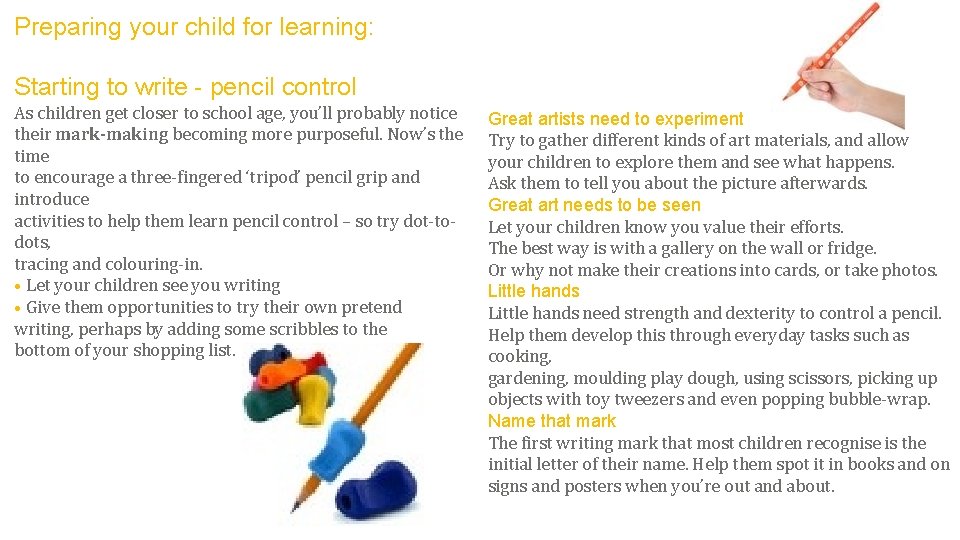
Preparing your child for learning: Starting to write - pencil control As children get closer to school age, you’ll probably notice their mark-making becoming more purposeful. Now’s the time to encourage a three-fingered ‘tripod’ pencil grip and introduce activities to help them learn pencil control – so try dot-todots, tracing and colouring-in. • Let your children see you writing • Give them opportunities to try their own pretend writing, perhaps by adding some scribbles to the bottom of your shopping list. Great artists need to experiment Try to gather different kinds of art materials, and allow your children to explore them and see what happens. Ask them to tell you about the picture afterwards. Great art needs to be seen Let your children know you value their efforts. The best way is with a gallery on the wall or fridge. Or why not make their creations into cards, or take photos. Little hands need strength and dexterity to control a pencil. Help them develop this through everyday tasks such as cooking, gardening, moulding play dough, using scissors, picking up objects with toy tweezers and even popping bubble-wrap. Name that mark The first writing mark that most children recognise is the initial letter of their name. Help them spot it in books and on signs and posters when you’re out and about.
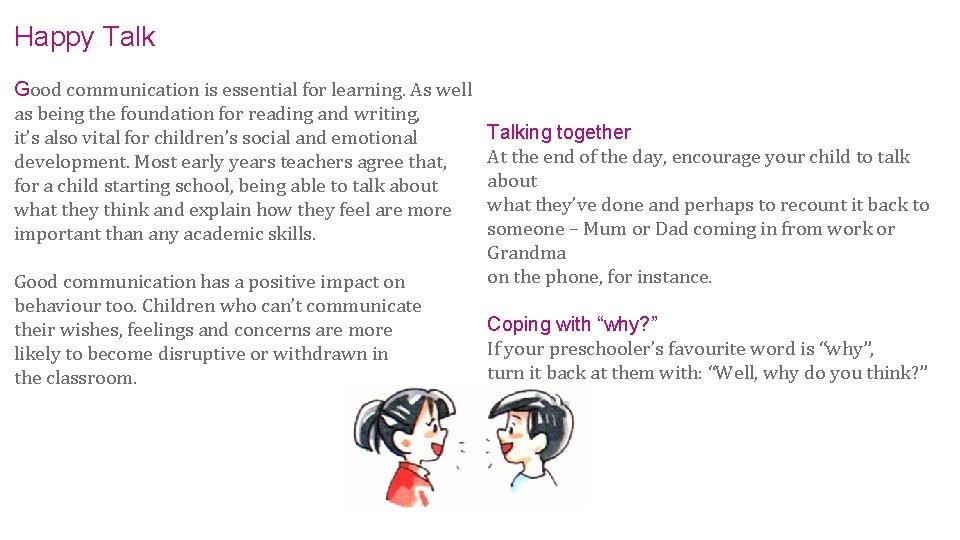
Happy Talk Good communication is essential for learning. As well as being the foundation for reading and writing, it’s also vital for children’s social and emotional development. Most early years teachers agree that, for a child starting school, being able to talk about what they think and explain how they feel are more important than any academic skills. Good communication has a positive impact on behaviour too. Children who can’t communicate their wishes, feelings and concerns are more likely to become disruptive or withdrawn in the classroom. Talking together At the end of the day, encourage your child to talk about what they’ve done and perhaps to recount it back to someone – Mum or Dad coming in from work or Grandma on the phone, for instance. Coping with “why? ” If your preschooler’s favourite word is “why”, turn it back at them with: “Well, why do you think? ”
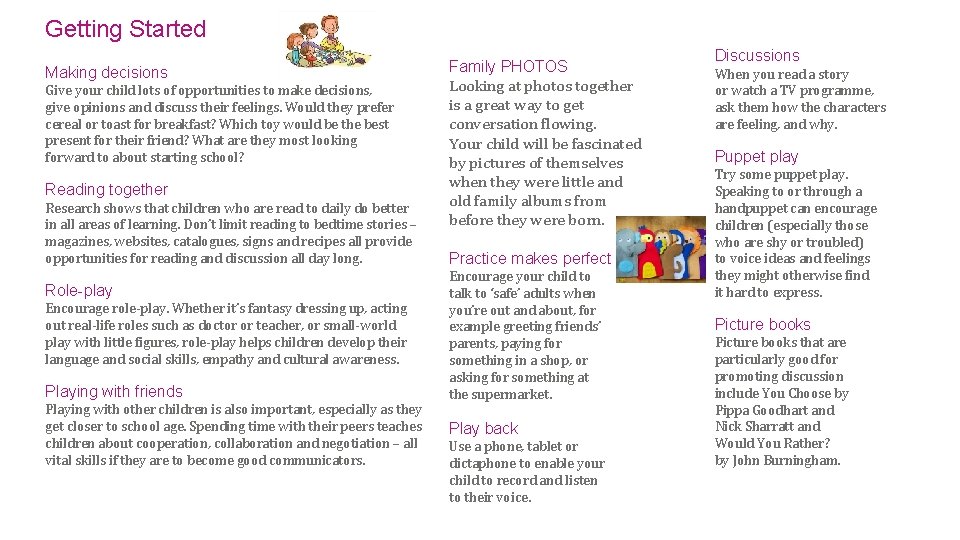
Getting Started Making decisions Give your child lots of opportunities to make decisions, give opinions and discuss their feelings. Would they prefer cereal or toast for breakfast? Which toy would be the best present for their friend? What are they most looking forward to about starting school? Reading together Research shows that children who are read to daily do better in all areas of learning. Don’t limit reading to bedtime stories – magazines, websites, catalogues, signs and recipes all provide opportunities for reading and discussion all day long. Role-play Encourage role-play. Whether it’s fantasy dressing up, acting out real-life roles such as doctor or teacher, or small-world play with little figures, role-play helps children develop their language and social skills, empathy and cultural awareness. Playing with friends Playing with other children is also important, especially as they get closer to school age. Spending time with their peers teaches children about cooperation, collaboration and negotiation – all vital skills if they are to become good communicators. Family PHOTOS Looking at photos together is a great way to get conversation flowing. Your child will be fascinated by pictures of themselves when they were little and old family albums from before they were born. Practice makes perfect Encourage your child to talk to ‘safe’ adults when you’re out and about, for example greeting friends’ parents, paying for something in a shop, or asking for something at the supermarket. Play back Use a phone, tablet or dictaphone to enable your child to record and listen to their voice. Discussions When you read a story or watch a TV programme, ask them how the characters are feeling, and why. Puppet play Try some puppet play. Speaking to or through a handpuppet can encourage children (especially those who are shy or troubled) to voice ideas and feelings they might otherwise find it hard to express. Picture books that are particularly good for promoting discussion include You Choose by Pippa Goodhart and Nick Sharratt and Would You Rather? by John Burningham.
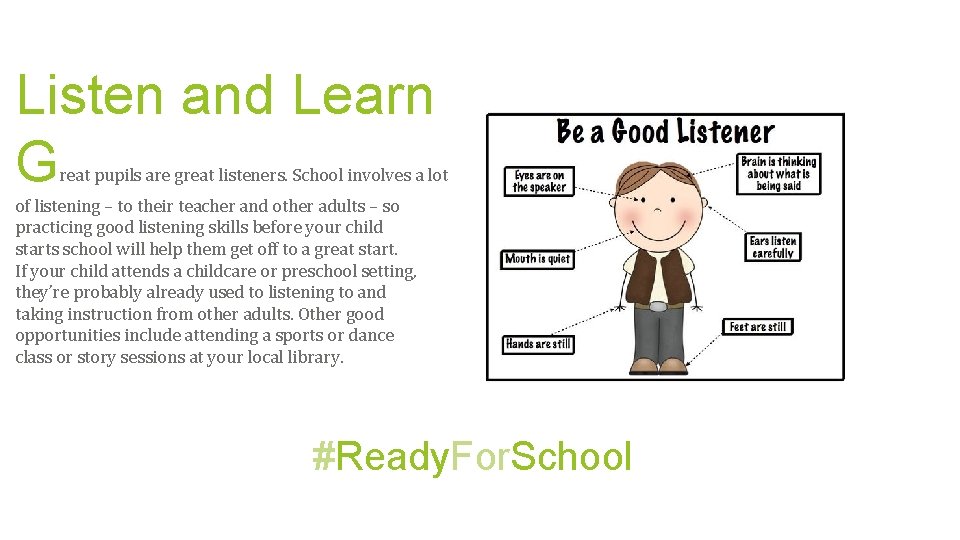
Listen and Learn G reat pupils are great listeners. School involves a lot of listening – to their teacher and other adults – so practicing good listening skills before your child starts school will help them get off to a great start. If your child attends a childcare or preschool setting, they’re probably already used to listening to and taking instruction from other adults. Other good opportunities include attending a sports or dance class or story sessions at your local library. #Ready. For. School
Listening training Sometimes your child may seem not to hear you – probably because they’re completely absorbed in what they’re doing and don’t want it to end. If this often happens with your child, call them by name and give them a five-minute countdown to playtime ending. If they get angry or frustrated, discuss their feelings with them. It’s all good practice for having to stick to an adult-led routine at school. Sharing concerns If you suspect there may be a genuine issue with your child’s hearing, have a chat with their childcarer, preschool teacher or health visitor. If they share your concerns, go and see your GP so the issue can be investigated before they start school. Simon Says Play ‘Simon Says’ – try replacing ‘Simon’ with your child’s favourite toy or character. What can you hear? Ask your child to close their eyes for one minute and list everything they can hear: a clock ticking, birdsong, cars. . . Traffic Lights In the game ‘Traffic Lights’, you say a colour and children do an action. Once they’ve mastered for stop and green for go, introduce new colours and actions, such as orange for turn around and blue for touch the ground. deliberate mistakes Get nursery rhymes deliberately wrong – “Humpty Dumpty sat on the sofa” or “Jack and Jill went up the escalator”. Children love to spot the mistake and put it right. good listeners Encourage listening skills by being a good listener yourself – so give your child plenty of opportunity to talk to you. Chat about their play or their day and ask for their views. On the same level When you are talking to your child – make eye contact. Get down to their level whenever possible. Attention Please Minimise distractions by turning off TVs and stereos and ignoring phones and computers – especially during meals, stories, baths and bedtime. Do you recall? When you finish reading a book or watching a TV programme together, ask your child if they can recall the storyline. What happened next? Make up a joint story, where you say one sentence, your child gives the next, and you keep alternating. Memory Games Play games such as ‘I Spy’ or ‘I Went to the Shops and I Bought. . . ’ to boost memory as well as listening skills.
Numbers Game E very day your child is facing challenges involving problem-solving, thinking and reflection skills that make him or her a natural mathematician. Babies as young as five months are aware of quantities and will notice changes in amounts of objects. Help your child to prepare for learning maths at school with these simple games, rhymes and everyday activities. Maths teaching in primary schools has undergone a revolution in recent years – find fun ways of exploring maths at home, and then see how the fun continues as your child starts school. Accentuate the positive Even if you didn’t enjoy maths at school, avoid saying thing like “I’m rubbish at maths” or “I always hated maths” so your child maintains a positive attitude. TOP
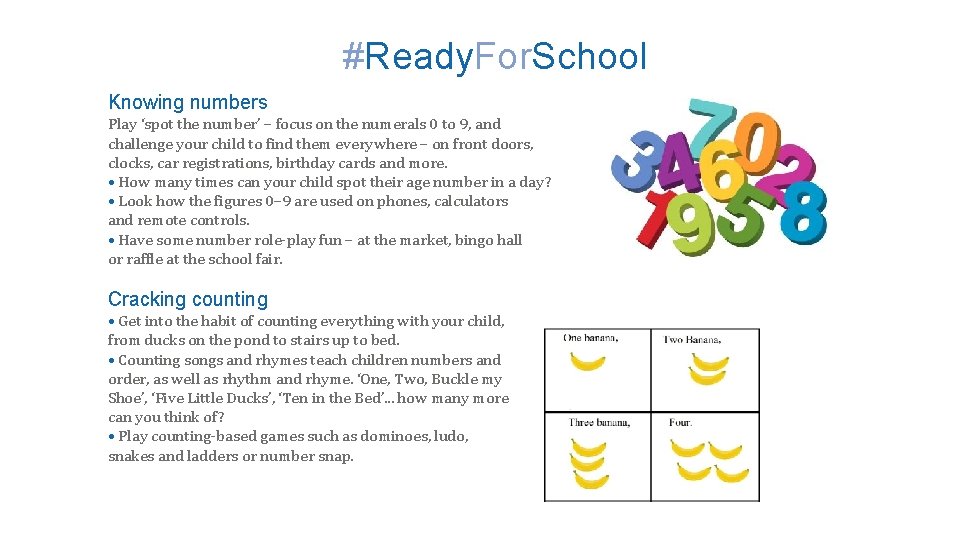
#Ready. For. School Knowing numbers Play ‘spot the number’ – focus on the numerals 0 to 9, and challenge your child to find them everywhere – on front doors, clocks, car registrations, birthday cards and more. • How many times can your child spot their age number in a day? • Look how the figures 0– 9 are used on phones, calculators and remote controls. • Have some number role-play fun – at the market, bingo hall or raffle at the school fair. Cracking counting • Get into the habit of counting everything with your child, from ducks on the pond to stairs up to bed. • Counting songs and rhymes teach children numbers and order, as well as rhythm and rhyme. ‘One, Two, Buckle my Shoe’, ‘Five Little Ducks’, ‘Ten in the Bed’. . . how many more can you think of? • Play counting-based games such as dominoes, ludo, snakes and ladders or number snap.
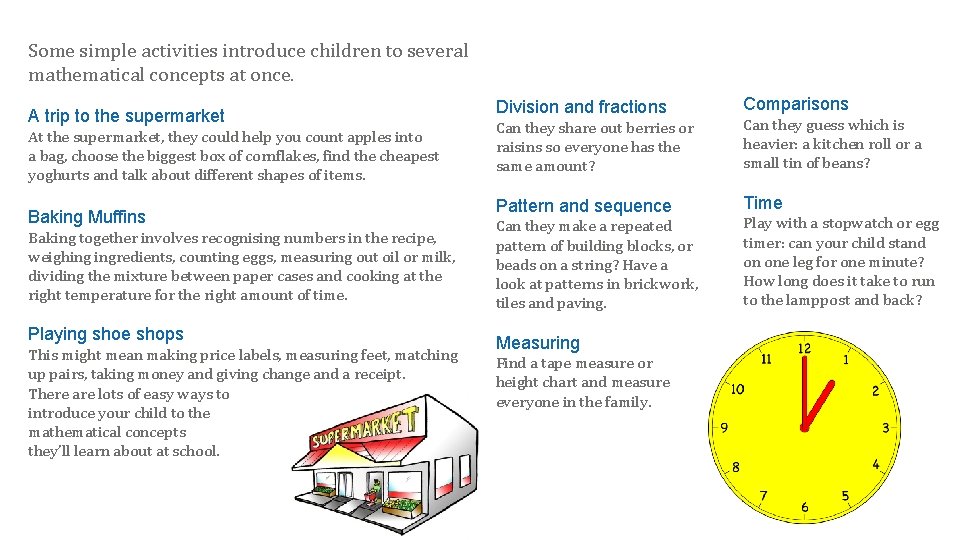
Some simple activities introduce children to several mathematical concepts at once. A trip to the supermarket At the supermarket, they could help you count apples into a bag, choose the biggest box of cornflakes, find the cheapest yoghurts and talk about different shapes of items. Baking Muffins Baking together involves recognising numbers in the recipe, weighing ingredients, counting eggs, measuring out oil or milk, dividing the mixture between paper cases and cooking at the right temperature for the right amount of time. Playing shoe shops This might mean making price labels, measuring feet, matching up pairs, taking money and giving change and a receipt. There are lots of easy ways to introduce your child to the mathematical concepts they’ll learn about at school. Division and fractions Comparisons Can they share out berries or raisins so everyone has the same amount? Can they guess which is heavier: a kitchen roll or a small tin of beans? Pattern and sequence Time Can they make a repeated pattern of building blocks, or beads on a string? Have a look at patterns in brickwork, tiles and paving. Measuring Find a tape measure or height chart and measure everyone in the family. Play with a stopwatch or egg timer: can your child stand on one leg for one minute? How long does it take to run to the lamppost and back?
Can do attitude Help to develop your child’s independence and a ‘can do’ attitude by giving them a few everyday responsibilities as they get closer to school age. Perhaps they could lay the table, feed a pet or put their own laundry away. More top tips: Get your child ready for their new routine by switching their meal times to match those of the school day Encourage your child to explore new environments and interact with new people Talk to your child about what they are most looking forward to at school Let your child practise putting their new school uniform on and taking it off And remember, every child is different and starts school with different abilities Steps to starting school Build your child’s confidence so that they start school confident, curious and ready to learn.
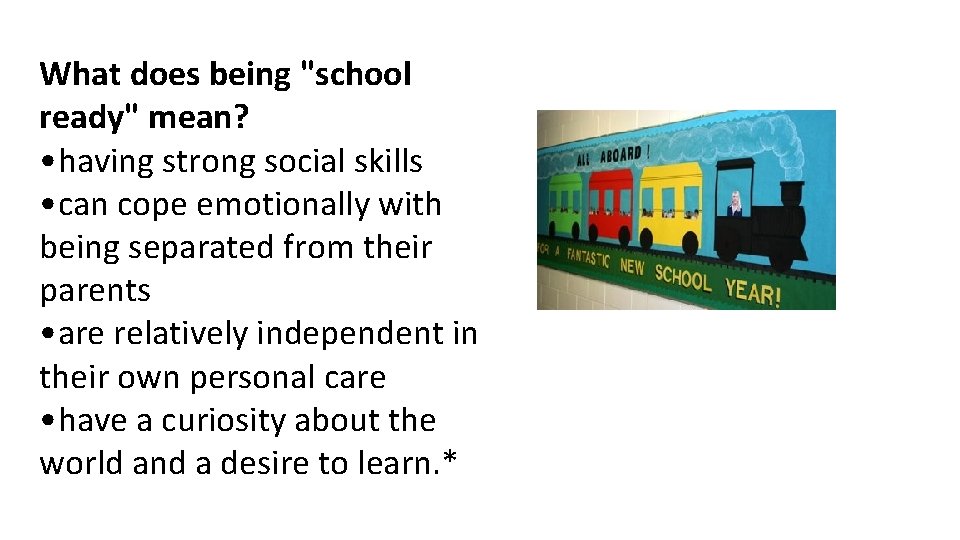
What does being "school ready" mean? • having strong social skills • can cope emotionally with being separated from their parents • are relatively independent in their own personal care • have a curiosity about the world and a desire to learn. *
What's Next? • Usually we have Nursery Transition visits or phone call by member of staff from WAPS. This year Mrs Beadie has already made contact with nurseries before school closure and will continue to make contact via email to the nurseries to help transitions. The school blog/website and Twitter page will also be updated to support our families during school closure. • Two Induction Days (currently postponed) • Placing Request Decisions • P 7 Buddies (to be arranged) • Don't Worry • Any questions, we are here to help contact ht@wishaw. n-Lanark. sch. uk