
Preparing Texture Modified Foods A Training Program for



- Slides: 48
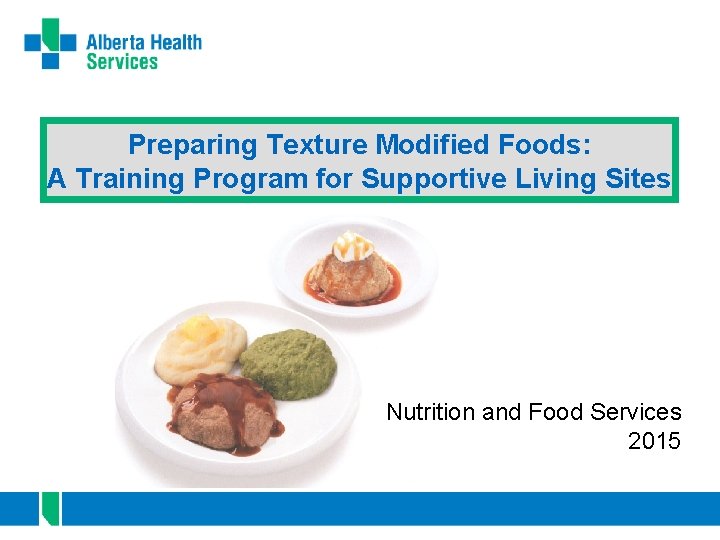
Preparing Texture Modified Foods: A Training Program for Supportive Living Sites Nutrition and Food Services 2015
Outline • Objectives • Introduction • Texture Modified Diets • Equipment for Texture Modified Diets • Texture Modified Foods: Primary Textures • Easy to Chew • Dysphagia Soft • Minced • Pureed Additional Texture Modifications • • • Cut/Diced No Mixed Consistencies Pureed Bread Products • Preparation tips • Following Recipes • Appearance • Taste • Food Safety • Sample Pureed Menu Plan • Summary • Questions 2
Objectives • Learn what different texture modified foods look like • Practice preparing texture modified foods by using the right guidelines, recipes and equipment • Serve appropriate food texture modifications for each diet 3
Introduction • It is important to ensure staff: • Understand the different types of texture modified diets • Practice preparing texture modified foods • Are able to follow textured modified recipes • Commercial texture modified foods (sourced products) are also available. These products can help to ensure safety and consistent nutrition. 4
Primary Texture Diets 5
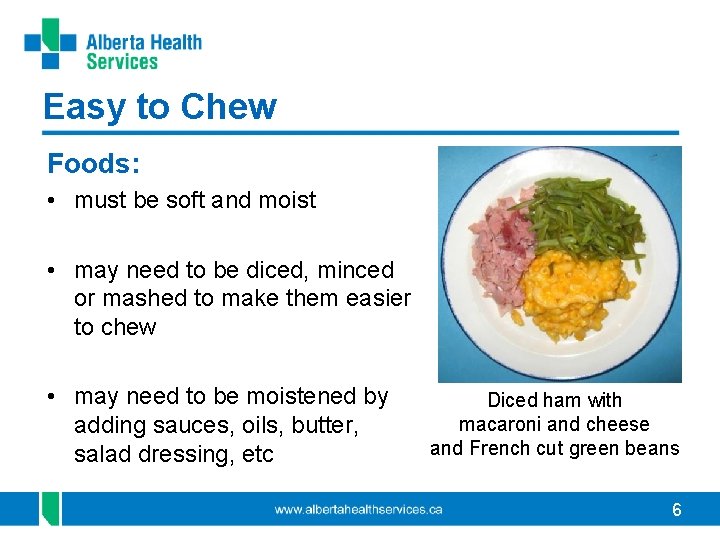
Easy to Chew Foods: • must be soft and moist • may need to be diced, minced or mashed to make them easier to chew • may need to be moistened by adding sauces, oils, butter, salad dressing, etc Diced ham with macaroni and cheese and French cut green beans 6
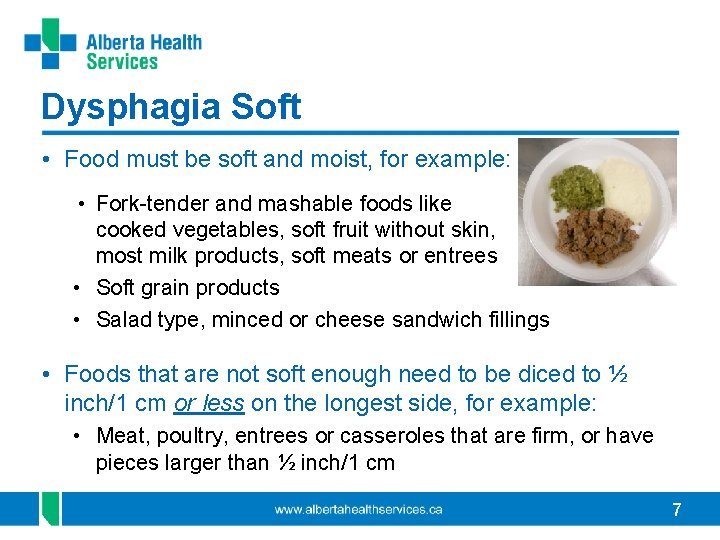
Dysphagia Soft • Food must be soft and moist, for example: • Fork-tender and mashable foods like cooked vegetables, soft fruit without skin, most milk products, soft meats or entrees • Soft grain products • Salad type, minced or cheese sandwich fillings • Foods that are not soft enough need to be diced to ½ inch/1 cm or less on the longest side, for example: • Meat, poultry, entrees or casseroles that are firm, or have pieces larger than ½ inch/1 cm 7
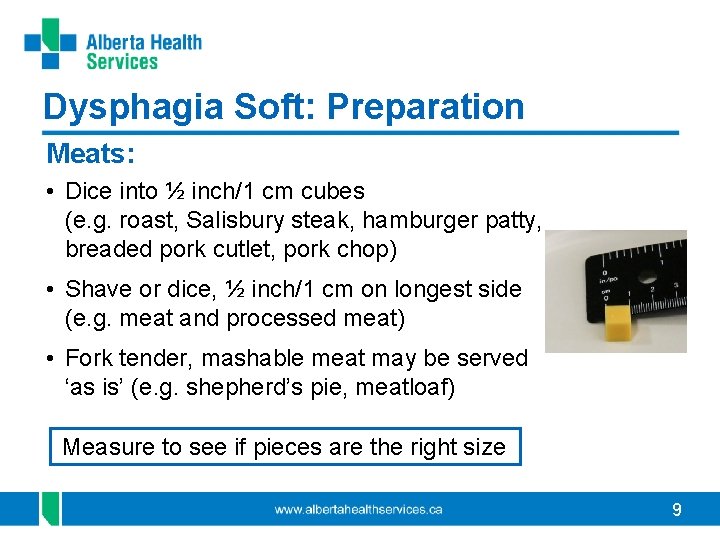
Dysphagia Soft: Preparation Meats: • Dice into ½ inch/1 cm cubes (e. g. roast, Salisbury steak, hamburger patty, breaded pork cutlet, pork chop) • Shave or dice, ½ inch/1 cm on longest side (e. g. meat and processed meat) • Fork tender, mashable meat may be served ‘as is’ (e. g. shepherd’s pie, meatloaf) Measure to see if pieces are the right size 9
Dysphagia Soft: Preparation Vegetables: • Cook until soft. May be served ‘as is’ if they are mashable or diced to ½ inch/1 cm cubes. • Mince cooked vegetables that are fibrous and stringy (e. g. green beans or broccoli). • Mince salads (e. g. lettuce, coleslaw, and other leafy greens). Fruit: • Dice (½ inch/1 cm cubed) or mash soft ripe fruits. Can also use soft canned or frozen fruit. 10
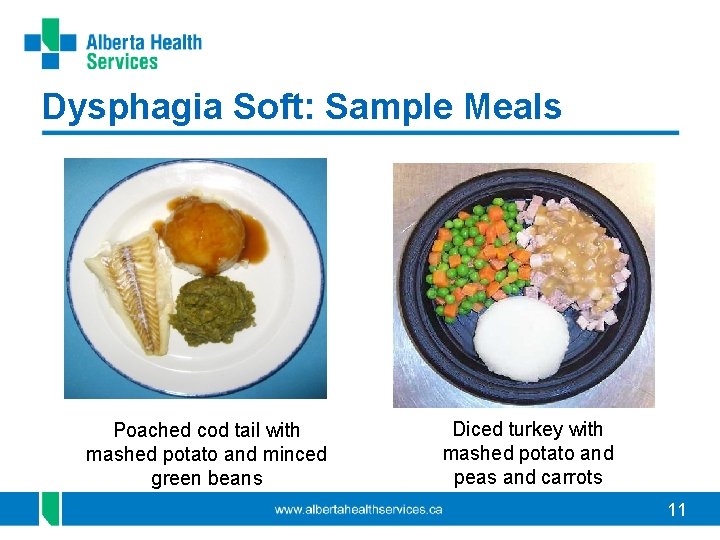
Dysphagia Soft: Sample Meals Poached cod tail with mashed potato and minced green beans Diced turkey with mashed potato and peas and carrots 11
Minced • Foods are minced, grated or finely mashed to a size less than ¼ inch or ½ cm. • Foods are moist with no liquid separation. • Some foods need to be pureed to be safe on a minced diet. For example, kernel corn and pitted stewed prunes. 12
Minced Breads: • Soft and moist bread, buttered toast, muffins, buns and biscuits are allowed as is. • Pancakes, waffles or French toast must have applesauce or syrup added to moisten. • Ensure the bread product is checked before serving to ensure it is not hard, dry and chewy. • If the crust of any product is too chewy, the crust would need to be removed. 13
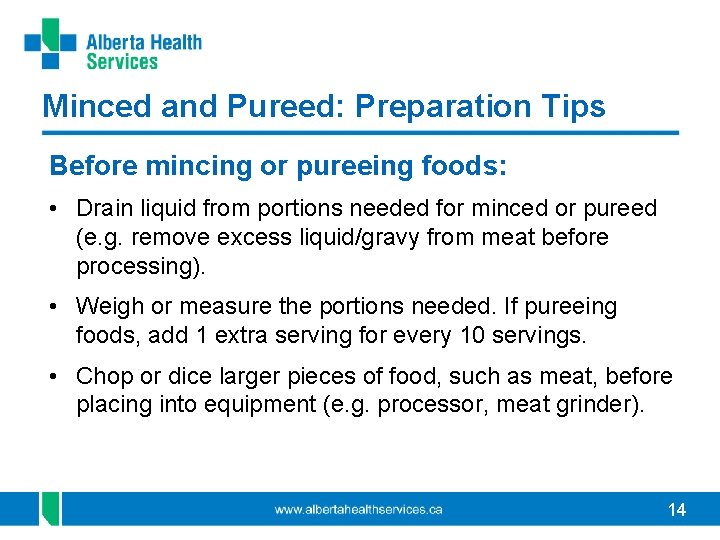
Minced and Pureed: Preparation Tips Before mincing or pureeing foods: • Drain liquid from portions needed for minced or pureed (e. g. remove excess liquid/gravy from meat before processing). • Weigh or measure the portions needed. If pureeing foods, add 1 extra serving for every 10 servings. • Chop or dice larger pieces of food, such as meat, before placing into equipment (e. g. processor, meat grinder). 14
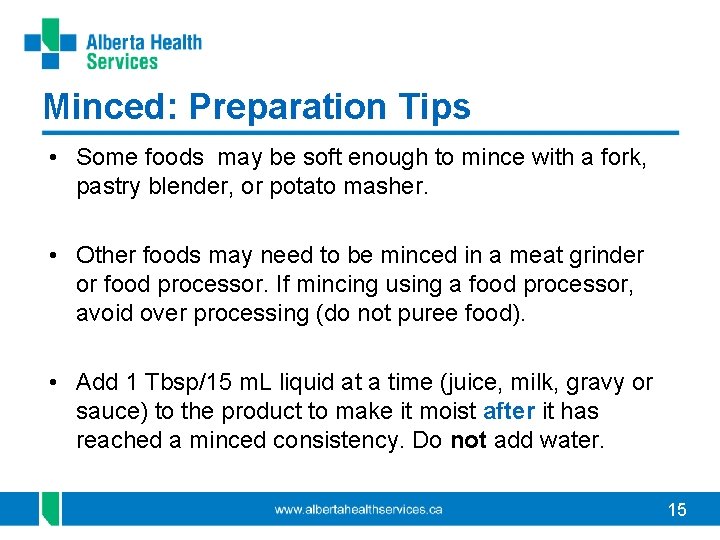
Minced: Preparation Tips • Some foods may be soft enough to mince with a fork, pastry blender, or potato masher. • Other foods may need to be minced in a meat grinder or food processor. If mincing using a food processor, avoid over processing (do not puree food). • Add 1 Tbsp/15 m. L liquid at a time (juice, milk, gravy or sauce) to the product to make it moist after it has reached a minced consistency. Do not add water. 15
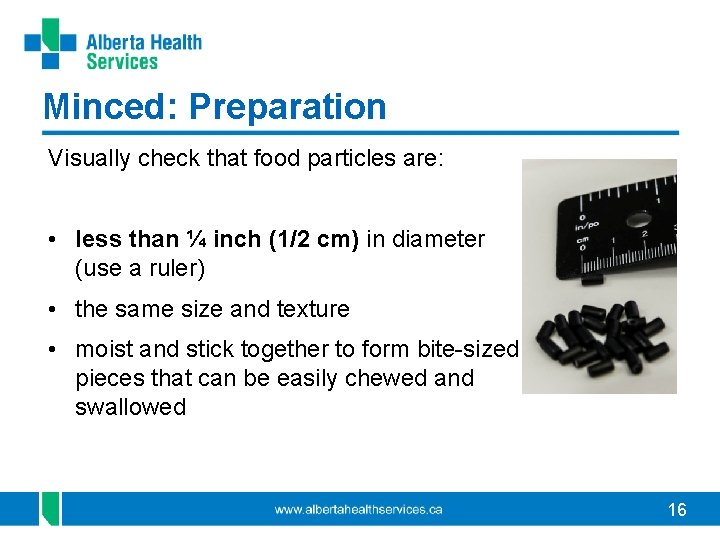
Minced: Preparation Visually check that food particles are: • less than ¼ inch (1/2 cm) in diameter (use a ruler) • the same size and texture • moist and stick together to form bite-sized pieces that can be easily chewed and swallowed 16
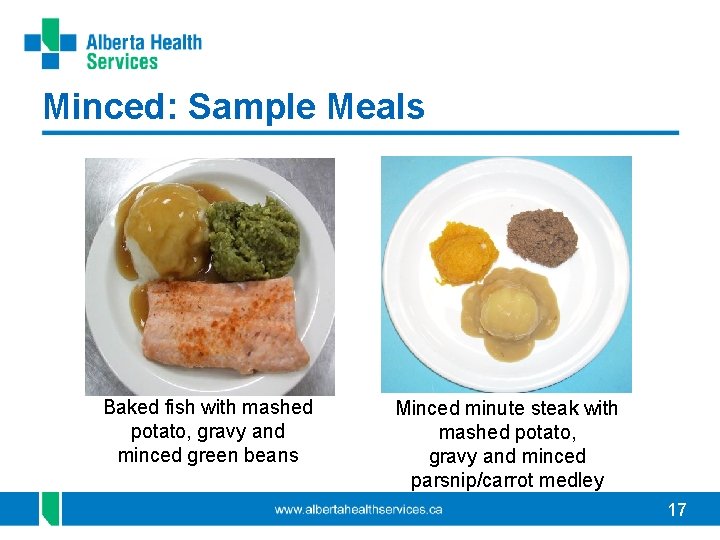
Minced: Sample Meals Baked fish with mashed potato, gravy and minced green beans Minced minute steak with mashed potato, gravy and minced parsnip/carrot medley 17
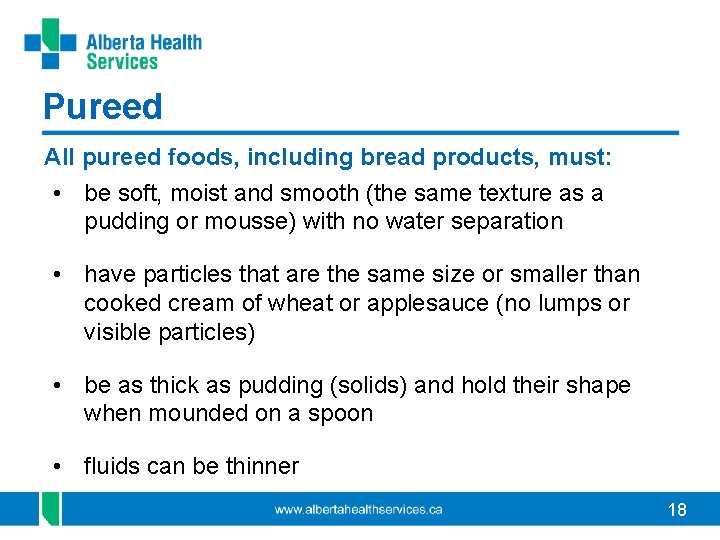
Pureed All pureed foods, including bread products, must: • be soft, moist and smooth (the same texture as a pudding or mousse) with no water separation • have particles that are the same size or smaller than cooked cream of wheat or applesauce (no lumps or visible particles) • be as thick as pudding (solids) and hold their shape when mounded on a spoon • fluids can be thinner 18
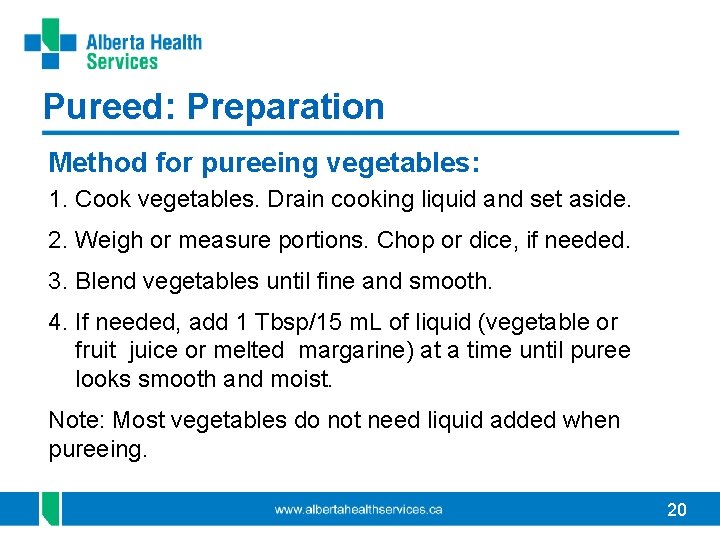
Pureed: Preparation Method for pureeing vegetables: 1. Cook vegetables. Drain cooking liquid and set aside. 2. Weigh or measure portions. Chop or dice, if needed. 3. Blend vegetables until fine and smooth. 4. If needed, add 1 Tbsp/15 m. L of liquid (vegetable or fruit juice or melted margarine) at a time until puree looks smooth and moist. Note: Most vegetables do not need liquid added when pureeing. 20
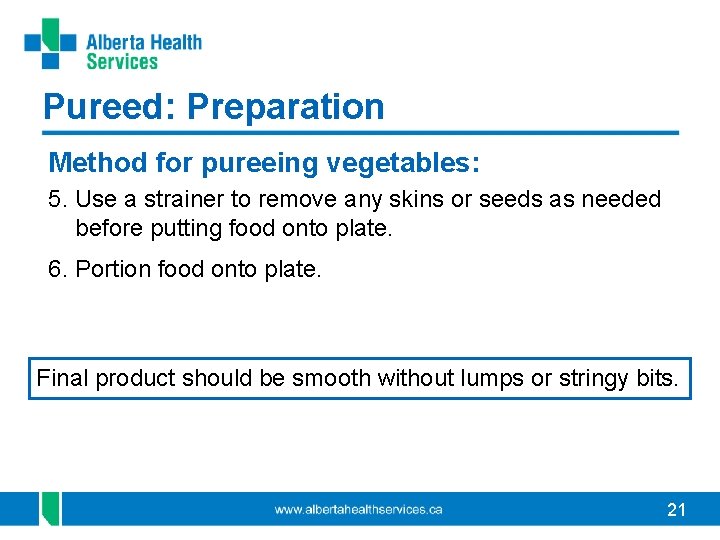
Pureed: Preparation Method for pureeing vegetables: 5. Use a strainer to remove any skins or seeds as needed before putting food onto plate. 6. Portion food onto plate. Final product should be smooth without lumps or stringy bits. 21
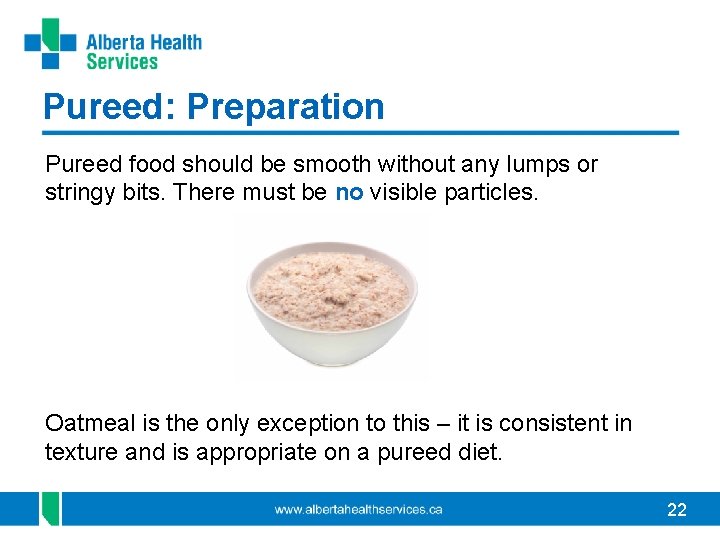
Pureed: Preparation Pureed food should be smooth without any lumps or stringy bits. There must be no visible particles. Oatmeal is the only exception to this – it is consistent in texture and is appropriate on a pureed diet. 22
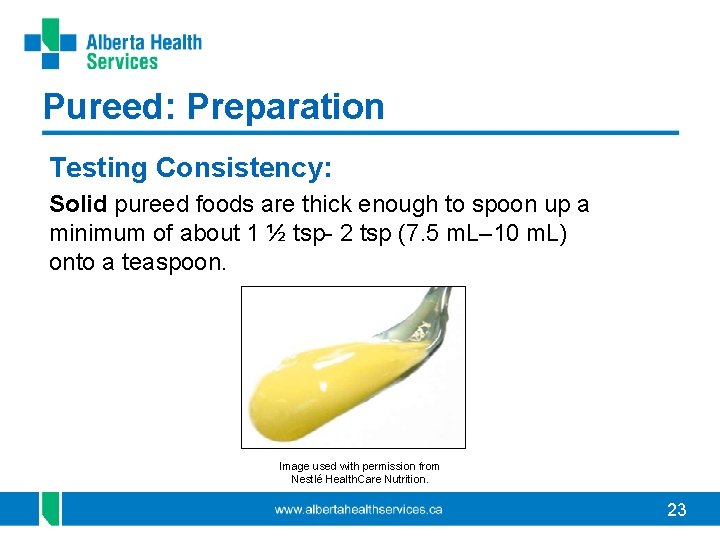
Pureed: Preparation Testing Consistency: Solid pureed foods are thick enough to spoon up a minimum of about 1 ½ tsp- 2 tsp (7. 5 m. L– 10 m. L) onto a teaspoon. Image used with permission from Nestlé Health. Care Nutrition. 23
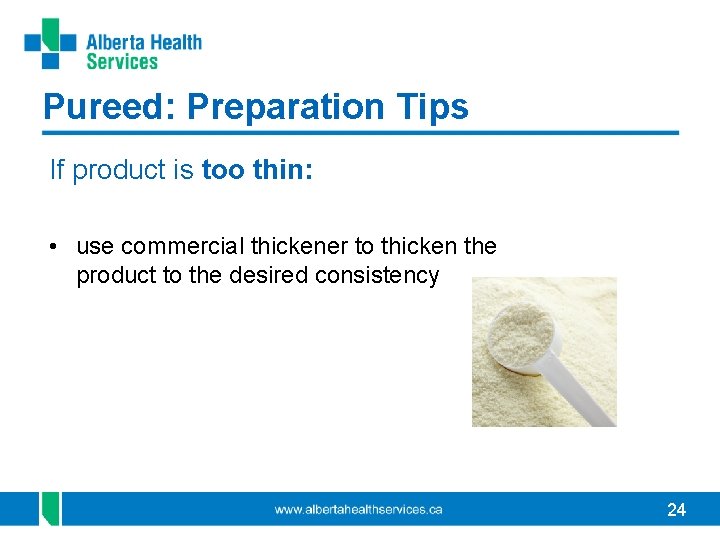
Pureed: Preparation Tips If product is too thin: • use commercial thickener to thicken the product to the desired consistency 24
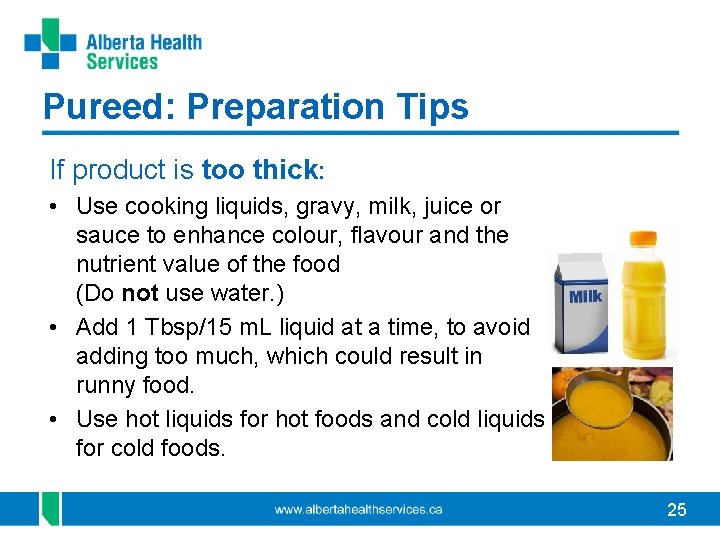
Pureed: Preparation Tips If product is too thick: • Use cooking liquids, gravy, milk, juice or sauce to enhance colour, flavour and the nutrient value of the food (Do not use water. ) • Add 1 Tbsp/15 m. L liquid at a time, to avoid adding too much, which could result in runny food. • Use hot liquids for hot foods and cold liquids for cold foods. 25
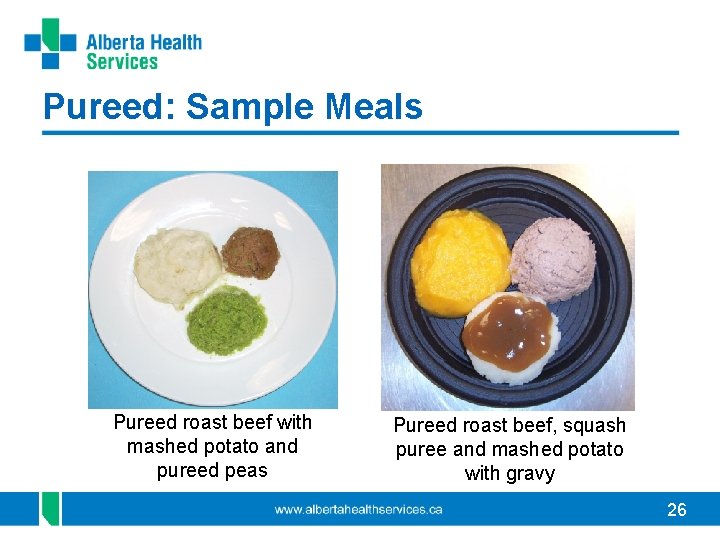
Pureed: Sample Meals Pureed roast beef with mashed potato and pureed peas Pureed roast beef, squash puree and mashed potato with gravy 26
Additional Texture Modifications 27
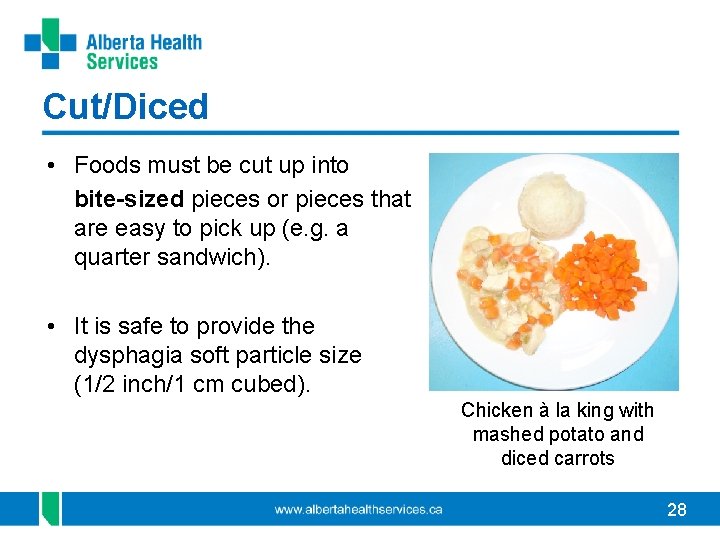
Cut/Diced • Foods must be cut up into bite-sized pieces or pieces that are easy to pick up (e. g. a quarter sandwich). • It is safe to provide the dysphagia soft particle size (1/2 inch/1 cm cubed). Chicken à la king with mashed potato and diced carrots 28
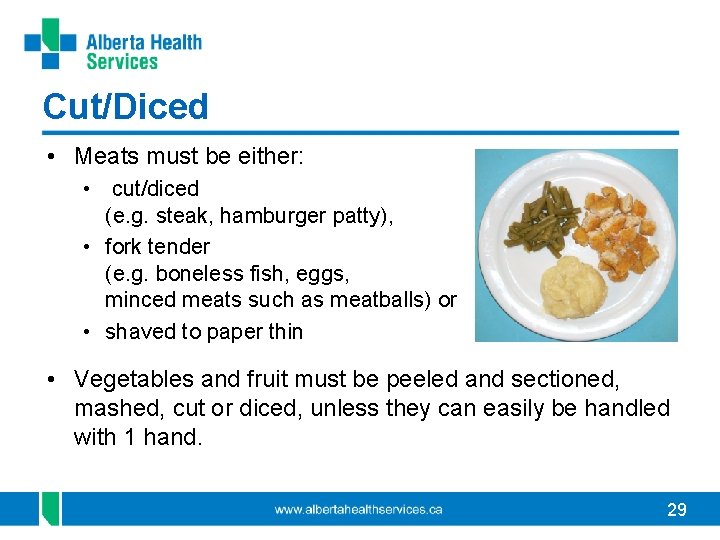
Cut/Diced • Meats must be either: • cut/diced (e. g. steak, hamburger patty), • fork tender (e. g. boneless fish, eggs, minced meats such as meatballs) or • shaved to paper thin • Vegetables and fruit must be peeled and sectioned, mashed, cut or diced, unless they can easily be handled with 1 hand. 29
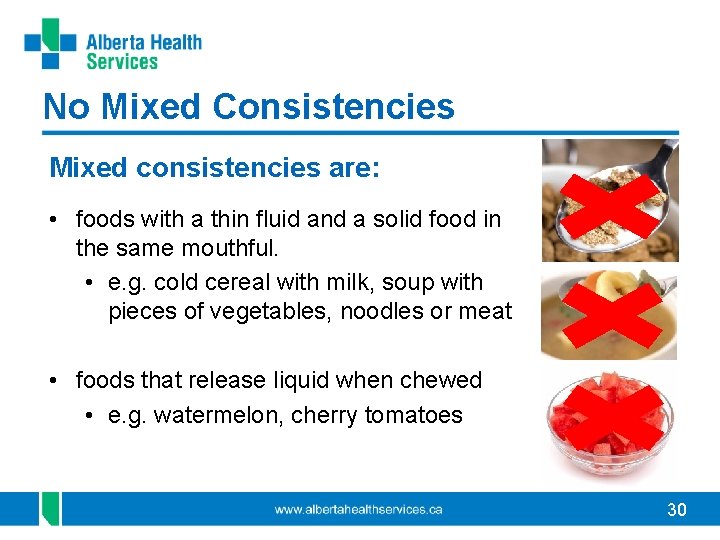
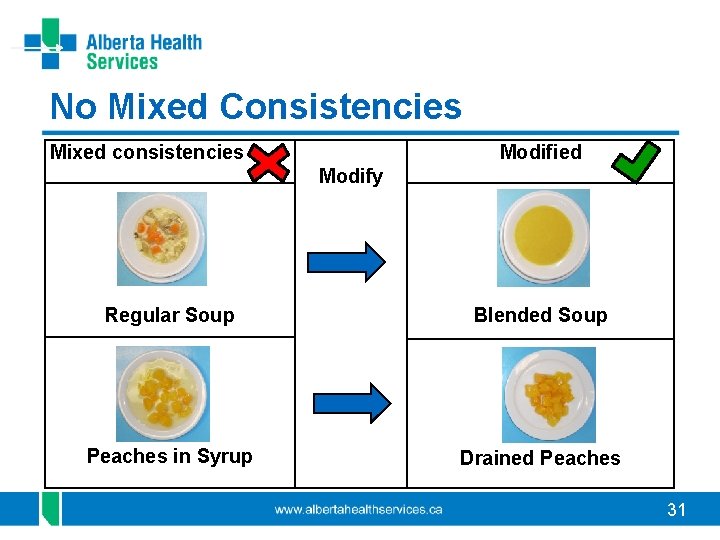
No Mixed Consistencies Mixed consistencies are: • foods with a thin fluid and a solid food in the same mouthful. • e. g. cold cereal with milk, soup with pieces of vegetables, noodles or meat • foods that release liquid when chewed • e. g. watermelon, cherry tomatoes 30
No Mixed Consistencies Mixed consistencies Modified Modify Regular Soup Blended Soup Peaches in Syrup Drained Peaches 31
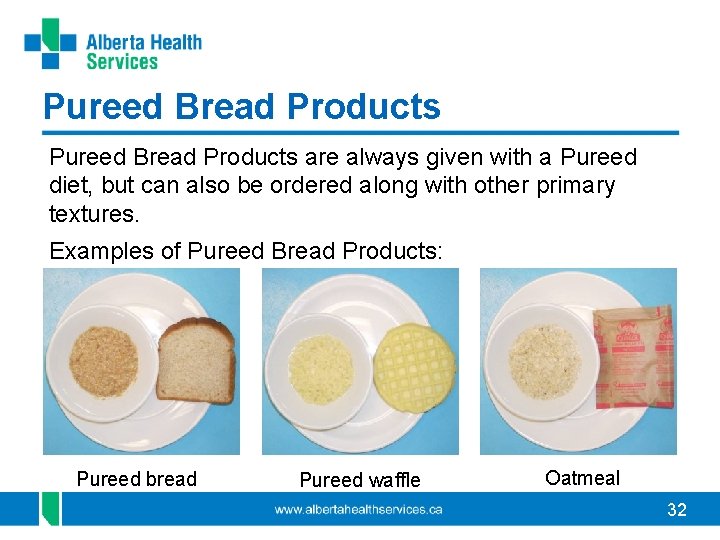
Pureed Bread Products are always given with a Pureed diet, but can also be ordered along with other primary textures. Examples of Pureed Bread Products: Pureed bread Pureed waffle Oatmeal 32
Pureed Bread Products How to Puree Bread Products: Pureed Bread Products can be made by either pureeing or by making a slurry. 33
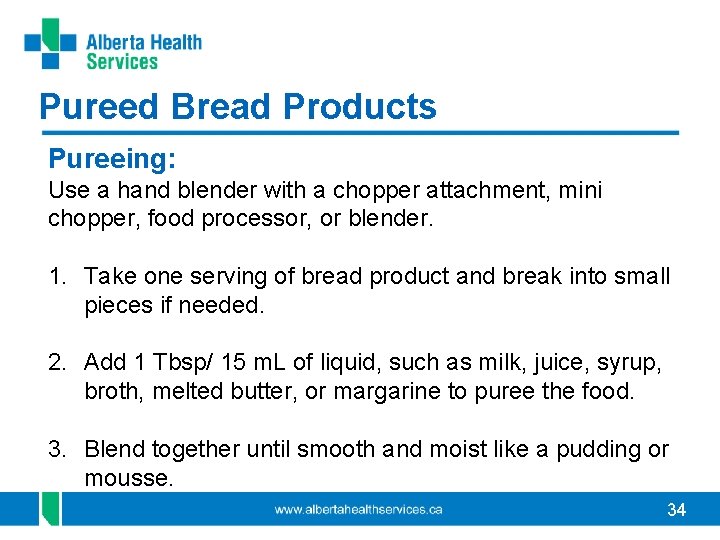
Pureed Bread Products Pureeing: Use a hand blender with a chopper attachment, mini chopper, food processor, or blender. 1. Take one serving of bread product and break into small pieces if needed. 2. Add 1 Tbsp/ 15 m. L of liquid, such as milk, juice, syrup, broth, melted butter, or margarine to puree the food. 3. Blend together until smooth and moist like a pudding or mousse. 34
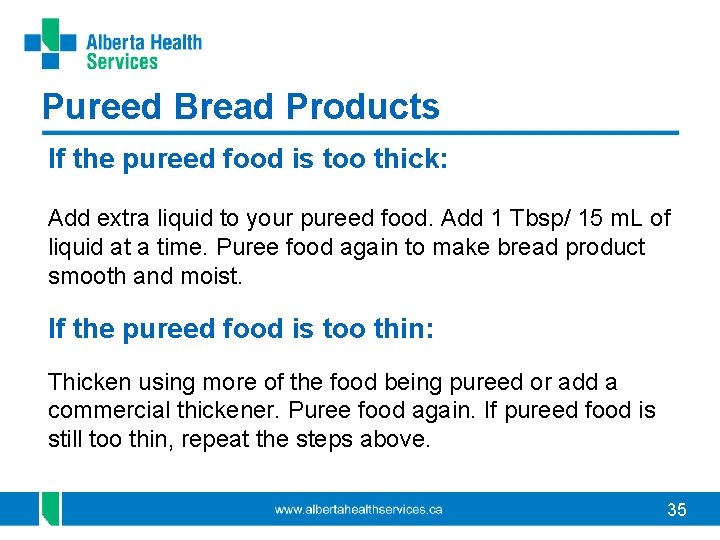
Pureed Bread Products If the pureed food is too thick: Add extra liquid to your pureed food. Add 1 Tbsp/ 15 m. L of liquid at a time. Puree food again to make bread product smooth and moist. If the pureed food is too thin: Thicken using more of the food being pureed or add a commercial thickener. Puree food again. If pureed food is still too thin, repeat the steps above. 35
Pureed Bread Products: Slurries • Slurries can soften bread or baked items. • Slurries are made with a liquid and commercial thickener to modify a product for the Pureed diet. • The finished product looks like the initial product (meaning it will keep its original form). • Foods made with a slurry must not contain nuts, seeds, raisins, dates or coconut. • Examples of slurries include a bread slurry, French toast, pancake or waffle slurry, muffin slurry, cake/cookie slurry, or a brownie/bar slurry. 36
Pureed Bread Products: Slurries Method for preparing slurries: 1. Mix the commercial thickener and hot liquid (hot milk, juice, water or nutrition supplement drink) and stir until smooth. Follow the recipe for amounts of thickener and liquid. 2. Place the bread product (digestive cookies, pancakes, muffin, etc) in a dish and add the slurry mix. Spread evenly and cover, allowing the bread product to absorb the slurry mix. Follow recipe instructions for how long to let the bread product absorb the slurry mix. 3. Serve cold or warm, depending on the bread product. 37
Equipment for Texture Modified Diets Institutional Equipment Food processor/ Robot. Coupe Meat grinder Mixer 38
Equipment for Texture Modified Diets Home Style Equipment Blender Hand held mixer Food processor 39
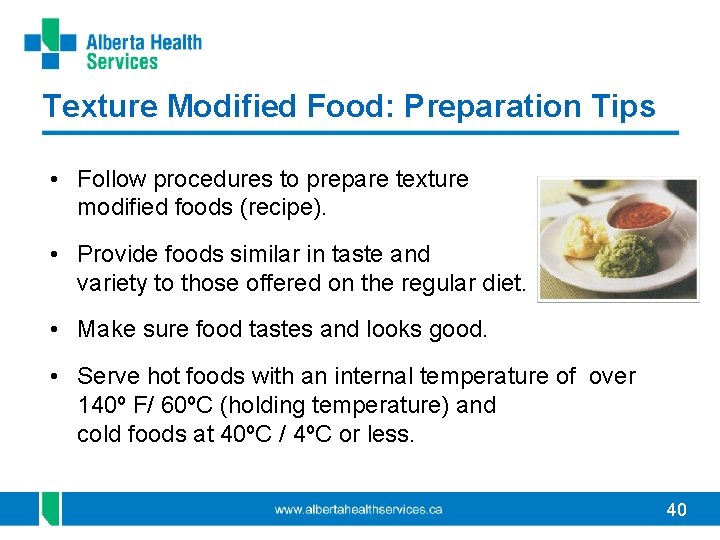
Texture Modified Food: Preparation Tips • Follow procedures to prepare texture modified foods (recipe). • Provide foods similar in taste and variety to those offered on the regular diet. • Make sure food tastes and looks good. • Serve hot foods with an internal temperature of over 140º F/ 60ºC (holding temperature) and cold foods at 40ºC / 4ºC or less. 40
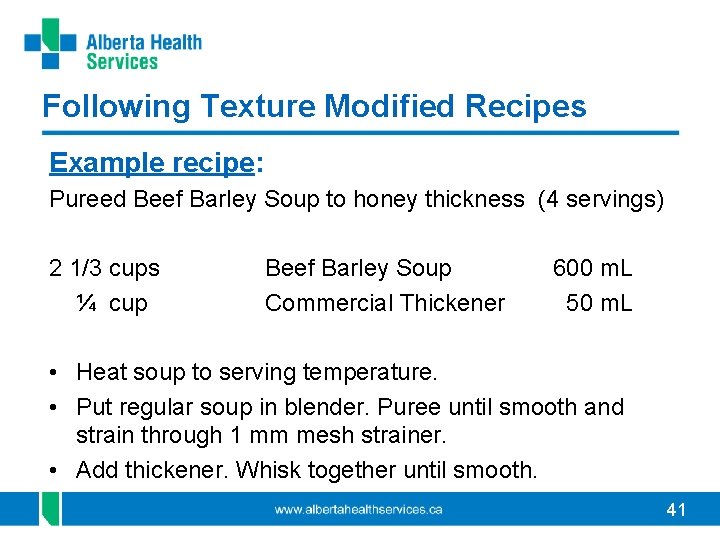
Following Texture Modified Recipes Example recipe: Pureed Beef Barley Soup to honey thickness (4 servings) 2 1/3 cups ¼ cup Beef Barley Soup Commercial Thickener 600 m. L 50 m. L • Heat soup to serving temperature. • Put regular soup in blender. Puree until smooth and strain through 1 mm mesh strainer. • Add thickener. Whisk together until smooth. 41
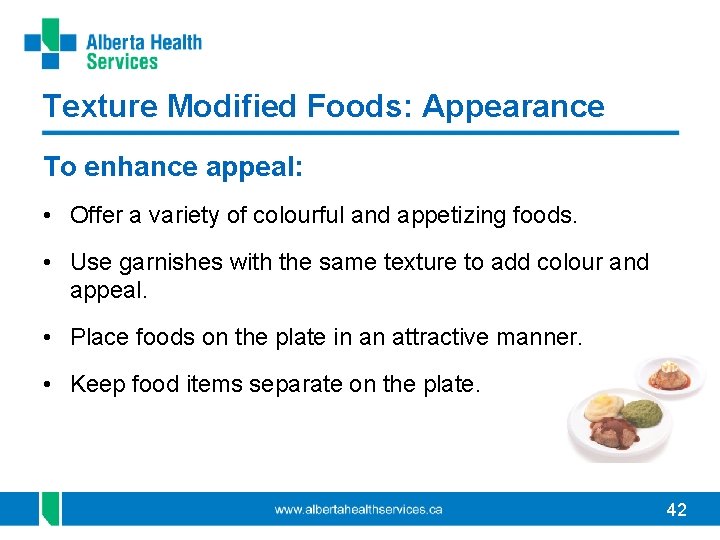
Texture Modified Foods: Appearance To enhance appeal: • Offer a variety of colourful and appetizing foods. • Use garnishes with the same texture to add colour and appeal. • Place foods on the plate in an attractive manner. • Keep food items separate on the plate. 42
Texture Modified Foods: Taste To enhance taste: • Add cooking liquids, gravy, milk, juice or sauces to enhance colour and flavour, not water. • Use spices (except salt) to add flavour. • Serve meals at the correct temperature (hot foods must be served hot, cold foods must be served cold). • Taste the food before serving it to residents. Staff should be positive and encouraging about the meal when serving it to the resident. 43
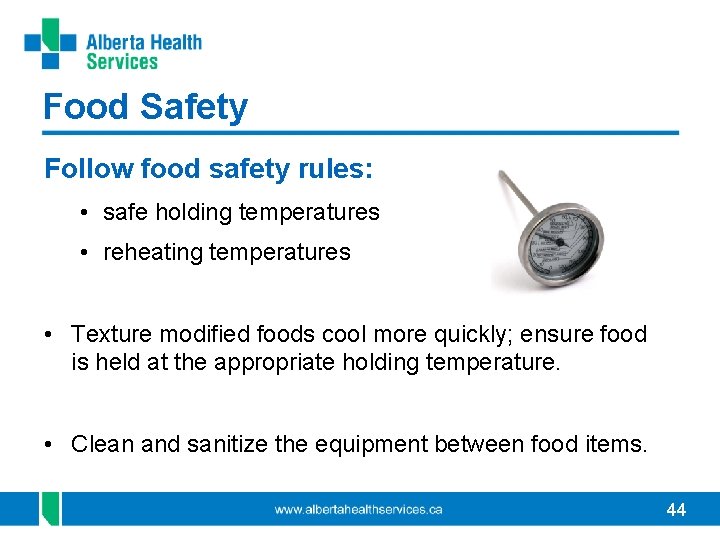
Food Safety Follow food safety rules: • safe holding temperatures • reheating temperatures • Texture modified foods cool more quickly; ensure food is held at the appropriate holding temperature. • Clean and sanitize the equipment between food items. 44
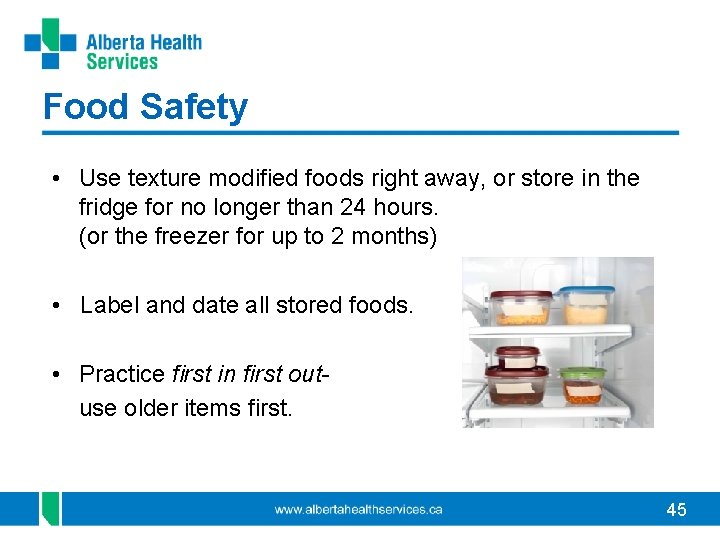
Food Safety • Use texture modified foods right away, or store in the fridge for no longer than 24 hours. (or the freezer for up to 2 months) • Label and date all stored foods. • Practice first in first outuse older items first. 45
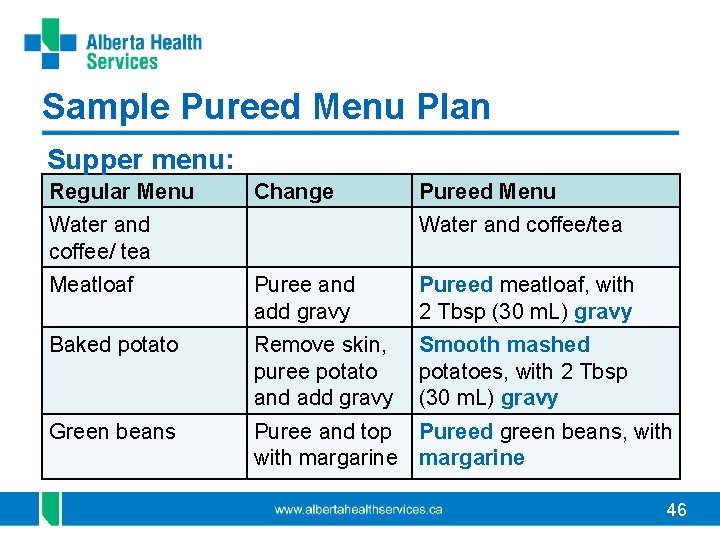
Sample Pureed Menu Plan Supper menu: Regular Menu Change Water and coffee/ tea Pureed Menu Water and coffee/tea Meatloaf Puree and add gravy Pureed meatloaf, with 2 Tbsp (30 m. L) gravy Baked potato Remove skin, puree potato and add gravy Smooth mashed potatoes, with 2 Tbsp (30 m. L) gravy Green beans Puree and top Pureed green beans, with margarine 46
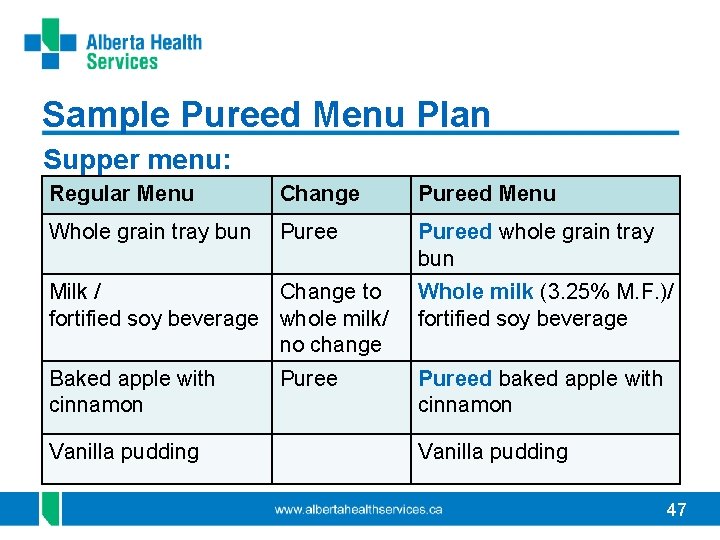
Sample Pureed Menu Plan Supper menu: Regular Menu Change Pureed Menu Whole grain tray bun Pureed whole grain tray bun Milk / Change to fortified soy beverage whole milk/ no change Whole milk (3. 25% M. F. )/ fortified soy beverage Baked apple with cinnamon Pureed baked apple with cinnamon Vanilla pudding Puree Vanilla pudding 47
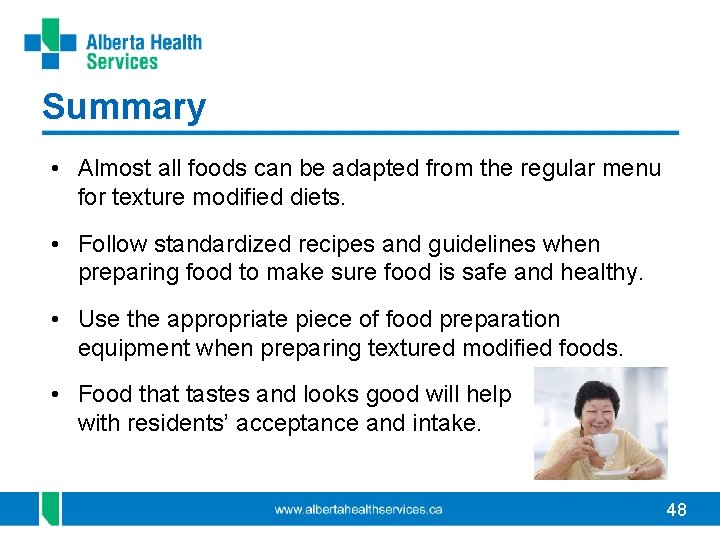
Summary • Almost all foods can be adapted from the regular menu for texture modified diets. • Follow standardized recipes and guidelines when preparing food to make sure food is safe and healthy. • Use the appropriate piece of food preparation equipment when preparing textured modified foods. • Food that tastes and looks good will help with residents’ acceptance and intake. 48
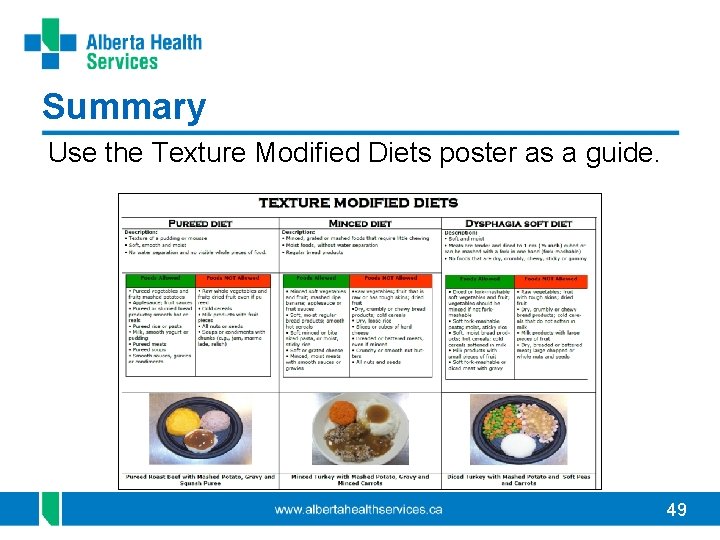
Summary Use the Texture Modified Diets poster as a guide. 49
Questions? If you have any future questions about texture modified foods, please ask your supervisor. 50