
Preparing Students for Success with Quality Career Pathways
![[ ] Preparing Students for Success with Quality Career Pathways Presentation by William Symonds](https://slidetodoc.com/presentation_image_h2/b15144ddceee3a5a9ba2c791708fb421/image-1.jpg "[ ] Preparing Students for Success with Quality Career Pathways Presentation by William Symonds")

- Slides: 36
[ ] Preparing Students for Success with Quality Career Pathways Presentation by William Symonds Director, the Global Pathways Institute CACTA Mid-Winter Conference Colorado Springs February 10, 2016
The Global Pathways Institute: Year One • CREATION OF THE INSTITUTE • OUR BOARD • PRIORITIES: (1) Multiple Pathways (2) Career Literacy • SOUTHWEST PATHWAYS CONFERENCE www. Global. Pathways. Institute. org
GPI’S Vision We are committed to creating an America in which all young people are prepared to lead productive and successful lives. We believe that providing young people with highquality multiple pathways is the best way to help them discover and develop their potential and achieve economic independence.
SOUTHWEST PATHWAYS CONFERENCE MAY 28 -29 AT ASU SKYSONG Teams from 5 states: CO, UT, NV, NM and AZ 350 Attendees; more than 100 speakers
TODAY’S AGENDA • The Pathways Challenge • Why We Are Failing So Many Young Adults • How We Can Help Prepare More Young Adults to Achieve Economic Independence: ØCareer Development/ “Career Literacy” ØPromote Multiple Pathways ØWork-Based Learning • How You Can Get Engaged!
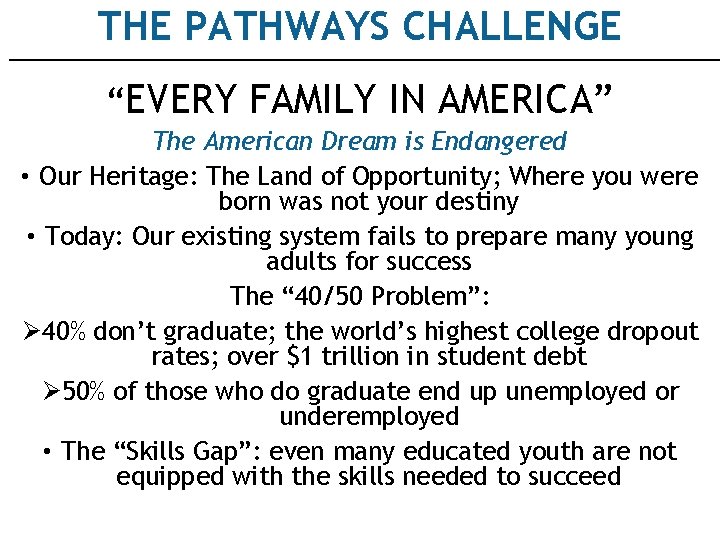
THE PATHWAYS CHALLENGE “EVERY FAMILY IN AMERICA” The American Dream is Endangered • Our Heritage: The Land of Opportunity; Where you were born was not your destiny • Today: Our existing system fails to prepare many young adults for success The “ 40/50 Problem”: Ø 40% don’t graduate; the world’s highest college dropout rates; over $1 trillion in student debt Ø 50% of those who do graduate end up unemployed or underemployed • The “Skills Gap”: even many educated youth are not equipped with the skills needed to succeed
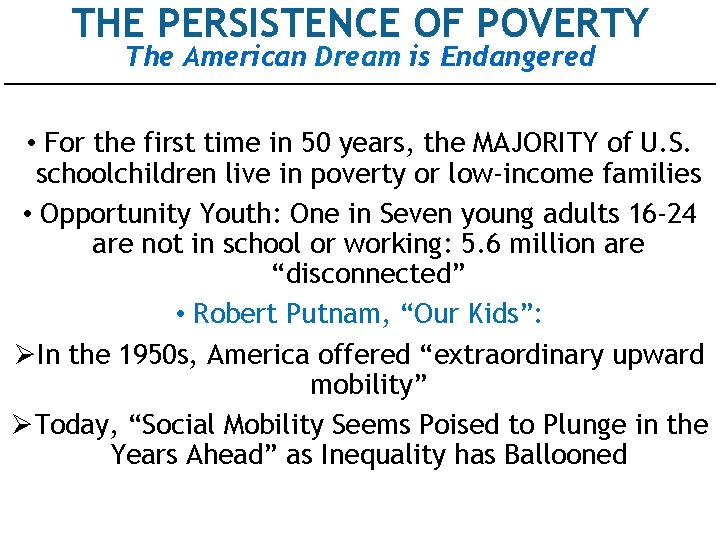
THE PERSISTENCE OF POVERTY The American Dream is Endangered • For the first time in 50 years, the MAJORITY of U. S. schoolchildren live in poverty or low-income families • Opportunity Youth: One in Seven young adults 16 -24 are not in school or working: 5. 6 million are “disconnected” • Robert Putnam, “Our Kids”: ØIn the 1950 s, America offered “extraordinary upward mobility” ØToday, “Social Mobility Seems Poised to Plunge in the Years Ahead” as Inequality has Ballooned
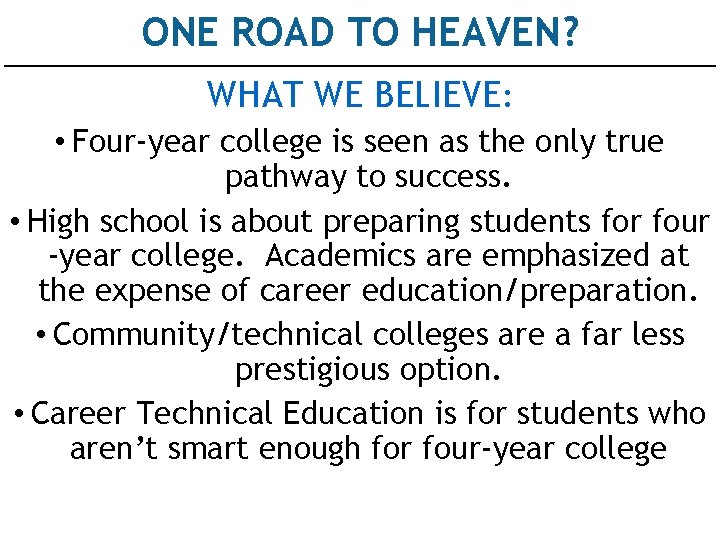
ONE ROAD TO HEAVEN? WHAT WE BELIEVE: • Four-year college is seen as the only true pathway to success. • High school is about preparing students for four -year college. Academics are emphasized at the expense of career education/preparation. • Community/technical colleges are a far less prestigious option. • Career Technical Education is for students who aren’t smart enough for four-year college
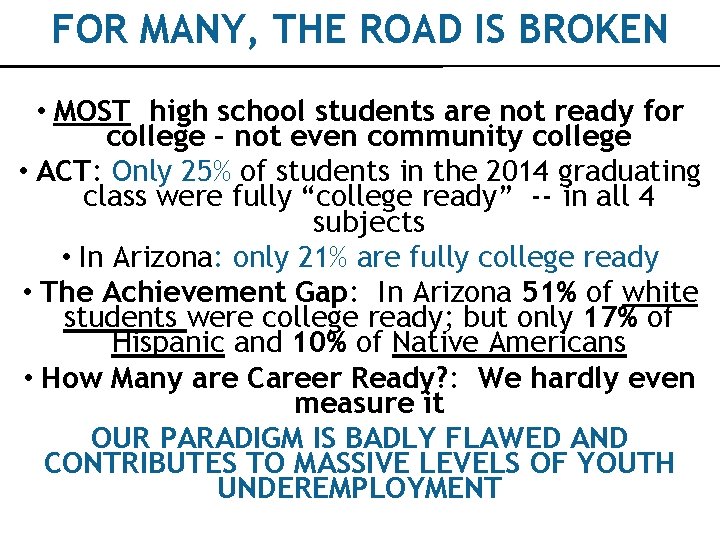
FOR MANY, THE ROAD IS BROKEN • MOST high school students are not ready for college – not even community college • ACT: Only 25% of students in the 2014 graduating class were fully “college ready” -- in all 4 subjects • In Arizona: only 21% are fully college ready • The Achievement Gap: In Arizona 51% of white students were college ready; but only 17% of Hispanic and 10% of Native Americans • How Many are Career Ready? : We hardly even measure it OUR PARADIGM IS BADLY FLAWED AND CONTRIBUTES TO MASSIVE LEVELS OF YOUTH UNDEREMPLOYMENT
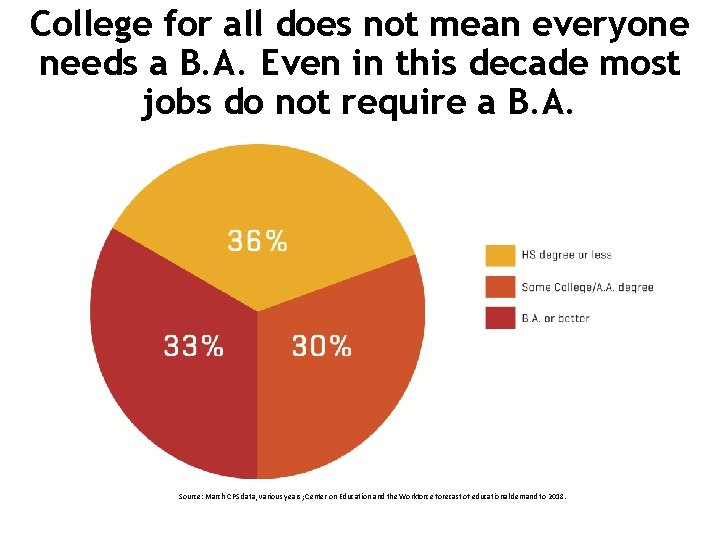
College for all does not mean everyone needs a B. A. Even in this decade most jobs do not require a B. A. Source: March CPS data, various years; Center on Education and the Workforce forecast of educational demand to 2018.
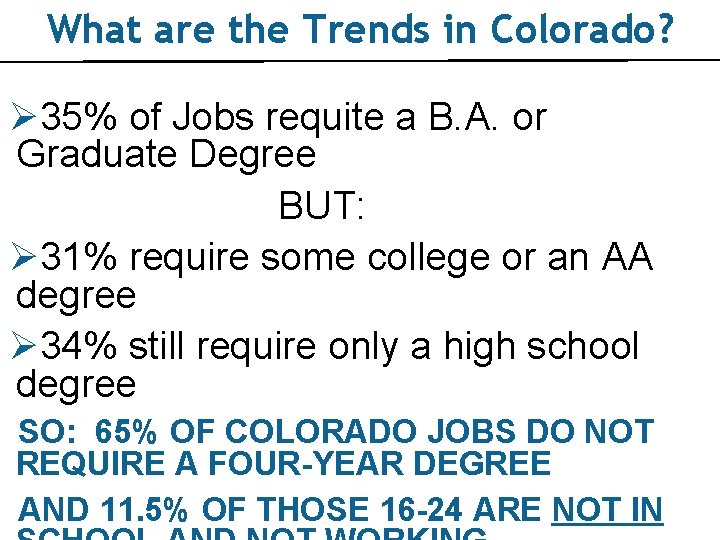
What are the Trends in Colorado? Ø 35% of Jobs requite a B. A. or Graduate Degree BUT: Ø 31% require some college or an AA degree Ø 34% still require only a high school degree SO: 65% OF COLORADO JOBS DO NOT REQUIRE A FOUR-YEAR DEGREE AND 11. 5% OF THOSE 16 -24 ARE NOT IN
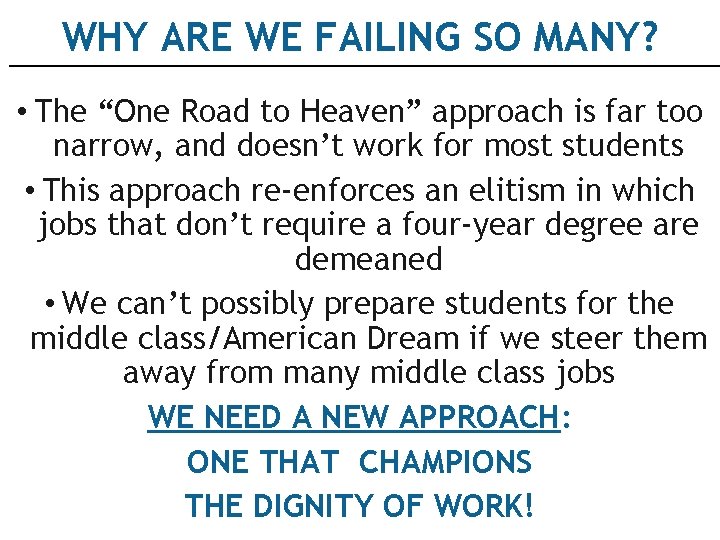
WHY ARE WE FAILING SO MANY? • The “One Road to Heaven” approach is far too narrow, and doesn’t work for most students • This approach re-enforces an elitism in which jobs that don’t require a four-year degree are demeaned • We can’t possibly prepare students for the middle class/American Dream if we steer them away from many middle class jobs WE NEED A NEW APPROACH: ONE THAT CHAMPIONS THE DIGNITY OF WORK!
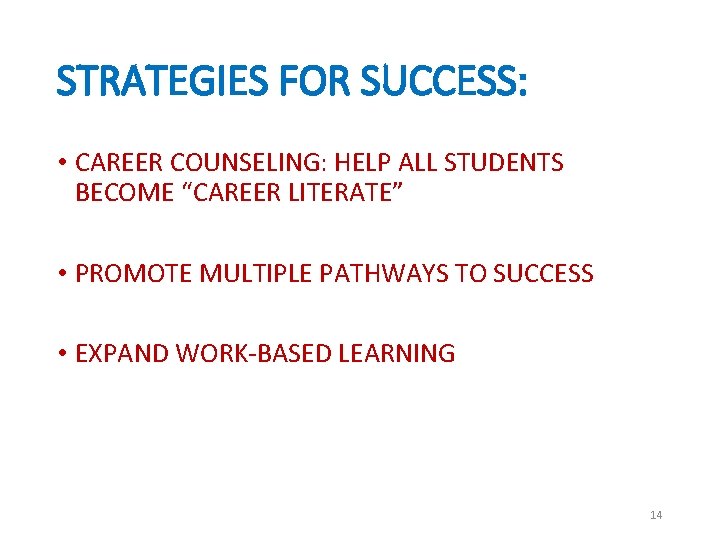
STRATEGIES FOR SUCCESS: • CAREER COUNSELING: HELP ALL STUDENTS BECOME “CAREER LITERATE” • PROMOTE MULTIPLE PATHWAYS TO SUCCESS • EXPAND WORK-BASED LEARNING 14
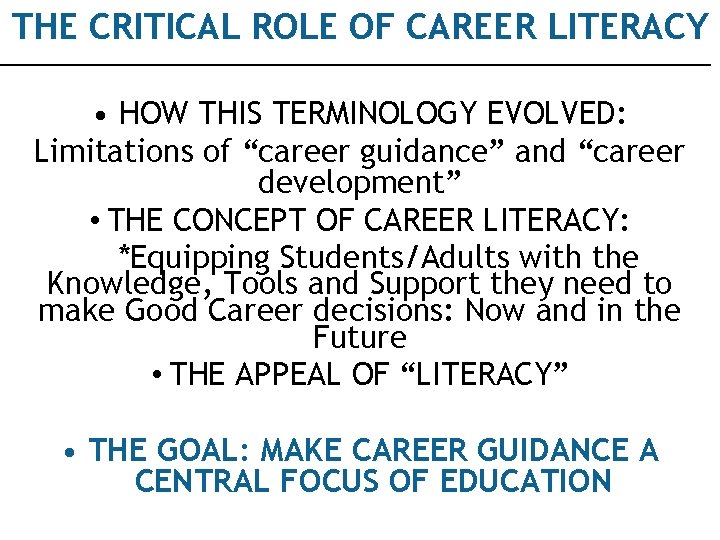
THE CRITICAL ROLE OF CAREER LITERACY • HOW THIS TERMINOLOGY EVOLVED: Limitations of “career guidance” and “career development” • THE CONCEPT OF CAREER LITERACY: *Equipping Students/Adults with the Knowledge, Tools and Support they need to make Good Career decisions: Now and in the Future • THE APPEAL OF “LITERACY” • THE GOAL: MAKE CAREER GUIDANCE A CENTRAL FOCUS OF EDUCATION
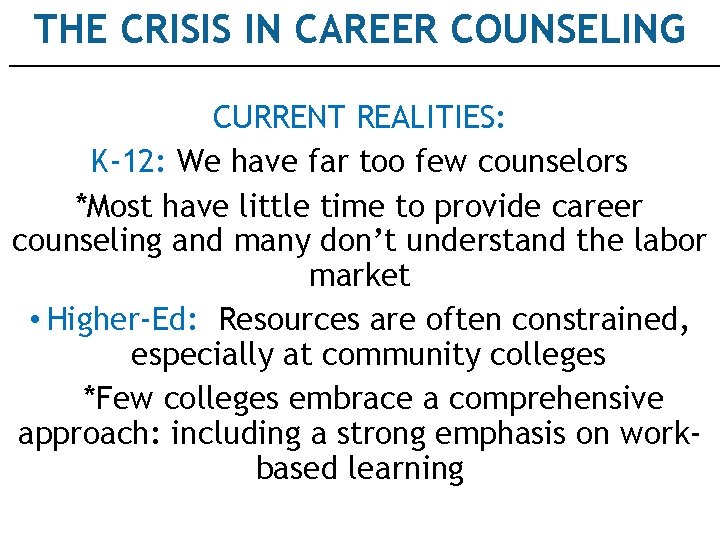
THE CRISIS IN CAREER COUNSELING CURRENT REALITIES: K-12: We have far too few counselors *Most have little time to provide career counseling and many don’t understand the labor market • Higher-Ed: Resources are often constrained, especially at community colleges *Few colleges embrace a comprehensive approach: including a strong emphasis on workbased learning
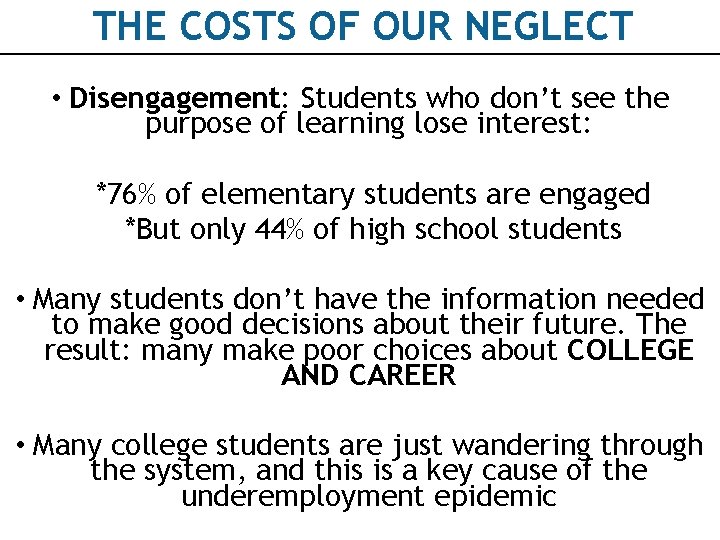
THE COSTS OF OUR NEGLECT • Disengagement: Students who don’t see the purpose of learning lose interest: *76% of elementary students are engaged *But only 44% of high school students • Many students don’t have the information needed to make good decisions about their future. The result: many make poor choices about COLLEGE AND CAREER • Many college students are just wandering through the system, and this is a key cause of the underemployment epidemic
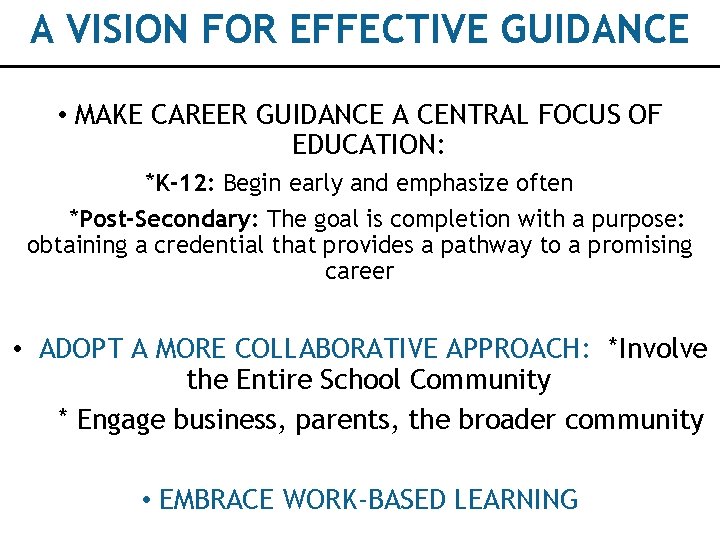
A VISION FOR EFFECTIVE GUIDANCE • MAKE CAREER GUIDANCE A CENTRAL FOCUS OF EDUCATION: *K-12: Begin early and emphasize often *Post-Secondary: The goal is completion with a purpose: obtaining a credential that provides a pathway to a promising career • ADOPT A MORE COLLABORATIVE APPROACH: *Involve the Entire School Community * Engage business, parents, the broader community • EMBRACE WORK-BASED LEARNING
FEB. 22 NATIONAL CONVENING OUR STEERING COMMITTEE: ACT INC ASSOCIATION FOR CAREER AND TECHNICAL EDUCATION AMERICA’S PROMISE ALLIANCE COUNCIL OF CHIEF STATE SCHOOL OFFICERS GLOBAL PATHWAYS INSTITUTE AT ARIZONA STATE UNIVERSITY MANUFACTURING SKILLS STANDARDS COUNCIL NATIONAL CAREER DEVELOPMENT ASSOCIATION NATIONAL GOVERNOR’S ASSOCIATION SME NATIONAL ASSOCIATION OF STATE DIRECTORS OF CAREER TECHNICAL EDUCATION CONSORTIUM THE NATIONAL COLLABORATIVE ON WORKFORCE AND DISABILITY FOR YOUTH US CHAMBER OF COMMERCE FOUNDATION 19
NATIONAL CONVENING HIGHLGHTS §Who Will Attend: 250 Invited Guests; Colorado Will be Represented §Review of the Program §Goals and Next Steps 20
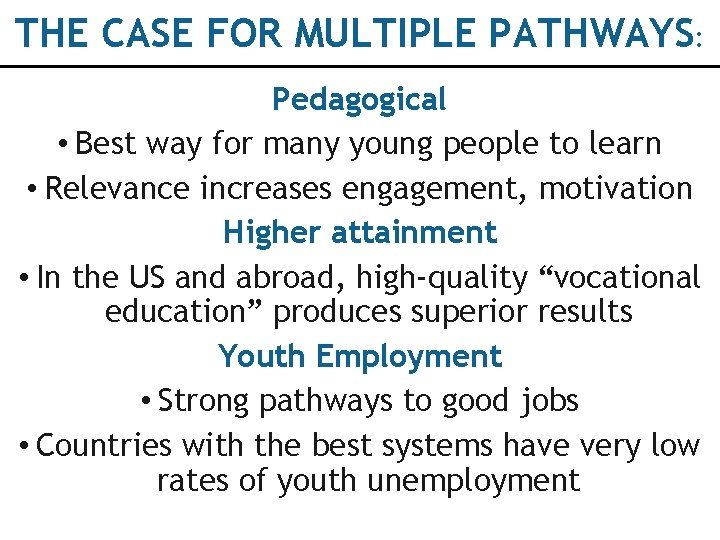
THE CASE FOR MULTIPLE PATHWAYS: Pedagogical • Best way for many young people to learn • Relevance increases engagement, motivation Higher attainment • In the US and abroad, high-quality “vocational education” produces superior results Youth Employment • Strong pathways to good jobs • Countries with the best systems have very low rates of youth unemployment
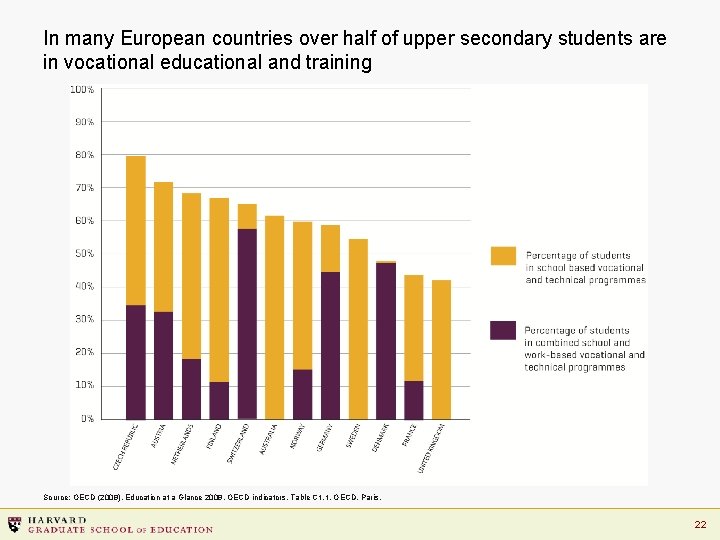
In many European countries over half of upper secondary students are in vocational educational and training Source: OECD (2008), Education at a Glance 2008, OECD indicators, Table C 1. 1, OECD, Paris. 22
EXEMPLARS FROM ABROAD • FEATURES OF THE “DUAL SYSTEM” **Vast choice of Career pathways **Based on an apprenticeship system **Integration of Academic/Vocational Instruction **Promotes the dignity/professionalism of all careers **The payoff: a seamless pathway to employment
U. S. PROGRESS ØGrowing Recognition we Need to Create Effective Pathways Systems ØMany Key Organizations are Driving Change: § Pathways to Prosperity/Harvard § NASDCTEc: Career Clusters § Department of Labor § National Governors Assn. § US Chamber of Commerce
KEY INGREDIENTS 1) Build Cross-Agency Partnerships 2) Identify Key Industry Sectors 3) Design Education/Training programs 4) Identify Funding Needs and Sources 5) Align Policies and programs 6) Measure Performance As identified in the “Career Pathways Toolkit, ” Published by US Department of Labor in 2015
CENTRAL CHALLENGES ØFor Educators: *Creating Seamless Pathways from High School to PSE *Focus on Credentials/Competencies, not Just Degrees ØEngaging Business/Industry: *Involvement is Essential *Work to Build Regional Sector Partnerships *Business Can Play Many Roles
COLORADO IS A LEADER ØLeadership/support from Governor ØCross-Agency Career Pathways Team ØStrong Examples of Regional Sector Partnerships But the Work is Just Beginning!
THE MASSACHUSETTS MODEL • HOW IT WORKS: **A network of regional vocational high schools **Students spend half time on a career major **Students must still pass MCAS exams **Heavy emphasis on work-based learning • IMPRESSIVE RESULTS: **Sky-high graduation/attendance rates **National leader in technical skill attainment **Most go on to Post-secondary education NPR DOCUMENTARY: “Ready to Work” www. American. Radio. Works. org/documentaries
OTHER STATE LEADERS WHERE CAREER READINESS COUNTS: ØFlorida: nearly 50% of high school students now earn industry-recognized credentials ØNorth Dakota: over half of students are CTE concentrators; and these students graduate at much higher rates ØKentucky: Measures College and Career Readiness ØNew York: has just approved multiple pathways to a high school diploma
THE ROLE OF WORK-BASED LEARNING WHY IS IT SO IMPORTANT? *Proven way to promote engagement *Develops key employability skills *The gold standard for career exploration. Helps students find out: Is this what I want to do? *For employers: An ideal method for attracting and identifying future employees
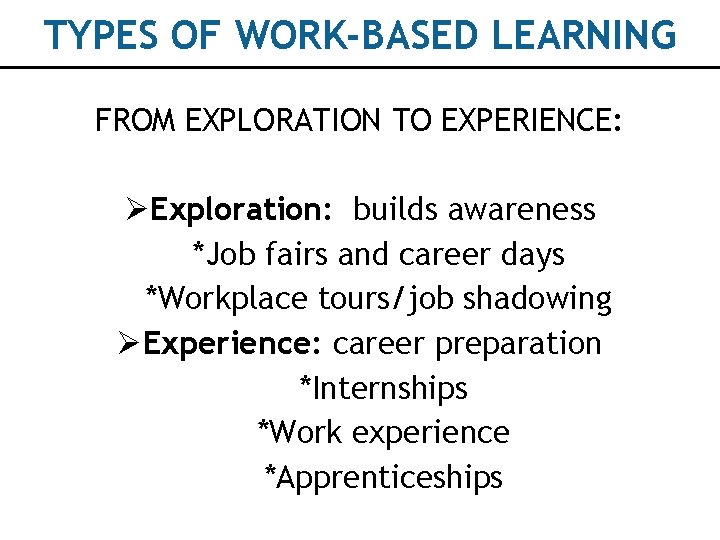
TYPES OF WORK-BASED LEARNING FROM EXPLORATION TO EXPERIENCE: ØExploration: builds awareness *Job fairs and career days *Workplace tours/job shadowing ØExperience: career preparation *Internships *Work experience *Apprenticeships
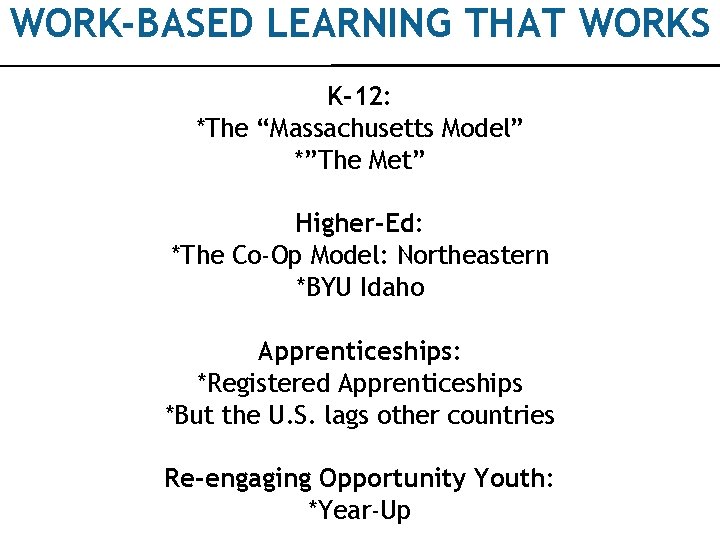
WORK-BASED LEARNING THAT WORKS K-12: *The “Massachusetts Model” *”The Met” Higher-Ed: *The Co-Op Model: Northeastern *BYU Idaho Apprenticeships: *Registered Apprenticeships *But the U. S. lags other countries Re-engaging Opportunity Youth: *Year-Up
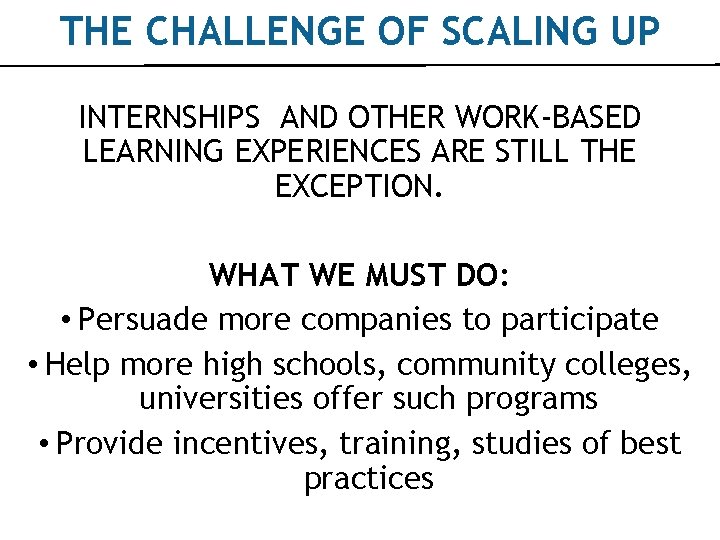
THE CHALLENGE OF SCALING UP INTERNSHIPS AND OTHER WORK-BASED LEARNING EXPERIENCES ARE STILL THE EXCEPTION. WHAT WE MUST DO: • Persuade more companies to participate • Help more high schools, community colleges, universities offer such programs • Provide incentives, training, studies of best practices
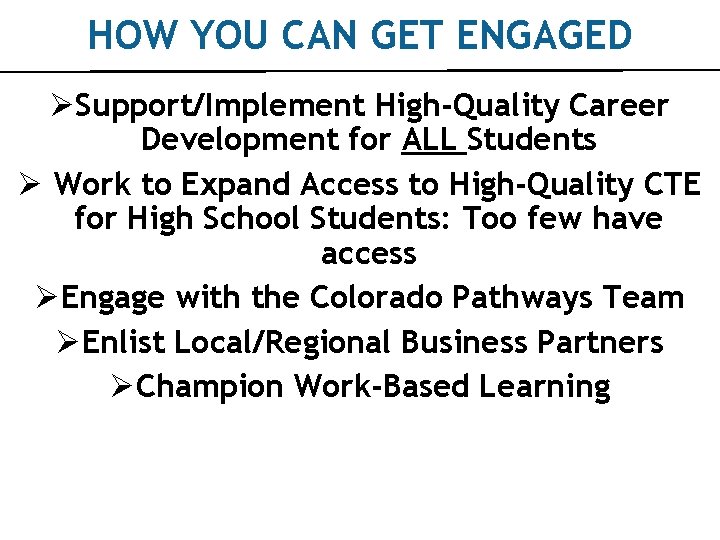
HOW YOU CAN GET ENGAGED ØSupport/Implement High-Quality Career Development for ALL Students Ø Work to Expand Access to High-Quality CTE for High School Students: Too few have access ØEngage with the Colorado Pathways Team ØEnlist Local/Regional Business Partners ØChampion Work-Based Learning
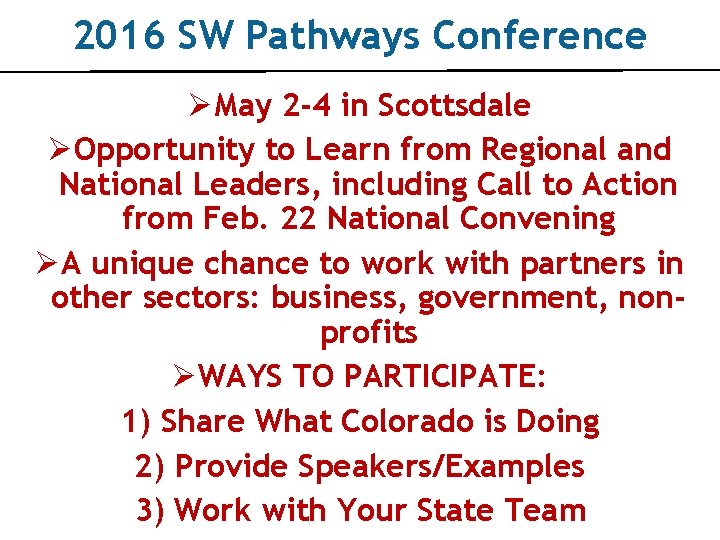
2016 SW Pathways Conference ØMay 2 -4 in Scottsdale ØOpportunity to Learn from Regional and National Leaders, including Call to Action from Feb. 22 National Convening ØA unique chance to work with partners in other sectors: business, government, nonprofits ØWAYS TO PARTICIPATE: 1) Share What Colorado is Doing 2) Provide Speakers/Examples 3) Work with Your State Team
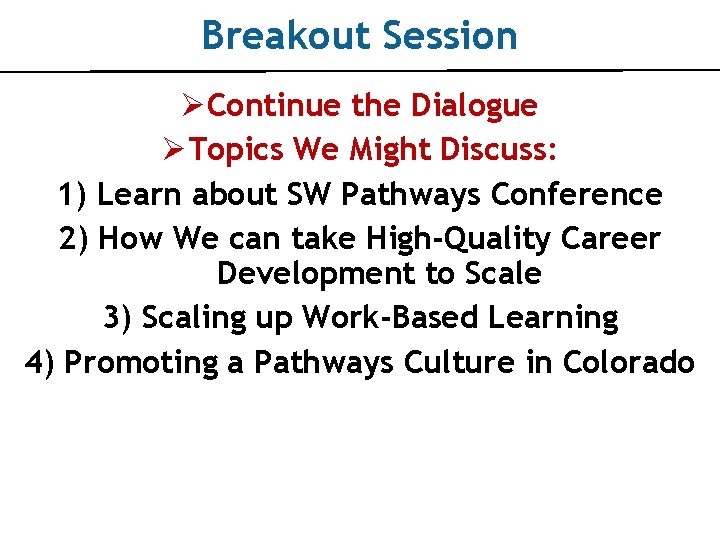
Breakout Session ØContinue the Dialogue ØTopics We Might Discuss: 1) Learn about SW Pathways Conference 2) How We can take High-Quality Career Development to Scale 3) Scaling up Work-Based Learning 4) Promoting a Pathways Culture in Colorado
[ [ QUESTIONS?