
Preparing Students for Distance Learning Presented by John
Preparing Students for Distance Learning Presented by John R. Knue, Ed. D. Baylor University John_Knue@Baylor. edu (http: //hsb. baylor. edu/html/knue/home. htm)
Overview Rationale n Terminology /Methodology n Types of D. L. offerings n Orientation techniques for a two-way environment n Q&A n
Rationale n n Studies show anxiety is higher in a D. L. course; impacts attrition Studies show student performance benefits from orientation Orientation helps students focus on “content” rather than the technology Students are often presumed ready
More Rationale n n Quality/expectations may be “perceived” as lower Necessary to build student & instructor comfort /confidence level Natural to want to know about policy and procedures Clarify instructor’s goals & students’ attitudes
Asynchronous n Internet or Web -based courses n Video-based / Telecourses
Asynchronous Courses n Internet or Telecourses Initial (on-site) orientation? n Flexible or prescribed schedule? n Testing requirements n Access to instructor n
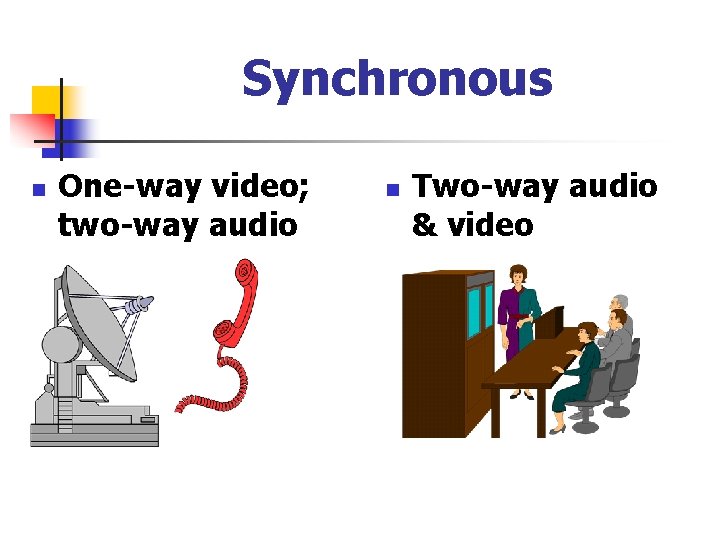
Synchronous n One-way video; two-way audio n Two-way audio & video
Synchronous Courses One-way video; two-way audio n n Instructor cannot see students; can only hear individual caller May be facilitator or monitor Requires closer attention to student discipline Usually includes multiple sites
Synchronous Courses Two-way audio and video n n n Interactive TV (ITV) or Videoconferencing Very common for secondary and postsecondary Uses T 1 (telephone lines) to transmit real-time audio & compressed video
D. L. Offerings Complete Degree Programs Individual Course Offerings
General Issues n Is D. L. appropriate for the learner’s individual style or situation n Are handbooks/guidelines provided? n Is there an orientation process? n Are there specific “Residency” requirements?
General Issues n (Cont. ) Student Services offered Contact person n Advising n Access to library /other resources n Admission & registration n Tuition & fees n Financial Aid n
ITV Conditions n Students may be at: Both origin & receive site(s) n Receive site(s) only n n Clarify receive site assistance Another teacher n Facilitator n Technical person n
ITV Orientation Students at the “Origin Site” n n Often surprised to be in D. L. environment May need orientation to microphones n Will need to learn to view monitors n May resent sharing the instructor
ITV Orientation Students at the “Receive Site(s)” n May also be surprised to be in D. L. environment n May need orientation to microphones n Will most always be on camera n n May have on-location facilitator or other May have to learn about equipment
All Students n Learner responsibilities: Patience Persistence Punctuality Presence Participation
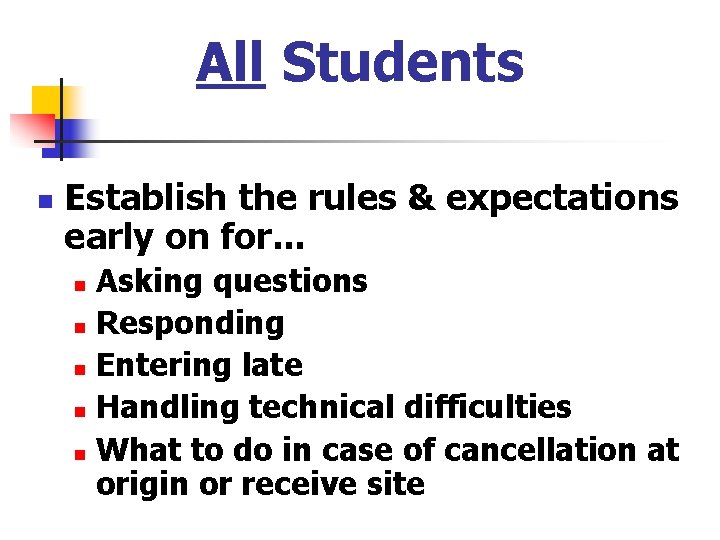
All Students n Establish the rules & expectations early on for. . . Asking questions n Responding n Entering late n Handling technical difficulties n What to do in case of cancellation at origin or receive site n
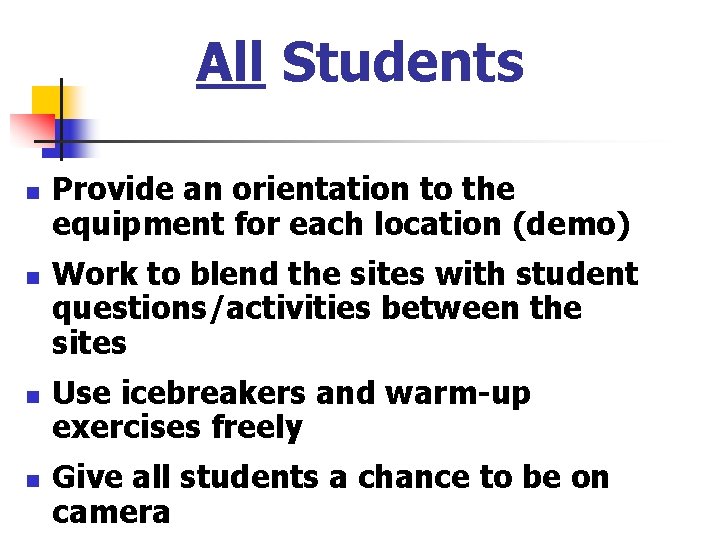
All Students n n Provide an orientation to the equipment for each location (demo) Work to blend the sites with student questions/activities between the sites Use icebreakers and warm-up exercises freely Give all students a chance to be on camera
Questions? Discussion!
- Slides: 19