
PREPARING SOLUTIONS AND REAGENTS Chemical Solutions aqueous water
- Slides: 10
PREPARING SOLUTIONS AND REAGENTS
Chemical Solutions (aqueous = water is the solvent) Types of vessels (least to most precise): ▪ ▪ Beaker Erlennmeyer flask Graduated cylinder Volumetric flask
DEFINITIONS: • SOLUTES -- substances that are dissolved • SOLVENTS -- substance in which solutes are dissolved (usually water) • AMOUNT -- how much
Goals • Make solutions • Dilute solutions • Convert between different concentrations of solutions
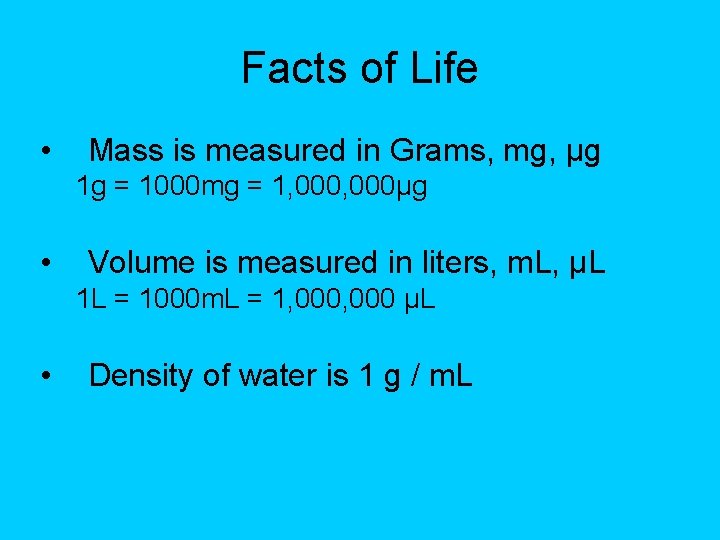
Facts of Life • Mass is measured in Grams, mg, μg 1 g = 1000 mg = 1, 000µg • Volume is measured in liters, m. L, μL 1 L = 1000 m. L = 1, 000 μL • Density of water is 1 g / m. L
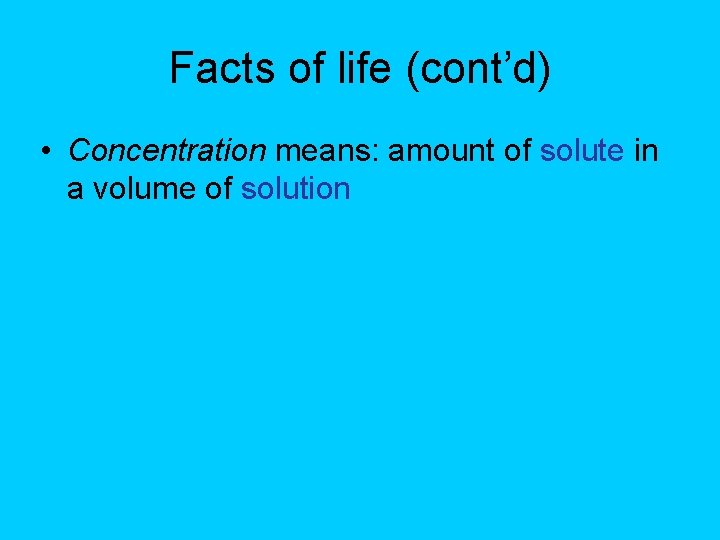
Facts of life (cont’d) • Concentration means: amount of solute in a volume of solution
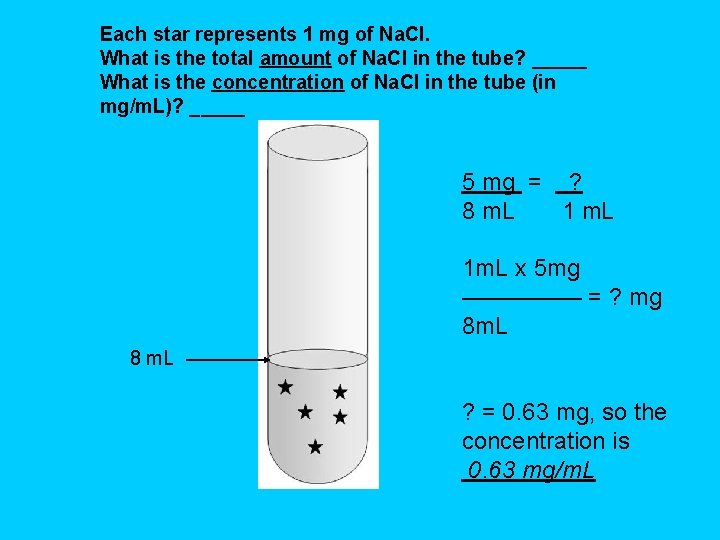
Each star represents 1 mg of Na. Cl. What is the total amount of Na. Cl in the tube? _____ What is the concentration of Na. Cl in the tube (in mg/m. L)? _____ 5 mg = ? 8 m. L 1 m. L x 5 mg ————— = ? mg 8 m. L 8 m. L ? = 0. 63 mg, so the concentration is 0. 63 mg/m. L
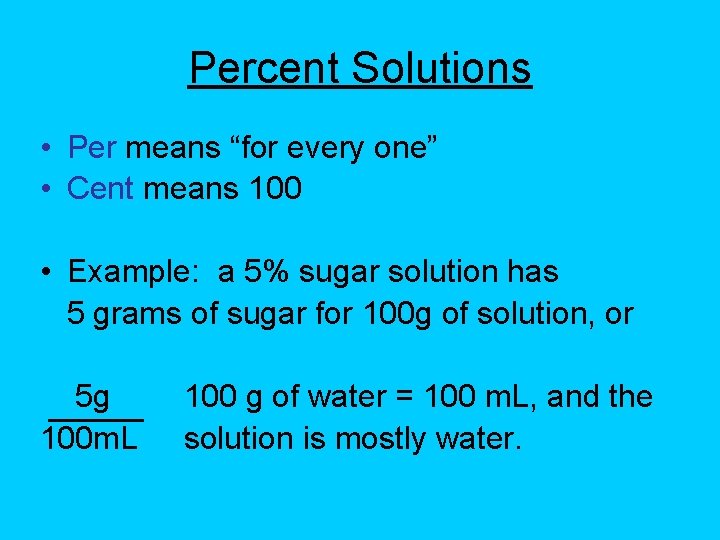
Percent Solutions • Per means “for every one” • Cent means 100 • Example: a 5% sugar solution has 5 grams of sugar for 100 g of solution, or 5 g 100 m. L 100 g of water = 100 m. L, and the solution is mostly water.
Procedure » 1. Measure out 7. 5 g of lemonade and put in 75 m. L of water. (This is the solution) » 2. Measure out 2. 25 g of lemonade and put it in 75 m. L of water. (This is the 30% dilution)
Questions » 1. What was the solvent in the lab? » 2. What was the solute in the lab? » 3. Independent variable? » 4. Dependent variable? » 5. Constants?