
Preparing for the Midcourse Review Deb Franko Senior
Preparing for the Midcourse Review Deb Franko Senior Vice Provost for Academic Affairs October 8 th, 2020
Faculty Handbook https: //faculty. northeastern. edu/handbook/appointments-promotion-and-tenure/ PRE-TENURE REVIEW • During the third or fourth year, the unit tenure committee will conduct a comprehensive review of performance relative to the university’s criteria for tenure. Each unit will develop procedures for this review. • The review will culminate in a written evaluation that makes a recommendation for reappointment or non-reappointment. Where reappointment is recommended, the review must discuss strengths and weaknesses, and areas that require development for continued progress toward tenure. The unit head will discuss the written evaluations with the faculty member and place a copy in the faculty file. • The review will be forwarded to the dean. If the dean disagrees with the evaluation and/or recommendation of the unit, the dean transmits to the review committee the reasons for disagreement. • The dean’s decision in this matter is final, subject only to the review and determination of the provost on appeal by the faculty member. 2
WHAT is the midcourse review? • A review of your work that takes place in the spring of the third year or early in the fourth year of the tenure clock • Like the annual review, assesses tenure-track faculty member’s progress in all three areas of performance required for tenure consideration—teaching, scholarship, service 3
WHAT is the midcourse review? • Review is conducted by unit tenure committee based on a dossier of work to date in format close to that of the final tenure dossier • Committee writes report which you receive and is sent to the college dean • Outcome: Recommendation for reappointment (may be with additional review) or nonreappointment by the dean 4
Think of the midcourse review as a “dress rehearsal” for tenure. 5
Timing of midcourse review • Faculty Handbook: “During the third or fourth year…. . the unit will conduct a comprehensive review…. . ” • 3 rd year: Report should be completed shortly after spring term and sent to dean in May • 4 th year: Report should be completed and sent to dean by mid. October 6
COVID-19 Tenure Extension Requests https: //provost. northeastern. edu/covid-19 -tenure-extension-requests/ • “In light of the coronavirus crisis and likely impact to teaching, research, and service, the Office of the Provost has amended the tenure clock extension policy to be applicable to all tenure-track faculty who were hired before July 1, 2020. • A candidate may request to extend their tenure clock by one year any time before July 1 of the year when dossier is due (e. g. , if the dossier is due October 1, 2024, the candidate may request an extension any time before July 1, 2024). • The candidate’s request, with rationale, should be sent via email to Deb Franko, Senior Vice Provost for Academic Affairs, with a copy to the candidate’s unit head and dean. All submitted requests will be approved. ” 7
Faculty with interdisciplinary appointments • The committee responsible for conducting a pre-tenure review includes one representative from each unit in which candidate holds a secondary appointment • Secondary unit faculty selects representative (of appropriate rank and area of expertise) • Dean of tenure home unit consults with secondary unit dean before making decision on reappointment 8
WHY is there a midcourse review? • Takes a longer perspective than annual review of progress • Thorough review at a point advanced enough to make evaluation meaningful, but early enough to change course to correct problems or change commitments • Ensures that candidates have experience with dossier-building before crunch time • In multi-unit colleges, provides the perspective of the dean beyond the department level • In interdisciplinary appointments, incorporates perspective of all faculties and deans concerned 9
How do I prepare for the midcourse review? • Talk to your mentor and your department head about department and college guidelines • Ask about involvement of other units for joint appointments • Become familiar with the university-wide dossier requirements embodied in the Model Tenure Dossier https: //provost. northeastern. edu/app/uploads/Updated-Model-Tenure-Dossier_July-1 -2020. pdf 10
Midcourse review dossiers: Electronic • Length for midcourse review: Aim for ~40 -50 pages • Dossiers must follow order of Model Dossier checklist • Order, organization, and page limits matter 11
Developing your materials efficiently Looking towards your electronic tenure dossier, you should: • Maintain files to be included in the tenure dossier in electronic formats (with backup!) • Ask for documents (e. g. , annual performance reviews) from your department/college in PDF format as well as paper, or scan paper documents you may already have on file 12
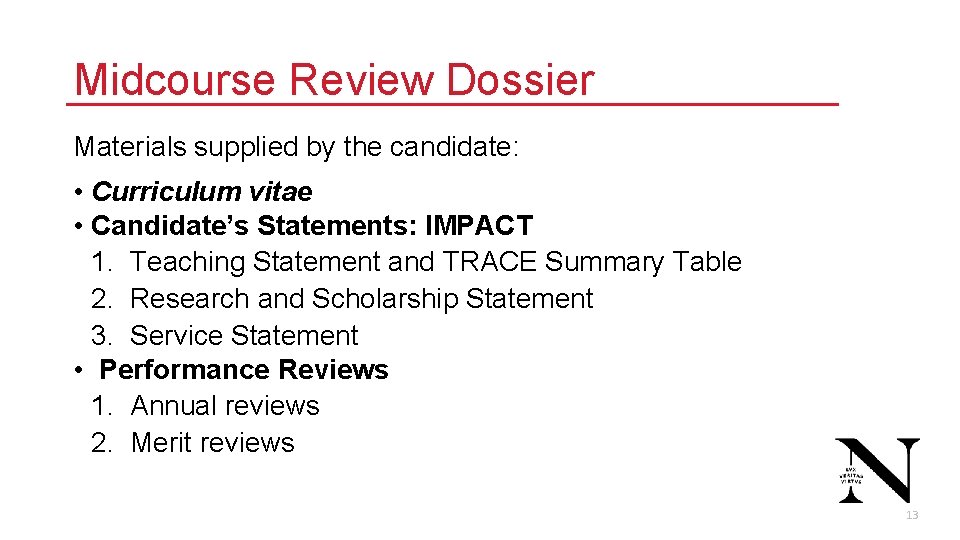
Midcourse Review Dossier Materials supplied by the candidate: • Curriculum vitae • Candidate’s Statements: IMPACT 1. Teaching Statement and TRACE Summary Table 2. Research and Scholarship Statement 3. Service Statement • Performance Reviews 1. Annual reviews 2. Merit reviews 13
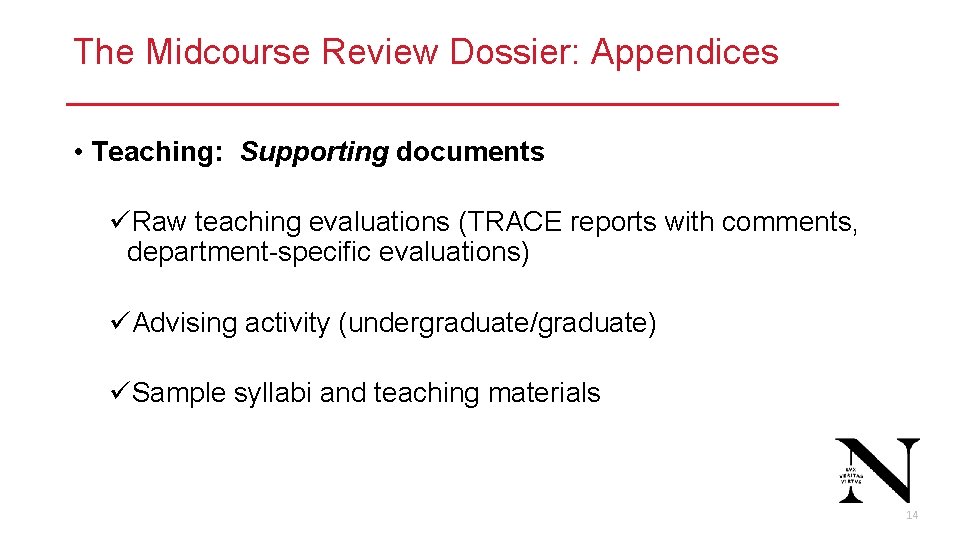
The Midcourse Review Dossier: Appendices • Teaching: Supporting documents üRaw teaching evaluations (TRACE reports with comments, department-specific evaluations) üAdvising activity (undergraduate/graduate) üSample syllabi and teaching materials 14
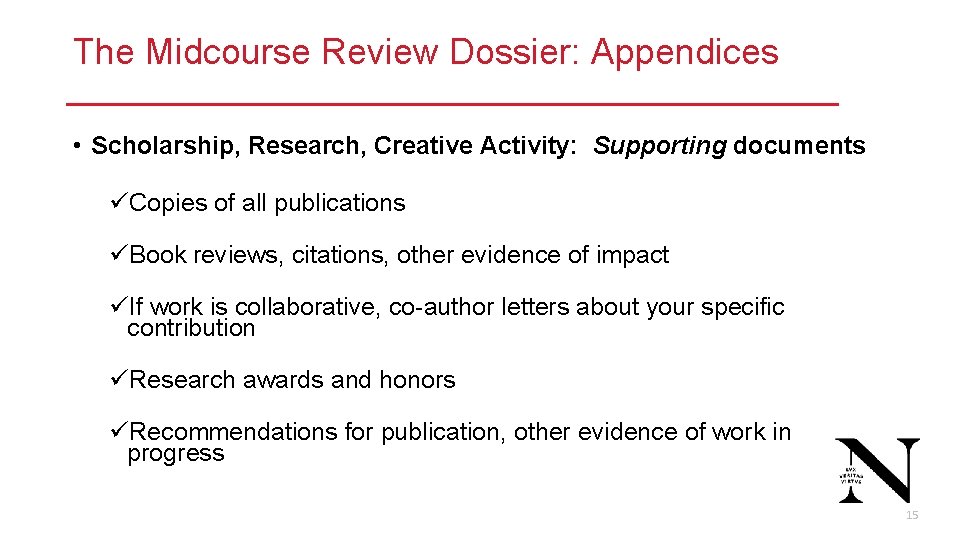
The Midcourse Review Dossier: Appendices • Scholarship, Research, Creative Activity: Supporting documents üCopies of all publications üBook reviews, citations, other evidence of impact üIf work is collaborative, co-author letters about your specific contribution üResearch awards and honors üRecommendations for publication, other evidence of work in progress 15
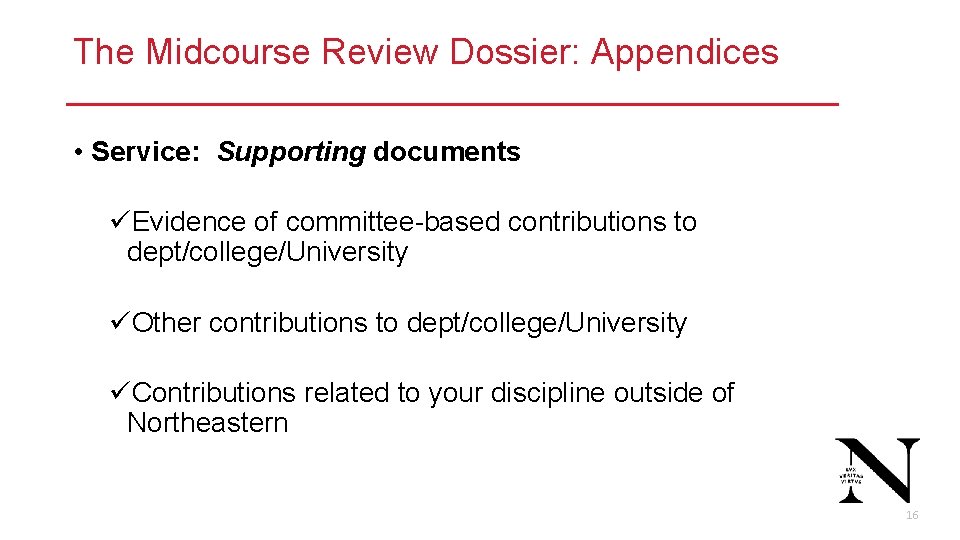
The Midcourse Review Dossier: Appendices • Service: Supporting documents üEvidence of committee-based contributions to dept/college/University üOther contributions to dept/college/University üContributions related to your discipline outside of Northeastern 16
WHAT should I take away from the midcourse review? • A long start on the documentation needed for tenure • Reconstruct any missing pieces now rather than at crunch time • Assess your record-keeping habits and make them serve you 17
WHAT should I take away from the midcourse review? • A chance to stand back from your career to date and tell its story in your statements about teaching, research, and service. • Tell the committee and your dean about your impact in teaching and research. • In response, deeply considered advice on how your story is advancing towards tenure. Heed it carefully. 18
Midcourse review as inflection point What may be emphasized going forward? • Sustainability of research agenda Ø External funding where appropriate Ø Timeline for realization of projects through publication Ø Pipeline of projects beyond dissertation research Ø Supervision of graduate students • Independence as investigator/scholar Ø Lead authorship Ø Networks developing beyond dissertation director 19
Midcourse review as inflection point What may be emphasized going forward? • Trajectory of educational contributions Ø Slope and quality of teaching evaluations Ø Contribution to curricular innovation Ø Work with students outside the classroom • Trajectory of university and professional citizenship Ø Entry into academically based, influential professional service Ø Slope of involvement in department, college, university Ø Emphasis on quality and impact 20
Midcourse Review To summarize: • Midcourse review is a time to show the work you’ve done over your first 3 years • You get a review by your department colleagues to let you know how you are doing on your path toward tenure • It’s your dress rehearsal 21

QUESTIONS? 22
Evaluation Survey Please fill out the evaluation survey by scanning the QR code or clicking the link in the Zoom chat. 23
- Slides: 23