
PREPARING FOR SUCCESS MASTERING THE MULTIPLE CHOICE EXAM



- Slides: 19
PREPARING FOR SUCCESS: MASTERING THE MULTIPLE CHOICE EXAM Katherine Le. Roy Academic Support Coordinator Samuel Merritt University
Workshop Agenda • • • Overview: Study Strategies & Time Mgmt Parts of the Question Test Taking Strategies Examples & Practice Additional Tips
Test Prep Fundamentals You need to have an effective study strategy & time mgmt system in place!
Study Cycle • PREVIEW – Look over Power. Points – Listen to podcasts – Answer study questions – Read assigned chapters/material (or at LEAST skim them!) – Take notes on the PPT’s or in a format that works for you
Study Cycle • STUDY – Review lecture notes within 24 hours – Intense study sessions: 3 -5 short study sessions per day – Be as active as possible: talk-backs, practice tests, written summaries, group sessions, flashcards, charts and concept maps…
Study Cycle • ASSESS – Do I understand the material enough to teach it to others? – Can I successfully answer practice questions? – Have I memorized terms and vocabulary? – Keep a running list of concepts/vocab you aren’t retaining!
Time Management • Build in time within your study schedule for lecture prep • Schedule time for consistent (daily? ) review of previous lectures • Use your “retention” list to help you prioritize and study smart
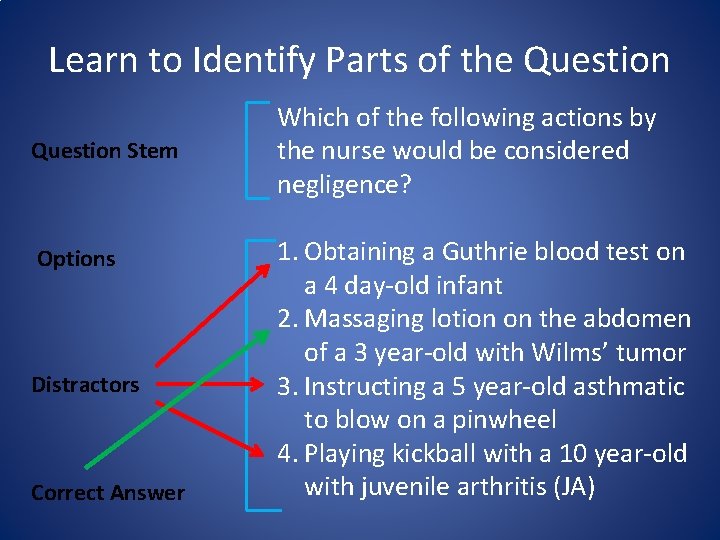
Learn to Identify Parts of the Question Stem Options Distractors Correct Answer Which of the following actions by the nurse would be considered negligence? 1. Obtaining a Guthrie blood test on a 4 day-old infant 2. Massaging lotion on the abdomen of a 3 year-old with Wilms’ tumor 3. Instructing a 5 year-old asthmatic to blow on a pinwheel 4. Playing kickball with a 10 year-old with juvenile arthritis (JA)
Test Taking Strategies • Cover the answers with a sheet of paper or a flashcard • Read the question aloud or mumble to yourself Yes you look weird doing this Yes it really works • Read it a second time and identify important information • Do a quick “teach back”: What do you know about the key concepts?
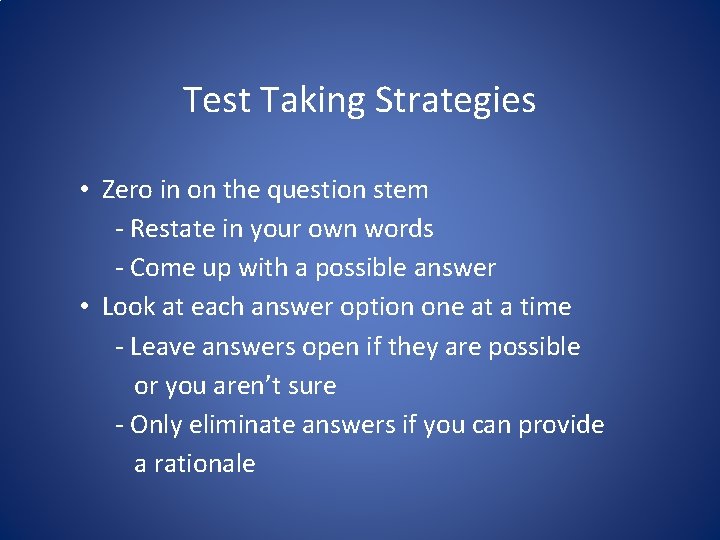
Test Taking Strategies • Zero in on the question stem - Restate in your own words - Come up with a possible answer • Look at each answer option one at a time - Leave answers open if they are possible or you aren’t sure - Only eliminate answers if you can provide a rationale
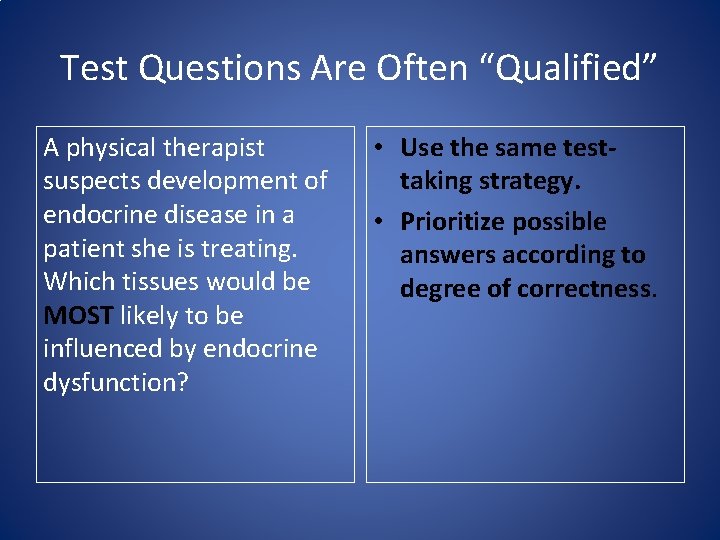
Test Questions Are Often “Qualified” A physical therapist suspects development of endocrine disease in a patient she is treating. Which tissues would be MOST likely to be influenced by endocrine dysfunction? • Use the same testtaking strategy. • Prioritize possible answers according to degree of correctness.
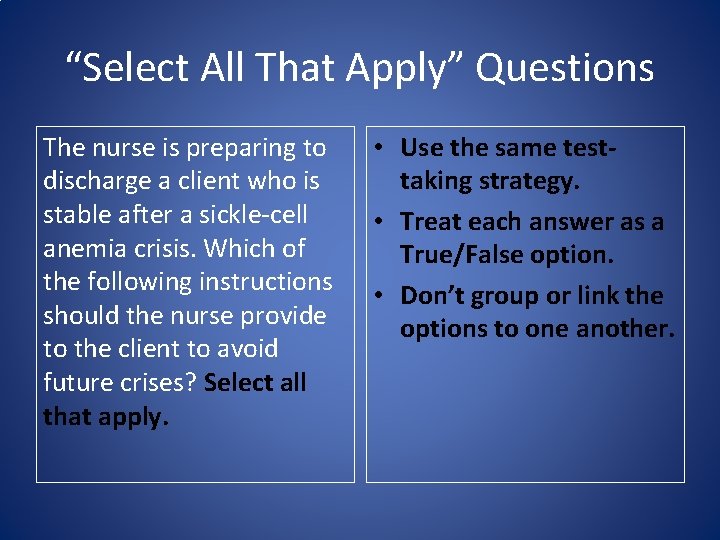
“Select All That Apply” Questions The nurse is preparing to discharge a client who is stable after a sickle-cell anemia crisis. Which of the following instructions should the nurse provide to the client to avoid future crises? Select all that apply. • Use the same testtaking strategy. • Treat each answer as a True/False option. • Don’t group or link the options to one another.
Remember: You’re finding the answer in the QUESTION! (not in the answers)
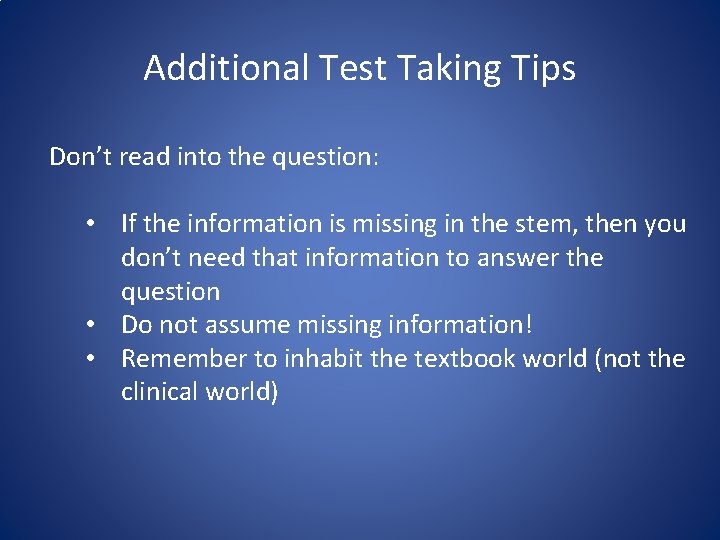
Additional Test Taking Tips Don’t read into the question: • If the information is missing in the stem, then you don’t need that information to answer the question • Do not assume missing information! • Remember to inhabit the textbook world (not the clinical world)
Additional Test Taking Tips Don’t change your answer unless: • you remembered a key piece of information OR a later question gave you new information • Statistically speaking, your first choice is the correct choice!
Additional Test Taking Tips Look at general test-taking tips from a board exam prep resource: • Familiarize yourself with common concepts and start applying these to your course exams • Understand basic skill areas (eg Clinical Intervention, History Taking, etc) • Understand basic content areas (eg Cardiovascular, Endocrine, etc) • Memorize lab values & medical terminology (prefixes and suffixes)
Additional Test Taking Tips PRACTICE QUESTIONS!!!
Additional Test Taking Tips Immediately after the exam: • Take note of rationales during any in-class exam reviews…look for patterns • Meet with the professor to go over lingering questions • Schedule an exam review/coaching session – identify content vs. strategy errors
Thank you and keep in touch! Katherine Le. Roy Academic Support Coordinator kleroy@samuelmerritt. edu 510 -869 -6511 x 5612