
Preparing for Primary 1 Learning at home Learning
- Slides: 21
Preparing for Primary 1 Learning at home
Learning is a progression. Your child will already have many of the skills that they need to be safe, happy and to achieve well in Primary 1. The following activities will support you to continue to build your child’s confidence in their development and learning before the move to primary.
Learning at home We will look at – • • Reading Writing Numeracy Shape, position, movement and measure
Early reading skills The importance of reading is something to consider as your child moves to Primary 1. They are listening and learning new things, by reading to them you are creating opportunities as they grow in life. Reading sparks curiosity and explains how things work in the world around us.
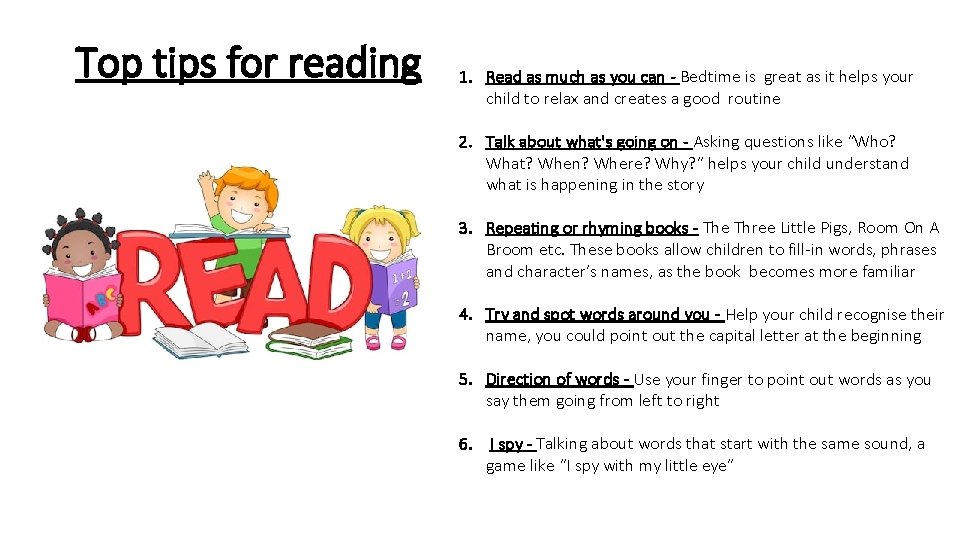
Top tips for reading 1. Read as much as you can - Bedtime is great as it helps your child to relax and creates a good routine 2. Talk about what's going on - Asking questions like “Who? What? When? Where? Why? ” helps your child understand what is happening in the story 3. Repeating or rhyming books - The Three Little Pigs, Room On A Broom etc. These books allow children to fill-in words, phrases and character’s names, as the book becomes more familiar 4. Try and spot words around you - Help your child recognise their name, you could point out the capital letter at the beginning 5. Direction of words - Use your finger to point out words as you say them going from left to right 6. I spy - Talking about words that start with the same sound, a game like “I spy with my little eye”
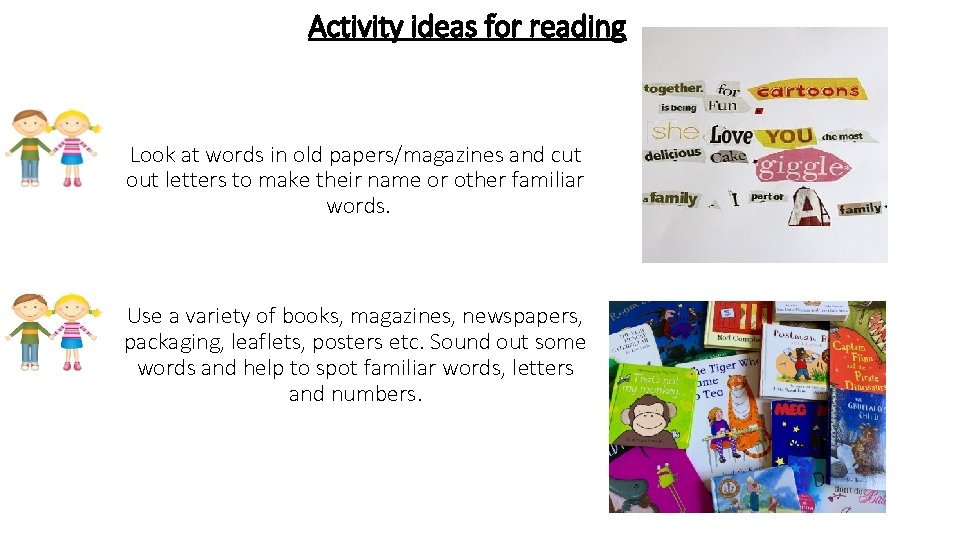
Activity ideas for reading Look at words in old papers/magazines and cut out letters to make their name or other familiar words. Use a variety of books, magazines, newspapers, packaging, leaflets, posters etc. Sound out some words and help to spot familiar words, letters and numbers.
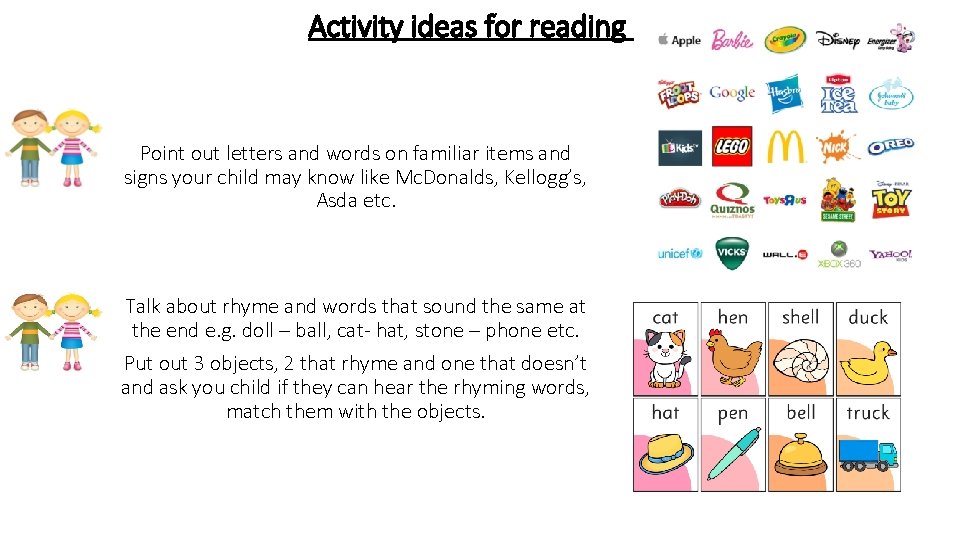
Activity ideas for reading Point out letters and words on familiar items and signs your child may know like Mc. Donalds, Kellogg’s, Asda etc. Talk about rhyme and words that sound the same at the end e. g. doll – ball, cat- hat, stone – phone etc. Put out 3 objects, 2 that rhyme and one that doesn’t and ask you child if they can hear the rhyming words, match them with the objects.
Early writing skills Always allow your child to go at their own pace and praise them for trying hard. Talking and reading as much as possible will support your child’s writing skills. The more often children draw, the more confident they will become.
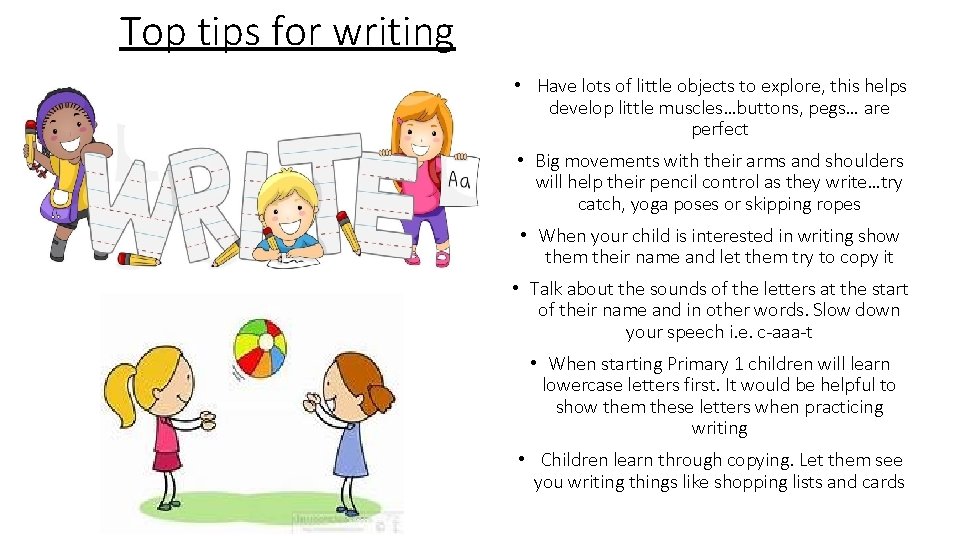
Top tips for writing • Have lots of little objects to explore, this helps develop little muscles…buttons, pegs… are perfect • Big movements with their arms and shoulders will help their pencil control as they write…try catch, yoga poses or skipping ropes • When your child is interested in writing show them their name and let them try to copy it • Talk about the sounds of the letters at the start of their name and in other words. Slow down your speech i. e. c-aaa-t • When starting Primary 1 children will learn lowercase letters first. It would be helpful to show them these letters when practicing writing • Children learn through copying. Let them see you writing things like shopping lists and cards
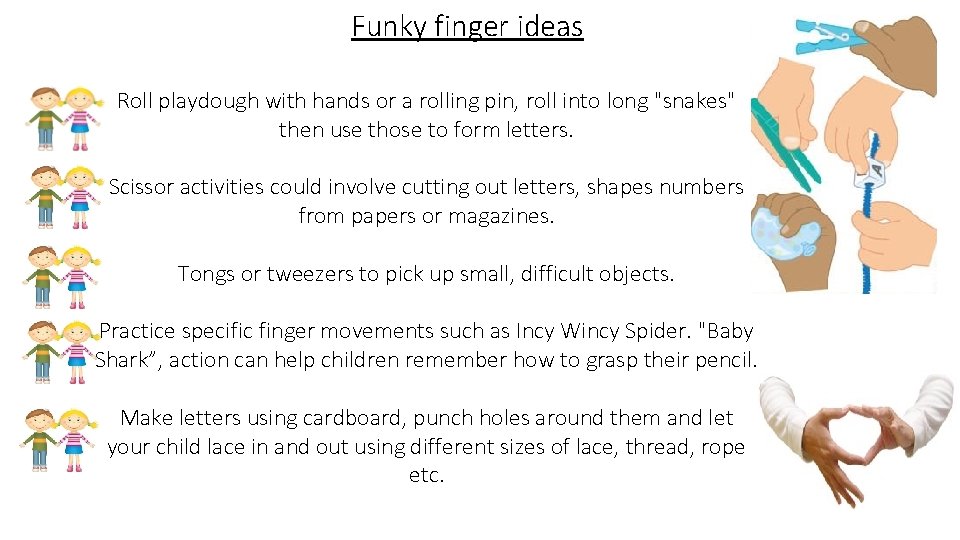
Funky finger ideas Roll playdough with hands or a rolling pin, roll into long "snakes" then use those to form letters. Scissor activities could involve cutting out letters, shapes numbers from papers or magazines. Tongs or tweezers to pick up small, difficult objects. Practice specific finger movements such as Incy Wincy Spider. "Baby Shark”, action can help children remember how to grasp their pencil. Make letters using cardboard, punch holes around them and let your child lace in and out using different sizes of lace, thread, rope etc.
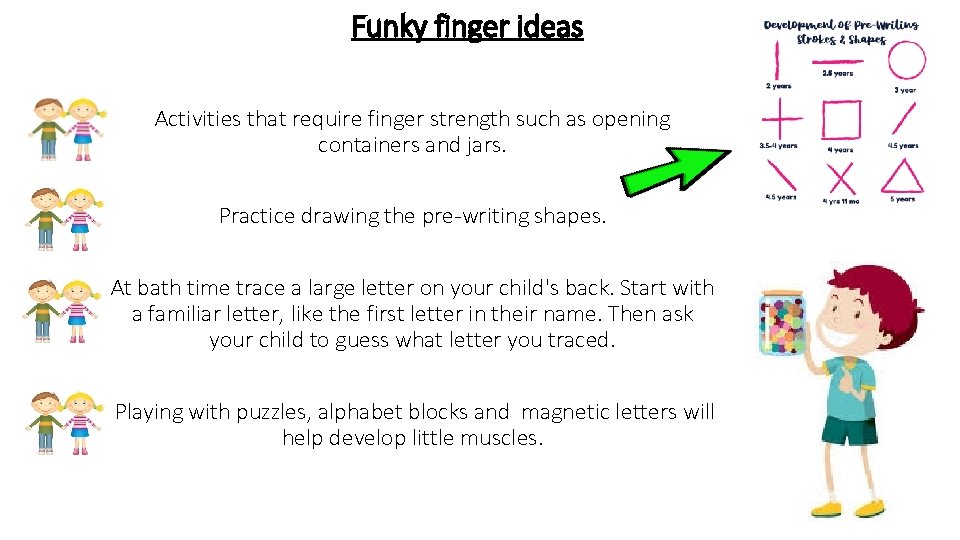
Funky finger ideas Activities that require finger strength such as opening containers and jars. Practice drawing the pre-writing shapes. At bath time trace a large letter on your child's back. Start with a familiar letter, like the first letter in their name. Then ask your child to guess what letter you traced. Playing with puzzles, alphabet blocks and magnetic letters will help develop little muscles.
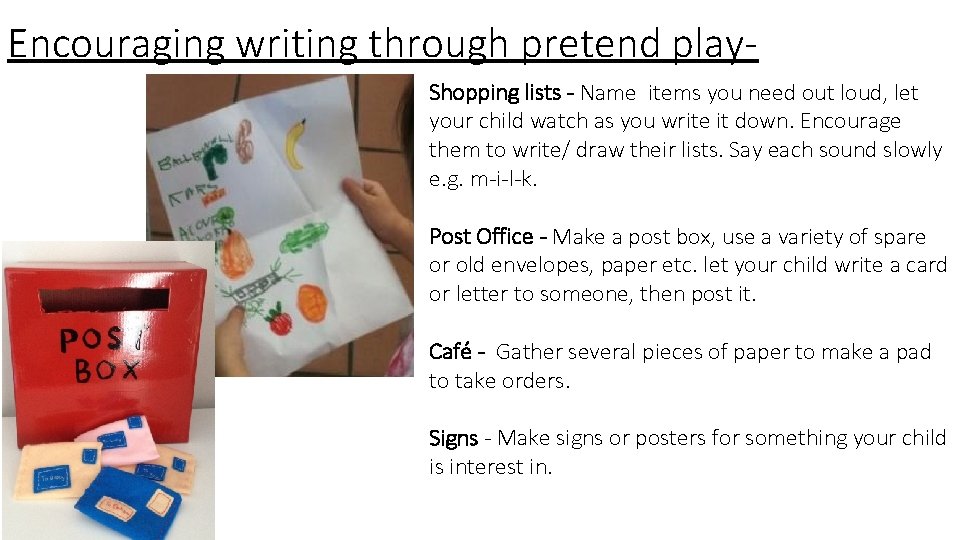
Encouraging writing through pretend play. Shopping lists - Name items you need out loud, let your child watch as you write it down. Encourage them to write/ draw their lists. Say each sound slowly e. g. m-i-l-k. Post Office - Make a post box, use a variety of spare or old envelopes, paper etc. let your child write a card or letter to someone, then post it. Café - Gather several pieces of paper to make a pad to take orders. Signs - Make signs or posters for something your child is interest in.
Numeracy Numbers are something your child has explored as they have grown and something that they will continue to learn about as they start Primary 1. We have gathered some top tips to help your little one develop their “number sense”.
Top tips for numeracy Numbers are all around us, you can help your child by pointing them out on doors, signs and buses In school we use language like more, less before and after. You can help your child with this language through day to day activities i. e. Can I have more carrots? If you are 3 now what age will you be after your birthday? Count as you go up and down the stairs this will help with adding and subtracting later on You can help your child with maths language when talking about their height- tall, taller, tallest or with weight-heavy, heavier, heaviest
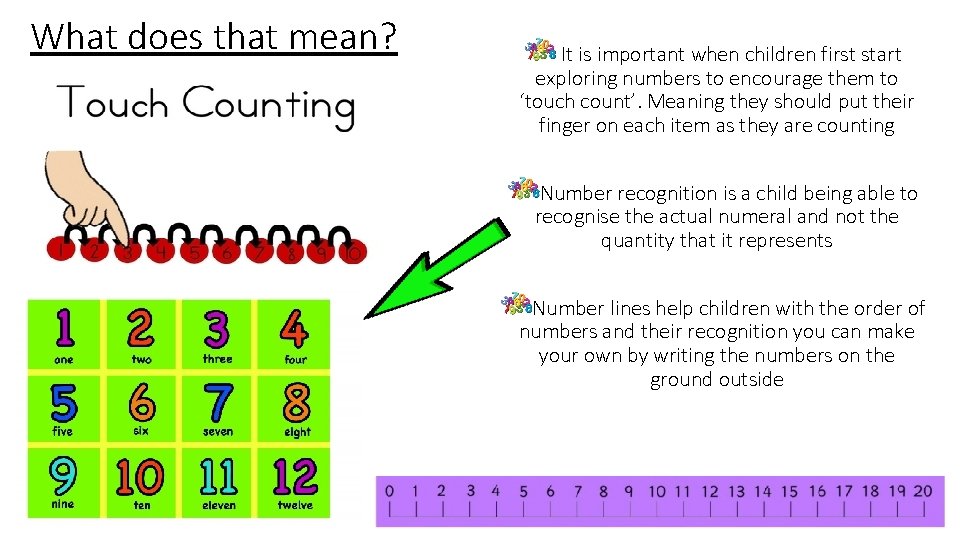
What does that mean? It is important when children first start exploring numbers to encourage them to ‘touch count’. Meaning they should put their finger on each item as they are counting Number recognition is a child being able to recognise the actual numeral and not the quantity that it represents Number lines help children with the order of numbers and their recognition you can make your own by writing the numbers on the ground outside
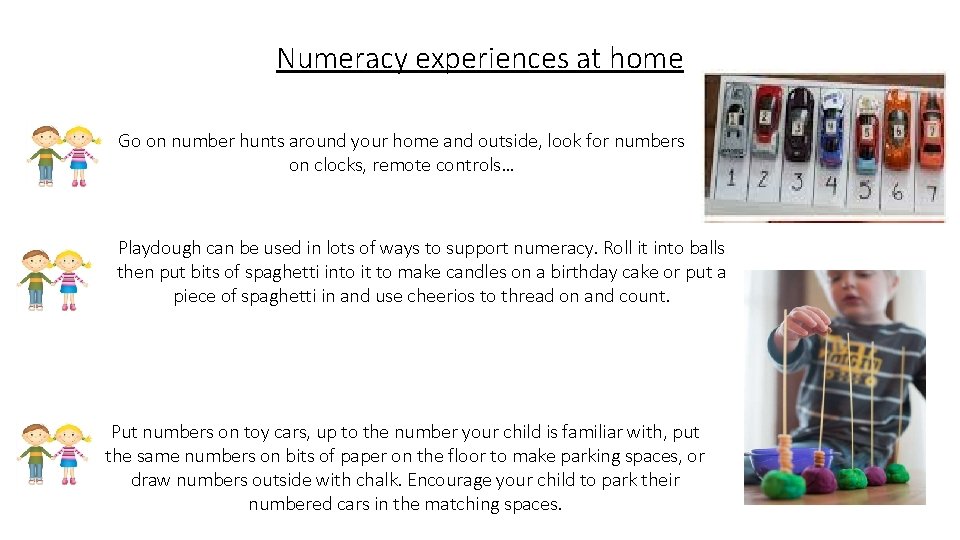
Numeracy experiences at home Go on number hunts around your home and outside, look for numbers on clocks, remote controls… Playdough can be used in lots of ways to support numeracy. Roll it into balls then put bits of spaghetti into it to make candles on a birthday cake or put a piece of spaghetti in and use cheerios to thread on and count. Put numbers on toy cars, up to the number your child is familiar with, put the same numbers on bits of paper on the floor to make parking spaces, or draw numbers outside with chalk. Encourage your child to park their numbered cars in the matching spaces.
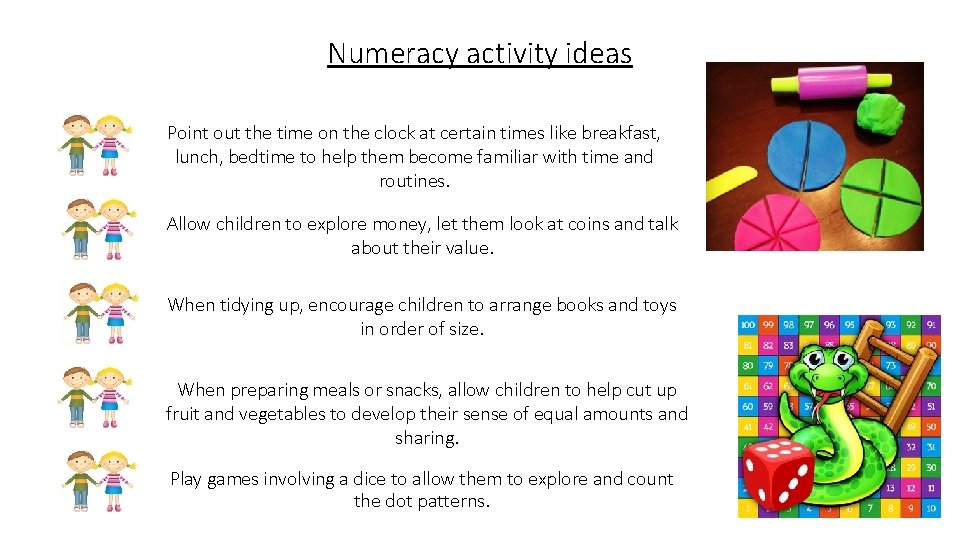
Numeracy activity ideas Point out the time on the clock at certain times like breakfast, lunch, bedtime to help them become familiar with time and routines. Allow children to explore money, let them look at coins and talk about their value. When tidying up, encourage children to arrange books and toys in order of size. When preparing meals or snacks, allow children to help cut up fruit and vegetables to develop their sense of equal amounts and sharing. Play games involving a dice to allow them to explore and count the dot patterns.
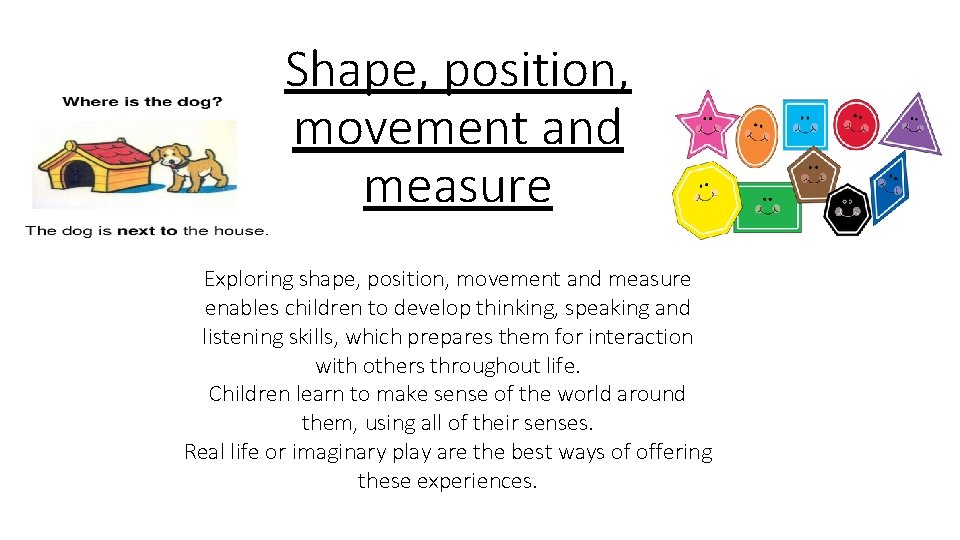
Shape, position, movement and measure Exploring shape, position, movement and measure enables children to develop thinking, speaking and listening skills, which prepares them for interaction with others throughout life. Children learn to make sense of the world around them, using all of their senses. Real life or imaginary play are the best ways of offering these experiences.
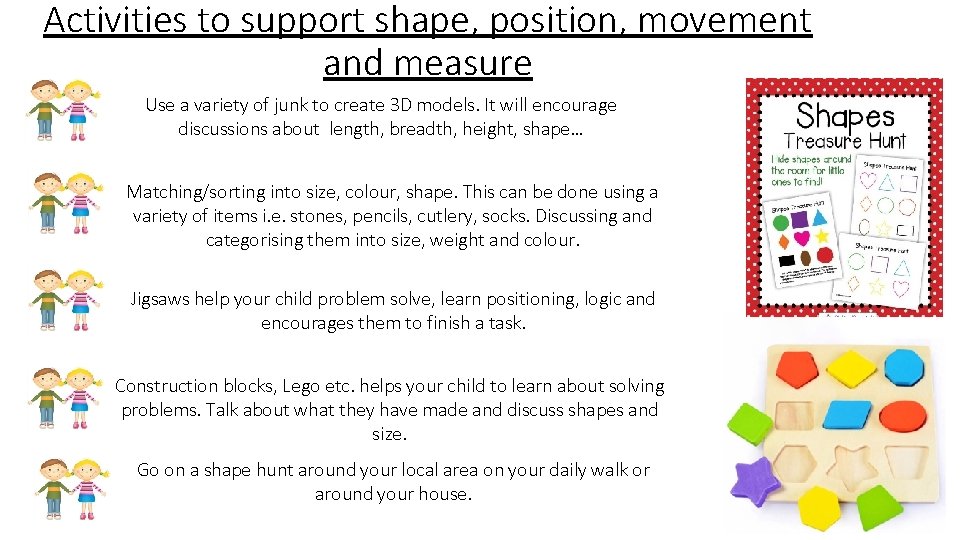
Activities to support shape, position, movement and measure Use a variety of junk to create 3 D models. It will encourage discussions about length, breadth, height, shape… Matching/sorting into size, colour, shape. This can be done using a variety of items i. e. stones, pencils, cutlery, socks. Discussing and categorising them into size, weight and colour. Jigsaws help your child problem solve, learn positioning, logic and encourages them to finish a task. Construction blocks, Lego etc. helps your child to learn about solving problems. Talk about what they have made and discuss shapes and size. Go on a shape hunt around your local area on your daily walk or around your house.
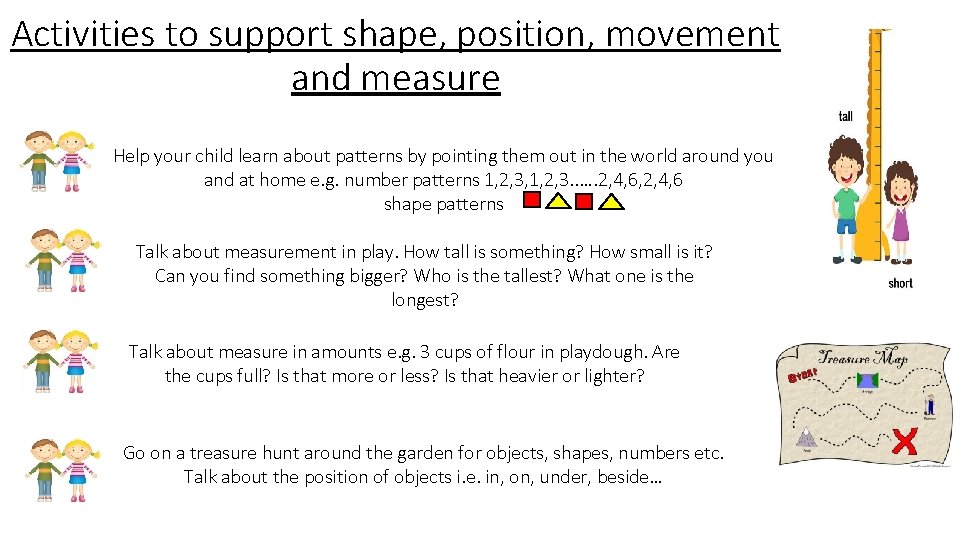
Activities to support shape, position, movement and measure Help your child learn about patterns by pointing them out in the world around you and at home e. g. number patterns 1, 2, 3, 1, 2, 3. . …. 2, 4, 6, 2, 4, 6 shape patterns Talk about measurement in play. How tall is something? How small is it? Can you find something bigger? Who is the tallest? What one is the longest? Talk about measure in amounts e. g. 3 cups of flour in playdough. Are the cups full? Is that more or less? Is that heavier or lighter? Go on a treasure hunt around the garden for objects, shapes, numbers etc. Talk about the position of objects i. e. in, on, under, beside…
Online activity ideas Bud’s Number Garden – includes number ordering, counting and more than and less than games. https: //www. bbc. co. uk/bitesize/topics/zjkphbk/articles/zd 4 b 382? xtor=CS 8 -1000 -[Discovery_Cards]-[Multi_Site]-[SL 09][PS_BITESIZE~C~~P_Number. Game] Teddy numbers game – counting different amounts. https: //www. topmarks. co. uk/learning-to-count/teddy-numbers Shape monsters – Introduction to 2 D shapes for children. https: //www. topmarks. co. uk/early-years/shape-monsters Dough disco https: //www. youtube. com/watch? v=Dr. Bs. Nhwxzgc Finger gym https: //www. youtube. com/watch? v=3 K-CQrj. I 0 u. Y Parentzone Some reading for parents with children starting school in August. https: //education. gov. scot/parentzone/my-child/transitions/starting-school/ BBC Bitesize https: //www. bbc. co. uk/bitesize/articles/zks 4 kmn Parents in Scotland https: //www. parentingacrossscotland. org/publications/top-ten-tips/starting-primary-school/