
Preparing for Academic Reentry Stage 2 Formative Assessment
- Slides: 18
Preparing for Academic Re-entry Stage 2: Formative Assessment
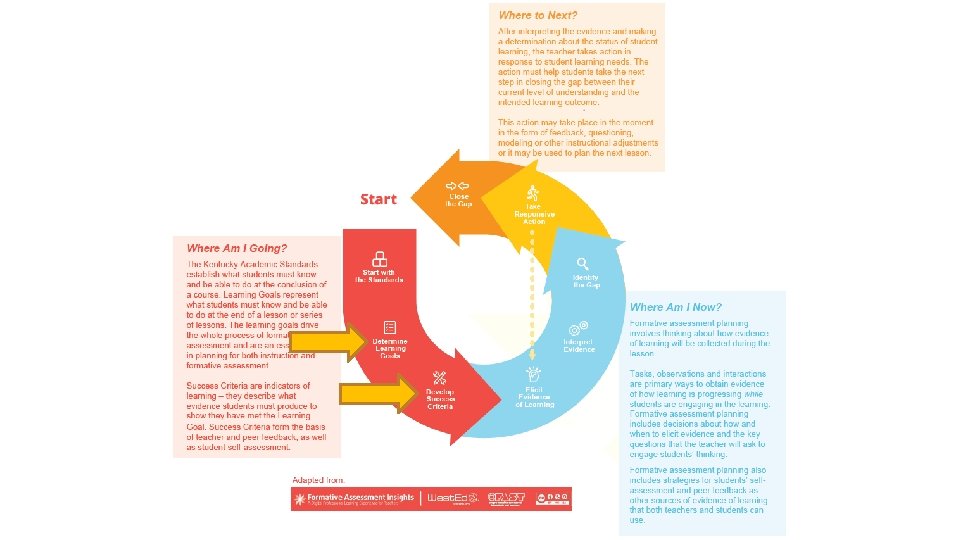
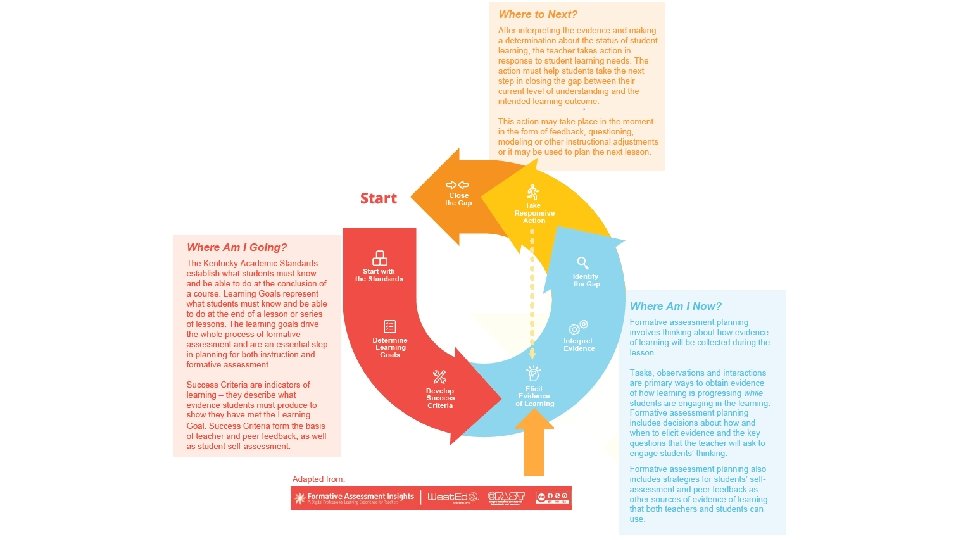
Academic Re-entry Stage 2 • Purpose of Stage 2 is to: • Define formative assessment and explain the benefits for students and teachers • Describe four key strategies that support the formative assessment process • Identify instructional approaches for taking responsive action to address the needs of all learners.
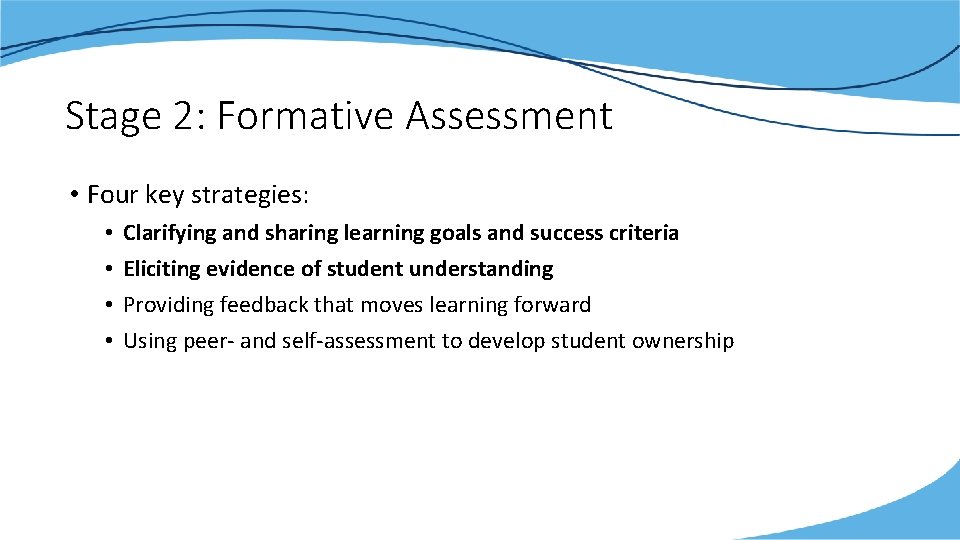
Stage 2: Formative Assessment • Four key strategies: • • Clarifying and sharing learning goals and success criteria Eliciting evidence of student understanding Providing feedback that moves learning forward Using peer- and self-assessment to develop student ownership
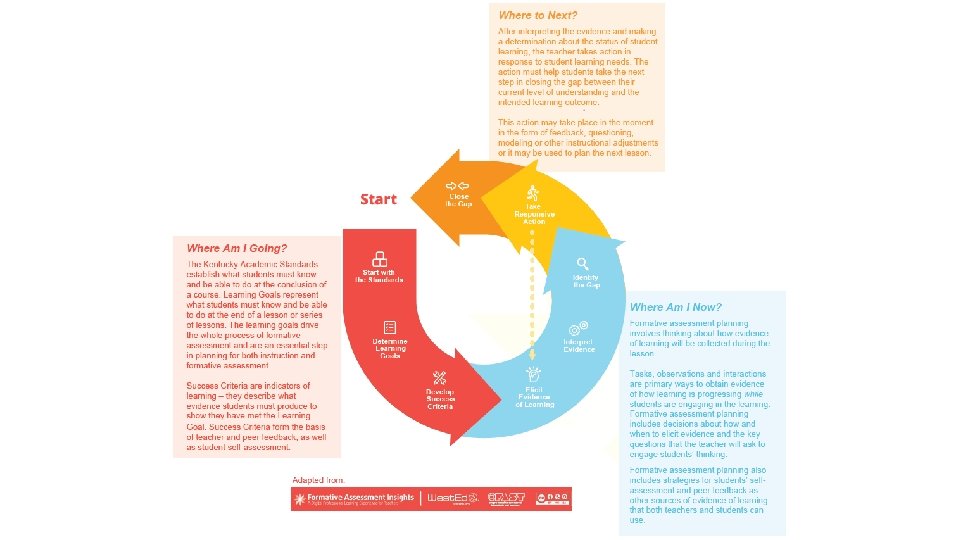
Stage 2: Formative Assessment • Strategy 1: Clarifying and sharing learning goals and success criteria • Formative assessment process starts with teachers being clear on where students are going and sharing the intended learning with the students • Starts with analyzing the standards to determine what students need to know and be able to do to meet the depth of the standard’s expectation • By sharing the learning goals and success criteria with students, it shifts the focus away from “What are we doing? ” to “What are we learning? ”
Stage 2: Formative Assessment Learning Goals Success Criteria • Brief statement that clearly describes what students should know or be able to do at the end of a lesson or series of lessons • Represent the “destination” of where students are going • Focused on the intended learning, not a list of activities • Statements that describe the evidence students must produce to achieve the learning goals • Provide a “map” to the learning destination • Used as the basis for teacher and peer feedback and self-assessment • Supported through modeling, exemplars or work samples
Stage 2: Formative Assessment Learning Goals Success Criteria • We are learning to identify the central idea of a text. • I can define central idea. • I can list key details of a text. • I can analyze key details to determine the central idea of a text. • I can analyze how the central idea is reflected in a text and cite relevant evidence to support thinking around the central idea.
Stage 2: Formative Assessment • Possible ideas for sharing learning intentions and success criteria • When introducing new learning goals and success criteria, have students reflect on what they already know and words/phrases they don’t understand or that might be confusing • In a virtual setting, use the chat feature or an electronic document to capture thinking • Remind students of the learning goals and success criteria before starting any instructional task or activity to focus the learner • In a virtual setting, write the learning goal and success criteria on the assignment/task
Stage 2: Formative Assessment • Possible ideas for sharing learning intentions and success criteria • During teacher-directed instruction, share the learning goals and success criteria at the beginning, and then build in opportunities throughout for students to reflect on the intended learning • If using a slide presentation as part of direct instruction or an assignment in a virtual setting, insert a slide at the beginning that describes the learning goals. Where applicable, insert slides at critical points throughout that contain questions to help students reflect on the intended learning • When recording an audio file for students, clearly state the learning target and success criteria at the beginning to focus the learner and reference throughout as applicable
Stage 2: Formative Assessment • Possible ideas for helping students understand the success criteria • Utilize examples of student work and ask students to reflect on them using the success criteria • In a virtual setting, these examples could be in a document shared electronically with the students, shown and discussed in a recorded video for easy student access, or shared in live meetings • Provide modeling where appropriate • In a virtual setting, this could be done in a live virtual meeting or recorded and shared with students for reference when needed
Stage 2: Formative Assessment • Strategy 2: Eliciting evidence of student understanding • Teachers need to plan in detail how to find out where students are in their learning throughout a lesson, relative to the learning goal and success criteria • When teachers ask students to engage in activities directly related to the learning goals and success criteria, students are motivated and see learning experience as coherent and purposeful
Stage 2: Formative Assessment • Strategy 2: Eliciting evidence of student understanding • When eliciting evidence, it must: • Be aligned to the learning goals and success criteria • Be thought through in advance and placed at strategic points in the lesson • Use multiple approaches to gain a richer picture of student learning to analyze and act on during instruction
Stage 2: Formative Assessment • Strategy 2: Eliciting evidence of student understanding • Instructional routines for eliciting evidence • Activating background knowledge • Academic dialogue • Questioning • Observation and analysis of student work
Stage 2: Formative Assessment • Strategy 2: Eliciting evidence of student understanding • Considerations: • How will you collaborate with grade-level or course content teachers to determine the best way to elicit evidence for the learning goals and success criteria for grade-level standards? • How will you collaborate with teachers in the previous grade level or course to determine possible ways to elicit evidence of student learning for those standards identified as gaps due to the extended remote learning during the spring of 2020? • How will you ensure that what you ask students to say, do, make or write will provide you with the information needed to determine where students are in their understanding relative to the learning goals and success criteria in both the classroom and virtual setting?
Stage 2: Formative Assessment • Strategy 2: Eliciting evidence of student understanding • Considerations: • At what strategic points throughout the lesson will evidence of student learning need to be intentionally designed? • When designing lessons, what typical misconceptions might students have or what common errors might they make? How will you elicit evidence to address those misconceptions or errors in thinking? • What classroom norms are needed to support academic dialogue in both the classroom and virtual settings?
Stage 2: Formative Assessment • Coming up next: • Video 3: Closer Look at Strategies 3 & 4 and Taking Responsive Action • Providing feedback that moves learning forward • Using peer- and self-assessment to develop student ownership • Questions? • Please send questions to standards@education. ky. gov